ORIGINAL ARTICLE
큰땅빈대와 애기땅빈대의 라디칼 소거, 세포독성 억제 및 항염증 활성 비교
임태진*
상지대학교 동물생명자원학부 동물생명공학전공
Comparison of Radical Scavenging, Anticytotoxic, and
Anti-Inflammatory Effects of Euphorbia Maculata and E. supina
Tae-Jin Rhim*
Department of Animal Biotechnology in Division of Animal and Life Resources, Sangji University, Wonju 26339, Korea
Abstract
This study was conducted to compare the antioxidant, anticytotoxic, and anti-inflammatory properties of Euphorbia maculata ethanol extract with those of E. supina ethanol extract. 2,2-Diphenyl-1-picrylhydrazyl (DPPH) radical and superoxide scavenging activities of E. maculata at 50 μg/mL were 38.3 ± 3.7 and 21.5 ± 1.2%, respectively, whereas those of E. supina at the same concentration were 109.4 ± 0.9 and 59.5 ± 4.8%, respectively. Oxygen radical absorbance capacities of E. maculata and E. supina at 10 μg/mL were 14.70 ± 0.63 and 26.17 ± 1.36 nmol/mL Trolox, respectively. Cupric reducing antioxidant capacities of E. maculata and E. supina at 10 μg/mL were 10.22 ± 0.97 and 62.99 ± 5.28 nmol/mL Trolox, respectively. Total phenolic contents of E. maculata and E. supina at 50 μg/mL were 29.03 ± 0.14 and 87.89 ± 0.20 nmol/mL gallic acid, respectively. E. maculata and E. supina were reported to prevent supercoiled DNA breakage induced by peroxyl and hydroxyl radicals in a concentration-dependent manner, where protection against the supercoiled DNA breakage provided by E. supina was greater than that provided by E. maculata. E. maculata and E. supina at 100 μg/mL inhibited tert-butyl hydroperoxide-induced cytotoxicity in HepG2 cells by 49.4 ± 4.3 and 87.3 ± 4.5%, respectively. E. maculata and E. supina at 500 μg/mL inhibited lipopolysaccharide-induced nitric oxide production in RAW 264.7 cells by 63.1 ± 7.0 and 85.2 ± 1.6%, respectively. The antioxidant capacities including DPPH radical scavenging, superoxide scavenging, oxygen radical absorbance, and cupric reducing antioxidant activity were found to be highly correlated with total phenolic content (0.896 < r < 0.983, p <
0.01) and anticytotoxic activities (0.915 < r < 0.960, p < 0.01). However, the superoxide scavenging activity was not significantly correlated (r = 0.604, p > 0.05) with the anti-inflammatory activity. Thus, these findings demonstrated that the radical scavenging, anticytotoxic, and anti-inflammatory capacities of E. supina were more potent than those of E. maculata.
Further studies are needed to elucidate the properties of polyphenolic constituents in E. supina responsible for these effects and the underlying mechanisms.
Key words : Euphorbia maculata, Euphorbia supina, Radical scavenging, Anticytotoxic, Anti-inflammatory 1)
Received 9 June, 2016; Revised 15 August, 2016;
Accepted 17 August, 2016
*Corresponding author : Tae-Jin Rhim, Department of Animal Biotechnology in Division of Animal and Life Resources, Sangji University, Wonju 26339, Korea
Phone: +82-33-730-0544 E-mail: [email protected]
ⓒ The Korean Environmental Sciences Society. All rights reserved.
This is an Open-Access article distributed under the terms of the Creative Commons Attribution Non-Commercial License (http://
creativecommons.org/licenses/by-nc/3.0) which permits unrestricted non-commercial use, distribution, and reproduction in any medium, provided the original work is properly cited.
1. 서 론
슈퍼옥시드, 히드록실 라디칼, 과산화수소 등과 같 은 반응산소종(reactive oxygen species, ROS)은 미토 콘드리아에서 세포대사의 부산물로서 생성되며, 과다 한 세포의 ROS 생성은 지질과산화, 단백질 불활성화, DNA 변성 등을 야기시켜 세포의 기능장애를 유발하 고, 동맥경화증, 관절염, 당뇨병, 암, 파킨슨 질병 등 수많은 질병을 일으키는 것으로 보고되고 있다 (Thannickal and Fanburg, 2000). 항산화제는 ROS에 의해 유도되는 산화 스트레스로 인해 생성되는 산화 물질들을 방어하는 물질이다. 최근에는 식물계에 널 리 분포되어 있는 천연 항산화제의 중요성이 높아지 고 있어, 이에 관한 연구가 증가하고 있다.
큰땅빈대(Euphorbia maculata)와 애기땅빈대 (Euphorbia supina)는 밭이나 들에서 자라는 대극과 에 속하는 일년생 초본 식물이다. 큰땅빈대는 높이 20 60 cm이고 원줄기는 비스듬히 서며, 잎 끝이 둔하 고 긴 털이 드문드문 있고 가장자리에 둔한 톱니가 있 다. 반면에, 애기땅빈대는 길이 10 25 cm이고 원줄 기는 지면을 따라 퍼지며, 잎 끝이 둥글며 가장자리에 둔한 잔톱니가 있고 중앙부에 붉은 빛이 도는 갈색 반점 이 있다(Lee, 2006). 큰땅빈대와 애기땅빈대의 주요 성 분들에는 탄닌(Agata et al., 1991), 플라보노이드(Hong et al., 2008), 테르페노이드(Tanaka and Matsunaga, 1988) 등이 보고된 바 있으며, 항암(Choi and Lim, 2014), 항염증(Chae et al., 2015), 항산화(Nugroho et al., 2014), 항골다공증(Luyen et al., 2014), 항혈소판 (Kwon et al., 2015) 등의 효과가 보고되고 있다.
이와 같이, 큰땅빈대와 애기땅빈대의 유효 성분, 항 암, 항염증, 항산화 활성 등에 관해 보고되고 있으나, 애기땅빈대와 큰땅빈대의 생리활성 비교에 관한 연구 는 거의 수행된 바가 없다. 따라서, 본 연구에서는 큰 땅빈대와 애기땅빈대 추출물의 항산화, 세포독성 억 제 및 항염증 효과 등을 비교 조사하였다.
2. 재료 및 방법 2.1. 재료 및 시약
실험에 사용된 큰땅빈대와 애기땅빈대 지상부 시
료는 강원도 원주시 우산동에서 채취하여 사용하였 다. pBR322 DNA는 KOSCHEM(Seoul, Korea)으로 부터 구입하였고, GelRed 핵산 겔염색시약은 Biotium (Hayward, CA, USA)으로부터 구입하였으며, 우태아 혈청은 Lonza(Walkersville, MD, USA)로부터 구입 하여 사용하였다. 그 외 실험에 사용된 시약들은 분석 급으로 시그마-알드리치사(St. Louis, MO, USA)로부 터 구입하였다.
2.2. 시료의 추출
마쇄한 큰땅빈대와 애기땅빈대 시료 각각 300 g에 450 mL의 95% 에탄올을 첨가하여 혼합한 후, 80 에 서 4시간 추출하였다. 추출액을 여과한 뒤, 45 에서 감압 농축시켰다. 동결건조 후 큰땅빈대 10.6 g과 애 기땅빈대 49.4 g의 추출물을 각각 회수하였고, 분석시 까지 -25 에서 보관하였다.
2.3. 총페놀 측정
총페놀 함량은 Singleton et al.(1999)의 방법에 따 라 측정하였다. 추출물에 0.08 N Folin-Ciocalteu 시약 을 첨가하고, 실온에서 6분 방치한 다음, 3% 중탄산나 트륨 용액을 첨가하고 실온에서 90분 방치한 뒤, 760 nm에서 흡광도를 측정하였다. 갈산을 사용하여 표준 곡선을 작성하였고, 총페놀 함량은 nmol/mL 갈산으 로 표기하였다.
2.4. 라디칼 소거활성 측정
2.4.1. 2,2-Diphenyl-1-picrylhydrazyl(DPPH) 라디칼 소거활성 측정
DPPH 라디칼 소거활성은 Malterud et al.(1993)의 방법에 따라 측정하였다. DPPH 용액(45 μg/mL)을 추 출물과 혼합하고, 515 nm에서 5분 동안 흡광도를 측 정하였다. DPPH 라디칼 소거활성은 pyrogallol 용액 (125 μg/mL)의 흡광도 감소를 100%로 기준하여 결정 하였다. 또한, 양성 대조군으로 α-토코페롤을 사용하 여 DPPH 라디칼 소거활성을 비교 조사하였다.
2.4.2. 슈퍼옥시드 소거활성 측정
슈퍼옥시드 소거활성은 Liu et al.(1997)의 방법 에 따라 측정하였다. 추출물에 62 μM nitroblue tetrazolium (NBT)과 98 μM β-nicotinamide adenine
dinucleotide (NADH) 용액을 혼합하고, 20 mM Tris 와 33 μM phenazine methosulfate (PMS) 용액을 각각 첨가한 후, 560 nm에서 10분 동안 흡광도를 측정하였 다. 슈퍼옥시드 소거활성은 억제율로 표기하였고, 양 성 대조군으로 카테킨을 사용하여 슈퍼옥시드 소거활 성을 비교 조사하였다.
2.4.3. 산소라디칼 흡수능(oxygen radical absorbance capacity) 측정
산소라디칼 흡수능은 Huang et al.(2002)의 방법에 따라 측정하였다. 추출물에 6×10⁻⁵ mM 플로레신 용 액을 첨가하고, 37 에서 10분 가열한 다음, 19 mM 2,2’-azobis(2-methylpropionamidine dihydrochloride (AAPH) 용액을 첨가한 뒤, 자극 파장 485 nm과 방출 파장 530 nm에서 60분 동안 형광도를 측정하였다. 표 준시약으로 사용한 Trolox와 추출물의 곡선 면적(area under the curve)을 측정하였으며, 산소라디칼 흡수능 은 표준시약 농도와 곡선 면적 간의 회귀곡선을 이용 하여 nmol/mL Trolox로 표기하였다. 또한, 양성 대조 군으로 아스코르빈산을 사용하여 산소라디칼 흡수능 을 비교 조사하였다.
2.5. 구리 환원 항산화능(cupric reducing antioxidant capacity) 측정
구리 환원 항산화능은 Apak et al.(2004)의 방법에 따라 측정하였다. 추출물에 2.44 mM 염화구리, 1.83 mM neocuproine 및 0.24 M 초산암모늄 용액을 첨가 하고, 실온에서 1시간 방치한 후, 450 nm에서 흡광도 를 측정하였다. Trolox를 사용하여 표준곡선을 작성 하였고, 구리 환원 항산화능은 nmol/mL Trolox로 표 기하였다. 또한, 양성 대조군으로 α-토코페롤을 사용 하여 구리 환원 항산화능을 비교 조사하였다.
2.6. 초나선 DNA 밴드 절단
퍼옥실 라디칼에 의한 DNA 밴드의 절단은 Hu et al.(2000)의 방법에 따라 실시하였다. 초나선 pBR322 DNA 0.2 μg에 추출물을 첨가하고, 5 mM AAPH와 함께 37 에서 2시간 배양하였다. 양성 대조군으로 Trolox를 사용하였다.
히드록실 라디칼에 의한 초나선 DNA 밴드의 절단 은 Hiramoto et al.(1996)의 방법에 따라 실시하였다.
초나선 pBR322 DNA 0.2 μg에 추출물을 첨가하고, 0.1 mM 과산화수소 용액과 0.1 mM 황화철 용액과 함께 37 에서 1시간 배양하였다. 양성 대조군으로 세사몰을 사용하였다.
배양 후, 겔 완충용액을 첨가하고, 0.01% GelRed 핵산 겔염색시약이 포함된 0.8% 아가로스에서 전기 영동을 실시하였다. 자외선 하에서 사진을 촬영한 후, Image J 1.44 프로그램(NIH, Bethesda, MD, USA)을 사용하여 DNA 밴드 밀도를 측정하였으며, 초나선 DNA 밴드의 보유율을 측정함으로써 큰땅빈대와 애 기땅빈대 추출물의 초나선 DNA 밴드 절단 억제효과 를 조사하였다.
2.7. 세포독성 유발 및 생존율 측정
HepG2 세포(KCLB No. 88065, 한국세포주은행) 를 웰당 0.5×10⁵ 세포수가 되도록 24-웰 플레이트 에 분주하고, 37 , 5% 이산화탄소 배양기에서 배 양하였다. 산화스트레스를 유발하기 위해, tert-butyl hydroperoxide(t-BHP)가 포함된 배지로 교체하고 추 출물과 함께 12시간 배양하였다. 세포생존율을 측정 함으로써 큰땅빈대와 애기땅빈대 추출물의 t-BHP에 대한 세포독성 억제 효과를 조사하였다.
배양 후, 상등액을 제거하고 세포를 PBS용액으로 세척하였다. 세포 단층에 Mosmann(1983)의 방법에 따라 3-(4,5-dimethylthiazol-2-yl)-2,5-diphenyltetrazolium bromide(MTT) 시약(5 mg/mL)을 첨가하고, 3시간 배 양한 후, 0.04 M 염산 용액을 첨가하고, 570 nm에서 흡광도를 측정함으로써 MTT 값을 측정하였다. 세포 생존율은 대조군의 MTT 값을 100%로 기준하여, 처 리군의 MTT 값으로 표기하였다.
2.8. 염증 유발 및 일산화질소(nitric oxide, NO) 측정 RAW 264.7 세포(KCLB No. 40071, 한국세포주은 행)를 웰당 0.5×10⁵ 세포수가 되도록 24-웰 플레이트 에 분주하고, 37 , 5% 이산화탄소 배양기에서 배양 하였다. 24시간 경과 후, 추출물이 포함된 배지로 교 체하고 2시간 전처리하였다. 염증을 유발하기 위해, lipopolysaccharide (LPS)가 포함된 배지로 교체하고 24시간 배양하였다. NO 생성을 측정함으로써 큰땅빈 대와 애기땅빈대 추출물의 LPS에 대한 염증 억제 효
과를 조사하였다.
NO 농도는 Stuehr and Nathan(1989)의 방법에 따 라 측정하였다. 배양한 후, 상등액을 취하고 동량의 Griess 시약(1% sulfanilamide/0.1% naphthylethylene diamine dihydrochloride/5% 인산용액)을 첨가하고, 실온에서 10분 방치한 후, 550 nm에서 흡광도를 측정 하였다. 아질산나트륨을 사용하여 표준곡선을 작성하 였다.
2.9. 통계 분석
SPSS Statistics(version 22) 프로그램을 이용하여 통계분석을 실시하였다. 일원 분산분석을 사용하여 추출물 농도별 활성을 조사하였고, Duncan의 다중 범 위 검정을 사용하여 p<0.05에서 평균값 차이의 유의 성을 조사하였다. 대응표본 T-검정을 사용하여 p<0.05에서 큰땅빈대 추출물과 애기땅빈대 추출물, 그리고 각 추출물과 양성대조군 간 효능을 비교하였 다. 또한, Pearson의 상관분석을 사용하여 DPPH 라디 칼 소거활성, 슈퍼옥시드 소거활성, 산소라디칼 흡수 능, 구리 환원 항산화능 등의 항산화능과 총페놀 함량 간, 그리고 항산화능과 세포독성 억제 효능 및 항염증 활성 간의 상관관계들을 조사하였다.
3. 결과 및 고찰 3.1. 총페놀 함량
페놀 화합물 또는 폴리페놀은 페놀산과 같은 단순 구조부터 탄닌과 같은 고도로 중합된 구조 화합물에 이르기까지 식물계에 광범위하게 존재하며, 유리 라 디칼 소거와 금속이온 킬레이트 등의 항산화 활성과 항돌연변이 활성 등에 기인하여 순환계 질병과 암 발 생율을 감소시킨다고(Bravo, 1998) 알려져 있다.
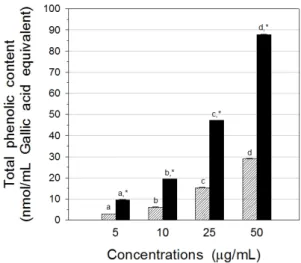
큰땅빈대와 애기땅빈대 추출물의 농도별 총페놀 함량은 Fig. 1에 나타나 있다. 5 μg/mL 농도의 큰땅빈 대 추출물의 총페놀 함량은 2.84 nmol/mL 갈산이었 으며, 추출물 농도가 증가함에 따라 총페놀 함량도 비 례적으로 증가하여, 10, 25 및 50 μg/mL 농도에서는 각각 6.02, 15.40 및 29.03 nmol/mL 갈산을 나타내었 다. 반면에, 5, 10, 25 및 50 μg/mL 농도의 애기땅빈대 추출물의 총페놀 함량은 각각 9.61, 19.46, 47.23 및
87.89 nmol/mL 갈산으로 나타나, 모든 농도에서 애기 땅빈대 추출물의 총페놀 함량이 큰땅빈대 추출물에 비해 높게 나타났다. An et al.(2006)은 10 및 100 μ g/mL 농도의 비단풀 물추출물의 총페놀 함량이 각각 12.1 및 100.7 μM 갈산으로 보고한 바 있어, 본 연구 에서 관찰된 애기땅빈대의 높은 총페놀 함량 연구결 과와 일치하고 있다. 또한, 항산화 활성이 높다고 알려 진 산겨릅나무의 총페놀 함량이 25 및 50 μg/mL 농도 에서 각각 21.50 및 38.98 nmol/mL 갈산으로 보고된 바 있어(Rhim, 2015), 애기땅빈대의 총페놀 함량이 탁월하게 높음을 알 수 있었다. 본 연구에서 사용된 애 기땅빈대의 주요 폴리페놀 성분으로 isoquercitrin 6”-gallate(16.99 mg/g), ellagic acid(15.64 mg/g), astragalin 6”-gallate(13.72 mg/g), gallic acid(5.40 mg/g) 등이 보고된 바 있다(Nugroho et al., 2014).
Fig. 1. Total phenolic content between E. maculata extract and E. supina extract. Data results were expressed as nmol/mL gallic acid equivalents. Each bar represents the mean ± SD of triplicate determinations. : E. maculata extract, : E.
supina extract. abcdValues with different letters are significantly different at p<0.05 within same group.
*p<0.05 compared with E. maculata extract.
3.2. 라디칼 소거활성
3.2.1. DPPH 라디칼 소거활성
큰땅빈대와 애기땅빈대 추출물의 농도별 DPPH
Fig. 2. DPPH radical scavenging activity between E.
maculata extract and E. supina extract. Data results were expressed as % radical scavenging activity relative to 100% that of pyrogallol solution as reference. Each bar represents the mean ± SD of triplicate determinations. : E. maculata extract, : E. supina extract, : α-tocopherol (positive control). abcdValues with different letters are significantly different at p<0.05 within same group.
#p<0.05 compared with positive control. ##p<0.05 compared with E. supina extract. *p<0.05 compared with E. maculata extract.
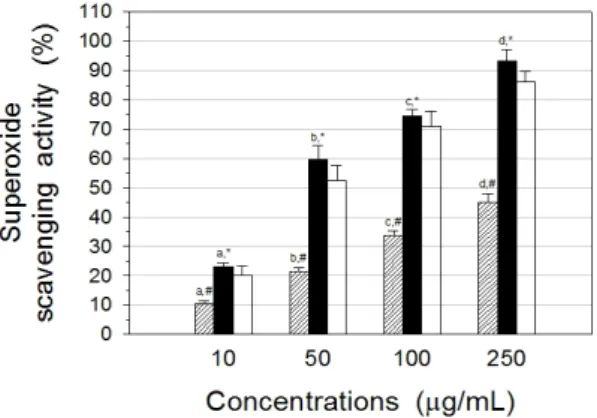
Fig. 3. Superoxide radical scavenging activity between E.
maculata extract and E. supina extract. Data results were expressed as % inhibition of the activity. Each bar represents the mean ± SD of triplicate determinations.
: E. maculata extract, : E. supina extract, : catechin (positive control). abcdValues with different letters are significantly different at p<0.05 within same group. #p<0.05 compared with positive control.
*p<0.05 compared with E. maculata extract.
라디칼 소거활성은 Fig. 2에 나타나 있다. Pyrogallol 의 억제율을 100%로 기준하였을 때, 5 μg/mL 농도의 큰땅빈대 추출물의 DPPH 라디칼 소거활성은 3.6%이 었으며, 추출물 농도가 증가함에 따라 소거활성도 비 례적으로 증가하여, 10, 25 및 50 μg/mL 농도에서는 각각 8.8, 17.3 및 38.3%를 나타내었다. 반면에, 5, 10, 25 및 50 μg/mL 농도의 애기땅빈대 추출물의 DPPH 라디칼 소거활성은 각각 24.1, 39.1, 66.7 및 109.4%
를 나타나, 모든 농도에서 큰땅빈대 추출물에 비해 높 게 나타났다. 양성대조군으로 사용한 α-토코페롤의 소거활성은 5, 10, 25 및 50 μg/mL 농도에서 각각 13.1, 26.9, 48.6 및 85.4%로 측정되어, 애기땅빈대 추 출물의 DPPH 라디칼 소거활성이 α-토코페롤에 비해 높게 나타났으나, 큰땅빈대 추출물은 α-토코페롤에 비해 낮게 나타났다. 그러나 Song et al.(2014)은 25 및 50 μg/mL 농도에서 애기땅빈대 에틸아세테이트추 출물의 DPPH 라디칼 소거활성이 각각 29.9 및 31.8%
로, 양성대조군으로 사용한 butylated hydroxytoluene (BHT)에 비해 낮은 수준이라고 보고한 바 있다.
3.2.2. 슈퍼옥시드 소거활성
큰땅빈대와 애기땅빈대 추출물의 농도별 슈퍼옥시 드 소거활성은 Fig. 3에 나타나 있다. 10 μg/mL 농도 의 큰땅빈대 추출물의 슈퍼옥시드 소거활성은 10.3%
이었으며, 추출물 농도가 증가함에 따라 소거활성도 비례적으로 증가하여, 50, 100 및 250 μg/mL 농도에 서는 각각 21.5, 33.8 및 45.1%를 나타내었다. 반면에, 10, 50, 100 및 250 μg/mL 농도의 애기땅빈대 추출물 의 슈퍼옥시드 소거활성은 각각 22.9, 59.5, 74.5 및 93.2%로 나타나, 모든 농도에서 애기땅빈대 추출물의 소거활성이 큰땅빈대 추출물에 비해 높게 나타났다.
양성대조군으로 사용한 카테킨의 소거활성은 10, 50, 100 및 250 μg/mL 농도에서 각각 20.2, 52.5, 70.9 및 86.2%로 측정되어, 애기땅빈대 추출물의 소거활성과 카테킨의 소거활성 간에 유의적(p>0.05) 차이가 관찰 되지 않았다. 그러나 큰땅빈대 추출물의 소거활성은 카테킨에 비해 낮게 나타났다. Pavlova et al.(2016)은 애기땅빈대의 주성분으로 알려진 ellagic acid의 슈퍼 옥시드 소거활성이 천연항산화제인 아스코르빈산이나
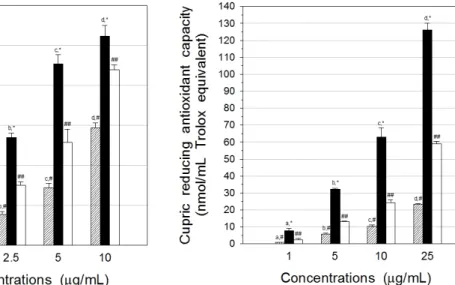
Fig. 4. Oxygen radical absorbance capacity between E.
maculata extract and E. supina extract. Data results were expressed as nmol/mL Trolox equivalent. Each bar represents the mean ± SD of triplicate determinations. : E. maculata extract, : E. supina extract, : ascorbic acid (positive control).
abcdValues with different letters are significantly different at p<0.05 within same group. #p<0.05 compared with positive control. ##p<0.05 compared with E. supina extract. *p<0.05 compared with E.
maculata extract.
Fig. 5. Cupric reducing antioxidant capacity between E.
maculata extract and E. supina extract. Data results were expressed as nmol/mL Trolox equivalent. Each bar represents the mean ± SD of triplicate determinations. : E. maculata extract, : E.
supina extract, : α-tocopherol (positive control).
abcdValues with different letters are significantly different at p<0.05 within same group. #p<0.05 compared with positive control. ##p<0.05 compared with E. supina extract. *p<0.05 compared with E.
maculata extract.
α-토코페롤에 비해 더 높다고 보고한 바 있다.
3.2.3. 산소라디칼 흡수능
산소라디칼 흡수능 분석법은 Trolox를 표준물질로 사용하여, 추출물이 AAPH에 의해 생성된 퍼옥실 라 디칼로 인한 플로레신의 산화적 분해(형광도 감소)로 부터 보호 정도를 측정하는 방법이다. 큰땅빈대와 애 기땅빈대 추출물의 농도별 산소라디칼 흡수능은 Fig.
4에 나타나 있다. 1 μg/mL 농도의 큰땅빈대 추출물의 산소라디칼 흡수능은 1.76 nmol/mL Trolox이었으며, 추출물 농도가 증가함에 따라 소거활성도 비례적으로 증가하여, 2.5, 5 및 10 μg/mL 농도에서는 각각 3.88, 7.19 및 14.70 nmol/mL Trolox를 나타내었다. 반면에, 애기땅빈대 추출물의 산소라디칼 흡수능은 1, 2.5, 5 및 10 μg/mL 농도에서 각각 5.46, 13.49, 22.67 및 26.17 nmol/mL Trolox로 나타나, 모든 농도에서 큰땅
빈대 추출물에 비해 높게 나타났다. 양성대조군으로 사용한 아스코르빈산의 소거활성은 1, 2.5, 5 및 10 μg/mL 농도에서 각각 2.41, 7.52, 12.90 및 21.95 nmol/mL Trolox로 측정되어, 애기땅빈대 추출물의 산소라디칼 흡수능이 아스코르빈산에 비해 높게 나타났으나, 큰 땅빈대 추출물의 활성은 아스코르빈산에 비해 낮게 나타났다. Hong et al.(2008)은 애기땅빈대 메탄올추 출물 에틸아세테이트 분획의 산소라디칼 흡수능이 양 성대조군인 Trolox에 비해 높게 나타났다고 보고한 바 있어, 본 연구에서 관찰된 애기땅빈대의 탁월한 퍼 옥실 라디칼 소거활성 결과와 일치하고 있다.
3.3. 구리 환원 항산화능
구리 환원 항산화능 분석법은 산화제로서 구리 (II)-neocuproine을 사용하여 추출물의 구리 이온에 대한 환원력을 측정하는 방법이다. 큰땅빈대와 애기
(A)
1 2 3 4 5 6 7
N
L
S
(B)
1 2 3 4 5 6 7
N
L
S
Fig. 6. Electrophoresis of pBR322 DNA treated with peroxyl radical and hydroxyl radical in the presence of E. maculata extract, E. supina extract or positive control. (A) peroxyl radical was generated by 5 mM AAPH. (B) hydroxyl radical was generated by 0.1 mM H2O2 and 0.1 mM FeSO4. Lane 1, DNA alone; Lane 2, DNA+radical; Lane 3, DNA+radical+10 μg/mL of E. maculata extract; Lane 4, DNA+radical+10 μg/mL of E. supina extract; Lane 5, DNA+radical+100 μg/mL of E. maculata extract; Lane 6, DNA+radical+100 μg/mL of E. supina extract; Lane 7, DNA+radical+10 μg/mL of Trolox(A) or 100 μg/mL sesamol(B). N, nicked DNA; L, linear DNA; S, supercoiled DNA.
땅빈대 추출물의 농도별 구리 환원 항산화능은 Fig. 5 에 나타나 있다. 1 μg/mL 농도의 큰땅빈대 추출물의 구리 환원 항산화능은 0.78 nmol/mL Trolox이었으며, 추출물 농도가 증가함에 따라 활성도 비례적으로 증 가하여, 5, 10 및 25 μg/mL 농도에서는 각각 5.63, 10.22 및 23.37 nmol/mL Trolox를 나타내었다. 반면 에, 애기땅빈대 추출물의 구리 환원 항산화능은 1, 5, 10 및 25 μg/mL 농도에서 각각 7.67, 32.19, 62.99 및 126.01 nmol/mL Trolox로 나타나, 모든 농도에서 큰 땅빈대 추출물에 비해 높게 나타났다. 양성대조군으 로 사용한 α-토코페롤의 활성은 1, 5, 10 및 25 μg/mL 농도에서 각각 2.26, 13.19, 24.18 및 58.84 nmol/mL Trolox로 측정되어, 큰땅빈대 추출물의 활성은 α-토 코페롤에 비해 낮게 나타났으나, 애기땅빈대 추출물 의 활성은 α-토코페롤에 비해 높게 나타나, 애기땅빈
대 추출물의 환원력이 탁월함을 알 수 있었다. 그러나 Song et al.(2014)은 애기땅빈대 에틸아세테이트추출 물의 철 이온 환원력이 양성대조군으로 사용한 BHT 에 비해 낮은 수준이라고 보고한 바 있다.
3.4. 초나선 DNA 밴드 절단 억제효과
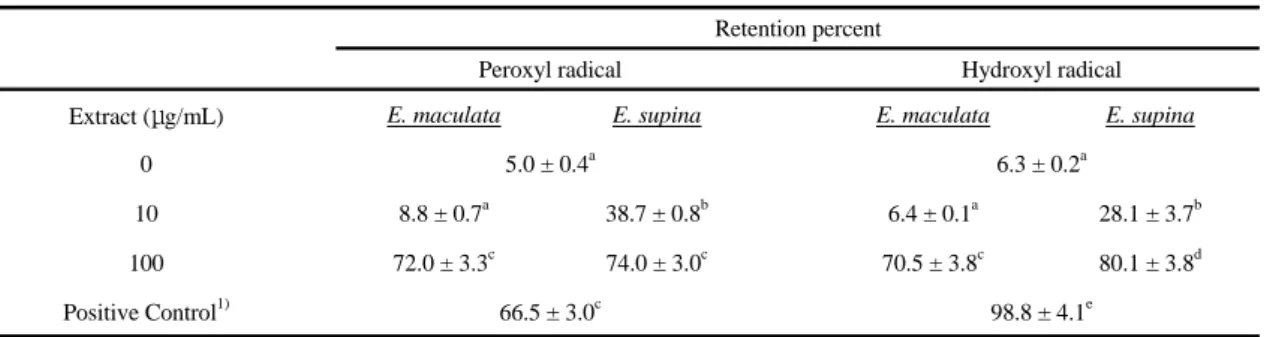
큰땅빈대와 애기땅빈대 추출물의 농도별 퍼옥실 및 히드록실 라디칼에 의해 유도된 초나선 DNA 밴 드 절단에 미치는 효과는 Fig. 6과 Table 1에 나타나 있다.
3.4.1. 퍼옥실 라디칼에 의한 초나선 DNA 밴드 절단 억제효과
AAPH 처리에 의해 생성되는 퍼옥실 라디칼 존재 하에, pBR322 DNA의 초나선형은 열린 고리형과 직 선형으로 전환되었다(lane 1 vs 2, Fig. 6A). 퍼옥실
Retention percent
Peroxyl radical Hydroxyl radical
Extract (μg/mL) E. maculata E. supina E. maculata E. supina
0 5.0 ± 0.4a 6.3 ± 0.2a
10 8.8 ± 0.7a 38.7 ± 0.8b 6.4 ± 0.1a 28.1 ± 3.7b
100 72.0 ± 3.3c 74.0 ± 3.0c 70.5 ± 3.8c 80.1 ± 3.8d
Positive Control1) 66.5 ± 3.0c 98.8 ± 4.1e
Supercoiled pBR322 DNA were treated with 5 mM AAPH (for peroxyl radical generation) or 0.1 mM H2O2, 0.1 mM FeSO4 (for hydroxyl radical generation) in the presence of E. maculata extract, E. supina extract or positive control. The supercoiled and open circular forms of plasmid DNA were separated on a 0.8% agarose gel. Retention percent of supercoiled DNA band was calculated as described in Materials and Methods. The values are means ± SD of triplicate determinations.
1)10 μg/mL Trolox for peroxyl radical- and 100 μg/mL sesamol for hydroxyl radical-induced supercoiled DNA strand breakage
abcde
Values in the same column with different superscripts are significantly different (p<0.05)
Table 1. Retention percent of supercoiled DNA strand between E. maculata extract and E. supina extract in peroxyl radical- and hydroxyl radical-induced pBR322 plasmid DNA breakage
라디칼 존재하에 10 μg/mL 농도의 큰땅빈대와 애기 땅빈대 추출물 첨가시 초나선 DNA 밴드의 보유율은 각각 8.8 및 38.7%로 나타나, 큰땅빈대 추출물에 비해 애기땅빈대 추출물이 퍼옥실 라디칼에 의한 초나선 DNA 밴드의 절단을 억제시켰다(lane 3 vs 4, Fig. 6A 및 Table 1). 100 μg/mL 농도의 큰땅빈대와 애기땅빈 대 추출물 첨가시 초나선 DNA 밴드의 보유율은 각각 72.0 및 74.0%로 나타나, 두 추출물 간에 차이는 관찰 되지 않았고(lane 5 vs 6, Fig. 6A 및 Table 1), 10 μ g/mL 농도의 양성대조군인 Trolox(66.5%)와도 차이 가 없었다(lanes 5, 6 vs 7, Fig. 6A 및 Table 1).
3.4.2. 히드록실 라디칼에 의한 초나선 DNA 밴드 절단 억제효과
과산화수소와 황화철 처리에 의해 생성되는 히드 록실 라디칼 존재하에, pBR322 DNA의 초나선형은 열린 고리형과 직선형으로 전환되었다(lane 1 vs 2, Fig. 6B). 히드록실 라디칼 존재하에 10 μg/mL 농도 의 큰땅빈대와 애기땅빈대 추출물 첨가시 초나선 DNA 밴드의 보유율은 각각 6.4 및 28.1%로 나타나, 큰땅빈대 추출물에 비해 애기땅빈대 추출물이 히드록 실 라디칼에 의한 초나선 DNA 밴드의 절단을 억제시 켰다(lane 3 vs 4, Fig. 6B 및 Table 1). 100 μg/mL 농 도의 추출물 첨가시 애기땅빈대 추출물 첨가에 의한
초나선 DNA 밴드의 보유율(80.1%)은 큰땅빈대 추출 물(70.5%)에 비해 높게 나타났으나(lane 5 vs 6, Fig.
6B 및 Table 1), 동일한 농도의 양성대조군인 세사몰 (98.8%)에 비해 낮게 나타났다(lanes 5, 6 vs 7, Fig.
6B 및 Table 1).
본 연구에서 애기땅빈대와 큰땅빈대 추출물이 퍼 옥실 및 히드록실 라디칼 등의 산화 스트레스에 의해 유도된 DNA 밴드 절단을 억제시킨 결과와 유사하게, An et al.(2006)은 비단풀 물추출물이 과산화수소에 의해 유도된 인간 백혈구 DNA의 손상을 억제시켰다 고 보고한 바 있다.
3.5. 세포독성 억제효과
큰땅빈대와 애기땅빈대 추출물의 t-BHP로 유발된 세포독성에 대한 억제효과는 Fig. 7에 나타나 있다.
HepG2 세포에 0.5 mM 농도의 t-BHP 첨가는 19.9%
의 세포 생존율을 나타내어, t-BHP에 의한 세포독성 을 확인하였다. 10 μg/mL 농도의 큰땅빈대와 애기땅 빈대 추출물 처리시 세포생존율은 각각 23.8 및 37.0%로 나타나, 큰땅빈대 추출물은 t-BHP에 의한 세포독성을 억제시키지 못하였으나 애기땅빈대 추출 물은 억제시켰다. 100 μg/mL 농도의 큰땅빈대와 애기 땅빈대 추출물 처리시 세포생존율은 각각 55.8 및 86.2%로 나타나, t-BHP에 의한 세포독성이 각각 49.4
Fig. 7. The effect of E. maculata and E. supina extracts on HepG2 cell viability treated with t-BHP. HepG2 cells were treated with t-BHP in the presence or absence of extracts for 12 hours. Cell viability was determined using MTT method. Each bar represents the mean ± SD of triplicate determinations. : E. maculata extract, : E. supina extract. abcdValues with different letters are significantly different at p<0.05. *p<0.05 when compared with E. maculata extract.
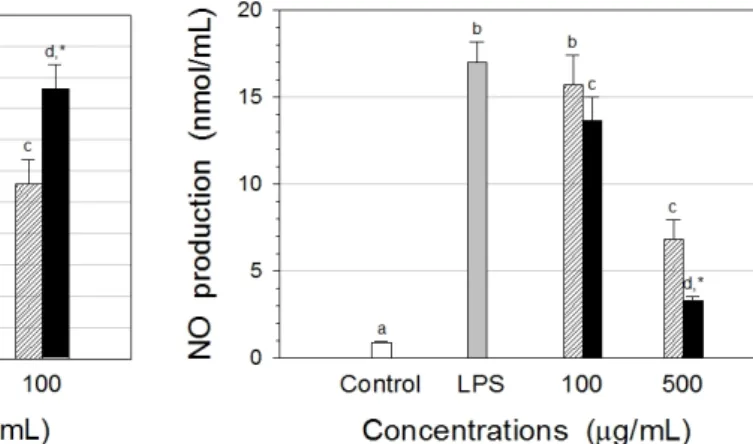
Fig. 8. The effect of E. maculata and E. supina extracts on NO production in LPS-stimulated RAW 264.7 cells. RAW 264.7 cells were treated with extracts for 2 hours, then exposed to 1 μg/mL LPS for 24 hours. NO production was determined using Griess reagent method. Each bar represents the mean ± SD of triplicate determinations.
: E. maculata extract, : E. supina extract.
abcdValues with different letters are significantly different at p<0.05. *p<0.05 when compared with E.
maculata extract.
및 87.3% 억제되었다. Vidyashankar et al.(2010)은 0.2 mM 농도의 t-BHP로 24시간 처리시 HepG2 세포 생존율은 5% 미만이었으나, t-BHP 존재하에 아스코 르빈산 처리시 세포생존율이 약 25%로 보고한 바 있 어, 본 연구에서 관찰된 애기땅빈대의 t-BHP로 유발 된 세포독성에 대한 억제효과가 탁월함을 알 수 있었 다. 또한, Garcia-Nino and Zazueta(2015)는 애기땅빈 대의 주성분으로 알려진 ellagic acid가 알콜 또는 사 염화탄소에 의해 유발된 랫트의 간세포 손상을 억제 시켜 간보호(세포독성 억제) 효과를 나타냈다고 보고 한 바 있다.
3.6. 염증 억제효과
염증은 병원체, 세포 손상 등과 같은 유해한 자극에 대한 생체조직 반응으로써 선천성 면역반응의 일부이 다(Ferrero-Miliani et al., 2007). NO는 순환계, 면역 계 등에서 생물학적 활성을 조절하는 신호물질로 작 용하는 라디칼이며(Moncada et al., 1991), 특히 E.
coli LPS 처리에 의해 대식세포는 과다한 NO를 생성 하여 염증을 유발시킨다고(Stuehr and Marletta,
1985) 알려져, 천연물추출물의 항염증 연구의 모델로 써 사용되고 있다.
큰땅빈대와 애기땅빈대 추출물의 첨가가 LPS로 유 발된 대식세포에서 NO 생성에 미치는 효과는 Fig. 8 에 나타나 있다. RAW 264.7 세포에 1 μg/mL 농도의 LPS 처리시 생성된 NO 농도는 16.99 nmol/mL로 나 타나, 염증 유발을 확인하였다. 100 μg/mL 농도의 큰 땅빈대와 애기땅빈대 추출물 처리시 생성된 NO 농도 는 각각 15.71 및 13.64 nmol/mL로 나타나, 큰땅빈대 추출물과 애기땅빈대 추출물은 LPS에 의한 염증효과 를 각각 8.0 및 20.9% 억제시켰으나, 두 추출물 간에 염증 억제효과의 차이는 관찰되지 않았다. 그러나, 500 μg/mL 농도의 큰땅빈대와 애기땅빈대 추출물 처 리시 NO 농도는 각각 6.85 및 3.29 nmol/mL로 나타 나, LPS에 의해 유발된 염증효과가 각각 63.1 및 85.2% 억제되었고, 큰땅빈대에 비해 애기땅빈대 추출 물의 염증 억제효과가 더욱 탁월한 것으로 나타났다.
본 연구결과와 유사하게, Park and Son(2011)은 0.1 및 0.5 mg/mL 농도의 애기땅빈대 에탄올추출물이
DPPH radical scavenging activity
Superoxide scavenging activity
Oxygen radical absorbance capacity
Cupric reducing antioxidant capacity
Total phenolic content 0.983* 0.970* 0.896* 0.974*
Anticytotoxic activity 0.950* 0.960* 0.939* 0.915*
Anti-inflammatory activity N/A 0.604NS N/A N/A
*Significant correlation at p<0.01
NSNot significant correlation(p>0.05)
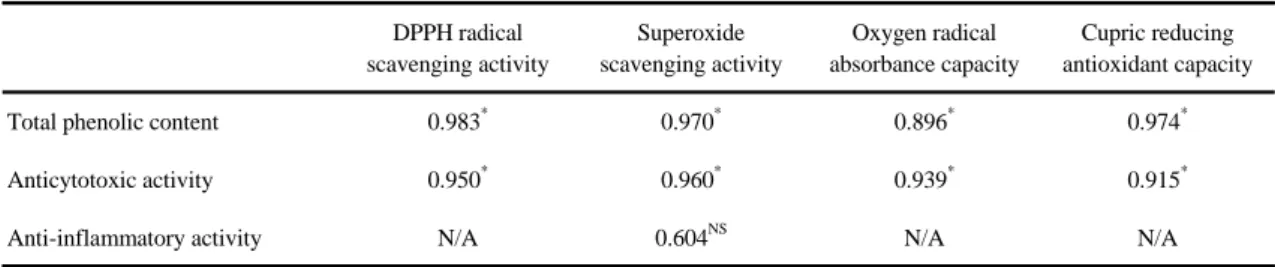
Table 2. Correlation coefficients among antioxidant capacity, total phenolic content, anticytotoxic activity and anti-inflammatory activity of E. maculata extract and E. supina extract
RAW 264.7 세포에서 LPS에 의한 NO 생성을 각각 38.3 및 74.7% 억제시켰다고 보고한 바 있으며, Chae et al.(2015)은 RAW 264.7 세포에서 애기땅빈대 메탄 올추출물이 큰땅빈대 추출물에 비해 LPS에 의해 유 발된 NO 생성을 보다 더 억제시켰다고 보고한 바 있 다. 또한, Seo et al.(2016)은 RAW 264.7 세포에서 애 기땅빈대의 주성분으로 알려진 ellagic acid가 LPS에 의한 종양괴사인자-α 생성을 억제시켰고, 반면에 인 터루킨-6 생성을 증가시켜 항염증 효과를 나타냈다고 보고한 바 있다.
3.7. 항산화능, 총페놀 함량, 세포독성 억제효능 및 항염증 활성 간 상관관계
항산화능, 총페놀 함량, 세포독성 억제효능 및 항염 증 활성 간 상관분석의 상관계수(r)는 Table 2에 나타 나 있다. DPPH 소거활성, 슈퍼옥시드 소거활성, 산소 라디칼 흡수능, 구리 환원 항산화능과 총페놀 함량 간 의 상관계수는 각각 0.983, 0.970, 0.896 및 0.974로 측정되어, 항산화활성과 총페놀 함량 간의 상관관계 가 유의적으로(p<0.01) 나타났다. 본 연구결과와 유사 하게, 키위 추출물을 사용한 연구에서도 총페놀 함량 과 항산화활성 간 높은 상관성이 보고된 바 있다(Du et al., 2009). DPPH 소거활성, 슈퍼옥시드 소거활성, 산소라디칼 흡수능, 구리 환원 항산화능과 세포독성 억제효능 간의 상관계수는 각각 0.950, 0.960, 0.939 및 0.915로 측정되어, 항산화활성과 세포독성 억제효 능 간의 상관성도 유의적으로(p<0.01) 나타났다. 반면 에, 슈퍼옥시드 소거활성과 항염증 활성 간의 상관계 수는 0.604로 측정되었고, 슈퍼옥시드 소거활성과 항
염증 활성 간의 상관성은 유의적이지 않은 것으로 (p>0.05) 나타났다.
4. 결 론
본 연구에서는 큰땅빈대와 애기땅빈대 에탄올추출 물의 항산화, 세포독성 억제 및 항염증 효능을 비교 조 사하였다. 큰땅빈대 50 μg/mL 농도의 DPPH 라디칼 과 슈퍼옥시드 소거활성은 각각 38.3±3.7과 21.5
±1.2%이었으며, 반면에 동일 농도의 애기땅빈대의 DPPH 라디칼과 슈퍼옥시드 소거활성은 각각 109.4
±0.9와 59.5±4.8%이었다. 큰땅빈대와 애기땅빈대 10 μg/mL 농도의 산소라디칼 흡수능은 각각 14.70±0.63 과 26.17±1.36 nmol/mL Trolox이었다. 큰땅빈대와 애기땅빈대 10 μg/mL 농도의 구리 환원 항산화능은 각각 10.22±0.97과 62.99±5.28 nmol/mL Trolox이었 다. 큰땅빈대와 애기땅빈대 50 μg/mL 농도의 총페놀 함량은 각각 29.03±0.14와 87.89±0.20 nmol/mL 갈산 이었다. 큰땅빈대와 애기땅빈대는 퍼옥실 라디칼과 히드록실 라디칼에 의해 유도된 초나선 DNA 밴드 절 단을 농도 의존적으로 억제시켰으며, 애기땅빈대가 큰땅빈대에 비해 초나선 DNA 밴드 절단을 더 크게 보호하였다. 100 μg/mL 농도의 큰땅빈대와 애기땅빈 대는 t-BHP로 유도된 HepG2 세포의 세포독성을 각 각 49.4±4.3과 87.3±4.5% 억제시켰다. 500 μg/mL 농 도의 큰땅빈대와 애기땅빈대는 LPS로 유도된 RAW 264.7 세포의 일산화질소 생성을 각각 63.1±7.0과 85.2±1.6% 억제시켰다. DPPH 라디칼 소거활성, 슈퍼 옥시드 소거활성, 산소라디칼 흡수능, 구리 환원 항산
화능 등의 항산화능은 총페놀 함량과 높은 상관관계 (0.896<r<0.983, p<0.01)를 나타냈다. 항산화능과 세포독성 억제효능 간에도 높은 상관관계(0.915<r<
0.960, p<0.01)가 나타났지만, 슈퍼옥시드 소거활성 과 항염증 활성 간에는 유의적인 상관관계(r=0.604, p>0.05)가 나타나지 않았다. 따라서 이러한 결과들은 애기땅빈대의 라디칼 소거, 세포독성 억제 및 항염증 활성들이 큰땅빈대에 비해 우수하다는 것을 나타내고 있다. 향후 이러한 효능들을 나타내는 애기땅빈대의 폴리페놀 성분들과 이들의 기전들을 규명하는 추가 연구가 필요하다고 사료된다.
감사의 글
이 논문은 2014년도 상지대학교 교내연구비 지원 에 의한 것임.
REFERENCES
Agata, I., Hatano, T., Nakaya, Y., Sugaya, T., Nishibe, S., Yoshida, T., Okuda, T., 1991, Tannins and related polyphenols of Euphorbiaceous plants. VIII. eumaculin A and eusupinin A, and accompanying polyphenols from Euphorbia maculata L. and E. supina Rafin., Chem. Pharm. Bull., 39, 881-883.
An, D. H., Cho, S. J., Jung, E. S., Lee, H. J., Hwang, J. H., Park, E., Park, H. R., Lee, S. C., 2006, Antioxidant and anticancer activities of water extracts from Ceramium kondoi, J. Korean Soc. Food Sci.
Nutr., 35, 1304-1308.
Apak, R., Güçlü, K., Özyürek, M., Karademir, S. E., 2004, Novel total antioxidant capacity index for dietary polyphenols and vitamins C and E, using their cupric ion reducing capability in the presence of neocuproine: CUPRAC method, J. Agric. Food Chem., 52, 7970-7981.
Bravo, L., 1998, Polyphenols: Chemistry, dietary sources, metabolism, and nutritional significance, Nutr. Rev., 56, 317-333.
Chae, H. S., Song, H. H., Kim, Y. M., Lee, H. K., Oh, S.
R., Chin, Y. W., 2015, Euphorbia supina inhibits inflammatory mediators in mouse bone marrow-derived mast cells and macrophages, Int. Immunopharmacol.,
29, 966-973.
Choi, H. M., Lim, S. Y., 2014, Fatty acid composition and antiproliferative activity of extracts from Euphorbia supina, J. Life Sci., 24, 74-80.
Du, G., Li, M., Ma, F., Liang, D., 2009, Antioxidant capacity and the relationship with polyphenol and vitamin C in Actinidia fruits, Food Chemistry, 113, 557-562.
Ferrero-Miliani, L., Nielsen, O. H., Andersen, P. S., Girardin, S. E., 2007, Chronic inflammation:
Importance of NOD2 and NALP3 in interleukin-1β generation, Clin. Exp. Immunol., 147, 227-235.
Garcia-Nino, W. R., Zazueta, C., 2015, Ellagic acid:
Pharmacological activities and molecular mechanisms involved in liver protection, Pharmacol. Res., 97, 84-103.
Hiramoto, K., Ojima, N., Sako, K. I., Kikugawa, K., 1996, Effect of plant phenolics on the formation of the spin-adduct of hydroxyl radical and the DNA strand breaking by hydroxyl radical, Biol. Pharm.
Bull., 19, 558-563.
Hong, H. K., Kwak, J. H., Kang, S. C., Lee, J. W., Park, J. H., Ahn, J. W., Kang, H. S., Choung, E. S., Zee, O.
P., 2008, Antioxidative constituents from the whole plants of Euphorbia supina, Kor. J. Pharmacogn., 39, 260-264.
Hu, C., Zhang, Y., Kitts, D. D., 2000, Evaluation of antioxidant and prooxidant activities of bamboo Phyllostachys nigra var. Henonis leaf extract in vitro, J. Agric. Food Chem., 48, 3170-3176.
Huang, D., Ou, B., Hampsch-Woodill, M., Flanagan, J.
A., Prior, R. L., 2002, High-throughput assay of oxygen radical absorbance capacity (ORAC) using a multichannel liquid handling system coupled with a microplate fluorescence reader in 96-well format, J.
Agric. Food Chem., 50, 4437-4444.
Kwon, S. U., Cha, J. Y., Lee, H. Y., Xin, M., Ji, S. J., Kim, D. K., Park, D. S., Pyo, M. K., Lee, Y. M., 2015, Chloroform fraction of Euphorbia maculata has antiplatelet activity via suppressing thromboxane B2 formation, Mol. Med. Rep., 11, 4255-4261.
Lee, T. B., 2006, Coloured flora of Korea, Hyangmunsa, Seoul, 676-677.
Liu, F., Ooi, V. E. C., Chang, S. T., 1997, Free radical scavenging activities of mushroom polysaccharide
extracts, Life Sci., 60, 763-771.
Luyen, B. T. T., Tai, B. H., Thao, N. P., Lee, S. H., Jang, H. D., Lee, Y. M., Kim, Y. H., 2014, Evaluation of the anti-osteoporosis and antioxidant activities of phenolic compounds from Euphorbia maculata, J.
Korean Soc. Appl. Biol. Chem., 57, 573-579.
Malterud, K. E., Farbrot, T. L., Huse, A. E., Sund, R. B., 1993, Antioxidant and radical scavenging effects of anthraquinones and anthrones, Pharmacol., 47, 77-85.
Moncada, S., Palmer, R. M. J., Higgs, E. A., 1991, Nitric oxide: Physiology, pathophysiology, and pharmacology, Pharmacol. Rev., 43, 109-142.
Mosmann, T., 1983, Rapid colorimetric assay for cellular growth and survival: Application to proliferation and cytotoxicity assays, J. Immunol. Methods, 65, 55-63.
Nugroho, A., Rhim, T. J., Choi, M. Y., Choi, J. S., Kim, Y. C., Kim, M. S., Park, H. J., 2014, Simultaneous analysis and peroxynitrite-scavenging activity of galloylated flavonoid glycosides and ellagic acid in Euphorbia supina, Arch. Pharm. Res., 37, 890-898.
Park, S. C., Son, D. Y., 2011, Inhibitory effects of Euphorbia supina Rafin on the production of pro-inflammatory mediator by LPS-stimulated RAW 264.7 macrophages, J. Korean Soc. Food Sci. Nutr., 40, 486-492.
Pavlova, E. L., Zografov, N. N., Simeonova, L. S., 2016, Comparative study on the antioxidant capacities of synthetic influenza inhibitors and ellagic acid in model systems, Biomed. Pharmacother., 83, 755-762.
Rhim, T. J., 2015, Anticytotoxic and radical scavenging activities of Acer tegmentosum Maxim stem extracts, J. Environ. Sci. Int., 24, 1315-1329.
Seo, C. S., Jeong, S. J., Yoo, S. R., Lee, N. R., Shin, H.
K., 2016, Quantitative analysis and in vitro anti -inflammatory effects of gallic acid, ellagic acid, and quercetin from radix sanguisorbae, Pharmacogn.
Mag., 12, 104-108.
Singleton, V. L., Orthofer, R., Lamuela-Raventós, R. M., 1999, Analysis of total phenols and other oxidation substrates and antioxidants by means of Folin-Ciocalteu reagent, Methods Enzymol., 299, 152-178.
Song, Y., Jeong, S. W., Lee, W. S., Park, S., Kim, Y. H., Kim, G. S., Lee, S. J., Jin, J. S., Kim, C. Y., Lee, J.
E., Ok, S. Y., Bark, K. M., Shin, S. C., 2014, Determination of polyphenol components of Korean prostrate spurge (Euphorbia supina) by using liquid chromatography tandem mass spectrometry: Overall contribution to antioxidant activity, J. Anal. Methods Chem., 2014, 418690.
Stuehr, D. J., Marletta, M. A., 1985, Mammalian nitrate biosynthesis: Mouse macrophages produce nitrite and nitrate in response to Escherichia coli lipopolysaccharide, Proc. Natl. Acad. Sci. USA, 82, 7738-7742.
Stuehr, D. J., Nathan, C. F., 1989, Nitric oxide: A macrophage product responsible for cytostasis and respiratory inhibition in tumor target cells, J. Exp.
Med., 169, 1543-1555.
Tanaka, R., Matsunaga, S., 1988, Triterpene constituents from Euphorbia supina, Phytochemistry, 27, 3579- 3584.
Thannickal, V. J., Fanburg, B. L., 2000, Reactive oxygen species in cell signaling, Am. J. Physiol. Lung Cell.
Mol. Physiol., 279, L1005-L1028.
Vidyashankar, S., Mitra, S. K., Nandakumar, K. S., 2010, Liv.52 protects HepG2 cells from oxidative damage induced by tert-butyl hydroperoxide, Mol.
Cell. Biochem., 333, 41-48.