Biomedical Science Letters 2018, 24(3): 196~205 https://doi.org/10.15616/BSL.2018.24.3.196 eISSN : 2288-7415
Antioxidant and Anti-inflammatory Properties of Raw and Processed Fruits and Vegetables
Yuan Yee Lee
1,*, Evelyn Saba
1,*, Minki Kim
1,*, Man Hee Rhee
1,†,**and Hyun-Kyoung Kim
2,†,**1
Laboratory of Physiology and Cell Signaling and, College of Veterinary Medicine, Kyungpook National University, Daegu 41566, Korea
2
Department of Food Science and Engineering, Seowon University, Chungbuk 28674, Korea
Reactive oxygen species (ROS) generated from metabolic reactions cause oxidative DNA damage, which results in oxidative tissue injury. Therefore, there is an increasing demand in the intake of high antioxidant sources in order to maintain a healthy environment in cells. In this study, we investigated the antioxidant and anti-inflammatory activities of Malus domestica (apple), Pyrus communis L. (pear), Daucus carota L. (carrot), Brassica oleracea var. (broccoli), Brassica oleracea var. capitata (cabbage), and Raphanus sativus L. (radish) obtained from the local market. Since these are common fruits and vegetables that are widely consumed, we aimed to investigate their beneficial properties, placing particular emphasis on their antioxidant and anti-inflammatory properties. The samples were processed via an indirect heating method and their properties were compared to their raw forms. Based on DPPH and ABTS assays, processed samples showed better antioxidant activities when compared to raw samples and processed pear samples exhibited the best antioxidant activity. The anti-inflammatory activities of the samples were also investigated in LPS-treated RAW 264.7 cells. mRNA expression of pro-inflammatory mediators and cytokines (iNOS, COX-2, TNF-α, IL-1β, and IL-6) was assessed using RT-PCR. As expected, processed samples exhibited better iNOS inhibition when compared to their raw forms and processed broccoli and cabbage samples exhibited outstanding anti-inflammatory effects. The samples, up to 1 mg/mL concentration, did not exhibit cytotoxicity against RAW 264.7 cells as demonstrated by cell viability assays.
Altogether, processed broccoli and cabbage samples exhibited the strongest anti-inflammatory properties.
Key Words: Antioxidant, Anti-inflammation, RAW 264.7, Fruits, Vegetables
INTRODUCTION
Plant-based sources such as fruits and vegetables have increasingly gained the interest of scientists in search of
naturally-existing antioxidants (Wang et al., 2017; Nile et al., 2018). These sources exhibit strong biological activity and are easily available. Moreover, they are better alternatives to several synthetic antioxidants that promote carcinogenesis (Ito et al., 1983; Kahl and Kappus, 1993). Antioxidant com-
Original Article
Received: July 10, 2018 / Accepted: August 17, 2018
*Undergraduate student, **Professor.
†Corresponding author: Man Hee Rhee. Laboratory of Physiology and Cell Signaling, College of Veterinary Medicine, Kyungpook National University, Daegu 41566, Korea.
Tel: +82-53-950-5967, Fax: +82-53-950-5955, e-mail: [email protected]
†Corresponding author: Hyun-Kyoung Kim. Department of Food Science and Engineering, Seowon University, Chungbuk 28674, Korea.
Tel: +82-43-299-8474, Fax: +82-43-299-8470, e-mail: [email protected]
○CThe Korean Society for Biomedical Laboratory Sciences. All rights reserved.
○CCThis is an Open Access article distributed under the terms of the Creative Commons Attribution Non-Commercial License (http://creativecommons.org/licenses/by-nc/3.0/) which permits unrestricted non-commercial use, distribution, and reproduction in any medium, provided the original work is properly cited.
pounds sourced from plants exhibit protective effects in cells against reactive oxygen species (ROS). They consist of singlet oxygen, peroxyl radicals, hydroxyl radicals, super- oxide, and peroxynitrite, which induce oxidative stress, and thereby cause cellular damage (Bayr, 2005). Therefore, it is important to continue evaluating the antioxidant activities and free radical-quenching abilities of plant-based sources.
In our study, we investigated the antioxidant properties of Malus domestica (apple), Pyrus communis L. (pear), Daucus carota L. (carrot), Brassica oleracea var. (broccoli), Brassica oleracea var. capitata (cabbage), and Raphanus sativus L.
(radish). Besides raw samples, we also investigated processed samples that underwent indirect heat treatment, since pro- cessed fruits and vegetables have been indicated to exhibit elevated and improved bioactive properties (Dewanto et al., 2002). Therefore, we aimed to investigate the antioxidative properties of raw samples and to determine whether increased processing improved their bioactive properties.
Inflammation occurs when an organism combats invasion, either physically or via noxious chemical stimuli. The inflam- matory response is a mechanism that inactivates invading pathogens (Guzik et al., 2003). Since ROS are activators of inflammation (Reuter et al., 2010), we proceeded to investi- gate the anti-inflammatory properties of the aforementioned samples. Both nitric oxide (NO) and ROS modulate inflam- mation. Lipopolysaccharides (LPS), specific ligands to toll- like receptors and inducers of inflammation, are chemical moieties that are present in the outer membrane of gram- negative bacteria (Heo et al., 2008). In our study, we also investigated the anti-inflammatory properties of the samples by treating RAW 264.7 cells with LPS in order to determine NO production and expression of pro-inflammatory medi- ators (iNOS and COX-2) and cytokines (TNF-α, IL-1β, and IL-6) at the transcriptional level. Our results showed that additional processing of these fruit and vegetable extracts elevated their antioxidant and anti-inflammatory properties.
MATERIALS AND METHODS Reagents
Dulbecco's Modified Eagle's Medium (DMEM) and fetal bovine serum (FBS) were obtained from WelGENE (South
Korea). Streptomycin and penicillin were obtained from Lonza (MD, USA). TRIzol reagent was sourced from In- vitrogen (Carlsbad, CA, USA). LPS (Escherichia coli 055:
B5), 3-(4,5-dimethylthiazol-2-yl)-2,5-diphenyltetrazolium bromide (MTT), 2,2-diphenyl-1-picrylhydrazyl (DPPH), and 2,2'-azino-bis(3-ethylbenzothiazoline-6-sulphonic acid) (ABTS) were obtained from Sigma-Aldrich. Oligo(dT) and iNOS, COX-2, TNF-α, IL-1β, IL-6, and GAPDH primers were purchased from Bioneer (South Korea).
Sample preparation
Malus domestica (apple), Pyrus communis L. (pear), Daucus carota L. (carrot), Brassica oleracea var. (broccoli), Brassica oleracea var. capitata (cabbage), and Raphanus sativus L. (radish) samples were agricultural products grown in South Korea and locally purchased from a traditional market. The samples were washed, cut into uniform shapes of 0.5 cm × 0.5 cm × 0.5 cm, freeze-dried, sealed dry to keep moisture away, and stored in -70℃. Raw samples were prepared by extracting the samples at 60℃ for 2 h.
To obtain processed samples, previously freeze-dried sam- ples were heat-treated under pressurized conditions (10 kg/
cm
2) using a heating apparatus (Jusco, Seoul, South Korea).
Samples were placed in the inner compartment and water was added to the outer compartment of the container. The apparatus was heated according to predetermined tempera- ture and time values (140~150℃ for 6 h) to prevent car- bonization of the samples from direct heat. Finally, samples were weighed for further experiments.
DPPH radical scavenging activity
To measure the radical scavenging activity of fruits and vegetables, 20 μL of the samples were mixed with 200 μL of DPPH solution (0.2 mM in ethanol). Ethanol was used as the control for these experiments. After a 30-min reaction at 37℃, the absorbance of the solution was measured at 517 nm.
The free radical scavenging activity of each fraction was
determined by comparing their absorbance with that of the
control groups. Ascorbic acid was used as a positive control
sample. The ability to scavenge the DPPH radical was cal-
culated using the following equation:
DPPH scavenging activity (%) = [1 - (A1 - A2)/(A3 - A4)] × 100
where, A1 is the absorbance of DPPH and the sample, A2 is the absorbance of 100% ethanol and the sample, A3 is the absorbance of DPPH and the solvent for sample dilution (DMSO/DDW), and A4 is the absorbance of 100% ethanol and the solvent for sample dilution (DMSO/DDW).
ABTS radical scavenging activity
The ABTS cation radical was produced via a reaction between 5 mL of 14 mM ABTS solution and 5 mL of 4.9 mM potassium persulfate (K
2S
2O
8) solution, which was then stored in the dark for 16 h at room temperature. Before use, this solution was diluted with ethanol to obtain an absorbance of 0.700 ± 0.020 at 734 nm. Various concentrations of the fruit and vegetable extracts (50 μL) were mixed with 100 μL of ABTS solution in 96-well plates and allowed to stand in the dark for 10 min. Trolox was used as the positive control group for standardizing ABTS activity. The inhibition per- centage of the ABTS radical was calculated using the fol- lowing formula:
ABTS scavenging activity (%) = [1 - (A1 - A2)/(A0)] × 100
where, A1 is the absorbance of the ABTS working solution and sample, A2 is the absorbance of the sample without ABTS working solution, and A0 is the absorbance of the ABTS working solution only.
Cell culture
This study used RAW 264.7 cells, a murine macrophage cell line obtained from the American Type Culture Collection (ATCC), which were maintained in DMEM (WelGENE, South Korea) supplemented with 5% FBS, 100 IU/mL of penicillin, and 100 μg/mL of streptomycin sulfate. The cells were maintained at 37℃ and 5% CO
2.
Nitric oxide & MTT cell viability assays
NO assay was carried out using RAW 264.7 cells, which were seeded into 96-well plates for 24 h. The cells were
treated with various sample concentrations, followed by 0.1 μg/mL LPS treatment 30 min later. After 18 h of incubation, 100 μL of the supernatant was collected, mixed with an equal amount of Griess reagent, and the absorbance was measured using a microplate reader (VersaMax; Molecular Devices, USA) at 540 nm. Cell viability was determined using MTT reagent, which was added to the cells at a concentration of 0.1 mg/mL. The plates were incubated for 3 h at 37℃ and 5% CO
2. The resulting crystals were dissolved in DMSO and read at 560 nm using a microplate reader (VersaMax).
Reverse-transcriptase polymerase chain reaction (RT- PCR)
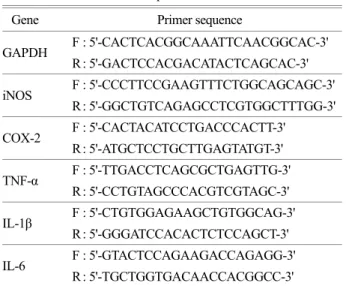
After seeding RAW 264.7 cells into 6-well plates for 24 h, they were treated with or without 1 mg/mL of samples followed by 0.1 μg/mL of LPS 30 min later. After 18 h, TRIzol reagent was used to extract RNA. The steps that fol- lowed were implemented based on a previous report (Saba et al., 2015). The primer sequences used is given in Table 1.
Statistical analysis
All data is presented as mean ± SEM. One-way ANOVA and Dunnett's test were applied for statistical evaluation of the data. Statistical analyses with P < 0.001 were considered to be significant.
Table 1. Primer sequences used for RT-PCR
Gene Primer sequence
GAPDH F : 5'-CACTCACGGCAAATTCAACGGCAC-3' R : 5'-GACTCCACGACATACTCAGCAC-3' iNOS F : 5'-CCCTTCCGAAGTTTCTGGCAGCAGC-3'
R : 5'-GGCTGTCAGAGCCTCGTGGCTTTGG-3' COX-2 F : 5'-CACTACATCCTGACCCACTT-3'
R : 5'-ATGCTCCTGCTTGAGTATGT-3' TNF-α F : 5'-TTGACCTCAGCGCTGAGTTG-3'
R : 5'-CCTGTAGCCCACGTCGTAGC-3' IL-1β F : 5'-CTGTGGAGAAGCTGTGGCAG-3'
R : 5'-GGGATCCACACTCTCCAGCT-3' IL-6 F : 5'-GTACTCCAGAAGACCAGAGG-3'
R : 5'-TGCTGGTGACAACCACGGCC-3'
RESULTS
Processed samples exhibited stronger antioxidant activity than raw samples
The antioxidant properties of raw and processed apple (A), carrot (B), pear (C), broccoli (D), cabbage (E), and radish (F) samples were compared using DPPH assay (Fig. 1). Ascorbic acid was used as a positive control. The results showed that processed samples exhibited a higher percentage of radical scavenging activity when compared to raw samples espe-
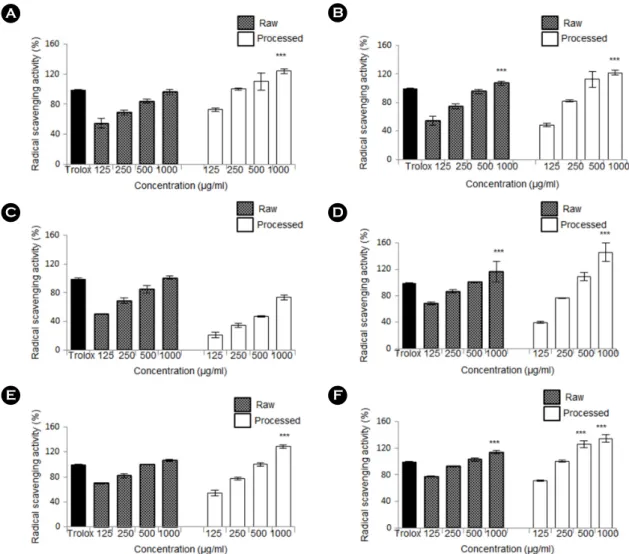
cially in the case of apple, pear, broccoli, and cabbage. How- ever, both raw and processed samples exhibited strong radical scavenging activity when compared to Trolox in the ABTS assay, which was used as a positive control (Fig. 2). Collec- tively, all processed samples showed comparatively stronger antioxidant activity.
Variable anti-inflammatory activity of raw and processed samples
NO production was induced with LPS treatment in RAW
Fig. 1. Radical scavenging activity of the fruit and vegetable samples using DPPH assay. The antioxidant activity of the samples was tested and compared to 100 μg/mL of ascorbic acid (AA), which was used as a positive control. The absorbance was read at 517 nm using a microplate reader and the radical scavenging activity was calculated using the formula mentioned in the Materials and Methods section. The radical scavenging activity of raw and processed apple is shown in (A), raw and processed carrot in (B), raw and processed pear in (C), raw and processed broccoli in (D), raw and processed cabbage in (E), and raw and processed radish in (F). Processed samples show relatively higher amounts of scavenged radicals, indicating higher antioxidant activity. Values in the bar graph are mean ± SEM of at least 3 independent experiments. ***, P < 0.001; significantly lesser than AA only treatments.A B
D C
F E
264.7 cells. Raw and processed samples were treated with LPS and the ability of the samples to inhibit NO production, which correlated to their anti-inflammatory properties, was assessed using Griess reaction. As shown in Fig. 3, raw carrot and pear samples exhibited strong anti-inflammatory effects and processed broccoli and cabbage exhibited more potency when compared to their raw counterparts. Cabbage had strong anti-inflammatory effects whether it was raw or processed, with the latter being more potent. Since the dos- ages used in our study were very high (1 mg/mL), we also sought to determine cytotoxicity using MTT reagent as
shown in Fig. 4. However, none of the concentrations used in our studies showed any cytotoxic effects.
Pro-inflammatory mediator and cytokine expression in RAW 264.7 cells using RT-PCR
Pro-inflammatory mediator (iNOS and COX-2) and cyto- kine (TNF-α, IL-1β, and IL-6) expression were assessed using RT-PCR. GAPDH was used as a loading control. As shown in Fig. 5, LPS increased the expression of all pro- inflammatory mediators and cytokines. Samples 1~6 are raw samples, whereas samples 7~12 are processed samples.
A B
D C
F E
Fig. 2. Radical scavenging activity of the fruit and vegetable samples using ABTS assay. Trolox (5 mM) was used as a positive control. The absorbance was read at 734 nm using a microplate reader and the radical scavenging activity was calculated. The radical scavenging activity of raw and processed apple is shown in (A), raw and processed carrot in (B), raw and processed pear in (C), raw and processed broccoli in (D), raw and processed cabbage in (E), and raw and processed radish in (F). All samples show good radical scavenging activity when compared to Trolox. Values in the bar graph are mean ± SEM of at least 3 independent experiments. ***, P < 0.001; significantly higher than Trolox only treatments.
Raw and processed apple, broccoli, cabbage, and radish samples showed potent iNOS inhibition. COX-2 was also potently inhibited by raw cabbage, whereas processed cab- bage potently inhibited IL-1β. However, TNF-α and IL-6 were not inhibited by any of the samples. These results were confirmed via gel image quantification using the ImageJ software (Fig. 5).
DISCUSSION
In our study, we selected six commonly available domestic fruits and vegetables, which included Malus domestica (Vane
et al.), Pyrus communis L. (pear), Daucus carota L. (carrot), Brassica oleracea var. (broccoli), Brassica oleracea var.
capitata (cabbage), and Raphanus sativus L. (radish), and investigated them for their antioxidant and anti-inflammatory activities. Furthermore, raw and processed samples were compared to determine whether additional heat treatment on the raw samples improved their bioactive properties.
ROS are produced during normal metabolic and physio- logical reactions such as signal transduction, gene expression, and mitochondrial electron transport (Bayr, 2005). ROS generated from these reactions affect cellular components like DNA, proteins, and lipids, resulting in oxidative DNA
Fig. 3. Nitric oxide inhibition induced by LPS. RAW 264.7 cells were seeded into 96-well plates. After 24 h, cells were treated with or without samples followed by 0.1 μg/mL LPS treatment 30 min later. NO production was analyzed using Griess reagent. LPS-induced NO inhibition in raw and processed apple is shown in (A), raw and processed carrot in (B), raw and processed pear in (C), raw and processed broccoli in (D), raw and processed cabbage in (E), and raw and processed radish in (F). Values in the bar graph are mean ± SEM of at least 3 independent experiments. **, P < 0.01; ***, P < 0.001 when compared to LPS only treatments.A B
D C
E F
damage (Cadet et al., 1994). Hence, there is a need to reduce ROS quantities via the intake of food and nutrients exhibiting high antioxidant activity (Machlin and Bendich, 1987). DPPH, which has an absorption band of 517 nm and diminishes due to reduction in the presence of dietary antiradical compounds, was used here to investigate the antioxidant activity of com- pounds and extracts (Brand-Williams et al., 1995). ABTS cation generation via the ABTS-potassium persulfate reaction was also utilized in this study as a marker for antiradical compounds existing in the samples (Re et al., 1999).
DPPH assay results indicated that the processed forms of apple, carrot, pear, broccoli, and cabbage showed increased radical scavenging activities, indicating that processed sam- ples exhibited better antioxidant activities when compared to unprocessed samples. Among the samples, processed pear showed potent antioxidant activity similar to ascorbic acid (positive control). In the ABTS assay, apple, carrot, broccoli, cabbage, and radish samples showed similar radical sca- venging activities via both raw and processed samples.
However, processed radish samples showed lower radical
Fig. 4. Cell viability assay for RAW 264.7 cells treated with fruit and vegetable samples. Cells were seeded into 96-well plates, treated with or without samples after 24 h of incubation, and then treated with or without 0.1 μg/mL of LPS after 30 min. Assay results for raw and pro- cessed apple is shown in (A), raw and processed carrot in (B), raw and processed pear in (C), raw and processed broccoli in (D), raw and processed cabbage in (E), and raw and processed radish in (F). Based on the results, none of the tested samples exhibited cytotoxic effects on RAW 264.7 cells. Values in the bar graph are mean ± SEM of at least 3 independent experiments.A B
D
F C
E
scavenging activities when compared to its raw counterpart, thereby contradicting the DPPH assay results. A previous study conducted using plums found that the antioxidant activity measured by the ABTS assay highly correlated with total phenolic content while exhibiting a weak correlation towards antioxidant activity and total flavonoid content (Kim et al., 2003). This suggested that all the raw and processed
samples in this study had relatively high total phenolic con- tent, except for processed pear, which had reduced phenolic content but increased antioxidant activity and flavonoid content. The ABTS cation readily reacts with molecules that donate hydrogen atoms and electrons, such as phenolic com- pounds, which causes the disappearance of the blue-green color of the radical. ABTS radicals are relatively more re-
Fig. 5. Reverse-transcriptase polymerase chain reaction for pro-inflammatory cytokines in RAW 264.7 cells treated with or without fruit and vegetable samples. RAW 264.7 cells were seeded into 6-well plates for 24 h, treated with or without samples at 1 mg/mL, and then treated with or without LPS 30 min later. RNA was extracted as described 18 h later using TRIzol solution and RT-PCR was carried out. iNOS, COX-2, TNF-α, IL-1β, IL-6, and GAPDH expression was determined. Samples 1~6 are raw samples of (1) apple, (2) carrot, (3) pear, (4) broccoli, (5) cabbage, and (6) radish, whereas samples 7~12 are processed samples of (7) apple, (8) carrot, (9) pear, (10) broccoli, (11) cabbage, and (12) radish, as shown in (A). Gel image quantification for relative (B) iNOS, (C) COX-2, (D) TNF-α, (E) IL-1β, and (F) IL-6 expression against GAPDH was carried out in triplicates using the ImageJ software. Values in the bar graph are mean ± SEM of at least 3 independent experiments. ***, P < 0.001 when compared to LPS only treatments.A B
D C
F E
active than DPPH radicals. DPPH radicals are involved in the transfer of hydrogen atoms, whereas ABTS radicals work via electron transfer (Kaviarasan et al., 2007). This explains the generally high radical scavenging activity of the samples in the ABTS assay. It also indicates that the samples have high phenolic content. Although processed pear exhibits slightly lower radical scavenging activity in the ABTS assay, its effect in the DPPH assay is quite potent, demonstrating its high antioxidant activity and low phenolic content. Fur- ther research needs to be carried out on processed pears to identify their bioactive contents.
Inflammation contributes to the pathophysiology of many chronic ailments (Libby, 2007). Since NO and ROS play an important role in inflammation, we investigated the anti- inflammatory properties of these samples. Despite its bene- ficial roles, the large quantities of NO generated by iNOS are toxic and pro-inflammatory in nature (Guzik et al., 2003), making it a marker of inflammation. In this study, we in- vestigated the ability of these samples to inhibit NO produc- tion in LPS-treated RAW 264.7 cells. From our results, raw carrot, pear, and cabbage, and processed broccoli and cab- bage potently inhibited NO production. Moreover, their con- centrations (up to 1 mg/mL) were not cytotoxic to RAW 264.7 cells (Fig. 4).
We also proceeded to investigate the mRNA expression levels of pro-inflammatory mediators and cytokines. Based on our results, raw cabbage inhibited the production of both iNOS and COX-2, while processed broccoli inhibited the production of iNOS and IL-1β. Interestingly, both these sam- ples were the most potent among all the other samples. Raw broccoli and processed apple, cabbage, and radish also po- tently inhibited iNOS production. Processed samples strongly inhibited iNOS expression when compared to raw samples, thereby establishing their potent anti-inflammatory properties.
Our results also showed that broccoli and cabbage exhibited potent anti-inflammatory effects, which aligned with the NO inhibition results (Fig. 3).
Overall, our results showed that processed samples ex- hibited better antioxidant and anti-inflammatory properties when compared to their raw forms. They demonstrated higher radical scavenging activities via the DPPH and ABTS assays and stronger NO and iNOS inhibition at the transc-
riptional level. Among the processed samples, pear samples showed high antioxidant and flavonoid content (DPPH), while broccoli and cabbage samples exhibited the strongest anti-inflammatory properties.
ACKNOWLEDGEMENTS
This research was supported by the Korean Technology and Information Promotion Agency (Industry-academy- research cooperation technology development business of Assignment number C0531416).
CONFLICT OF INTEREST
The authors declare no conflicts of interest.
REFERENCES
Bayr H. Reactive oxygen species. Critical Care Medicine. 2005.
33: S498-S501.
Brand-Williams W, Cuvelier M-E, Berset C. Use of a free radical method to evaluate antioxidant activity. LWT-Food Science and Technology. 1995. 28: 25-30.
Dewanto V, Wu X, Adom KK, Liu RH. Thermal processing enhances the nutritional value of tomatoes by increasing total antioxidant activity. Journal of Agricultural and Food Che- mistry. 2002. 50: 3010-3014.
Guzik T, Korbut R, Adamek-Guzik T. Nitric oxide and superoxide in inflammation. J Physiol Pharmacol. 2003. 54: 469-487.
Heo S-K, Yun H-J, Noh E-K, Park W-H, Park S-D. Lps induces inflammatory responses in human aortic vascular smooth muscle cells via toll-like receptor 4 expression and nitric oxide production. Immunology Letters. 2008. 120: 57-64.
Ito N, Fukushima S, Haqlwara A, Shibata M, Ogiso T. Carcino- genicity of butylated hydroxyanisole in f344 rats. Journal of the National Cancer Institute. 1983. 70: 343-352.
Kahl R, Kappus H. Toxicology of the synthetic antioxidants bha and bht in comparison with the natural antioxidant vitamin e.
Zeitschrift fur Lebensmittel-untersuchung Und-forschung.
1993. 196: 329-338.
Kaviarasan S, Naik G, Gangabhagirathi R, Anuradha C, Priyadarsini K. In vitro studies on antiradical and antioxidant activities of fenugreek (trigonella foenum graecum) seeds. Food Chemistry.
2007. 103: 31-37.
Kim D-O, Chun OK, Kim YJ, Moon H-Y, Lee CY. Quantification
of polyphenolics and their antioxidant capacity in fresh plums.
Journal of Agricultural and Food Chemistry. 2003. 51: 6509 -6515.
Libby P. Inflammatory mechanisms: The molecular basis of inflam- mation and disease. Nutrition Reviews. 2007. 65: S140-S146.
Machlin LJ, Bendich A. Free radical tissue damage: Protective role of antioxidant nutrients. The FASEB Journal. 1987. 1: 441-445.
Nile SH, Keum YS, Nile AS, Jalde SS, Patel RV. Antioxidant, anti-inflammatory, and enzyme inhibitory activity of natural plant flavonoids and their synthesized derivatives. Journal of Biochemical and Molecular Toxicology. 2018. 32: e22002.
Re R, Pellegrini N, Proteggente A, Pannala A, Yang M, Rice- Evans C. Antioxidant activity applying an improved abts radical cation decolorization assay. Free Radical Biology and Mmedicine. 1999. 26: 1231-1237.
Reuter S, Gupta SC, Chaturvedi MM, Aggarwal BB. Oxidative stress, inflammation, and cancer: How are they linked? Free Radical Biology and Medicine. 2010. 49: 1603-1616.
Saba E, Jeon BR, Jeong D-H, Lee K, Goo Y-K, Kwak D, Kim S, Roh S-S, Kim SD, Nah S-Y. A novel korean red ginseng com-
pound gintonin inhibited inflammation by mapk and nf-κb pathways and recovered the levels of mir-34a and mir-93 in raw 264.7 cells. Evidence-Based Complementary and Alternative Medicine. 2015.
Vane JR, Mitchell JA, Appleton I, Tomlinson A, Bishop-Bailey D, Croxtall J, Willoughby DA. Inducible isoforms of cyclooxy- genase and nitric-oxide synthase in inflammation. Proceedings of the National Academy of Sciences. 1994. 91: 2046-2050.
Wang Z, Hwang SH, Quispe YNG, Arce PHG, Lim SS. Investi- gation of the antioxidant and aldose reductase inhibitory acti- vities of extracts from peruvian tea plant infusions. Food Che- mistry. 2017. 231: 222-230.