Print ISSN: 2288-4637 / Online ISSN 2288-4645 doi:10.13106/jafeb.2021.vol8.no3.0287
The Ownership of the Largest Family Blockholders and Korean Firm Risk
Hung Sik KIM
1, Kyung-Shick CHO
2Received: November 20, 2020 Revised: January 25, 2021 Accepted: February 03, 2021
Abstract
This paper investigates the relationship between the ownership of the largest family blockholders and corporate risk. We also examine whether firms that belong to 30 main Chaebol groups lower corporate risk. We use panel analysis for companies listed on the Korea Exchange from 2005 to 2017. We use beta, volatility, and idiosyncratic risk as a proxy for corporate risk. We employ both the ownership of the largest family blockholders and firms that belong to 30 main Chaebol groups as a major independent variable. The results show that the ownership of the largest family blockholders is associated with low beta. In terms of the effects of the ownership of the largest family blockholders on beta, we find that a firm that belongs to the 30 main Chaebol group reinforces the lower beta. These results suggest that the ownership of the largest family blockholders and firms that belongs to 30 main Chaebol groups may be associated with low systematic risk in the Korean stock market. Our findings can provide meaningful information to investors and field officers who are interested in the relationship between firm risk and both the largest family blockholders’ ownership and firms that belong to 30 main Chaebol groups.
Keyword: Family Blockholder, Ownership, Beta, Volatility, Idiosyncratic Risk JEL Classification Code: G30, G32, G35
of stock price returns. First, previous studies use the investor base as a proxy for ownership structure. They use an investor base as the number and ownership of minority shareholders, ownership of institutional investors, and ownership of foreign investors (Chichemea et al., 2015; Li et al., 2011;
Merton, 1987; Rubin & Smith, 2009; Wang, 2007). Second, previous studies also use portfolio concentration as a proxy for ownership. They employ portfolio concentration as the largest non-diversified (concentrated) shareholders, the degree of concentration or diversification (distribution) among large shareholders, and the presence and the number of large shareholders (Ekholm & Maury, 2014; Faccio et al., 2011; Rossetto & Stagliano, 2012). However, previous studies do not show consistent results in the effects of each ownership on corporate risk. Also, previous studies analyze the influence of other factors on corporate risk. Other factors are market value versus book value, profitability, stock liquidity, firm size, leverage, and dividend payments(Black, 1976; Cao et al., 2006; Dennis & Strickland, 2004; Faccio et al., 2011; Li et al., 2011; Pastor & Veronesi, 2003; Schwert, 2002; Wei & Zhang, 2006). However, prior studies also do not show consistent results in the impact of other factors on firm risk. Some research shows that the relationship between stockholders and earnings volatility(Faccio et al., 2011;
John et al., 2008).
1
First Author. Professor, College of Management and Economics, Dongguk University Gyeongju Campus, South Korea.
Email: [email protected]
2
Corresponding Author. Visiting Professor, College of Management and Economics, Dongguk University Gyeongju Campus, South Korea [Postal Address: 109-1411, 163, Dongbuk-ro, Buk-gu, Daegu, 41519, South Korea] Email: [email protected]
© Copyright: The Author(s)
This is an Open Access article distributed under the terms of the Creative Commons Attribution Non-Commercial License (https://creativecommons.org/licenses/by-nc/4.0/) which permits unrestricted non-commercial use, distribution, and reproduction in any medium, provided the original work is properly cited.
1. Introduction
In the field of finance, the risk of stock price returns is a central theme in portfolio theory, asset pricing model, and option valuation. Therefore, this theme has been actively studied. In the fields of portfolio theory, asset pricing model, and option valuation, it is assumed that the risk of stock price returns is known and constant. However, the risk of the stock price return is variable. The risk of stock price returns is a very important issue for financial theory and investors (Campbell et al., 2001; Zhang, 2010).
Until now, many studies have been focused on the
ownership structure as a factor that determines the volatility
There are some studies on the relationship between blockholder ownership and corporate risk. Blockholders are defined as shareholders who hold 5% or more of the total stake (Dlugosz et al., 2006). For example, the impact of founding families on the idiosyncratic risk and total risk (Anderson & Reeb, 2003b), the relationship between the largest blockholder ownership and total risk (Rossetto
& Stagliano, 2012), the relationship between long-term shareholders and the risk that related to the ownership of large shareholders (Newton & Paeglis, 2019). In general, blockholders are classified into families, institutional investors, and foreign investors within a firm. Unlike the United States, the largest blockholder is a family in South Korea’s ownership. However, previous studies overlooked the relationship between the ownership of the largest family blockholders and corporate risk. As far as we know, there is very little regarding the relationship between firm risk and the ownership of the largest family blockholders who include both affiliated persons and affiliates. Korea listing companies can provide good examples of the largest family blockholders who include both affiliated persons and affiliates.
Our analysis makes two contributions to the literature as to the relationship between ownership structure and corporate risk. First, the ownership of South Korean companies is different from that of US companies. Institutional investors are the largest shareholders of US companies (Volkova, 2018). However, families who include affiliated persons and affiliates are the largest blockholders of South Korean companies. Therefore, this study is differentiated in that we analyze the relationship between firm risk and the ownership of the largest family blockholders who include affiliated persons and affiliates. Second, this study also analyzes the relationship between firm risk and the interaction between the ownership of the largest family blockholders and the 30 main Chaebol groups. This has not been addressed by earlier studies. This extends the existing literature on the association between ownership structure and corporate risk.
2. Literature Review and Hypotheses 2.1. The Relationship between Ownership
and Firm Risk
Previous studies analyze the relationship between ownership structure and corporate risk from two perspectives:
investment base and portfolio concentration. Previous studies use the proxy for investment base as the number and ownership of minority shareholders, institutional investor ownership, and foreign investor ownership.
Concerning the relationship between the number and ownership of minority shareholders and the firm risk, Merton
(1987) argues that the number of investors has a positive influence on the stock price under incomplete information.
Wang (2007) finds that the size of the investor base has a negative impact on firm risk. However, Jankensgard and Vilhelmsson (2015) report a positive relationship between firm risk and the number and ownership of minority shareholders. Regarding the association between volatility and institutional investor’s ownership, Dennis and Strickland (2004) report that there is a positive relationship between volatility and the ownership of financial institutions and mutual funds. Chichernea et al. (2015) report that institutional investors with a short-term investment are associated with high volatility. Campbell et al. (2001) and Zhang (2010) examine that there is a positive relationship between volatility and the ownership of institutional investors.
However, Rubin and Smith (2009) argue that dividend payments are the determining factor that the ownership of institutional investors affects the volatility. They find that there is a negative (positive) relationship between volatility and institutional investor’s ownership when paying (not) dividends. Jankensgard and Vilhelmsson (2015) report that there is a negative relationship between volatility and the ownership of institutional investors. Regarding the association between volatility and foreign investor’s ownership, Li et al. (2011) argue that foreign investors not only decrease volatility through monitoring activities but also improved governance in emerging markets.
Previous studies report that there is a relationship between portfolio concentration and firm risk. Investors who have different investment orientations have different characteristics in terms of governance and risk-taking.
Faccio et al. (2011) show that companies that are controlled by the largest diversified (decentralized) shareholders opt for more risker investment options than those that controlled by the largest non-diversified (concentrated) shareholders.
Ekholm and Maury (2014) argue that whether a firm that prefers a stable policy with low risk is related to not only the degree of concentration but also diversification among the largest shareholders. However, we know very little as to the association between the ownership of the largest family blockholder and firm risk.
As far as we know, only three prior studies have explicitly investigated the effects of blockholders on firm risk. For example, Anderson and Reeb (2003b) examine the seriousness of these moral hazard problems by analyzing whether founding families – as undiversified, large blockholders – seek to decrease firm-specific risk by impacting the firm’s diversification and leverage decisions. They find that the effects of founding families on firm-specific risk and the total depend critically on the founding family’s generation responsible for the company.
Rossetto and Stagliano (2012) investigate empirically
the relationship between firm risk and medium-sized blockholders. They show that the existence of multiple blockholders has a positive impact on corporate risk. They also show that the ownership of the largest blockholder decrease company risk only when the corporation has no other blockholders. Newton and Paeglis (2019) show that the ownership of individual blockholders is related to the lower systematic risk while firm blocks were associated with the systemic risk. Recently, Lee et al. (2018) examine the relationship between a controlling family’s ownership and South Korea company’s risk-taking behavior. They show that a non-linear U-shaped relationship exists between family ownership and a firm’s risk-taking. They argue that a family with small ownership takes a small risk for pursuing their private interests, while a family with more ownership modify their interest with their company’s by taking more value-enhancing risky projects. Rajverma et al. (2019) find that firms owned by the family are dominant with concentrated ownership. Management pays low dividends leading to decrease valuation and increase idiosyncratic risk. They illustrate that family control and family ownership concentration affect both firm performance and risk.
We assume that the largest family blocks will use their control to reduce the risk because of their risk-aversion.
Based on these preceding studies the relationship between family blockholders’ ownership and firm risk, this study formulates the following hypothesis.
H1: There is a negative relationship between the ownership of the largest family blockholders and firm risk.
2.2. Interaction of 30 Major Chaebol Groups
A Chaebol is a big industrial conglomerate that is controlled and run by a family or an owner in South Korea.
A Chaebol is often made up of many diversified affiliates, managed by an owner whose control over the group often surpass legal authority. Some Chaebol is one large firm while others have dispersed loosely connected groups of divided companies sharing a common name. Campbell II and Keys (2002) examines the influence of corporate governance dominated by some large Korea’s business groups. They show that firms affiliated with the top five groups exhibit higher sales growth and lower performance relative to other firms. Lee et al. (2005) focus on the determining factors of conditional skewness of stock return. They find that risk-sharing has effects on affiliated firm heterogeneity.
Previous studies have analyzed 30 major Chaebol groups in Korea (Cho & Park, 2002; Lee et al., 2005). The Fair Trade Commission selects the 30 major Chaebol groups. Whether or not the 30 main Chaebol group belongs to the group is based on the total assets of each company.
In terms of the effects of the ownership of the largest family blockholders on firm risk, we expect that the
interaction between firms that belongs to the 30 major Chaebol groups and the largest family blockholders reinforces the lowering of corporate risk. Therefore, the following hypothesis is established.
H2: The interaction between the largest family blockholders and companies that belongs to the 30 main Chaebol groups strengthens the lowering of corporate risk.
3. Method
3.1. Sample and Data
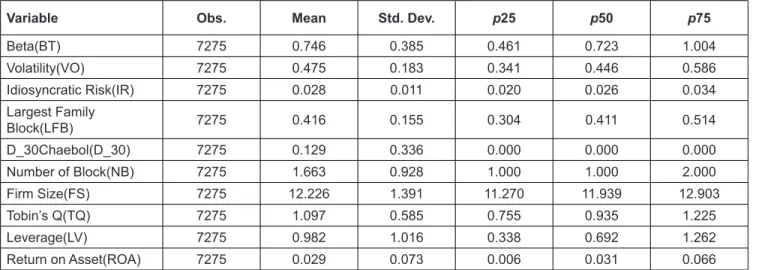
Our data is composed of firm-level information, not only from TS-2000 (similar to COMPUSTAT of U.S.), which is provided by the Korea Listed Companies Association, but also KIS VALUE Library (similar to CRSP of U.S.), which is provided by Korea Investors Service Corporation. Our final sample is composed of 7,275 firm-year observations from 646 non-financial firms from Korea exchange between 2005 and 2017. Samples are selected based on the following criteria. First, we exclude companies for which financial statements are not available from both TS-2000 and KIS VALUE Library. Second, we also do not include the financial sectors such as banks, securities, and insurances because they differ from manufacturing in terms of capital structure and business methods. Third, to control the effect of outliers on the analysis results, the upper and lower 1% of each variable is removed.
3.2. Model and Variables Measures
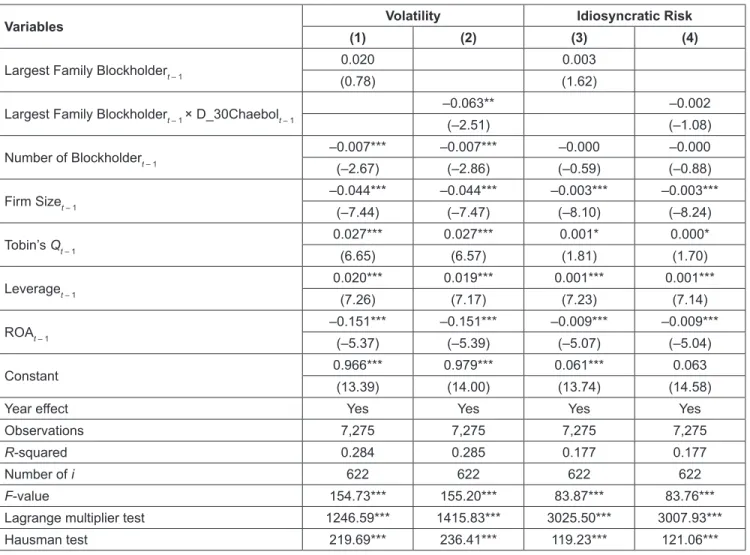
To analyze the effect of the ownership of the largest family blockholders on corporate risk, we use an equation (1). To analyze the relationship between a firm that belongs to the 30 main Chaebol groups and corporate risk, we use an equation (2). We conduct empirical analysis through panel analysis based on panel data. Chamberlain and Griches (1984) argue that the fixed-effects model has the advantage that there is no bias in the estimation result even if there is a correlation between the missing variable and the independent variable. We confirm the existence of corporate characteristics and time (year) characteristic effects through the Lagrange multiplier test suggested by Breusch and Pagan (1980) and also confirmed that the fixed effect model is more suitable than the probability effect model through the Hausman test.
FR LFB NB X
it
= a
0+ b
1 it−1+ b
2 it−1+ b
3 t−1+ m l e
t+ +
t it(1)
FR LFB XD Chaebol NB
X
it it it it
t t t i
= + +
+ + + +
− − −
−
a b b
b m l e
0 1 1 1 2 1
3 1
30 _
tt