1. Introduction
1)Gardens, which are usually not accessible to modern people living in multi-unit dwellings like an apartment, have been closely related to daily lives and played an important role as the space close to the nature. This is not only reflection of housing culture but also conglomerated space of living culture, value system, and arts representing the period and society (Choi, 2004). Traditional Korean garden has been the place to find peace where the ancestors feel the
nature and rest but it has become difficult for modern people to experience nature followed by urbanization and industrialization. Moreover, entering into the era of globalization and aging society is providing the modern people with more opportunities to live in limited space isolated from the nature. As a result, the people started longing for nature and the necessity of gardens is increasing as the place with natural beauty and values.
According to Park(2013), more than 85% of the gardens in individual households living in south
Received 11 October, 2018; Revised 29 October, 2018;
Accepted 30 October, 2018
*Corresponding author :Jin Hee, Lee, Department of Environmental Landscape Architecture Sangmyung University, Cheonan 31066, Korea
Phone:+82-41-550-5301 E-mail : [email protected]
ⓒ The Korean Environmental Sciences Society. All rights reserved.
This is an Open-Access article distributed under the terms of the Creative Commons Attribution Non-Commercial License (http://
creativecommons.org/licenses/by-nc/3.0) which permits unrestricted non-commercial use, distribution, and reproduction in any medium, provided the original work is properly cited.
ORIGINAL ARTICLE
Leaf Growth of Seven Fruit Trees in Response to Different Lights for Garden Tree
Yu Kyeong Nam, Jin Hee Lee
1)*, O Man Kwon
2) Phyto-Research Institute, Seoul 132-863, Korea1)Department of Environmental Landscape Architecture Sangmyung University, Cheonan 31066, Korea
2)Department of Architecture Dsign Kyung Dong University, Yangju 11458, Korea
Abstract
To select fruit trees suitable for shaded urban garden with Elaeagnus umbellata var. coreana, Malus domestica 'Alps Otome', Malus domestica 'Fujii', Prunus mume, Prunus persica for. persica, Rubus fructicosus, and Vaccinium corymbosum 'Reka', leaf growth in response to different light was investigated two years after 35% shade treatment. Leaf area of E. umbellata var. coreana, M. domestica 'Alps Otome', P. mume, P. persica for. persica, and V. corymbosum 'Reka' increased in shading. Fresh weight of leaves make inconsistent response to shading in every species but dry weight of E. umbellata var. coreana and P. persica for.
persica showed the highest 150% and 148%, increment, respectively. Althought leaf water content of E. umbellata var. coreana decreased in shading, there is no difference in P. persica for. persica. Chlorophyll value of E. umbellata var. coreana and P.
persica for. persica that showed higher than any other species is correlated with dark leaf green. Compared to specific leaf weight of E. umbellata var. coreana, P. persica for. persica, and V. corymbosum 'Reka' showed lower than any other species in shading, that of M. domestica 'Fujii', and R. fructicosus increased in reverse. These results indicate that E. umbellata var. coreana and P.
persica for. persica that showed high value in several invesetigaton items are suitable for shady urban condition considering leaf growth in response to shading.
Key words : Chlorophyll value, Leaf area, Leaf weight, Shade tolerance, Shading
-central part of Korea are large gardens larger than 165 m². Meanwhile, the national average size of
‘urban forest’, easily accessible by people residing in urban areas, is 9.91 ㎡ per person, satisfying the WHO’s guideline(9 ㎡), but is still insufficient compared to developed nations. Since the necessity of urban forest is increasing in order to alleviate air pollutions such as fine dust and heat waves(Korea Forest Service, 2017), expansion of garden size would contribute to creating pleasant lifestyles along with increase in green areas per person. Recently,
‘provision of green space in urban areas’ and
‘community-focused urban regeneration’ have emerged as the new directions for improving the urban environment and changing the lives of residents, spreading the interest in village gardens and kitchen gardens, followed by attention to publicness and participative functions of gardens (Sim & Zoh, 2015). Currently, tree species used for gardens in middle temperate region are total of 53 species including 8 species of evergreen shrubs, 36 species of summergreen shrubs, 8 species of needle-leaved evergreen shrubs, and 1 species of needle-leaved summergreen shrubs(Park, 2013) mostly using ornamental tree types. The performances of the landscaping shade trees were very good at screening the solar radiation at the garden and reducing infiltrating light into indoor. Therefore it is important to selecting fruit trees with leaves suitable for garden tree (Yuichi et al., 2016). However, modern-type garden trees should serve not only ornamental functions but should also have productive functions.
Therefore, it is required to expand usage of fruit trees possessing both ornamental values as well as practical values by providing edible fruits (Nam &
Lee, 2017). Park(2013) examined the preferences on fruit trees being used in middle temperate region, and reported that 27.2% for Prunus mume Siebold &
Zucc., 21.2% for Diospyros kaki Thunb and Zizyphus
salicina Lindl. and Chaenomeles sinensis Koehne.
However, the tree species currently being used in gardens are limited to the ones that have been used for a long time and all except P. mume and P.
tomentosa Thunb. are tree-type thus shrub-type species are required which have shadow tolerance suitable for shaded environment in limited space (Yim, 2006) and new types of fruit trees should be introduced to satisfy for taste of modern people.
Therefore, fruit trees with having edible fruits which are adaptable to urban environment will be promising garden tree adding ornamental value and growing pleasure. The present study was conducted initially to select fruit trees suitable for shaded urban gardens by planting seven different types of fruit trees in a single location, all of which have ornamental values and are edible, and by observing leaf growth in response to different light condition.
2. Method
2.1. Materials and method
As the testing materials for the experiment, seven
types of biennial grafted seedlings including
Elaeagnus umbellata var. coreana, Malus domestica
'Alps Otome', M. domestica 'Fujii', P. mume, Prunus
persica for. persica, Rubus fructicosus, Vaccinium
corymbosum 'Reka' were planted on November 15
th2016 in open field located at Daedeok-ri,
Beolgok-myeon, Nonsan, with plant density of 1 m X
1 m and were observed on September 30
th2018. In
order to examine leaf growth in response to different
lighting, lighting treatment was applied differently
between open field group and the other group
covered with 35% cheesecloth. The light
transmission ratio for the cheesecloth-treated group
was 47.62% compared to the open field group during
both in the morning and afternoon, as a result of
converting to % after measuring Photosynthesis
using light meter (LI-250A, LI-COR, USA). At this time, all treatment included three repetitions for five species.
2.2. Growth measurement 2.2.1 Leaf growth reaction
In order to identify leaf growth characteristics in response to different light condition, 4~5th leaves were measured by 30 repetitions in terms of fresh-weight, dry-weight, moisture content, leaf area, and Specific Leaf Weight (SLW).
2.2.2. Leaf transpiration
In order to identify the differences in leaf transpiration in response to different light condition, 4~5th leaves were measured by 3 repetitions using leaf porometer SC-1, C & H, Inc.
2.2.3 Leaf chlorophyll content measurement In order to identify leaf chlorophyll content in response to different light condition, chlorophyll meter (SPAD 502, Minota, Japan) was used to measure 4~5th leaves by 30 repetitions.
2.3. Statistical analysis
For data analysis, SAS programme (SAS Institute Inc., 2004) was used based on student’s t-test with P<0.05 significance level.
3. Results and discussion
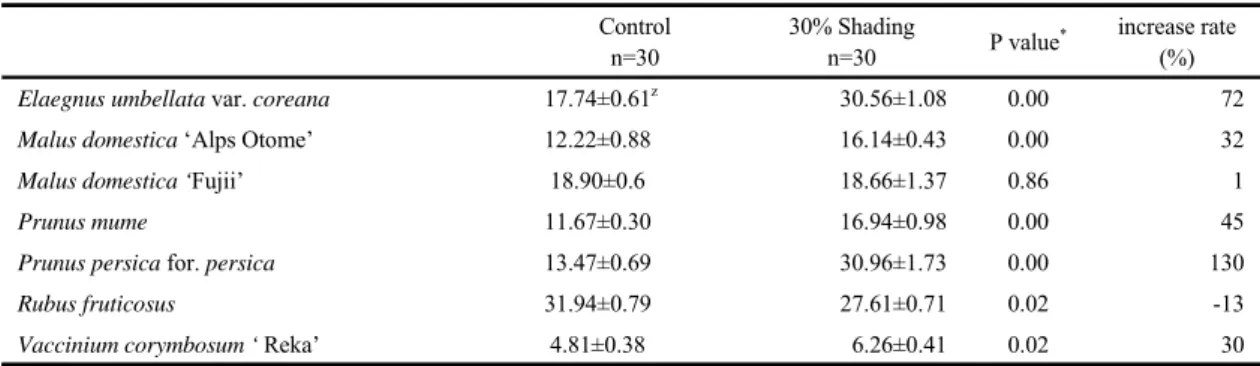
The adaptive potential of tree species to cope with climate change has important ecological and economic implications. Many temperate tree species experience a wide range of environmental conditions, suggesting high adaptability to new environmental conditions (Hanne et al., 2014). Fruit trees are greatly affected by precipitation and amount of sunshine between April and October. Moreover, when using fruit trees as garden trees, shades are created because of numerous buildings surrounding the garden, making it difficult for the plants to receive sufficient amount of lighting. When the amount of sunshine is insufficient, the branches and shoots are impeded and flower bud creation is deterred, debasing the quality of fruits as well as decreasing the flowering and fruition rate, which makes them unsuitable as landscaping trees (Nam & Lee, 2017). Therefore, it is required to select fruit trees with shade tolerance suitable for urban environment, Consequently, 7 types of fruit trees were treated with lighting treatment and leaf growth was measured as the fundamental experiment to identify whether the selected trees can adapt to the shaded urban environment or not. As a result, there was difference in leaf areas excluding Malus domestica ‘Fujii’, all of which were increased under light-treatment
Control n=30
30% Shading
n=30 P value* increase rate (%)
Elaegnus umbellata var. coreana 17.74±0.61z 30.56±1.08 0.00 72
Malus domestica ‘Alps Otome’ 12.22±0.88 16.14±0.43 0.00 32
Malus domestica ‘Fujii’ 18.90±0.6 18.66±1.37 0.86 1
Prunus mume 11.67±0.30 16.94±0.98 0.00 45
Prunus persica for. persica 13.47±0.69 30.96±1.73 0.00 130
Rubus fruticosus 31.94±0.79 27.61±0.71 0.02 -13
Vaccinium corymbosum ‘ Reka’ 4.81±0.38 6.26±0.41 0.02 30
zAll data were measured on November 30th 2018 at 3 years after treatment.
* Student’s t-test (p<0.05)
Table 1. Leaf area of 7 fruit trees in response to different light levels 2 years after treatment (unit: )
environment. Especially, Prunus persica for. persica showed 130% increase and Vaccinium showed 30%
increase despite of the fact that it is photophilic (Old Farmer’s Almana, 2017), which demonstrated its adaptation to shaded areas. However, Rubus fruticosus showed decrease in leaf areas under light-treatment environment (Table 1, Fig. 1). In general, it is known that lack of soil water leads to physiological changes in the root and aboveground part of the species, resulting in decrease of leaf extension and leaf stomatal conductance (Zhanga et al, 1998). Moreover, insufficient lighting causes increase in leaf areas to accommodate light as much as possible to compensate for the insufficient lighting, demonstrating the adaptation of the plants to cope with lighting shortage. Therefore, the difference was clear by the treatment thus M. domestica ‘Fujii’
and R. fruticosus are considered to be not suitable for shade-tolerant species in urban environment with low lighting since they did not show changes or even showed decrease in leaf areas.
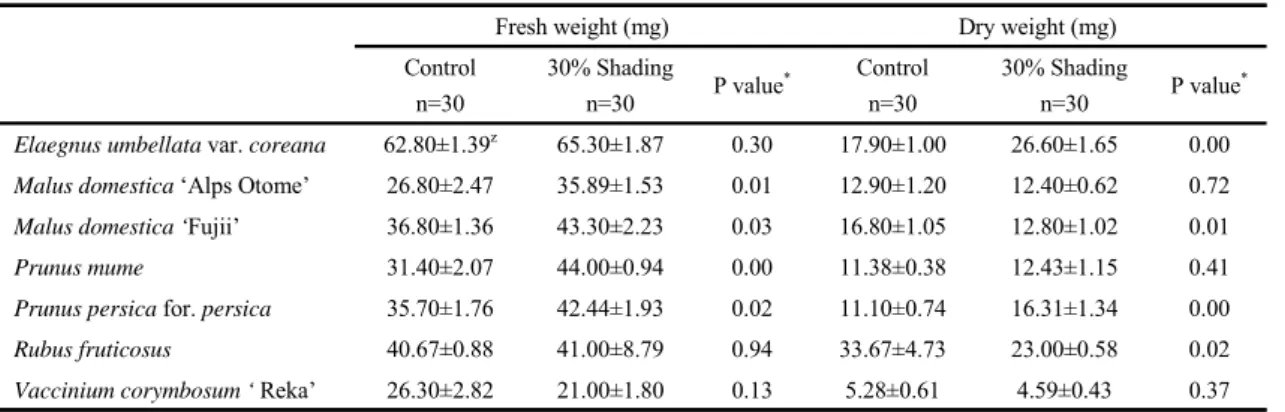
As a result of light treatment, leaf weight showed different results by the species. In terms of fresh weight, 4 species showed significant increase excluding E. umbellata var. coreana, R. fruticosus, and V. corymbosum ‘Reka’ and in terms of dry
persica showed statistically significant increase. The reason leaf light weight was increased in general species other than V. under light treatment environment was that leaf water loss has been suppressed by contained amount of evaporation followed by lighting. According to Niinemets and Kull (1994), plants’ leaf weight is increased along with increase in light intensity and the margin of increase is larger when less shade-tolerant. The experiment was conducted based on Niinemets and Kull (1994)’s conclusion and the dry weight was decreased for M. domestica ‘Fujii, R. fruticosus, and V. corymbosum 'Reka', all of which are photophilic thus seamless water absorption had not taken place through roots in shaded environment, making them species with weak shade tolerance. However, under light treatment environment, the dry weight of Elaegnus umbellata var. coreana and Prunus persica for. persica showed 150% and 148% increase (Table 2), which corresponds with the report that shade-tolerant species’ leaf weight is related with increased number of palisade parenchyma and enlargement of cells (Richard and Donald, 1990).
Consequently, laegnus umbellata var. coreana and Prunus persica for. persica, which showed much larger increase in leaf weight compared to the control
Fig. 1. Leaf area and leaf color of 7 fruit trees in response to different light levels 2 years after treatment. 1: Elaeagnusumbellata var. coreana, 2: Malus domestica 'Alps Otome', 3: Malus domestica 'Fujii', 4: Prunus mume, 5: Prunus persica for. persica, 6: Rubus fructicosus, 7: Vaccinium corymbosum 'Reka'.
light treatment thus are suitable for shaded urban environment. However, further examination is required on the impact of reproductive organs followed by light shortage.
Leaf photosynthesis is highly sensitive to soil water stress via stomatal and/or biochemical responses, which markedly suppress the growth of landscape trees. Effective irrigation management to maintain leaf photosynthesis and information on species-specific photosynthetic responses to soil water stress are essential for the sustainable management of landscape trees in Japan, in which summer drought often occurs(Yuich et al, 2016). In
general, transpiration is suppressed under light treatment and leaves’ moisture content is increased but in this experiment, E. umbellata var. coreana showed decrease whereas P. persica for. persica showed no difference. As seen in the results of dry weight (Table 2), it is regarded that shade tolerance is more related to increase in dry weight rather than moisture content within the leaves. However, there was no difference between species in transpiration followed by light treatment(Table 3).
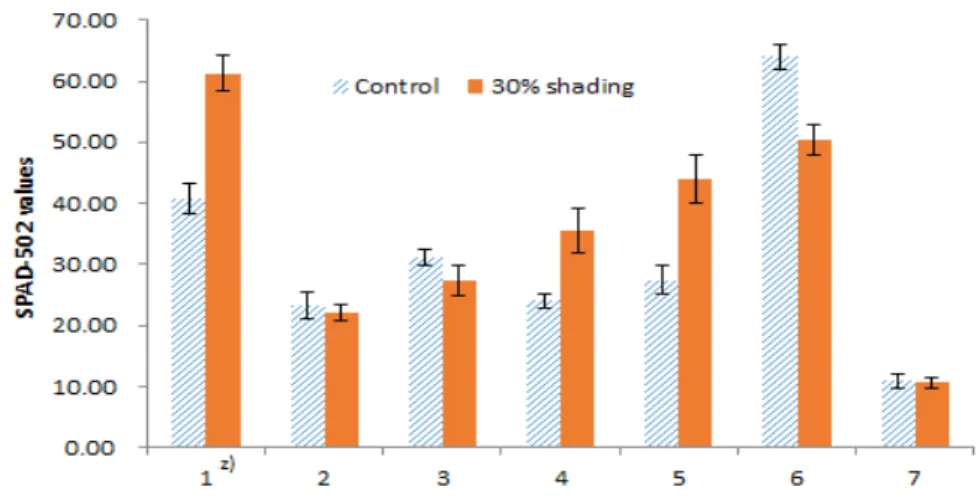
In terms of Chlorophyll value, there was no difference or showed higher value in light treatment groups compared to control groups except for R.
Fresh weight (mg) Dry weight (mg)
Control n=30
30% Shading
n=30 P value* Control
n=30
30% Shading
n=30 P value* Elaegnus umbellata var. coreana 62.80±1.39z 65.30±1.87 0.30 17.90±1.00 26.60±1.65 0.00 Malus domestica ‘Alps Otome’ 26.80±2.47 35.89±1.53 0.01 12.90±1.20 12.40±0.62 0.72 Malus domestica ‘Fujii’ 36.80±1.36 43.30±2.23 0.03 16.80±1.05 12.80±1.02 0.01
Prunus mume 31.40±2.07 44.00±0.94 0.00 11.38±0.38 12.43±1.15 0.41
Prunus persica for. persica 35.70±1.76 42.44±1.93 0.02 11.10±0.74 16.31±1.34 0.00
Rubus fruticosus 40.67±0.88 41.00±8.79 0.94 33.67±4.73 23.00±0.58 0.02
Vaccinium corymbosum ‘ Reka’ 26.30±2.82 21.00±1.80 0.13 5.28±0.61 4.59±0.43 0.37
zAll data were measured on November 30th 2018 at 3 years after treatment.
* Student’s t-test (p<0.05)
Table 2. Leaf weight of 7 fruit trees in response to different light levels 2 years after treatment
Water content (mg) Transpiration (mmol H2O/m2/sec) Control
n=30
30% Shading
n=30 P value* Control n=30
30% Shading
n=30 P value* Elaegnus umbellata var. coreana 44.90±1.29z 38.70±2.27 0.03 346.40±48.41 435.00±49.44 0.16 Malus domestica ‘Alps Otome’ 13.90±2.25 23.49±1.23 0.00 504.67±19.78 514.00±38.03 0.83 Malus domestica ‘Fujii’ 20.00±1.41 30.50±2.31 0.00 459.67±64.09 540.67±36.78 0.34
Prunus mume 21.16±2.72 31.57±1.22 0.00 553.33±49.21 489.00±40.85 0.37
Prunus persica for. persica 24.60±4.93 26.13±4.92 0.51 528.67±29.95 467.67±29.31 0.22
Rubus fruticosus 7.00±2.89 18.00±4.04 0.09 435.67±60.63 478.00±19.08 0.54
Vaccinium corymbosum ‘ Reka’ 21.02±2.42 16.41±1.73 0.14 442.00±44.56 385.67±27.27 0.34
zAll data were measured on November 30th 2018 at 3 years after treatment.
* Student’s t-test (p<0.05)
Table 3. Leaf water content and transpiration of 7 fruit trees in response to different light levels 2 years after treatment
fruticosus which showed lower value than non-treated group. Especially, E. umbellata var.
coreana and P. persica for. persica showed 50% and 60% increase in light treatment environment (no data), resulting in dark green color of the leaves. As explained in the growth measurement, it is regarded that Chlorophyll content is increased in order to adapt to shades (Fig. 2). It corresponds with the report of
green leaves in shades are related to Chlorophyll content and it shows healthy status of the plants.
Therefore, when selecting the plants suitable for garden, dark green leaves could be an important factor to consider.
In terms of interpreting plant growth, Specific Leaf Weight (SLW) indicates the weight of leaf areas against the leaf weight. It varies by the light
Fig 2. Chlorophyll value of 7 fruit trees in response to different light levels using a SPAD-502 chlorophyll meter. All datawere measured on November 30th 2018 at 3 years after treatment.
zSee Fig. 1.
Fig. 3. Specific leaf area of 7 fruit trees in response to different light levels. All data were measured on November 30th 2018 at 3 years after treatment.
zSee Fig. 1.