I. 서 론
1970년대 이후 산업화와 도시화 과정을 거치면서 우 리 농촌은 이촌향도 현상으로 과소화가 심화되고 있다.
인구감소에 따른 농촌지역경제의 총 수요 감소는 지속적 으로 농촌경제를 위축시키고 있으며, 노령화는 농촌사회 의 활력과 농업의 지속가능성 마저 위태롭게 하고 있다.
이에 정부에서는 농촌지역의 일자리 창출과 경제활성화 를 위해 1990년부터 농촌의 다원적 기능을 활용한 농업 외 소득원개발과 정주여건개선을 중심으로 농촌주민의 삶의 질 개선에 초점을 둔 각종 농촌지역개발사업을 추
Corresponding author : Chang, Woo Seok
Tel : 043-249-1808
E-mail : [email protected]
진하였다. 그러나 하향식 위주로 추진된 농촌지역개발정 책은 중앙정부 주도의 사업전개로 인하여 지역주민의 소 극적 참여, 수혜자 입장이라는 인식을 유발하였고, 이는 형식적, 제한적인 주민참여, 사업에 대한 주민의식 약화 라는 결과를 초래하였다(Park et al., 2000). 이렇게 추진 된 농촌지역개발사업은 사업내용의 획일화, 사업추진주 체의 소외, 사업효과 저조 등 다양한 문제를 야기하였는 데, 이를 해결하기 위하여 2000년부터 사업추진방식을 하향식에서 상향식으로 변경하게 되었다. 상향식 사업추 진을 통해 농촌지역개발사업에 대한 주민의 주인의식과 책임의식을 고취하여, 자발적인 주민참여로 농촌지역개 발사업의 내실화를 꾀하고, 주민 스스로 지역사회 문제 해결능력을 향상시키는 학습의 장으로 활용하면 농촌 지 역사회발전을 위한 내생적 역량을 강화시킬 수 있기 때
권역단위 농촌지역개발사업의 주민역량 측정을 위한 설문도구개발
리신호 ∙ 민흥기*∙ 윤성수 ∙ 정남수**∙ 장우석***
충북대학교 농업생명환경대학 지역건설공학과 ∙*한국농어촌공사 옥천영동지사
**공주대학교 산업과학대학 지역건설공학 ∙***충북농촌활성화지원센터
Development of a Survey Table for Measurement Regional Community Capacity on Rural Development Project of Region Unit
Rhee, Shinho ∙ Min, Heung Gi*∙Yoon, Sung Soo ∙ Jung, Nam Su**∙Chang, Woo Seok***
Dept. of Agricultural and Rural Engineering, Chungbuk Nat'l Univ.
*
Korea Rural Community Corporation
**
Dept. of regional Construction Engineering, Kongju Nat
́l Univ.
***
Chungbuk Rural Invigoration Support Center
ABSTRACT : The purpose of this study was to develop survey tools for diagnosis of capacity levels in business promotion of rural residents when performing a rural development project of a regional unit. The cases of previous studies were analyzed to select community capacity indicators related to a rural development project. Five indicators were derived : social capital, consciousness of participation, community spirit, and leadership. Based on the five indicators, measurement items of various capacities were selected and 54 survey items were selected through evaluation of experts twice. The pilot tests were conducted and targeted at Jeonnam song ho-jung village and Gyeongnam Haegeumgang village to identify derived survey items. In addition, descriptive statistic analysis and reliability analysis were conducted. As a result, survey items were corrected by reducing 10 items of the total 54 items. This results showed that using this tool could help us understand capacity levels of rural residents.
Key words : Rural Development Project, Regional Community Capacity, Empowerment, Survey Table, Pilot Test
1)문이다(Park, 2003).
농촌지역개발사업은 마을을 중심으로 추진되기 때문 에 원활한 사업추진을 위해서는 주민의 공동체의식에 기 초한 자발적 참여와 지도자들의 리더십 발휘, 합리적인 의사결정과 갈등조정이 가능한 주민역량수준이 필요하 다. 특히 마을주민과 공동체에 내재된 사회자본, 공동체 의식, 참여의식, 리더십, 갈등의 가치가 중요하게 인식되 고 있으며 이와 관련된 연구가 활발히 진행되고 있다.
그러나 이러한 요소들은 농어촌사회의 내생적 발전을 위 한 역량임에도 불구하고, 연구자의 관점 및 학문분야에 따라 세분되거나, ‘삶의 질’이나 ‘주민 생활만족도’와(Lee et al, 2014)같이 특정지표에 국한되어 연구되어 왔을 뿐 이다. 또한 농림축산식품부는 농촌현장포럼 사업을 통해
‘생활여건 만족도’, ‘자원인식’, ‘경제인식’, ‘지도자 역량 인식’, ‘공동체 활동인식’ 등 6개 항목으로 구분된 설문 조사표를 활용하여 주민역량측정 위한 설문조사를 실시 하고 있으나, 농촌지역개발사업의 추진역량을 파악하는 데 중요한 요인인 사회적 자본 형성 수준과 갈등수준을 명확히 파악하거나 진단하지 못한다는 한계점이 있다.
따라서 사회자본, 공동체 의식, 참여의식, 리더십, 갈등 요인을 농촌지역개발사업과 관련한 주민내부역량으로 판 단하고 농촌지역사회역량과의 관련성을 검증한 연구가 필요한 시점이다.
이에 본 연구에서는 권역단위 농촌지역개발사업과 관 련되는 주민역량인 사회자본, 공동체 의식, 참여의식, 리 더십과 갈등수준을 측정 할 수 있는 설문도구를 개발하 여 지역사회 역량의 상호관계를 규명하고자 한다. 이를 통해 농촌지역개발사업 시행과정에서 주민역량 수준을 부문별로 정확히 진단하고, 그 결과에 따라 역량강화사 업이 설계 및 시행되면 사업수행과정에서 발생하는 주민 의 내부적 갈등해소와 아울러 성공적 사업수행, 나아가 농어촌지역사회 주민의 전반적인 역량강화에 기여할 수 있을 것으로 판단된다.
II. 선행연구고찰
주민참여형 상향식 농촌지역개발사업을 추진하게 되 면서 자연스럽게 지역주민 역량강화의 필요성이 대두되 었다. 그 예로 2004년부터 시작된 농촌마을종합개발사업 은 기초생활환경정비사업, 경관정비사업, 소득기반정비사 업 등을 지원하면서 주민의 역량강화사업을 병행하며 사 업을 추진하였다. 이와 같은 농촌지역개발사업이 매년 증가하면서 농촌지역개발사업의 참여주체 역량강화나, 사회자본, 공동체 의식, 지도자의 리더십 등이 농촌개발
에 미치는 영향에 대한 연구가 활발히 진행되었으며, 농 촌지역개발사업을 추진하는 과정에서 주민들 간의 갈등, 마을간 갈등이 발생하면서 갈등관리의 중요성도 함께 연 구되기 시작하였다. 이에 본 연구에서는 농촌지역개발사 업에 직·간접적으로 영향을 미치는 요인들을 파악하기 위하여 관련 선행연구를 조사하였다.
‘역량’이란 사전적 의미로 ‘어떤 일을 해낼 수 있는 힘’을 뜻한다. 농촌개발에서 지역역량개념은 ‘농촌 지역 사회를 긍정적인 방향으로 변화시킬 수 있는 힘’을 뜻하 는 것으로 이해할 수 있다. 그러므로 ‘역량강화’란 ‘그러 한 힘을 축적하는 것’이라고 정의할 수 있다. 농촌개발 과 관련하여 ‘역량’이라는 개념은 주체를 누구로 상정하 느냐에 따라 ‘농촌개발정책사업 참여주체의 역량’과 ‘농 촌지역사회 전체의 역량’으로 구분할 수 있으며 개인의 역량은 사회적 관계를 통해 지역사회 전체의 역량강화로 이어질 수 있다(Kim and Kwon, 2009; Shultz, 1976). 따라 서 농촌개발에서 지역역량은 참여주체의 주민역량을 포 함하여 농촌마을 전체의 지역사회역량을 의미한다. Shaffer and Sumers(1989)는 ‘지역사회의 발전(development of the community)’과 ‘지역사회 내 발전(development in the community)'의 개념을 구분하여 정리하였는데, 두 개 념을 구분하여 역량강화의 문제에 접근할 필요가 있다.
‘지역사회 내 발전’이라는 입장에서 본다면 개별정책사 업의 계획, 실행, 평가과정에 참여하는 행위자들의 역량 을 강화하는 것이 중요하다. ‘지역사회의 발전’이라는 입 장에서는 전체로서의 지역사회가 지속적이고 긍정적인 방향으로 변화하도록 이끄는 내적 동력인 사회적 관계를 확충하는 것이 더 중요한 과제이다. 따라서 특정 농촌개 발정책사업 참여 주체의 역량과 농촌지역사회의 역량을 구분하여 접근 할 필요가 있다(Kim and Kwon, 2009).
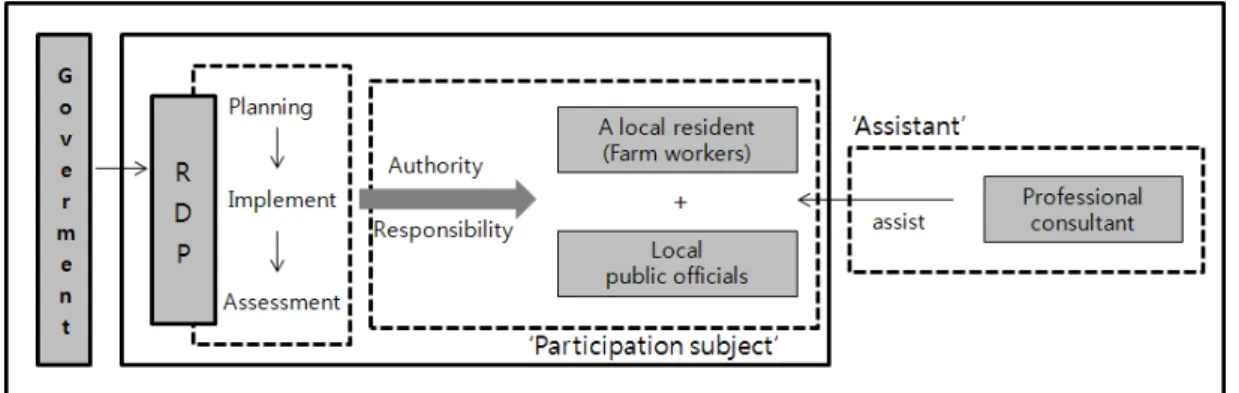
농촌지역개발사업은 주로 소규모 마을단위로 시행하 며 우선적으로 사업 추진주체에 대한 역량강화를 중요시 한다. 즉, 주민참여형 상향식 농촌지역개발사업의 주체는 지역주민이기 때문이다. Kim and Kwon(2009)는 농촌지 역개발사업의 참여주체를 ‘사업의 계획, 실행, 평가 등 전 과정에서 책임과 권한을 가지고 주도적으로 활동하는 개인 및 조직’이라하고 참여주체는 ‘지역주민’, ‘지방자 치단체 공무원’, 조력자는 ‘전문컨설턴트’가 있음을 Figure 1과 같이 정의한 바 있다. 따라서 역량강화의 대 상자는 구체적으로 농촌지역개발사업의 추진 주체인 농 촌마을 지역주민이 대상이 된다.
또한 마을이 속한 지리적 영역에는 마을의 구성원인 혈연공동체, 지연공동체, 결사공동체가 존재한다. 이러한 공동체 구성원들은 구성원들이 추구하는 목적을 달성하 기 위해 다양한 노력과 활동을 하며 이러한 지역공동체
의 사회역량은 사회적 관계 속에 배태되며 공동체 내 문 제를 해결하고 삶의 질 향상을 위해 지역사회의 인적자 본과 조직자원, 그리고 사회자본들 간의 상호작용 행위 로서, 비공식적 과정 혹은 조직화된 노력을 통해 작동된 다(Chaskin, 1999; Kang, 2004).
이 같은 이론적 배경을 바탕으로 농촌지역개발과 관 련한 지역사회역량에 대한 논의를 살펴보면 주로 네 가 지 측면에서 검토할 수 있다. 첫째는 사회자본이다. 농촌 지역사회에 내재된 사회자본이 농촌사회발전에 긍정적인 기능과 역할로서 중요함과 농촌지역개발사업과의 관련성 을 검증하는 연구가 활발히 진행되어 왔다(Yoo, 2006;
Jung et al., 2006). 둘째는 공동체 의식이다. 동일한 지역 을 생활기반으로 하여 마을 공동체 구성원 간의 사회적 상호작용 통해서 나타나는 공동체 의식은 농촌마을의 유 지와 공동의 이익을 위한 노력을 촉발하는 내부기제이며 농촌마을계획시 중요하게 고려되어야 하는 요인이다 (Yoo, 2003; Kang, 2004). 셋째는 참여의식이다. 농촌개발 의 주체는 주민이며, 주민참여가 농촌지역개발사업의 성 과에 긍정적인 영향을 미친다(Song and Kim, 1991;
Cho, 2003). 넷째는 리더십이다. 훌륭한 리더십은 농촌마 을사업을 성공으로 이끌고 사회자본의 육성과 형성에 영 향에 미치는 요인이다. 리더십은 지역의 총체적인 역량 을 강화시키는 요인으로 농촌개발의 가장 중요한 조건으 로 다뤄지며 관련 연구가 활발하게 진행되고 있다(Heo and Jung, 2003; Yoo, 2006, Park and Kim, 2008). 이들 네 가지 측면의 ‘사회자본’, ‘공동체 의식’, ‘참여의식’,
‘리더십’은 모두 지역사회 주민들에게 배태되어 있는 의 식으로서 마을주민들과 마을공동체의 무형적인 가치관으 로 볼 수 있다. 다섯째, 갈등이다. 농촌지역개발사업은 사업추진 과정 및 사업완료, 완료 후 단계까지 다양한 의사결정이 반복되며, 많은 이해관계가 복잡하게 얽히게
된다. 이로 인해 발생하는 사업주체 간 갈등은 농촌지역 역량강화를 위해 적절한 관리가 필요한 시점이다.
이처럼, 다양한 요소들이 농촌지역의 내생적 발전을 위한 역량조건이라 할 수 있지만 이에 대한 선행연구는 주성분분석 등 개념파악 수준에 머무르고 있으며, 이를 통합하여 상호 작용관계나 지역의 수준을 평가하고자 하 는 시도는 부족하였다. 따라서 이러한 지역역량 요소들 을 활용하여 마을별 역량수준을 측정하고 또 이들이 세 부적으로 상호 어떻게 작동되는지 통합적인 관점에서 연 구가 필요하다.
III. 연구내용 및 방법
본 연구에서는 농촌마을 주민들에게 존재하는 ‘사회자 본’, ‘공동체 의식’, ‘참여의식’, ‘리더십’, ‘갈등’은 농촌지 역개발사업을 추진하는 주민들에게 필요한 무형적인 자 원이며 농촌지역역량으로 판단하였다. 그러나 이러한 역 량 요소들은 서로 독립적으로 작용하는 것이 아니라 상 호유기적인 관계 속에서 나타나는 특징이 있는데 선행 연구결과를 보면 개별요소 중심으로 연구결과가 이루어 졌다(Min, 2014). 이에 본 연구에서는 이러한 요소들을 통합적 접근과 분석이 필요하다는 관점에서 연구를 수행 하였다.
지역사회 역량측정 설문지 개발 절차는 Figure 2와 같 이 선행 연구결과를 바탕으로 1차 측정변인을 도출하고 전문가 자문을 거쳐 2차 측정변인을 확정하여 설문지를 개발한다. 개발된 설문지를 바탕으로 실제 주민역량강화 사업이 수행되고 있는 지역을 선정하여 Pilot Test를 실 시였으며 기술통계분석, 신뢰도 분석을 실시하여 그 결 과 및 적용성을 검토하고, 전문가 자문의견 및 분석결과
Figure : Kim and Kwon(2009)
Figure 1. Definition of the participants and assistant
를 바탕으로 설문항목을 보정하여 최종 설문항목을 도출 하였다.
IV. 지역사회 역량 측정을 위한 설문항목개발
1. 지역사회 역량 지표 도출
1) 사회자본관련 변수 도출
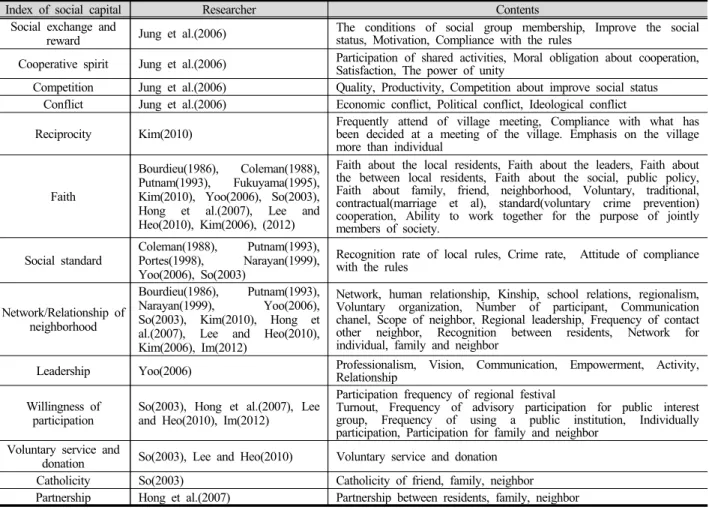
사회자본에 대한 국내외 연구자들의 연구는 초기에 사회자본이 신뢰, 네트워크, 규범 등 3개 요소 범위 내에 서 개념정립이 이루어졌으며, 이후 연구가 활성화 되면 서 사회자본의 개념이 연구목적에 따라 다양하게 확대되 어 가는 것으로 나타나고 있다. 관련 선행 연구를 분석 한 결과 Table 1과 같이 사회자본은 총 13개의 지표로 1
차 도출할 수 있었으며 대표적인 사회자본의 세부지표는 신뢰, 연결망(네트워크, 이웃관계), 사회적 규범, 주민참 여 순으로 나타났다. 그러나 사회적 교환과 보상, 사회적 규범처럼 중 일부지표는 조사내용과 목적에 상호 유사성 이 존재하여 별도의 지표로 편성할 경우 조사자 및 응답 자의 혼란을 줄 수 있을 것으로 판단된다. 따라서 이러 한 특징을 보이는 일부지표는 조사목적과 내용을 바탕으 로 통합하거나 조정할 필요가 있다(Min, 2014).
본 연구에서는 1차 도출된 사회자본 지표를 Figure 3 과 같이 지표를 별도로 독립시키거나 통합하였는데, 조 사범주가 큰 지표로 통합한 후, 세부항목에 조사내용을 포함시키는 방법으로 항목을 조정하였다. 사회자본 지표 중 ‘주민참여’는 ‘참여의식’ 역량으로 ‘리더십’과 ‘갈등’
은 분리하여 ‘리더십’ 역량과 ‘갈등’ 역량으로 독립시켰 다. 그리고 내부적으로 우선 사회자본의 구성 요소 중 개념이 유사한 ‘사회적 교환과 보상’과 ‘호혜성’은 ‘사회 적 규범’으로 통합하고 ‘관용성/포용력’과 ‘파트너십’은 Figure 2. Process of this study
Figure 3. Result of adjustment of social capital variables
‘네트워크/연결망/이웃관계’로 통합하였다. ‘봉사활동/기 부’는 ‘참여의식’ 역량 항목으로 조정할 수 있었다(Min, 2014).
2) 참여의식관련 변수도출
농촌지역개발사업에서 주민참여가 강조되고 있음에도 주민참여에 대한 연구는 많지 않다. 특히 주민참여 수준 이 사업목적 달성에 긍정적인 영향을 미치므로 주민들의 참여의식이나 수준을 평가하는 연구는 더욱 필요하다 (Song and Sung, 2004). 관련연구를 살펴보면 주민참여형 마을개발사업의 평가 모형에서 착수, 계획, 시행, 관리운 영단계별로 주민들의 참여 실태와 참여지수를 측정하여
사업성과와 관련성을 살펴본 연구가 수행되었는데, Shin(2012)은 ‘농촌마을 주민 공동체 의식연구’에서 ‘참 여도’와 ‘참여 용의성’에 대한 측정항목을 도출한 연구를 수행한 바 있으며, Lee and Park(2009)은 농촌마을개발사 업에 대한 지역주민의 의사결정분석에서 ‘참여의향’과
‘참여정도’ 관점에서 연구를 수행한 바 있다. 따라서 주 민들의 참여의식은 주민들의 역량이므로 현재 마을 내에 서 이루어지는 공동사업이나 다양한 마을 활동에 주민들 의 참여정도를 파악하는 ‘참여도’와 앞으로 이러한 사업 과 활동에 대한 참여의지를 묻는 ‘참여의향’을 참여의식 의 측정지표로 도출하였다(Table 2). Lee and Heo(2010) 는 주민참여와 관련되는 ‘참여활동’과 ‘봉사활동’, ‘기부
Index of social capital Researcher Contents
Social exchange and
reward Jung et al.(2006) The conditions of social group membership, Improve the social status, Motivation, Compliance with the rules
Cooperative spirit Jung et al.(2006) Participation of shared activities, Moral obligation about cooperation, Satisfaction, The power of unity
Competition Jung et al.(2006) Quality, Productivity, Competition about improve social status Conflict Jung et al.(2006) Economic conflict, Political conflict, Ideological conflict
Reciprocity Kim(2010) Frequently attend of village meeting, Compliance with what has been decided at a meeting of the village. Emphasis on the village more than individual
Faith
Bourdieu(1986), Coleman(1988), Putnam(1993), Fukuyama(1995), Kim(2010), Yoo(2006), So(2003), Hong et al.(2007), Lee and Heo(2010), Kim(2006), (2012)
Faith about the local residents, Faith about the leaders, Faith about the between local residents, Faith about the social, public policy, Faith about family, friend, neighborhood, Voluntary, traditional, contractual(marriage et al), standard(voluntary crime prevention) cooperation, Ability to work together for the purpose of jointly members of society.
Social standard Coleman(1988), Putnam(1993), Portes(1998), Narayan(1999), Yoo(2006), So(2003)
Recognition rate of local rules, Crime rate, Attitude of compliance with the rules
Network/Relationship of neighborhood
Bourdieu(1986), Putnam(1993), Narayan(1999), Yoo(2006), So(2003), Kim(2010), Hong et al.(2007), Lee and Heo(2010), Kim(2006), Im(2012)
Network, human relationship, Kinship, school relations, regionalism, Voluntary organization, Number of participant, Communication chanel, Scope of neighbor, Regional leadership, Frequency of contact other neighbor, Recognition between residents, Network for individual, family and neighbor
Leadership Yoo(2006) Professionalism, Vision, Communication, Empowerment, Activity, Relationship
Willingness of
participation So(2003), Hong et al.(2007), Lee and Heo(2010), Im(2012)
Participation frequency of regional festival
Turnout, Frequency of advisory participation for public interest group, Frequency of using a public institution, Individually participation, Participation for family and neighbor
Voluntary service and
donation So(2003), Lee and Heo(2010) Voluntary service and donation Catholicity So(2003) Catholicity of friend, family, neighbor Partnership Hong et al.(2007) Partnership between residents, family, neighbor
Table : Min (2014)Table 1. Deduction variables for measurement of the social capital
Index of willingness of participation Contents
Participation Participation of residents for the various activities carried out in the village
Rural development project, Investment, Mutualism, Donate
Intent to participation Intent to participation of rural development project
Table 2. Deduction variables for measurement of the willingness of participation활동’을 사회자본의 구성 요소로 보았는데 본 연구에서 는 이를 참여의식 항목에 포함하였다.
3) 공동체 의식 관련 변수 도출
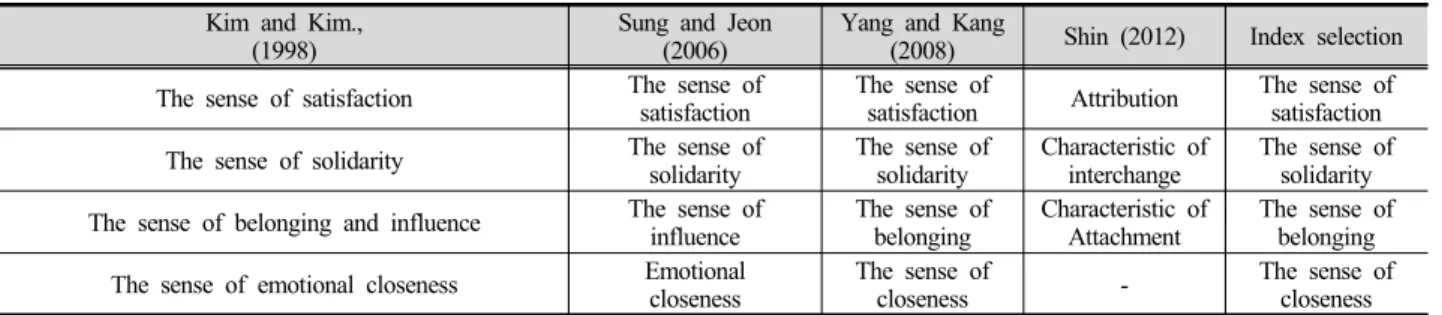
공동체 의식 측정과 관련된 연구 중 Kim and Kim(1998), Sung and Jeon(2006), Yang and Kang(2008), Shin(2012)의 연구에서 가장 보편적으로 인식하고 있는
‘충족감’, ‘연대감’, ‘소속감’, ‘친밀감’을 공동체 의식 세 부 지표로 Table 3과 같이 정리하였으며, 이를 측정하기 위한 항목은 Table 4와 같다.
4) 리더십 관련 변수 도출
Park et al(2004)에 의하면 농촌마을에서 리더의 역할도
시기별로 변화되어 왔다. Yoo(2006)는 주민참여를 바탕으 로 한 마을공동사업 추진 시 주민과 함께 사업을 이끌어 갈 수 있는 새로운 리더십과 역량을 가진 리더의 필요성 을 제기하였고, Park et al(2006)은 농촌지도자의 역할로 변화촉진자, 의사 소통자, 변화유도자, 협상자, 창출자, 조 직가, 조정자, 점검자로 설명하였다. 또한 Park(2008)은 농촌관광마을에서 마을리더의 역량을 측정하기 위한 지 표도출하고 적용하는 연구를 수행한 바 있다. 각 연구자 들이 주장한 농촌지역개발 사업 추진 시 필요한 지도자 의 리더십 개념을 정리하면 Table 5와 같다.
5) 갈등 관련 변수 도출
농촌마을 공동체의 갈등을 연구한 사례는 많지 않다.
Kim and Kim.,
(1998) Sung and Jeon
(2006) Yang and Kang
(2008) Shin (2012) Index selection The sense of satisfaction The sense of
satisfaction The sense of
satisfaction Attribution The sense of satisfaction The sense of solidarity The sense of
solidarity The sense of
solidarity Characteristic of
interchange The sense of solidarity The sense of belonging and influence The sense of
influence The sense of
belonging Characteristic of
Attachment The sense of belonging The sense of emotional closeness Emotional
closeness The sense of
closeness - The sense of
closeness
Table 3. Deduction variables for measurement of the community spiritIndex of community spirit Contents
The sense of satisfaction
Satisfaction, Problem solving, Interdependence
Benefits of regional membership, Satisfaction about living environment, Satisfaction of income, Satisfaction of safety
The sense of solidarity Unitedly problem solving, Sharing of grief, Well each other The sense of belonging One of the society, A unique spirit and order,
Interrelation between me and regional society
The sense of closeness As a comfortable communication partner, Not lonely, There is a close friend or neighbor of mine
Table 4. Details of the community spiritResearcher Contents
Park(2008)
Learning directivity, Compliance with principles, Planning ability, Dedicated organization, Relationship, Confidence, Integritous, Development of human resource, Ability to control, Teamwork/cooperation, Rationalization, Performance directivity, Continuous challenge, Creative improvement, A Customer directivity
Yoo(2006) Professionalism, Vision, Communication, Empowerment, Activity, Relationship Heo and Jung(2003) Professionalism, Vision, Communication, Empowerment, External activity, Relationship
Lee(1998) Ability to problem solving, Ability to communication decision, The formation of teamwork, Motivation, Attract external resources, Relations with the outside
Park et al(2006)
Information capacity, Decision making, Suggest vision, Motivation, Communication, Foster of other members, Management of members, Problem solving, Learning capacity, Flexibility, Presentation, Business understanding, Making relationship, The coaching and feedback, Negotiation capacity, Conflict management, Idea creation
Table 5. The concept of leadership in advanced research
주로 연구된 대상은 농촌관광, 농촌체험마을 등 마을주 민들이 공동의 소득사업을 추진하면서 발생하는 갈등 형 태나 원인이다. 농촌지역 갈등 측정에 대한 주요 연구는 Jung et al(2006), Kim(2009)이 있으며, 각 연구자들의 연 구한 주요 갈등형태와 갈등 원인은 Table 6과 같다.
2. 농촌 지역사회역량지표 결정 및 전문가자문실시 이와 같이 검토를 거쳐 Table 7과 같이 농촌지역사회 역량은 5개 차원으로 설정하고 사회자본은 4개 지표, 공 동체 의식 4개 지표, 참여의식 2개 지표를 도출하였다.
한편, 리더십과 갈등은 선행연구에서 제시되는 주요 개 념이 유사하고, 개념을 구분하는 기준이 모호하기 때문
에, 세부지표를 도출하는 것보다 통합해서 측정하는 것 이 합리적이라는 판단으로 세부지표를 설정하지 않았다. 이후 농촌지역사회역량 측정변인도출 설문의 타당성 과 객관성을 높이기 위하여 Table 8과 같이 관광, 지역 분석, 지역계획, 사회개발, 조경분야별 박사학위 소지자 로 실무와 학계를 중심으로 구성하였다. 변인 도출을 위 해 1차 전문가 자문은 지역개발관련 실무경험이 풍부한 전문가 6인을 구성하였고 2차 설문 문항 구성 시는 각 분야별로 실무와 학계에서 전문가 8인을 구성 하였다.
3. 농촌 지역사회역량 및 지표 변인 도출
선행연구 고찰 결과를 바탕으로 농촌지역사회역량의
Socail Capital (4 Index)
Community Sprit (4 Index)
Willingness of participation (2 Index)
Leadership (0 Index)
Conflict ( 0 Index)
Faith The sense of satisfaction Participation - -
Cooperation The sense of solidarity Intent to participation - -
Network The sense of belonging - - -
Social standard The sense of closeness - - -
Table 7. Determine the variables of regional community capacity
Researcher Contents
Jung et al (2006) - Causes of conflict : Profit distribution, Cost sharing, Leadership and influence, The election of director, Ideological conflict
Kim (2009)
- Conflict types : Conflict between a public officer and residents, Conflict between leader and residents, Conflict between leader, Conflict between residents
- Causes of conflict : Difference of goal and recognition, Communication, Leadership, Negative recognition, Distribution of profit and responsibility, A closed society, Distribution of support fund, Communication decision, Cooperation
Jang and Kwon (2010)
- Conflict types : Conflict between residents, Conflict between leader and residents, Conflict rural development project
- Causes of conflict : A greedy leader, Profit distribution
Jo et al (2008)
- Conflict types : Conflict between a public officer and residents, Conflict between leader and residents, Conflict between leader
- Causes of conflict : Difference of goal and recognition, Communication, Leadership, Negative recognition, Distribution of profit and responsibility, A closed society
Kim(2004) Jo and Kim (2008)
- Conflict types : Conflict between a public officer and residents, Conflict between leader and residents, Conflict between leader, Conflict between residents
- Causes of conflict : Profit distribution, Dogmatic business process, Lack of communication sprit, Leadership, Problem between public business project and private business
Table 6. The cause and Conflict types in advanced research
Classification Total Tourism Regional analyst
Regional
Planner Social analyst A landscape Etc
First advice 6 1 - 2 2 1 Executives
Secondly advice 8 1 1 3 3 - Researcher
Table 8. Construction of expert advisory group
지표별 측정범주는 Table 9와 같이 결정하였다. 농촌지 역개발사업이 주로 마을단위로 이루어지므로 마을단위에 적용가능 할 뿐만 아니라 농촌의 연령대를 고려한 알맞 은 용어로 바꾸었다. 농촌지역사회역량 및 지표별 변인 도출은 관련 변인 중 2명 이상의 연구자가 선택한 변인 들을 우선적으로 관련 변인으로 설정하였다. 그리고 선 행연구결과가 부족한 경우는 예외적으로 1인의 연구자 변인을 사용하였다. 그리고 타당성 확보를 위해 전문가 자문을 실시하였다.
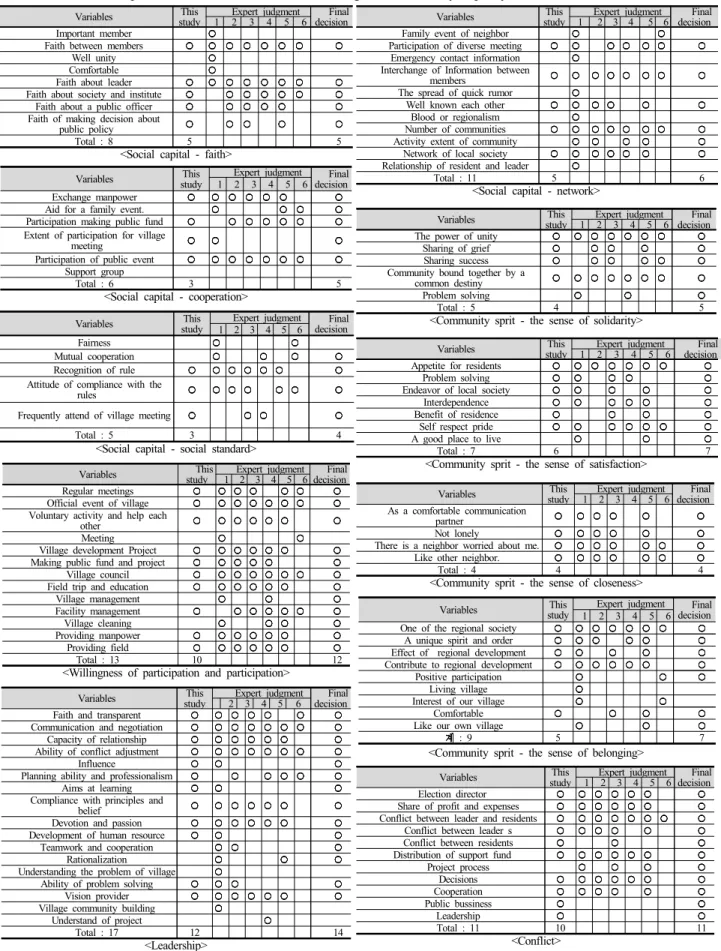
본 연구에서 선행 연구로부터 변인을 도출하고 이를 전문가 6명의 1차 자문을 거쳐 요소별 최종 선정된 변인 을 정리한 결과는 Table 10과 같다.
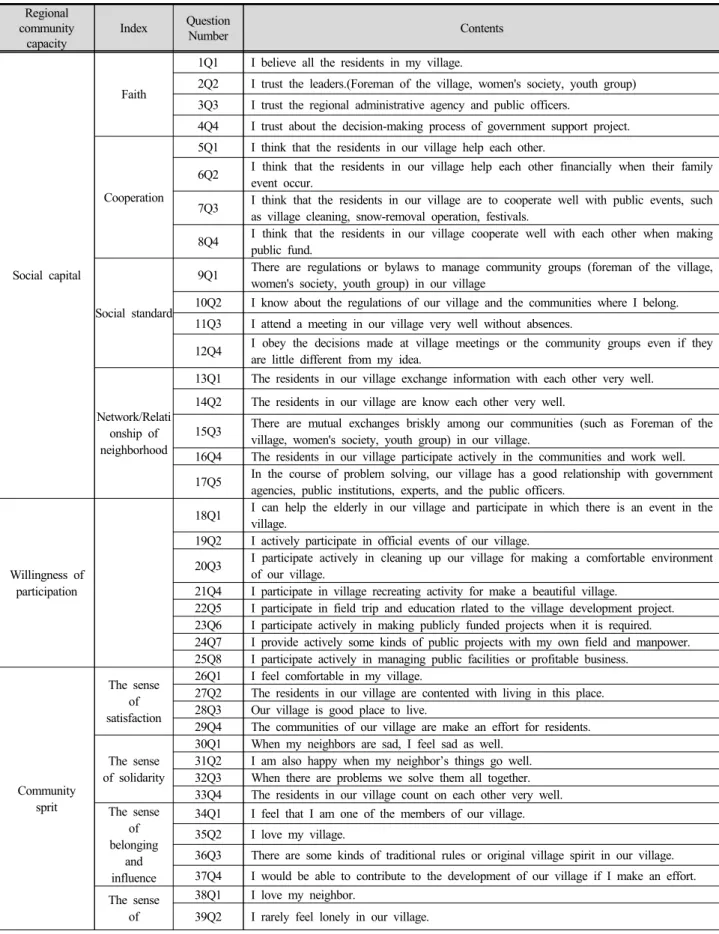
4. 농촌 지역사회역량 측정을 위한 설문 문항 구성 전문가 1차 자문을 거쳐 확정된 변인을 바탕으로 농 촌지역사회역량 측정을 위한 설문 문항을 구성하고, 전 문가 2차 자문의견을 반영하여 질문 문구 수정, 유사문 항 통합, 삭제를 실시하여 설문 문구를 정리하였다. 전문 가들의 의견 중 참여의식의 ‘참여도’와 ‘참여의향’으로 구분하여 측정하는 것은 의미가 낮다는 의견 있었으며, 이를 구분하여 측정한 결과의 실효성, 고령인 농촌주민
들의 설문 편의성 등을 고려하여 두 항목을 단일항목으 로 조정하였다. 그리고 ‘갈등’이 역량이라고 보는 것은 적절하지 않다는 일부 의견도 제시되었다. 그러나 역량 이란 개인 혹은 조직이 가지고 있는 독자적이고, 궁극적 인 능력으로서, 조직내부의 기술 등을 넘는 종합적인 능 력을 의미한다. 따라서 갈등은 농촌지역개발사업 추진과 성패를 좌우하는 요소로, 농촌지역개발사업과 관련하여 생각하면 사업수행에 영향을 미치는 요인으로 볼 수 있 다. 이러한 측면에서 볼 때 갈등은 농촌지역개발사업에 영향을 주는 역량으로 갈등수준이 낮을수록 해당 지역사 회가 농촌지역개발사업 추진을 위한 역량이 높은 것으로 판단할 수 있다.
이와 같이 전문가 자문을 통해 사회자본 17개, 참여의 식 8개, 공동체 의식 16개, 리더십 6개, 갈등 7개로, 총 54개의 설문 문항을 선정하고 이를 적용하기 위한 Pilot Test 설문지를 구성하였다(Table 11).
5. 설문지 타당성 검증을 위한 PILOT TEST
1) 설문대상지 선정 및 설문조사 실시
설문지 항목의 타당성 검증을 위하여 Pilot Test를 실
Regional capacity Index Contents
Social capital
Faith •The faith about residents, The faith about leaders •The faith about regional public officer
•The faith about village and community
Cooperation •Cooperation with family events, Making public fund, Joint festival, Cooperation with community
Social standard
•Recognition of attitude about the village rules and standards •Attend for village and community meeting
•Compliance with what has been decided at a meeting of the village, Emphasis on village more than individual
Network/Relationship of neighborhood
•Relationship with neighbor, Communication, Interrelation •A social gathering in the village, Relationship with community
•Relationship with regional administrative agency and public officers, Outside catholicity
Willingness of participation
Participation •Participation of residents for the various activities carried out in the village - Rural development project, Investment, Mutualism, Donative activity Intent to participation •Intent to participation of rural development project
Communication sprit
The sense of satisfaction •Satisfaction, Problem solving. Interdependence, Regional membership benefits, Satisfaction about living environment, Satisfaction of income, Satisfaction of safety The sense of solidarity •Unitedly problem solving, Misery loves company, Well each other
The sense of belonging •One of the regional society, A unique spirit and rules, Interrelation between me and regional society
The sense of closeness •As a comfortable communication partner, Not lonely, There is a close friend or neighbor of mine
Leadership •Professionalism, Vision, Communication, Empowerment, Activity, Relationship Conflict •Conflict between leader and residents, Conflict between leader, Conflict between
residents, Election director, Conflict between communities
Table 9. Details of regional community capacityVariables This
study Expert judgment Final decision
1 2 3 4 5 6
Important member Faith between members
Well unity Comfortable Faith about leader Faith about society and institute
Faith about a public officer Faith of making decision about
public policy
Total : 8 5 5
<Social capital - faith>
Variables This
study Expert judgment Final decision
1 2 3 4 5 6
Exchange manpower Aid for a family event.
Participation making public fund Extent of participation for village
meeting Participation of public event
Support group
Total : 6 3 5
<Social capital - cooperation>
Variables This
study Expert judgment Final decision 1 2 3 4 5 6 Fairness
Mutual cooperation Recognition of rule Attitude of compliance with the
rules
Frequently attend of village meeting
Total : 5 3 4
<Social capital - social standard>
Variables This
study Expert judgment Final decision 1 2 3 4 5 6 Regular meetings
Official event of village Voluntary activity and help each
other Meeting Village development Project Making public fund and project
Village council Field trip and education
Village management Facility management
Village cleaning Providing manpower
Providing field
Total : 13 10 12
<Willingness of participation and participation>
Variables This
study Expert judgment Final decision
2 3 4 5 6
Faith and transparent Communication and negotiation
Capacity of relationship Ability of conflict adjustment
Influence
Planning ability and professionalism Aims at learning Compliance with principles and
belief Devotion and passion Development of human resource
Teamwork and cooperation Rationalization Understanding the problem of village
Ability of problem solving Vision provider Village community building
Understand of project
Total : 17 12 14
<Leadership>
Variables This
study Expert judgment Final decision
1 2 3 4 5 6
Family event of neighbor Participation of diverse meeting
Emergency contact information Interchange of Information between
members The spread of quick rumor
Well known each other Blood or regionalism Number of communities Activity extent of community
Network of local society Relationship of resident and leader
Total : 11 5 6
<Social capital - network>
Variables This
study Expert judgment Final decision 1 2 3 4 5 6 The power of unity
Sharing of grief Sharing success Community bound together by a
common destiny Problem solving
Total : 5 4 5
<Community sprit - the sense of solidarity>
Variables This
study Expert judgment Final decision
1 2 3 4 5 6
Appetite for residents Problem solving Endeavor of local society
Interdependence Benefit of residence
Self respect pride A good place to live
Total : 7 6 7
<Community sprit - the sense of satisfaction>
Variables This
study Expert judgment Final decision 1 2 3 4 5 6 As a comfortable communication
partner Not lonely
There is a neighbor worried about me.
Like other neighbor.
Total : 4 4 4
<Community sprit - the sense of closeness>
Variables This
study Expert judgment Final decision 1 2 3 4 5 6 One of the regional society
A unique spirit and order Effect of regional development Contribute to regional development
Positive participation Living village Interest of our village
Comfortable Like our own village
: 9 5 7
<Community sprit - the sense of belonging>
Variables This
study Expert judgment Final decision 1 2 3 4 5 6 Election director
Share of profit and expenses Conflict between leader and residents
Conflict between leader s Conflict between residents Distribution of support fund
Project process Decisions Cooperation Public bussiness
Leadership
Total : 11 10 11
<Conflict>
Table 10. Result of expert advice for measurement of the regional community capacity
Regional community
capacity
Index Question
Number Contents
Social capital
Faith
1Q1 I believe all the residents in my village.
2Q2 I trust the leaders.(Foreman of the village, women's society, youth group) 3Q3 I trust the regional administrative agency and public officers.
4Q4 I trust about the decision-making process of government support project.
Cooperation
5Q1 I think that the residents in our village help each other.
6Q2 I think that the residents in our village help each other financially when their family event occur.
7Q3 I think that the residents in our village are to cooperate well with public events, such as village cleaning, snow-removal operation, festivals.
8Q4 I think that the residents in our village cooperate well with each other when making public fund.
Social standard
9Q1 There are regulations or bylaws to manage community groups (foreman of the village, women's society, youth group) in our village
10Q2 I know about the regulations of our village and the communities where I belong.
11Q3 I attend a meeting in our village very well without absences.
12Q4 I obey the decisions made at village meetings or the community groups even if they are little different from my idea.
Network/Relati onship of neighborhood
13Q1 The residents in our village exchange information with each other very well.
14Q2 The residents in our village are know each other very well.
15Q3 There are mutual exchanges briskly among our communities (such as Foreman of the village, women's society, youth group) in our village.
16Q4 The residents in our village participate actively in the communities and work well.
17Q5 In the course of problem solving, our village has a good relationship with government agencies, public institutions, experts, and the public officers.
Willingness of participation
18Q1 I can help the elderly in our village and participate in which there is an event in the village.
19Q2 I actively participate in official events of our village.
20Q3 I participate actively in cleaning up our village for making a comfortable environment of our village.
21Q4 I participate in village recreating activity for make a beautiful village.
22Q5 I participate in field trip and education rlated to the village development project.
23Q6 I participate actively in making publicly funded projects when it is required.
24Q7 I provide actively some kinds of public projects with my own field and manpower.
25Q8 I participate actively in managing public facilities or profitable business.
Community sprit
The sense of satisfaction
26Q1 I feel comfortable in my village.
27Q2 The residents in our village are contented with living in this place.
28Q3 Our village is good place to live.
29Q4 The communities of our village are make an effort for residents.
The sense of solidarity
30Q1 When my neighbors are sad, I feel sad as well.
31Q2 I am also happy when my neighbor’s things go well.
32Q3 When there are problems we solve them all together.
33Q4 The residents in our village count on each other very well.
The sense of belonging
and influence
34Q1 I feel that I am one of the members of our village.
35Q2 I love my village.
36Q3 There are some kinds of traditional rules or original village spirit in our village.
37Q4 I would be able to contribute to the development of our village if I make an effort.
The sense of
38Q1 I love my neighbor.
39Q2 I rarely feel lonely in our village.
Table 11. Determine survey items and survey table
시할 대상 마을은 전남 해남군 송호 ․ 중리 마을과 경남 거제시 해금강 마을로 선정하였다. 이 마을들은 2013년 도 해양수산부에서 어촌특화발전을 위한 어촌마을주민 역량강화교육을 시행하고 있는 마을로 도출된 설문항목 적용에 알맞은 마을로 판단하였다. 전남 해남군 송지면 송호 ․ 중리 마을은 농가 30, 어가 150, 비 농어가 23가 구로 전체 203가구에 523명이 거주하는 마을로써 연령 구조는 65세 이상이 23%로 초고령 사회에 진입한 마을 이며, 경남 거제시 남부면 갈곶리 해금강마을은 농가 40, 어가 34, 비 농어가 2가구로 전체 76가구에 168명이 거 주하는 마을로써 65세 이상이 27.4%인 마을이다.
설문조사는 어촌특화역량강화 교육을 시행하고 있는 담당자와 본 연구자가 해당 마을에 직접 마을을 방문하 여 역량강화 교육이 종료된 직후 참석자를 대상으로 설 문취지와 배경, 설문지 응답 방법을 설명한 후 집단적으 로 실시하였으며, 모든 설문지는 현장에서 회수되었다.
경남 거제 해금강마을은 2013년 11월 5일, 전남 해남 송 호 ․ 중리 마을은 2013년 11월 6일에 실시하였다. 이번 설문조사에 참여한 인원은 설문 당일 교육 참석자 중 설 문지 작성이 곤란한 고령자 등은 제외하고 실시하였는데 거제 해금강마을은 전체 거주인구의 11.9%인 20명, 해남 송호 ․ 중리 마을은 전체 거주인구의 4.8%인 25명이 설 문에 참여하였다.
2) 마을간 통계적 특성
역량강화 교육과 설문에 참여한 마을의 통계적 특성 을 보면 성별로는 해금강마을은 남성 60%, 여성40%로
송호 ․ 중리마을 남성 92%, 여성 8%보다 여성의 참여비 율이 매우 높게 나타나고 있다. 연령별로는 해금강마을 은 60세 이상이 50%로 고령화 된 반면에 송호 ․ 중리마 을 40대가 44%로 60세 이상이 24%로 상대적으로 젊은 인력이 많다. 학력은 해금강마을은 고졸이상이 35%인 반면 송호 ․ 중리마을은 68%로 고학력자가 많다. 거주자 의 외부 전입을 묻는 고향여부는 해금강마을이 송호 ․ 중리마을보다 외부 유입자가 많은 것으로 나타났다.
마을의 주요한 산업특성으로 해금강마을은 상업중심 이었으며, 송호 ․ 중리마을은 어업중심의 특성을 갖고 있 었다. 각 마을별 소속된 공동체는 해금강마을 부녀회와 어촌계 중심으로 송호 ․ 중리마을은 어촌계와 청년회 중 심으로 활동이 우세하다. 연간 소득은 2,000만원 미만이 해금강마을은 25%에 불과한 반면, 송호 ․ 중리마을은 48%로 상대적으로 저 소득자가 많다. 이러한 결과가 나 타난 이유는 해금강마을의 경우 지역에서 생산되는 해산 물 가공품을 관광객을 대상으로 판매하거나 식당 운영을 통해 높은 소득을 올리기 때문인 것으로 판단되며, 송호
․ 중리마을은 전복양식 생산량과 생산액이 많음에도 불 구하고 1차 산업에 의존하는 영세 어업인이 많기 때문인 것으로 판단된다. 대체로 소득이 높은 사람보다 소득이 낮은 어촌주민들이 정부에서 추진하는 새로운 농어업 소 득향상 정책에 관심이 높고 교육에 대한 참여율도 높았 다.
3) 항목별 기술통계 및 신뢰도 분석
본 연구에서는 조사된 자료를 분석하기 위하여 통계
Regional
community capacity
Index Question
Number Contents
emotional closeness
40Q3 I can find out someone else to talk with in our village when I want to have a talk.
41Q4 There are neighbors in our village who concern me.
Leadership
42Q1 Leaders of our village, to the processing of work transparently.
43Q2 Leaders of our village are passionate and devoted to developing our village.
44Q3 Leaders of our village are working on reflecting the opinions of the residents.
45Q4 Leaders of our village lead well to unite our residents.
46Q5 Leaders of our village mediate well when there conflicts occur.
47Q6 The leaders of our village has a good relationship with relevant administrative organs, public institutions, experts, and public officers.
Conflict
48Q1 There is a conflict among residents in our village.
49Q2 There is a conflict between residents and leaders of our village.
50Q3 There is a conflict among leaders in our village.
51Q4 There is a conflict in processing with election directors in our village.
52Q5 There is a conflict related to the village development projects.
53Q6 There is a conflict in the distribution of support funds.
54Q7 There is a conflict in distribution of profit funds and cost sharing.
패키지 프로그램인 SPSS 18.0을 사용하였다. 통계분석은 농촌지역사회역량을 측정하기 위한 변수 54개(사회자본 17개, 참여의식 8개, 공동체 의식 16개, 리더십 6개, 갈 등 7개)에 대한 기술통계 분석과, 응답의 신뢰성을 파악 하기 위한 신뢰도 분석 실시하였다. 신뢰도 분석은 설문 결과의 안정성 혹은 일관성을 파악하는 방법으로 분석결
과가 얼마나 오차 없이 정확하게 측정되는지 판단하기 위한 방법이다. 신뢰도 분석 시 조사결과의 정밀도는 Cronbach 알파 값으로 결정하는데, 이 값이 0.6 이상이면 신뢰도가 있다고 판단할 수 있는데, 본 연구에서는 이 기준을 적용하여 다른 항목의 Cronbach 알파 값과 비동 질적인 설문항목을 삭제하였다.
Index Contents Average S.div If item deleted
Cronbach α
Faith
I believe all the residents in my village. 3.71 0.757 0.912 I trust the leaders.(Foreman of the village, women's society, youth group) 3.82 0.716 0.913 I trust the regional administrative agency and public officers. 3.47 1.014 0.913 I trust about the decision-making process of government support project. 3.58 1.011 0.915
Average of items 3.64 0.757 -
Cooperation
I think that the residents in our village help each other. 3.68 0.883 0.910 I think that the residents in our village help each other financially when their
family event occur. 3.77 0.841 0.913
I think that the residents in our village are to cooperate well with public
events, such as village cleaning, snow-removal operation, festivals. 3.65 0.870 0.916 I think that the residents in our village cooperate well with each other when
making public fund. 3.37 1.024 0.917
Average of items 3.59 0.717 -
Social standard
There are regulations or bylaws to manage community groups (foreman of the
village, women's society, youth group) in our village 3.55 1.017 0.917 I know about the regulations of our village and the communities where I belong. 3.40 0.849 0.915 I attend a meeting in our village very well without absences. 3.71 0.920 0.918 I obey the decisions made at village meetings or the community groups even
if they are little different from my idea. 3.77 0.83 0.914
Average of items 3.61 0.666 -
Network/Relat ionship of neighborhood
The residents in our village exchange information with each other very well. 3.48 0.902 0.914 The residents in our village are know each other very well. 3.79 0.888 0.915 There are mutual exchanges briskly among our communities (such as Foreman
of the village, women's society, youth group) in our village. 3.21 0.833 0.916 The residents in our village participate actively in the communities and work well. 3.24 0.773 0.919
In the course of problem solving, our village has a good relationship with
government agencies, public institutions, experts, and the public officers. 3.48 0.731 0.915
Average of items 3.43 0.640 -
Total average 3.56 0.556
Table 12. Result of the social capital variables analysis
Contents Average S.div If item deleted
Cronbach α I can help the elderly in our village and participate in which there is an event in the
village. 3.70 0.914 0.871
I actively participate in official events of our village. 3.80 0.734 0.865
I participate actively in cleaning up our village for making a comfortable environment of
our village. 3.64 0.802 0.868
I participate in village recreating activity for make a beautiful village. 3.72 0.882 0.860 I participate in field trip and education rlated to the village development project. 3.91 0.868 0.875 I participate actively in making publicly funded projects when it is required. 3.44 0.841 0.876 I provide actively some kinds of public projects with my own field and manpower. 3.11 0.920 0.888*
I participate actively in managing public facilities or profitable business. 3.75 0.719 0.864
Total average 3.63 0.631 -
Table 13. Result of the willingness of participation variables analysis
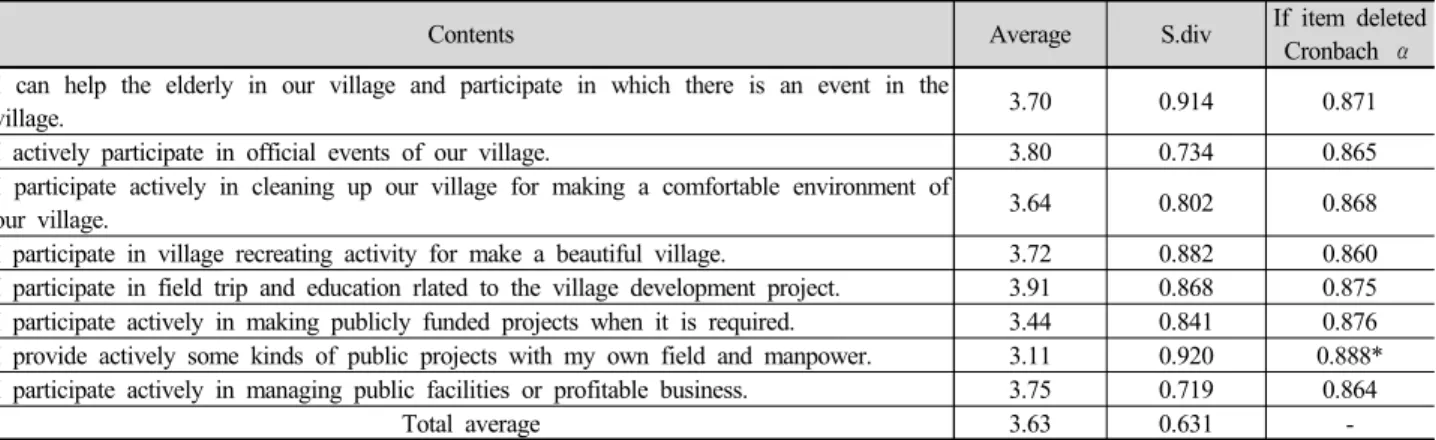
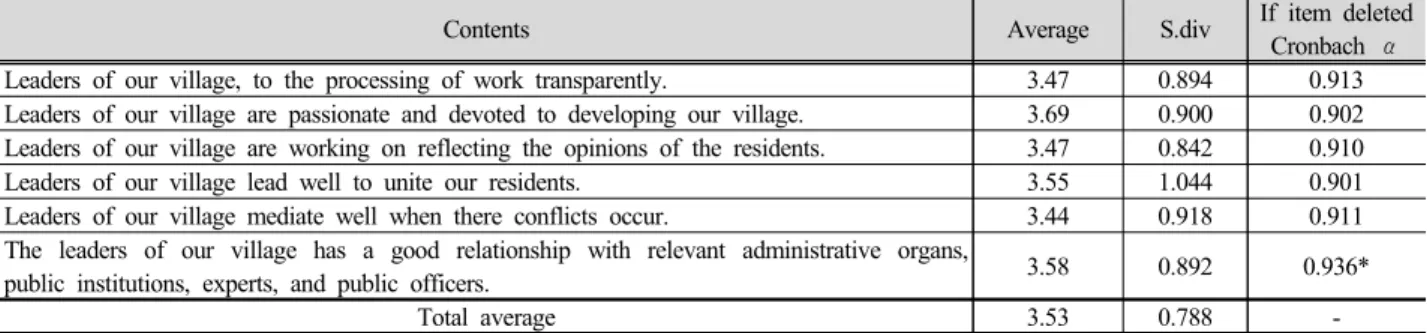
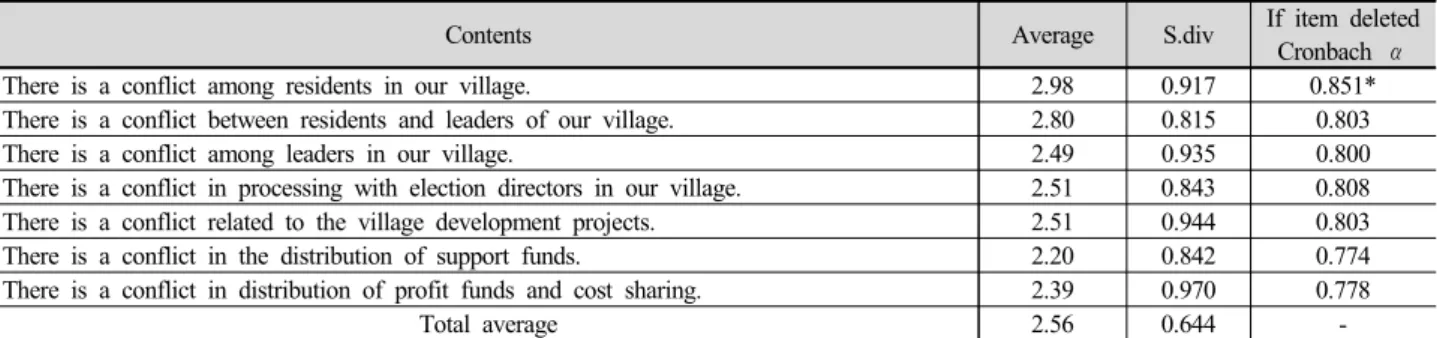
농촌지역사회역량 측정을 위해 5점 리커트 척도로 ‘사 회자본, 참여의식, 공동체 의식, 리더십, 갈등’에 대한 변 수별 기술통계 분석(평균)을 실시하였다. 분석결과 Table 12와 같이 ‘사회자본’은 평균 3.56점, ‘참여의식’은 3.63 점, ‘공동체 의식’은 3.66점, ‘리더십’은 3.53점, ‘갈등’은 2.56점으로 나타났다. ‘갈등’을 제외하고는 ‘공동체 의 식’, ‘참여의식’, ‘사회자본’ 및 ‘리더십’ 순으로 높게 나 타났다.
신뢰도 분석결과 ‘사회자본’은 17개 변수 중 Cronbach 의 알파 값 0.920보다 작은 비동질적인 변수가 없어 제 거된 항목은 없었다. ‘참여의식’은 8개 변수 중 Cronbach
의 알파 값 0.885보다 작은 비동질적인 변수 1개(나는 우리 마을의 공동사업 등에 노동력과 토지를 적극 제공 한다)를 제거하였다. ‘공동체 의식’은 16개 변수 중 Cronbach의 알파 값 0.943보다 작은 비동질적인 변수 2 개(우리 마을에만 있는 고유한 정신이나 질서가 있다.
나는 내가 대화하고 싶을 때 이야기할 수 있는 사람을 우리 마을에서 찾을 수 있다)를 제거하였다. ‘리더십’은 6개 변수 중 Cronbach의 알파 값 0.926보다 작은 비동질 적인 변수 1개(우리 마을 지도자들은 행정기관, 공공기 관, 전문가, 관내 공무원 등과 관계가 좋다)를 제거하였 다. ‘갈등’은 7개 변수 중 Cronbach의 알파 값 0.827보다
Index Contents Average S.div If item deleted
Cronbach α
The sense of satisfaction
I feel comfortable in my village. 3.51 0.757 0.940
The residents in our village are contented with living in this place. 3.73 0.915 0.937
Our village is good place to live. 4.07 0.818 0.937
The communities of our village are make an effort for residents. 3.64 0.838 0.943 When my neighbors are sad, I feel sad as well. 3.73 0.646
The sense of solidarity
I am also happy when my neighbor’s things go well. 3.84 0.767 0.938 When there are problems we solve them all together. 3.84 0.713 0.938 The residents in our village count on each other very well. 3.60 0.915 0.939 I feel that I am one of the members of our village. 3.20 0.869 0.938
I love my village. 3.61 0.700
The sense of belonging and
influence
There are some kinds of traditional rules or original village spirit in our
village. 3.66 0.834 0.939
I would be able to contribute to the development of our village if I make
an effort. 4.00 0.826 0.937
I love my neighbor. 3.22 0.902 0.945*
I rarely feel lonely in our village. 3.75 0.751 0.939
I can find out someone else to talk with in our village when I want to
have a talk. 3.66 0.639
The sense of emotional closeness
There are neighbors in our village who concern me. 3.77 0.803 0.938
I do not feel quite lonely in our village. 3.40 0.863 0.942
I can be found in our village, the people that i can talk to when I want to
talk. 3.64 0.908 0.944*
In our village, there are people in the neighborhood who worried me. 3.76 0.712 0.938
Average of items 3.64 0.647
Total average 3.66 0.589 -
Table 14. Result of the community spirit variables analysis
Contents Average S.div If item deleted
Cronbach α Leaders of our village, to the processing of work transparently. 3.47 0.894 0.913 Leaders of our village are passionate and devoted to developing our village. 3.69 0.900 0.902 Leaders of our village are working on reflecting the opinions of the residents. 3.47 0.842 0.910
Leaders of our village lead well to unite our residents. 3.55 1.044 0.901
Leaders of our village mediate well when there conflicts occur. 3.44 0.918 0.911 The leaders of our village has a good relationship with relevant administrative organs,
public institutions, experts, and public officers. 3.58 0.892 0.936*
Total average 3.53 0.788 -
Table 15. Result of the leadership variables analysis
작은 비동질적인 변수 1개(우리 마을은 주민과 주민 간 갈등이 있다)를 제거하였다.
Pilot test를 실시한 2개 마을의 농촌지역사회역량을 Table 17과 같이 비교해 본 결과 ‘사회자본, 참여의식, 공동체 의식, 리더십’의 4개 지표의 역량은 해금강마을 3.64점, 송호 ․ 중리마을 3.55점으로 해금강마을이 다소 높게 평가되었다. 4개의 역량지표에서 해금강마을 3개 지표, 송호 ․ 중리마을은 1개 지표가 우세하였다. 마을 내 ‘갈등’ 지표는 해금강 마을이 2.6점으로 송호 ․ 중리 마을 2.51점 보다 다소 높게 나타났는데 농촌지역사회역 량이 높은 해금강 마을이 오히려 갈등이 높게 존재하였 다.
한편, ‘리더십’과 ‘갈등’은 마을리더와 주민의 평가가 다소 다를 수 있다는 판단에 따라 세부적으로 Table 18 과 같이 비교 분석하였다. ‘리더십’의 경우, 해금강마을 은 마을전체는 3.68점, 마을리더의 평가는 4.11점, 주민 평가는 3.59점으로 마을 리더들은 ‘리더십’을 매우 높게 평가하고 있는 반면 주민들이 바라보는 시각과는 차이가
크게 나타나고 있다. 반면 송호 ․ 중리마을의 경우 마을 전체는 3.41점, 마을리더 평가는 3.33점, 주민평가는 3.44 점으로 오히려 마을주민들보다 마을 리더들이 ‘리더십’
역량을 작게 평가하고 있는 것으로 나타났다. 이는 두 마을 간의 리더십의 유형이 다름으로 인하여 나타나는 현상으로 판단된다. ‘갈등’의 경우 해금강과 송호 ․ 중리 마을 모두 리더들은 갈등이 낮게 존재한다고 평가한 반 면, 주민들이 체감하는 갈등의 수준은 상당히 높게 평가 되었다.
6. 설문지 보정결과
Pilot test의 신뢰도 분석결과 각 농촌지역사회역량의 Cronbach의 알파 값이 0.827∼0.943으로 설문지가 갖는 신뢰성은 매우 높은 것으로 분석되었다. 설문문항별 Cronbach의 알파 값을 기준으로 총 54개 변수 중 신뢰도 에 영향을 미치는 비동질적인 변수는 ‘참여의식’ 1개,
‘공동체 의식’ 2개, ‘리더십’ 1개, ‘갈등’ 1개 등 총 5개의 변수 정도로 나타나 농촌지역사회역량을 측정하는 설문
Contents Average S.div If item deleted
Cronbach α
There is a conflict among residents in our village. 2.98 0.917 0.851*
There is a conflict between residents and leaders of our village. 2.80 0.815 0.803
There is a conflict among leaders in our village. 2.49 0.935 0.800
There is a conflict in processing with election directors in our village. 2.51 0.843 0.808 There is a conflict related to the village development projects. 2.51 0.944 0.803
There is a conflict in the distribution of support funds. 2.20 0.842 0.774
There is a conflict in distribution of profit funds and cost sharing. 2.39 0.970 0.778
Total average 2.56 0.644 -
Table 16. Result of the conflict variables analysis
Contents Heagumgang Songho-Jungri
Regional community capacity
Social capital 3.64 3.55
Willingness of participation 3.54 3.71
Community sprit 3.70 3.62
Leadership 3.68 3.41
Total/Average 14.56/3.64 14.29/3.57
Conflict 2.60 2.51
Table 17. Comparison between Pilot test villages
Contents Heagumgang Songho-Jungri
Leadership
The whole village 3.68 3.41
The leaders answer 4.11 3.33
The peoples answer 3.59 3.44
Conflict
The whole village 2.60 2.51
The leaders answer 2.14 2.29
The peoples answer 2.68 2.59
Table 18. Comparison between leadership and conflict variable