RESEARCH ARTICLE
The risk of stroke/systemic embolism and major bleeding in Asian patients with non- valvular atrial fibrillation treated with non- vitamin K oral anticoagulants compared to warfarin: Results from a real-world data analysis
Oh Young Bang
1, Young Keun On
2, Myung-Yong Lee
3, Sung-Won Jang
4,
Seongwook Han
5, Sola Han
6, Mi-Mi Won
7, Yoo-Jung Park
7, Ji-Min Lee
7, Hee-Youn Choi
7, Seongsik Kang
7, Hae Sun Suh
ID6*, Young-Hoon Kim
8*
1 Department of Neurology, Samsung Medical Center, Sungkyunkwan University School of Medicine, Seoul,
South Korea, 2 Department of Cardiology, Samsung Medical Center, Sungkyunkwan University School of Medicine, Seoul, South Korea, 3 Division of Cardiology, Department of Internal Medicine, Dankook University, Chung Nam, South Korea, 4 Division of Cardiology, Department of Internal Medicine, Catholic University of Korea, Seoul, South Korea, 5 Division of Cardiology, Department of Internal Medicine, Dongsan Hospital, Keimyung University School of Medicine, Daegu, South Korea, 6 Pharmaceutical Economics, Outcomes Research & Policy, College of Pharmacy, Pusan National University, Busan, South Korea, 7 Pfizer Korea Ltd., Seoul, South Korea, 8 Division of Cardiology, Department of Internal Medicine, Korea University, Seoul, South Korea
* [email protected] (HSS); [email protected] (YHK)
Abstract
Background
Although randomized trials provide a high level of evidence regarding the efficacy of non- vitamin K oral anticoagulants (NOACs), the results of such trials may differ from those observed in day-to-day clinical practice.
Aims
To compare the risk of stroke/systemic embolism (S/SE) and major bleeding (MB) between NOAC and warfarin in clinical practice.
Methods
Patients with non-valvular atrial fibrillation (NVAF) who started warfarin/NOACs between January 2015 and November 2016 were retrospectively identified from Korea’s nationwide health insurance claims database. Using inpatient diagnosis and imaging records, the Cox models with inverse probability of treatment weighting using propensity scores were used to estimate hazard ratios (HRs) for NOACs relative to warfarin.
a1111111111 a1111111111 a1111111111 a1111111111 a1111111111
OPEN ACCESS
Citation: Bang OY, On YK, Lee M-Y, Jang S-W, Han S, Han S, et al. (2020) The risk of stroke/
systemic embolism and major bleeding in Asian patients with non-valvular atrial fibrillation treated with non-vitamin K oral anticoagulants compared to warfarin: Results from a real-world data analysis. PLoS ONE 15(11): e0242922. https://doi.
org/10.1371/journal.pone.0242922 Editor: Tomohiko Ai, Ohio State University, UNITED STATES
Received: July 10, 2020 Accepted: November 11, 2020 Published: November 30, 2020
Copyright: © 2020 Bang et al. This is an open access article distributed under the terms of the Creative Commons Attribution License, which permits unrestricted use, distribution, and reproduction in any medium, provided the original author and source are credited.
Data Availability Statement: The study data were extracted and analyzed from Korea Health Insurance Review & Assessment Service (HIRA) claims database. Researchers who are interested in using HIRA claims database should request the data through a formal application process (https://
opendata.hira.or.kr/or/orb/useGdInfo.do; contact
number: +82-33-739-1087), because HIRA strictly
prohibits researchers from providing or sharing the
raw data to unauthorized persons.
Results
Of the 48,389 patients, 10,548, 11,414, 17,779 and 8,648 were administered apixaban, dabigatran, rivaroxaban and warfarin, respectively. Many patients had suffered prior strokes (36.7%, 37.7%, 31.4%, and 32.2% in apixaban, dabigatran, rivaroxaban, and warfarin group, respectively), exhibited high CHA
2DS
2-VASc (4.8, 4.6, 4.6, and 4.1 in apixaban, dabigatran, rivaroxaban, and warfarin group, respectively) and HAS-BLED (3.7, 3.6, 3.6, and 3.3 in apixaban, dabigatran, rivaroxaban, and warfarin group, respectively) scores, had received antiplatelet therapy (75.4%, 75.7%, 76.8%, and 70.1% in apixaban, dabigatran, riv- aroxaban, and warfarin group, respectively), or were administered reduced doses of NOACs (49.8%, 52.9%, and 42.8% in apixaban, dabigatran, and rivaroxaban group, respec- tively). Apixaban, dabigatran and rivaroxaban showed a significantly lower S/SE risk [HR, 95% confidence intervals (CI): 0.62, 0.54–0.71; 0.60, 0.53–0.69; and 0.71, 0.56–0.88, respectively] than warfarin. Apixaban and dabigatran (HR, 95% CI: 0.58, 0.51–0.66 and 0.75, 0.60–0.95, respectively), but not rivaroxaban (HR, 95% CI: 0.84, 0.69–1.04), showed a significantly lower MB risk than warfarin.
Conclusions
Among Asian patients who were associated with higher bleeding risk, low adherence, and receiving reduced NOAC dose than that provided in randomised controlled trials, all NOACs were associated with a significantly lower S/SE risk and apixaban and dabigatran with a sig- nificantly lower MB risk than warfarin.
Introduction
Large randomized controlled trials (RCTs) of patients with non-valvular atrial fibrillation (NVAF) have established that non-vitamin K oral anticoagulants (NOACs) are as effective as warfarin for preventing stroke/systemic embolism (S/SE) and safer than warfarin with regard to major bleeding (MB) and intracranial hemorrhage (ICH) [1–4], making NOACs the recom- mended first-line drugs for treating stroke prophylaxis in patients with NVAF, and their use has grown dramatically worldwide [5–7].
Although RCTs have provided a high level of evidence regarding the efficacy of NOACs, the results of such trials may differ from those observed in day-to-day clinical practice. This can arise when the patients enrolled in RCTs do not represent those encountered in clinical practice. For instance, the trials included only a relatively small number of Asian patients, which may be of relevance because warfarin-associated ICH is more prevalent in Asian popu- lations and anticoagulation control quality can be worse than that for Caucasian populations [8, 9]. In reality, an RCT in Japan demonstrated that rivaroxaban at a reduced dose of 10–15 mg/day was effective and safe, which is now the common dose administered in countries such as Japan and Taiwan [10, 11].
There is limited evidence based on data from clinical practice on the effectiveness and safety of NOACs compared to warfarin; moreover, assessment of the optimal anticoagulant therapy for patients with atrial fibrillation (AF) based on actual clinical practice data that is country- specific is definitely needed. We hypothesized that NOACs are more effective and safer than warfarin for patients with AF in clinical settings where the quality of care may not be as good as that in RCTs. Thus, this study compared the thromboembolic events and MB/ICH in
Funding: This research was sponsored by Pfizer Pharmaceuticals Korea Ltd. and Bristol-Myers Squibb (collectively “Funders”). The funder provided support in the form of consultancy for authors O-Y. Bang, Y-K. On, M-Y. Lee, S-W. Jang, S. Han, S. Han, H-S. Suh, and Y-H. Kim. Authors Y- J. Park, J-M. Lee, and S. Kang are full-time employees and stockholders of Pfizer Inc. M-M.
Won and H-Y. Choi are previously employees of Pfizer Inc. in connection with the development of this manuscript. The funders were involved in study design, data collection and analysis, decision to publish, or preparation and review of the manuscript. Authors Y-J. Park and H-Y. Choi wrote the original draft of the paper; M-M. Won, Y-J.
Park, J-M. Lee, H-Y. Choi and S. Kang did review and editing drafted manuscript; H-Y. Choi and S.
Kang provided supervision of project management;
M-M. Won, Y-J. Park, J-M. Lee, H-Y. Choi and S.
Kang were involved in project administration. All authors have read and agreed to the published version of the manuscript.
Competing interests: Authors Y-J. Park, J-M. Lee, and S. Kang are full-time employees and stockholders of Pfizer Inc. M-M. Won and H-Y.
Choi are previously employees of Pfizer Inc. in
connection with the development of this
manuscript. Authors O-Y. Bang, Y-K. On, M-Y. Lee,
S-W. Jang, S. Han, S. Han, H-S. Suh, and Y-H. Kim
are paid consultants for Pfizer Korea Ltd. This does
not alter our adherence to PLOS ONE policies on
sharing data and materials.
Korean patients with NVAF treated with NOACs (dabigatran/rivaroxaban/apixaban) and those treated with warfarin, based on Korea’s nationwide insurance claims database.
Materials and methods Data source
The study data were obtained from the Korean Health Insurance Review and Assessment Ser- vice (HIRA) database for the period of January 2007 to November 2016. South Korea has a uni- versal health insurance system; thus, this database covers the entire population [12]. The data included the baseline demographics and medical and pharmacy claims of the patients, which were anonymously provided [12]. Diagnoses in the database were coded according to the Korean Standard Classification of Diseases, which is based on the International Classification of Diseases 10
thRevision (ICD-10) codes [12]. The Pusan National University Institutional Review Board determined that this study was exempted from ethical review (PNU IRB/2016_137_HR).
Study population
The study included oral anticoagulant (OAC)-naïve patients who received at least one pre- scription for apixaban/dabigatran/rivaroxaban/warfarin during the intake period (1 July 2015 to 30 November 2016). The date of the first prescription of OAC was designated as the index date. The inclusion criteria were as follows: age �18 years on the index date and at least two outpatient visits or hospitalization at least once with a diagnosis of AF (ICD-10 code I48) before or on the index date. These criteria had performed well in a previous validation study with a positive predictive value (94.1%) [13]. The exclusion criteria were as follows: hip/knee replacement surgery within 6 weeks prior to the index date, valvular AF/a prosthetic heart valve/venous thromboembolism/thyrotoxicosis/hypertrophic cardiomyopathy/elective defi- brillation/radiofrequency ablation/left atrial appendage occlusion/end-stage chronic kidney disease/kidney transplant/dialysis/pericarditis during the 12-month baseline period, or pre- scriptions for more than one OAC on the index date.
Patient data were followed from the index date to the date of the first occurrence of one of the following: switching from the index treatment to another OAC, discontinuation, death or 30 November 2016. Discontinuation was defined as no prescription for any OAC treatment within 30 days after the last day of supply of the final fulfilled prescription. Switching was defined as a prescription for non-index OAC treatment within 30 days after the last day of sup- ply of the last filled prescription or during the index OAC treatment use after the index date.
Study endpoints
The effectiveness outcome was S/SE, including ischemic and haemorrhagic stroke and SE. The safety outcome was MB, including ICH, gastrointestinal (GI) and other bleeding.
Stroke and ICH events were identified from the diagnosis codes using hospitalization and brain computed tomography/magnetic resonance imaging (CT/MRI) records [14, 15]. SE events were identified from diagnosis codes with hospitalization and any CT/MRI records. GI and other bleeding events were identified from the related diagnosis codes using hospitaliza- tion records. In defining each outcome, we used the primary and all secondary diagnosis codes. Further details are provided in S1 Table in S1 File.
Statistical analysis
To balance baseline demographics and clinical characteristics, we applied the inverse probability
of treatment weighting (IPTW) method using the propensity score. Because the weights may be
unstable for patients who received treatment contrary to prediction, we used stabilized weights [16]. Propensity scores were estimated using logistic regression that included age, sex, insurance type, baseline medication use, baseline comorbidities (heart failure, hypertension, diabetes, ische- mic stroke, vascular disease, abnormal renal function, abnormal liver function, bleeding, alcohol- ism, and chronic pulmonary disease), Charlson comorbidity index (CCI), CHA
2DS
2-VASc score, HAS-BLED score and individual risk factors of the CHA
2DS
2-VASc and HAS-BLED scores. We evaluated the balance between the treatment groups using standardized differences in the weighted sample [17]. A standardized difference of <10% was considered acceptable [17].
To address confounding in observational studies, Propensity Score (PS) based methods such as matching, stratification, and IPTW are widely used. For this study, we used IPTW for the fol- lowing reasons. First, IPTW performed better to balance baseline characteristics between treat- ment and control group compared to matching or stratification when the number of patients in comparison groups largely differ [18]. In this study, the number of patients with warfarin were less than that of NOAC. IPTW also performed better to remove a greater degree of systematic dif- ferences between two groups compared to other PS methods [19, 20]. Second, we used the entire population in IPTW thus we did not lose any data, which was the advantage of using IPTW [18].
Usually, some patients could have been excluded under PS matching method because they were not matched. Third, we did not have a concern with extreme weight problem, which is a statisti- cal term referring to cases when there are patients who received treatment contrary to prediction.
IPTW results are generally thought to be unstable under extreme weight problem. Since the results did not change when we trimmed 1% and 0.5% of both sides of distribution of weight, we concluded that an extreme weight problem would not be an issue in this study.
Cox proportional hazards models were used to compare the outcomes between the treatment groups, calculating the hazard ratios (HRs) with 95% confidence intervals (CIs). The proportional hazard assumption was assessed using log–log plots, Schoenfeld’s residuals and time-dependent covariates [21]; however, if this assumption was not met, an extended Cox model that included the product term of the variable with a log of time was used to estimate the HR at 1 year [21].
Each patient’s medication adherence was assessed by calculating the medication possession ratio from the total days of index treatment prescribed medication during 1 year of follow-up [22].
Subgroup analyses were performed based on patient baseline characteristics, including the CHA
2DS
2-VASc score, HAS-BLED score, age and sex. Diagnosis and medication codes used for the analysis are provided in S2–S6 Tables in S1 File. We used SAS 9.4 (SAS Institute Inc., Cary, NC, USA) for all analyses.
Sensitivity analysis
For the first sensitivity analysis, we assessed the crude event rates by restricting the ischemic stroke events to those that met all of the following criteria: inpatient claims with ischemic stroke (ICD-10 code I63/I693/G459) as the primary diagnosis, claims at the Department of Neurology and Neurosurgery and claims with brain CT/MRI records. For the second sensitivity analysis, we assessed the crude event rates by restricting the ischemic stroke and haemorrhagic stroke events to those that met all of the following criteria: inpatient claims with ischemic stroke (ICD-10 code I63/G459) or hemorrhagic stroke (ICD-10 code I61/I62) as the primary diagnosis, claims at the Department of Neurology and Neurosurgery and claims with brain CT/MRI records.
Results
Baseline characteristics
Of the 48,389 OAC-naïve patients identified from the HIRA database, 10,548, 11,414, 17,779
and 8,648 were prescribed apixaban, dabigatran, rivaroxaban (regardless of doses) and
warfarin, respectively (Fig 1). Before the weighting application, patients who started warfarin were younger with lower CHA
2DS
2-VASc, HAS-BLED, and CCI scores than those who started apixaban/dabigatran/rivaroxaban. After applying weighting using the IPTW method, differ- ences in baseline characteristics were balanced (all P > 0.05; absolute standardized
difference < 0.1; Table 1).
Effectiveness outcomes. The crude cumulative incidence curve for S/SE for the patients prescribed warfarin was higher than the corresponding curves for those prescribed NOACs (Fig 2). The weighted event rate for S/SE was 7.2–7.7/100 person-years for the three NOACs and 12.9–13.5/100 person-years for warfarin (Table 2). Apixaban, dabigatran and rivaroxaban were associated with a significantly lower S/SE risk than warfarin, with the following HRs (95% CIs): apixaban, 0.62 (0.54–0.71); dabigatran, 0.60 (0.53–0.69); and rivaroxaban, 0.71 (0.56–0.88) (Fig 3).
Safety outcomes. The crude cumulative incidence curves for MB and ICH for the patients prescribed warfarin were higher than the corresponding curves for those who were prescribed NOACs (Fig 2). The weighted event rate for MB was 8.0–9.6/100 person-years for the three NOACs and 13.8–14.7/100 person-years for warfarin (Table 2). The crude event rates of GI bleeding were 3.55, 3.68, 4.33, and 5.57/100 person-years in apixaban, dabigatran, rivaroxaban,
Fig 1. Cohort creation flowchart. AF, atrial fibrillation; HCMP, hypertrophic cardiomyopathy; ICD-10,
International Classification of Diseases 10thRevision; NOAC, non-vitamin K antagonist oral anticoagulant; OAC, oral anticoagulant;VTE, venous thromboembolism.
�Patients were required to have made at least one inpatient claim/two outpatient
claims with a diagnosis of ICD-10 code I48 (atrial fibrillation and flutter) within 8.5 years prior to or on the index date.
��
No OACs (apixaban/dabigatran/rivaroxaban/warfarin) should have been prescribed 1 year prior to the index date.
https://doi.org/10.1371/journal.pone.0242922.g001
Table 1. Baseline character istics of patients who were prescribed warfarin and NOACs. Inverse probabilit y of treatment weighting Before After
1,2)Apixaban (n = 10,548) Warfarin (n = 8,648) Dabigatran (n = 11,414 ) Warfarin (n = 8,648) Rivaroxaba n (n = 17,779) Warfarin (n = 8,648) Apixaban Warfarin Dabigatran Warfar in Rivaroxaban Warfar in Age (years), mean 73.89 68.73 72.23 68.73 73.27 68.73 71.64 71.64 70.68 70.78 71.83 71.85 Female, % 48.81 37.44 43.16 37.44 45.95 37.44 43.93 44.11 41.01 40.84 43.15 43.47 Insurance, % National health insurance 93.32 92.45 92.10 92.45 92.33 92.45 92.63 92.85 92.22 92.28 92.38 92.45 Medical aid 6.68 7.55 7.90 7.55 7.67 7.55 7.37 7.15 7.78 7.72 7.62 7.55 CHADS
2, mean 3.15 2.75 3.05 2.75 3.00 2.75 3.02 3.01 2.95 2.96 2.94 2.98 CHA
2DS
2-VASc, mean 4.78 4.06 4.58 4.06 4.60 4.06 4.52 4.51 4.40 4.41 4.45 4.49 HAS-BL ED, mean 3.65 3.34 3.58 3.34 3.58 3.34 3.54 3.53 3.50 3.50 3.52 3.53 CCI, mean 4.33 4.04 4.05 4.04 4.11 4.04 4.25 4.25 4.10 4.09 4.11 4.16 Medical history, % Heart failure 43.82 41.00 40.96 41.00 43.90 41.00 43.19 42.94 41.18 41.11 43.07 43.36 Hyperte nsion 88.49 80.80 89.18 80.80 89.81 80.80 85.72 85.34 85.74 85.81 87.10 87.12 Diabetes 56.74 51.57 54.89 51.57 54.61 51.57 55.27 55.21 53.92 54.19 53.99 54.82 Ischemic stroke 36.73 32.15 37.69 32.15 31.37 32.15 36.09 35.91 36.59 36.73 32.38 33.38 Vascular disease 29.69 29.24 29.16 29.24 30.06 29.24 29.47 29.70 29.46 29.29 29.95 30.28 Renal disease (CKD3/4) 2.17 2.45 0.91 2.45 1.45 2.45 2.31 2.30 1.83 1.58 1.83 1.83 Bleeding 12.80 13.54 8.73 13.54 10.25 13.54 13.15 13.23 11.16 10.90 11.52 11.59 Cancer 11.24 7.96 9.46 7.96 10.42 7.96 11.04 8.15 9.80 7.55 10.48 7.80 Medication history, % NSAIDs 80.93 76.38 81.21 76.38 82.20 76.38 78.92 78.80 78.84 79.01 80.17 80.18 Antiplate lets 75.44 70.06 75.67 70.06 76.80 70.06 73.21 73.34 73.64 73.72 74.58 74.53 Antiarrh ythmics 52.25 48.60 47.30 48.60 42.62 48.60 50.54 50.58 48.09 47.82 44.48 44.52 Statins 59.74 51.41 61.47 51.41 55.75 51.41 56.94 56.77 57.50 57.79 54.80 55.45 PPI 45.05 42.77 42.89 42.77 42.50 42.77 44.32 44.40 42.79 42.88 42.71 42.86 H2RA 68.89 66.27 68.71 66.27 67.45 66.27 68.04 67.83 68.04 67.83 67.17 67.41 Digoxin 23.79 27.56 25.03 27.56 26.01 27.56 25.80 25.68 26.13 26.24 26.56 26.78 CCI, Charlson Comor bidity Index; CHADS
2, score based on congestive heart failure, hyperte nsion, age � 75 years, diabetes mellitus , prior stroke or transient ischemic attack; CHA
2DS
2-VASc, score based on conges tive heart failure, hypertension, age � 75 years, diabetes mellitus, stroke, vascular disease, age 65–74 years and sex; CKD, chronic kidney disease; HAS-BLED , score based on hyperten sion, abnormal renal and liver function, stroke, bleeding, labile internat ional normalized ratio, elderly, drugs or alcohol; H2RA, H
2-receptor antagon ists; PPI, proton pump inhibitors. 1)
Pvalues were not significan t for all the comparison s (apixaban vs. warfarin; dabigatr an vs. warfarin and rivaroxaban vs. warfarin) for variables used to derive propensity score. 2) Absolute standard ized differences were
<10% for all the comparison s (apixaban vs. warfarin; dabigatr an vs. warfarin and rivaroxaban vs. warfarin) for variables used to derive propensity score. https://d oi.org/10.1371/j ournal.pon e.0242922.t00 1
and warfarin group, respectively. The weighted event rates of GI bleeding for all NOACs were lower versus warfarin: 3.44 and 6.20/100 person-years in apixaban and warfarin group, respec- tively; 4.17 and 5.56/100 person-years in dabigatran and warfarin group, respectively; 4.32 and 5.78/100 person-years in rivaroxaban and warfarin group, respectively (Table 2).
Compared to warfarin, apixaban and dabigatran were associated with significantly lower MB and ICH risks, whereas rivaroxaban was associated with a significantly lower ICH risk, but not MB risk. The HRs (95% CIs) were as follows: for MB, apixaban, 0.58 (0.51–0.66); dabiga- tran, 0.75 (0.60–0.95); and rivaroxaban, 0.84 (0.69–1.04) and for ICH, apixaban, 0.37 (0.21–
0.66); dabigatran, 0.54 (0.39–0.74); and rivaroxaban, 0.66 (0.51–0.87) (Fig 3). Compared to warfarin, the HRs (95% CIs) for GI bleeding were apixaban, 0.60 (0.49–0.73); dabigatran, 0.83 (0.69–1.00); and rivaroxaban, 0.82 (0.69–0.97) (Fig 3).
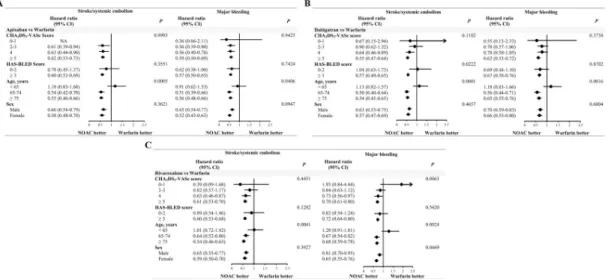
Subgroup analyses. In the subgroup analyses for the comparisons of the three NOACs with warfarin, no interactions with the treatment effect were observed for the subgroups of CHA
2DS
2-VASc score, HAS-BLED score and sex, except for that of age (Fig 4).
Fig 2. Crude cumulative incidence curves. (A) stroke/systemic embolism, (B) major bleeding, (C) intracranial hemorrhage and (D) gastrointestinal bleeding.
https://doi.org/10.1371/journal.pone.0242922.g002
Sensitivity analyses. The crude event rates in the two sensitivity analyses, in which the stroke events were restricted to those that met stricter definitions, were lower overall than those of the main analysis (Table 3).
Discussion
We found that patients in real-world clinical practice showed different characteristics and received a different quality of care than those enrolled in RCTs. In addition, all three NOACs
Table 2. Number of events and crude and adjusted event rates of non-vitamin K antagonist oral anticoagulants or warfarin users.
Inverse probability of treatment weighting
Before After
Apixaban (n = 10,548)
Dabigatran (n = 11,414)
Rivaroxaban (n = 17,779)
Warfarin (n = 8,648)
Apixaban Warfarin Dabigatran Warfarin Rivaroxaban Warfarin
Events Crude
IR
1)Events Crude
IR
1)Events Crude
IR
1)Events Crude
IR
1)Adjusted IR
1)2)S/
SE
419 8.00 451 7.14 700 7.07 413 11.86 7.66 13.52 7.20 13.53 7.18 12.89
MB 432 8.26 491 7.81 927 9.44 466 13.53 7.97 14.73 8.57 13.77 9.55 14.23
ICH 76 1.43 68 1.06 140 1.40 73 2.06 1.37 2.38 1.17 2.31 1.47 2.37
GIb 188 3.55 234 3.68 432 4.33 196 5.57 3.44 6.2 4.17 5.56 4.32 5.78
GIb, GI bleeding; ICH, intracranial haemorrhage; IR, incidence rate; MB, major bleeding; S/SE, stroke/systemic embolism.
1) Incidence rates were calculated as the number of patients experiencing the event divided by 100 person-years.
2) Obtained using inverse probability of treatment weighting.
https://doi.org/10.1371/journal.pone.0242922.t002
Fig 3. Hazard ratios for stroke/systemic embolism, major bleeding, intracranial haemorrhage and gastrointestinal bleeding for non-vitamin K antagonist oral anticoagulants relative to warfarin. NOACs, non-vitamin K antagonist oral anticoagulants. 1) Obtained using inverse probability of treatment weighting. The patient
group treated with warfarin served as the reference.
�Reported hazard ratio at 1 year since the proportional hazard assumption was violated.
https://doi.org/10.1371/journal.pone.0242922.g003
were significantly associated with a reduced S/SE risk than with warfarin, and apixaban and dabigatran were associated with a significantly reduced MB risk than with warfarin in these patients.
Evidence from clinical practice and RCTs is considered to be mutually complementary.
Therefore, results from actual clinical practice may help in translating RCT results into proto- cols and guidelines for health professionals to apply in their own clinical practice. Many patients with NVAF are prescribed multiple medications, and antiplatelet agents are widely used in clinical practice. The concomitant use of antiplatelet agents with oral anticoagulants can increase ICH and MB risks. In one RCT, 34% of the warfarin and NOAC groups used aspi- rin at baseline [23]. In this study, approximately three-quarters of the patients received both antiplatelet therapy and oral anticoagulants.
Observational studies in Asian countries have reported that a large proportion of patients with AF is being sub-optimally treated with NOACs [11]. In this study, approximately half of the patients were initiated a reduced dose of NOACs. The inappropriate use of reduced NOAC doses may reduce bleeding event risk; however [24], there are controversial results from Asian countries about the stroke event risk with the use of reduced NOAC doses than standard doses [25–27]. A few retrospective, nationwide cohort studies from the USA and Europe have shown worse effectiveness outcomes with reduced NOAC doses than with warfa- rin [28, 29]. Moreover, the results of this study should be interpreted with caution because whether dose selection matches indicated dose reduction criteria was unclear from the data source.
The effectiveness and safety may be influenced by the patient’s thromboembolic risk and prior stroke. In this study, the mean CHADS
2scores were similar to those of four pivotal RCTs of NOACs [1–4]. Approximately one-third of the patients in this study had suffered a stroke, whereas a prior stroke/transient ischemic attack was reported for about one-fifth of the patients in the RE-LY, ARISTOTLE and ENGAGE AF-TIMI 48 trials and in half of the patients in the ROCKET-AF trial [1–4].
Fig 4. Subgroup analyses for the comparisons of stroke/systemic embolism and major bleeding between the three non- vitamin K antagonist oral anticoagulants and warfarin. (A) apixaban vs warfarin, (B) dabigatran vs warfarin, (C) rivaroxaban vs warfarin. CHA
2DS
2-VASc, score based on congestive heart failure, hypertension, age �75 years, diabetes mellitus, stroke, vascular disease, age 65–74 years and sex; CI, confidence interval; CKD, chronic kidney disease; HAS-BLED, score based on hypertension/abnormal renal and liver function/stroke/bleeding/labile international normalized ratio/elderly/drugs/alcohol;
NOACs, non-vitamin K antagonist oral anticoagulants. The
P value is for the interaction.https://doi.org/10.1371/journal.pone.0242922.g004
Given the absence of routine anticoagulation monitoring with NOAC treatment, adherence with the treatment protocol is paramount for the efficacy and safety of all oral anticoagulants [30, 31]. In this study, the 1-year medication possession ratio, an indicator of medication adherence, was 0.42 and 0.70 for warfarin and NOACs, respectively. It was impossible to make a direct comparison with the RCTs of NOACs, which reported only discontinuation rates and not adherence per se, and claims-based/patient-reported methods to measure oral anticoagula- tion adherence may lead to different results [31, 32]. Anticoagulation control with warfarin may be lower for patients in real clinical practice than for those included in RCTs. In the afore- mentioned RCTs, the median time within the therapeutic range was 58%–68%, and based on a multicentre study including Korean patients, it was at a much lower range (49.1%) [33].
Recently, there have been reports of several nationwide population-based studies conducted in Korea, Taiwan, USA and France and of prospective post-marketing safety surveillance stud- ies; these are summarized in S7 Table in S1 File. Several studies reported that NOACs were associated with better effectiveness and safety than warfarin [25, 27, 34], whereas other studies showed inconclusive results, such as dabigatran having similar effectiveness, reduced ICH and increased MB vs. warfarin [35], or no differences in effectiveness and safety between dabiga- tran/rivaroxaban and warfarin [36]. These may be cautiously interpreted with the differences in patient characteristics (ethnicity/comorbidities/quality of control), the coding system used for comorbidities and outcomes, or the dose/type of NOAC used in each study. This study showed that all three NOACs were associated with lower S/SE and ICH risks than warfarin in Asian patients with AF who were associated with higher bleeding risk, low adherence, and reduced NOAC dose intake.
The present study had several strengths. First, the data source was Korea’s HIRA claims database, which includes data of the entire Korean population and provides opportunities to study the interventional effectiveness in the general population in routine clinical practice, including populations who may be excluded from/underrepresented in RCTs and other claims databases [12]. Second, this study has two sensitivity analyses for stroke. We used inpatient diagnosis codes in any position to identify outcomes. This may complicate the comparison of the results with those of previous studies that used only primary diagnosis codes for their out- comes. Our two sensitivity analyses showed incidence rates that were generally similar to those reported in two Taiwanese studies using only primary diagnosis codes [11, 27]. This indicates that the diagnosis codes are important in the outcome definition and that some outcomes may be missed if defined only by the primary diagnosis code.
Table 3. Summary of the crude event rates for stroke in the main analysis and the two sensitivity analyses.
Main analysis Sensitivity analysis 11) Sensitivity analysis 22)
Apixaban (n = 10,548)
Dabigatran (n = 11,414)
Rivaroxaban (n = 17,779)
Warfarin (n = 8,648)
Apixaban (n = 10,548)
Dabigatran (n = 11,414)
Rivaroxaban (n = 17,779)
Warfarin (n = 8,648)
Apixaban (n = 10,548)
Dabigatran (n = 11,414)
Rivaroxaban (n = 17,779)
Warfarin (n = 8,648)
Crude incidence rates Crude incidence rates Crude incidence rates
IS 7.25 6.54 6.20 10.33 2.91 3.02 3.11 5.58 2.89 3.02 3.09 5.52
HS 1.13 0.69 1.12 1.52 NA NA NA NA 0.41 0.09 0.56 0.65
HS, haemorrhagic stroke; ICD-10,
International Classification of Diseases 10thRevision; IS, ischemic stroke; NA, not assessed.Incidence rates were calculated as the number of patients with the event divided by 100 person-years.
1) In sensitivity analysis 1, ischemic stroke events were restricted to those meeting all of the following criteria: an inpatient claim for ischemic stroke (ICD-10 code I63, I693 or G459) as the primary diagnosis, a claim at the Department of Neurology and Neurosurgery and brain CT/MRI records.
2) In sensitivity analysis 2, the ischemic stroke and haemorrhagic stroke events were restricted to those meeting all of the following criteria: an inpatient claim for ischemic stroke (ICD-10 code I63 or G459) or haemorrhagic stroke (ICD-10 code I61 or I62) as the primary diagnosis, a claim at the Department of Neurology and Neurosurgery and brain CT/MRI records.
https://doi.org/10.1371/journal.pone.0242922.t003
This study had several limitations inherent to retrospective analyses based on claims data.
There may have been other unmeasured confounding or coding errors of comorbidities and outcomes. Moreover, we assumed that the patients took all the medications as prescribed;
however, it was impossible to accurately measure whether the patients took their medication or the precise timing of treatment discontinuation. The HIRA database does not contain labo- ratory data (e.g. international normalized ratio data for patients treated with warfarin) or information about the use of over-the-counter medication. Lastly, the follow-up period (median follow-up time were 149, 171, 175, and 105 days in apixaban, dabigatran, rivaroxaban, and warfarin group, respectively) was relatively short because insurance reimbursement expansion of NOAC as first-line therapy took effect from 1 July 2015. Thus, further studies may be required to explore the long-term effectiveness and safety of NOACs.
Supporting information S1 File.
(DOCX)
Acknowledgments
Editorial and manuscript formatting support was provided by Enago (www.enago.co.kr).
Author Contributions Conceptualization: Oh Young Bang.
Data curation: Sola Han, Hae Sun Suh.
Formal analysis: Sola Han, Hae Sun Suh.
Investigation: Oh Young Bang, Young Keun On, Myung-Yong Lee, Sung-Won Jang, Seong- wook Han, Sola Han, Hae Sun Suh, Young-Hoon Kim.
Methodology: Sola Han, Hae Sun Suh.
Project administration: Mi-Mi Won, Yoo-Jung Park, Ji-Min Lee, Hee-Youn Choi, Seongsik Kang.
Supervision: Hee-Youn Choi, Seongsik Kang, Hae Sun Suh, Young-Hoon Kim.
Writing – original draft: Oh Young Bang, Sola Han, Yoo-Jung Park, Hee-Youn Choi, Hae Sun Suh.
Writing – review & editing: Oh Young Bang, Young Keun On, Myung-Yong Lee, Sung-Won Jang, Seongwook Han, Sola Han, Mi-Mi Won, Yoo-Jung Park, Ji-Min Lee, Hee-Youn Choi, Seongsik Kang, Hae Sun Suh, Young-Hoon Kim.
References
1.
Connolly SJ, Ezekowitz MD, Yusuf S, Eikelboom J, Oldgren J, Parekh A, et al. Dabigatran versus warfa- rin in patients with atrial fibrillation. N Engl J Med. 2009; 361: 1139–1151. https://doi.org/10.1056/
NEJMoa0905561 PMID: 19717844
2.
Patel MR, Mahaffey KW, Garg J, Pan G, Singer DE, Hacke W, et al. Rivaroxaban versus warfarin in nonvalvular atrial fibrillation. N Engl J Med. 2011; 365: 883–891. https://doi.org/10.1056/
NEJMoa1009638 PMID: 21830957
3.
Granger CB, Alexander JH, McMurray JJ, Lopes RD, Hylek EM, Hanna M, et al. Apixaban versus war- farin in patients with atrial fibrillation. N Engl J Med.2011; 365: 981–992. https://doi.org/10.1056/
NEJMoa1107039 PMID: 21870978
4.
Giugliano RP, Ruff CT, Braunwald E, Murphy SA, Wiviott SD, Halperin JL, et al. Edoxaban versus war- farin in patients with atrial fibrillation. N Engl J Med. 2013; 369: 2093–2104. https://doi.org/10.1056/
NEJMoa1310907 PMID: 24251359
5.
Kirchhof P, Benussi S, Kotecha D, Ahlsson A, Atar D, Casadei B, et al. 2016 Esc guidelines for the man- agement of atrial fibrillation developed in collaboration with EACTS. Eur Heart J. 2016; 37: 2893–2962.
https://doi.org/10.1093/eurheartj/ehw210 PMID: 27567408
6.
Lip GYH, Banerjee A, Boriani G, Chiang CE, Fargo R, Freedman B, et al. Antithrombotic therapy for atrial fibrillation. Chest. 2018; 154: 1121–1201. https://doi.org/10.1016/j.chest.2018.07.040 PMID:
30144419
7.
Chiang CE, Okumura K, Zhang S, Chao TF, Siu CW, Lim TW, et al. 2017 Consensus of the Asia Pacific Heart Rhythm Society on stroke prevention in atrial fibrillation. J Arrhythm. 2017; 33: 345–367. https://
doi.org/10.1016/j.joa.2017.05.004 PMID: 28765771
8.
Yoon CH, Park YK, Kim SJ, Lee MJ, Ryoo SK, Kim GM, et al. Eligibility and preference of new oral anti- coagulants in patients with atrial fibrillation. Stroke. 2014; 45: 2983–2988. https://doi.org/10.1161/
STROKEAHA.114.005599 PMID: 25147329
9.
Shen AY, Yao JF, Brar SS, Jorgensen MB, Chen W. Racial/ethnic differences in the risk of intracranial hemorrhage among patients with atrial fibrillation. J Am Coll Cardiol 2007; 50: 309–315. https://doi.org/
10.1016/j.jacc.2007.01.098 PMID: 17659197
10.
Hori M, Matsumoto M, Tanahashi N, Momomura SI, Uchiyama S, Goto S, et al. J-ROCKET AF study investigators. Rivaroxaban vs. warfarin in Japanese patients with atrial fibrillation–the J-ROCKET AF study. Circ J. 2012; 76: 2104–2111. https://doi.org/10.1253/circj.cj-12-0454 PMID: 22664783
11.Chan YH, Kuo CT, Yeh YH, Chang SH, Wu LS, Lee HF, et al. Thromboembolic, bleeding, and mortality
risks of Rivaroxaban and dabigatran in Asians with nonvalvular atrial fibrillation. J Am Coll Cardiol.
2016; 68: 1389–1401. https://doi.org/10.1016/j.jacc.2016.06.062 PMID: 27659460
12.
Kim JA, Yoon S, Kim LY, Kim DS. Towards actualizing the value potential of Korea health insurance review and assessment (HIRA) data as a resource for health research: strengths, limitations, applica- tions, and strategies for optimal use of HIRA data. J Korean Med Sci 2017; 32: 718–728. https://doi.org/
10.3346/jkms.2017.32.5.718 PMID: 28378543
13.
Kim TH, Yang PS, Uhm JS, Kim JY, Pak HN, Lee MH, et al. CHA
2DS
2-VASc score (congestive heart failure, hypertension, age �75 [doubled], diabetes mellitus, prior stroke or transient ischemic attack [doubled], vascular disease, age 65–74, female) for stroke in Asian patients with atrial fibrillation: A Korean nationwide sample cohort study. Stroke. 2017; 48: 1524–1530. https://doi.org/10.1161/
STROKEAHA.117.016926 PMID: 28455320
14.
Park TH and Choi JC. Validation of stroke and thrombolytic therapy in Korean national health insurance claim data. J Clin Neurol. 2016; 12: 42–48. https://doi.org/10.3988/jcn.2016.12.1.42 PMID: 26365022
15.Cha MJ, Choi EK, Han KD, Lee SR, Lim WH, Oh SI, et al. Effectiveness and safety of non-vitamin k
antagonist oral anticoagulants in Asian patients with atrial fibrillation. Stroke. 2017; 48: 3040–3048.
https://doi.org/10.1161/STROKEAHA.117.018773 PMID: 28974629
16.
Stu¨rmer T, Wyss R, Glynn RJ, Brookhart MA. Propensity scores for confounder adjustment when assessing the effects of medical interventions using nonexperimental study designs. J Intern Med.
2014; 275: 570–580. https://doi.org/10.1111/joim.12197 PMID: 24520806
17.
Austin PC and Stuart EA. Moving towards best practice when using inverse probability of treatment weighting (IPTW) using the propensity score to estimate causal treatment effects in observational stud- ies. Stat Med. 2015; 34: 3661–3679. https://doi.org/10.1002/sim.6607 PMID: 26238958
18.
Austin PC. The use of propensity score methods with survival or time-to-event outcomes: reporting measures of effect similar to those used in randomized experiments. Stat Med. 2014; 33: 1242–1258.
https://doi.org/10.1002/sim.5984 PMID: 24122911
19.
Austin PC, Grootendorst P, Anderson GM. A comparison of the ability of different propensity score mod- els to balance measured variables between treated and untreated subjects: a Monte Carlo study. Stat Med. 2007; 26: 734–753. https://doi.org/10.1002/sim.2580 PMID: 16708349
20.
Austin PC. The relative ability of different propensity score methods to balance measured covariates between treated and untreated subjects in observational studies. Med Decis Making. 2009; 29: 661–
677. https://doi.org/10.1177/0272989X09341755 PMID: 19684288
21.
Kleinbaum DG and Klein M. Survival analysis: a self-learning text. 2nd ed. New York, NY: Springer Science+Business Media, Inc., 2005.
22.
Peterson AM, Nau DP, Cramer JA, Benner J, Gwadry-Sridhar F, Nichol M. A checklist for medication compliance and persistence studies using retrospective databases. Value Health. 2007; 10: 3–12.
https://doi.org/10.1111/j.1524-4733.2006.00139.x PMID: 17261111
23.
Ruff CT, Giugliano RP, Braunwald E, Hoffman EB, Deenadayalu N, Ezekowitz MD, et al. Comparison of the efficacy and safety of new oral anticoagulants with warfarin in patients with atrial fibrillation: A meta-analysis of randomised trials. Lancet. 2014; 383: 955–962. https://doi.org/10.1016/S0140-6736 (13)62343-0 PMID: 24315724
24.
Ruff CT, Giugliano RP, Braunwald E, Morrow DA, Murphy SA, Kuder JF, et al. Association between edoxaban dose, concentration, anti-factor Xa activity, and outcomes: an analysis of data from the ran- domised, double-blind ENGAGE AF-TIMI 48 trial. Lancet. 2015; 385: 2288–2295. https://doi.org/10.
1016/S0140-6736(14)61943-7 PMID: 25769361
25.
Cho MS, Yun JE, Park JJ, Kim YJ, Lee J, Kim HM, et al. Outcomes after use of standard- and low-dose non-vitamin K oral anticoagulants in Asian patients with atrial fibrillation. Stroke. 2019; 50: 110–118.
26.
Yu HT, Yang PS, Kim TH, Jang ES, Kim DH, Uhm JS, et al. Impact of renal function on outcomes with edoxaban in real-world patients with atrial fibrillation. Stroke 2018; 49: 2421–2429. https://doi.org/10.
1161/STROKEAHA.118.021387 PMID: 30355093
27.
Chan YH, See LC, Tu HT, Yeh YH, Chang SH, Wu LS, et al. Efficacy and safety of apixaban, dabiga- tran, rivaroxaban, and warfarin in Asians with nonvalvular atrial fibrillation. J Am Heart Assoc. 2018; 7:
e008150. https://doi.org/10.1161/JAHA.117.008150 PMID: 29622587
28.
Nielsen PB, Skjøth F, Søgaard M, Kjældgaard JN, Lip GYH, Larsen TB. Effectiveness and safety of reduced dose non-vitamin k antagonist oral anticoagulants and warfarin in patients with atrial fibrillation:
propensity weighted nationwide cohort study. BMJ. 2017; 356: j510. https://doi.org/10.1136/bmj.j510 PMID: 28188243
29.
Yao X, Shah ND, Sangaralingham LR, Gersh BJ, Noseworthy PA. Non-vitamin k antagonist oral antico- agulant dosing in patients with atrial fibrillation and renal dysfunction. J Am Coll Cardiol. 2017; 69:
2779–2790. https://doi.org/10.1016/j.jacc.2017.03.600 PMID: 28595692
30.
Morgan CL, McEwan P, Tukiendorf A, Robinson PA, Clemens A, Plumb JM. Warfarin treatment in patients with atrial fibrillation: observing outcomes associated with varying levels of INR control. Thromb Res. 2009; 124: 37–41. https://doi.org/10.1016/j.thromres.2008.09.016 PMID: 19062079
31.
Raparelli V, Proietti M, Cangemi R, Lip GYH, Lane DA, Basili S. Adherence to oral anticoagulant ther- apy in patients with atrial fibrillation. Thromb Haemost. 2017; 117: 209–218. https://doi.org/10.1160/
TH16-10-0757 PMID: 27831592
32.
Stephenson JJ, Shinde MU, Kwong WJ, Fu AC, Tan H, Weintraub WS. Comparison of claims vs patient-reported adherence measures and associated outcomes among patients with nonvalvular atrial fibrillation using oral anticoagulant therapy. Patient Prefer Adherence. 2018; 12: 105–117. https://doi.
org/10.2147/PPA.S148697 PMID: 29391782
33.
Hong KS, Kim YK, Bae HJ, Nam HS, Kwon SU, Bang OY, et al. Quality of anticoagulation with warfarin in Korean patients with atrial fibrillation and prior stroke: A multicenter retrospective observational study. J Clin Neurol. 2017; 13: 273–280. https://doi.org/10.3988/jcn.2017.13.3.273 PMID: 28748679
34.Lip GYH, Keshishian A, Li X, Hamilton M, Masseria C, Gupta K, et al. Effectiveness and safety of oral anticoagulants among nonvalvular atrial fibrillation patients. Stroke. 2018; 49: 2933–2944. https://doi.
org/10.1161/STROKEAHA.118.020232 PMID: 30571400
35.
Graham DJ, Reichman ME, Wernecke M, Zhang R, Southworth MR, Levenson M, et al. Cardiovascular, bleeding, and mortality risks in elderly medicare patients treated with dabigatran or warfarin for nonvalv- ular atrial fibrillation. Circulation 2015; 131: 157–164. https://doi.org/10.1161/CIRCULATIONAHA.114.
012061 PMID: 25359164
36.