ABSTRACT
Background and Objectives: Rivaroxaban is noninferior to warfarin for preventing stroke or systemic embolism in patients with high-risk atrial fibrillation (AF) and is associated with a lower rate of intracranial hemorrhage (ICH). We assessed the cost-effectiveness of rivaroxaban compared to adjusted-dose warfarin for the prevention of stroke in patients with nonvalvular AF.
Methods: We built a Markov model using the Korean Health Insurance Review & Assessment Service database. The base-case analysis assumed a cohort of patients with prevalent AF who were aged 18 years or older without contraindications to anticoagulation.
Results: Number of patients with CHA
2DS
2-VASc scores 0, 1 and ≥2 were 56 (0.2%), 1,944 (6.3%) and 28,650 (93.5%), respectively. In patients with CHA
2DS
2-VASc scores ≥2, the incidence rate of ischemic stroke was 3.11% and 3.76% in warfarin and rivaroxaban groups, respectively. The incidence rates of ICH were 0.42% and 0.15%, and those of gastrointestinal bleeding were 0.32% and 0.15% in warfarin and rivaroxaban, respectively. Patients with AF treated with rivaroxaban lived an average of 11.8 quality-adjusted life years (QALYs) at a lifetime treatment cost of $20,886. Those receiving warfarin lived an average of 11.4 QALYs and incurred costs of $17,151. Patients with rivaroxaban gained an additional 0.4 QALYs over a lifetime with an additional cost of $3,735, resulting in an incremental cost-effectiveness ratio of $9,707 per QALY.
Conclusions: Patients who had been treated with rivaroxaban may be a cost-effective alternative to warfarin for stroke prevention in Korean patients with AF.
Keywords: Atrial fibrillation; Rivaroxaban; Warfarin; Cost effectiveness
INTRODUCTION
Atrial fibrillation (AF) is the most commonly encountered cardiac arrhythmia in the clinical practice,
1)2)and is associated with a 4- to 5-fold increase in stroke risk.
2)Stroke prevention is the principal management priority in patients with AF. Vitamin K antagonists (VKAs) have been the maintenance of oral anticoagulant (OAC) treatment for several decades and reduce the relative risk of stroke in patients with AF by 64% and all-cause mortality by 26%,
Original Article
Received: Jul 3, 2018 Revised: Sep 7, 2018 Accepted: Oct 23, 2018 Correspondence to Changsoo Kim, MD, PhD
Department of Preventive Medicine, Institute of Human Complexity and Systems Science, Yonsei University College of Medicine, 50, Yonsei-ro, Seodaemun-gu, Seoul 03722, Korea.
E-mail: [email protected] Boyoung Joung, MD
Division of Cardiology, Department of Internal Medicine, Severance Cardiovascular Hospital, Yonsei University College of Medicine, 50, Yonsei-ro, Seodaemun-gu, Seoul 03722, Korea.
E-mail: [email protected]
*Hyunmi Kim and Hyeongsoo Kim contributed equally to this work.
†
Joint senior authors.
Copyright © 2019. The Korean Society of Cardiology
This is an Open Access article distributed under the terms of the Creative Commons Attribution Non-Commercial License (https://
creativecommons.org/licenses/by-nc/4.0) which permits unrestricted noncommercial use, distribution, and reproduction in any medium, provided the original work is properly cited.
ORCID iDs Hyunmee Kim
https://orcid.org/0000-0002-7006-1656 Hyeongsoo Kim
https://orcid.org/0000-0002-5030-952X
Hyunmee Kim , MD
1,*, Hyeongsoo Kim , MD
2,*, Seong-Kyung Cho , MS
1, Jin-Bae Kim , MD
3, Boyoung Joung , MD
2,†, and Changsoo Kim , MD, PhD
1,†1
Department of Preventive Medicine, Institute of Human Complexity and Systems Science, Yonsei University College of Medicine, Seoul, Korea
2
Division of Cardiology, Department of Internal Medicine, Severance Cardiovascular Hospital, Yonsei University College of Medicine, Seoul, Korea
3
Division of Cardiology, Department of Internal Medicine, Kyung Hee University Hospital, Kyung Hee University, Seoul, Korea
Cost-Effectiveness of Rivaroxaban
Compared to Warfarin for Stroke
Prevention in Atrial Fibrillation
Seong-Kyung Cho
https://orcid.org/0000-0002-8524-2732 Jin-Bae Kim
https://orcid.org/0000-0002-0293-0901 Boyoung Joung
https://orcid.org/0000-0001-9036-7225 Changsoo Kim
https://orcid.org/0000-0002-5940-5649 Funding
This study was supported by a research grant from the Basic Science Research Program through the National Research Foundation of Korea funded by the Ministry of Education, Science and Technology, and grants from the Korean Healthcare Technology R&D project funded by the Ministry of Health & Welfare (HC15C1200).
Conflict of Interest
The authors have no financial conflicts of interest.
Author Contributions
Data curation: Kim JB; Formal analysis: Cho SK; Writing - original draft: Kim H, Kim H;
Writing - review & editing: Joung B, Kim C.
compared to control.
3)However, VKAs have many limitations including narrow therapeutic window, variability in dose response, slow onset and offset of action, and food and drug interactions.
4)The non-VKA oral anticoagulants (NOACs) have all been proven at least as effective and safe as warfarin in large randomized controlled trials,
5-8)with a lower incidence of intracranial hemorrhage (ICH). Indeed, NOACs also have advantages compared with warfarin, such as fewer drug–drug and food–drug interactions and no requirement for routine coagulation monitoring.
9)Current guidelines recommend preferential use of NOAC in patients with nonvalvular AF and risk of thromboembolic events.
10)11)Nevertheless, the use of NOAC has been limited due to both economical and medical reasons.
In patients with AF, rivaroxaban was noninferior to warfarin for the prevention of stroke or systemic embolism. There was no significant between-group difference in the risk of major bleeding, although intracranial and fatal bleeding occurred less frequently in the rivaroxaban group.
6)Cost-effectiveness of NOAC was well demonstrated in western counties. However, it has not been well assessed in Asian countries. The aim of our study was to evaluate the costs, cost-effectiveness, quality-adjusted life years (QALYs), and incremental cost-effectiveness ratio (ICER) of rivaroxaban compared to adjusted-dose warfarin for the prevention of stroke in Korean patients with AF.
METHODS
This study is based on the national health claims database established by the Health Insurance Review & Assessment Service (HIRA) of Republic of Korea.
12)13)The National Health Insurance Service (NHIS) is the single insurer controlled by the Korean government, and the majority (97.1%) of Korean population are mandatory subscribers, with the remaining 3% of the population being medical aid subjects. HIRA database contains the information of medical aid subjects, therefore it is based on the entire Korean population.
12)13)The sociodemographic information of patients, their use of inpatient and outpatient services, pharmacy dispensing claims, and mortality data are provide. Every subject in the HIRA database was linked by the Korean social security numbers. This study was approved by the Institutional Review Board of Yonsei University Health System (4-2016-0179) and informed consent was waived.
Study population
In the Korean NHIS data, 109,125 patients with prevalent AF who were aged 18 years or older were identified during the period from January 1, 2012 to December 31, 2014. After the diagnosis of AF, warfarin and rivaroxaban were used to confirm the prescription, and the number of all drugs used in the analysis was calculated. It was prescribed for 20,431 patients with warfarin, and 713 patients with rivaroxaban. The following were exclusion criteria: 1) those with valvular AF such as moderate to severe mitral valve stenosis and prosthetic valve disease (International Classification of Disease [ICD]-I050, I052, I342), and 2) those who ever received treatment with NOAC before enrollment. Finally, this study included 19,895 patients who had taken warfarin and 709 patient who had taken rivaroxaban.
AF was diagnosed using the International Classification of Disease 10th Revision (ICD-10)
codes, I48 (AF and atrial flutter), I48.0 (AF), and I48.1 (atrial flutter). Moreover, patients were
defined as AF only when it was a discharge diagnosis or confirmed more than twice in the outpatient department to ensure diagnostic accuracy. The AF diagnosis has previously been validated in the NHIS database with a positive predictive value of 94.1%.
1)14)15)Decision tree model
The cost-effectiveness of rivaroxaban (at a daily dose of 20 mg) compared to adjusted- dose warfarin in patients with AF was evaluated using a Markov chain Monte Carlo model.
Rivaroxaban was reduced to a daily dose of 15 mg in patients with creatinine clearance from 15 to 50 mL/min.
16)The base-case analysis assumed a cohort of patients with AF who were aged 18 years or older regardless of congestive heart failure, hypertension, age ≥75 (doubled), diabetes mellitus, prior stroke or transient ischemic attack (doubled), vascular disease, age 65 to 74, female (CHA
2DS
2-VASc) score (CVS).
The CHA
2DS
2-VASc score was calculated using the medical history of the past year for AF diagnosis. The CHA
2DS
2-VASc scores of 0, 1 and 2 or more were classified as low-, intermediate- and high-risk group, respectively.
17)Adherence rates of therapy were assumed to be similar across all treatments, and the efficacy was assumed to remain constant over time for rivaroxaban and warfarin. Patient movement between health states was modeled using 1-month cycles for 20 years or until death. The mean age of the patients was 66.5 years for men and 71.8 years for women in analysis, and twenty cycles were repeated to determine the transition probability to the final health state, considering that the average life expectation was 77.3 years for men and 84 years for women.
18)Baseline comorbidities and outcomes were defined using the medical claims and prescription medication. In order to ensure diagnostic accuracy, the patients were considered to have comorbidities when the condition was a discharge diagnosis or was confirmed at least twice in an outpatient setting, which was similar to previous studies with NHIS (Supplementary Table 1).
2)12)19)The base case included the following health states: healthy, ischemic stroke, ICH, myocardial infarction (MI), and death (Figure 1). We classified all events into fatal and non-fatal. Events related with death were defined as fatal events. Non-fatal ischemic stroke included stroke with major (moderated to severe neurologic residua), minor (neurologic residua), or reversible ischemic neurologic deficit (no neurologic residua).
20)Non-fatal ICH included ICH with major, minor or no neurologic deficit.
21)Non-fatal gastrointestinal (GI) bleeding events included overt or occult GI tract bleeding. Non-fatal MI was defined MI events which was not related with death.
Over a period of 30 years using a societal perspective, quality-adjusted life expectancy, risk of adverse events, and net costs were quantified.
All costs were calculated in Korean won (KRW) and converted into US dollar (1 US dollar=1,000 KRW). Cost-effective therapies were selected using a willingness-to-pay threshold of $30,000 per QALY gained.
22)Model implementation, sensitivity analyses, and outcome calculations were performed using TreeAge Pro 2012 (TreeAge Inc, Williamstown, MA, USA).
Probability and severity of adverse events
In our study, the probability parameters of NOACs and adverse events of warfarin were based
on nation specific real-world data using HIRA registration data.
Fatal Non-fatal
Death
Post IS (major stroke)
Post TIA (minor stroke) Fatal
Non-fatal
Death
Post ICH Fatal
Non-fatal
Death
Post MI Fatal
Non-fatal
Death
Death
Healthy with AF Non-event death
Healthy with AF
Post IS (major stroke) Warfarin
Aspirin Newly diagnosed AF
Dabigatran Rivaroxaban Apixaban Enoxaban
Post TIA (minor stroke) Post ICH
Post MI Death
High risk (CHA2D2-VASc score=2) Low risk
(CHA2D2-VASc score=0)
Intermediate risk (CHA2D2-VASc score=1)
GI bleeding MI ICH
TLA (minor stroke) IS (major stroke) Healthy AF
Markov information Termination condition _stage=120
M
Figure 1. Schematic representation of Markov model shows that all patients start at 65 years of age with AF and then cycle between health states until death occurs or the 20-year time horizon is reached. Probabilities of these events depend on prescribed therapies. The length of each cycle is 1 year. Patients can die from stroke, hemorrhage, MI, or other co-morbidities. Decision node (square), chance nodes (circles) under the control of transition probabilities, and terminal nodes (triangles) are depicted.
AF = atrial fibrillation; ECH = extracranial hemorrhage; M = Markov node; MI = myocardial infarction; RIND = reversible ischemic neurological deficit.
In the diagnosis of AF, HIRA data were used to calculate the CHA
2D
2-VASc scores of patients, and also, the ratio of low, intermediate, and high-risk was calculated.
6)Probabilities of adverse events for warfarin were calculated from pooled data. If ischemic stroke, transient ischemic accident (TIA), ICH or MI were non-fatal, they were considered as post disease status. In contrast, if they were fatal, they were considered to death. Non-fatal GI bleeding was considered to as “healthy with AF.”
Utilities
The baseline patient utility value was adjusted for age, AF, and OAC treatment.
23)Subsequent disutilities for ischemic stroke, neurological events with residual symptom, MI, GI hemorrhage, and minor hemorrhage were estimated using pooled nationally representative Medical
Expenditure Panel Survey data, as well as derived from published population-specific articles.
23)Cost
We defined the healthy state is assumed to be transition in annually. The transient probability is determined by the probability of an independent health event occurring within 1 year. The probability of occurrence of each health event was estimated based on the data of the newly diagnosed AF patient from January 1, 2012 to December 31, 2014.
The cost was composed of single event cost, medication cost, maintenance cost. The cost of each event (GI bleeding, hemorrhage, and MI) was defined as hospitalization costs for each health events and it was calculated based on HIRA data. Annual costs of medication were defined as 365 times the price of daily medication price also based on HIRA. Post-event cost was defined as the total cost minus medication cost and event related cost.
Costs and QALYs were implemented in each cycle according to the health state of patients.
According to the amount of time a person spent in the health state, the costs and QALYs accrued for each Markov state were weighted. Costs were calculated in US dollars and utility was based on QALY units. The utility value corresponding to each health condition was defined in the existing literature. The cost-effectiveness of each healthy state was compared through an ICER. The willing-to-pay ratio was set at 30,000 USD/QALY to reflect the GDP (US $29,115 in 2017). The discount rate is set at 5% per annum, reflecting the annual inflation rate in Korea.
RESULTS
Number of patients with CHA
2DS
2-VASc scores 0, 1 and ≥2 were 56 (0.2%), 1,944 (6.3%) and 28,650 (93.5%), respectively. In patients with CHA
2DS
2-VASc scores ≥2, the incidence rate of ischemic stroke was 3.11% and 3.76% in warfarin and rivaroxaban groups, respectively.
The incidence rate of ICH was 0.42% and 0.15% in warfarin and rivaroxaban, respectively.
Moreover, the incidence rate of GI bleeding was 0.32% and 0.15% in warfarin and rivaroxaban, respectively.
Warfarin disutility was 0.03 and rivaroxaban disutility was 0.004.
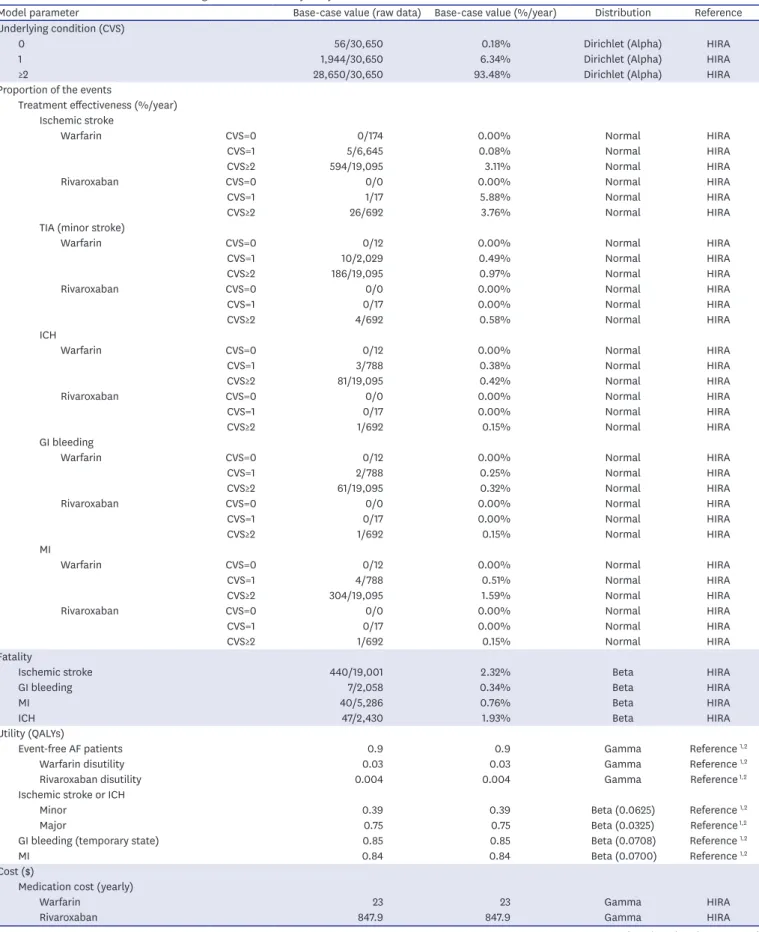
24)25)Disutility of major ischemic stroke or ICH, GI bleeding, and MI were 0.75, 0.85, and 0.84, respectively. Annual medication cost was $23 for warfarin and $847.9 for rivaroxaban. The cost of major ischemic stroke, TIA, MI, hemorrhagic stroke, and GI bleeding were $2,318.68, $2,361.62, $2,337.87,
$2,666.39, and $3,218.91, respectively (Table 1).
Table 1. Base-case model variables and ranges used in sensitivity analysis
Model parameter Base-case value (raw data) Base-case value (%/year) Distribution Reference
Underlying condition (CVS)
0 56/30,650 0.18% Dirichlet (Alpha) HIRA
1 1,944/30,650 6.34% Dirichlet (Alpha) HIRA
≥2 28,650/30,650 93.48% Dirichlet (Alpha) HIRA
Proportion of the events
Treatment effectiveness (%/year) Ischemic stroke
Warfarin CVS=0 0/174 0.00% Normal HIRA
CVS=1 5/6,645 0.08% Normal HIRA
CVS≥2 594/19,095 3.11% Normal HIRA
Rivaroxaban CVS=0 0/0 0.00% Normal HIRA
CVS=1 1/17 5.88% Normal HIRA
CVS≥2 26/692 3.76% Normal HIRA
TIA (minor stroke)
Warfarin CVS=0 0/12 0.00% Normal HIRA
CVS=1 10/2,029 0.49% Normal HIRA
CVS≥2 186/19,095 0.97% Normal HIRA
Rivaroxaban CVS=0 0/0 0.00% Normal HIRA
CVS=1 0/17 0.00% Normal HIRA
CVS≥2 4/692 0.58% Normal HIRA
ICH
Warfarin CVS=0 0/12 0.00% Normal HIRA
CVS=1 3/788 0.38% Normal HIRA
CVS≥2 81/19,095 0.42% Normal HIRA
Rivaroxaban CVS=0 0/0 0.00% Normal HIRA
CVS=1 0/17 0.00% Normal HIRA
CVS≥2 1/692 0.15% Normal HIRA
GI bleeding
Warfarin CVS=0 0/12 0.00% Normal HIRA
CVS=1 2/788 0.25% Normal HIRA
CVS≥2 61/19,095 0.32% Normal HIRA
Rivaroxaban CVS=0 0/0 0.00% Normal HIRA
CVS=1 0/17 0.00% Normal HIRA
CVS≥2 1/692 0.15% Normal HIRA
MI
Warfarin CVS=0 0/12 0.00% Normal HIRA
CVS=1 4/788 0.51% Normal HIRA
CVS≥2 304/19,095 1.59% Normal HIRA
Rivaroxaban CVS=0 0/0 0.00% Normal HIRA
CVS=1 0/17 0.00% Normal HIRA
CVS≥2 1/692 0.15% Normal HIRA
Fatality
Ischemic stroke 440/19,001 2.32% Beta HIRA
GI bleeding 7/2,058 0.34% Beta HIRA
MI 40/5,286 0.76% Beta HIRA
ICH 47/2,430 1.93% Beta HIRA
Utility (QALYs)
Event-free AF patients 0.9 0.9 Gamma Reference
1,2Warfarin disutility 0.03 0.03 Gamma Reference
1,2Rivaroxaban disutility 0.004 0.004 Gamma Reference
1,2Ischemic stroke or ICH
Minor 0.39 0.39 Beta (0.0625) Reference
1,2Major 0.75 0.75 Beta (0.0325) Reference
1,2GI bleeding (temporary state) 0.85 0.85 Beta (0.0708) Reference
1,2MI 0.84 0.84 Beta (0.0700) Reference
1,2Cost ($)
Medication cost (yearly)
Warfarin 23 23 Gamma HIRA
Rivaroxaban 847.9 847.9 Gamma HIRA
(continued to the next page)
Cost-effectiveness of rivaroxaban and warfarin
Under base-case hypothesis, patients who treated with adjusted-dose warfarin lived an average of 11.4±0.2 QALYs, and caused mean lifetime treatments costs of $17,151. Those treated with rivaroxaban lived a mean of 11.8±0.2 QALYs, with an average lifetime cost of $20,886 (Table 2).
Figure 2 shows the cost-effectiveness scatterplot of rivaroxaban and warfarin.
Table 2. Descriptive statistics of cost and effectiveness for warfarin and rivaroxaban
Variables Cost ($)
*Effectiveness (QALYs)
Warfarin Rivaroxaban Warfarin Rivaroxaban
Mean±SD 17,151±185 20,886±195 11.4±0.2 11.8±0.2
Median 17,151 20,885 11.4 11.8
Minimum 16,506 20,156 10.4 10.8
Maximum 17,834 21,663 12.1 12.5
Sum 171,505,530 208,855,207 114,276.8 118,124.5
Size 10,000 10,000 10,000 10,000
Variance 34,139 38,069 0.0 0.0
Variance/size 3 4 0.0 0.0
SQRT (variance/size) 2 2 0.0 0.0
SD = standard deviation; SQRT, square root; QALYs = quality-adjusted life-years.
*
All costs were calculated in Korean won and converted into US dollar (1 US dollar=1,000 KRW).
Cost ( $)
Effectiveness (QALYs)
12.4 12.2 12.0 11.8 11.6 11.4 11.2 11.0 10.8 10.6 22,000
21,000
20,000
18,000
16,000 17,000
19,000 Rivaroxaban
Warfarin
Figure 2. Cost-effectiveness scatterplot.
QALY = quality-adjusted life-year.
Model parameter Base-case value (raw data) Base-case value (%/year) Distribution Reference
Event related cost (per event)
Major ischemic stroke 2,318.68 2,318.68 Gamma HIRA
TIA 2,361.62 2,361.62 Gamma HIRA
MI 2,337.87 2,337.87 Gamma HIRA
Hemorrhagic stroke 2,666.39 2,666.39 Gamma HIRA
GI bleeding 3,218.91 3,218.91 Gamma HIRA
AF = atrial fibrillation; CVS = congestive heart failure, hypertension, age ≥75 (doubled), diabetes mellitus, prior stroke or transient ischemic attack (doubled), vascular disease, age 65 to 74, female (CHA
2DS
2-VASc) score; GI = gastrointestinal; HIRA = Health Insurance Review & Assessment Service; ICH = intracranial hemorrhage; MI = myocardial infarction; QALYs = quality-adjusted life years; TIA = transient ischemic attack.
Table 1. (Continued) Base-case model variables and ranges used in sensitivity analysis
Incremental cost-effectiveness ratio
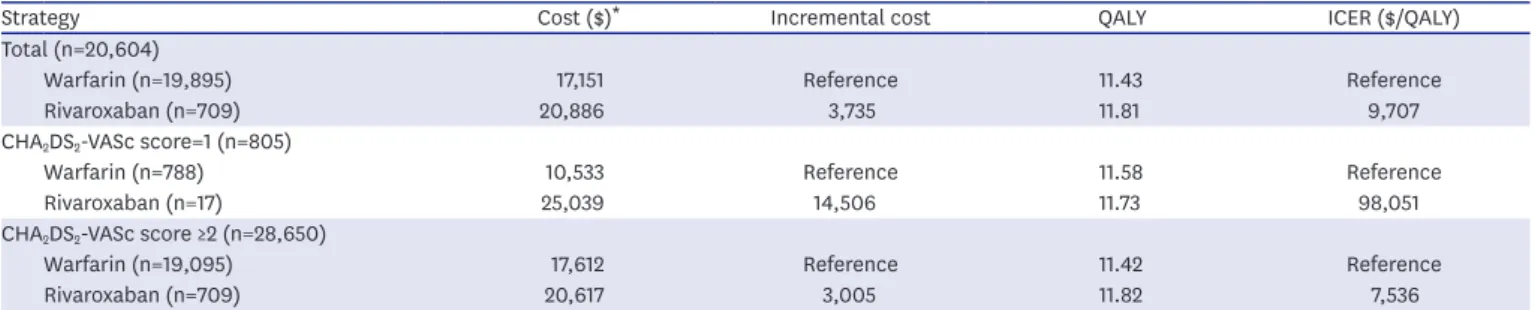
Cost, benefits and ICER for base-case analysis over a life-time is presented in Table 3. While the ICER for rivaroxaban was $9,707 per QALY in total AF patients, it was $7,536 per QALY in those with high stroke risk (CHA
2DS
2-VASc score ≥2). Figure 3 shows that rivaroxaban is more cost-effective with willingness-to-pay more than $9,707.
DISCUSSION
The cost-effectiveness analysis demonstrated that rivaroxaban may be a cost-effective alternative to warfarin in Korean patients with AF. Patients with rivaroxaban needed an additional cost of $3,735, but gained an additional 0.4 QALYs over a lifetime, resulting in an ICER of $9,707 per QALY. The probability of rivaroxaban was remaining cost-effective at willingness-to-pay thresholds of $9,707 per QALY in Monte Carlo simulation. To our knowledge, this is the first study which demonstrate that rivaroxaban is cost-effective in Korean AF patients.
Table 3. Cost, benefits and incremental cost-effectiveness ratio for base-case analysis over a life-time
Strategy Cost ($)
*Incremental cost QALY ICER ($/QALY)
Total (n=20,604)
Warfarin (n=19,895) 17,151 Reference 11.43 Reference
Rivaroxaban (n=709) 20,886 3,735 11.81 9,707
CHA
2DS
2-VASc score=1 (n=805)
Warfarin (n=788) 10,533 Reference 11.58 Reference
Rivaroxaban (n=17) 25,039 14,506 11.73 98,051
CHA
2DS
2-VASc score ≥2 (n=28,650)
Warfarin (n=19,095) 17,612 Reference 11.42 Reference
Rivaroxaban (n=709) 20,617 3,005 11.82 7,536
CHA
2DS
2-VASc = congestive heart failure, hypertension, age ≥75 (doubled), diabetes mellitus, prior stroke or transient ischemic attack (doubled), vascular disease, age 65 to 74, female; ICER = incremental cost-effectiveness ratio; QALY = quality-adjusted life-year.
*
All costs were calculated in Korean won and converted into US dollar (1 US dollar=1,000 KRW).
% It er ations Cost -Effectiv eness
Willingness-to-pay ($)
$9,707
40,000 30,000
20,000 10,000
0 1
Rivaroxaban Warfarin
Figure 3. Changes in ICER estimates for rivaroxaban compared to warfarin with different time horizons. Employing a shorter time horizon (e.g., 1 year) results in a peak ICER of $9,707 perQALY. Vertical dotted line demarcates the
$9,707 per QALY threshold.
ICER = incremental cost-effectiveness ratio; QALY = quality-adjusted life-year.
Current guidelines for stroke prevention published by the 2016 European Society of Cardiology and 2014 American Heart Association/American College of Cardiology/Heart Rhythm Society recommend OAC, and NOAC as an alternative to warfarin for patients with high stroke risk factors (i.e., CHA
2DS
2-VASc score ≥2).
17)Although the cost-effectiveness of NOAC had been identified in Korea, it was evaluated in many countries.
Dabigatran found a cost-effective alternative to warfarin in all economic models performed at a $50,000–$100,000 per QALY willingness-to-pay threshold. Dabigatran was reported to be a cost-effective alternative to warfarin in Randomized Evaluation of Long-Term Anticoagulation Therapy (RE-LY) trial (ICER of US $45,372 per QALY),
26)and from a
Canadian (Canada $10,440 per QALY) and United Kingdom health care perspective (€26,700 per QALY), respectively.
27)28)Markov model using a United States payer/Medicare perspective and a lifetime time horizon showed that the ICER for rivaroxaban was $27,498 per QALY.
29)Our Markov model demonstrated that the ICER for rivaroxaban was $9,707 per QALY in total Korean AF patients.
Interestingly, the cost-effectiveness was improved with $7.536 per QALY in Korean AF patients with high stroke risk (CHA
2DS
2-VASc score ≥2). ICER of intermediate risk (CHA
2DS
2- VASc score=1) group was higher than that of high-risk group. This finding might be caused by small number of rivaroxaban group with intermediate risk (n=17) rather than low cost- effectiveness of rivaroxaban. In addition, ICER cannot be calculated in low risk group because there were none who was described rivaroxaban in this group
Interestingly, the ICER for rivaroxaban calculated in Korean AF was much lower than those reported in previous studies.
28)29)The favorable ICER seen in our model reflects the decreased costs and increased QALYs resulting from relatively low price of NOAC in Korea and the avoidance of ICH with rivaroxaban compared to warfarin.
A recent meta-analysis reported that assuming that the UK National Health Service is willing to pay £20,000 for each year of perfect health (one QALY), all NOACs have a positive expected incremental net benefit compared with warfarin. Apixaban 5 mg twice daily has the highest expected incremental net benefit (£7533), followed by dabigatran 150 mg twice daily (£6,365), rivaroxaban 20 mg once daily (£5,279), and edoxaban 60 mg once daily (£5,212).
30)Therefore, other NOACs which is not evaluated in this study may be cost-effective in Korean patients with AF.
There are several limitations to this study. First, in this study, the use of NOACs including
rivaroxaban was extremely low compared with warfarin resulting in big difference of patient
numbers between warfarin and NOACs. However, study number of patients with rivaroxaban
might not affect the direction of the result. Small study number usually exaggerates incidence
of events and worsen the treatment effectiveness of study drugs. Therefore, small study
number could act as a bias that leads the result toward the null. Our result revealed that
rivaroxaban was cost-effective. Moreover, based on Markov chain Monte Carlos methods,
small study size can be somehow overcome by the number of iteration. We conducted 10,000
iterations for each cycle and it is enough to compensate sample size. However, further study
with larger size is needed for the size of effect, because the effectiveness of rivaroxaban
could be underestimated due to small study size. Second, health events were analyzed
using Korean National Health Insurance Service (KNHIS) data for three years from January
2012 to December 2014 and this data will not fully reflect the efficacy and safety of the real
world. Considering that NOAC has been used in Korea since 2011 for the stroke prevention of nonvalvular AF patients, relatively early data might be included in this study. Third, as in similar models, we assumed any major bleeding would result in permanent discontinuation of rivaroxaban or warfarin and initiation of aspirin. This may not always be the case and would likely be based on individual patient factors.
In conclusion, the cost-effectiveness analysis demonstrated that rivaroxaban may be a cost- effective alternative to warfarin in Korean patients with AF. Patients with rivaroxaban needed an additional cost of $3,735, but gained an additional 0.4 QALYs over a lifetime, resulting in an ICER of $9,707 per QALY. The probability of rivaroxaban was remaining cost-effective at willingness-to-pay thresholds of $9,707 per QALY in Monte Carlo simulation. To our knowledge, this is the first study which demonstrate that rivaroxaban is cost-effective in Korean AF patients.
SUPPLEMENTARY MATERIAL
Supplementary Table 1
Definitions and ICD-10 codes used for defining the comorbidities and clinical outcomes Click here to view
REFERENCES
1. Lee H, Kim TH, Baek YS, et al. The trends of atrial fibrillation-related hospital visit and cost, treatment pattern and mortality in Korea: 10-year nationwide sample cohort data. Korean Circ J 2017;47:56-64.
PUBMED | CROSSREF
2. Kim TH, Yang PS, Uhm JS, et al. CHA
2DS
2-VASc score (congestive heart failure, hypertension, age ≥75 [doubled], diabetes mellitus, prior stroke or transient ischemic attack [doubled], vascular disease, age 65–74, female) for stroke in Asian patients with atrial fibrillation: a Korean nationwide sample cohort study. Stroke 2017;48:1524-30.
PUBMED | CROSSREF
3. Hart RG, Pearce LA, Aguilar MI. Meta-analysis: antithrombotic therapy to prevent stroke in patients who have nonvalvular atrial fibrillation. Ann Intern Med 2007;146:857-67.
PUBMED | CROSSREF
4. Decker C, Garavalia L, Garavalia B, et al. Exploring barriers to optimal anticoagulation for atrial fibrillation: interviews with clinicians. J Multidiscip Healthc 2012;5:129-35.
PUBMED | CROSSREF
5. Connolly SJ, Ezekowitz MD, Yusuf S, et al. Dabigatran versus warfarin in patients with atrial fibrillation. N Engl J Med 2009;361:1139-51.
PUBMED | CROSSREF
6. Patel MR, Mahaffey KW, Garg J, et al. Rivaroxaban versus warfarin in nonvalvular atrial fibrillation. N Engl J Med 2011;365:883-91.
PUBMED | CROSSREF
7. Granger CB, Alexander JH, McMurray JJ, et al. Apixaban versus warfarin in patients with atrial fibrillation.
N Engl J Med 2011;365:981-92.
PUBMED | CROSSREF
8. Giugliano RP, Ruff CT, Braunwald E, et al. Edoxaban versus warfarin in patients with atrial fibrillation. N Engl J Med 2013;369:2093-104.
PUBMED | CROSSREF
9. Nelson WW, Song X, Coleman CI, et al. Medication persistence and discontinuation of rivaroxaban versus warfarin among patients with non-valvular atrial fibrillation. Curr Med Res Opin 2014;30:2461-9.
PUBMED | CROSSREF
10. Camm AJ, Lip GY, De Caterina R, et al. 2012 focused update of the ESC Guidelines for the management of atrial fibrillation: an update of the 2010 ESC Guidelines for the management of atrial fibrillation. Developed with the special contribution of the European Heart Rhythm Association. Eur Heart J 2012;33:2719-47.
PUBMED | CROSSREF
11. January CT, Wann LS, Alpert JS, et al. 2014 AHA/ACC/HRS guideline for the management of patients with atrial fibrillation: a report of the American College of Cardiology/American Heart Association Task Force on Practice Guidelines and the Heart Rhythm Society. J Am Coll Cardiol 2014;64:e1-76.
PUBMED | CROSSREF
12. Kim D, Yang PS, Jang E, et al. 10-year nationwide trends of the incidence, prevalence, and adverse outcomes of non-valvular atrial fibrillation nationwide health insurance data covering the entire Korean population. Am Heart J 2018;202:20-6.
PUBMED | CROSSREF
13. Kim D, Yang PS, Jang E, et al. Increasing trends in hospital care burden of atrial fibrillation in Korea, 2006 through 2015. Heart 2018;heartjnl-2017-312930.
PUBMED | CROSSREF
14. Baek YS, Yang PS, Kim TH, et al. Associations of abdominal obesity and new-onset atrial fibrillation in the general population. J Am Heart Assoc 2017;6:e004705.
PUBMED | CROSSREF
15. Lee HY, Yang PS, Kim TH, et al. Atrial fibrillation and the risk of myocardial infarction: a nation-wide propensity-matched study. Sci Rep 2017;7:12716.
PUBMED | CROSSREF
16. Ades AE, Cliffe S. Markov chain Monte Carlo estimation of a multiparameter decision model: consistency of evidence and the accurate assessment of uncertainty. Med Decis Making 2002;22:359-71.
PUBMED | CROSSREF
17. Kirchhof P, Benussi S, Kotecha D, et al. 2016 ESC Guidelines for the management of atrial fibrillation developed in collaboration with EACTS. Eur Heart J 2016;37:2893-962.
PUBMED | CROSSREF
18. Korean Statistical Information Service (KOSIS). Korean life expectation. 2016.
19. Kim TH, Yang PS, Yu HT, et al. Age threshold for ischemic stroke risk in atrial fibrillation: cohort data covering the entire Korean population. Stroke 2018;39:ehy565.P2904.
20. O'Brien CL, Gage BF. Costs and effectiveness of ximelagatran for stroke prophylaxis in chronic atrial fibrillation. JAMA 2005;293:699-706.
PUBMED | CROSSREF
21. Hylek EM, Singer DE. Risk factors for intracranial hemorrhage in outpatients taking warfarin. Ann Intern Med 1994;120:897-902.
PUBMED | CROSSREF
22. Neumann PJ, Sandberg EA, Bell CM, Stone PW, Chapman RH. Are pharmaceuticals cost-effective? A review of the evidence. Health Aff (Millwood) 2000;19:92-109.
PUBMED | CROSSREF
23. Sullivan PW, Ghushchyan V. Preference-Based EQ-5D index scores for chronic conditions in the United States. Med Decis Making 2006;26:410-20.
PUBMED | CROSSREF
24. Lanitis T, Kongnakorn T, Jacobson L, De Geer A. Cost-effectiveness of apixaban versus warfarin and aspirin in Sweden for stroke prevention in patients with atrial fibrillation. Thromb Res 2014;134:278-87.
PUBMED | CROSSREF
25. Magnuson EA, Vilain K, Wang K, et al. Cost-effectiveness of edoxaban vs warfarin in patients with atrial fibrillation based on results of the ENGAGE AF-TIMI 48 trial. Am Heart J 2015;170:1140-50.
PUBMED | CROSSREF
26. Freeman JV, Zhu RP, Owens DK, et al. Cost-effectiveness of dabigatran compared with warfarin for stroke prevention in atrial fibrillation. Ann Intern Med 2011;154:1-11.
PUBMED | CROSSREF
27. Sorensen SV, Kansal AR, Connolly S, et al. Cost-effectiveness of dabigatran etexilate for the prevention of stroke and systemic embolism in atrial fibrillation: a Canadian payer perspective. Thromb Haemost 2011;105:908-19.
PUBMED | CROSSREF
28. Pink J, Lane S, Pirmohamed M, Hughes DA. Dabigatran etexilate versus warfarin in management of non-valvular atrial fibrillation in UK context: quantitative benefit-harm and economic analyses. BMJ 2011;343:d6333.
PUBMED | CROSSREF
29. Lee S, Anglade MW, Pham D, Pisacane R, Kluger J, Coleman CI. Cost-effectiveness of rivaroxaban compared to warfarin for stroke prevention in atrial fibrillation. Am J Cardiol 2012;110:845-51.
PUBMED | CROSSREF
30. López-López JA, Sterne JA, Thom HH, et al. Oral anticoagulants for prevention of stroke in atrial fibrillation: systematic review, network meta-analysis, and cost effectiveness analysis. BMJ 2017;359:j5058.
PUBMED | CROSSREF