Trend Report
건축물 에너지 효율화를 위한
IEA의 국제 연구 동향
1. 국제에너지기구(IEA)의 건물에너지연구 체계
국제에너지기구(IEA)는 OECD(경제협력개발기구)의 산하 조직으로 원자력기구(Nuclear Energy Agency) 등 과 함께 독립적 예산운영 및 자체 사무국을 갖고 있는 준 자율적 부속기구(Semi-Autonomous Body)이다. IEA 는 제1차 석유위기가 발생한 1973년 직후 에너지 공급과 수요, 국제석유시장의 안정, 에너지 효율적 이용과 관 리, 국제협력 및 공동연구 그리고 환경과 에너지 정책의 조화 등을 위한 활동을 목적으로 설립되었으며 현재 세 계 28개국이 가입하여 활동하고 있다.
IEA는 이사회 하부에 에너지 R&D를 총괄하는 CERT(Committee on Energy Research & Technology)를 두 고 있으며 CERT 밑에는 에너지 절약(Energy End-Use), 신재생에너지(Renewable Energy), 화석연료(Fossil Fuel), 핵융합발전(Fusion Power) 등 4개의 워킹 그룹을 두고 있다. 건물부문 에너지 연구를 수행하는 것은 EBC(Energy in Buildings and Communities)로 Working Party on Energy End-Use Technology에 배치 되어 있다. 같은 워킹파티에는 연료전지, 자동차, 수요관리, 지역냉난방, 에너지 저장, 히트펌르, 수소 전기 자동 차 등이 같이 소속되어 있다. 신재생에너지에는 Solar Heating and Cooling 프로그램이 있으며 건물분야 관련 연구를 많이 수행하고 있다. 그림 1은 이러한 IEA의 연구 조직 체계도를 나타내며 그림 2는 EBC에 참여하고 있 는 국가를 보여준다. 표 1은 Working Party별 에너지기술협력 프로그램을 보여주고 있다. 글 / 한국건설기술연구원 선임연구위원 이승언 (IEA EBC 집행위원회 한국대표) 그림 1. IEA 조직에서의 EBC의 위치 그림 2. EBC 참여 국가 Standing Committee Committee on Energy Research & Technology (CERT) International Energy Agency (IEA)
INDUSTRY NON-MEMBER COUNTRIES
IE A M E M B E R C O U N T R IE S IE A S E C R E TA R IA T Governing Board Working Party on Energy End-Use Technologies Working Party on Renewable Energy Technologies Working Party on Fossil Fuel Technologies Fusion Power Co-ordinating Committee Energy in Buildings and Communities (EBC)
EBC Participating Countries - 26개국
ㅁ Australia ㅁ Austria ㅁ Belgium ㅁ Canada ㅁ Czech Republic ㅁ Denmark ㅁ Finland ㅁ France ㅁ Germany ㅁ Greece ㅁ Istrael ㅁ Italy ㅁ Japan ㅁ Korea ㅁ New Zealand ㅁ Netherlands ㅁ Norway ㅁ Poland ㅁ Portugal ㅁ Sweden ㅁ Switzerland ㅁ United States of ㅁ America ㅁ China ㅁ Spain ㅁ Ireland ㅁ Turkey ㅁ Greece ㅁ Russia 정식 가입 추진 중
2. EBC의 연구 프로젝트(Annex)
건축물과 커뮤니타(도시) 차원의 에너지 효율화를 위한 연구 조직인 EBC는 1977년 ECBCS(Energy Coservation in Buildings and Community System)으로 출발하여 2013년에 EBC로 이름을 바꾸었다. EBC에서는 연구단 위를 Annex라고 하며 연구기간은 3~5년 정도 수행되는데 발족이후 현재까지 승인된 Annex는 총 65개이다. 2013년 11월 기준으로 51개가 종료되었으며 14개가 진행되고 있다. 표 2는 종료된 Annex를, 표 3에는 진행되 고 있는 Annex를 나타낸다. (13개 프로그램) • Energy Conservation and Emissions Reduction in Combustion • Energy in Buildings and Communities (EBC) (건축 및 도시 에너지) • Energy Conservation Through Energy Storage • Heat Pumping Technologies • Hybrid and Electric Vehicles • Process Integration • Pulp and Paper Fossil Fuels (6개 프로그램) • Clean Coal Sciences • Enhanced Oil Recovery • Fluidized Bed Conversion • IEA Clean Coal Centre • IEA Greenhouse Gas RD Programme • Multiphase Flow Sciences Fusion Power (8개 프로그램) • Environmental, Safety and Economic Aspects of Fusion Power • Fusion Materials • Large Tokamaks • Nuclear Technology of Fusion Reactors • Plasma Wall Interaction in TEXTOR • Reversed Field Pinches • Stellarator Concept • Toroidal Physics in, and Plasma Technologies of Tokamaks with Poloidal Field Divertors (ASDEX-Upgrade) Renewable Energy Technologies (9개 프로그램) • Bioenergy • Geothermal • Hydrogen • Hydropower • Ocean Energy Systems ◦Photovoltaic Power Systems • Solar Heating and Cooling ◦SolarPACES ◦Wind Turbine Systems Intersectoral (4개 프로그램) • Climate Technology Initiative (CTI) • Energy and Environmental Technologies Information Centres (EETIC) • Energy Technology Data Exchange (ETDE) • Energy Technology Systems Analysis Programme (ETSAP) 표1. Working Praty별 에너지 기술협력 프로그램
ESCO Report
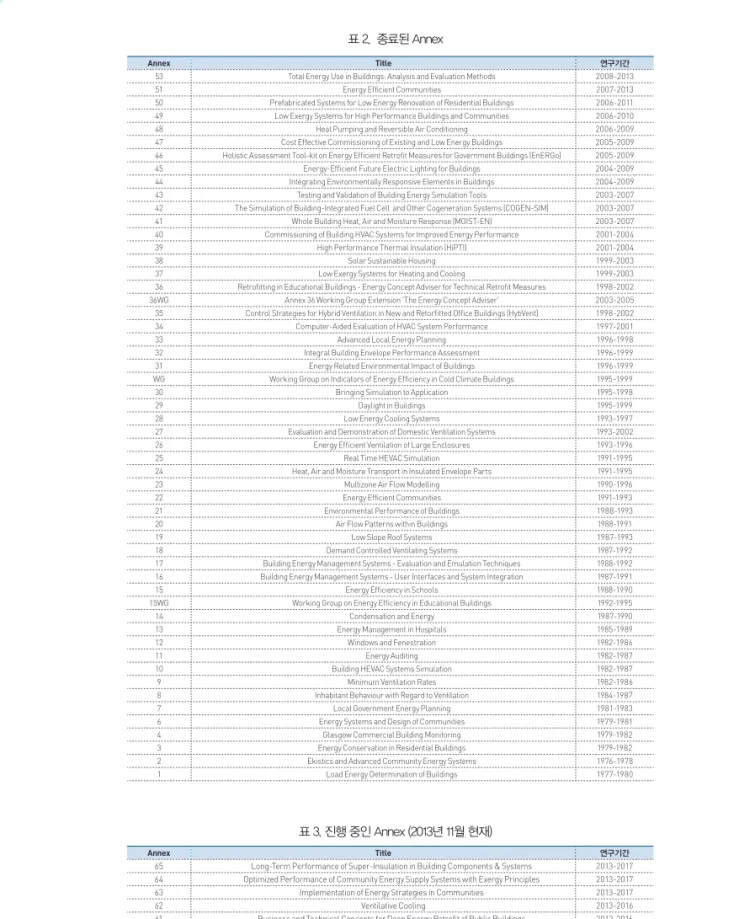
표 2. 종료된 Annex
Annex Title 연구기간
53 Total Energy Use in Buildings: Analysis and Evaluation Methods 2008-2013
51 Energy Efficient Communities 2007-2013
50 Prefabricated Systems for Low Energy Renovation of Residential Buildings 2006-2011 49 Low Exergy Systems for High Performance Buildings and Communities 2006-2010 48 Heat Pumping and Reversible Air Conditioning 2006-2009 47 Cost Effective Commissioning of Existing and Low Energy Buildings 2005-2009 46 Holistic Assessment Tool-kit on Energy Efficient Retrofit Measures for Government Buildings (EnERGo) 2005-2009 45 Energy-Efficient Future Electric Lighting for Buildings 2004-2009 44 Integrating Environmentally Responsive Elements in Buildings 2004-2009 43 Testing and Validation of Building Energy Simulation Tools 2003-2007 42 The Simulation of Building-Integrated Fuel Cell and Other Cogeneration Systems (COGEN-SIM) 2003-2007 41 Whole Building Heat, Air and Moisture Response (MOIST-EN) 2003-2007 40 Commissioning of Building HVAC Systems for Improved Energy Performance 2001-2004 39 High Performance Thermal Insulation (HiPTI) 2001-2004
38 Solar Sustainable Housing 1999-2003
37 Low Exergy Systems for Heating and Cooling 1999-2003 36 Retrofitting in Educational Buildings - Energy Concept Adviser for Technical Retrofit Measures 1998-2002 36WG Annex 36 Working Group Extension 'The Energy Concept Adviser' 2003-2005 35 Control Strategies for Hybrid Ventilation in New and Retorfitted Office Buildings (HybVent) 1998-2002 34 Computer-Aided Evaluation of HVAC System Performance 1997-2001
33 Advanced Local Energy Planning 1996-1998
32 Integral Building Envelope Performance Assessment 1996-1999 31 Energy Related Environmental Impact of Buildings 1996-1999 WG Working Group on Indicators of Energy Efficiency in Cold Climate Buildings 1995-1999
30 Bringing Simulation to Application 1995-1998
29 Daylight in Buildings 1995-1999
28 Low Energy Cooling Systems 1993-1997
27 Evaluation and Demonstration of Domestic Ventilation Systems 1993-2002 26 Energy Efficient Ventilation of Large Enclosures 1993-1996
25 Real Time HEVAC Simulation 1991-1995
24 Heat, Air and Moisture Transport in Insulated Envelope Parts 1991-1995
23 Multizone Air Flow Modelling 1990-1996
22 Energy Efficient Communities 1991-1993
21 Environmental Performance of Buildings 1988-1993
20 Air Flow Patterns within Buildings 1988-1991
19 Low Slope Roof Systems 1987-1993
18 Demand Controlled Ventilating Systems 1987-1992
17 Building Energy Management Systems - Evaluation and Emulation Techniques 1988-1992 16 Building Energy Management Systems - User Interfaces and System Integration 1987-1991
15 Energy Efficiency in Schools 1988-1990
15WG Working Group on Energy Efficiency in Educational Buildings 1992-1995
14 Condensation and Energy 1987-1990
13 Energy Management in Hospitals 1985-1989
12 Windows and Fenestration 1982-1986
11 Energy Auditing 1982-1987
10 Building HEVAC Systems Simulation 1982-1987
9 Minimum Ventilation Rates 1982-1986
8 Inhabitant Behaviour with Regard to Ventilation 1984-1987
7 Local Government Energy Planning 1981-1983
6 Energy Systems and Design of Communities 1979-1981
4 Glasgow Commercial Building Monitoring 1979-1982
3 Energy Conservation in Residential Buildings 1979-1982 2 Ekistics and Advanced Community Energy Systems 1976-1978
1 Load Energy Determination of Buildings 1977-1980
표 3. 진행 중인 Annex (2013년 11월 현재)
Annex Title 연구기간
65 Long-Term Performance of Super-Insulation in Building Components & Systems 2013-2017 64 Optimized Performance of Community Energy Supply Systems with Exergy Principles 2013-2017 63 Implementation of Energy Strategies in Communities 2013-2017
62 Ventilative Cooling 2013-2016
61 Business and Technical Concepts for Deep Energy Retrofit of Public Buildings 2012-2016 60 New Generation Computational Tools for Building & Community Energy Systems 2012-2017 59 High Temperature Cooling and Low Temperature Heating in Buildings 2012-2015 58 Reliable Building Energy Performance Characterisation Based on Full Scale Dynamic Measurements 2011-2015 57 Evaluation of Embodied Energy and CO2 Emissions for Building Construction 2011-2015 56 Cost-Effective Energy and CO2 Emission Optimization in Building Renovation 2010-2015 55 Reliability of Energy Efficient Building Retrofitting - Probability Assessment of Performance and Cost 2009-2013 54 Integration of Micro-generation and Related Energy Technologies in Buildings 2009-2013 52 Towards Net Zero Energy Solar Buildings (NZEBs) 2008-2013 5 Air Infiltration and Ventilation Centre
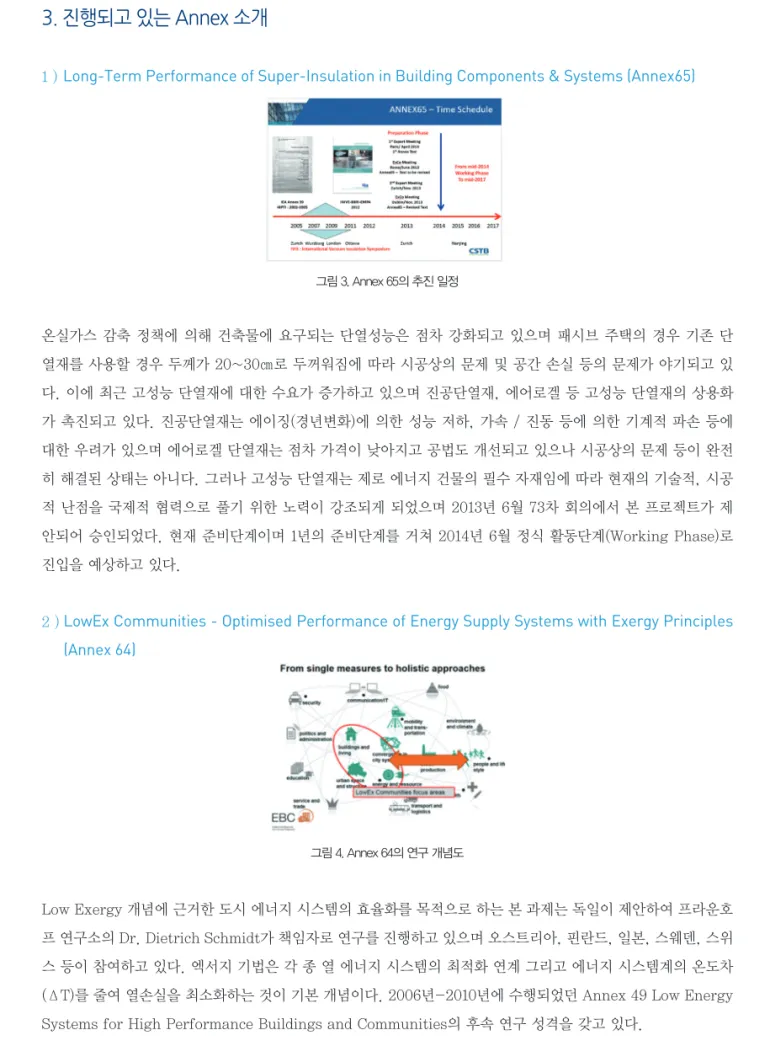
그림 3. Annex 65의 추진 일정 온실가스 감축 정책에 의해 건축물에 요구되는 단열성능은 점차 강화되고 있으며 패시브 주택의 경우 기존 단 열재를 사용할 경우 두께가 20~30㎝로 두꺼워짐에 따라 시공상의 문제 및 공간 손실 등의 문제가 야기되고 있 다. 이에 최근 고성능 단열재에 대한 수요가 증가하고 있으며 진공단열재, 에어로겔 등 고성능 단열재의 상용화 가 촉진되고 있다. 진공단열재는 에이징(경년변화)에 의한 성능 저하, 가속 / 진동 등에 의한 기계적 파손 등에 대한 우려가 있으며 에어로겔 단열재는 점차 가격이 낮아지고 공법도 개선되고 있으나 시공상의 문제 등이 완전 히 해결된 상태는 아니다. 그러나 고성능 단열재는 제로 에너지 건물의 필수 자재임에 따라 현재의 기술적, 시공 적 난점을 국제적 협력으로 풀기 위한 노력이 강조되게 되었으며 2013년 6월 73차 회의에서 본 프로젝트가 제 안되어 승인되었다. 현재 준비단계이며 1년의 준비단계를 거쳐 2014년 6월 정식 활동단계(Working Phase)로 진입을 예상하고 있다.
2 ) LowEx Communities - Optimised Performance of Energy Supply Systems with Exergy Principles
(Annex 64)
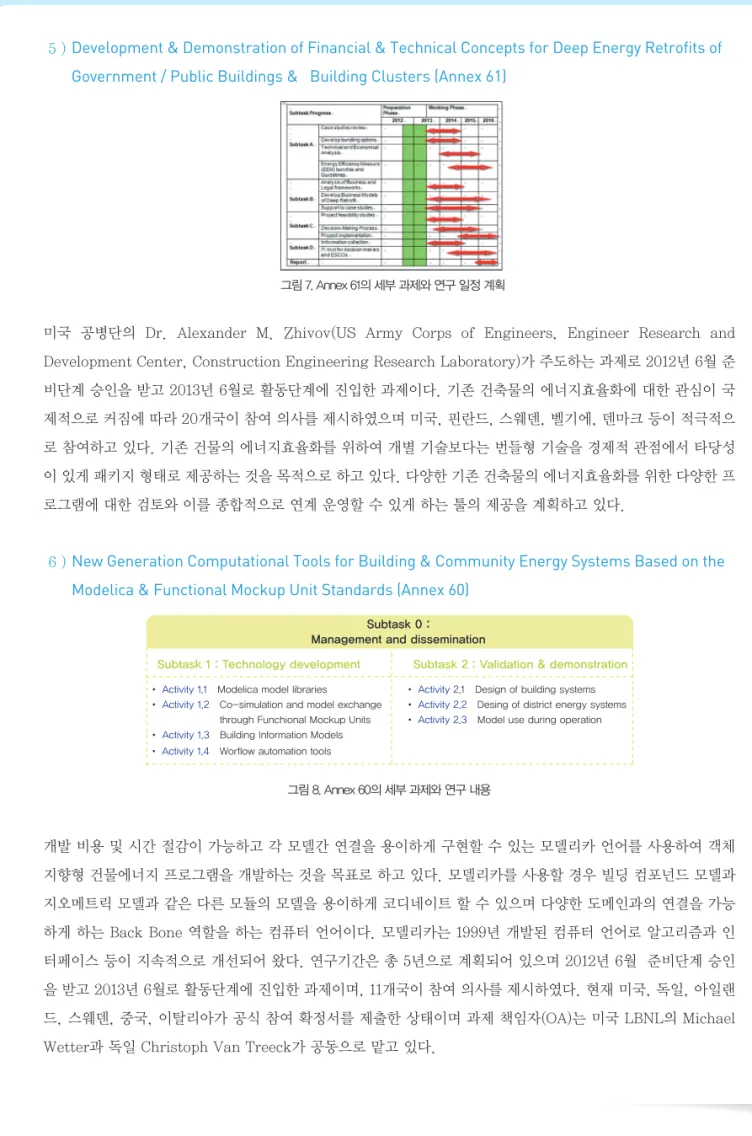
그림 4. Annex 64의 연구 개념도
Low Exergy 개념에 근거한 도시 에너지 시스템의 효율화를 목적으로 하는 본 과제는 독일이 제안하여 프라운호 프 연구소의 Dr. Dietrich Schmidt가 책임자로 연구를 진행하고 있으며 오스트리아, 핀란드, 일본, 스웨덴, 스위 스 등이 참여하고 있다. 엑서지 기법은 각 종 열 에너지 시스템의 최적화 연계 그리고 에너지 시스템계의 온도차 (ΔT)를 줄여 열손실을 최소화하는 것이 기본 개념이다. 2006년-2010년에 수행되었던 Annex 49 Low Energy Systems for High Performance Buildings and Communities의 후속 연구 성격을 갖고 있다.
ESCO Report
3 )Implementation of Energy Strategies in Communities (Annex 63)
그림 5. Annex 63의 연구 개념도 오스트리아가 제안하여 진행되는 Annex로 커뮤니티(도시 규모) 레벨의 저탄소화 디자인 및 설계 프로세스를 개 발하는 과제이다. 기존 도시를 저에너지화로 변환시키기 위한 디자인과 기술의 연계 전략 개발을 목적으로 진행 되며 계획단계에서 의사 결정을 지원할 수 있는 프로세스와 툴 개발을 포함하고 있다. 2013년 6월 73차 회의에 서 준비단계로 승인된 이 Annex는 오스트리아가 OA(주관국가)를 하고 있으며 도시의 저에너지화를 구현하기 위한 기술, 정책 방안을 실무적으로 접근하는 연구를 진행하고 있다.
4 ) Ventilative Cooling (Annex 62)
Annex Outcome
• Guidelines for energy-efficient reduction of the risk of overheating by ventilative cooling • Guidlines for ventilative cooling design and operation in residential and commercial
buildings • Recommendation for intergration of ventilative cooling in legislation, standards, design briefs as well as on energy performance calculation and verification methods • New ventilative cooling solutions including their control strategles as well as improvement of capacity of existing systems • Documented performance of ventilative cooling systems in case studies. Annex 62 VentilativeCooling 그림 6. Annex 62의 목표 성과물 환기는 실내공기의 청정 유지를 목적으로 사용되는 것이었으나, 환기를 보다 적극적으로 활용함으로써 저비용 건물 냉방 시스템으로 활용하자는 것이 연구의 목적이다. 특히 패시브 주택 등 고단열, 고기밀 주택에서 발생하 는 비동계 기간의 과열 문제(Overheating)를 해소할 수 있는 방안으로 추진되고 있다. 이를 위한 수단으로 통풍 형 냉방(Ventilative Cooling)을 제안하고 있으며 자연환기, 기계환기, 자연+기계 환기 병용 방식에 대해 종합 소루션 제공을 연구하고 있다. 2012년 12월 출발한 Annex로 Working Phase에 진입하여 진행되고 있다. 주관 기관(OA)는 Annex 44 Integrating Environmentally Responsive Elements in Buildings의 책임자였던 덴 마크의 Per Heiselberg 교수가 맡고 있다. 16개국이 참여 의사를 표명하고 있으며 현재 중국, 아일랜드, 이탈리 아, 일본이 공식 참여하고 있다.
Trend Report
미국 공병단의 Dr. Alexander M. Zhivov(US Army Corps of Engineers, Engineer Research and Development Center, Construction Engineering Research Laboratory)가 주도하는 과제로 2012년 6월 준 비단계 승인을 받고 2013년 6월로 활동단계에 진입한 과제이다. 기존 건축물의 에너지효율화에 대한 관심이 국 제적으로 커짐에 따라 20개국이 참여 의사를 제시하였으며 미국, 핀란드, 스웨덴, 벨기에, 덴마크 등이 적극적으 로 참여하고 있다. 기존 건물의 에너지효율화를 위하여 개별 기술보다는 번들형 기술을 경제적 관점에서 타당성 이 있게 패키지 형태로 제공하는 것을 목적으로 하고 있다. 다양한 기존 건축물의 에너지효율화를 위한 다양한 프 로그램에 대한 검토와 이를 종합적으로 연계 운영할 수 있게 하는 툴의 제공을 계획하고 있다.
6 ) New Generation Computational Tools for Building & Community Energy Systems Based on the
Modelica & Functional Mockup Unit Standards (Annex 60)
그림 8. Annex 60의 세부 과제와 연구 내용 개발 비용 및 시간 절감이 가능하고 각 모델간 연결을 용이하게 구현할 수 있는 모델리카 언어를 사용하여 객체 지향형 건물에너지 프로그램을 개발하는 것을 목표로 하고 있다. 모델리카를 사용할 경우 빌딩 컴포넌드 모델과 지오메트릭 모델과 같은 다른 모듈의 모델을 용이하게 코디네이트 할 수 있으며 다양한 도메인과의 연결을 가능 하게 하는 Back Bone 역할을 하는 컴퓨터 언어이다. 모델리카는 1999년 개발된 컴퓨터 언어로 알고리즘과 인 터페이스 등이 지속적으로 개선되어 왔다. 연구기간은 총 5년으로 계획되어 있으며 2012년 6월 준비단계 승인 을 받고 2013년 6월로 활동단계에 진입한 과제이며, 11개국이 참여 의사를 제시하였다. 현재 미국, 독일, 아일랜 드, 스웨덴, 중국, 이탈리아가 공식 참여 확정서를 제출한 상태이며 과제 책임자(OA)는 미국 LBNL의 Michael Wetter과 독일 Christoph Van Treeck가 공동으로 맡고 있다.
Subtask 2 : Validation & demonstration
• Activity 2.1 Design of building systems • Activity 2.2 Desing of district energy systems • Activity 2.3 Model use during operation
Subtask 1 : Technology development
• Activity 1.1 Modelica model libraries • Activity 1.2 Co-simulation and model exchange through Funchional Mockup Units • Activity 1.3 Building Information Models • Activity 1.4 Worflow automation tools Subtask 0 : Management and dissemination 그림 7. Annex 61의 세부 과제와 연구 일정 계획
ESCO Report
7 ) High Temperature Cooling & Low Temperature Heating in Buildings (Annex 59)
비주거용 건물의 HAVC에 대하여 고온냉방(Highr Temp. Cooling), 저온난방(Low Temp. Heating)을 구현 하는 것을 목적으로 하는 과제이다. HAVC 시스템의 혼합손실과 반송손실 저감 방법론을 개발하고 실내 터미널 (Terminal)의 혁신적인 디자인과 외기조화 프로세서의 효율적 경로 설계(Flow Path)를 제안하고 있다. 주관 기 관은 중국 칭화대학이 맡고 있으며 벨기에, 덴마크, 핀란드, 독일, 이탈리아, 일본, 미국 등이 참여하고 있으며 한국은 서울대학교가 참여하고 있다.
8 ) Reliable Building Energy Performance Characterisation Based on Full Scale Dynamic
Measurements (Annex 58)
벨기에 루벤대학 Staf Roels 교수가 책임자이며 실물 규모(Full Scale) 측정을 통한 건물에너지 성능 특성을 보 다 명확하고 정확하게 도출하는 것이 목적이다. 건물 구성요소와 건물 전체의 실제 에너지 성능 특성의 규명을 위하여 동적 테스트(Dynamic Test) 시험 장치, 동적 데이터의 분석 기법 그리고 기술 네트워크를 구축 등을 세 부과제로 제시하고 있다.
9 ) Evaluation of Embodied Energy & CO2 Emissions for Building Construction (Annex 57)
일본의 타츠오 오까 교수가 책임자이며, 한국은 건설기술연구원이 Sub Task 1의 리더로 참여하고 있다. 건축물 의 전과정평가(LCA, Life Cycle Assessment)를 기반으로 하여 건축물 자재 투입에 대한 내재에너지(Embodied Energy)와 이산화탄소 배출 평가, 설계 단계에서 적용할 수 있는 저 내재에너지 건축설계 방법론 개발을 연구 내용으로 하고 있다.
10 ) Cost Effective Energy & CO2 Emissions Optimizationin Building Renovation (Annex 56)
포르투갈 민호 대학의 Manuela Almeida 교수가 책임자로 OA로 활동하고 있다. Annex 56은 건물 리노베이션 시 에너지소비와 탄소배출 저감을 경제적 관점에서 최적화하는 방법론을 제시하는 것을 목적으로 진행되고 있 다. 기존 건축물의 탄소저감이 중요해짐에도 불구하고 명확한 정보와 의사결정 방법이 부재함에 따라 에너지효 율화 수준별 맞춤형 의사결정 지원 방법론을 제공하고자 하며, 아울러 유럽 각국의 성공적인 실제 사례(Shining Trend Report 그림 10. Annex 58의 연구 구성 그림 9. Annex 59의 연구 구성
주택의 에너지 성능, 결로 하자 등에 대한 케이스 스터디를 포함하고 있다.
12 )Integration of Micro-Generation & Related Energy Technologies in Buildings (Annex 54)
연구책임은 캐나다 CANMET ENERGY Research Centre의 Evgueniy Entchev와 독일 TU Munich의 Peter Tzscheutschler가 공동으로 맡고 있다. 주택용 열병합 시스템인 마이크로 제너레이션 시스템 기술과 평가 기법 의 개발을 목적으로 진행되었다. 11개국이 참여하고 있으며, 한국의 에너지기술연구원(KIER)도 참여하고 있다. 최종 종료 단계에 있다.
13 ) Total Energy Use in Buildings : Analysis & Evaluation Methods (Annex 53)
일본 도호쿠 대학의 요시노 교수가 진행한 Annex로 공식 종료 승인을 받아 보고서 최종 출간 단계에 있다. 건물 에서의 실제 에너지 사용량에 대한 분석과 예측에 대한 연구이며 시물레이션과 실제에너지 사용량의 차이점에 대 한 원인 규명, 거주자의 행태가 에너지사용량에 미치는 영향 등에 대한 분석을 수행하였다.
14 )Towards Net Zero Energy Solar Buildings (Annex 52)
향후 건축물의 궁극적인 목표인 제로에너지 건물 구현을 위한 국제 공동연구로 NZEB(Near Zero Building) 개 념을 건축 시장에 확대할 수 있도록 설계 및 평가기법을 제공하는 것을 목적으로 진행되었다. 종료 승인을 받아 보고서의 출간을 남겨두고 있다. 15 )AIVC (Annex 5) Annex 5는 다른 Annex가 약 4-5년의 기간을 갖고 수행되는 것과는 달리, 1979년 시작된 이후 지속적으로 운 영되고 있다. 일종의 상설 기구형 프로젝트로 국가 회원제로 운영되고 있으며 참여 국가는 국가 분담금 납부 의무 가 있다. 한국은 한국건설기술연구원이 참여하고 있다. 건축물의 환기와 기밀에 대한 연구와 기술보고서의 발간 그리고 기술과 시장과의 연계를 지원하는 역할을 하고 있다. 최근 저에너지 주택의 고기밀화에 의하여 발생하는 실내공기질의 문제, 실내 과열 등의 문제를 환기로서 풀기 위한 전략과 방안 모색을 제안하고 있다.
4. 맺음말
국제에너지기구의 건물 부문 연구를 EBC(Energy in Buildings and Communities) 프로그램 중심으로 간략히 살펴 보았다. 방대한 연구 분야를 짧은 지면에 소개하고자 함에 따라 충분한 소개가 되지 못하였다. EBC의 전반 적인 정보는 http://www.iea-ebc.org/에서 찾아 볼 수 있으며, 각 Annex별 정보는 http://www.iea-ebc. org/projects/에서 현재 진행중인 과제와 종료된 것을 구분하여 제공하고 있다. 또한 각 Annex별로 개별 사이