돈모 단백질의 급여가 닭의 영양소 대사에 미치는 영향
오현민
1ㆍ박노성
1ㆍ조치현
1ㆍ김성복
1ㆍ임재삼
2ㆍ이봉덕
1ㆍ이수기
1*
1충남대학교 동물자원생명과학과, 2충남축산기술연구소
Effects of dietary protein of hog hair on the nutrients metabolism in poultry
Hyun-Min Oh
1, Noh-Sung Park
1, Chi-Hyun Jo
1, Sung-Bok Kim
1, Jae-Sam Lim
2, Bong-Duk Lee
1, Soo-Kee Lee
1*
1
Dept. of Animal Science and Biotechnology, Chungnam National University, Daejeon 305-764, Korea
2
Chungnam Institute of animal science, Cheongyang 345-811, Korea
Received on 5 December 2011, revised on 12 December 2011, accepted on 18 December 2011
Abstract : Two experiments were conducted to investigate the effect of feeding hog hair protein (HHP) on the nutritional value for poultry. In experiment 1, twenty roosters of Hanhyup-3 strain were alloted, and metabolizability of HHAA was measured. In experiment 2, forty roosters of Hanhyup-3 strain were alloted to 0, 3, 7.6 and 15.1% of HHAA treatments, 10 birds per treatment, and measured feed utilization and blood parameters. In experiment 1, no trend was found in excretion of amino acid, high in glysine and glutelin, low in valine, threonine, and methionine. HHAA metabolizability of serine, phenylalanine, alanine, and isoleucine was more higher than that of lysine, cystine, asparagine, and tyrosine. In experiment 2, as the HHAA level increased, feed intake decreased significantly in 15.1% treatment, but water intake increased significantly in 15.1% traetment. Dry matter and nitrogen metabolizability decreased in 7.6 and 15.1% treatments. Although no significant difference was found among three treatments(0, 3, and 5.7%), as the HHAA level increased, dry matter and nitrogen metabolizability decreased. Serum creatinine level was significantly increased in 15.1% treatment. In conclusion, it is considered that proper level to substitute soybean meal by HHAA was 10%.
Key words : Hog hair amino acid, Nutrients metabolism, Poultry
*Corresponding author: Tel: +82-42-821-5775 E-mail address: [email protected]
I. 서 론
동물의 생산비 중 사료비가 차지하는 비중은 날로 커지 고 있으며, 특히 단백질 사료의 비용 증가는 매우 크다고 할 수 있다. 이에 대한 대비책으로 과거부터 사료자원의 개 발은 지속적으로 이루어지고 있으나 항상 미흡한 상태이다.
이와 관련하여 고품질-저비용 사료의 개발이 매우 중요한 과제로 인식되고 있으며, 이 문제는 기상 이변, 농지 감소 등에 의한 사료자원 고갈에 따라 더욱 심각해지고 있다.
이들 문제의 해소를 위하여 연구자들은 일찍이 조류의 깃털을 분쇄한 우모분(Naber 등, 1961; Moran 등, 1966a,b;
Smith, 1968; Brugos 등, 1974; Papadopoulos 등, 1985;
Han과 Parsons, 1991; Dale, 1992), 돈모분(Lee, 1979;
Wang과 Parsons, 1997) 등에 대한 실험을 수행하였으나 경제성 등 외적 요인에 의하여 활발하게 이용되지 못하였 다. 그러나 최근에 대기, 토양 및 수질의 오염이 사회적 문 제로 대두되어 폐기물에 대한 처리의 중요성이 인식되고 사료가격이 상승함에 따라 우모류의 이용은 재조명을 받게 되었다.
우모류의 처리에 대한 보고로서 Kim(1987) 및 Lee 등
(1998)은 우모분 단백질의 이용에 관한 연구를 수행한 바
있으며, Baik 등(2004)은 우모의 keratin으로부터 taurine
을 합성하는 연구를 시도한 바 있다. Baker 등(1981)은 우
모를 고압증기에 처리하여 이용성 증진을 도모하였고,
Lee(1979)도 돈모분을 고압증기처리를 하여 사용하였는데
브로일러 및 대추에 각각 6 및 9% 정도 활용가능하다고
보고하였다. 한편 Jang(2008)은 알칼리 추출법을 이용하
기도 하였는데, 추출 방법은 재료의 화학적 및 물리적 성상
Table 1. Formula for experimental diets in the trial 1.
Ingredients %
Corn 75.4
Soybean meal
122.0
Salt 0.3
CaCl
22.0
Vit.-Min. mixture
20.3
Total 100.0
Chemical composition
ME. kcal/kg 2,750
Crude protein, % 15.6
Ca, % 2.0
P, % 0.6
1
Soybean meal.
2
Vit.-min mixture provided followings per kg diet : Provided followings per kg of diet: Cu, 10 mg; Fe, 80 mg; Mn, 80 mg; Zn, 80 mg; I, 0.9 mg; Se, 0.2 mg; Co, 0.5 mg. vit. A, 12,000IU; vit. D
3, 3,000IU; tocopherol 15 mg; vit. K
3, 2 mg;
thiamin, 2.0 mg; riboflavin, 6.0 mg; pyridoxine, 2 mg; vit.
B12, 0.03 mg; folic acid, 1.0 mg; biotin, 0.15 mg; niacin, 45 mg; D-Ca pantotenate, 15 mg; antioxidant, 0.5 mg.
Table 2. Chemical composition and pepsin digestibility of hog hair protein used in the trial 1.
Ingredients Concentration, DM, %
Amino acid
Asp 0.81
Glu 2.96
Ser 0.83
Gly 8.35
His 2.23
Arg 2.81
Thr 1.52
Ala 0.44
Pro 37.58
Tyr 1.14
Val 1.57
Met 0.45
Cys 1.64
Ile 1.21
Leu 1.99
Phe 0.52
Lys 1.59
0.2% pepsin
digestibility 79.09
Table 3. Contents of heavy metal in hog hair protein.
Item Contents, ppm
Cr 2.34
1Pb 1.51
1Hg 0.00
11
Less than permissible limit of Korea(2004) 등에 따라 처리 방법도 다양하고 그 결과에 있어서도 매우
다양한 결과를 보여주고 있다.
돈모는 국내에서 연간 27,000 MT 정도 생산되지만 대부 분이 많은 처리비용을 부담하면서 폐기되고 있는 실정이 다. 본 시험에서는 돈모로부터 추출한 단백질의 활용방법 을 제시하기 위하여 실험 1에서는 돈모단백질의 급여가 수
탉의 단백질이용성에 미치는 영향을, 실험 2에서는 돈모단백질의 대두박 대체가 사료이용성 및 혈액성상에 미치는 영향을 조사하였다.
II. 재료 및 방법
1. 돈모단백질 의 급여가 수탉의 대사율에 미치는 영향
1) 공시 동물 및 사료
공시동물은 한협3호(한협농장, 충남 금산군 소재) 수탉 종계(50주령, 평균체중 2.9 kg) 20수를 사용하였다. 수탉 은 대사 케이지에 1수씩 수용하였고, 실온은 20-25℃가 유 지되었다. 사용된 사료의 배합비와 화학적 조성은 Table 1 과 같다.
2) 돈모단백질
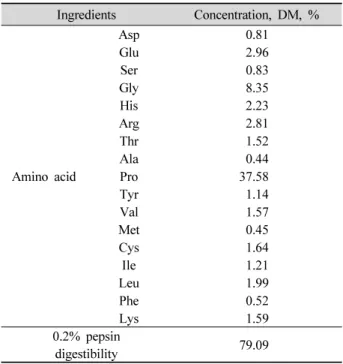
돈모단백질은 돈모를 가성소다(pH 10) 용액에 녹여 황 산으로 중화한 것(주, 에코엔 제조)을 사용하였으며, 이의 아미노산 조성은 Table 2와 같다. 그리고 돈모단백질 내의 중금속 성분으로서 크롬, 납 및 수은의 농도는 Table 3과 같다.
3) 조사 항목 및 방법
(1) 절식 시의 아미노산 배설량
수탉을 30시간 절식시킨 후 배설물을 수거한 후 5% 염산 으로 처리하였으며, 이것을 건조기에서 70℃로 48시간 건 조하여 아미노산량을 정량하였다.
(2) 아미노산 이용율
아미노산 이용율을 측정하기 위하여 대조구의 공시동물
에게는 기본사료를, 처리구에는 기본사료에 돈모단백질을
2 g 첨가하여 각각 30 g씩 소낭에 강제급여하였다. 계산
Table 4. Formula for experimental diets.
Ingredients Substitution levels of SBM
1by HHP
2, %
0 10 25 50
--- % ---
Corn 75.4 74.6 73.3 71.3
Soybean meal 22.0 19.8 16.5 11.0
Hog hair amino acid 0 3.0 7.6 15.1
Salt 0.3 0.3 0.3 0.3
CaCl
22.0 2.0 2.0 2.0
Vit.-Min. mixture
30.3 0.3 0.3 0.3
100.0 100.0 100.0 100.0
Chemical composition
ME. kcal/kg 2,750 2,755 2,758 2,765
Crude protein, % 15.6 15.7 15.7 15.7
Ca, % 2.0 2.0 2.0 2.0
P, % 0.6 0.6 0.6 0.6
1
Soybean meal.
2
Hog hair protein.
3
Vit.-min mixture provided followings per kg diet : Provided followings per kg of diet: Cu, 10 mg; Fe, 80 mg; Mn, 80 mg; Zn, 80 mg; I, 0.9 mg; Se, 0.2 mg; Co, 0.5 mg. vit. A, 12,000IU; vit. D
3, 3,000IU; tocopherol 15 mg; vit. K
3, 2 mg; thiamin, 2.0 mg; riboflavin, 6.0 mg; pyridoxine, 2 mg; vit. B
12, 0.03 mg; folic acid, 1.0 mg; biotin, 0.15 mg; niacin, 45 mg; D-Ca pantotenate, 15 mg; antioxidant, 0.5 mg.
방법은 차이법(Han 등, 1983)을 이용하였으며 공 복시의 질 소배설량을 공제하여 계산하였다. 반복수는 각각 10반복으 로 반복당 수수는 1수로 하였다.
아미노산
이용율(%) =
아미노산섭취량-(분뇨배설
아미노산량-내생 아미노산배설량) ×100
아미노산 섭취량
2. 돈모단백질의 대두박 대체가 사료이용성 및 혈액 성상에 미치는 영향
1) 공시동물 및 관리
공시동물은 한협3호(한협농장, 충남 금산군 소재) 수탉 종계(50주령, 평균체중 2,9 kg) 40수를 사용하였다. 수탉 은 대사 케이지에 1수씩 수용하였고 실온은 20-25℃가 유 지되었다.
2) 돈모단백질 및 사료
돈모단백질은 돈모를 가성소다용액(pH 10) 에 용해시
킨 후 황산으로 중화한 것(주, 에코엔 제조)을 사용하였으 며 그 아미노산 조성은 Table 2와 같으며, 사용된 사료의
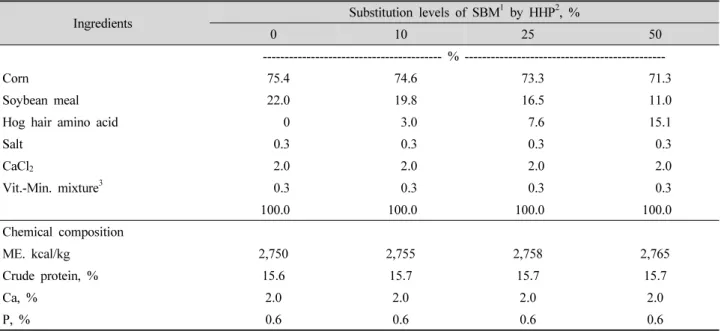
배합비와 화학적 조성은 Table 4와 같다.
3) 조사항목
(1) 사료섭취량, 음수량 및 질소 대사량
돈모단백질의 대두박 대체수준은 예비실험을 통하여 0,
10, 25 및 50%의 4수준으로 하였다. 사료섭취량은 Table 4에 수록된 4처리의 사료를 개체당 120 g씩 급여한 후 잔량 을 조사하여 구하였다. 음수량은 공급량과 잔량의 차이로, 질 소대사량은 섭취량과 배설량의 차이로서 구하였다.
(2) 혈액 성상
혈액은 시험 종료일 사료급여 전 각 처리별로 5수씩 익정 맥을 통해 5 mL씩 채취 하였다. 채취한 혈액은 centrifuge (T25 basic, Ika co., Germany)로 19,000× g에서 15분간 원심분리 후 상층액을 취하여 -70℃에서 냉동시킨 후, 자 동 혈액분석기(Selectra 2, Merk Ltd. Co. Netherland)로 한꺼번에 분석하였다.
조사항목으로는 손상 받은 간세포로부터 Disse강 내로
빠져나가 직접 혈류로 용이하게 확산되어 간 손상을 측정
할 수 있는 aspartate aminotransferase (AST), alanine
aminotransferase (ALT), 간담계 질환과 골질환 등에 주
Table 5. Dry matter and endogenous amino acid excretion by fasting roosters.
DM excretion,
g
Amino acids Endogenous amino acid excretion, mg
6.9
1Asp 42.5
Glu 67.0
Ser 26.5
Gly 80.2
His 43.5
Arg 29.2
Thr 23.2
Ala 36.0
Pro 38.7
Tyr 33.7
Val 22.9
Met 24.6
Cys 53.3
Ile 26.8
Leu 38.8
Phe 37.1
Lys 28.0
1
n=10
Table 6. Amino acid availabilities of hog hair protein by roosters
1Amino acids Metabolizability, %
Asp 62.2
Glu 67.0
Ser 84.3
Gly 80.2
His 78.6
Arg 72.6
Thr 67.7
Ala 82.9
Pro 72.6
Tyr 63.5
Val 72.4
Met 69.8
Cys 56.3
Ile 82.0
Leu 78.7
Phe 84.2
Lys 60.5
Mean 72.7
1
n=20 로 측정되는 alkaline phosphatase (ALP), 단백질 대사의
최종산물로 주로 간에서 urea cycle에 의해서 혈중에 방출 되는 blood urea nitrogen (BUN), 신장 기능의 지표로 이 용되는 creatinine, 간 장애나 체내 단백대사 이상의 지표 로 사용되는 albumin, 그리고 혈액내의 glucose 함량을 측 정하였다.
(3) 시료의 분석
시료의 조단백질 분석은 AOAC(1995) 방법으로, 아미노 산분석은 시료 100 ul을 취하여 PICO-tag 방법을 이용하여 PITC labeling을 실시하였으며, PITC labeling된 시료 400 ul 중 30 ul을 취하여 HPLC(Waters 510)에 loading하였다.
(4) 실험 설계 및 통계분석
4처리(돈모단백질 0, 3, 7.6 및 15.1%), 10반복, 반복당 1수로 실시하였으며, 얻어진 자료의 통계분석은 SPSS를 이용하여 general linear model procedure을 수행한 후, Duncan(1955)의 신다중검정법으로 5% 수준에서의 유의 성을 검정하였다.
III. 결과 및 고찰
1. 돈모단백질의 급여가 수탉의 단백질 이용성에 미 치는 영향
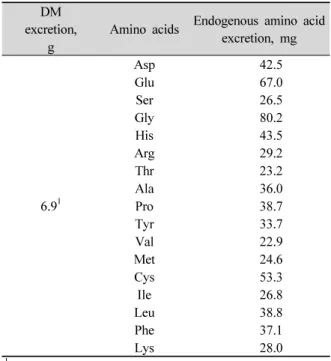
절식시의 질소 및 아미노산 배설량은 Table 5에 수록하 였다. 각 아미노산간에 많은 차이를 보이고 있는 바, glycine, glutelin 등의 배설량이 높은 편이었고 valine, threonine, methionine의 배설량은 상대적으로 적었다. 절식시의 아 미노산 배설량은 공시동물의 생리적 상태에 따라 변이가 많다고 알려져 있다(Papadopoulos, 1985).
돈모 아미노산의 이용율(availability)은 Table 6에 나타 난 바와 같다. Serine, phenylalanine, alanine, isoleucine 등은 다른 아미노산에 비하여 비교적 높은 이용율을 보였 으나, lysine, cystine, asparagine, tyrosine 등은 상대적으 로 낮았다. 본 시험에서 나타난 성적은 이 등(1988)이 White leghorn 수탉 실험에서 보고한 옥수수에 함유된 아 미노산(90.98%), 대두박(88.78%), 밀(90.32%)의 경우 보다 이용율이 낮았으며, 우모분의 71.97%와 유사한 수준 이었다.
2. 돈모단백질의 대두박 대체가 사료이용성 및 혈액 성상에 미치는 영향
사료섭취량, 음수량, 건물대사율 및 질소 대사량은
Table 7에서 보는 바와 같다. 사료섭취량은 돈모단백질의
첨가수준이 3% 수준까지 증가되어도 유의한 변화가 없었
Table 7. Effect of supplementation of hog hair amino acid on feed and water intake.
HHP
1, % Feed intake Water intake DM
metaboliza-bility
Nitrogen metaboliza-bility
DM
2, g mL/feed, DM, g % %
0 99.4
a±1.03 2.1
c±0.01 80.5
a±0.98 86.7
a±1.02
3.0
398.1
a±1.11 2.2
c±0.01 78.6
a±0.95 85.8
a±0.97
7.6
493.1
ab±1.24 2.6
b±0.01 76.1
ab±0.96 81.3
ab±0.97
15.1
590.2
b±1.18 3.2
a±0.01 74.7
b±0.95 79.2
b±0.93
1
Hog hair protein.
2
Dry matter.
3
10% substitution of soybean meal by HHAA.
4
25% substitution of soybean meal by HHAA.
5
50% substitution of soybean meal by HHAA.
a-c
Means with different superscripts within a column are significantly different (p<0.05).
Table 8. Blood parameters of rooster fed hog hair protein.
HHP
1, % Creatinine AST
2BUN
3ALT
4Total protein Glucose Albumin
0 mg/dl IU/L mg/dl IU/L g/dl mg/dl g/dl
0.5
b±0.04 223±13.2 under 5 under10 4.8±0.49 261±8.28 2.0±0.07
3.0
50.6
b±0.04 193±14.2 under 5 under10 4.4±0.11 285±17.9 2.0±0.08
7.6
60.6
b±0.05 210±16.6 under 5 under10 5.1±0.21 272±16.8 2.3±0.09
15.1
70.8
a±0.05 215±15.9 under 5 under10 4.9±0.19 270±18.2 2.1±0.08
1
Hog hair protein.
2
Aspartate aminatransferase.
3
Blood urea nitrogen.
4
Alanin aminatransferase.
5
10% substitution of soybean meal by HHAA.
6
25% substitution of soybean meal by HHAA.
7
50% substitution of soybean meal by HHAA.
a,b
Means with different superscripts within a column are significantly different (p<0.05).
으나 15.1%(대두박 50% 대체) 첨가 시에는 유의하게 감 소하였다. 그리고 음수량은 돈모단백질 첨가량이 많아질수 록 증가하는 경향을 나타내었는데 7.6%(대두박 25% 대 체) 첨가 및 15.1%(대두박 50% 대체) 첨가 시에는 유의하 게 증가하였다. 이러한 결과는 수분섭취량이 사료섭취량에 많은 영향을 미친 것으로 생각된다. 몇 연구자들(Wise and Barrick, 1963; Rakes 등, 1968)은 우모분의 급여가 기호 성에 부정적 영향을 미칠 수 있다고 지적한 바 있으나, 본 연구에서는 알칼리 처리를 하여 취기에 의한 영향은 별로 없었을 것으로 생각한다. Kornegay와 Thomas(1973)는 가수분해한 돈모를 육성돈 사료에 6% 정도 사용하여도 사 료섭취량에 영향을 주지 않았다고 하였으며, 본 시험 에서 는 돈모단백질을 7.6% 첨가하였을 때의 성적과 유사한 결 과로 생각된다. 돈모단백질 첨가량이 증가함에 따라 수분
섭취량이 증가하는 것은 돈모단백질의 제조 공정 중 중화 과정에서 발생하는 황산나트륨 또는 정제과정에서 발생할 수 있는 염화나트륨에 의하여 영향을 받았을 것으로 추측 된다.
건물대사율과 질소대사율은 돈모단백질의 첨가량이 증
가함에 따라 감소하는 경향이었으며 15.1% 첨가구는 첨가
량이 낮은 구(0-3%)에 비하여 유의하게 감소하였다. 돈모
분(hog hair meal)은 조단백질을 90% 이상 함유하고 있으
나 주로 keratin으로 되어있어 자연 상태로는 소화되기 어
렵다. Moran 등(1966
b)은 육성계 실험에서 고온 ․ 고압 가
수분해를 통하여 cystine의 disulfide bond를 분해되기 쉬
운 형태로 만들어 돈모분의 소화율을 증가시켰다고 하였고,
Wray 등(1979)은 숫송아지 사육에서 돈모 단백질 급여구
가 대두박 급여구에 비하여 일당증체량, 사료효율, 사료섭
취량, 도체특성에 처리구간 유의한 차이가 없었다고 하였 다. 본 실험에서는 돈모를 고온고압 가수분해를 한 것이 아 니고 알칼리 처리를 한 것이어서 다른 연구자들의 결과와 단순비교할 수 있는 것은 아니지만 케라틴 단백질의 이용 가능성을 제시하였다는 점에서 의미가 있다고 하겠으며, 위 결과에서 보면 7.6% 이하의 첨가수준에서는 별다른 무 리가 없는 것으로 사료된다.
돈모단백질의 급여시 혈액 성상은 Table 8에 나타난 바 와 같이 Creatine치에 있어 0∼7.6% 첨가시에는 유의한 변 화가 없었으나 15.1% 급여 시에는 유의하게 높은 수치를 보였다. creatinine은 근육의 수축 energy로서 creatine phosphate에서 생성된 creatine이 탈수되어 생긴 최종 대 사산물로서 신사구체에서 배설되고, 일부는 세뇨관에서 배 설되나 세뇨관에서 재흡수되지 않는다. 그러므로 혈중 creatinine농도는 신장의 배설기능에 관련이 있기 때문에 신혈류량 감소 또는 신사구체 여과율이 감소할 경우에 증 가할 수 있다(Delanghe 등, 1989). 이 결과는 신장 등 배설 기관에 이상을 초래할 가능성도 있다고 생각되어 보다 면 밀한 조사가 요구된다고 하겠다. 혈청의 AST, BUN, ALT, Total protein, glucose 및 albumin 수준에는 유의한 차이를 발견할 수 없었다.
IV. 결 론
본 연구는 돈모단백질의 가축사료로의 이용성을 조사하 기 위하여 실시하였으며, 실험 1에서는 50주령의 한협3호 수탉 종계 20수를 공시하여, 돈모단백질의 급여가 수탉의 단백질 이용성에 미치는 영향을 조사하였고, 실험 2에서는 한협 3호 수탉 종계를 4처리(돈모단백질 0, 3, 7.6 및 15.1%), 10반복, 반복당 1수로 돈모단백질의 대두박 대체 가 사료이용성 및 혈액성상에 미치는 영향을 조사하였다.
결과는 실험 1에서 glycine, glutelin 등의 배설량이 높 은 편이었고 valine, threonine, methionine의 배설량은 상 대적으로 적었다. 돈모 아미노산의 대사율은 serine, phenylalanine, alanine, Isoleucine 등은 다른 아미노산에 비하여 비교적 높은 대사율을 보였으나, lysine, cystine, asparagine, tyrosine 등은 상대적으로 낮았다. 실험 2에서 는 사료섭취량은 15.1%(대두박 50% 대체) 첨가 시에 유 의하게 감소하였다. 음수량은 돈모추출아미노산의 첨가량 이 증가함에 따라 감소하는 경향을 나타내었고, 질소대사
율은 15.1% 첨가구에서 다른 처리구에 비하여 유의한 감소 를 보였다. 혈액성상에 있어서는 creatinine이 15.1% 첨가 구에서 유의하게 높은 수치를 보였을 뿐, 다른 항목에서는 유의한 차이를 나타내지 않았다.
위의 실험 결과에서 보듯이 각 처리에서 돈모단백질의 급여에 의하여 유의성이 인정되는 변화는 없어 부정적인 결과는 나타나지 않았다고 할 수 있으며, 돈모단백질이 대 두박의 10% 수준의 대체에는 무리가 없는 것으로 판단된다.
참 고 문 헌