Effects of Lowering the Dietary Levels of Energy, Protein and Amino Acid (Methionine and Cysteine) on the Performance of Laying Hens
Subin Serpunja, Balamuralikrishnan Balasubramanian and In Ho Kim
† Department of Animal Resource & Science, Dankook University, Cheonan 330-714, South KoreaABSTRACT The purpose of our study was to determine the effects of varying levels of energy, protein, and amino acids on the performances of laying hens. A total of 240 Hy-Line Brown laying hens at 36 weeks of age were used in this 4-week feeding trial. The hens were randomly allocated to five treatment diets, with eight replications of six hens in each replicate cage. The treatment diets were as follows: A- basal diet + 18% crude protein, metabolizable energy 2,800 kcal, total (methionine + cysteine) 0.65%; B- basal diet + 17% crude protein, metabolizable energy 2,700 kcal, total (methionine + cysteine) 0.59%; C- basal diet + 16.5% crude protein, metabolizable energy 2,700 kcal, total (methionine + cysteine) 0.59%; D- basal diet + 16.5% crude protein, metabolizable energy 2,700 kcal, total (methionine + cysteine) 0.54%; and E- basal diet + 16% crude protein, metabolizable energy 2,680 kcal, total (methionine + cysteine) 0.54%. The study results revealed that the hen-day egg production of hens that were fed with low-energy diets (B, C, and D) was comparable with that of hens fed with high-energy diet A, whereas average daily feed intake in hens fed treatment diet D and E was significantly higher (P<0.05) than that in hens fed treatment diet A. Overall, the eggshell thickness was unaffected by any of the treatment diets. Egg weight was comparable among the treatment diets, except for treatment diet E. Haugh unit improved with decreasing levels of dietary energy, protein, and methionine + cysteine in the diet. We can summarize that laying hens fed with low dietary energy and low crude protein treatment diets B, C, and D had satisfactory performance compared with those fed with high-energy treatment diet A. This indicates that there is the potential to reduce feed costs by formulating diets with lower energy and low protein levels.
(Key words: amino acid, energy, laying hens, performance, protein)
†To whom correspondence should be addressed : [email protected]
INTRODUCTION
Due to the soaring prices of the feed, the study of different nutrient density diets and protein levels in feed has become important. The reason for this price hike is due to the increa- sing demand for corn and soybean for human consumption because of human population growth. In addition, the other reason for this dramatic increment of price is due to high demand for corn and soybean for producing ethanol, which is used as an alternative fuel source (Tokgoz et al., 2007).
In order to overcome this problem, different compositions of the diet are experimented to minimize the cost of the feed.
Pinto et al. (2003) suggested that cheaper diets with lower crude protein levels when supplemented with amino acid (AA) could meet the nutrition requirement of laying hens.
Furthermore, Polese et al. (2012) carried out experiments on brown shaver laying hens (50 to 66 week age) and suggested the methionine + cysteine requirement be 0.572%, which co- rresponds to 682 mg of digestible (methionine + cysteine)/bird/
day.
Energy is one of the major cost components in poultry diet.
Chickens use the supplied energy for maintenance, growth, and egg production. Feed intake is higher in low energy diet and lower in high energy diet. Hens fed with 1,848 kcal productive energy consumed 9.7% more feed than the hens provided with 2,046 kcal productive energy per kg of feed (Hill et al., 1956), increased in energy from 2,680 kcal to 2,810 kcal of ME/kg, and decreased the feed intake by 4%
(Grobas et al., 1999). Similarly, Harms et al. (2000) conclud- ed that the hens fed with 2,519 kcal of ME/kg consumed 8.5% more feed than the hens fed with 2,798 kcal of ME/kg diet, and hens fed with 3,078 kcal of ME/kg diet consumed 3% less feed compared to the hens fed with 2,798 kcal of ME/kg diet. However, feed intake was unaffected by the die- tary energy levels used in the diet (Jalal et al., 2006).
In formulating diets, we took reference of Yuan et al. (2009) and hypothesized that supplementing the diets with lysine and methionine + cysteine would highly improve the performance
of laying hens. The existing information on the comparison of the effects of varying levels of energy, protein, and amino acid in the diet of laying hen is not sufficient because of inconsistent results and research limitations. Therefore, the objective of the present study was to evaluate the effects of lowering the dietary levels of protein, energy, and amino acid (methionine + cysteine) on the performance of laying hens.
MATERIALS AND METHODS
1. Experimental Design, Birds and Housing The procedures used in this study were approved by the Animal Care and Use Committee of Dankook University. A total of 240 Hy-Line Brown layer hens at 36 weeks of age were used with the room that was maintained at 25℃ through- out the experiment. Artificial lighting with a light intensity of 5.2 lx was provided for sixteen hours (0500 to 2100 h) per day. Layers were allocated into 5 dietary treatments with 8 replications (6 hens/ replication) per treatment according to a randomized complete block design (RCBD). Experimental diets were formulated as per the guidelines recommended by NRC (1994). Dietary treatment groups were: A - basal diet + CP 18
%, ME 2,800 kcal, total (methionine + cysteine) 0.65%; B - basal diet + CP 17%, ME 2,700 kcal, total (methionine + cys- teine) 0.59%; C - basal diet + CP 16.5%, ME 2,700 kcal, total (methionine + cysteine) 0.59%; D - basal diet + CP 16.5%, ME 2,700 kcal, total (methionine + cysteine) 0.54%; E - basal diet + CP 16%, ME 2,680 kcal, total (methionine + cysteine) 0.54
%. Easy access to feed and water was provided throughout the experiment.
2. Sampling and Measurements
A daily record of egg production and a weekly record of egg weight were kept. The egg-production was calculated by keeping records of the eggs produced by each bird daily. In addition, the egg quality was checked at the 1st, 2nd, 3rd and 4th week of the experimental period. At the end of the week, 30 eggs (excluding the weak and broken ones) were collected from each treatment and the egg quality was checked on the same day. The egg weight was evaluated before breaking. The egg quality was evaluated as per the methods applied by
Zhang ZF and Kim IH (2014).
3. Statistical Analysis
Randomized complete block design (RCBD) was used in this experiment to analyze the data by using the GLM pro- cedure (SAS Inst. Inc. Cary, NC, USA). The cage was used as the experimental unit. Duncan multiple comparison test was used to determine the difference among the treatment means considering P<0.05 as significant difference.
RESULTS
1. Egg Production and Feed Intake
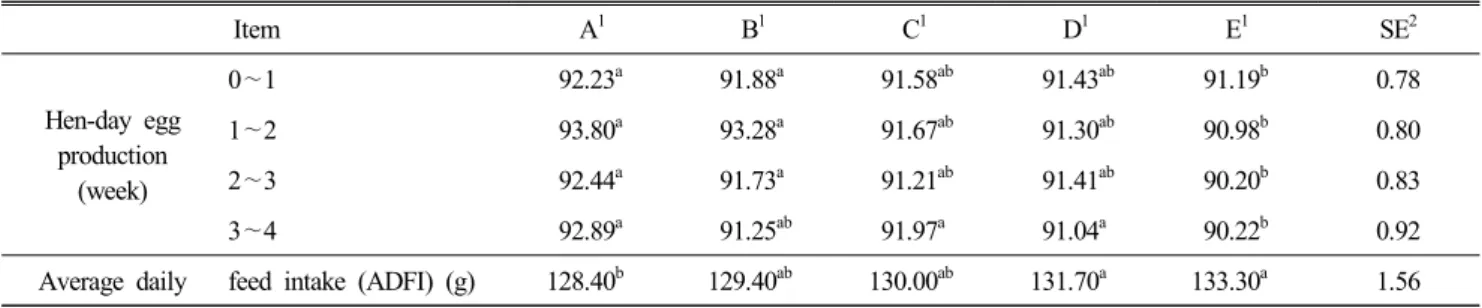
Hens fed treatment diet B and C had slightly higher feed intake; in contrast hens fed treatment diet D and E had sig- nificantly higher feed intake than hens fed treatment diet A (P<0.05) (Table 2). Hen-day egg production of hens fed diet E was significantly lower compared to hens fed high energy diet A (P<0.05) (Table 2). However, no significant difference was observed in the egg production of hens fed diet B, C, and D compared to diet A (P>0.05).
2. Egg Quality
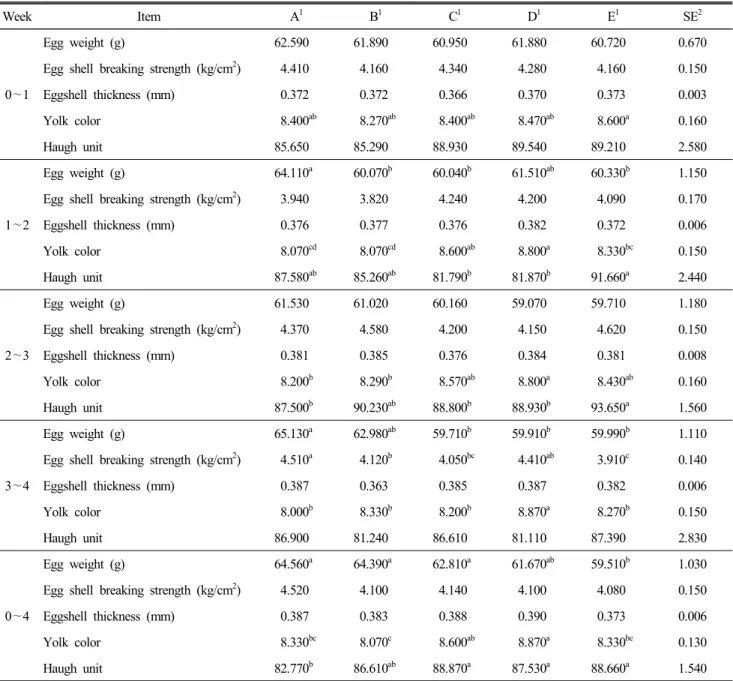
Eggshell thickness was unaffected by any of the treatment diets. There was no change in eggshell breaking strength ex- cept in the 3∼4 week. In the 4th week, the eggshell breaking strengths of treatment diet B, C and E were significantly lo- wer than A (P<0.05). No difference was found in egg weight of the 1st and 3rd week. In the 2nd week, the egg weights of treatment B, C and E were significantly lower than that of treatment A (P<0.05), where as, the egg weights of C, D and E were significantly lower than that of treatment A (P<0.05).
No significant difference was observed in egg yolk color in the 1st week (P>0.05). The hens fed with treatment diet D had higher value for yolk color compared to other treatments diets (P<0.05). The treatment diets had no effect in haugh unit at the 1st and 4th week (P>0.05). In the 2nd week, the haugh unit of treatment E was significantly higher than that of C & D treatments (P<0.05). In the 2nd week, haugh unit of E was significantly higher than those of C and D treatments (P<0.05). However in the 3rd week haugh unit of treatment
Table 1. Experimental diet composition (as-fed basis)
Item A1 B1 C1 D1 E1
Ingredients (%)
Corn 56.30 57.88 58.43 60.50 60.35
Soybean meal (46%) 22.72 22.62 20.93 22.14 22.13
Corn gluten meal 3.00 - - - -
Distillers dried grain soluble 5.00 8.00 8.00 3.44 3.52
Tallow 1.61 - - - -
Limestone 9.36 9.58 9.60 9.54 9.54
MCP:DCP (3:1) 1.41 1.37 1.39 1.51 1.51
Salt 0.22 0.18 - 0.44 0.44
Sodium bicarbonate 0.10 0.10 0.36 1.50 1.50
Methionine (99%) 0.02 0.01 0.03 0.60 0.05
Lysine (24%) - - 1.00 0.07 0.70
Vitamin premix1 0.06 0.06 0.06 0.06 0.06
Choline (50%) 0.10 0.10 0.10 0.10 0.10
Mineral premix2 0.10 0.10 0.10 0.10 0.10
Calculated nutrient content
Metabolizable energy (kcal/kg3) 2,800.00 2,700.00 2,700.00 2,700.00 2,680.00
Crude protein (%) 18.00 17.00 16.50 16.50 16.00
Lysine (%) 0.85 0.84 1.03 1.16 1.16
Methionine + cysteine (%) 0.65 0.59 0.59 0.54 0.54
Calcium (%) 3.87 3.95 3.95 3.95 3.95
Total phosphorus (%) 0.61 0.61 0.61 0.61 0.61
Abbreviation: MCP, Monocalcium phosphate; DCP, Dicalcium phosphate.
1 Provided per kilogram of diet: vitamin A, 12,500 IU; vitamin D3, 2500 IU; vitamin E, 13 IU; vitamin K3, 2 mg; vitamin B1, 1 mg; vitamin B2, 5 mg; vitamin B6, 1 mg; vitamin B12, 0.04 mg; folic acid, 0.9 mg; niacin, 55 mg; Ca-pantothenate, 14 mg.
2 Provided per kilogram of diet: Mn (as MnO2), 50 mg; Zn (as ZnSO4), 620 mg; Cu (as CuSO4․5H2O), 5 mg; Fe (as FeSO4․7H2O), 40 mg; Co (as CoSO4․5H2O), 0.3 mg; I (as KI), 1.5 mg; and Se (as Na2SeO3․5H2O), 0.15 mg.
3 Values for ingredients used in diet formulation were based on laying hen requirements in NRC (1994).
Table 2. Effect of experimental diet supplementation on hen-day egg production and feed intake in laying hens
Item A1 B1 C1 D1 E1 SE2
Hen-day egg production
(week)
0∼1 92.23a 91.88a 91.58ab 91.43ab 91.19b 0.78
1∼2 93.80a 93.28a 91.67ab 91.30ab 90.98b 0.80
2∼3 92.44a 91.73a 91.21ab 91.41ab 90.20b 0.83
3∼4 92.89a 91.25ab 91.97a 91.04a 90.22b 0.92
Average daily feed intake (ADFI) (g) 128.40b 129.40ab 130.00ab 131.70a 133.30a 1.56
1 A: basal diet + CP18%, ME 2,800 kcal, total (methionine + cysteine) 0.65%; B: basal diet + CP17%, ME 2,700 kcal, total (methionine + cysteine) 0.59%; C: basal diet + CP16.5%, ME 2,700 kcal, total (methionine + cysteine) 0.59%; D: basal diet + CP16.5%, ME 2,700 kcal, total (methionine + cysteine) 0.54%; E: basal diet + CP16%, ME 2,680 kcal, total (methionine + cysteine) 0.54%.
2 Pooled standard error.
ab Values with different superscripts in the same row differ significantly (P<0.05).
diet E was significantly higher compared to those of treat- ment diet A, C, D (P<0.05).
Overall, the egg weight was unaffected by the treatment diets except for treatment E. Likewise, eggshell breaking strength and egg shell thickness were unaffected by the treatment diets. However, the yolk color of treatment diet D was significantly higher than those of A, B and E (P<0.05), whereas, Haugh unit of A was significantly lower than those of C, D and E (P<0.05).
DISCUSSION
In our study, average daily feed intake (ADFI) increased significantly (P<0.05) with lowering dietary energy, crude protein, and methionine+cysteine level (Table 2). Feed intake was significantly decreased with the higher levels of dietary energy (Wu et al., 2005a, 2005b). Similarly, as the methionine + cysteine level increased from (0.61%, 0.68%, 0.75% and 0.82 to 0.89%), a linear reduction was observed in the feed intake (P<0.01) of brown-egg laying hens (Filho et al., 2006).
So our research along with previous research indicate that dietary energy level plays an important role in feed intake.
However, no significant effect on feed intake (P>0.05) with different levels of digestible methionine + cysteine was observ- ed in brown egg laying hens (Safaa et al., 2008), which is contrary to the results of our present study.
Hen-day egg production of hens fed low energy diet was comparable to egg production of hens fed high energy diet.
However, it was significantly lower in the case of hens fed treatment diet E (P<0.05) (Table 2). But, there was a linear decrease in egg laying rate (86.56 to 91.06%) of brown-egg laying hens (20 to 44 weeks) as the levels of methionine + cysteine increased from (0.61%, 0.68%, 0.75% and 0.82 to 0.89%) (Filho et al., 2006).
No significant effect was observed in eggshell breaking strength (P>0.05), except in the 3rd week (Table 3). The eggshell breaking strengths of treatment diet B, C and E were lower compared to that of treatment diet A. No significant effect was observed on eggshell thickness, specific gravity, shell weight per surface area, and shell percentage with me- thionine + digestible cysteine levels, when fed to laying hens (Polese et al., 2012). Likewise, albumen percentage, egg shell,
and yolk of brown egg laying hens at 20 to 44 weeks of age was unaffected by the methionine + cysteine levels in the diet (Filho et al., 2006). The above researches corroborate our studies because no significant effect was observed (P<0.05) in eggshell thickness in our study (Table 3). However, increa- sing levels of methionine + cysteine in the diet lead to decrease in eggshell thickness (Junior and Lima, 1999), which is contradictory with our study.
In our study, overall egg weight was unaffected (P>0.05) by dietary energy level, crude protein and methionine + cys- teine levels, except treatment E. Egg production, egg specific gravity, egg weight, egg mass, feed consumption, feed con- version, and body weight of hens were significantly increased by the increased protein level (Liu et al., 2004, 2005; Wu et al., 2005a). Increasing levels of methionine + cysteine showed a negative correlation between egg weight and egg production (Harms and Russel 1998).
A haugh unit ranging from 100 to 72 is considered the best quality according to (USDA 2000). Methionine + cysteine had no significant effect on haugh unit when supplied in the diet of layer hens (54 to 70 weeks of age) (Cupertino et al., 2009). Similarly, yolk index, albumen, and a haugh unit were not influenced by digestible methionine + cysteine levels in the diet (Sa et al., 2007). However, on reducing levels of methionine + cysteine in diet, Solarte et al. (2005) observed improvement in haugh unit, which corroborates our present study. Our study shows that the haugh unit is improving with the decreasing level of dietary energy, protein, and methio- nine + cysteine.
An important issue of our study focused on ammonia (NH3) emission. NH3 emission is a major concern for the poultry industry and can be lowered by dietary inclusion of fibrous ingredients and by lowering the dietary CP content (Roberts et al., 2007). NH3 adversely affects the health and production of poultry (Miles et al., 2004). Moreover, it emits noxious odors and may also cause eutrophication of surface water resources (Ritz et al., 2004). However, optimum level of CP should be maintained because massive reduction in CP level may result in unproductive effect due to a misbalance of op- timal limiting amino acid requirements (lysine, methionine).
Efficiency of protein utilization has been found to increase with the supplementation of poultry diets with methionine
Table 3. Effect of experimental diet supplementation on egg quality in laying hens
Week Item A1 B1 C1 D1 E1 SE2
0∼1
Egg weight (g) 62.590 61.890 60.950 61.880 60.720 0.670
Egg shell breaking strength (kg/cm2) 4.410 4.160 4.340 4.280 4.160 0.150
Eggshell thickness (mm) 0.372 0.372 0.366 0.370 0.373 0.003
Yolk color 8.400ab 8.270ab 8.400ab 8.470ab 8.600a 0.160
Haugh unit 85.650 85.290 88.930 89.540 89.210 2.580
1∼2
Egg weight (g) 64.110a 60.070b 60.040b 61.510ab 60.330b 1.150
Egg shell breaking strength (kg/cm2) 3.940 3.820 4.240 4.200 4.090 0.170
Eggshell thickness (mm) 0.376 0.377 0.376 0.382 0.372 0.006
Yolk color 8.070cd 8.070cd 8.600ab 8.800a 8.330bc 0.150
Haugh unit 87.580ab 85.260ab 81.790b 81.870b 91.660a 2.440
2∼3
Egg weight (g) 61.530 61.020 60.160 59.070 59.710 1.180
Egg shell breaking strength (kg/cm2) 4.370 4.580 4.200 4.150 4.620 0.150
Eggshell thickness (mm) 0.381 0.385 0.376 0.384 0.381 0.008
Yolk color 8.200b 8.290b 8.570ab 8.800a 8.430ab 0.160
Haugh unit 87.500b 90.230ab 88.800b 88.930b 93.650a 1.560
3∼4
Egg weight (g) 65.130a 62.980ab 59.710b 59.910b 59.990b 1.110
Egg shell breaking strength (kg/cm2) 4.510a 4.120b 4.050bc 4.410ab 3.910c 0.140
Eggshell thickness (mm) 0.387 0.363 0.385 0.387 0.382 0.006
Yolk color 8.000b 8.330b 8.200b 8.870a 8.270b 0.150
Haugh unit 86.900 81.240 86.610 81.110 87.390 2.830
0∼4
Egg weight (g) 64.560a 64.390a 62.810a 61.670ab 59.510b 1.030
Egg shell breaking strength (kg/cm2) 4.520 4.100 4.140 4.100 4.080 0.150
Eggshell thickness (mm) 0.387 0.383 0.388 0.390 0.373 0.006
Yolk color 8.330bc 8.070c 8.600ab 8.870a 8.330bc 0.130
Haugh unit 82.770b 86.610ab 88.870a 87.530a 88.660a 1.540
1 A: basal diet + CP18%, ME 2,800 kcal, total (methionine + cysteine) 0.65%; B: basal diet + CP17%, ME 2,700 kcal, total (methionine + cysteine) 0.59%; C: basal diet + CP16.5%, ME 2,700 kcal, total (methionine + cysteine) 0.59%; D: basal diet + CP16.5%, ME 2,700 kcal, total (methionine + cysteine) 0.54%; E: basal diet + CP16%, ME 2,680 kcal, total (methionine + cysteine) 0.54%.
2 Pooled standard error.
a∼d Values with different superscripts in the same row differ significantly (P<0.05).
(Schutte et al., 1994) or lysine (Uzu G and Larbier M, 1985).
So, based on these research findings, we supplied additional lysine in diet C, D and E with the hypothesis that it will help in the performance of laying hens. The performance of laying hens fed with low dietary energy and crude protein (B, C and D) were comparable to that of laying hens fed with high
dietary energy and high protein (A). According to our resear- ch, the treatment diet E is not favorable in poultry diets in terms of hens’ performance because egg laying rate and egg weight of this treatment diet are significantly lower compared to those of other treatment diets. As far as the other treatment diets (A, B, C, and D) are concerned, supplementation of
lysine would have compensated the negative effects of low dietary energy and crude protein on the performance of laying hens. Another advantage of lysine is that it is commercially available and also cheaper compared to protein. Therefore, our research can be helpful in formulating diets with low dietary energy and protein level, ultimately saving the cost of feed, as well as, preventing environmental pollution.
REFERENCES
Cupertino ES, Gomes PC, Rostagno HS, Donzele JL, Schmidt M, Mello CHH 2009 Exigência nutricional de metionina+
cistina digestíveis paragalinhas poedeiras de 54 a 70 se- manas de idade. R Bras Zootec 38:1238-1246.
Filho JJ, Silva JHV, Silva EL, Luis M, Ribeiro G, Martins TDD, Rabello CBV 2006 Exigências nutricionais de me- tionina+cistina para poedeiras semipesadas do início de produção até o pico de postura. R Bras Zootec 35:1063- 1069. (supl.).
Grobas S, Mendez J, Blas C, Mateos GG 1999 Laying hen productivity as affected by energy, supplemental fat, and linoleic acid concentration of the diet. Poult Sci 78:1542- 1551.
Harms RH, Russel GB 1998 The influence of methionine on commercial laying hens. J Appl Poult Res 7:45-52.
Harms RH, Russell GB, Sloan DR 2000 Performance of four strains of commercial layers with major changes in dietary energy. J Appl Poult Res 9:535-541.
Hill FW, Anderson DL, Dansky LM 1956 Studies of the energy requirements of chickens 3: The effect of dietary energy level on the rate and gross efficiency of egg pro- duction. Poult Sci 35:54–59.
Jalal MA, Scheideler SE, Marx D 2006 Effect of bird cage space and dietary metabolizable energy level on produc- tion parameters in laying hens. Poult Sci 85:306-311.
Junior M, Lima FR 1999 Efeito dos níveis de Proteína e de metionina da dieta sobre o desempenho de galinhas Poe- deiras após a muda forçada. Braz J Vet Res An 36:332- 338.
Liu Z, Wu G, Bryant MM, Roland DA Sr 2004 Influence of added synthetic lysine for first phase second cycle commer- cial Leghorns with the methionine + cysteine/lysine ratio
maintained at 0.75. Int J Poult Sci 3:220-227.
Liu Z, Wu G, Bryant MM, Roland DA Sr. 2005 Influence of added synthetic lysine in low-protein diets with the me- thionine plus cysteine to lysine ratio maintained at 0.75.
J Appl Poult Res 14:174-182.
Miles DM, Branton SL, Lott BD 2004 Atmospheric ammonia is detrimental to the performance of modern commercial broilers. Poult Sci 83:1650-1654.
Pinto R, Ferreira AS, Donzele JL, Albino LFT, Silva MA, Soares RTRN, Pereira CA 2003 Exigência de metionina mais cistina e de lisina para codornas japonesas na fase de crescimento e de postura. R Bras Zootec 32:1174-1181.
Polese C, Nunes RV, Christiane GV, Agustini MA, Takahashi SE, Vilela VO, Souza C, Reis CC 2012 Nutritional levels of digestible methionine + cysteine to brown-egg laying hens from 50 to 66 weeks of age. R Bras Zootec 41:1691- 1698.
Ritz CW, Fairchild BD, Lacy MP 2004 Implications of ammo- nia production and emissions from commercial poultry facilities: A review. J Appl Poult Res 13:684-692.
Roberts SA, Xin B, Kerr J, Russell JR, Bregendahl2 K 2007 Effects of dietary fiber and reduced crude protein on nit- rogen balance and egg production in laying hens1. Poult Sci 86:1716-1725.
Safaa HM, Serrano MP, Valencia DG, Arbe X, Moreno EJ, Lazaro R, Mateo GG 2008 Effects of the levels of methi- onine, linoleic acid and added fat in the diet on productive performance and egg quality of Brown laying hens in the late phase of production. Poult Sci 87:1595-1602.
SAS 1995 SAS user’s guide: Statistics, SAS Inst. Inc. Cavy, NC. 13. Sawada H, Nippon IkaDaigakuZasshi, 62:142.
Schutte JB, De Jong J, Bertram HL 1994 Requirement of the laying hen for sulfur amino acids. Poult Sci 73:274-280.
Solarte NW, Rostagno HS, Soares PR, Silva MA, Valasquez LFU 2005 Nutritional requirements in Methionine + Cys- teine for white egg laying hens during the first cycle of production. Int J Poult Sci 4:965-968.
Tokgoz S, Elobeid AE, Fabiosa JF, Dermot JH, Babcock BA, Yu TH, Dong F, Hart CE, Beghin JC 2007 Emerging bio- fuels: Outlook of effects on U.S. grain, oilseed and livestock markets. CARD Staff Report, SR 101:1-41.
Uzu G, Larbier M 1985 Lysine requirement in laying hens.
Arch. Geflügelkd 49:148-150.
Wu G, Bryant MM, Roland DASr 2005a Influences of die- tary energy and protein levels on performance of Hyline W-36 hens in phase I. Poult Sci 84:50.
Wu G, Bryant M, Voitle RA, Roland DASr 2005b Effect of dietary energy on performance and egg composition of Bovans White and Dekalb White hens during phase 1.
Poult Sci 84:1610-1615.
Yuan K, Wu G, Bryant MM, Roland DASr 2009 Effects of dietary fat and protein on performance, egg composition,
egg solids, and egg quality of Hy-line W-36 hens during phase 1. J Poult Sci 46:322-327.
Zhang ZF, Kim IH 2014 Effects of probiotic supplementation in different energy and nutrient density diets on perfor- mance, egg quality, excreta microflora, excreta noxious gas emission, and serum cholesterol concentrations in laying hens. J Anim Sci 91:4781-4787.
Received Feb. 15, 2017, Revised May 25, 2017, Accepted Jun. 5, 2017