고온 스트레스 하에 타우린 첨가가 육계 간의 Heat Shock Protein 70 및
In Vitro
의 단백질 합성에 미치는 영향조은소리․박강희․심관섭†
전북대학교 동물생명공학과
Effects of Taurine Supplementation on Heat Shock Protein 70 and In Vitro Protein Syntheses in Liver of Broiler Chicks under Chronic Heat Stress
Eun So Ri Cho, Garng Hee Park and Kwan Seob Shim†
Department of Animal Biotechnology, Chonbuk National University, Jeonju 561-756, Korea
ABSTRACT This study was conducted to investigate the effect of taurine supplementation on heat shock protein 70 and in vitro protein turnover in broiler chicks under chronic heat stress. Chicks were allocated into 3 groups of 10 birds per group;
the control group was maintained at a temperature of 24℃ without taurine (CO group), the heat-stressed group maintained at a temperature of 34℃ without taurine (HO group), and heat-stressed group maintained at a temperature of 34℃ with taurine (HT group). The final body and liver weights of broilers in the HO and HT groups were significantly lower than those of broilers in the CO group (P<0.05). However, these parameters of the broilers in the HT group were significantly higher than those of broilers in the HO group (P<0.05). The heat shock protein 70 (hsp70) concentration in the liver of broilers in the HO group was significantly higher than that of broilers in the CO and HT groups, but the hsp70 concentration in the liver of broilers in the HT group was not different from that of broilers in the CO group. Liver homogenates of 21 day-old broilers were incubated at temperatures of 37°C and 45℃ to prove the effect of high temperature and taurine on total protein syntheses.
Neither high temperature nor taurine supplementation affected protein syntheses in liver homogenates of the broilers. However, the more the temperature increased, the more the degradation rates of cytoplasmic protein in liver homogenates increased;
however, taurine supplementation had no effects on the protein syntheses in the liver of the broiler. It is possible that taurine indirectly affected protein turnover via various physiological mechanisms.
(Key words: broiler chicks, heat stress, taurine, protein syntheses)
†To whom correspondence should be addressed : [email protected]
서 론
최근 기후 변화로 인한 폭염이 극심하게 발생하였으며, 이 에 따라 가축에게 미치는 영향에 대한 관심이 지속적으로 높 아지고 있다(Hoffmann, 2010). 특히, 닭은 땀샘이 없어 고온 환경에서 체온 조절이 어렵기 때문에 사육 온도는 가금 산업 에서 매우 중요한 환경적 요인이다(Yu and Bao, 2008). 고온 스트레스에 노출된 육계는 낮은 생산성 및 높은 폐사율로 농 가에 경제적인 손실을 끼치게 되며(Sohn et al., 2013), 생체 내에선 빠른 대사로 인한 내분비 질환, 전신면역조절 이상 및 장점막 손상이 유발된다(Quinteiro-Filho et al., 2010; Sohail et al., 2012).
생명체가 일반적으로 스트레스에 노출될 때, 생체 내 대부 분의 단백질은 합성이 지체된다(Yu and Bao, 2008). 하지만 heat shock protein 70(hsp 70)은 일반적인 온도보다 높은 온 도에 노출이 되어 열 충격에 의해 합성이 유도되는 단백질로 (Long et al., 2015), 열 충격 단백질 조립과 분해(Wang et al., 2013; Hartl and Hayer-Hartl, 2002), 단백질 접힘과 변성(Zie- tkiewicz et al., 2004) 및 단백질 수송(Ryan and Pfanner, 2002) 의 기능을 수행함으로써 스트레스 받은 세포의 생존에 중요 한 역할과 내부 환경을 안정화하는 역할을 하고 있다.
타우린은 무향, 무색 및 무취로 대부분의 포유동물에서 다 량으로 존재하고 있는 유리 아미노산이다(Shim et al., 2006).
타우린은 담즙산과 결합(Ito et al., 2004), 세포 내 삼투압 조
절(Schaffer et al., 2010), 항산화(Kocak-Toker et al., 2005), 세 포손상 예방(Sener et al., 2005) 및 고온 스트레스 완화(Shim et al., 2006) 등 많은 생리적 기능을 가지고 있다. 하지만 고 온 스트레스 하의 육계에서 타우린 급여가 hsp70 발현 및 단 백질 합성에 미치는 영향에 대한 연구는 전무하다.
따라서 본 연구는 타우린의 고온 스트레스 완화 효과에 대 한 기초 자료를 제공하는 동시에, 타우린이 고온 스트레스 를 받은 육계의 hsp70 발현 정도 및 cell free system 상태에 서 단백질 합성에 미치는 영향을 구명하고자 실시하였다.
재료 및 방법
1. 고온 스트레스가 In Vivo에 미치는 영향
1) 공시동물, 시험설계 및 사양관리
본 실험은 (주)동우 부화장에서 부화한 1일령의 무감별 Ross종 육계 병아리 200수를 공시하여 2주간 적응 기간을 거친 후 14일령에 본 시험에 이용하였다. 적응기간 및 시험 기간의 사육 환경은 고온스트레스 처리를 위한 온도 변경 외 에는 동일하였다. 전 사양기간 동안 24시간 종일 점등하였 고, 계사의 온도는 34℃에서 감온하여 시험 종료 시에는 24
℃로 유지시켰으며, 상대습도는 시험기간 동안 평균 60%가 되도록 하였다. 시험사료는 시판사료를 구입하여 초기, 전기 및 후기로 나누어 급여하였고, 물은 자유로이 섭취하도록 하 였다. 고온 스트레스 처리를 위해 2주간 적응된 시험동물은 평균체중에 따라 선별하여 각 처리구 당 40수(10수 4반복) 씩 3처리구에 총 120수를 배치하여 33일령까지 사양시험을 실시하였다. 시험구 배치는 대조구(Control: 24℃), 고온 처리 구(HO: 34℃), 고온 처리에 0.1% 타우린 처리구(HT: HO+0.1
% 타우린)로 배치였다. 타우린의 공급은 14일령부터 음수 1 L당 타우린 1 g을 용해시켜 시험 종료까지 공급하였으며, 고 온 스트레스 처리는 21일령부터 사육실 온도를 한 시간에 2℃씩 증가시켜 34℃로 12일 동안 유지하였다. Hsp70 발현 과 in vitro 단백질 합성을 위한 샘플은 고온 환경에 노출 후 3, 6, 9, 12일에 각 처리구 당 10수씩 선발하여 채취하였다.
선발된 개체는 체중을 측정하고, 12시간 절식시킨 후 간을 적 출하여 액체질소에 즉시 넣어 동결시킨 다음 무게를 측정하 였다. 분리된 간 조직은 분석 전까지 —70℃에서 보관하였다.
2) Hsp70 발현
처리구별로 육계 각 10마리의 간을 pool로 합하여 1 g의 간을 5 mL의 lysis buffer(50 mM Tris, 150 mM NaCl, 0.1%
SDS, 0.5% Deoxy cholic acid, 1% Triton X-100, pH 7.5)에 30 초씩 3회 균질화한 뒤 4,000 rpm에서 20분 동안 원심분리한 후 분리된 상층액을 다시 15,000 rpm에서 20분 동안 원심분 리하여 분석 전까지 —20℃에 보관하였다. 단백질 정량은 DC Protein assay kit(Rio-rad, USA)를 이용하여 매뉴얼의 지시 에 따라 측정하였다. 전기영동은 Vinoth et al.(2015)의 방법 을 수정하여 20 mA/gel로 90분간 실시한 후 분리된 단백질 을 150 mM에 1시간 동안 transfer를 실시하였다. Transfer 후 blocking buffer(Sigma, USA)에 1시간 동안 상온에서 blocking 을 실시하였다. TTBS(20 mM Tris, 137 mM NaCl, 5 mM KCl, 0.05% Tween-20(v/v), pH 7.4)로 5분씩 5차례 세척 후 hsp70 (Enzo Life Sciences, USA)과 actin(Enzo Life Sciences, USA) 을 12시간동안 4℃에서 반응시켰다. 세척 후 Goat anti-mouse IgG antibody(Enzo Life Sciences, USA)와 Goat anti-rabbit IgG antibody(Enzo Life Sciences, USA)을 상온에서 1시간 교반 후 TTBS로 세척을 실시하였다. HRP colorimetric kit(Bio-rad, USA)를 이용하여 10분 동안 발색시켰으며, 증류수에 1분 동 안 반응을 종료시킨 후 membrane을 건조시켰다. Membrane 은 Perfection V700 Photo(EPSON, Japan)에 스캔하여 이미지 를 얻었고, Image master 1D software(Amersham Pharmacia Biotech, Sweden)를 이용하여 이미지 분석을 실시하였다
2. In Vitro 총 단백질 생합성
간 균질액의 in vitro 단백질 합성량은 Shim et al.(2006)의 방법을 수정하여 측정하였다. 간 3 g씩 6 mL의 ice cold buffer (50 mM Tris-HCl pH 7.5, 3 mM MgCl2, 2.5 mM KCl, 1.5 mM dithiothreitol, 0.2 mM spermidine, 0.25 M sucrose)에 30초 동 안 3차례 균질화시켜 실험에 사용하였고, 모든 과정은 clean bench 안에서 멸균된 물품들을 이용하여 진행하였다. 간 균 질액을 pool로 합하여 5 uCi [35S]-methionine(1175Ci/mmoL, Perkin-Elmer Life Sciences, USA)이 첨가된 medium Ⅰ에 16 시간 동안 항온수조에서 각각 37, 41, 45 및 49℃에서 배양하 였고, 타우린은 0, 10, 20, 40, 80 및 120 mM의 농도로 첨가 되어 37과 45℃에서 16시간 동안 배양시켰다. 배양이 끝난 후 15% ice-cold trichloroacetic acid(TCA)를 첨가하여 반응을 종 료시켰고, 3,000 ×g에서 4℃, 15분 원심분리시켜 가라앉은 pellet을 세척하기 위해 15% TCA를 제거하는 과정을 3차례 반복하였다. 세척 후 pellet에 NCS tissue solubilizer(Amersham, USA)와 Liquid Scintillation Cocktail(Amersham, USA)를 1:3 의 비율로 첨가하여 TRI-CARB 2300TR Liquid scintillation analyzer(Packard Bioscience, Switzerland)를 이용하여 radio- activity를 측정하였다.
(a) (b) (c) CO HO HT
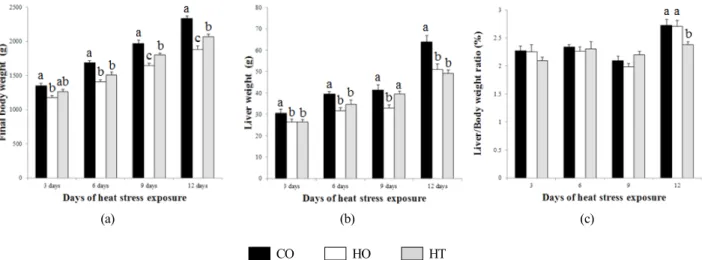
Fig. 1. Effects of taurine on final body weight (a), liver weight (b) and liver/body ratio (c) of broilers on 3, 6, 9 and 12 days of high temperature exposure period.
3. 통계 분석
본 연구에서 도출된 자료는 SAS Program(SAS 9.1, USA) 을 이용하여 General Linear Model procedure로 분산분석을 실시하였다. 처리구의 수치는 평균±표준오차로 나타냈으며, Duncan’s new multiple range test를 이용하여 5% 유의수준 에서 처리구간 통계적 차이를 분석하였다.
결과 및 고찰
1. 고온 스트레스가 체중과 간 무게에 미치는 영향 육계에서 고온 스트레스 노출 기간에 따라 각 3, 6, 9, 12 일의 체중과 간 무게는 Fig. 1에 나타냈다. 사양 종료 후 최 종 체중은 고온 스트레스에 노출된 전 기간 동안 HO군이 CO 군보다 유의적으로 낮았다(P<0.05). 이러한 결과는 만성적 인 고온 스트레스에 노출된 육계에서 체중이 32.6% 감소하 였다고 보고한 Sohail et al.(2012)과 10% 체중감소를 보고한 Deeb and Cahaner(2002)의 연구결과와 유사하였다. 또한 고 온 스트레스에 노출된 일령에 따라 HT군이 HO군보다 체중 이 높은 경향을 보였으며, 특히 9일과 12일에서 유의적으로 각각 8.7%와 9.0% 정도 높았다(P<0.05). 이러한 결과는 34℃
에서 만성적인 고온 스트레스에 노출된 육계에서 타우린 첨 가구가 무 첨가구보다 증체량이 유의적으로 높다는 것을 보 고한 Shim et al.(2006)의 결과와 유사하였다. 간 무게는 최 종 체중과 유사하게 HO군이 CO군보다 유의적으로 낮았다 (P<0.05). 이러한 결과는 만성적인 고온 스트레스에 노출된 산란계에서 간 무게가 감소하였다고 보고한 Felver-Gant et al.(2012)의 결과와 유사하다. 고온 스트레스에 노출된 일령
에 따라 간 무게는 HT군이 HO군보다 높은 경향을 보였다.
이러한 결과는 만성적인 고온 스트레스 하에 육계에서 0.8%
타우린 첨가구가 무 첨가구보다 간의 무게가 높았다고 보고 한 Shim et al.(2006)의 결과와 유사하게 타우린이 고온 스트 레스 시 간 무게의 감소를 완화시키는 기능을 수행한 것이 라 사료된다. 간/체중 무게 비율은 고온 스트레스에 노출된 전 기간 동안 유의적인 차이가 나지 않았다.
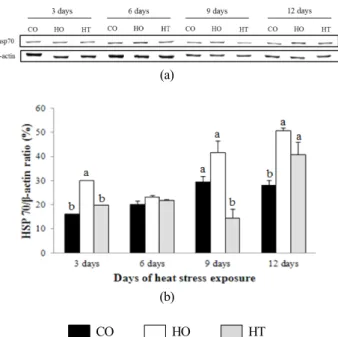
2. 고온 스트레스가 hsp70 발현에 미치는 영향 육계의 간에서 고온 환경에 노출된 기간에 따른 hsp70의 발현은 Fig. 2에 나타냈다. Fig. 2에 나타난 바와 같이, 고온 스트레스에 노출된 전 기간 동안 hsp70의 발현은 HO군이 CO군보다 유의적으로 높았다(P<0.05). 이러한 결과는 41℃
의 고온 스트레스에 노출된 육계의 간에서 hsp70의 발현이 유의적으로 증가하였다(P<0.05)고 보고한 Yu and Bao(2008) 의 연구결과와 유사하다. 또한 고온 스트레스에 노출된 전 기 간 동안 HT군 육계의 간에서 발현된 hsp70은 HO군보다는 유의적으로 낮았으나(P<0.05), CO군과는 차이가 없었다. 이 러한 결과는 초기에는 고온 스트레스로 인해 육계의 간에서 hsp70 합성이 증가하였고, 타우린의 급여가 고온 스트레스 반응을 약화시킴으로써 간에서 hsp70의 합성을 완화시킨다 는 것을 의미한다.
3. 온도 처리 수준이 총 단백질 합성에 미치는 영향 간 균질액을 각각 37과 45℃에서 16시간 동안 배양한 후 단백질 합성의 time course를 측정한 결과는 Fig. 3에 나타내 었다. 단백질 합성은 2시간 동안 급격하게 증가하였고, 4시
(a)
(b)
CO HO HT
Fig. 2. Hsp70 and β-actin expression (a) and ratio of hsp70/β- actin expression level (b) in liver of broiler chicks on 3, 6, 9 and 12 days of high temperature exposure.
a,b Means without bearing the same superscripts differ significantly (p<0.05).
37℃ 45℃
Fig. 3. Time course of protein synthesis in liver of broiler incubated at 37 and 45℃ for 45 minutes.
간 이후부턴 완만하게 증가하였다. Time course에서 온도 간 의 단백질 합성량은 유의적인 차이가 나지 않았다. Fig. 4는 타우린이 간 균질액의 단백질 합성에 미치는 영향을 측정하 기 위하여, 각각 37과 45℃에 16시간 동안 타우린을 0, 10, 20, 40, 80 및 120 mM 수준으로 첨가한 단백질 합성량을 나 타낸 것으로, 온도 처리 및 타우린 첨가수준에 따른 단백질 합성량에서 유의적인 차이가 나타나지 않았다. 본 연구의 결
(a)
(b)
Fig. 4. Protein synthesis in liver of broiler incubated for 16 hours at 37 (a) and 45 (b) ℃ by taurine concentrations.
과, 고온 스트레스 노출 및 타우린 처리 시 단백질 합성 총 량의 유의적인 차이가 없었으며, 이는 고온 스트레스 노출 시 간에서 hsp60(Yan et al., 2009), hsp70(Mahmoud et al., 2003) 및 hsp90(Lei et al., 2009) 등 여러 단백질의 합성이 증가한 다고 보고된 다른 연구결과들과 상반된다. 이러한 결과는 고 온 스트레스에 대한 단백질 합성이 in vivo 상태와 균질액을 이용한 in vitro 환경에는 차이가 있을 수 있다는 것을 시사 한다. In vivo 상태에서는 영양조건, 내분비 조절, 기타 여러 가지 복합적인 요인에 의하여 단백질의 합성량이 결정되지 만, 세포를 파괴한 균질액을 이용한 in vitro 상태에서는 열 또는 타우린 외에는 모든 조건이 동일하기 때문이다. 따라 서 총 단백질의 합성량에 차이가 없는 것으로 나타난 본 연 구의 결과는 열처리나 타우린 첨가에 의해 직접적으로 총 단 백질 합성에는 영향을 미치지 못한다는 것을 시사한다.
적 요
본 연구는 고온 스트레스 하에 타우린 첨가가 육계의 간 에서 heat shock protein 70(hsp 70) 및 cell free system 상태
에서 단백질 합성에 미치는 영향을 조사하였다. 공시동물은 1일령 육계 120수를 2주간 사육 후, 대조(CO, 24℃)와 고온 스트레스 처리(34℃)에서 타우린을 공급하지 않은 처리구 (HO)와 타우린 0.1%를 공급한 처리구(HT)로 나누어 3처리 4반복, 반복 당 10수씩 배치하였다. 고온 스트레스는 3, 6, 9, 12일간 진행하였다. 최종 체중과 간 무게는 HO와 HT가 CO보다 유의적으로 낮았다(P<0.05). 그러나 타우린을 첨가 한 HT은 HO보다 유의적으로 높았다(P<0.05). 육계 간에서 hsp70 발현은 HO가 CO와 HT보다 유의적으로 높았으나(P<
0.05), CO와 HT는 유의적인 차이가 없었다. In vitro 실험에 서 고온 및 타우린은 21일령 육계 간의 총 단백질 합성률에 영향을 미치지 않았다. 따라서 타우린 섭취가 in vivo 육계의 성장에서 고온 스트레스를 완화시키지만, 생체 내의 단백질 합성에 직접적인 영향을 미치지 않는 것을 보이며, 이러한 결 과는 타우린이 다양한 생리학적 기전을 통해 단백질 turnover 대사에 간접적으로 영향을 미칠 수 있다는 것으로 사료된다.
(색인어: 육계, 고온 스트레스, heat shock protein 70, 타우 린, 간, 단백질 합성)
REFERENCES
Deeb N, Cahaner A 2002 Genotype-by-environment interac- tion with broiler genotypes differing in growth rate. 3.
Growth rate and water consumption of broiler progeny from weight-selected versus nonselected parents under normal and high ambient temperatures. Poult Sci 81:293- 301.
Felver-Gant J, Mack L, Dennis R, Eicher S, Cheng HW 2012 Genetic variations alter physiological responses following heat stress in 2 strains of laying hens. Poult Sci 91:1542- 1551.
Hartl FU, Hayer-Hartl M 2002 Molecular chaperones in the cytosol: From nascent chain to folded protein. Sci 295:
1852-1858.
Hoffmann I 2010 Climate change and the characterization, breeding and conservation of animal genetic resources.
Anim Genet 41(s1):32-46.
Ito T, Fujio Y, Hirata M, Takatani T, Matsuda T, Muraoka S, Takahashi K, Azuma J 2004 Expression of taurine trans- porter is regulated through the TonE (tonicity-responsive element)/TonEBP (TonE-binding protein) pathway and con- tributes to cytoprotection in HepG2 cells. Biochem J 15
(382):177-182.
Kocak-Toker N, Giris M, Tulubas F, Uysal M, Aykac-Toker G 2005 Peroxynitrite induced decrease in Na+, K+-ATPase activity is restored by taurine. World J Gastroentero 11:
3554-3557.
Lei L, Yu J, Bao E 2009 Expression of heat shock protein 90 (Hsp90) and transcription of its corresponding mRNA in broilers exposed to high temperature. Br Poult Sci 50:
504-511.
Long LL, Han YL, Sheng Z, Du C, Wang YF, Zhu JQ 2015 Expression analysis of HSP70 in the testis of Octopus tan- kahkeei under thermal sress. Comp Biochem Physiol Part A 187:150-159.
Mahmoud KZ, Edens F, Eisen E, Havenstein G 2003 Effect of ascorbic acid and acute heat exposure on heat shock protein 70 expression by young white Leghorn chickens.
Comp Biochem Physiol Part C Toxicol Pharmacol 136:
329-335.
Quinteiro-Filho W, Ribeiro A, Ferraz-de-Paula V, Pinheiro M, Sakai M, Sa L, Ferreira A, Palero-Neto J 2010 Heat stress impairs performance parameters, induces intestinal injury, and decreases macrophage activity in broiler chickens. Poult Sci 89:1905-1914.
Ryan MT, Pfnner N 2002 Hsp70 proteins in protein translo- cation. Adv Protein Chem 59:223-243.
Schaffer SW, Jong CJ, Ramila K, Azuma J 2010 Physiological roles of taurine in heart and muscle. J Biomed Sci 17:S2.
Sener G, Sehirli O, Cetinel S, Midilliolu S, Gedik N, Ayanolu- Dulger G 2005 Protective effect of taurine against alendro- nate-induced gastric damage in rats. Fund Clin pharmacol 19:93-100.
Shim K, Hwang K, Son M, Park G 2006 Lipid metabolism and peroxidation in broiler chicks under chronic heat stress.
Asian-Aust J Anim Sci 19:1206.
Sohail M, Hume M, Byrd J, Nisbet D, Ijaz A, Sohail A, Sha- bbir M, Rehman H 2012 Effect of supplementation of prebiotic mannan-oligosaccharides and probiotic mixture on growth performance of broilers subjected to chronic heat stress. Poult Sci 91:2235-2240.
Sohn SH, Cho EJ, Jang IS, Moon YS 2013 The effects of dietary supplementation of vitamin C and E on the growth performance and the stress response in broiler chickens.
Korean J Poult Sci 40(1):31-40.
Vinoth A, Thirunalasundari T, Tharian JA, Shanmugam M, Rajkumar U 2015 Effect of thermal manipulation during embryogenesis on liver heat shock protein expression in chronic heat stressed colored broiler chickens. J Therm Biol 53: 162-171.
Wang J, Cui S, Zhang X, Wu Y, Wu H 2013 High expre- ssion of heat shock protein 90 is associated with tumor aggressiveness and poor prognosis in patients with advanced gastric cancer. PLoS One 8(4):e62876.
Yan J, Bao E, Yu J 2009 Heat shock protein 60 expression in heart, liver and kidney of broilers exposed to high tem-
perature. Res Vet Sci 86: 533-538.
Yu J, Bao E 2008 Effect of acute heat stress on heat shock protein 70 and its corresponding mRNA expression in the heart, liver and kidney of broilers. Asian-Aust J Anim Sci 21:1116-1126.
Zietkiewicz S, Krzewska J, Liberek K 2004 Successive and synergistic action of the Hsp70 and Hsp100 chaperones in protein disaggregation. J Biol Chem 279:44376-44383.
Received Aug. 30, 2016, Revised Oct. 6, 2016, Accepted Oct.
18, 2016