Copyright ⓒ 2010, The Microbiological Society of Korea
난분해성 케라틴 단백질을 함유하는 닭 우모 분해세균의 분리 및 특성
김세종1·조천휘2·황경숙1,3*
1목원대학교 미생물나노소재학과, 2(주)카프코 생물화학연구소, 3목원대학교 미생물생태자원연구소
Isolation and Characterization of Keratinolytic Protein Chicken Feather-Degrading Bacteria
Se-Jong Kim
1, Chun-Hwi Cho
2, and Kyung-Sook Whang
1,3*1Department of Microbial & Nano Materials, Mokwon University, Daejeon 302-729, Republic of Korea
2KAFCO Biochemistry Research Institute, Chungbuk 373-831, Republic of Korea
3Institute of Microbial Ecology and Resources, Mokwon University, Daejeon 302-729, Republic of Korea (Received February 25, 2010/Accepted March 15, 2010)
Thirty-one chicken feather-degrading bacteria were isolated from wasted feather, compost and wastewater in a chicken farm. These isolates were categorized as Firmicutes (21 strains), γ-proteobacteria (4 strains), Actinobacteria (4 strains), and Bacteroidetes (2 strains) by 16S rRNA gene sequence analysis.
We examined the feather-degrading isolates for degradation in the 2% of chicken feather meal. The strain Chryseobacterium sp. FBF-7, Stenotrophomonas maltophilia FBS-4, and Lysinibacillus sp. FBW-3 were selected as a keratinolytic protein degrading bacteria which showed the highest feather degradation of 75-90%. The characteristics of amino acids extracted from chicken feather meal by using keratinolytic protein degrading isolates and chemical method with Ca(OH)
2were analyzed. Total amino acid content of strain Chryseobacterium sp. FBF-7 was 1,661.6 μmol/ml, which was the highest and it was similar with chemical method. And essential amino acid content of total amino acid was thirty-seven percent (619.3 μmol/ml) and 596.9 μmol/ml for keratinolytic protein degrading isolates and chemical method, respectively. The major amino acids were valine, glutamic acid, aspartic acid, glycine, and proline by the strain Chryseobacterium sp. FBF-7 and especially, higher contents of aspartic acid, threonine, serine, cysteine, and tyrosine were detected compared with chemical method.
Keywords: amino acids, chicken feather, keratinolytic protein degrading bacteria
국내에서 사육되고 있는 대표적 가금류인 닭은 연평균 약 58,000만 마리 정도가 도계되어 가공 처리되고 있으며, 도계 처리과정에서 발생되는 닭 우모(chicken feather)는 닭 생체중 의 5-7%를 차지하여 연간 5만 톤 이상이 부산물로서 생산되고 있다(11, 26). 우모를 비롯하여 생물체의 보호기능을 하는 피부 각질이나, 손톱, 머리카락, 양모, 말발굽, 뿔, 깃털 등과 같은 케라틴(keratin)은 섬유상 구조 단백질(5, 9)로 β-helix를 형성 하는 펩타이드 결합과 사슬 내 수많은 수소결합 및 이황화결합 등 다양한 결합으로 이루어져 있기에 pepsin, trypsin, papain 등과 같은 일반적인 protease로는 거의 분해되지 않고 물리화 학적으로도 매우 안정한 난분해성 단백질로 알려져 있다(6, 30). 이러한 난분해성 케라틴 단백질이 주성분인 우모는 극히
* For correspondence. E-mail: [email protected]; Tel: +82-42- 829-7593; Fax: +82-42-829-7599
일부만이 보온재 및 쿠션 등 충전재로 사용되고 대부분 소각이 나 매립 처리되어 왔으나, 소각 시 많은 매연이 발생하고 매립으 로 인한 토양 환경오염의 주요 요인 중 하나로 알려져 왔다(18).
최근 동물 영양학자들에 의해 케라틴 단백질의 영양적 우수 성이 알려지면서 폐기물로 배출되던 우모를 우모분(feather meal) 형태로 가공하여 가축 및 양어 사료 등으로 이용하고 있 다(10). 또한, 조단백질 함량이 약 85%인 우모를 가압, 가열 등 물리적 처리법과 산⋅알칼리 처리에 의한 화학적 분해법을 이용하여 아미노산을 추출하여 활용하고 있다(12). 물리⋅화학 적 처리에 의한 아미노산 추출은 공정과정 중 폐수 및 악취가 대량 발생하여 환경오염을 유발하는 원인이 되어 왔으며, 처리 비용이 높아 경제성이 낮을 뿐 아니라 단위동물에 대한 소화율 도 50% 이하로 매우 저조한 것으로 알려져 있다(2, 21). 이와 같은 물리⋅화학적 처리공정의 비효율성을 고려하여 생물학적
분해기술을 이용한 친환경적 가공 처리법에 관한 연구가 절실 히 요구되고 있다.
미생물이 생성하는 효소를 이용하여 난분해성 케라틴 단백 질을 분해시키는 생물학적 분해기술에 관한 연구가 전통적으 로 이용되고 있는 화학촉매를 대체하기 위하여 수행되고 있다.
케라틴 단백질 분해미생물이 생산하는 특이적인 효소를 kera- tinase 또는 keratinolytic protease라고 하는데, 이 효소들은 케 라틴 외에도 매우 안정된 구조의 다양한 난분해성 기질을 분해 한다는 측면에서 일반적인 단백질 분해효소와 구별되어진다 (8). 지금까지 분리 보고된 keratinase 및 keratinolytic protease 를 생성하는 미생물군은 세균이 대부분을 차지하고 일부 방선 균과 곰팡이도 보고되어 왔다(3, 8, 13, 16, 16, 20, 25, 27). 이 들 우모 분해균에 관한 연구는 keratinolytic protease 생성균의 분리와 동정 그리고 케라틴 단백질 분해효소의 특성에 관한 연 구(21)가 주로 이루어진 반면, 이들 효소를 이용하여 우모로부 터 추출된 아미노산의 특성과 산업적 가치 평가에 관한 연구는 미흡한 실정이다.
본 연구에서는 국내 다양한 지역의 양계장으로부터 폐기물 로 버려지는 폐깃털을 효율적으로 분해할 수 있는 케라틴 단백 질 분해세균을 다수 확보하고, 우수 미생물을 선발하여 이들 균주를 이용하여 아미노산을 추출한 다음 화학적 분해법에 의 해 추출된 아미노산과 특성을 비교함으로써 생물학적 분해법 에 의해 추출된 아미노산의 친환경 비료로써의 사용 가능성을 평가하고자 하였다.
재료 및 방법
시료채취
케라틴 단백질 분해세균을 분리하기 위하여 충남 보령과 홍 성에 소재한 양계장으로부터 폐깃털 9시료와 양계장 부산물을 이용하여 퇴비발효가 진행되고 있는 계분퇴비 9시료를 채취하 였으며, 전북 익산의 육계 가공공장으로부터 발생되는 폐수 시 료를 포함해 총 19개의 시료를 채취하였다. 폐깃털은 양계장 내에 1년 이상 야적한 부산물을 채취하였고, 계분퇴비는 양계 장 바닥 내 9개 지점으로부터 100 g씩 채취한 후 polyethylene vinyl bag에 넣어 실험실로 운반하여 4°C에 보존한 후 24시간 이내에 실험하였다.
배양배지
채취한 시료로부터 세균을 분리하기 위하여 NA 평판배지 (1.0% bacto beef extract, 1.0% bacto peptone, 0.5% NaCl, 1.2% agar, pH 7.5±0.2)를 사용하였다. 단백질 분해세균의 선 별을 위하여 기초배지(0.03% K2HPO4, 0.03% KH2PO4, 0.01%
Na2CO3, 1.5% agar, pH 7.5±0.2)에 1.0% skim milk를 첨가한 평판배지를 이용하여 단백질 분해능을 판별하였다. 우모 분해 능 시험을 위하여 무기염배지(0.05% NH4Cl, 0.05% NaCl, 0.03% K2HPO4, 0.03% KH2PO4, 0.01% MgCl2․6H2O, 0.01%
yeast extract, pH 7.5±0.2)에 케라틴 단백질 우모분(chicken feather meal)을 2.0% 첨가한 배지를 사용하였다(27).
케라틴 단백질 분해능
채취한 각 시료로부터 순수 분리된 균주를 1.0% skim milk agar plate에 접종하여 28°C, 2일간 배양한 후 10 mm 이상의 큰 투명환을 생성하는 균주를 단백질 분해능이 우수한 균주로 판정하고 1차 분리하였다. Protease 활성 측정을 위해 배지에 서 3일간 배양된 배양액을 4°C, 8,000 rpm에서 20분 동안 원 심분리한 후 회수한 상등액을 조효소액으로 사용하였다. 효소 의 활성 측정은 casein을 기질로 이용하는 방법을 사용하였다.
조효소액 0.5 ml를 2.5 ml의 0.6% casein 현탁액(50 mM Tris- HCl buffer, pH 7.0)에 첨가하여 37°C에서 20분간 반응시킨 후, 2.5 ml의 50% trichloroacetic acid (TCA) 저해제를 첨가 하여 반응을 정지시키고 여과지(Whatman filter paper No.2 90 mm∅)에 여과하여 불용성의 기질을 제거하였다. 여과된 여과액 1 ml에 0.55 M Na2CO3 2.5 ml를 첨가하고 6배로 희 석한 folin reagent를 0.5 ml 첨가하여 실온에서 30분간 발색시 킨 후 660 nm에서 흡광도(UVICON Spectrophotometer 930, Kontron Instruments, USA)를 측정하였다. 효소 단위는 tyrosine 표준도표를 이용하여 기본 조건하에서 1분간 기질로부터 1 μg 의 tyrosine을 유리하는 효소의 총량을 1 unit로 하여 protease activity를 나타내었다. 이들 단백질 분해세균을 2.0% 우모분이 첨가된 무기염 배지에 각각 접종하여 25°C, 150 rpm으로 3일 간 회전진탕 배양하면서 배양 24시간 마다 배양액을 여과지 (whattman filter paper No.2, 90 mm∅)로 거른 후 증류수로 4 회 세척하였다. 여과지에 걸러진 깃털을 60°C 건조기(drying oven Mov-212, SANYO, Japan)에서 8시간 건조시킨 후 깃털 의 건중량을 백분율로 나타내어(17) 우모분 분해능을 산출하 였다.
닭 우모 분해세균의 계통해석
케라틴 단백질 분해미생물로 선발된 균주의 계통학적 위치 를 검토하기 위하여 평판배지에 형성된 콜로니를 주형 DNA로 하여 16S rRNA PCR 증폭하였다. 16S rRNA PCR 증폭에 사 용된 primer는 E. coli 16S rDNA 부분의 conserved sequence 를 기초로 하여 합성된 27F (5′-AGAGTTTGATCCTGGCTC AG-3′) primer와 1492R (5′-AAGGAGGTGATCCAGCCGC- 3′) primer를 사용하였다. PCR은 initial denaturation 94°C, 5 min; denaturation 94°C, 30 sec; annealing 53- 56°C, 30 sec;
extention 72°C, 1 min의 조건으로 35 cycle을 실시한 후, final extention을 72°C에서 7분간 유지하여 증폭을 종결하였다.
16S rRNA의 PCR 증폭산물은 1% agarose gel, 0.5× TAE buffer (0.045 M Tris-borate, 0.001 M EDTA)에서 100 V, 25 mA로 30분 동안 전기영동(Mupid-21, Gel documentation system, Bio-Rad, USA)한 후, ethidtum bromide (EtBr)로 15분 간 염색하여 UV하에서 증폭 여부를 확인하고, QIAquick® PCR Purification kit (QIAGEN Inc.)를 이용하여 정제하였다.
정제된 PCR 증폭산물의 16S rRNA 염기서열 결정에는 ABI PRISM BigDye Terminator Cycle Sequencing Ready Reaction kit (Applied Biosystems)를 이용하여 cycle sequencing을 수행 한 후, ABI PRISM 310 Genetic Analyser (Applied Bio-
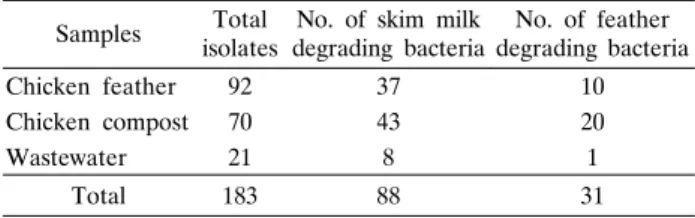
Table 1. Collection of chicken feather-degrading bacteria from chicken feather, compost and wastewater
Samples Total
isolates No. of skim milk
degrading bacteria No. of feather degrading bacteria
Chicken feather 92 37 10
Chicken compost 70 43 20
Wastewater 21 8 1
Total 183 88 31
systems)로 염기서열을 결정하였다.
16S rRNA 유전자 분석을 통하여 염기서열을 결정한 후 DDBJ/NCBI/RDP/GenBank database의 BLAST program을 이 용하여 계통분류학적 유연관계를 분석하였다. 각 염기서열의 alignment는 CLUSTAL X algorithm를 이용하여 병렬로 정렬 하였고, 계통도의 작성은 근린 결합법(24)에 의거하여 계통분 류학적 위치를 결정하였다(29).
아미노산 추출 및 분석
수산화칼슘 처리에 의한 화학적 분해로 우모로부터 아미노 산을 추출하기 위하여 Ca(OH)2를 처리한 후, 95°C에서 6시간 동안 가열시켜 우모를 가수분해한 후 phosphoric acid로 pH가 6-7인 약산성이 되도록 중화하고 감압 여과하여 가수분해물인 액상의 아미노산을 추출한 후, 4°C, 8,000 rpm에서 20분간 원 심분리하여 상층액을 회수하였다. 생물학적 분해를 이용한 아 미노산 추출은 본 연구에서 최종 선발된 우수 균주를 2.0% 우 모분이 첨가된 무기염배지에 각각 접종하여 25°C에서 150 rpm으로 3일간 회전진탕배양한 후, 배양액을 4°C, 8,000 rpm 에서 20분간 원심분리하여 상층액을 회수하였다(31). 각각의 분해법으로 추출된 아미노산의 함량과 조성은 아미노산 분석 기(L-8900 Amino Acid Analyzer, Hitachi, Ltd., Japan)를 이 용하여 분석하였다.
결과 및 고찰
케라틴 단백질 분해세균의 수집
양계장으로부터 채취한 폐깃털 및 계분퇴비와 닭 가공공장 의 폐수시료로부터 순수 분리된 총 183 균주를 대상으로 skim milk 평판배지 상에서 직경이 10-17 mm 이상의 큰 투명환을 나타내는 단백질 분해세균을 1차 선별한 결과, 폐깃털로부터 37균주, 계분퇴비로부터 43균주 그리고 폐수로부터 8균주 총 88균주가 단백질 분해 우수균주로 선별되어 분리균주의 약 50%가 단백질 분해능을 나타내는 특성을 나타내었다. 선별된 단백질 분해 우수균주의 protease 활성을 측정한 결과 약 99-2,585 unit/ml/min의 높은 활성을 나타내었다. 이와 같은 결 과로부터 양계장 부산물 시료는 단백질 분해미생물 유전자원 수집을 위한 우수한 시료임을 확인해 주었다.
단백질 분해능이 우수한 88균주 중 난분해성 케라틴 단백질 분해세균을 선발하기 위하여 2% 우모분이 첨가된 무기염배지 에 상기의 단백질 분해세균을 각각 접종하고, 37°C에서 3일간 진탕배양하면서 각 균주의 우모 분해능을 조사하였다. 배양 3 일 후 65% 이상의 높은 우모 분해능을 나타내는 균주를 선발 한 결과, 폐깃털로부터 분리한 단백질 분해세균 중 10균주, 계 분퇴비로부터 20균주, 폐수로부터 1균주가 높은 우모 분해능을 나타내어 총 31균주를 케라틴 단백질 분해 우수균주로 확보하 였다(Table 1).
닭 우모 분해세균의 계통학적 다양성
양계장 부산물로부터 확보한 우모 분해세균 31균주에 대해
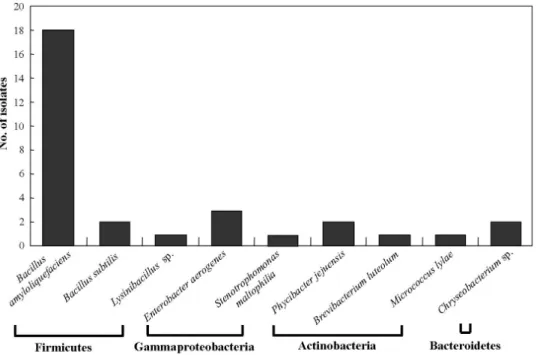
16S rRNA 염기서열을 결정하여 계통학적 특성을 검토한 결 과, Firmicutes 계통군에 속하는 균주는 21균주로 수집된 총 우모 분해세균의 68%를 차지하였으며, γ-proteobacteria 계통 군에 속하는 균주는 4균주, Actinobacteria 계통군에 속하는 균 주는 4균주 그리고 Bacteroidetes 계통군에는 2균주가 확인되 었다. 특히, Firmicutes 계통군에 속하는 균주 중 Bacillus amyloliquefaciens 균주가 18균주로 우점을 이루었으며, 그 외 에 Bacillus subtilis, Lysinibacillus sp.가 속하였다. γ-Proteo- bacteria 계통군에는 Enterobacter aerogenes, Stenotro- phomonas maltophilia가 속하였으며, Actinobacteria 계통군에 는 Phycibacter jejuensis, Brevibacterium luteolum, Micrococcus lylae가 속하였고 그리고 Bacteroidetes 계통군에는 Chryseo- bacterium 속에 속하는 균주가 확인되어 계통학적으로 다양한 우모 분해세균이 양계장 부산물 내에 서식하는 것으로 판단되 었다(Fig. 1).
지금까지 보고된 keratinolytic protease 또는 keratinase를 생산하며 우모를 분해하는 세균으로는 Bacillus 속에 속하는 B. pumilis, B. cereus, B. licheniformis, B. subtilis 그리고 B. megaterium 등이 가장 많이 보고되었으며, 이 외에도 Pseudomonas sp, Vibrio sp., Chryseobacterium sp. 그리고 Flavobacterium 등이 분리 보고되었다(8, 14, 23, 25, 28, 30, 31, 32).
닭 우모 분해 우수균주 선발
케라틴 단백질 우모 분해세균 31 균주 중 우모 분해율을 검 토한 결과, FBS-4 균주의 분해율은 90%, FBW-3 균주은 85%
그리고 FBF-7 균주는 75%의 높은 분해율을 나타내어 우수균 주로 최종 선발하였다. 우모분이 첨가된 무기염배지 내에서 이 들 우수 균주의 생육능을 조사한 결과, 2.1×10⁸-1.5×10⁹ CFU/ml 의 높은 생육능을 나타내었다. Protease 활성을 측정한 결과, FBS-4 균주는 1,402 unit/ml/min를, FBW-3 균주는 1,276 unit/ml/min를 그리고 FBF-7 균주가 2,585 unit/ml/min의 매우 높은 활성을 나타내었다.
최종 선발된 이들 우모 분해 우수균주의 계통학적 위치를 검토한 결과를 Fig. 2에 나타내었다. 폐깃털 시료로부터 분리 한 FBF-7 균주는 Bacteroidetes 계통군의 Chryseobacterium 속에 속하였으며 Chryseobacterium 속의 근연종들과 상동성을 검토한 결과, Chryseobacterium gambriniT (AM232810)와 99.15%, Chryseobacterium stagniT (DQ314742)와 99.08%의 상동성을 나타내었다(7). 계분퇴비 시료로부터 분리한 FBS-4 균주는 γ-proteobacteria 계통군의 Stenotrophomonas 속에 속
Fig. 1. Phylogenetic characteristics of feather-degrading bacteria collected from chicken farm.
Fig. 2. Phylogentic relationships of feather-degrading bacteria based on similarities of 16S rRNA. The phylogenetic tree was constructed using the neighbor-joining method. Bootstrap values and shown at nodes. Scale bar, 1 nucleotide substitution in 100 bases. Superscript T means the type strain.
하였으며 Stenotrophomonas 속의 근연종들과 상동성을 조사한 결과, Stenotrophomonas maltophiliaT (X95923)와 99.78%의 높은 상동성을 나타내었다(15). 또한, 닭 가공공장에서 채취한 폐수 시료로부터 분리한 FBW-3 균주는 Firmicutes 계통군의 Lysinibacillus 속에 속하였으며 Lysinibacillus 속에 속하는 근 연종들과 상동성을 조사한 결과, Lysinibacillus boronitoleransT
(AB199591)와 97.70%, Lysinibacillus fusiformisT (L14013)와 97.11%, Lysinibacillus sphaericusT (L14010)와 96.96%의 상 동성을 나타내어 FBW-3 균주는 Lysinibacillus 속의 신종으로 제안되었다(1).
상기의 Chryseobacterium sp. FBF-7, Stenotrophomonas maltophilia FBS-4 및 Lysinibacillus sp. FBW-3의 염기서열은
Content of total amino acid (mol/ml) Content of essential amino acid (mol/ml)
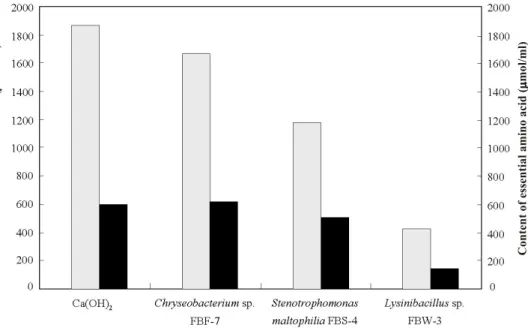
Fig. 3. Comparison of total amino acid and essential amino acid extracted from chicken feather meal by chemical and biological methods. ( ) content of total amino acid, ( ) content of essential amino acid.
GenBank에 각각 accession no. FJ938215, GQ287630 그리고 GQ287636로 등록하였다.
생물학적 및 화학적 분해법에 의해 추출된 아미노산의 특성 본 연구에서 우모 분해 우수균주로 선발된 Chryseobacterium sp. FBF-7, Stenotrophomonas maltophilia FBS-4 그리고 Lysinibacillus sp. FBW-3 균주를 2% 우모분이 함유된 무기염 배지에 각각 접종한 후 미생물 효소분해에 의해 추출된 총 아 미노산 함량과 수산화칼슘(Ca(OH)2) 처리에 의한 화학적 분해 법에 의해 추출된 총 아미노산 함량을 각각 비교⋅검토하였다.
Chryseobacterium sp. FBF-7 균주에 의해 추출된 총 아미노산 함량은 1661.6 μmol/ml로 가장 높은 함량을 나타내었으며, S. maltophilia FBS-4 균주는 1175.8 μmol/ml 그리고 Lysini- bacillus sp. FBW-3 균주는 427.4 μmol/ml로 추출되었다. 화 학적 분해법에 의해 추출된 총 아미노산 함량은 1866.8 μmol/ml 로 Chryseobacterium sp. FBF-7 균주에 의해 추출된 총 아미 노산 함량과 유사하였다.
생물학적 분해법과 화학적 분해법에 의해 추출된 아미노산 중 필수 아미노산(histidine, threonine, lysine, methionine, valine, isoleucine, leucine, phenylalanine, tryptophan) 함유량을 비교 검토한 결과, Chryseobacterium sp. FBF-7 균주에 의해 추출 된 총 아미노산 함량 중 필수 아미노산 함량은 619.3 μmol/ml 로 총 아미노산 함량의 37%를 차지하였고, S. maltophilia FBS-4 균주는 503.5 μmol/ml로 43% 그리고 Lysinibacillus sp. FBW-3 균주는 139.5 μmol/ml로 33%를 차지하였다. 한편, 화학적 분 해법에 의해 추출된 필수 아미노산 함량은 596.9 μmol/ml로 총 아미노산 함유량의 32%를 차지하는 것으로 나타났다(Fig. 3).
이상의 결과로부터 Chryseobacterium sp. FBF-7 균주는 화 학적 분해법에 의해 추출된 아미노산 함량과 유사한 함유량을
나타내었으며, 특히 필수 아미노산 함량이 화학적 분해법보다 더 높게 추출되는 특성을 나타내었다.
아미노산 생성량이 가장 높게 나타난 Chryseobacterium sp.
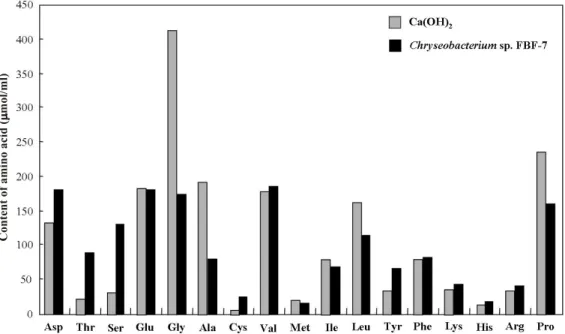
FBF-7 균주를 이용한 생물학적 분해법과 Ca(OH)2 처리에 의 한 화학적 분해법에 의해 추출된 아미노산의 조성을 비교 검토 하였다. Chryseobacterium sp. FBF-7에 의해 총 17종의 아미 노산이 추출되었으며, aspartic acid (11%), glutamic acid (11%), glycine (10%), valine (11%) 그리고 proline (10%)이 주요 아미노산으로 추출되는 특성을 나타내었다. 화학적 처리 에 의해 추출된 아미노산의 경우, glutamic acid (10%), glycine (22%), alanine (10%) 그리고 valine (10%), proline (13%)이 주요 아미노산으로 추출되는 것으로 나타났다.
Chryseobacterium sp. FBF-7에 의해 추출된 아미노산의 경 우 aspartic acid, threonine, serine, cysteine, valine, tyrosine, phenylalanine, lysine, histidine 그리고 arginine은 화학적 분해 법보다 높게 추출되는 특성을 나타내었다. 특히, aspartic acid (38%), threonine (287%), serine (303%), cysteine (262%) 그 리고 tyrosine (88%)은 화학적 분해법보다 더 높게 추출되는 특징을 나타내었다(Fig. 4).
케라틴계열 단백질 부산물 중 가금류의 우모는 다양한 아미 노산을 함유하고 있는 것으로 알려져 영양학적 관점에서 우모 로부터 추출된 아미노산은 고가의 젤라틴이나 콜라겐보다 저 렴하기 때문에 비료로써의 가치가 매우 우수하다. 우모로부터 아미노산을 추출하기 위해 가압, 가열 등 물리적 처리법과 산⋅
알칼리 처리에 의한 화학적 분해법을 이용하여 추출하고 있으 나 물리⋅화학적 처리에 의한 아미노산 추출은 공정과정 중 폐 수 및 악취가 대량 발생하여 환경오염을 유발하는 원인이 되어 왔다. 국내의 경우 이와 같은 아미노산 함유 물질로부터 미생 물이 생산하는 효소를 이용한 생물학적 분해에 의한 아미노산
Content of amino acid (mol/ml)
Fig. 4. Comparison of amino acids extracted from 2% chicken feather meal medium by chemical and biological methods.
추출과 분해산물의 이용에 관한 연구가 매우 미흡한 실정이다.
본 연구를 통하여 확보된 케라틴 단백질 분해세균은 계통학 적으로 다양한 미생물로 구성되어 있어 다양한 분야의 효소산 업에 이용될 수 있는 유전자원으로 잠재적 가치가 클 것으로 기대한다. 특히 최종 선발된 우모 분해 우수세균 Chryseobac- terium sp. FBF-7에 의해 추출된 추출 아미노산 함량은 기존 화학적 분해법에 의해 추출되는 함량과 유사하고 필수 아미노 산 생성량도 높게 나타나 산업공정에서 전통적으로 이용되고 있는 화학촉매를 대체할 수 있는 상업용 효소로 개발 가능하다 고 판단된다. Chryseobacterium sp. FBF-7 균주를 이용하여 케라틴 단백질 우모로부터 생산된 아미노산은 친환경 토양 개 량제 및 작물생육촉진을 위한 아미노산 비료로써의 활용 가치 가 매우 높을 것으로 기대된다.
적요
양계장 부산물 시료로부터 우모 분해세균 31균주를 분리하 였다. 수집된 우모 분해세균에 대해 16S rRNA 염기서열을 해 석하여 계통학적 특성을 검토한 결과, Firmicutes (21균주), γ-proteobacteria (4균주), Actinobacteria (4균주) 그리고 Bacteroidetes (2균주) 계통군에 속하는 다양한 세균이 확보되 었다. 우모 분해세균 중 우모 분해율이 75-90% 이상인 우수균 주 Chryseobacterium sp. FBF-7, Stenotrophomonas maltophilia FBS-4 그리고 Lysinibacillus sp. FBW-3를 최종 선발하였다.
이들 균주를 이용한 생물학적 분해법과 Ca(OH)2를 이용한 화 학적 분해법에 의해 추출된 아미노산의 특성을 비교한 결과, Chryseobacterium sp. FBF-7에 의해 추출된 총 아미노산 함량 이 1661.6 μmol/ml로 선발 균주 중 가장 높게 나타났으며, 화 학적 분해법에 의해 추출된 총 아미노산 함량과 유사하였다.
Chryseobacterium sp. FBF-7에 의해 생성된 필수 아미노산 함 유량은 619.3 μmol/ml로 총 아미노산의 37%를 함유하였으며, 화학적 분해법에 의한 경우, 596.9 μmol/ml의 필수 아미노산 을 생산하여 총 아미노산 함유량의 32%를 차지하는 것으로 나 타났다. Chryseobacterium sp. FBF-7에 의해 추출된 아미노산 의 조성을 검토한 결과, valine, glutamic acid, aspartic acid, glycine 그리고 proline이 주요 아미노산이었으며, 특히 aspartic acid, threonine, serine, cysteine 그리고 tyrosine이 화학적 추 출법보다 더 높게 추출되는 특징을 나타내었다.
감사의 말
본 연구는 교육과학기술부와 한국산업기술진흥원의 지역혁 신인력양성사업으로 수행된 연구결과로 이에 감사드립니다 (M-02-20080704171810).
참고문헌
1. Ahmed, I., A. Yokota, A. Yamazoe, and T. Fujiwara. 2007.
Proposal of Lysinibacillus boronitolerans gen. nov. sp. nov., and transfer of Bacillus fusiformis to Lysinibacillus fusiformis comb.
nov. and Bacillus sphaericus to Lysinibacillus sphaericus comb.
nov. Int. J. Syst. Bacteriol. 57, 1117-1125.
2. Baker, D.H., R.C. Blitenthal, K.P. Boebel, G.L. Czarnecki, L.L.
Southern, and G.M. Willis. 1981. Protein-amino acid evalluation of steam-processed feather meal. Poult. Sci. 60, 1865-1872.
3. Bockle, B., B. Galunski, and R. Muller. 1995. Characterization of a keratinolytic serine protease from Streptomyces pactum DSM40530. Appl. Environ. Microbiol. 61, 3705-3710.
4. Chon, D.H., S.M. Kang, and T.J. Kwon. 2003. Purification and some properties of keratinolytic protease produced by Pseudomonas sp. KP-364. Kor. J. Microbiol. Biotechnol. 31, 224-229.
5. Colette, M.H. and G.H. Michael. 1994. Bioconversion of waste
keratins: wool and feathers. Conserv. Recyc. 11, 179-188.
6. Gupta, R. and P. Ramnani. 2006. Microbial keratinase and their prospective application: an overview. Appl. Microbiol. Biotechnol.
70, 21-33.
7. Herzog. P., I. Winkler, D. Wolking, P. Kampfer, and A. Lipski.
2008. Chryseobacterium ureilyticum sp. nov., Chryseobacterium gambrini sp. nov., Chryseobacterium pallidum sp. nov. and Chryseobacterium molle sp. nov., isolated from beer-bottling plants. Int. J. Syst. Evol. Microbiol. 58, 26-33.
8. Kim, J.M., W.J. Lim, and H.J. Suh. 2001. Feather-degrading Bacillus species from poultry waste. Process Biochem. 37, 287- 291.
9. Kim, W.K. and P.H. Patterson. 2000. Nutritional value of enzyme- or sodium hydroxide treated feathers from dead hens. Poult. Sci.
79, 528-534.
10. Kim, Y.B., J.B. Lee, K.S. Sung, and N.H. Lee. 1998. Effects of physical processing on protein content and pepsin digestibility of feather meals. Kor. J. Anim. Sci. 40, 103-110.
11. Korea Chicken Council. 2002. www.chicken.or.kr/chicken/data/
state.htm.
12. Lee, N.H., Y.B. Kim, H.J. Kim, K.S. Seong, J.H. Rho, and C.K.
Han. 1999. Effects of physiochemical treatment on the isolation of keratinaceous protein and amino acids of feather meal. Kor. J.
Anim. Nutr. Feed. 23, 15-20.
13. Lin, X., C.C. Lee, E.S. Casale, and J.C.H. Shih. 1992. Purification and characterization of a keratinase from a feather-degrading Bacillus licheniformis strain. Appl. Environ. Microbiol. 58, 3271- 3275.
14. Marchisio, V.F., A. Fusconi, and S. Rigo. 1994. Keratinolysis and its morphological expression in hair digestion by airborne fungi.
Mycopathologia 127, 103-115.
15. Moore, E.R.B., A.S. Kruger, L. Hauben, S.E. Seal, R. De Baere, R. De Wachter, K.N. Timmis, and J. Swings. 1997. 16S rRNA gene sequence analysis and inter- and intrageneric relationships of Xanthomonas species and Stenotrophomonas maltophilia. FEMS Microbiol. Lett. 151, 145-153.
16. Mukhopadyay, R.P. and A.L. Chandra. 1990. Keratinase of Streptomycete. Indian J. Exp. Bio. 28, 575-577.
17. Oyeka, C.A. and H.C. Gugnani. 1997. Keratin degradation by Scytalidium species and Fusarium solani. Mycoses 41, 73-76.
18. Papadopoulose, M.C. 1985. Processed chicken feathers as feedstuff for poultry and swine. A review. Agric. Wastes 14, 275-290.
19. Papadopoulose, M.C., A.R. El Boushy, and A.E. Roodbeen. 1985.
The effect of varying autoclaving conditions and added sodium hydroxide on amino acid content and nitrogen characteristics of feather meal. J. Sci. Food Agric. Abstr. 36, 1219-1226.
20. Qin, L.M., S. Dekio, and J. Jidoi. 1992. Some biochemical characteristics of a partially purified extacellular keratinase from Trichophyton schoenleinii. Zentralbl. Bakteriol. 277, 236-244.
21. Onifade, A.A., N.A. Al-Sane, A.A. Al-Musallam, and A. Al- Zarban. 1998. A review: Potentials for biotechnological applications of keratin-de-grading microorganisms and their enzymes for nutritional improvement of feathers and other keratins as livestock feed resources. Biores. Technol. 66, 1-11.
22. Riffel, A. and A. Brandelli. 2000. Isolation and characterization of a feather-degrading bacterium from the poultry processing industry. J. Ind. Microbiol. Biotechnol. 29, 255-258.
23. Riffel, A., A. Brandelli, C.M. Bellato, G.H.M.F. Souza, M.N.
Eberlin, and F.C.A. Tavares. 2007. Purification and characterization of a keratinolytic metalloprotease from Chryseobacterium sp. kr6.
J. Biotechnol. 128, 693-703.
24. Saitou, N. and M. Nei. 1987. The neighbor-joinning method: a new method for reconstruction phylogenetic trees. Mol. Biol.
Evol. 4, 406-426.
25. Sangali, S. and A. Brandelli. 2000. Feather keratin hydrolysis by a Vibrio sp. strain kr2. J. Appl. Microbiol. 89, 735-743.
26. Santos, R.M.D.B., A.A.P. Firmino, C.M de Sá, and C.R Felix.
1996. Keratinolytic activity of Aspergillus fumigatus. Curr.
Microbiol. 33, 364-370.
27. Son, H.J., G.T. Park, and Y.G. Kim. 2004. Production of a keratinolytic protease by a feather-degrading bacterium, Bacillus megaterium F7-1. Kor. J. Microbiol. 40, 43-48.
28. Taha, I.Z. 1998. Cloned Bacillus subtilis alkaline protease(apr A) gene showing high level of keratinolytic activity. Appl. Biochem.
Biotechnol. 70/72, 199-205.
29. Thomson, J.D., D.G. Higgins, and T.J. Gibson. 1994. CLUSTAL W: improving the sensitivity of progressive multiple sequence alignment through sequence weighting, positions specific gap penalties and weight matrix choice. Nucleic Acids Res. 22, 4673- 4680.
30. Wang, J.J. and J.C.H. Shih. 1999. Fermentation production of keratinase from Bacillus licheniformis PWD-1 and a recombinant B. subtilis FDB-29. J. Ind. Microbiol. Biotechnol. 22, 608-616.
31. Woo. E.O., M.J. Kim, H.S. Son, E.Y. Ryu, S.Y. Jeong, H.J. Son, S.J. Lee, and G.T. Park. 2007. Production of keratinolytic protease by Bacillus pumilus RS7 and feather hydrolysate as a source of amino acids. J. Environ. Sci. 16, 1203-1208.