140 책임저자:엄애선, 133-791, 서울시 성동구 행당동 17번지
한양대학교 생물과학대학 식품영양학과 Tel: 02-2220-1203, Fax: 02-2292-1226 E-mail: [email protected]
접수일:2009년 5월 7일, 게재승인일:2009년 5월 22일
Correspondence to:Ae-Son Om
Department of Food and Nutrition, College of Human Ecology, Hanyang University, 17, Haengdang-dong, Seongdong-gu, Seoul 133-791, Korea Tel: +82-2-2220-1203, Fax: +82-2-2292-1226
E-mail: [email protected]
Chlorella Vulgaris May Have Protective Effects on Bioelement Metabolism in Cadmium Exposed Rats
Jae-Young Shim1, Hye-Seoung Shin2, Byung Gon Kim3, Jae-Gab Han3, Woel-Kyu Ha3 and Ae-Son Om1
1Department of Food and Nutrition, College of Human Ecology, Hanyang University, Seoul 133-791,
2Hankyung National University, Analysis Center, Guri 456-749, 3Daesang Corp., Inchon 467-813, Korea
We investigated the effects of Chlorella vulgaris (CV) on cadmium (Cd) status and mineral (Zn, Cu, Fe, Ca and Mg) contents in Cd-administered rats for 8 weeks. Forty male rats (5 weeks old, n=10/group) were given control tap water or tap water containing 10 ppm of CdCl2 ad libitum. They were divided into a control group and 3 experimental groups consisting of a Cd (Cd/CV0%) group or a 5% of CV (Cd/CV5%) group or a 10% of CV (Cd/CV10%) group. The concentration of Cd, Ca, Fe, Mg, Cu and Zn in the serum, liver, kidney, spleen, urine and feces were measured by Inductively Coupled Plasma (ICP-MS). The results showed that body weight gain in a control and CV-treated groups were significantly higher than that in Cd/CV0% group. The relative liver and kidney weight are significantly decreased by CV treatments. Cd levels in liver and the kidney and feces were in dose-dependent manner. Cd level in CV-treated groups was decreased while Ca, Fe, Mg and Zn concentration was increased in liver and kidney. On the other hand, Cd was more excreted in CV-treated groups than in Cd/CV0% group. Thus, CV may have beneficial effects on excretion of Cd and retention of divalent metals. (Cancer Prev Res 14, 140-145, 2009)
Key Words: Chlorella vulgaris, Mineral, Cadmium
INTRODUCTION
Heavy metals are found in increasingly hazardous concen- trations in air, food, and water. The Agency for Toxic Substance and Disease Registry (ATSDR) lists cadmium among the top seven of the 275 most hazardous substances in the environment.1) Exposure to Cd can occur in the workplace and in the natural environment because it is utilized in a number of industrial practices and is a ubiquitous contaminant of the environment and dietary product.2,3) Cd toxicity in humans and experimental animals has been widely studied and reported.4~7) Also, Cd is one of the metals that is not essential for an organism but is present in all tissues. Cd is preferentially accumulated in the liver, kidney, and reproductive systems of animals but under certain circumstance other tissues.8~10)
One of the adverse effects of continuous cadmium exposure is a disturbance in metabolism along with in the functions of some essential elements, including Zn, Cu, Fe, Ca, and Mg.9~13) It is thought that interactions of cadmium with metabolism and functions of bioelements are one of the mechanisms of this heavy metal toxicity. Also, it has been known for some time that feeding high concentration of these bioelements to animals reduces the rate of absorption of Cd from various environmental sources.13~15)
There are many literatures that functional food can excrete heavy metals from body. However, few studies were done that functional food containing dietary fiber and phytate etc may speed up the excretion of mineral excretion out of body.
Chlorella is a single-celled freshwater algae that contains large amounts of chlorophyll, protein, all essential amino acids and dietary fiber along with minerals. Chlorella has also been
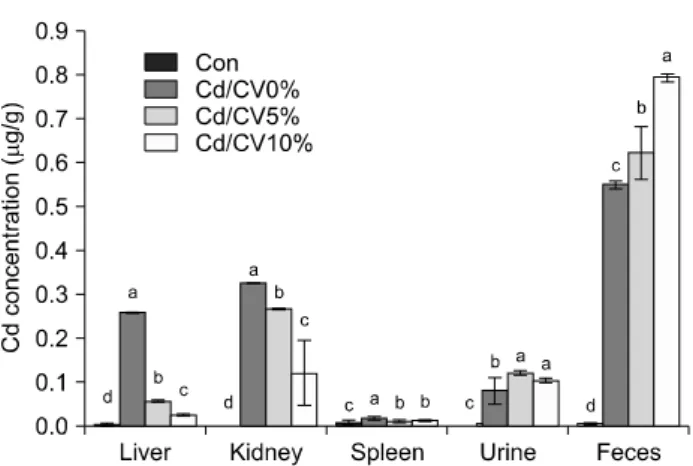
Fig. 1. Effect of Chlorella vulgaris on Cd level in tissues of Cd-exposed rats. Values are mean±S.D.; n=10 rats per treatment group. Con: control group fed without Cd in drinking water, Cd/CV0%: Cd 10 ppm treatment, chlorella free diet, Cd/CV5%: Cd 10 ppm treatment, chlorella supplementation (5% chlorella diet), Cd/CV10%: Cd 10 ppm treatment, chlorella supplementation (10% chlorella diet). a,b,c,dDifferent letters are significantly different (p<0.05; analysis of variance plus Tukey- Kramer’s test) compared to the Con.
reported to exert a stimulatory effect on fecal excretion of Cd, Hg, and dioxin.5,16∼20)
Also, not many studies have been done on effects of Chlorella on minerals by exposing heavy metals such as Cd, Pb, and Hg. Therefore, this study was performed to determine if CV may affect metabolism of minerals (Ca, Fe, Mg, Cu and Zn) and Cd in the serum, liver, kidney, spleen, urine and feces.
MATERIALS AND METHODS 1. Experimental animals and diets
Five-week-old male Sprague-Dawley (SD) rats weighing 90
∼110 g were obtained from Orient Bio Inc. (Seoul, Korea) and allowed to acclimatize for one week prior to com- mencement of the test. The animals were housed in plastic cages in a room with controlled temperature (23±2°C), humidity (50∼60%), and lighting (12 h light: 12 h darkness) with free access to water and lab chow. They were randomly divided into one control and three 10 ppm of CdCl2
(Cd)-treated groups in drinking water. The Cd groups (n=
10/group) included a Cd-treated group (Cd/CV0%-treated group), 5% Chlorella diet group (Cd/CV5%-treated group) or 10% Chlorella diet (Cd/CV10%-treated group). All the rats had freely access to water and diet for 8 weeks. CV was obtained from Daesang Corp. (Seoul, Korea) and composition of normal and chlorella meal-based diet were made up 20%
casein, 0.3% DL-methionine, 15% cornstarch, 50% sucrose, 5% cellulose, 5% coconut oil, 3.5% mineral mixture, 1%
vitamin mixture, and 0.2% Choline bitartrate. These diets had nearly the same composition except that chlorella meal-based diet contains 5% or 10% chlorella. All treatments and procedures were conducted in accordance with Hanyang University Lab Animal Care Committee (HALACC) animal use protocols.
2. Measurement of Cd, Ca, Fe, Mg, Cu and Zn contents in serum, liver, kidney, spleen, urine and feces
At the end of the experiment, blood was collected from the heart. 24-h urine and feces were collected and also the liver, kidney, and spleen were removed under CO2 anesthesia.
Whole blood was centrifuged after coagulation and serum was separated immediately. The Cd, Ca, Fe, Mg, Cu and Zn contents were determined by Inductively Coupled Plasma Mass
Spectrophotometry (ICP-MS, Model 3520, Perkin Elmer, Fremont, CA, USA). All samples were wet-digested with 5 ml of HNO3 and diluted up to 25 ml with water. They were stored at −20°C until analysis.
3. Statistical analysis
All data were presented as means±S.D. To assess differences of all parameters studied between the four groups, statistical analysis of data was conducted by one-way analysis of variance (ANOVA) followed by the Tukey-Kramer multiple comparison test. p<0.05 was considered to be statistically significant.
RESULTS 1. Body weight gain
Changes in body weight of all experimental rats were shown that rats in Cd/CV0% group (64.35±37.28 g) had a signi- ficantly (p<0.05 g) less body weight gain than those in Con (90.75±26.08 g), Cd/CV5% (72.30±37.28 g), and Cd/CV10%
(81.21±34.79 g) groups. Rats in Cd/CV0% group had signifi- cantly (p<0.05) heavier relative liver and kidney weight than those in Con, Cd/CV5%, and Cd/CV10% groups (data is not shown).
Fig. 2. Effect of Chlorella vulgaris on Zn concentration in Cd-exposed rats. Values are mean±S.D.; n=10 rats per treatment group. Con: control group fed without Cd in drinking water, Cd/CV0%: Cd 10 ppm treatment, chlorella free diet, Cd/CV5%: Cd 10 ppm treatment, chlorella supplementation (5% chlorella diet), Cd/CV10%: Cd 10 ppm treatment, chlorella supplementation (10% chlorella diet). a,b,c,dDifferent letters are significantly different (p<0.05; analysis of variance plus Tukey- Kramer’s test) compared to the Con.
Fig. 3. Effect of Chlorella vulgaris on Cu concentration in Cd-exposed rats. Values are mean±S.D.; n=10 rats per treatment group. Con: control group fed without Cd in drinking water, 10Cd/CV0%: Cd 10 ppm treatment, chlorella free diet, 10Cd/CV5%: Cd 10 ppm treatment, chlorella supplementation (5% chlorella diet), 10Cd/CV10%: Cd 10 ppm treatment, chlorella supplementation (10% chlorella diet). a,b,c,dDifferent letters are significantly different (p<0.05; analysis of variance plus Tukey-Kramer’s test) compared to the Con.
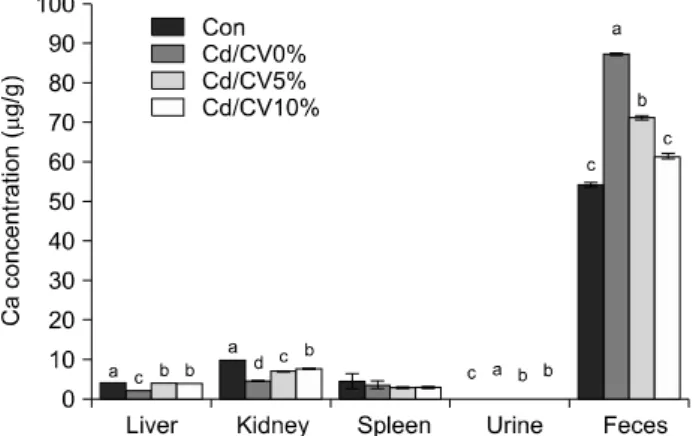
Fig. 4. Effect of Chlorella vulgaris on Ca concentration in Cd-exposed rats. Values are mean±S.D.; n=10 rats per treatment group. Con: control group fed without Cd in drinking water, 10Cd/CV0%: Cd 10 ppm treatment, chlorella free diet, 10Cd/CV5%: Cd 10 ppm treatment, chlorella supplementation (5% chlorella diet), 10Cd/CV10%: Cd 10 ppm treatment, chlorella supplementation (10% chlorella diet). a,b,c,dDifferent letters are significantly different (p<0.05; analysis of variance plus Tukey- Kramer’s test) compared to the Con.
2. Cd accumulation and excretion
The amount of Cd in liver, kidney, spleen of Cd/CV0%
group was significantly higher than that of the Cd/CV-treated groups. The Cd content in liver and kidney was 18% as high as that in spleen of the Cd/Cb0% group. Fecal loss of Cd was
higher in Cd/ CV-treated groups than in Cd/ CV0% diet group. It showed that Cd level in liver and kidney was decreased but that in feces was increased by CV treatment in dose-dependent manner (Fig. 1).
3. Mineral accumulation and excretion
Zinc concentration in liver and kidney was dose-dependently increased by feeding CV, while that in spleen was not changed.
Fecal loss of Zn was significantly highly excreted in Cd/ CV0%
group, compared with Cd/CV5% and 10% groups (Fig. 2).
Copper concentration in liver, kidney, spleen, and feces of rats exposed to Cd or/and CV showed in Fig. 3. The concentration of Cu in liver was dose-dependently increased by feeding CV, whereas there were no significant difference from all the groups in kidney. Fecal excretion of Cu did not differ in both Cd/CV0% group and Cd/CV5% and 10% groups.
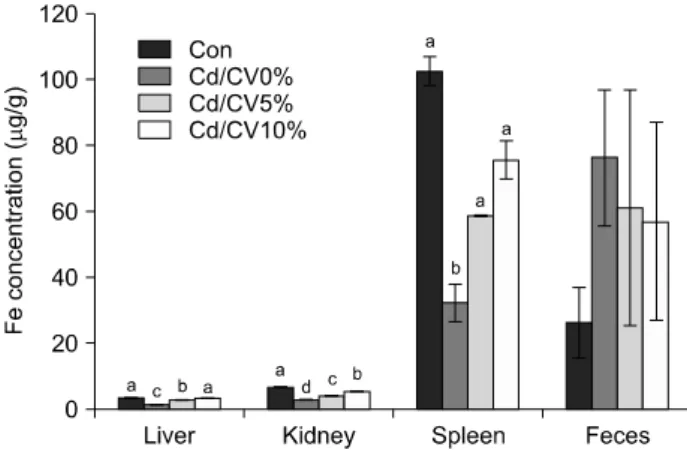
Exposure of rats to Cd led to a increase in Ca excretion through urine as shown in Fig. 4. Meanwhile the concentration of Ca in liver and kidney was increased by feeding CV, demonstrating about 2.0 and 1.5∼1.7 folds in Cd/CV5% and Cd/CV10% groups, compared to Cd/CV0% group, respectively (Fig. 4). Likewise, exposure of rats to Cd resulted in decreasing Fe concentration on liver, kidney and spleen and increasing its excretion in feces (Fig. 5). Fe concentration in liver and kidney of rats in Cd/CV5% and Cd/CV10% groups were increased
Fig. 5. Effect of Chlorella vulgaris on Fe concentration in Cd-exposed rats. Values are mean±S.D.; n=10 rats per treatment group. Con: control group fed without Cd in drinking water, 10Cd/CV0%: Cd 10 ppm treatment, chlorella free diet, 10Cd/CV5%: Cd 10 ppm treatment, chlorella supplementation (5% chlorella diet), 10Cd/CV10%: Cd 10 ppm treatment, chlorella supplementation (10% chlorella diet). a,b,c,dDifferent letters are significantly different (p<0.05; analysis of variance plus Tukey-Kramer’s test) compared to the Con.
compared with Cd/CV0% group (p<0.05). There is a signi- ficant difference in concentration of Fe in spleen of both Cd/CV5% and Cd/CV10% groups compared with Cd/CV0%
group. CV treatment to rats had no statistically effect on its excretion but had a tendency of decreasing Fe excretion via feces. Unlike other bioelements, Mg levels did not differ among all the groups (data is not shown).
DISCUSSION
The present work was aimed at studying the influence of chlorella vulgaris (CV) on Cd and minerals such as Zn, Cu, Fe, Ca and Mg in rats continuously exposed to 10 ppm of CdCl2. The body weight change was crucial indicator for health in both humans and animals by which the possibility of morphological and functional damage was evaluated under toxicity test. In this study, all rats gained body weight showing significant difference between Cd/CV0% group and CV-treated groups. The body weight loss by Cd treatment in this data was in accordance with that in Waalkes et al. (1999) study who reported the weight loss of rats administered Cd. Also, the data showed body weight gain by Chlorella treatment has been potentially attributed to stabilization of body metabolism.
Liver and kidney weight was heavier in Cd-treated rats than that in Cd/CV-treated rats. It showed that Cd absorbed via
blood circulation system is firstly transported and accumulated into the liver although the Cd is transported and accumulated in the kidneys over the time. Cd accumulation in the liver was associated with degeneration and inflammatory changes in its organ (unpublished observations). This might explain a significant increase of spleen and liver weight indexes in all Cd-treated rats. In order to identify this, hepatic Cd content was determined. As expected, hepatic Cd contents were significantly (p<0.05) lower in Cd/CV5% and Cd/CV10%- treated rats compared to Cd-treated rats. Based on this result, Cd treatment has been associated with the hypertrophy of organ tissues. However, Chlorella treatment may have the resistance to Cd-induced hepatotoxicity which is associated in part with a lower accumulation of the metal in liver.
The observations made in the present study indicate that animals administered both CV and Cd influence the turnover of Cd. The rats simultaneously exposed to CV and Cd had an increase in Cd fecal excretion in comparison to those to Cd.
It is known that essential minerals decrease the permeability of biological membranes to various substances, including metals.22) CV had many bioelements14) causing decrease in absorption of Cd.22)
Chlorella may minimize internal accumulation and conta- mination of Cd by reducing the absorption of Cd from the gastrointestinal tract and their deposition in target organs, and increasing excretion of Cd through urine and feces. The decreased Cd absorption and increased its excretion by CV give clear evidence of decreased Cd retention under conditions of simultaneously exposed to CV and Cd.
An excessive exposure to Cd and its accumulation in the organism lead to disturbances in metabolism of essential elements.22-24) Cu, Zn and Fe are antagonistic to Cd.22) The Cd-zinc, Cd-copper, and Cd-iron interactions are strictly associated and are dependent dose of those elements. Cd- induced changes in tissue Zn concentration have been widely observed.25∼29) It has reported that Cd toxicity may occur as Zn levels increase in the liver and kidney and decrease in other tissues. This effect, observed in the liver and kidneys, was probably caused by an increase in metallothionein synthesis and intensive transportation of Zn from blood to the liver and kidney.13,27) We have shown that CV administered potentialized this heavy metal-induced retention of Zn in these organs. The other metal with metabolism associated with metallothionein is Cu. As noted in the case of Zn, Cd also increased Cu
concentration in the liver and kidney dependent on the level of exposure. A change in Cu metabolism in rats exposed to Cd has been reported by other authors.13,26∼29) The rise in hepatic Cu level may reflect an increase in the synthesis of mallothionein due to Cd exposure. The changes observed in Cu concentration in some tissues after CV treatment demonstrate the disturbed distribution of this bioelement. Apart from Zn and Cu, important metabolic roles are played by Mg and Ca.
The effects of Cd on Ca metabolism and probable mechanisms of such effects have been previously reported by other authors.9,13,30,31)
They have shown that Cd at exposure levels leading to clear disturbances in Zn, Cu, Fe, and Ca metabolism has no effect on Mg metabolism. On this basis, it can be concluded that Mg is the most stable of bioelements under conditions of Cd intoxication.22) Friberg et al.9) discussed the experiment on different groups of rats kept on low and high Ca diets, which were given cadmium chloride in drinking water for 1 or 2 months. They found 50% higher Cd accumulation in the liver and kidneys of rats on a low Ca diet. It has reported that Cd could cause anemia due to a lower absorption of Fe from the gastrointestinal tract. The mucosal transport and intestinal retention of Fe in rats is less sensitive to Cd than, for instance, Mn.29,31∼34) Only high or low doses (2.0, 0.02 mg daily) of Cd decrease the transfer but not the retention of Fe in GI tract. In addition, Cd can reduce Fe levels in tissues or may district erythrocytes. Likewise, Cd is well known to disturb the homeostasis of bioelements, showing increase in excretion of divalent minerals.
Chlorella supplementation can change microelement meta- bolism in rats exposed to Cd by either/both the result of direct or/and indirect actions of CV. CV may decrease body burden of Cd in conditions of simultaneous exposure to Cd since CV contains diverse divalent minerals such as Ca, Zn, Fe, Cu and Mg. It is more likely to have a chance of binding to Cd and then of excreting Cd out of body.22) According to the present results, the minerals of CV is supposed to supply minerals to organs. Accordingly, CV may play a role in preventing the excretion of divalent minerals or may refill the loss of minerals through excretion with its minerals.
Therefore, many studies are needed to explain the mechanism by which CV play roles in controlling the meta- bolism of microelement in rats exposed to Cd.
CONCLUSION
Chlorella vulgaris (CV) contains large amounts of chlorophyll, protein, all essential amino acids and dietary fiber along with minerals. CV has also been reported to exert a stimulatory effect on fecal excretion of hazard substances such as Cd, Hg, and dioxin etc. Many studies showed that chelation of heavy metals to functional nutrients or/and non-nutrients including chlorophyll, dietary fiber may simultaneously cause the excre- tion of heavy metals and minerals, leading to loss of divalent minerals. This study shows that CV can prevent the loss of micro bioelements as well as promote the fecal excretion of Cd in Cd-exposed rats. The mechanism is not clear, however, these findings suggest that Chlorella may be useful in the treatment of humans exposed to Cd. Thus, many studies are needed to explain the mechanism by which CV play roles in controlling the metabolism of microelements in rats exposed to Cd.
REFERENCES
1) National Priorities List. U.S. Environmental Protection Agency. December 24, 2002.
2) World Health Organization. Environment Health Criteria, 134 Cadmium. IPCS, Genev, 1992.
3) Friberg L, Piscator M, Nordberg GF, Kjellstrom T. Cadmium in the environment, 2nd ed. Cleveland: CRC Press Inc., 1974.
4) Om AS, Chung KW, Chung HS. Effect of cadmium accumulation on renal tissues in broiler. Bull Environ Contam Toxicol 68, 297-301, 2002.
5) Shim JY, Shin HS, Han JG, Park HS, Lim BL, Chung KW, Om AS. Protective effects of Chlorella vulgaris on liver toxicity in cadmium-administered rats. J Med Food 11, 479-485, 2008.
6) Friberg L. Cadmium and the kidney. Environ Health Perspect 54, 1-11, 1984.
7) Om AS, Shim JY. Effect of daidzein, a soy isoflavone, on bone metabolism in Cd-treated ovariectomized rats. Acta Biochimica Polonica 54, 641-646, 2007.
8) Peters JM, Thomas D, Falk H, Oberdorster G, Smith TJ.
Contribution of metals to respiratory cancer. Environ Health Perspect 70, 71-83, 1986.
9) Waalkes MP, Anver MR, Diwan BA. Chronic toxic and carcinogenic effects of oral cadmium in the Noble (NBL/Cr) rat: induction of neoplastic and proliferative lesions of the adrenal, kidney, prostate, and testes. J Toxicol Environ Health 29, 199-214, 1999.
10) Schroeder HA, Nason AP, Prior RE, Reed JB, Haessler WT.
Influence of cadmium in renal ischemic hypertension in rats.
Am J Physiol 214, 469-474, 1968.
11) Yoshiki S, Yanagisawa T, Kimura M. Bone and kidney leisons in experimetal cadmium intoxification. Arch Environ Health 30, 559-562, 1975.
12) Schümann K, Friebel P, Schmolke G, Elsnhans B. State of iron repletion and cadmium tissues accumulation as a function of growth in young rats after oral cadmium exposure. Arch Environ Contami Toxicol 31, 283-487, 1996.
13) Brzóska MM, Moniuszko-Jakoniuk J, Rogowski F. The in- fluence of cadmium on calcium absorption from the digestive tract and its excretion in urine. Polish J of Environ Studies 6(Suppl), 25-38, 1997.
14) Chmielnicka J, Sowa B. Cadmium interaction with essential metal (Zn, Cu, Fe), metabolism metallothionein, and cerulopasmin in pregnant rats and fetuses. Ecotoxicology and Environmental Safety 35, 277-291, 1996.
15) Mahaffey K, Capar SG, Gladen BC, Fowler BA. Concurrent exposure to lead, cadmium and arsenic. Effect of toxicity and tissue metal concentrations in the rat. J of Lab and Clin Med 98, 463-481, 1981.
16) Brzóska MM, Moniuszko-Jakoniuk J. The influence of calcium content in diet on the accumulation and toxicity of cadmium in the organism. Arch Toxicol 72, 63-73, 1998.
17) Rai PK, Mallick N, Rai LC. Effect of Cu and Ni on growth, mineral uptake, photosynthesis and enzyme activities of Chlorella Vulgaris at different pH values. Biomed Environ Sci 7, 56-67, 1994.
18) Hwang YK, Choi HJ, Nam M, Yoo JD, Kim YH. Effects of chlorella on metallothionein synthesis and binding capacity of cadmium in cadmium poisoned rat liver and kidney. J Exp Biomed Sci 12, 23-27, 2006.
19) Mohanty RC, Mohanty L, Mohapatra PK. Change in toxicity effect of mercury at static concentration to Chlorella vulgaris with addition of organic carbon sources. Acta Biol Hung 44, 211-222, 1993.
20) Shim JY, Om AS. Chlorella vulgaris has protective effect on cadmium induced liver damage in rats. Mol Cell Toxicol 4, 138-143, 2008.
21) Om AS, Shin HS, Shim JY, Han JG, Kim JH. Chlorella vulgaris may excrete dioxin-like PCB-138, -153 via urine of rats. Mol Cell Toxicol 5, 88-92, 2009.
22) Morita K, Matsuda T, Iida T, Hasegawa T. Chlorella accelerates dioxin excretion in rats. J Nutr 129, 1731-1736,
1999.
23) Sullivan MF, Miller BM, Goebel JC. Gastrointestinal absorption of metals (51Cr, 65Zn, 95Tc, 109Cd, 113Sn, 147Pm, and
238Pu) by rats and swine. Environ Res 35, 439-453, 1984.
24) Peraza MA, Ayala-Fierro F, Barber DS, Casarez E, Rael LT.
Effects of micronutrients on metal toxicity. Environ Health Perpect 106, 203-216, 1998.
25) Brzóska MM, Moniuszko-Jakoniuk J, Jurczuk M, Rogalska J.
Effect of short-term ethanol administration on cadmium retention and bioelement metabolism in rats continuously exposed to cadmium. Alcohol & Alcoholism 35, 439-445, 2000.
26) Sharma G, Sandhir R, Nath R, Gill K. Effect of ethanol on cadmium uptake and metabolism of zinc and copper in rats exposed to cadmium. J Nut 121, 87-91, 1991.
27) Reeves PG, Chaney RL. Mineral status of female rats affects the absorption and organ distribution of dietary cadmium derived from edible sunflower kernels (Helianthus annuus L.).
Environ Res 85, 215-225, 2001.
28) Glover CN, Hogstrand C. Effects of dissolved metals and other hydrominerals on in vivo intestinal zinc uptake in freshwater rainbow trout. Aquat Toxicol 62, 281-293, 2003.
29) Evans GW, Magors PF, Cornatzer WE. Mechanism for cadmium and zinc antagonism of copper metabolism. Biochem Biophys Res Commu 40, 1142-1148, 1970.
30) Elsenhans B, Kolb K, Schümann K, Forth W. The longi- tudinal distribution of cadmium, zinc, copper, iron and metal- lothionein in the small-intestinal mucosa of rats after adminis- tration of cadmium chloride. Biol Trace Elem Res 41, 31-46, 1994.
31) Brzóska MM, Jurcrzuk M, Moniuszko-Jakoniuk J. Distur- bances in calcium metabolism in rats after oral cadmium into- xication. Acta Pol Toxicol 5, 91-97, 1997.
32) Hamilton L, Valberg LS. Relationship between cadmium and iron absorption. Am J Physiol 227, 1033-1037, 1974.
33) Shukla A, Agarwal KN, Shukla GS. Effect of latent iron deficiency on the levels of iron, calcium, zinc, copper, manganese, cadmium and lead in liver, kidney and spleen of growing rats. Experimenta 46, 751-752, 1990.
34) Gruden N, Munić S. Effect of iron upon cadmium-manganese and cadmium-iron interaction. Bull Environ Contam Toxicol 60, 52-59, 1987.