118
Copyright © 2021 The Korean Society of Fisheries and Aquatic Science pISSN:0374-8111, eISSN:2287-8815
서 론
어분(fishmeal)은고등어, 정어리, 멸치, 명태, 대구등식용으 로이용가치가낮은어류로부터생산되고있으며, 높은단백질 소화율, 균형있는아미노산조성및어류의높은기호성때문에 항상양식사료의주요단백질공급원으로고려되어왔다(Lim et al., 2004). 근래에는기후의변화, 기상이변, 어족자원의남 획등으로인해어분의공급및가격이불규칙하여성장하는양 식산업의수요를충족시킬수없기때문에어분을대체할수있
는단백질공급원을찾기위해다양한연구들이수행되고있다 (NRC 2011; Li et al., 2020). 어분을대체하여사용될수있는 여러식물성단백질원료중세계적으로가장많이이용되는원 료는콩과에속하는유지작물인대두(soybean)를들수있다 (Lim et al., 2004). 대두박은대두의기름을추출하고남은부산 물로써다른식물성단백질원료에비해아미노산조성이비교 적균형적이며, 가격및원료공급에있어시장성이높기때문에 양어용배합사료내에가장널리사용되고있는식물성단백질 원중하나이다(Kikuchi, 1999; Kim et al., 2013). 그러나대두
은연어(Oncorhynchus kisutch) 사료내 어분 대체원으로서 대두농축단백 의 이용에 따른 성장 및 성분분석
유광열·최원석1·배진호2·윤현호3·이승한4·배승철5*
특허청 식품생물자원심사과, 1부경대학교 사료영양연구소, 2부경대학교 사료영양연구소, 3CJ 제일제당주식회사, 4국립수산과학원 사료연구센터,
5FAO 세계수산대학/부경대학교 사료영양연구소
Effects on Growth and Body Composition to Soy Protein Concentrate as a Fishmeal Replacement in Coho Salmon Oncorhynchus kisutch
Gwangyeol Yoo, Wonsuk Choi1, Jinho Bae2, Hyeonho Yun3, Seunghan Lee4 and Sungchul C. Bai5*
1Food and Biological Resources Examination Division, Korean Intellectual Property Office, Daejeon 35208, Korea
2Feeds and Foods Nutrition Research Center, Pukyong National University, Busan 48513, Korea
3CJ Cheiljedang corporation, Seoul 04560, Korea
4Aquafeed Research Center, National Institute of Fisheries Science, Pohang 37517, Korea
5FAO World Fisheries University Pilot Program/Feeds & Foods Nutrition Research Center, Pukyong National University, Busan 48513, Korea
This study was conducted to evaluate plant proteins as a replacement for a fishmeal diet in the rearing of coho salmon Oncorhynchus kisutch. Twelve groups of 20 fish averaging 34.0±0.62 g were randomly distributed into 12 rectan- gular tanks (250 L). Four experimental diets included a control diet containing 60% fishmeal (Control), and three other diets that replaced 20% of fishmeal with soy protein concentrate (SPC), fermented soybean protein concentrate (F-SPC), and enzyme-processed soy protein concentrate (E-SPC). At the end of the feeding trial, fish that were fed Control, SPC and E-SPC diets showed significantly higher weight gain, specific growth rate, feed efficiency, and protein efficiency ratio than those that were fed F-SPC diet. However, there were no significant differences among the fish that were fed Control, SPC, and E-SPC diets. No significant differences were observed in crude protein, crude lipid, and ash of whole body among the fish that were fed all the diets. Therefore, these results indicated that 20% of fishmeal could be replaced by E-SPC or SPC without any adverse effects on the growth performance of coho salmon.
Keywords: Coho salmon, Oncorhynchus kisutch, Soybean, Soy protein concentrate, Plant protein
*Corresponding author: Tel: +82. 51. 629. 7922 Fax: +82. 51. 628. 6873 E-mail address: [email protected]
This is an Open Access article distributed under the terms of the Creative Commons Attribution Non-Commercial Licens (http://creativecommons.org/licenses/by-nc/3.0/) which permits unrestricted non-commercial use, distribution, and reproduction in any medium, provided the original work is properly cited.
Received 22 January 2021; Revised 26 January 2021; Accepted 27 January 2021 저자 직위: 유광열(심사관), 최원석(대학원생), 배진호(전임연구원), 윤현호(전 임연구원), 이승한(연구사), 배승철(교수/소장)
https://doi.org/10.5657/KFAS.2021.0118
Korean J Fish Aquat Sci 54(1), 118-123, February 2021
박은어분에비하여사료의이용성을저하시키는몇가지단점 이있다는것이밝혀지면서대두박의생물학적이용성을높이 기위한방안으로발효, 효소처리및화학처리등의연구가이루 어지고있다(Dabrowski et al., 1989; Murai et al., 1989; Pong- maneerat and Watanabe 1993; Refstie et al., 2005). 대두농축 단백(soy protein concentrate, SPC)은탈지된대두와에탄올을 이용하여제조되는것으로써조단백함량이 60-65%로 45% 내
외인대두박에비하여월등히높은것이특징이다. SPC는불
용성탄수화물및섬유소, 항영양인자(antinutritionals factors,
ANFs)를불활성혹은제거시켜사료원료이용성을증가시키
는효과를갖지만, 피틴염(phytates)등의항영양인자를완벽하 게제거시키지는못한다(Bureau et al., 1998; Storebakken et al., 2000). 은연어(Coho Salmon Oncorhynchus kisutch)는냉 수성어종으로, 오메가-3가풍부하여맛이좋으며, 성장이빨라 양식대상어종으로주목받아세계적으로양식되는연어과어류 중대서양연어(Salmo salar), 무지개송어(S. gairdner) 다음으 로많이생산되고있다(Iversen el al., 2020). 은연어는오호츠크 해, 알래스카만등을포함하여북태평양등지에주로분포하며, 북유럽국가를중심으로양식되었으나, 한국에서는 1960년대 후반부터양식기술을도입하여알을부화시켜소규모로양식 을이어왔다. 최근에는은연어를해수에연중양식하는데성공 하는등양식생산량을증대시키기위해지속적으로연구가진 행되고있는상황이다. 그러나은연어양식사료내어분단백질 대체원으로대두박을이용한연구는일부보고되었으나, SPC 를이용한연구는부족한실정이다(Tacon et al., 1983; Murai et al., 1989; Kim et al., 1992). 따라서본연구는은연어사료내 어분대체원료로써 SPC의이용가능성을평가하여, 은연어양 식을위한기초자료를제공하고자한다.
재료 및 방법
실험사료
실험에사용된사료원료와일반성분조성및구성아미노산 은 Table 1과 Table 2에나타내었다. 실험사료의주단백질원 으로어분, 소맥글루텐, 대두농축단백(SPC), B. Subtilis로발 효한 SPC (fermented soy protein concentrate, F-SPC) 및 pro- tease로효소처리한 SPC (enzyme-treated soy protein concen- trate, E-SPC)를사용하였으며, 실험에사용된 SPC, E-SPC 및 F-SPC는 CJ제일제당주식회사(Seoul, Korea) 소재연구팀으로 부터제공받았다. 탄수화물원으로는밀가루를 사용하였으며, 어유를지질원으로이용하였다. 대두단백질의효과를검증하 기위해기초사료(Control, Cont)에어분단백질을 SPC, E-SPC 및 F-SPC으로각각 20%씩대체하여총 4개실험구를설계하 였다. 실험사료의제조는원료를혼합한후펠렛기를이용하여 제조하였고환기가잘되는장소에서자연건조하여밀봉한후 냉동실(-20°C)에보관하여사용하였다.
실험어류 및 사육관리
은연어는강원도고성군에위치한 ㈜동해에스티에프양식장 에서구입하여부산에위치한부경대학교영양대사학연구실 내사육실로운반하였다. 2주간기초사료를공급하면서예비사 육후, 평균중량 34.0±0.62 g인은연어를 12개의 250 L FRP 사각수조(가로 60 cm, 세로 80 cm, 높이 60 cm)에 20마리씩수 용하여각실험구당 3반복으로무작위배치하였다. 일일사료 공급량은만복으로 1일 2회공급(09:00, 18:00)하였으며, 4주 간사료공급량은일일평균 0.84±0.08%를공급하였다. 실험
기간동안수온은냉각기를사용하여 13.2±0.5°C를유지시켜
주었다. 산소공급량은 7.1±0.31 ppm, 유수량은 2 L/min를동 일하게유지하였다.
어체 측정 및 성분분석
어체측정은실험개시시및 4주차(28일)에측정을실시하였으
Table1. Formulation and proximate composition of the experimen- tal diets for growing Coho salmon Oncorhynchus kisutch (% of dry matter basis)
Ingredients (%) Cont SPC E-SPC F-SPC
Fish meal from Chile 60.0 50.0 50.0 50.0
SPC1 0.0 11.4 0.0 0.0
Enzyme SPC 0.0 0.0 11.0 0.0
Fermented SPC 0.0 0.0 0.0 10.5
Wheat gluten meal 10.7 10.8 10.8 10.7
Wheat flour 14.4 11.8 12.2 12.9
Fish oil 10.9 11.7 11.6 11.6
Vitamin mix2 2.0 2.0 2.0 2.0
Mineral mix3 2.0 2.0 2.0 2.0
Lys 0.0 0.1 0.1 0.1
Met 0.0 0.2 0.2 0.2
Total 100 100 100 100
Proximate analysis (% As-is)
Moisture 9.7 7.3 8.9 10.1
Crude protein 52.2 53.2 52.1 51.6
Crude lipid 14.6 14.8 14.5 14.4
Crude ash 10.3 9.8 10.0 9.8
1SPC, Soy Protein Concentrate. 2Contains (as mg/kg in diets):
Ascorbic acid, 300; dl-Calcium pantothenate, 150; Choline bi- tate, 3000; Inositol, 150; Menadion, 6; Niacin, 150; Pyridoxine HCl, 15; Rivoflavin, 30; Thiamine mononitrate, 15; dl-a-Tocoph- erol acetate, 201; Retinyl acetate, 6; Biotin, 1.5; Folic acid, 5.4;
Cobalamin, 0.06. 3Contains (as mg/kg in diets): NaCl, 437.4;
MgSO4·7H2O, 1379.8; ZnSO4·7H2O, 226.4; Fe-Citrate, 299;
MnSO4, 0.016; FeSO4, 0.0378; CuSO4, 0.00033; Calciumiodate, 0.0006; MgO, 0.00135; NaSeO3, 0.00025.
며, 성장률을조사하기위하여 24시간절식시킨후각수조의 실험어전체무게를측정하였다. 실험종료후, 성장률(weight gain, %), 사료효율(feed efficiency, %), 일간성장률(specific growth rate, %/day), 사료전환효율(feed conversion ratio), 단백질이용효율(protein efficiency ratio), 및 생존율(survival rate, %)을조사하였다.
Weight gain (WG, %)=(final wt.-initial wt.)×100/initial wt Feed Efficiency (FE, %)=(wet weight gain/dry feed intake)×100 Specific growth rate (SGR, %)
=(loge final wt.-loge initial wt.)×100/days Feed conversion ratio (FCR)=(dry feed intake/wet weight gain) Protein efficiency Ratio (PER)=(wet weight gain/protein intake) Survival rate (%)=(total fish - dead fish)×100/total fish 일반성분은실험사료와각수조별로실험어 5마리씩무작위 로샘플하여전어체를분석하였으며, AOAC (2000)방법에따 라수분은삼압가열건조법(115°C, 4시간), 조단백은 Kjeldahl
질소 정량법(N×6.25), 조회분은 직접회화법으로각각 분석
하였다. 조지방은 Soxtec system 1046 (Tacator AB, Höganäs, Sweden)을사용하여 soxhlet 추출법으로분석하였다. 조지질 은 조지질추출기(Velp SER 148, Usmate, Italy)를 사용하여 ether로추출한후, 측정하였다. 구성아미노산분석은시료 0.5 g을정량하여시험관에넣고 6 N-HCl 15 mL를가하여감압 밀봉한후 110°C의 dry oven에서 24시간이상동안산가수분 해시켰다. Glass filter로분해액을여과하고얻은여액을 55°C 에서감압농축하여염산과물을완전히증발시킨다음, 농축 된시료를 sodium citrate buffer (pH 2.20)로 25 mL 정용플라 스크에정용하여 0.45 μm membrane filter로여과한시료액 을아미노산자동분석기(Biochrom 30, Biochrom Ltd., Cam- bridge, England)를사용하여다음과같은조건으로분석하였 다. Cation separation column (oxidised feedstuff column, 4.6 mm×200 mm)을사용하였고 0.2 M sodium citrate buffer (pH 3.20, 4.25)와 1.2 M sodium citrate buffer (pH 6.45) 및 0.4 M sodium hydroxide solution을이동상으로사용하였다. 이동상 의 유속은 0.42 mL/min, ninhydrin 용액의유속은 0.33 mL/
min, column 온도는 48-95°C, 반응온도는 135°C로조절하여 분석하였다.
통계처리
실험수조의배치는완전확률계획법(completely randomized design)을실시하였고, 성장및분석결과는 SAS (Version 9.1) 프로그램을 이용하여 One-way ANOVA로 통계를분석하였 다. 데이터값은최소유의차(LSD) 검정(P<0.05)으로비교하였
으며데이터는평균값±표준편차(mean±SD)로나타내었다.
결과 및 고찰
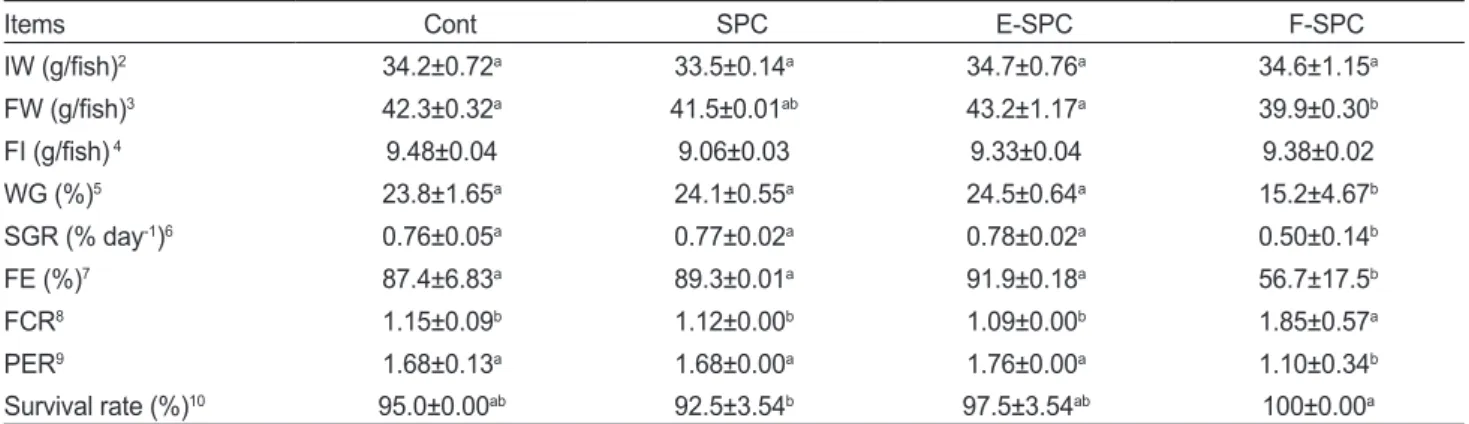
4주간의 사육실험 종료 후, 은연어의 성장결과는 Table 3 에 나타내었다. 증체율(weight gain, WG), 일간성장률(spe- cific growth rate, SGR), 사료효율(feed efficiency, FE), 단백 질이용효율(protein efficiency ratio, PER)에 있어 F-SPC가 Cont, SPC 및 E-SPC에비해유의한차이로낮게나타났으며 (P<0.05), Cont, SPC 및 E-SPC 사이에는유의한차이가나타 나지않았다(P<0.05). 생존율(survival rate)에있어서는 F-SPC 가 SPC에비해유의적으로높은결과값을보였으며, Cont와 E- SPC 사이에는유의한차이가나타나지않았다(P<0.05).
이와같이 Cont, SPC 및 E-SPC간에는증체율, 일간성장률, 사료효율, 단백질전환효율에있어서유의적인차이가없었던 것으로보아 SPC와 E-SPC 사료원은은연어사료내어분단백
질을 20% 대체하여도기호성의차이가나타나지않는것으로
판단된다. 이러한결과는 Atlantic halibut (Berge et al., 1999), Atlantic salmon (Refstie et al., 2001), common carp (Escaffre et al., 1997), rainbow trout (Kaushik et al., 1995; Médale et al., 1998; Mambrini et al., 1999) 및 Senegalese sole (Aragão Table 2. Amino acid composition of the experimental diets
Amino acids (g/100 g diet)
Diets
Cont SPC E-SPC F-SPC
Indispensable
Arginine 2.92 2.83 3.02 3.09
Threonine 2.11 2.16 2.15 2.15
Valine 2.64 2.72 2.76 2.82
Isoleucine 2.37 2.39 2.46 2.55
Leucine 3.89 3.93 4.02 4.11
Methionine 1.43 1.39 1.41 1.38
Lysine 3.58 3.61 3.66 3.73
Phenylalanine 2.34 2.33 2.42 2.48
Histidine 1.75 1.81 1.77 1.87
Dispensable
Serine 2.17 2.14 2.23 2.21
Glutamic acid 9.83 9.73 10.3 10.3
Proline 3.24 3.24 3.52 3.72
Glycine 2.62 2.69 2.69 2.88
Alanine 2.74 2.88 2.83 2.91
Tyrosine 1.51 1.47 1.58 1.72
Aspartic acid 4.59 4.52 4.71 4.72
Cont, control; SPC, soy protein concentrate; E-SPC, fermented soy protein concentrate; F-SPC, enzyme-treated soy protein con- centrate.
et al., 2003) 등다양한어종에서도사료내 40-75%의어분단백 질을 SPC로대체하여도실험어류의성장에영향을끼치지않 는다는보고와일치하였다. 반면 Atlantic salmon (Storebakken et al., 1998), chinook salmon and rainbow trout (Deng et al.,
2006)에있어어분을발효한대두농축단백질로대체하면어분
60% 이상의사료를공급한실험군에비해성장율이낮아진다
고보고되었다. 이와같이어류의성장에미치는영향이상이한 점에대해 Deng et al. (2006)은사료원료의조성, 어류의종류 및성장단계에따른것이라고보고하였다. 일반적으로대두박 을포함하는식물성사료원료의발효및효소처리는영양학적 가치를향상시켜주는것으로알려져있다. 본실험에서 E-SPC 는 Cont와성장및사료효율에있어유의한차이가없었다. 이 러한결과는 Atlantic salmon에있어서사료내 phytase를처리 한 SPC 첨가실험구가 phytase를처리하지않은 SPC 실험구에 비해성장및사료효율이양호하였고, largemouth bass에있어 서사료내효소처리한탈피대두박첨가실험구가대조구에비 해성장및사료효율이유의한차이로증가한다는연구들과유 사했다(Storebakken et al., 1998; Li et al., 2020). 한편본실험
에있어서 F-SPC의기호성은감소하였는데그이유로는발효
과정에서발생하는발효취및추가열처리로인한단백질의변 성때문인것으로추정된다. Yellowtail의사료내 Aspergillus
또는 Eurotium을이용하여발효시킨 대두박으로어분단백질
을대체할경우단백질과탄수화물소화율을증대시켜주었으 며(Shimeno et al., 1993), Atlantic salmon 사료내 Lactobacil- lus를이용하여발효시킨대두박으로어분단백질을대체할경 우에는지질소화율을향상시켰다고보고되었다(Refstie et al., 2005). 이에대해 Yamamoto et al. (2010)는발효로인해대두 의항영양인자중하나인 oligosaccharides를감소시켰기때문 이라고보고했다. 반면에 Li et al. (2020)은 largemouth bass에 서 Saccharomyces cerevisiae로발효한대두박을첨가한실험 구가 Lactobacillus bulgarigus, Saccharomyces cerevisiae 및 Bacillus subtilis 혼합균주로발효한대두박을 첨가한실험구 에비해성장및사료효율이유의한차이로낮게나타났다고보 고하였으며, Yamamoto et al. (2010)는동일한균주(Bacillus spp.)를이용해발효조건(수분 30%, 7 h, 80°C; 수분 45%, 10 h, 80°C)을달리한대두박들로실험사료를제조하여 rainbow
trout를대상으로사육실험한결과발효조건에따라성장의차
이가나타난다고보고하였다. 따라서다양한균주를이용해다
Table 3. Growth performance of growing coho salmon Oncorhynchus kisutch fed experimental diets for 28 days1
Items Cont SPC E-SPC F-SPC
IW (g/fish)2 34.2±0.72a 33.5±0.14a 34.7±0.76a 34.6±1.15a
FW (g/fish)3 42.3±0.32a 41.5±0.01ab 43.2±1.17a 39.9±0.30b
FI (g/fish) 4 9.48±0.04 9.06±0.03 9.33±0.04 9.38±0.02
WG (%)5 23.8±1.65a 24.1±0.55a 24.5±0.64a 15.2±4.67b
SGR (% day-1)6 0.76±0.05a 0.77±0.02a 0.78±0.02a 0.50±0.14b
FE (%)7 87.4±6.83a 89.3±0.01a 91.9±0.18a 56.7±17.5b
FCR8 1.15±0.09b 1.12±0.00b 1.09±0.00b 1.85±0.57a
PER9 1.68±0.13a 1.68±0.00a 1.76±0.00a 1.10±0.34b
Survival rate (%)10 95.0±0.00ab 92.5±3.54b 97.5±3.54ab 100±0.00a
1Values are means from triplicate groups, values in the same row not sharing a common superscript are significantly different (P<0.05).
2IW, Initial weight (g/fish). 3FW, Final weight (g/fish). 4FI, Total dry feed intake (g/fish). 5Weight gain (WG, %)=(final wt.-initial wt.)×100/
initial wt. 6Specific growth rate (SGR, % day-1)=(loge final wt.-loge initial wt.)×100/days. 7Feed Efficiency (FE, %)=(wet weight gain/dry feed intake)×100. 8Feed conversion ratio (FCR)=(dry feed intake/wet weight gain). 9Protein efficiency ratio (PER)=(wet weight gain/protein intake). 10Survival rate (%)=(total fish - dead fish)×100/total fish. Cont, control; SPC, soy protein concentrate; E-SPC, fermented soy protein concentrate; F-SPC, enzyme-treated soy protein concentrate.
Table 4. Proximate composition of whole body in coho salmon Oncorhynchus kisutch fed the experimental diets for 28 days (% wet weight)1
Cont SPC E-SPC F-SPC
Moisture 77.0±0.70 75.8±0.86 76.3±0.95 77.3±0.19
Crude protein 17.0±0.88 17.0±0.28 17.4±0.51 16.6±0.12
Crude lipid 4.44±0.88 4.80±0.26 4.97±0.62 4.43±0.92
Crude ash 2.51±0.18 2.47±0.13 2.49±0.10 2.58±0.02
1Values are means from triplicate groups, values in the same row not sharing a common superscript are significantly different (P<0.05). Cont, control; SPC, soy protein concentrate; E-SPC, fermented soy protein concentrate; F-SPC, enzyme-treated soy protein concentrate.
양한발효조건으로발효한대두농축단백들에대해많은연구가 수행되어야할것으로판단된다.
사육실험종료후실험사료를섭취한치어기은연어의전어체 일반분석결과는 Table 4에나타내었다. 전어체조단백질, 조지 질및조회분의함량은모든실험구에서유의적인차이를나타 내지않았다. 이러한결과는어분단백질을대두단백질로대체 한 flounder (Kim et al., 2013), rainbow trout (Yamamoto et al.,
2010) 등을대상으로실시한다른실험들과유사한것으로대두
단백질로대체함으로인해체조성의변화에미치는영향은매 우제한적이라는결과를뒷받침하고있다.
이상의결과로볼때, 대두농축단백과효소처리대두농축단백 으로은연어사료내어분단백질을 20%까지는대체할수있을 것으로판단되며, 위원료들의정확한대체율을평가하기위해 어분대체율별사육실험, 소화율평가등이더수행되어야할것 으로판단된다.
사 사
본연구는 CJ제일제당주식회사의지원을받아수행되었습 니다.
References
AOAC (Associaion of Official Analytical Chemists). 2000. Of- ficial methods of analysis, 16th ed. Associaion of official analytical chemists, Arlington, Virginia, U.S.A.
Aragão C, Conceicção LEC, Dias J, Marques AC and Gomes E and Dinis MT. 2003. Soy protein concentrate as a protein source for Senegalese sole (Solea senegalensis Kaup 1858) diets: effects on growth and amino acid metabolism of post- larvae. Aquac Res 34, 1443-1452. https://doi.org/10.1111/
j.1365-2109.2003.00971.x.
Berge GM, Grisdale-Helland B and Helland SJ. 1999. Soy protein concentrate in diets for atlantic halibut Hippoglos- sus hippoglossus. Aquaculture 178, 139-148. https://doi.
org/10.1016/S0044-8486(99)00127-1.
Bureau DP, Harris AM and Cho CY. 1998. The effects of puri- fied alcohol extracts from soy products on feed intake and growth of chinook salmon Oncorhynchus tshawytscha and rainbow trout Oncorhynchus mykiss. Aquaculture 161, 27- 43. https://doi.org/10.1016/S0044-8486(97)00254-8.
Dabrowski K, Poczyczynski P, Kock G and Berger B. 1989.
Effect of partially or totally replacing fish meal protein by soybean meal protein on growth, food utilization and pro- teolytic enzyme activities in rainbow trout Salmo gairdneri.
New in vivo test exocrine pancreatic secretion. Aquaculture 77, 29-49. https://doi.org/10.1016/0044-8486(89)90019-7.
Deng J, Mai K, Ai Q, Zhang W, Wang X, Xu W and Liufu Z.
2006. Effects of replacing fish meal with soy protein con- centrate on feed intake and growth of juvenile Japanese
flounder Paralichthys olivaceus. Aquaculture 258, 503-513.
https://doi.org/10.1016/j.aquaculture.2006.04.004.
Escaffre AM, Zambonino Infante JL, Cahu CL, Mambrini M, Bergot P and Kaushik SJ. 1997. Nutritional value of soy protein concentrate for larvae of common carp Cyprinus carpio based on growth performance and digestive enzyme activities. Aquaculture 153, 63-80. https://doi.org/10.1016/
S0044-8486(97)00010-0.
Iversen A, Asche F, Hermansen Ø and Nystøyl R. 2020. Pro- duction cost and competitiveness in major salmon farming countries 2003-2018. Aquaculture 522, 735089. https://doi.
org/10.1016/j.aquaculture.2020.735089.
Kaushik SJ, Cravedi JP, Lallès JP, Sumpter J, Fauconneau B and Laroche M. 1995. Partial or total replacement of fish meal by soybean protein on growth, protein utilization, potential es- trogenic or antigenic effects, cholesterolemia and flesh qual- ity in rainbow trout Oncorhynchus mykiss. Aquaculture 133, 257-274. https://doi.org/10.1016/0044-8486(94)00403-B.
Kikuchi K. 1999. Use of defatted soybean meal as a substitute for fish meal in diets of Japanese flounder Paralichthys olivaceus. Aquaculture 179, 3-11. https://doi.org/10.1016/
S0044-8486(99)00147-7.
Kim PK, Jeon JK, Kim HS, Myoung JG and Huh HT. 1992.
Use of soybean meal as a protein source for coho salmon Oncorhynchus kisutch diet I. Growth responses on soybean meal. J Aquaculture 5, 19-27.
Kim KW, Kim KD, Lee BJ, Lee JH, Han HS, Koo JW and Bai SC. 2013. Dietary fermented soybean meal as a replacement for fish meal in juvenile olive flounder Paralichthys oliva- ceus. Korean J Fish Aquat Sci 46, 769-776. http://dx.doi.
org/10.5657/KFAS.2013.0769.
Li S, Ding G, Song F, Sang C, Wang A and Chen N. 2020. Com- parison of dehulled, fermented and enzyme-treated soybean meal in diets for largemouth bass Micropterus salmoides:
Effects on growth performance, feed utilization, immune re- sponse and intestinal morphology. Anim Feed Sci Tech 267, 114548. https://doi.org/10.1016/j.anifeedsci.2020.114548.
Lim SR, Choi SM, Wang XJ, Kim KW, Shin IS, Min TS and Bai SC. 2004. Effects of dehulled soybean meal as a fish meal replacer in diets for fingerling and growing Korean rockfish, Sebastes schlegeli. Aquaculture 231, 457-468. https://doi.
org/10.1016/j.aquaculture.2003.09.008.
Mambrini M, Roem AJ, Cravèdi JP, Lallès JP and Kaushik SJ.
1999. Effects of replacing fish meal with soy protein con- centrate and of DL-methionine supplementation in high-en- ergy, extruded diets on the growth and nutrient utilization of rainbow trout Oncorhynchus mykiss. J Anim Sci 77, 2990- 2999. https://doi.org/10.2527/1999.77112990x.
Médale F, Boujard T, Vallée F, Blanc D, Mambrini M, Roem A and Kaushik S. 1998. Voluntary feed intake, nitrogen and phosphorus losses in rainbow trout Oncorhynchus mykiss fed increasing dietary levels of soy protein concentrate.
Aquat Living Resour 11, 239-246. https://doi.org/10.1016/
S0990-7440(98)89006-2.
Murai T, Ogata H, Villaneda A and Watanabe T. 1989. Utiliza- tion of soy flour by fingerling rainbow trout having different body size. Nippon Suisan Gakkaishi 55, 1067-1073. https://
doi.org/10.2331/suisan.55.1067.
NRC (National Research Council). 2011. Nutrient requirements of fish and shrimp. National Academies Press, Washington DC, U.S.A.
Pongmaneerat J and Watanabe T. 1993. Effect of extrusion pro- cessing on the utilization of soybean meal diets for rainbow trout. Nippon Suisan Gakkaishi 59, 1407-1414. https://doi.
org/10.2331/suisan.59.1407.
Refstie S, Sahlstrom S, Brathen E, Baeverfjord G and Krogedal P. 2005. Lactic acid fermentation eliminates indigestible car- bohydrates and antinutritional factors in soybean meal for Atlantic salmon Salmo salar. Aquaculture 246, 331-345.
https://doi.org/10.1016/j.aquaculture.2005.01.001.
Refstie S, Storebakken T, Baeverfjord G and Roem AJ. 2001.
Long-term protein and lipid growth of Atlantic salmon Salmo sala fed diets with partial replacement of fish meal by soy protein products at medium or high lipid level.
Aquaculture 193, 91-106. https://doi.org/10.1016/S0044- 8486(00)00473-7.
Shimeno S, Mima T, Yamamoto O and Ando Y. 1993. Effects of fermented defatted soybean meal in diet on the growth, feed conversion, and body composition of juvenile yellow- tail. Nippon Suisan Gakkaishi 59, 1883-1888. https://doi.
org/10.2331/suisan.59.1883.
Storebakken T, Refstie S and Ruyter B. 2000. Soy products as fat and protein sources in fish diets for intensive aquaculture.
In: Drackley JK Ed. Soy in Animal Nutrition. Federation of Animal Science Societies, Savoy, IL, U.S.A., 127-170.
Storebakken T, Shearerb KD and Roem AJ. 1998. Availabil- ity of protein, phosphorus and other elements in fish meal, soy-protein concentrate and phytase-treated soy-protein- concentrate-based diets to Atlantic salmon Salmo salar.
Aquaculture 161, 365-379. https://doi.org/10.1016/S0044- 8486(97)00284-6.
Tacon AGJ, Haster JV, Featherston PB, Kerr K and Fackon AF. 1983. Studies on the utilization of full-fat soybean and extracted soybean meal in a complete diet for rainbow trout. Bull Jap Soc Sci Fish 49, 1437-1443. https://doi.
org/10.2331/suisan.49.1437
Yamamoto T, Iwashitab Y, Matsunaria H, Sugitaa T, Furuitaa H, Akimotoc A, Okamatsuc K and Suzukib N. 2010. In- fluence of fermentation conditions for soybean meal in a non-fish meal diet on the growth performance and physi- ological condition of rainbow trout Oncorhynchus mykiss.
Aquaculture 309, 173-180. https://doi.org/10.1016/j.aqua- culture.2010.09.021.