Kor. J. Pharmacogn.
50(3) : 159∼ 164 (2019)
159
산초의 약물대사효소 CYP3A4 저해 활성
차배천*
상지대학교 보건과학대학 제약공학과
Inhibitory Activity of Drug-metabolizing Enzyme CYP3A4 of Zanthoxylum Peel
Bae Cheon Cha*
Department of Pharmaceutical Engineering, College of Health Sciences, Sangji University, Wonju 26339, Korea
Abstract − Zanthoxylum Peel is widely used as a common spice for a variety of foods. In the orient, it has also been used as traditional agents for treating diseases such as indigestion. Recently, Zanthoxylum Peel has been reported to have anti-cancer activity, anti-microbial activity, and anti-inflammatory activity. Chemical components are known sanshool compounds and xan- thoxylin. In this study, we were carried out to investigate the constituents of inhibiting a drug metabolizing enzyme CYP3A4 from Zanthoxylum Peel. CYP3A4 is known as an enzyme involved in drug metabolism as monooxygenase containing the heme. As a result of experiment, we found that bergapten (IC50 = 18.21 µM) and quercetin (IC50 = 17.27 µM) isolated from EtOAc extract of Zanthoxylum Peel showed remarkable CYP3A4-inhibiting activities. Structures of the isolated active com- pounds were established by chemical and spectroscopic means.
Keywords − Cytochrome P450 (CYP)3A4, Inhibiting activity, Zanthoxylum Peel, Bergapten, Quercetin
산초(Zanthoxylum Peel)는 대한약전에서 초피나무 Zanthoxylum piperitum De Candolle, 산초나무 Z.
schinifolium Siebold et Zuccarini 또는 화초(花椒) Z.
bungeanum Maximowicz(운향과 Rutaceae)의 잘 익은 열매 껍질로 규정하고 있는 생약으로서,1) 그 맛과 향이 독특하여 우리나라를 비롯하여 중국, 일본 등 동북아시아에서 가장 오래된 전통적인 향신료로서 뿐만 아니라 소화불량, 온중, 제한, 지통과 같은 약재로도 널리 사용되어져 왔다.2,3) 산초 는 다양한 약리적 효능도 연구되어져 항진균 활성, 혈소판 응집억제 작용, 항균활성과 항산화 활성 외에,4-7) 최근에는 항암활성, 항충치균 활성, 미백 및 항염증 활성 등이 알려 져 있다.8-10) 성분으로서는 신미성분인 sanshool류11)와 항진 균 및 혈소판 응집억제 효과가 보고된 xanthoxylin4,5)과 항 산화 활성 성분으로서 quercetin과 그들의 배당체인 flavonoid 류7)와 catechin, gallic acid, coumarin과 lignan류12,13) 등이 보고되어져 있다.
의약품, 발암성 물질, 농약, 살충제 및 식품 첨가물과 같 은 다양한 외인성 이물질들은 주로 간 microsome에 존재하
는 약물대사효소에 의하여 대사되어지나, 반면에 이들은 약 물대사효소를 억제 또는 유도함으로서 다른 약물이나 이물 질들의 대사에도 영향을 미쳐 약효나 독성 변화도 초래할 수도 있다.14-16) 환원상태에서 일산화탄소와 결합하여 450 nm에서 최고의 흡광도를 나타내므로 색소의 의미로 P450 으로 명명되어진 cytochrome P450은 약물대사의 산화에 관여하는 중요 효소로서 heme을 가진 hemoprotein인 monooxygenase로서 약물대사 반응의 약 80%에 관여하는 것으로 알려져 있다.17,18) 이들 cytochrome P450에는 많은 종류가 있으나 약물대사의 대부분은 CYP1, CYP2 및 CYP3 의 3종의 족이 주로 담당하며,19,20) 그 중 CYP3의 30%를 차 지하는 CYP3A4가 대부분의 약물대사에 관여하는 효소로 알려져 있다.21) CYP3A4와 같은 약물대사 효소는 외부로부 터 투여되는 약물에 따라 약물대사 속도가 달라지는 경우 가 있다. 예를 들면 proadifen, ketoconazole과 같은 물질은 간장 microsome에 의한 산화대사를 억제하여 약물대사 효 소를 저해하는 효소 저해 약물이고,22,23) benzopyrene, phenobarbital 및 스테로이드 호르몬은 약물대사 효소의 기 능을 증가시키는 효소 촉진 물질이다.24,25) 이들 효소 저해 와 촉진 물질들은 약물의 대사 속도에 영향을 미쳐 생체내
*교신저자(E-mail):[email protected] (Tel): +82-33-730-0554
다양한 약리적 변화를 발생시킬 수 있으므로 약물 투여 시 이들의 특성을 이용하면 약물 치료 효과를 향상시키는데 적 절히 응용할 수 있기 때문에 천연물질로부터 CYP3A4 저 해 활성을 나타내는 물질의 탐색 연구가 활발히 이루어지 고 있다.26-29)
본 연구에서는 향신료로부터 CYP3A4 저해 활성 물질 탐 색 연구의 하나로 예로부터 동북아시아에서 빈번하게 이용 되어지고 있는 향신료의 하나인 산초에 대하여 CYP3A4 저 해 활성을 검색하였다. 그 결과 산초 성분들이 CYP3A4 효 소 저해 활성이 있음을 확인하였으며, 또한 극성별 분획 및 정제에 의해 순차적으로 얻어지는 분획물들의 CYP3A4 저 해 활성 실험을 통하여 산초의 CYP3A4 효소 저해 활성 주 성분을 단리하였고, 그 화학적 구조를 NMR 등의 기기분석 을 통하여 결정하였으므로 이를 보고하고자 한다.
재료 및 방법
실험 재료 − 본 실험에 사용한 산초는 강원도 원주시 소 재 천일약업사에서 국산품을 구입하여 상지대학교 한의과 대학 김명동교수가 감정한 후 음건하고 세절하여 실험 재 료로 사용하였으며, 표본은 상지대학교 제약공학과 의약화 학실험실에 보관중이다.
실험기기 및 시약 − HPLC로는 Varian POLARIS 200을 사용하였으며, 융점은 Mettler FP 5를 사용하여 측정하였으 며 측정치는 따로 보정하지 않았다. FT-NMR은 Varian Mercury 300 MHz를 이용하여 TMS를 내부 표준물질로 사 용하여 측정하였으며 chemical shift는 δ unit로 나타내었다.
FT-IR은 Nicolet Impact 420을 사용하여 KBr법으로 측정하 였고, UV는 Milton Roy Genesis 5 spectrophotometer를 사용하여 측정하였다. 성분 분리를 위한 순상 column chromatography용 silica gel은 Kiesel gel 60(particle size 70-230 mesh, ASTM, Merck)을 사용하였고, 성분 확인용 TLC plate는 Kiesel gel 60F254(ART.5715, Merck)를 사용하 였다. 추출 및 분획용 용매는 모두 특급 시약을 사용하였다.
효소 반응을 위한 CYP3A4는 Gentest Corporation사 제품 을, 그 외 glucose-6-phosphate, glucose-6-phosphate dehydro- genase 및 NADP+는 Wako사 제품을 사용하였다. 기질로 사 용된 nifedipine과 내부표준물질 phenol은 Aldrich사 제품을 사용하였고, MeOH 등의 분석시약은 모두 HPLC용 시약을 사용하여 측정하였다. 기타 용매는 1급 시약을 사용하여 실 험하였다.
추출 및 분리 − 음건한 산초 100 g에 MeOH 1 L를 가하 여 수욕 상에서 5시간씩 3회 환류 추출하여 여과 후 농축 하여 산초 MeOH 추출물(12.55 g)을 얻었다. 얻어진 MeOH 추출물을 증류수에 현탁시켜 n-hexane, EtOAc 및 n-BuOH 순으로 분획 후 농축하여 각 분획물 n-hexane(0.70 g),
EtOAc(3.92 g), n-BuOH(2.01 g) 및 H2O(5.31 g)를 각각 얻 었다. 분획물 중 가장 강한 CYP3A4 저해활성 나타낸 EtOAc 분획물(3.0 g)을 n-hexane으로부터 EtOAc로 단계적 으로 극성을 높인 전개용매를 이용하여 silica gel column chromatography를 실시하여 5개의 활성 소분획물인 fraction 1(0.12 g), fraction 2(0.07 g), fraction 3(0.28 g), fraction 4 (0.15 g) 및 fraction 5(1.77 g)로 나누었으며, 우수한 CYP3A4 저해 활성을 나타낸 fraction 2와 4로부터 활성 주성분을 규 명하기 위해 계속하여 n-hexane : EtOAc = 10 : 1에서 1 : 1의 전개용매를 사용하여 silica gel column chromatography로 재정제하여 화합물 1과 2를 분리하였다.
화합물 1 − White powder; m.p : 189-192oC; UV : λmax(MeOH) : 221, 249, 310; IR(KBr)cm-1 : 1725(α- pyrone ring), 1652, 1500(aromatic C=C); 1H-NMR(300 MHz, CDCl3) δ: 4.26 (3H, s, OMe), 6.25 (1H, d, J=9.8 Hz, H-3), 7.01 (1H, d, J=2.5 Hz, H-3'), 7.11 (1H, s, H-8), 7.58 (1H, d, J=2.5 Hz, H-2'), 8.14 (1H, d, J=9.8 Hz, H- 4); 13C-NMR(75 MHz, CDCl3) δ : 60.0 (OMe), 93.7 (C- 8), 105.0 (C-3'), 106.3 (C-10), 112.4 (C-3), 112.6 (C-6), 139.2 (C-4), 144.7 (C-2'), 149.5 (C-5), 152.6 (C-9), 158.3 (C-7), 161.1 (C-2); EI-MS : m/z 216 [M]+
화합물 2 − Light yellow powder; m.p : 313-314oC; UV : λmax(MeOH) : 267, 371; IR(KBr)cm-1 : 3380(OH), 1676(C=O), 1608, 1516, 1235(aromatic C-O); 1H-NMR (CD3OD) δ: 6.19 (1H, d, J=2.0 Hz, H-6), 6.40 (1H, d, J=2.0 Hz, H-8), 6.89 (1H, d, J=8.5 Hz, H-5´), 7.64 (1H, dd, J=2.3, 8.5 Hz, H-6´), 7.74 (1H, d, J=2.3 Hz, H-2´);
13C-NMR(CD3OD) δ: 176.1 (C-4), 164.4 (C-7), 161.3 (C- 5), 157.0 (C-9), 147.6 (C-2), 146.7 (C-4'), 145.0 (C-3'), 136.0 (C-3), 122.9 (C-1'), 120.4 (C-6'), 115.0 (C-5'), 114.8 (C-2'), 103.3 (C-10), 98.0 (C-6), 93.2 (C-8) ; EI-MS : m/z 302 [M]+
CYP3A4 저해 반응 − CYP3A4 저해 활성은 nifedipine을 기질로 하는 산화 반응을 기초로 하여 다음과 같이 실시하 였다. 5 ml의 반응용 용기에 시료, 50 μM nifedipine, 0.5 mM NADP+, 0.5 mM MgCl2, 5 mM glucose-6-phosphate 및 4.3 μg/ml glucose-6-phosphate dehydrogenase를 100 mM 인산 완충용액(pH 7.4)에 녹인 후 37oC에서 5분간 preincubation 을 하였다. 동시에 CYP3A4 효소도 37oC에서 5분간 preincubation을 하였다. CYP3A4 40 pmole을 반응용기에 가한 후 37oC에서 1시간 incubation을 하여 반응 후 MeOH 100 ml를 가하여 반응을 정지시킨 후, ether 1 ml로 추출하 고, ether를 휘산시켜 잔유물을 얻었다. 이 잔유물을 125 μl MeOH에 녹인 후 20 μl를 HPLC에 주입하여 분석하였다.30) HPLC는 역상 HPLC용 column(TSK-gel ODS)을 사용하였 고, 이동상은 MeOH : H2O = 6 : 4를 사용하였다. 용매 이동
속도는 1 ml/min으로 하였고, 검출은 UV 254 nm에서 실시 하였다. 또한 내부 표준물질은 nifedipine와 nifedipine 대사 물이 겹치지 않는 phenol을 사용하였다.
산초 분획물과 화합물의 저해 활성 측정 − 산초 추출물 및 분획물 5 mg을 DMSO 1 ml에 녹인 후 최종 농도가 0~25 μg/ml가 되도록 그리고 화합물은 0~25 μM 농도가 되 도록 7개의 농도로 만들어 CYP3A4 저해반응 및 HPLC 분 석법에 따라 저해효과를 실시한 후 각 분획물 및 화합물의 IC50치를 산출하였다. IC50치는 Excel에서 분산형 차트를 구 하고, 다항식 함수를 이용하여 수치를 계산하였다.
결과 및 고찰
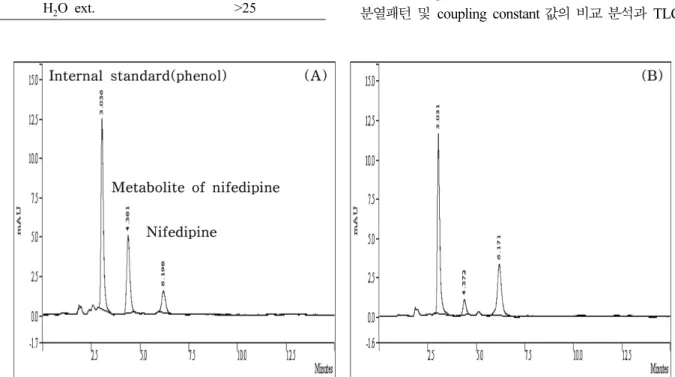
산초의 MeOH 추출물과 이를 n-hexane, EtOAc, n-BuOH 및 H2O의 순으로 용매별 분획하여 얻어진 각각의 분획물에 대하여 CYP3A4 저해 반응을 검토한 결과, Table I에 나타 낸 것과 같이 EtOAc 분획물이 IC50 19.1 μg/ml로서 가장 우 수한 CYP3A4 효소 저해효과를 나타내었다. 효소저해반응
결과 기질과 대사물의 변화를 나타내는 효소반응 HPLC 분 석 차트는 Fig. 1에 제시하였다. 계속하여 EtOAc 분획물을 column을 이용하여 소분획하여 얻어진 5종의 분획물에 대 해서도 CYP3A4 저해활성 실험 결과 Table II에 나타낸 것 과 같이 fraction 2와 4에서 우수한 효과를 나타내었다.
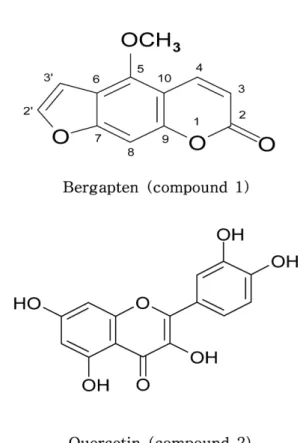
우수한 효과를 나타낸 fraction 2와 4 분획물에 대하여 활 성 성분의 규명을 위하여 silica gel column chromatography 로 재정제하여 화합물 1과 2를 얻었다(Fig. 2).
얻어진 화합물 1은 백색 분말로 vanillin-sulfuric acid 시 액에서 청색을 나타내고, UV에서 벤젠 유래의 흡광도를 보 이며 IR에서 α-pyrone 환과 방향족 탄소-탄소 이중결합 유 래의 피크를 보임에 따라 coumarin계 물질로 추정되었다.
1H-NMR spectrum에서 δ 6.25, 8.14, δ 7.01, 7.58 그리고 δ 7.11에서 5개의 proton signal이 관측되어져 linear furanocoumarin으로 추정할 수 있었으며, 또한 δ 4.26에서 methoxy 유래의 proton이 관측되며 13C-NMR spectrum에서 총 12개의 signal이 관측되어지는 등 NMR의 chemical shift, 분열패턴 및 coupling constant 값의 비교 분석과 TLC 등에 Table I. CYP3A4 inhibitory effect of solvent fractions
obtained from Zanthoxylum Peel
Sample IC50(µg/ml)
MeOH ext. >25
n-Hexane ext. 23.4
EtOAc ext. 19.1
n-BuOH ext. >25
H2O ext. >25
Fig. 1. HPLC chart of CYP3A4 inhibiting reaction by addition of EtOAc extract obtained from Zanthoxylum Peel. (A) Control and (B) Reaction.
Table II. CYP3A4 inhibitory effect of fractions prepared from EtOAc extract of Zanthoxylum Peel
Sample IC50(µg/ml)
Fraction 1 >25
Fraction 2 21.7
Fraction 3 >25
Fraction 4 19.8
Fraction 5 >25
서의 표준품과 비교 분석한 결과 화합물 1은 bergapten로 추정할 수 있었다. 최종적으로 화합물 1의 기기 분석치를 표준품 및 문헌치31-33)의 spectral data와 비교 분석한 결과 화합물 1의 구조는 Fig. 2에 나타낸 것과 같이 bergapten으 로 동정하였다.
화합물 2은 미황색 분말로 FeCl3 시험에서 녹색을, 아니 스알데히드-황산시액에서 오렌지색을 나타내어 flavan계 물 질로 추정되었고, IR에서 수산기가 확인되고 UV에서 벤젠 환의 존재를 확인할 수 있었다. 또한 1H-NMR spectrum에 서 sp2 carbon 유래의 5개의 signal이 δ 6.19, 6.40, 6.89, 7.64, 7.74에서 관측되고, 이들 proton signal의 chemical shift, 분열패턴 및 coupling constant 값의 비교 분석과 TLC 에서의 표준품과 비교 분석한 결과 화합물 2는 quercetin으 로 추정할 수 있었다. 최종적으로 화합물 2의 기기 분석치 를 표준품 및 문헌치34-36)의 spectral data와 비교 분석한 결 과 화합물 2의 구조는 Fig. 2에 나타낸 것과 같이 quercetin 으로 동정하였다.
계속하여 분리한 화합물 1과 2와 함께 저해 활성 대조군 으로서 ketoconazole 및 후추의 주성분으로서 CYP3A4 저 해 활성이 알려진 piperine을 사용하여 CYP3A4 저해 활성 시험을 실시한 결과를 Table III에 나타내었다. CYP3A4 저 해 활성 실험 결과, 산초로부터 단리한 bergapten은 IC50가 18.21 μM로서 이는 강력한 CYP3A4 효소저해 활성을 가진
ketoconazole의 0.11 μM보다는 저해 효과가 미약하나 piperine의 17.2 μM에는 근접하는 저해 효과를 나타내었는 데, 이는 bergapten이 CYP3A4 저해활성을 가진다는 보문37) 과 일치하는 결과를 보이고 있다. 또한 quercetin의 IC50는 17.27 μM로서 piperine과 유사한 저해 효과를 보임으로서 이전에 마늘의 CYP3A4 저해 활성 주성분 중의 하나가 quercetin이었다는 보고30)와 일치하고 flavonoid류의 CYP3A4 약물상호 작용에 대한 수치보다는38) 약간 강한 저해효과를 가지는 결과를 나타내고 있다.
이상의 실험 결과 향신료로서 널리 사용되어져온 산초의 약물대사효소 CYP3A4의 저해 활성은 산초의 주성분으로 알려진 정유 성분인 sanshool류가 아닌 산초에서 제초 활성 성분으로 보고39)된 bergapten과 항산화 성분으로 알려진12) flavonoid류인 quercetin에 기인한 저해 효과임을 시사하고 있다.
결 론
약물의 오남용으로 인한 부작용을 해소하고 효율적인 약 물 사용을 위한 연구의 하나로 향신료인 산초로부터 약물 대사효소 CYP3A4의 저해활성 물질 탐색연구를 수행하였 다. 산초의 MeOH 추출물과 극성별 분획물에 대하여 CYP3A4 저해활성을 실시한 결과 EtOAc 분획물이 가장 강 력한 저해 활성을 나타냈었고, 이를 silica gel column chromatography를 실시함과 동시에 CYP3A4 저해 반응을 통하여 활성 성분을 분리한 결과, bergapten과 quercetin을 분리하였다. 이들을 양성대조군으로서 ketoconazole과 후추 의 주성분인 piperine을 사용하여 CYP3A4 효소 저해 활성 시험을 실시한 결과, bergapten은 가장 강력한 CYP3A4 저 해 활성이 알려진 ketoconazole보다는 약하나 piperine에 근 접하는 CYP3A4 저해 효과를 나타내었고, quercetin도 ketoconazole에는 미치지 못하였지만 piperine과 유사한 저 해 활성을 보였다.
사 사
이 논문은 2018년 상지대학교 교내 연구비 지원에 의한 것임으로, 이에 감사드립니다.
Fig. 2. Structures of compounds 1 and 2 isolated from Zan- thoxylum Peel.
Table III. IC50 of bergapten and quercetin on CYP3A4 inhibiting activity
Sample IC50 (μM)
Bergapten 18.21
Quercetin 17.27
Ketoconazole 0.11
Piperine 17.20
인용문헌
1.식품의약안전처 (2014) 대한약전 제11개정, 의약품각조 제 2부, 53-54. (주)약업신문, 서울.
2.이성우 (1984) 한국식품문화사, 60. 교문사, 서울.
3. Lee, H. Y., An, R. B., Na, M. K., Park, J. Y., Lee, K. S., Kim, Y. H. and Bae, K. H. (2002) Quality evaluation of Zanthoxyli Fructus. Kor. J. Pharmacogn. 33: 45-48.
4. Fiho, V. C., Lima, E. O., Morais, V. M. F., Gomes, S. T. A., Miguel, O. G. and Yunes, R. A. (1996) Fungicide and fun- ngiostatic effects of xanthoxylin. J. Ethnopharmacol. 53:
171-173.
5. Jin, Y. and Shan, C. (1999) Effect of xanthoxylin on platelet aggregation in rabbits. Zhongguo Yaolixue Tongbao 15: 186- 187.
6. Kim, S. I. and Han Y. S. (1997) Isolation and identification of antimicrobial compound from Sancho (Zanthoxylum schini- folium). Korean J. Soc. Food Sci. 13: 56-63.
7. Mun, S. I., Ryu, H. S., Lee, H. J. and Choi, J. S. (1994) Fur- ther screening for antioxidant activity of vegetable plants and its active principles from Zanthoxylum schinifolium. J.
Korean Soc. Food Nutr. 23: 466-471.
8. Li, W., Sun, Y. N., Yan, X. T., Yang, S. Y., Kim, E. J., Kang, H. K. and Kim, Y. H. (2013) Coumarins and lignans from Zanthoxylum schinifolium and their anticancer activities. J.
Agric. Food Chem. 61: 10730-10740.
9. Lee, S. G. and Park, C. I. (2011) A study on the anti-microbial effect on S. mutans and anti-oxidant effect of Zanthoxylum pericarpium extract. Kor. J. Herbology 26: 181-185.
10. Jin, K. S., Oh, Y. N., Park, J. A., Lee, J. Y., Jin, S. J., Hyun, S. K., Hwang, H. J., Kwon, H. J. and Kim, B. W. (2012) Anti-oxidant, anti-melanogenic, and anti-inflammatory activ- ities of Zanthoxylum schinifolium extract. Korean J. Micro- biol. Biotechnol. 40: 371-379.
11. Ko, Y. S. and Han, H. J. (1996) Chemical constituents of Korean Chopi (Zanthoxylum piperitum) and Sancho (Zan- thoxylum schinifolium). Korean J. Food Sci. Technol. 28: 19- 27.
12. Cho, E. J., Yokozawa, T., Rhyu, D. Y., Kim, H. Y., Shibahara, N. and Park, J. C. (2003) The inhibitory effects of 12 medic- inal plants and their component compounds on lipid per- oxidation. Am. J. Chin. Med. 31: 907-917.
13. Li, W., Zhou, W., Shin, S. H. and Kim, Y. H. (2014) Chem- ical constituents of Zanthoxylum schinifolium (Rutaceae).
Biochem. Syst. Ecol. 55: 60-65.
14. Kato, R., Chiesara, E. and Vassanelli, P. (1964) Further stud- ies on the inhibition and stimulation of microsomal drug metabolizing enzymes of rat liver by various compounds.
Biochem. Pharmacol. 13: 69-83.
15. Conney, A. H. (1967) Pharmacological implication of mic- rosomal enzyme induction. Pharmacol. Rev. 19: 317-366.
16. Neter, K. J. (1980) Inhibition of oxidative drug metabolism in
microsomes. Pharm Ther. 10: 515-535 .
17. Wrighton, S. A. and Ring, B. J. (1992) Inhibition of human CYP3A4 catalyzed 1'-hydroxy midazolam formation by ketoconazole, bifedipine, erythromycin cimetidine, and niza- tidine. Pharm. Res. 11: 921-924.
18. Cantoni, L., Valaperta, R., Ponsoda, X., Castell, J. V., Barelli, D., Rizzardini, M., Mangolini, A., Hauri, L. and Villa, P.
(2003) Induction of hepatic heme oxygenase-1 by diclofenac in rodents: role of oxidative stress and cytochrome P-450 activity. J. Hepatol. 38: 776-783 .
19. Nelson, D. R., Koymans, L., Kamataki, T., Stegeman, J. J., Feyereisen, R., Waterman, M. R., Gotoh, O., Coon, M. J., Estabrook, R. W., Gunsalus, I. C. and Nebert, D. W. (1996) P450 superfamily : update on new sequences, gene mapping, accession numbers and nomenclature. Pharmacogenetics 6:
1-42.
20. Guengerich, F. P. (1997) Comparisons of catalytic selectivity of cytochrome P450 subfamily enzymes from different spe- cies. Chemico-Biological Interactions 106: 161-182.
21. Shimada, T., Tamazaki, H., Mimura, M., Inui, Y. and Guengerich, F. P. (1994) Interindividual variations in human liver cytochrome P450 enzymes involved in the oxidation of drugs, carcinogens and toxic chemicals : studies with liver microsomes of 30 Japanese and 30 Caucasians. J. Parmacol.
Exp. Ther. 270: 414-423.
22. Williams, M. L., Lennard, M. S., Martin, I. J. and Tucker, G.
T. (1994) Interindividual variation in the isomerization of 4- hydroxytamoxifen by human liver microsomes : involvement of cytochrome P450. Carcinogenesis. 15: 2733-2738.
23. Moltke, L. L., Greenblatt, D. J., Cotreau-Bibbo, M. M., Har- matz, J. S. and Shader, R. I. (1994) Inhibitors of alprazolam metabolism in effect of serotonin- reuptake-inhibitor anti- depressants, ketoconazole and quinidine. Br. J. Clin. Phar- macol. 38: 23-31.
24. Granberg, A. L., Brunstrom, B. and Brandt, I. (2000) Cyto- chrome P450-dependent binding of 7,12-dimethylbenz[a]
anthracene(DMBA) and benzo[a] pyrene (B[a]P) in murine heart, lung, and liver endothelial cells. Arch. Toxicol. 74: 593- 601.
25. Rushmore, T. H. and Kong, A. N. (2002) Phamacogenomics, regulation and signaling pathways of phase I and II drug metabolizing enzyme. Curr. Drug Metab. 3: 481-490.
26. Thu, O. K., Spigset, O., Nilsen, O. G. and Hellum, B. (2016) Effect of commercial Rhodiola rosea on CYP enzyme activ- ity in humans. Eur. J. Clin. Pharmacol. 72: 295-300.
27. Ahmmed, S. M., Mukherjee, P. K., Bahadur, S., Harwannsh, R. K., Kar, A., Bandyopadhyay, A., Al-Dhabi, N. A. and Duraipandiyan, V. (2016) CYP450 mediated inhibition potential of Swertia chirata: An herb from Indian traditional medicine. J. Ethnopharmacol. 178: 34-39.
28. Lv, Q. L., Wang, G. H., Chen, S. H., Hu, L., Zhang, X., Ying, G., Qin, C. Z. and Zhou, H. H. (2016) In vitro and in vivo
inhibitory effects of glycyrrhetinic acid in mice and human cytochrome P450 3A4. Int. J. Environ. Res. Public Health 13:
84-91.
29. Qin, C. Z., Ren, X., Zhou, H. H., Mao, X. Y. and Liu, Z. Q.
(2015) Inhibitory effect of salvianolate on human cytochrome P450 3A4 in vitro involving a noncompetitive manner. Int. J.
Clin. Exp. Med. 8: 15549-15555.
30. Cha, B. C. and Lee, E. H. (2006) Inhibiting activity of Garlic on a drug metabolizing enzyme CYP3A4. Kor. J. Phar- macogn. 37: 97-102.
31. Kim, S. J., Chin, Y. W., Yoon, K. D., Ryu, M. Y., Yang, M.
H., Lee, J. H. and Kim, J, W. (2008) Chemical constituents of Saposhnikovia divaricata. Kor. J. Pharmacogn. 39: 357-364.
32. Liu, R., Feng, L., Sun, A. and Kong, L. (2004) Preparative isolation and purification of coumarins from Cnidium mon- nieri (L.) Cusson by high-speed counter-current chroma- tography. J. Chromatography A. 1055: 71-76.
33. Masuda, T., Takasugi, M. and Anetai, M. (1998) Psoralen and other linear furanocoumarins as phytoalexinns in Glehnia lit- toralis. Phytochemistry 47: 13-16.
34. Huang, L., Cao, Y. and Chen, G. (2008) Purification of quer- cetin in Anoectochilu roxburghii (wall) Lindl using UMAE by high-speed counter-current chromatography and subse-
quent structure identification. Sep. Purif. Technol. 64: 101- 107.
35. Yoon, I., Wee, J. H., Moon, J. H., Ahn, T. H. and Park, K. H.
(2003) Isolation and identification of quercetin with anti- oxidative activity from the fruits of Rubus coreanum Miquel.
Korean J. Food Sci. Technol. 35: 499-502.
36. Peng, Z. F., Strack, D., Baumert, A., Subramaniam, R., Goh, N. K., Chia, T. F., Tan, S. N. and Chia, L. S. (2003) Anti- oxidant flavonoids from leaves of Polygonum hydropiper L.
Phytochemistry 62: 219-228.
37. Ho, P. C., Saville, D. J., Coville, S. P. and Wanwimolruk, S.
(2000) Content of CYP3A4 inhibitors, naringin, naringenin and bergapten in grapefruit and grapefruit juice products.
Pharm. Acta. Helv. 74: 379-385.
38. Li, Y., Ning, J., Wang, Y., Wang, C., Sun, C., Huo, X., Yu, Z., Feng, L., Zhang, B., Tian, X. and Ma, X. (2018) Drug inter- action study of flavonoids toward CYP3A4 and their quan- titative structure activity relationship (QSAR) analysis for predicting potential effects. Toxicol. Lett. 294: 27-36.
39. Kim, K. W., Baek, J. K. and Kim, J. S. (2005) Isolation of herbicidal compounds from the fruit of Zanthoxylum schini- folium S. et. Z. Kor. J. Weed Sci. 25: 194-201.
(2019. 7. 1 접수; 2019. 7. 12 심사; 2019. 7. 16 게재확정)