Print ISSN: 2288-4637 / Online ISSN 2288-4645 doi:10.13106/jafeb.2021.vol8.no1.915
The Impact of Psychological and Environmental Factors on Consumers’
Purchase Intention toward Organic Food: Evidence from Vietnam
Dinh Toan NGUYEN
1, Dinh Chien TRUONG
2Received: September 30, 2020 Revised: November 30, 2020 Accepted: December 14, 2020
Abstract
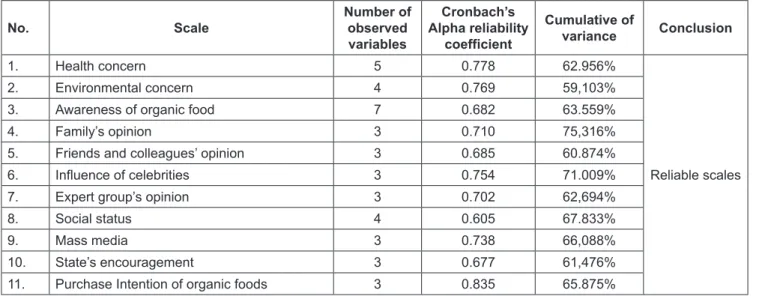
The study investigates some psychological and environmental factors affecting the intention to purchase organic foods of consumers in the inner-city of Hanoi. Impact factors applied for the study include three psychological factors (health concern, environmental concern, consumer awareness of organic foods) and seven environment factors (family’s opinion, friends and colleagues’ opinion, influence of celebrities, expert’s opinion, social status, mass media, state’s encouragement). We analyzed research data from 396 consumers to measure the impacting level of these factors. The convenient sampling method was used to collect the research sample. The measurement applied a 5-point Likert scale classifying from 1–completely disagree to 5–completely agree. Based on previous studies, the research model was recommended. We had estimated the reliability of the scales through Cronbach’s Alpha and composite reliability. The research data is analyzed by using Structural Equation Model method (SEM). The findings of the study suggest that psychological factors (health concern, environmental concern, consumer awareness of organic foods) had a significantly positive influence on consumer’s purchase attention toward organic food. The results also revealed that environmental factors (family’s opinion, friends and colleagues’ opinion, influence of celebrities, expert’s opinion, mass media) were positively linked to consumer’s purchase attention toward organic food.
Keywords: Organic Food, Purchase Intention, Psychological Factors, Environmental Factors JEL Classification Code: C38, M30, M31, M37
1
First Author and Corresponding Author. Lecturer, Faculty of Marketing, National Economics University, Hanoi, Vietnam [Postal Address: 207 Giai Phong Street, Hai Ba Trung District, Hanoi City, 100000, Vietnam] Email: [email protected]
2
Associate Professor, Lecturer, Faculty of Marketing, National Economics University, Hanoi, Vietnam Email: [email protected]
© Copyright: The Author(s)
This is an Open Access article distributed under the terms of the Creative Commons Attribution Non-Commercial License (https://creativecommons.org/licenses/by-nc/4.0/) which permits unrestricted non-commercial use, distribution, and reproduction in any medium, provided the original work is properly cited.
1. Introduction
According to the World Health Organization (WHO), organic agro-products (organic food) are perceived as
“products that are created from an organic agricultural sector whose production process only uses organic fertilizers, removes grass manually or mechanically, prevents pestilent insects by biological methods, creates products meeting foods hygiene and safety requirements, at the same time ensures that the production system is sustainable in terms of environment, society, economics, habitat protection for both the present and future”.
Organic food encompasses natural food items, which are free from artificial chemicals such as fertilizers, herbicides, pesticides, antibiotics, and genetically modified organisms.
Additionally, organic food is not subjected to irradiation (Gad Mohsen & Dacko, 2013). Thus, organic food is considered healthy because synthetic chemicals are not used in its production (Suprapto & Wijaya, 2012). The literature shows that many terms are used to refer to organic food, such as “natural,” “local,” “fresh,” and “pure” (Chan, 2001).
Organic farming has always been a healthy option to produce followed by at least some farmers all over the world (Dmitri, Lohr, Canavari, & Olson, 2007).
In recent years, organic food production and trading industries in the world have grown rapidly in recent years.
In the United States, the growth rate of the organic food
market is estimated at around 15.5% per year from 2013
to 2019 (according to the Organic Foods and Beverage
Market). According to Makatouni (2002), “the organic food
production and trading industry is one of the industries
with the fastest growth rate in the food market in Europe,
South America, Oceania and Japan”. The points-of-sales
of organic foods in markets, supermarkets and retail stores
have developed extraordinarily, with an average growth rate
of 20-50% (according to FFDI). Organic foods have become familiar to consumers in many countries and will become the world’s consumer trend in the future (Pham, 2020).
In Vietnam, in the context of popular unsafe foods, an increasing number of consumers, especially consumers in big cities like Hanoi and Ho Chi Minh have sought safe foods.
Therefore, the organic foods market in big cities of Vietnam like Hanoi is assessed to have potential for fast development.
However, in fact, the production and trading industry as well as the consumption market of organic agro-products in Vietnam have not really developed. The cause is that organic foods trading enterprises still lack knowledge about the purchasing behavior as well as factors affecting consumers’
behavior of buying organic foods. Therefore, the study of impact of factors affecting the behavior/intention to purchase organic foods is crucial to create an accurate source of input information to be the basis for strategic decisions to develop the organic foods market in Vietnam.
There have been numerous studies on the impact of factors on organic purchase intention (Akbar, Hassan, Khurshid, Niaz, & Rizwan, 2014; Kabadayı, Dursun, Alan, & Tuğer, 2015; Kong, Harun, Sulong, & Lily, 2014; Swain, 2012). In Vietnam, there have also been a number of studies on the factors affecting purchase intention toward green or organic foods. However, no studies have assessed the impact of specific external environmental factors on purchase intention toward organic food, including: family’s opinion, friends and colleagues’ opinion, influence of celebrities, expert’s opinion, social status, mass media, and state’s encouragement. From the mentioned reasons, authors decided to investigate the topic of personal psychological factors and environmental factors affecting the intention to purchase organic foods of consumers in Hanoi, Vietnam.
2. Literature Review
2.1. Purchase Intention of the Organic Food
According to WHO, “Organic foods (organic agro- products) are products that are produced based on the natural cultivation and husbandry system, do not use chemicals as fertilizers, do not use pesticides, herbicide, antibiotics or preserves, etc., but use natural products as fertilizers and use biological methods to prevent pestilent insects. Therefore, organic agro-products are also called healthy foods or natural foods.” Ajzen (2002) defined the purchase intention as
“human’s attempt to complete the behavior under the impact of factors, including behavior, trust in standards and trust in the control. The stronger the impact of these factors is, the stronger the human’s will to act is.” According to Rashid, Jusoff, and Kassim (2009), purchase intention for organic food is “the ability and intention of consumers themselves in using their preference for organic agro-foods rather than
ordinary foods in making consideration and assessment when purchasing”. Han, Hsu, Lee, and Sheu (2011) pointed out that the intention to purchase organic agro-products is often associated with “the intention to pay more for organic agro- products compared to ordinary products” and “good word-of- mouth about products”.
2.2. Factors Affecting Consumers’ Purchase Intention toward Organic Food
The existing studies on factors affecting purchase intention toward organic foods like that of Lê (2014) have measured the impact of these factors: health concern, perception of quality, environmental concern, subjective code of conduct, product availability, product pricing, reference groups, and mass media. The researchers applied some of the impact factors used in previous studies to continue the survey in the new context of the existing model, while developing a number of new impact factor that those previous studies had not mentioned. From qualitative interviews, the researchers have identified some more specific factors of some reference groups to assess the influence of purchase intention toward organic foods such as family’s opinion, friends and colleagues’
opinion, influence of celebrities, and expert’s opinion. Some other environmental factors that are also added to the research model including social status and state’s encouragement.
Because in the context of Vietnam, state’s encouragement is expressed in policies to enact and enforce regulations, which may have an impact on consumers’ purchase intention toward organic foods. The research model did not include business marketing factors such as product availability and product pricing to measure the impact of objective factors on Hanoians’ purchase intention toward organic food.
Using the factors mentioned in existing studies and through qualitative interviews, the researchers identified factors affecting consumers’ purchase intention toward organic foods in the research model, including:
(I) Psychological and personal factors: (1) Health concern; (2) Environmental concern; (3) Consumer awareness of organic foods.
(II) External environmental factors: (4) Family’s opinion;
(5) Friends and colleagues’ opinion; (6) Influence of celebrities; (7) Expert’s opinion; (8) Social status; (9) Mass media; (10) State’s encouragement.
2.2.1. Psychological and Personal Factors
• Health Concern
Consumers who are concerned about their health are
“consumers who thoroughly know their health status and
are concerned about their health benefits. They are willing
to do things to maintain good health and improve health and
quality of life” (Kraft & Goodell, 1993). These people tend
to prevent disease by engaging in healthy activities. They are knowledgeable about nutrition and participate in sports activities. Consumers have paid no attention to the marketing mix factors, but they care much about service quality and health consciousness (Tran, Pham, Van Pham, & Nguyen, 2020). When the economy develops, the people’s living standards are improved, consumers have paid more and more attention to health issues during their selection of products in general and food products in particular. Organic foods are assessed as good for the health, so it will affect consumers’
decision when buying foods for their daily meals. Moreover, many previous researches of authors, including Dickieson, Arkus, and Wiertz (2009), Kulikovski, Agolli, and Grougiou (2011), Nguyen (2011), Lê (2014), also proved that health concern is a factor that affects consumers’ intention/behavior to buy organic foods.
• Environmental Concern
Kalafatis, Pollard, East, and Tsogas (1999) describe environmental concern as the awakening and perception of consumers of the environment being threatened and the natural resources being increasingly depleted. Said and Fakhrul-Razi Ahmadun (2003) define environmental concern as beliefs, attitudes, and levels of personal concern for the environment. According to Winter and Davis (2006),
“organic foods are foods that help protect the environment because the production and trading process does not use chemicals and technologies that pollute the environment”;
therefore, environmental concern is considered one of the factors that affects consumers’ use of organic products or not.
The study of Magnusson et al. (2001) figured out that up to 89% of the respondents agreed that they paid a lot of attention to the consequences of the food product consumption to the environment. Environmental concerns had a positive impact on such practices, and the image of internal green supply chain management practices was found to have a significantly positive effect on consumer purchasing behavior (Lee & Lim, 2020).
• Consumer Awareness of Organic Foods
People consume foods when they are aware of the quality and benefits of products. In the food consumption, the awareness on the quality is the top concerns. Many studies argued that consumers describe organic produce as natural, unprocessed and free from growth hormones (Harper & Makatouni, 2002; Hutchins & Greenhalgh, 1997;
Lockie, Lyons, Lawrence, & Mummery, 2002). The common understanding of consumers on organic produces is that these have no pesticides, no artificial fertilizer, and residue-free safe products (Huang, 1996; Jolly, Schutz, Diaz-Knauf, &
Johal, 1989). Moreover, consumers often perceive organic produce as healthier with higher vitamin and mineral contents than conventional products and are environment friendly (Chinnici, D’Amico, & Pecorino, 2002; Lea & Worsley, 2005; McEachern, Seaman, Padel, & Foster, 2005; Radman,
2005). Perception plays an important role in knowing the potential consumers’ attitude and behaviors toward organic food. This factor is mentioned in the research models of many authors on factors affecting consumers’ intention to purchase organic foods, such as the studies of Dickieson et al. (2009), Kulikovski et al. (2011), Nguyen (2011), Lê (2014).
2.2.2. External Environmental Factors
The study of Roberts and Rundle-Thiele (2007) pointed out the referential groups that affect consumers’ intention to purchase organic foods, but they have not been able to figure out the impacting level and direction of specific reference groups. The specific reference groups are identified as follows:
• Family’s Opinion
The family is the group that has the most significant influence on an individual’s purchase intention toward goods, especially food, which is essential, used daily and serves the needs of all the members. At the same time, family members often use the same budget so the purchase intention will be influenced by the views and opinions of other members.
• Friends and Colleagues’ Opinion
Friends and colleagues are included in a group that each individual regularly contacts in the community, society, and group members often have similar characteristics in terms of interests, age, views, attitudes, and qualifications, etc.
Members of a group of friends and colleagues often have opinions on the issues they care about and those opinions affect the perceptions and thoughts of other members.
• Expert’s Opinion
Experts are people with extensive knowledge, information and thorough understanding of products. Consumers often seek for information from this group during the purchase decision-making process. In particular, for organic agro- products, opinions on nutrition facts, identification, etc. are always of consumers’ top concerns, so the inclusion of this group in the model for consideration under the perspective of the research team is completely suitable.
• Influence of Celebrities
Celebrities include influential people with broad awareness, which is the ideal role model for many consumers in some cases. Celebrities are key opinion leaders (KOLs) who influence consumers’ perceptions, attitudes and behaviors toward a particular product or brand. One of the factors in the social environment in Philips Kotler’s model that has impacts and needs to be considered is social status.
Consumers often tend to purchase products to show and assert
their social status. Organic agro-products are often products
that have high value and are safe for the environment and the
health. The use of these products makes consumers perceive
that they are at a high social status, broad knowledge, so
it will affect their purchase intention and decision. In the
current age when the information technology develops dramatically, consumers access information from various directions in which the mass mediate has very great impact on consumers. The information from the mass media helps form trust and attitude, thus affecting consumers’ purchase intention.
2.3. Research Framework and Hypotheses
According to Davis, Titterington, and Cochrane (1995), the most frequent motive to purchase organic food is based on consumers’ perception that organic food is healthy to them. Health concern appears as the most important reason for purchasing and consuming organic food (Magnusson, Arvola, Hursti, Åberg, & Sjödén, 2003; McEachern et al., 2005; Tregear, Dent, & McGregor, 1994; Wandel & Bugge, 1997). Previous research by Lockie et al. (2002); Grankvist and Biel (2001) has identified interest in health as a primary motive for the purchase of organic food. In addition health consciousness has been found to predict attitudes, intention and purchase of organic food (Magnusson et al., 2003;
Magnusson et al., 2001). Fotopoulos and Krystallis (2002) have their own opinion toward health consciousness that has given impact in purchase intention of organic food. The matter of increased health care through proper nutrition is a key factor influencing consumption choice. Based on the concept of each affecting factors and the relation with the intention to purchase organic foods, the research team has defined the following hypotheses:
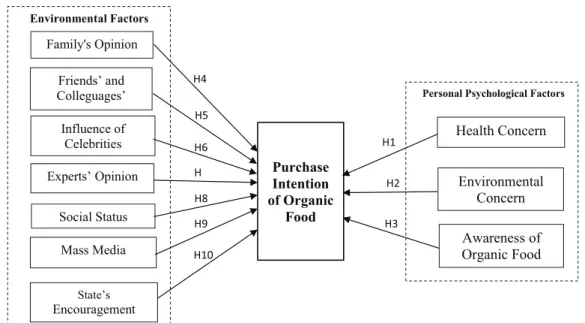
H1: Health concern has a positive impact on purchase intention of organic food.
When the life and income are improved, consumers start to pay more attention to the health in their daily-used products. Foods are essential consumer goods and the main source of nutrients; therefore, they directly affect consumers’
health. Many studies have asserted the proportional relation between health concern and the intention to purchase organic foods ((i.e., Nguyen (2011); Truong, Yap, & Ineson, 2012).
Health concern is the motivation to buy organic foods, so when consumers pay more attention to health, they will have intention to purchase organic foods.
H2: Environmental concern has a positive influence on purchase intention of organic food.
The environment is degrading and the environmental pollution has become very severe, so the green consumption has become the consumer trend of the world in general and Vietnam in particular. Howlett, McCarthy, and O’Reilly (2002) showed that consumers of organic foods have paid
a lot of attention to the environment. In Vietnam, Nguyen (2011) also asserted the proportional relation between environmental concern to the intention to purchase organic foods. As a result, consumers who pay more attention to the environment will have a strong intention to purchase organic foods.
H3: Awareness of organic foods has a positive influence on purchase intention of organic food.
Consumers will eat foods when they are aware of the product quality and their benefits. In the food consumption, the awareness of quality is one of the top concern. When consumers are aware of the high quality of organic foods and their benefits, they will form the intention and turn to consume organic foods. This proportional relation has been proved in many previous studies (i.e., Dickieson et al., 2009;
Magnusson et al., 2001), which are the basis for formulating this hypothesis.
H4: Family’s opinion that supports organic foods has a positive influence on purchase intention of organic food.
In families, members often exchange information and assessment on the selection and use of products. The intention of each family member will have direct influence on the remaining members in the consensus direction. Many research results have proved the proportional relation of the family’s opinion to the intention to buy many types of products and services in which food products are not an exception. Therefore, family members using organic foods or have the supporting intention to use organic foods instead of ordinary foods will encourage consumers to buy and use organic foods.
H5: Friends and colleagues’ opinions that support the use of organic foods have a positive influence on purchase intention of organic food.
Friends and colleagues are those who often come into contact after the family. Because there are usually similar characteristics in terms of age, interests, opinions, attitudes, etc., this referential group presents their opinions and perspective more freely and is more receptive to each other’s opinions. According to the research team’s hypothesis, the frequent exchange and evaluation of organic foods by friends and colleagues will first help consumers receive more information about organic foods, thereby promoting consumers’ purchase intention.
H6: Opinions of celebrities consuming organic foods
have a positive impact on purchase intention of organic food.
Celebrities are often the images that fans want to target and want to become. This is a relatively influential and well- known group of people. In some cases, this referential group is the representative for enterprises and a bridge to consumers.
Many products and services that consumers choose and use come from the influence of KOLs who are celebrities.
Therefore, the research team set out a hypothesis that the influence of celebrities will positively impact consumers’
intention to purchase organic foods.
H7: Expert group’s opinion about organic foods has a positive impact on purchase intention of organic food.
The expert group in the author’s study is divided into two main groups: food experts and State’s accrediting agencies.
This is a referential group with a deep understanding of organic foods and often gives information, advice or evidences as a basis for identifying and selecting products and brands of consumers. Therefore, the research team formulated a hypothesis that positive opinions of the expert group on organic foods will stimulate consumers’ purchase intention.
H8: The greater the desire to show social status, the stronger the purchase intention of organic food.
Consumers often tend to buy and consume products and services that demonstrate their social status. Organic foods are foods with a relatively high price compared to ordinary foods, the consumption of organic foods will help protect health and environment so they are expected to help enhance the images of consumers in the eyes of others.
Thus, the author submits a hypothesis that the higher the desire to show consumers’ social status, the stronger consumers’
intention to purchase organic foods.
H9: Mass media has a positive impact on purchase intention of organic food.
Mass media is a source of information that consumers consider useful and reliable while searching for information about products and services. This is a broad and profound source of information for consumers. In fact, there have been many studies showing the positive relationship of mass media to purchase intention (i.e., Wray Ricardo et al.; Inman Khalid). Organic foods are also no exceptions, so the research team formulated a hypothesis that the mass media would positively impact consumers’ purchase intention.
H10: State’s encouragement has a positive impact on purchase intention of organic food.
The State’s legal policies affect not only enterprises, but also consumers. All people and organizations must operate, work and do business in compliance with the law of the State. Therefore, the research team gave out a hypothesis that when the State has policies to encourage the development of the organic food industry, it will promote the development of production and business activities, thereby positively affecting consumers’ purchase intention.
Based on the synthesis of relationships and hypotheses, we draw a model to study some factors affecting the intention to purchase organic foods (Figure 1).
Environmental Factors
Personal Psychological Factors
Family's Opinion
Health Concern Purchase
Intention of Organic
Food
Environmental Concern Friends’ and
Colleguages’
H1 H2 H3
Influence of
Celebrities
H H6 H8 H4
H9
Awareness of Organic Food
H5
Experts’ Opinion Social Status
State’s