Tuberc Respir Dis 2011;71:24-29
CopyrightⒸ2011. The Korean Academy of Tuberculosis and Respiratory Diseases. All rights reserved.
만성 기침환자에서 기관지 과민성, 아토피와 비만의 상관관계: 두 기관 연구
1한림대학교 의과대학 내과학교실, 2울산대학교 의과대학 서울아산병원 내과학교실, 3전북대학교 의과대학 내과학교실, 4순천향대학
교 의과대학 내과학교실, 5성균관대학교 의과대학 강북삼성병원 내과학교실
박소영1, 박종원1, 오연목2, 이양근3, 이영목4, 박용범1*, 임성용5*, 천식연구회
The Association of Obesity, Airway Hyperresponsiveness and Atopy in Chronic Cough Patients: Results of a Two-Center Study
So Yong Park, M.D.1, Jong Won Park, M.D.1, Yeon Mok Oh, M.D., Ph.D.2, Yang Keun Rhee, M.D., Ph.D.3, Young Mok Lee, M.D.4, Yong Bum Park, M.D.1*, Seong Yong Lim, M.D., Ph.D.5*, Korean Asthma Study Group
1Division of Pulmonary and Critical Care Medicine, Department of Internal Medicine, Hallym University College of Medicine, Seoul, 2Department of Pulmonary and Critical Care Medicine, Department of Internal Medicine, Asan Medical Center, University of Ulsan College of Medicine, Seoul, 3Division of Pulmonary and Critical Care Medicine, Department of Internal Medicine, Chonbuk National University Medical School, Jeonju, 4Division of Pulmonary and Critical Care Medicine, Department of Internal Medicine, Soonchunhyang University College of Medicine, Seoul, 5Division of Pulmonary and Critical Care Medicine, Department of Internal Medicine, Kangbuk Samsung Hospital, Sungkyunkwan University College of Medicine, Seoul, Korea
Background: The rising prevalence of asthma worldwide may be associated with the rising prevalence of obesity in developed nations. Although several studies have suggested a relationship between asthma and obesity, controversy still remains. The aim of this study was to examine the relationship between obesity and asthmatic factors such as atopy, eosinophilia, serum total Ig E and bronchial hyperresponsiveness in chronic cough patients.
Methods: This study was a retrospective, observational study in two centers done between January 2007 and June 2008. The subjects included individuals who had a chronic cough. We examined body mass index (BMI) to measure obesity and pulmonary function. We did a metacholine provocation test for airway hyperresponsiveness (AHR), a skin prick test for atopy, and tests for blood eosinophils and serum IgE.
Results: A total of 1022 subjects were included. Airway hyperresponsiveness was not related with obesity (p=0.06), and atopy incidence was significant higher in non obese patients (p=0.00). There was no significant difference in serum IgE and blood eosinophil counts between obese and non obese patients. Forced expiratory volue in one second (FEV1)/forced vital capacity (FVC) was significantly reduced in obese patients (p=0.03), but FEV1 and FVC were no significant difference between obese and non obese patients.
Conclusion: There is no relationship between obesity and bronchial hyperresponsiveness. The nonobese group appears to have more atopy. The relationship between obesity and bronchial hyperresponsiveness and atopy need further investigation.
Key Words: Obesity; Bronchial Hyperresponsiveness; Dermatitis, Atopic
Address for correspondence: Yong Bum Park, M.D.
Division of Pulmonary and Critical Care Medicine, Department of Internal Medicine, Kangdong Sacred Heart Hospital, Hallym University College of Medicine, 445, Gil-dong, Gangdong-gu, Seoul 134-701, Korea
Phone: 82-2-2225-2754, Fax: 82-2-478-6925, E-mail: [email protected] Co-correspondence: Seong Yong Lim, M.D., Ph.D.
Division of Pulmonary and Critical Care Medicine, Department of Internal Medicine, Kangbuk Samsung Hospital, Sungkyunkwan University School of Medicine, Pyeong-dong, Jongno-gu, Seoul 110-746, Korea
Phone: 82-2-2001-2491, Fax: 82-2-2001-1596, E-mail: [email protected]
*These two authors equally contributed to this article.
Received: Apr. 28, 2011 Accepted: Jun. 24, 2011
서 론
만성 기침의 중요한 원인 중 하나인 천식은 자연적 또 는 치료에 의해 크게 변화하는 호흡 기류의 폐쇄에 의해 나타나는 특징적인 증후군이다1. 전세계적으로 천식의 유 병률은 지속적인 증가 추세를 보이고 있으며, 여기에는 대기오염, 흡연, 알레르기항원에의 노출, 식이 등의 환경 적인 요인이 다양한 기전을 통해 천식의 발생과 악화에 영향을 미치는 것으로 알려져 있다2-4. 최근에는 여러 연구 에서 이러한 요소 중 비만이 천식의 발생률과 유병률, 천 식의 중증도와 관련이 있다는 보고가 있었다5-11. 지난 수십 년간 비만의 유병률은 시간이 지날수록 전세 계적으로 증가하는 추세를 보이고 있으며, 우리나라에서 도 비만인구가 증가함에 따라 비만은 천식환자에 있어 중 요하게 고려할 만한 인자로 주목받고 있다12. 일반 성인을 대상으로 한 연구에서 비만한 경우 기관지 폐쇄 증상과 천식의 유병률이 증가함을 보고하였으며13,14, 비만한 천식 환자에서 체중감량으로 폐기능 향상과 천식증상이 호전 됨이 보고되었다15. 그러나, 이러한 결과들은 서양에서의 연구가 대부분이었고 천식과 비만의 상관관계에 있어 우 리나라 성인인구를 대표할 수 있는 연구가 미비한 상태이 다.
이에 본 연구에서는 비만을 정량적으로 나타낼 수 있는 체질량 지수와 천식의 관련 인자인 기관지 과민성, 아토피 의 임상적 척도를 분석함으로써 천식과 비만의 상관관계 를 알아보고자 하였다.
대상 및 방법 1. 연구 대상
본 연구는 2007년 1월부터 2008년 6월까지 18개월 동 안 한림대학교 강동성심병원과 성균관대학교 강북삼성병 원 호흡기 알레르기 내과 외래에 만성 기침을 주소로 내원 한 비흡연 또는 10갑년 이하의 흡연력을 가진 환자 1,022 명을 대상으로 후향적 관찰연구를 진행하였다. 단, 최근 수개월 내에 심근 경색이나 뇌경색이 진단된 환자, 조절되 지 않는 고혈압환자, 임신 중인 환자는 대상 군에서 제외 하였으며, 최근 6개월 이내에 전신적 스테로이드 투여를 받은 환자나 종양환자, 호흡기 결핵이나 만성 폐쇄성 폐질 환 등의 호흡기 질환을 진단받은 과거력이 있는 환자도 제외하였다.
2. 방법
1) 비만도: 비만도는 체질량지수(body mass index, BMI)로 결정하였다. 체질량지수는 체중과 신장을 이용한 Queterelets index를 이용하여 모든 환자들의 체중 및 키 를 측정하여 체질량지수를 계산하였다. 체질량지수 25 kg/m2를 기준으로 비만환자군과 일반환자군으로 구분하 였다.
2) 메타콜린 기관지 유발 시험: 비특이적 기도 과민성을 평가하기 위해 메타콜린으로 기관지 유발 시험을 시행하 였다. PC20 methacholine (1초간 노력성 호기량[forced expiratory volume in one second, FEV1]을 20% 감소시키 는 메타콜린 농도 mg/mL)을 구하여 기도 과민성을 정량 화하였고 PC20 methacholine이 25 mg/mL 이하인 경우를 기관지 과민성에 대한 양성 반응으로 판정하였다.
3) 아토피: 12종류의 allergen (Dermatophagoides pter- onyssinus, Dermatophagoides farine, Tree mix, Grass mix, birch, Mugwort, Ragweed, Cat, Dog, Cockroach, Alternaria, Aspergillus)에 대한 skin prick test를 시행하 여 A/H ratio가 1 이상인 경우 또는 MAST 검사에서 12종 의 알레르겐 중 한 개 이상에서 class 2 이상의 반응을 보이는 경우 아토피로 판정하였다.
또한 혈액 검사를 시행하여 각 환자의 혈중 호산구 수 와 혈청 IgE 농도를 확인하였다.
3. 통계분석
대상 군의 성별에 따른 연령과 FEV1의 차이는 t-test로 검정하였고 기관지 과민성 여부와 성별, 연령, 비만도와의 관계는 Chi-square 검정을 이용하여 비교하였다. 통계처 리는 SPSS version 15.0 (SPSS Inc, Chicago, IL, USA) 프 로그램을 사용하였으며, p값이 0.05보다 작은 경우 통계 적으로 유의한 차이가 있다고 판단하였다.
결 과 1. 대상 환자의 특성
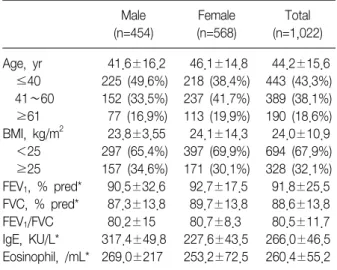
연구에 참여한 환자는 총 1,022명으로 대상자의 일반적 인 특징은 Table 1과 같다. 연령의 중간 값은 44.2±15.6 세였고 40세 이하가 443명(43.3%), 61세 이상이 190명 (18.6%)이었다. 대상자의 성별은 남자가 454명(43.3%), 여자가 568명(56.7%)이었다. 대상 환자 중 체질량지수가 25 kg/m2 이상인 환자는 328명(32.1%)이었는데, 남자가
Table 1. Clinical characteristics of study population Male
(n=454)
Female (n=568)
Total (n=1,022) Age, yr 41.6±16.2 46.1±14.8 44.2±15.6 ≤40 225 (49.6%) 218 (38.4%) 443 (43.3%) 41∼60 152 (33.5%) 237 (41.7%) 389 (38.1%) ≥61 77 (16.9%) 113 (19.9%) 190 (18.6%) BMI, kg/m2 23.8±3.55 24.1±14.3 24.0±10.9 <25 297 (65.4%) 397 (69.9%) 694 (67.9%) ≥25 157 (34.6%) 171 (30.1%) 328 (32.1%) FEV1, % pred* 90.5±32.6 92.7±17.5 91.8±25.5 FVC, % pred* 87.3±13.8 89.7±13.8 88.6±13.8 FEV1/FVC 80.2±15 80.7±8.3 80.5±11.7 IgE, KU/L* 317.4±49.8 227.6±43.5 266.0±46.5 Eosinophil, /mL* 269.0±217 253.2±72.5 260.4±55.2 Data were calculated by t-test.
*Mean±2 SD.
BMI: body mass index; FEV1: forced expiratory volume in one second; FVC: forced vital capacity; SD: standard deviation.
Table 3. Difference of AHR according to BMI
BMI <25 kg/m2 BMI ≥25 kg/m2 p-value AHR (−) 463 (45.3%) 238 (23.3%) 0.06 AHR (+) 231 (22.6%) 90 (8.8%)
Data were calculated by chi-squire test.
AHR: airway hyperresponsiveness; BMI: body mass index.
Table 4. Difference of atopy according to BMI Atopy (n=308) BMI <25 kg/m2 BMI ≥25 kg/m2 p-value
Atopy (−) 116 (37.7%) 69 (22.4%) 0.00 Atopy (+) 99 (32.1%) 24 (7.8%)
Data were calculated by chi-square test.
BMI: body mass index.
Table 2. Characteristics according to BMI BMI <25 kg/m2
(n=694)
BMI ≥25 kg/m2 (n=328) p-value
Age, yr 0.000†
≤40 337 (76.0) 106 (24.0) 41∼60 244 (62.7) 145 (37.3) ≥61 113 (59.5) 77 (40.5)
Gender 0.12
Male 297 (65.4) 157 (34.6) Female 397 (69.9) 171 (30.1)
FEV1, % pred* 91.3±16.7 92.7±37.9 0.434 FVC, % pred* 89.1±13.7 87.9±14.1 0.194 FEV1/FVC 81.0±13.3 79.5±7.3 0.025† IgE, KU/L* 286.0±15.4 215.7±34.3 0.174 Eosinophil, /mL* 266.7±63.2 244±24.3 0.763 Values are presented number (%) unless otherwise indicated.
Data were calculated by t-test.
*Mean±2 SD, †p<0.05.
BMI: body mass index; FEV1: forced expiratory volume in one second; FVC: forced vital capacity.
157명(34.6%)으로 여자 171명(30.1%)보다 많았으나 통계 학적인 차이는 보이지 않았다. 1초간 노력성 호기량 (FEV1)은 추정 정상치의 평균 91.8±25.5%이었고 노력성 폐활량(forced vital capacity, FVC)은 추정 정상치의 평균 88.6±13.8%였으며 1초간 노력성 호기량의 노력성 폐활 량에 대한 비(FEV1/FVC)는 평균 80.5±11.7%였다(Table 1).
2. 체질량지수와 천식의 지표와의 관계
체질량지수가 25 kg/m2 이상인 환자는 40세 미만에서 24%였으나 61세 이상 환자군에서는 40.5%로 체질량지수 는 나이가 많을수록 유의하게 증가하는 양상을 보였다 (p=0.00). 대상자의 성별에 따라서는 체질량 지수의 차이 를 보이지 않았다. 폐기능 검사에서는 1초간 노력성 호기 량(FEV1)과 노력성 폐활량(FVC)은 체질량 지수에 따른 차 이를 보이지 않았으나 1초간 노력성 호기량의 노력성 폐 활량에 대한 비(FEV1/FVC)는 체질량지수가 25 kg/m2 이 상인 환자에서 79.5±7.3, 체질량지수가 25 kg/m2 미만인 군 81.0±13.3으로 체질량지수가 25 kg/m2 이상인 환자 에서 의미있게 낮았다(p=0.025). 혈중 호산구 수와 혈청 IgE 농도는 체질량지수에 따른 차이를 보이지 않았다 (Table 2).
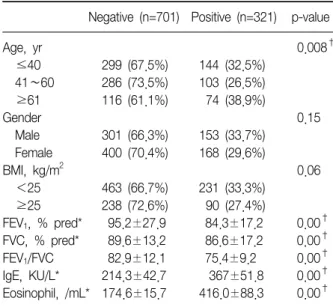
체질량지수가 25 kg/m2 이상인 군에서 기관지 과민성 양성인 환자는 90명(27.4%), 체질량지수가 25 kg/m2 미만 인 군에서 기관지 과민성 양성인 환자는 231명(33.3%)으
로 체질량지수에 따른 기관지 과민성의 차이는 보이지 않 았다(p=0.06) (Table 3).
아토피의 발현 양상을 시험한 환자 308명(30.1%) 중 체 질량지수가 25kg/m2 미만인 군에서 아토피가 양성인 군 은 99명(32.1%)으로 체질량지수가 25 kg/m2 이상인 군 24명(7.8%)보다 통계적으로 유의하게 많았다(p=0.00) (Table 4).
Table 5. Characteristics according to AHR
Negative (n=701) Positive (n=321) p-value
Age, yr 0.008†
≤40 299 (67.5%) 144 (32.5%) 41∼60 286 (73.5%) 103 (26.5%) ≥61 116 (61.1%) 74 (38.9%)
Gender 0.15
Male 301 (66.3%) 153 (33.7%) Female 400 (70.4%) 168 (29.6%)
BMI, kg/m2 0.06
<25 463 (66.7%) 231 (33.3%) ≥25 238 (72.6%) 90 (27.4%)
FEV1, % pred* 95.2±27.9 84.3±17.2 0.00† FVC, % pred* 89.6±13.2 86.6±17.2 0.00† FEV1/FVC 82.9±12.1 75.4±9.2 0.00† IgE, KU/L* 214.3±42.7 367±51.8 0.00† Eosinophil, /mL* 174.6±15.7 416.0±88.3 0.00† Data were calculated by t-test.
*Mean±2 SD, †p<0.05.
AHR: airway hyperresponsiveness; BMI: body mass index;
FEV1: forced expiratory volume in one second; FVC: forced vital capacity.
Table 6. Difference of atopy according to AHR
Atopy (−) Atopy (+) p-value OR (95% CI)
AHR (−) 138 (44.8%) 62 (20.1%) 0.000 2.889 (1.780∼4.688)
AHR (+) 47 (15.3%) 61 (19.8%)
Data were calculated by chi-squire test.
AHR: airway hyperresponsiveness; OR: odd ratio; CI: confidence interval.
3. 기관지 과민성을 기준으로 한 대상자의 특징 1,022명의 환자 중에서 321명(31.4%)이 기관지 과민성 유발시험 양성 소견을 보였다. 연령별 기관지 과민성의 유병률은 40세 미만에서 32.5%, 41∼60세에서 26.5%, 61 세 이상에서 38.9%로 60세 이상에서 기관지 과민성의 유 병률이 증가하는 소견을 보였다(p=0.008). 성별로는 남자 33.7%, 여자 29.6%에서 기관지 유발시험 양성 소견을 보 여 두 군간의 의미 있는 차이는 없었다(p=0.15). 기관지 과민성 양성은 체질량지수가 25 kg/m2 미만인 군은 33.3%, 25 kg/m2 이상인 군은 27.4%로 두 군간 통계학적 차이는 없었다(p=0.06). 기관지 과민성 양성군과 음성군 사이에는 통계적으로 유의한 FEV1, FVC, FEV1/FVC의 차 이를 확인할 수 있었다(p=0.00). 혈중 호산구수와 혈청
IgE 농도는 기관지 과민성 양성군에서 통계적으로 유의하 게 많았다(p=0.00) (Table 5).
아토피와 기관지 과민성은 통계적으로 유의한 상관관 계를 나타냈으며(p=0.00) 기관지 과민성을 가진 환자군에 서는 음성군에 비해 2.89배의 아토피 양성률을 보였다 (Table 6).
고 찰
본 연구에서는 만성기침으로 호흡기 내과 외래에 내원 한 환자들을 대상으로 하여 체질량지수와 천식과 관계된 요소인 기관지 과민성, 아토피 및 이와 관련 있는 요소들 에 대해 연관성을 밝히고자 하였다. 본 연구에서는 비만 과 기관지 과민성간의 유의한 연관성은 찾을 수 없었으며 아토피는 체질량지수가 25 kg/m2 미만인 군에서 의미있 게 증가하여 아토피와 체질량지수는 역상관 관계를 보였 다.
지난 수십 년간 비만은 전세계적으로도 매우 빠르게 증 가하고 있다12. 우리나라에서도 체질량지수 25 kg/m2 이 상인 경우를 기준으로 하였을 때 19세 이상 성인에서 비 만 유병률은 2007년 31.7%로 파악되고 있으며 1998년에 비하여 지난 10년간 5.7%가 증가하였다16. 전체 인구에서 와 같이 기침이나 호흡곤란을 동반한 환자에서도 비만이 동반된 환자들의 비율이 증가하고 있으며, 특히 비만과 천식에 대해서 발생 및 유병률에 유의한 상관관계를 보이 는 연구결과가 다수 보고된 바 있다5,10,14,17,18
.
비만과 천식과의 관련성을 설명할 수 있는 가설로는 첫 째, 비만 환자에서 나타나는 폐 생리의 변화를 그 원인으 로 고려할 수 있다. 비만 환자에서는 기능적 잔기 용량 (Functional residual capacity)과 호기 예비기량(expiratory reserve volume, ERV), 그리고 폐활량(vital capacity)이 감소함에 따라 흉곽유순도가 감소하며, 이로 인해 흡기근 육에 탄성부하가 걸리고 호흡일이 증가하게 된다19-21. 둘 째, 비만환자에서 보이는 전신적 염증 소견이 천식환자에
서의 전신 및 기도 염증과 관련이 있을 가능성이 제기된 바 있다. 비만한 경우 혈중에 사이토카인, 사이토카인 수 용체, 케모카인, 급성 반응 단백의 농도가 증가되어 있는
데22,23 이로 인해 기도 평활근에 만성적인 염증 반응이 진
행되며 특히 환자의 지방조직에서 분비되는 leptin, adpo- nectin 등의 사이토카인으로 인한 면역반응으로 인해 기 도 과민성이 증가된다는 것이다. 셋째, 비만과 천식의 발 생에 각각 유의한 영향을 미치는 동반 질환의 존재 가능성 이다. 비만환자에서 정상체중의 환자에 비해 역류성 식도 염 또는 수면무호흡증 등의 질환이 동반될 가능성이 높은 것으로 알려져 있으며, 이러한 동반질환을 가진 환자에서 정상 환자군과 비교했을 때 난치성 천식환자의 비율이 더 높음을 보고한 예가 있다24-26.
천식의 여러 지표 중 기관지 과민성은 여러 자극물질에 대한 기도의 수축능력을 나타내고 일반인에서 기관지 천 식의 발생을 예측하게 하며, 천식의 중등도와 밀접한 연관 성이 있다27. 기관지 과민성의 발현에는 유전적인 소인과 함께 아토피, 흡연력도 관여하는 것으로 알려져 있다28. 그러나, 최근까지 비만과 천식간의 관계를 설명하기 위해 기관지 과민성의 연관관계에 대한 연구가 이루어졌으나 일관되는 상관관계를 밝혀내지는 못했다29. 국내에서 Kim 등30이 연구한 바에 따르면 비만이 기관지 과민성의 발생 위험을 통계적으로 유의하게 증가시키는 것으로 나타났 다. 그러나 Schachter 등31이 백인 성인을 대상으로 한 연 구에서는 심한 비만 군에서 쌕쌕거리는 증상으로 천식이 진단되고 천식치료를 받는 빈도가 높았지만 기도폐쇄의 증거나 히스타민 기도 과민성의 증거는 없었다고 보고하 였다. 이는 비만 자체가 천식의 특징인 기도 과민성이나 아토피와 상관없이 천식과 비슷한 증상을 일으킬 수 있음 을 시사하고 천식의 정의에 기도 염증을 포함시킨다면 비 만과 기도 염증의 연관성에 대한 증거가 없기 때문에 비만 군에서 천식의 유병률이 실제로는 높지 않을 수 있다는 가능성을 생각할 수 있게 한 연구 결과이다. Bai 등32의 연구에서도 비만할수록 천식 증상은 호소하지만 기관지 과민성이나 아토피의 증거는 높지 않다고 하였는데 이는 해부학적 변화가 발생하여도 기도 반응의 변화 없이 천명 이나 호흡곤란이 일어날 수 있음을 시사한다고 할 수 있 다.
본 연구에서 기관지 과민성은 아토피, 혈중 호산구 수 와 혈청 IgE 농도 같은 천식 관련 인자와 유의한 상관관계 를 보였으나, 체질량지수와는 연관관계를 보이지 않았다.
이는 비만이 천식 발생이나 중증도에 미치는 기전과 기관
지 과민성의 기전이 독립적임을 시사한다. 또한 본 연구 에서 아토피가 비만과 역 연관성을 보이고 있는 점도 기관 지 과민성과 비만의 관련 가능성을 배제하는 데 도움을 줄 수 있다.
그러나 본 연구는 만성 기침환자를 대상으로 이루어졌 다는 점, 천식의 중증도와 비만도 사이의 연관성을 조사할 수 없었던 점, 호흡기 증상이 없는 정상 대조군과 비교 연구를 하지 않았다는 점에서 연구의 제한점이 있을 수 있다. 또한 천식이 가진 다양하고 복합적인 발생 기전을 고려할 때 연구 대상군의 연령, 성별의 분포, 흡연 유무에 따라 비만이 기관지 과민성에 미치는 상이한 결과를 보일 수 있어, 정확한 인과관계의 확인을 위해서는 더 많은 연 구가 필요할 것으로 생각된다.
결론적으로 비만과 기관지 과민성, 그리고 아토피와 천 식의 상관관계에 대해 더 많은 환자군을 대상으로 한 연구 가 필요하며, 이를 위해 비만을 동반한 천식환자의 표현형 을 확인하는 다양한 천식의 발생 기전에 대한 체계적이고 개별적인 접근이 요구된다. 또한 비만이 천식의 생리학적 양상과 염증성 질환으로서 미치는 영향에 대한 연구가 필 요할 것으로 생각된다.
참 고 문 헌
1. Bateman ED, Hurd SS, Barnes PJ, Bousquet J, Drazen JM, FitzGerald M, et al. Global strategy for asthma management and prevention: GINA executive sum- mary. Eur Respir J 2008;31:143-78.
2. Gershon AS, Guan J, Wang C, To T. Trends in asthma prevalence and incidence in Ontario, Canada, 1996∼
2005: a population study. Am J Epidemiol 2010;172:
728-36.
3. Gibson PG, McDonald VM, Marks GB. Asthma in older adults. Lancet 2010;376:803-13.
4. Pearce N, Aït-Khaled N, Beasley R, Mallol J, Keil U, Mitchell E, et al. Worldwide trends in the prevalence of asthma symptoms: phase III of the International Study of Asthma and Allergies in Childhood (ISAAC).
Thorax 2007;62:758-66.
5. Beuther DA, Sutherland ER. Overweight, obesity, and incident asthma: a meta-analysis of prospective epi- demiologic studies. Am J Respir Crit Care Med 2007;
175:661-6.
6. Camargo CA Jr, Weiss ST, Zhang S, Willett WC, Speizer FE. Prospective study of body mass index, weight change, and risk of adult-onset asthma in women.
Arch Intern Med 1999;159:2582-8.
7. Lugogo NL, Kraft M, Dixon AE. Does obesity produce a distinct asthma phenotype? J Appl Physiol 2010;
108:729-34.
8. Rönmark E, Andersson C, Nyström L, Forsberg B, Järvholm B, Lundbäck B. Obesity increases the risk of incident asthma among adults. Eur Respir J 2005;25:
282-8.
9. Shore SA. Obesity and asthma: possible mechanisms.
J Allergy Clin Immunol 2008;121:1087-93.
10. Sin DD, Sutherland ER. Obesity and the lung: 4.
Obesity and asthma. Thorax 2008;63:1018-23.
11. Sutherland TJ, Cowan JO, Young S, Goulding A, Grant AM, Williamson A, et al. The association between obe- sity and asthma: interactions between systemic and air- way inflammation. Am J Respir Crit Care Med 2008;
178:469-75.
12. Flegal KM, Carroll MD, Ogden CL, Curtin LR. Preval- ence and trends in obesity among US adults, 1999∼
2008. JAMA 2010;303:235-41.
13. Jarvis D, Chinn S, Potts J, Burney P; European Community Respiratory Health Survey. Association of body mass index with respiratory symptoms and atopy:
results from the European Community Respiratory Health Survey. Clin Exp Allergy 2002;32:831-7.
14. Chinn S, Jarvis D, Burney P; European Community Respiratory Health Survey. Relation of bronchial re- sponsiveness to body mass index in the ECRHS.
European Community Respiratory Health Survey.
Thorax 2002;57:1028-33.
15. Stenius-Aarniala B, Poussa T, Kvarnström J, Grönlund EL, Ylikahri M, Mustajoki P. Immediate and long term effects of weight reduction in obese people with asth- ma: randomised controlled study. BMJ 2000;320:827- 32.
16. Korea Center for Disease Control and Prevention.
National health & nutrition examination survey (KNHANES 4). Nutrition survey. Seoul: Ministry for Health, Welfare and Family Affairs; 2007.
17. Dixon AE, Holguin F, Sood A, Salome CM, Pratley RE, Beuther DA, et al. An official American Thoracic Soci- ety Workshop report: obesity and asthma. Proc Am Thorac Soc 2010;7:325-35.
18. Litonjua AA, Sparrow D, Celedon JC, DeMolles D, Weiss ST. Association of body mass index with the de- velopment of methacholine airway hyperresponsive- ness in men: the Normative Aging Study. Thorax 2002;
57:581-5.
19. Sharp JT, Henry JP, Sweany SK, Meadows WR, Pietras RJ. The total work of breathing in normal and obese men. J Clin Invest 1964;43:728-39.
20. Fredberg JJ, Inouye D, Miller B, Nathan M, Jafari S, Raboudi SH, et al. Airway smooth muscle, tidal stretch- es, and dynamically determined contractile states. Am J Respir Crit Care Med 1997;156:1752-9.
21. Raboudi SH, Miller B, Butler JP, Shore SA, Fredberg JJ.
Dynamically determined contractile states of airway smooth muscle. Am J Respir Crit Care Med 1998;158:
S176-8.
22. Hoene M, Weigert C. The role of interleukin-6 in in- sulin resistance, body fat distribution and energy balance. Obes Rev 2008;9:20-9.
23. Xu H, Uysal KT, Becherer JD, Arner P, Hotamisligil GS.
Altered tumor necrosis factor-alpha (TNF-alpha) proc- essing in adipocytes and increased expression of trans- membrane TNF-alpha in obesity. Diabetes 2002;51:
1876-83.
24. Jacobson BC, Somers SC, Fuchs CS, Kelly CP, Camargo CA Jr. Body-mass index and symptoms of gastro- esophageal reflux in women. N Engl J Med 2006;
354:2340-8.
25. Young T, Shahar E, Nieto FJ, Redline S, Newman AB, Gottlieb DJ, et al. Predictors of sleep-disordered breathing in community-dwelling adults: the Sleep Heart Health Study. Arch Intern Med 2002;162:893-900.
26. Kasasbeh A, Kasasbeh E, Krishnaswamy G. Potential mechanisms connecting asthma, esophageal reflux, and obesity/sleep apnea complex--a hypothetical re- view. Sleep Med Rev 2007;11:47-58.
27. Zhong NS, Chen RC, Yang MO, Wu ZY, Zheng JP, Li YF. Is asymptomatic bronchial hyperresponsiveness an indication of potential asthma? A two-year follow-up of young students with bronchial hyperresponsiveness.
Chest 1992;102:1104-9.
28. Cockcroft DW, Berscheid BA, Murdock KY. Unimodal distribution of bronchial responsiveness to inhaled his- tamine in a random human population. Chest 1983;
83:751-4.
29. Beuther DA. Recent insight into obesity and asthma.
Curr Opin Pulm Med 2010;16:64-70.
30. Kim SS, Choi SH, Park MJ, Kim YS, Yim JY, Lim SH, et al. Effects of obesity and smoking on bronchial hy- perresponsiveness in Korean adults. Korean J Asthma Allergy Clin Immunol 2005;25:217-22.
31. Schachter LM, Salome CM, Peat JK, Woolcock AJ.
Obesity is a risk for asthma and wheeze but not airway hyperresponsiveness. Thorax 2001;56:4-8.
32. Bai J, Peat JK, Berry G, Marks GB, Woolcock AJ.
Questionnaire items that predict asthma and other res- piratory conditions in adults. Chest 1998;114:1343-8.