• 검색 결과가 없습니다.

A Case of Pulmonary Capillary Hemangiomatosis-Like Lesion Followed for Seven Years

N/A
N/A
Protected

Academic year: 2021

Share "A Case of Pulmonary Capillary Hemangiomatosis-Like Lesion Followed for Seven Years"

Copied!
5
0
0

로드 중.... (전체 텍스트 보기)

전체 글

(1)

A Case of Pulmonary Capillary Hemangiomatosis-Like Lesion Followed for Seven Years

Chin Kook Rhee, M.D.

1,2

, Nam Yeol Yim, M.D.

3

, Soyeon Shim, M,D.

4

, Hui Jung Kim, M.D., Ph.D.

4

1

Division of Pulmonary and Critical Care Medicine, Department of Internal Medicine, The Catholic University of Korea College of Medicine, Seoul,

2

Division of Pulmonary and Critical Care Medicine, Department of Internal Medicine, Armed Forces Capital Hospital, Seongnam,

3

Department of Radiology, Chonnam National University Hospital, Gwangju,

4

Division of Pulmonary and Critical Care Medicine, Department of Internal Medicine, Wonkwang University Sanbon Hospital, Wonkwang University College of Medicine, Sanbon, Korea

Pulmonary capillary hemangiomatosis (PCH) is a rare disease of unknown etiology that is characterized by nodules composed of infiltrating capillary blood vessels. Herein, we describe a case of a PCH-like lesion that was detected by chest computed tomography. Transthoracic needle aspiration resulted in life-threatening hemorrhage. The patient was followed for seven years. He remained in good health and a follow up image showed little interval change.

Key Words: Hemangioma, Capillary/Diagnosis; Tomography, X-Ray Computed; Magnetic Resonance imaging

Address for correspondence: Hui Jung Kim, M.D., Ph.D.

Division of Pulmonary and Critical Care Medicine, Depart- ment of Internal Medicine, Wonkwang University Sanbon Hospital, 1142, Sanbon-dong, Gunpo 435-040, Korea Phone: 82-31-390-2300, Fax: 82-31-390-2999

E-mail: [email protected] Received: Sep. 15, 2010 Accepted: Nov. 15, 2010

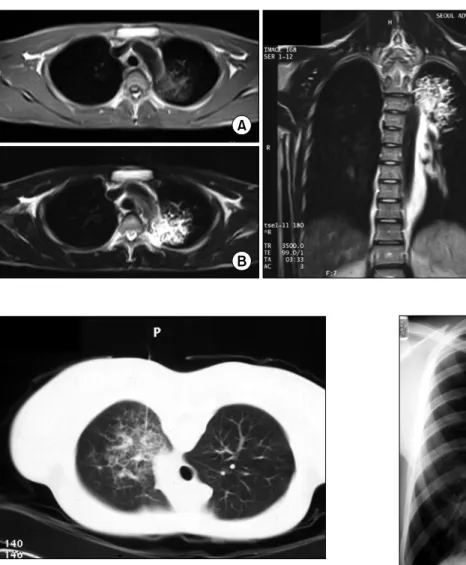
Figure 1. HRCT showed ill-defined nodular densities and interlobular and intralobular septal thickenings in LUL.

HRCT: high resolution computed tomography.

Introduction

Pulmonary capillary hemangiomatosis (PCH) has been described as multiple nodules in the lung paren- chyma or bronchovascular walls composed of infiltrat- ing thin-walled capillary blood vessels

1

. The typical de- scribed clinical course for patients with PCH is that of unrelenting symptoms of pulmonary hypertension and eventual death

2

. Unfortunately, a definitive diagnosis of PCH usually is not made until autopsy

1

. Here we de- scribe a case of PCH-like lesion that was detected by chest computed tomography (CT) and followed for sev- en years.

Case Report

A 17-year-old man was referred to Seoul Adventist Hospital in January 2003 for detailed evaluation of ab-

normal lesion that had been discovered by chest X-ray

and CT. Chest high resolution CT (HRCT) scan on ad-

mission showed ill-defined hazy densities and inter-

lobular and intralobular septal thickenings in left upper

lobe (LUL) (Figure 1). His physical condition was good,

and there were no signs of dyspnea or hemoptysis. On

admission, laboratory findings were normal. He had

(2)

Figure 2. MRI showed re- ticular shaped iso-signal intensity of T1WI (A) and mottled reticular shaped high signal intensity on T2WI (B). Dysplasia of branching vessel originat- ing from thoracic aorta was also noted on T2WI (C). MRI: magnetic reso- nance image; WI: weighted image.

Figure 3. CT-guided aspiration was performed in LUL.

CT: computer tomography; LUL: left upper lobe.

Figure 4. Chest X-ray after TTNA showed newly devel- oped hazy density in LUL. TTNA: transthoracic needle as- piration; LUL: left upper lobe.

been in relatively good health until admission except mild exertional dyspnea.

On the first hospital day, bronchoscopy was perform- ed. There was no endobronchial lesion in the exam.

Bronchial washing was done in LUL bronchus and the result for acid fast bacilli stain was negative. On the sec- ond hospital day, chest magnetic resonance image (MRI) was performed. MRI showed reticular shaped iso-signal intensity on T1 weighted image (WI) and mot- tled reticular shaped high signal intensity on T2WI (Figure 2). Dysplasia of branching vessel originating from thoracic aorta was noted. On the third hospital day, CT guided transthoracic needle aspiration (TTNA) was performed (Figure 3). After the biopsy, cough and hemoptysis with dyspnea were developed. Chest X-ray

showed ill defined hazy density with focal air broncho-

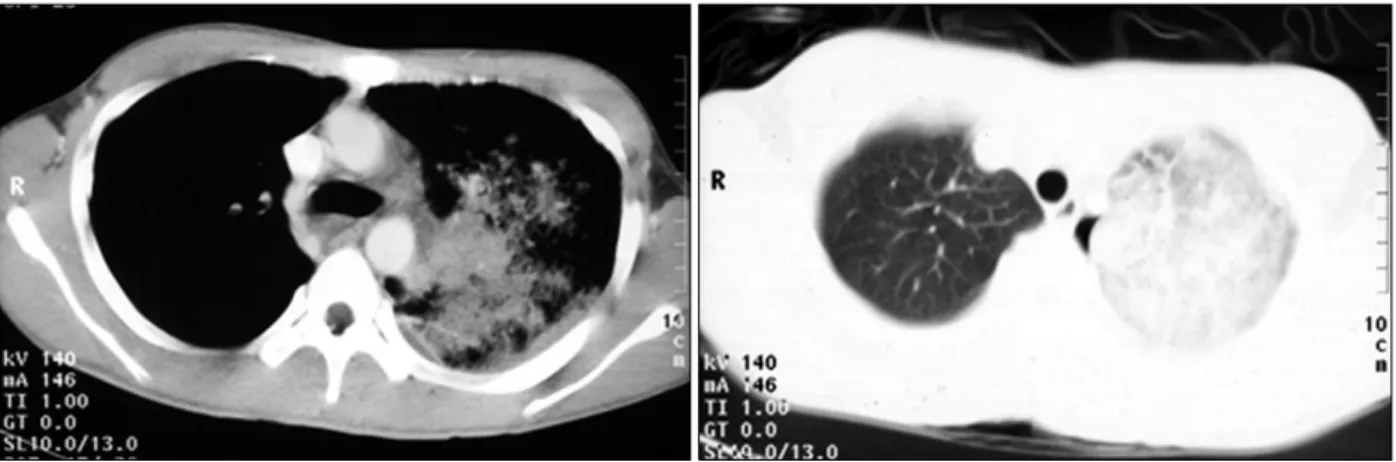
gram in LUL (Figure 4). Follow up CT was performed

and newly visible ill-defined air space consolidation in

LUL was noted (Figure 5). Laboratory examination

showed the decrease level of hemoglobin (11.5 g/dL)

and the patient was transferred to the intensive care

unit. On the ninth hospital day, hemoptysis, cough, and

dyspnea were subsided. Because of small amount of

specimen, biopsy result showed only a portion of fi-

brous tissue. On the 15th hospital day, X-ray showed

improvement of consolidation in LUL (Figure 6). The

patient was discharged. Follow up X-ray showed further

(3)

Figure 5. CT showed ill-defined air space consolidation in LUL. CT: computer tomography; LUL: left upper lobe.

Figure 6. Chest X-ray showed improvement of con- solidation in LUL. LUL: left upper lobe.

Figure 7. Chest X-ray showed further improvement of consolidation in LUL. LUL: left upper lobe.

improvement of consolidation (Figure 7).

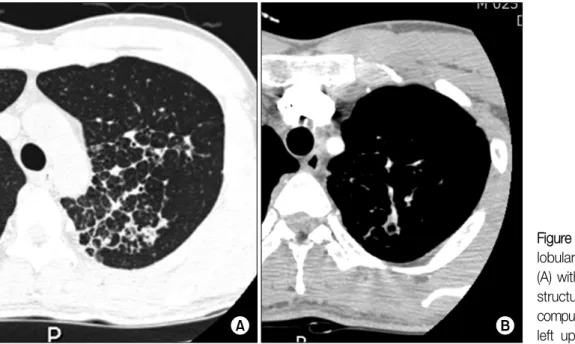
The patients were regularly followed up, and no sig- nificant problem was noted. In 2008, he joined the army and followed for two years at Armed Forces Yangju Hospital. During the period of service, he was in rela- tively good health except intermittent small amount of blood tinged sputum and mild exertional dyspnea. In 2010, enhanced chest CT was followed up for the rou- tine check (Figure 8). CT image showed little interval change compared with previous one taken in 2003.

Interlobular septal thickening was still noted with little change. Enhanced vascular structure was also noted in- side thickened interlobular septum. He finished service

in May 2010 with good health status.

Discussion

PCH is a rare disorder characterized by proliferating

capillaries that invade the pulmonary interstitium and al-

veolar septae, and occlude the pulmonary vasculature

3

.

Age at onset may vary between 6 and 71 years old, but

the majority of patients are between 20 and 40 years

old. The earliest symptom is a gradual onset of short-

ness of breath on exertion

4

. Clinical signs and symp-

toms include progressive pulmonary hypertension with

dyspnea, cough, fatigue, and weight loss. Hemoptysis

(4)

Figure 8. CT showed inter- lobular septal thickening (A) with enhanced vascular structure (B) in LUL. CT:

computer tomography; LUL:

left upper lobe.

occurs in more than 30% of cases

5

.

Although the diagnosis of PCH often occurs post- mortem, one useful diagnostic tool is HRCT. The most characteristic findings on HRCT in patients with PCH were diffuse thickening of the interlobular septae and small, centrilobular, poorly circumscribed nodular opac- ities

6-11

. Dufour et al.

6

showed that these features corre- lated well with pathologic abnormalities. Pathologic ex- amination of samples collected from the patients with PCH showed diffuse nodular proliferation of small capil- lary-sized vessels that widened the interalveolar septae with formation of small nodules or sheets of back-to- back capillary vessels. Eltorky et al.

11

also showed that interlobular septal thickening and centrilobular nod- ularity in HRCT correlated with the focal angiomatoid proliferation within the interlobular interstitium and the venous and alveolar walls, respectively. These imaging findings above were well compatible with our case.

Although exact pathologic diagnosis was not made in our case, septal thickening in HRCT probably reflect un- derlying nodular proliferation of small vessel. Addition- ally, enhance image of MRI and CT clearly showed that the lesion was composed of small vessel and TTNA re- sulted in massive hemorrhage in lung. These findings strongly favor the diagnosis of PCH.

The diagnosis of PCH is difficult and requires a high

degree of clinical suspicion and accurate pathologic study. Multiple sampling in pulmonary biopsy is essen- tial because of the patchy nature of the disease

12

. Almagro et al.

13

reviewed 37 cases of PCH. Among them, diagnosis was made with pulmonary biopsy in only 3 cases. The rest were wrongly classified as pulmo- nary fibrosis, pulmonary veno-occlusive disease, hemo- siderosis, and other entities, and definitive diagnosis was reached only after lung transplantation or autopsy.

Also, in our case, the specimen of TTNA showed only a portion of fibrous tissue. The lesson from our case is that when suspicious of PCH, biopsy procedure such as TTNA or transbronchial lung biopsy should be avoided. This procedure is not only inadequate for the diagnosis but also very dangerous.

PCH is a rapidly progressive disease, with a median survival of 3 years from the time of diagnosis. Accord- ing to the review by al-Fawaz et al.

14

, the condition usu- ally progresses rapidly, causing death from pulmonary hypertension and/or bleeding without effective treat- ment. Of the 19 cases, four underwent lung trans- plantation, one had pneumonectomy, and one was treated with interferon α-2a. These treatments re- portedly resulted in improvements in their conditions.

However, the other 13 cases died within a total clinical

course ranging from several months to several years,

(5)

ance, cardiac failure, and/or hemoptysis during this period.

In contrast to the active and progressive nature of the disease in above cases, our case has been followed up for seven years during which there has been no clinical deterioration or aggravation of the imaging findings.

Although usually the prognosis of PCH is poor and me- dian survival is short, there was a report of stable case of PCH. Takiguchi et al.

15

described a case of 29 year old man presented with hemoptysis. The diagnosis of PCH was established by typical HRCT findings and open lung biopsy. The patient was followed for 3.5 years and had no symptoms except for an occasional small amount of hemoptysis. His exercise capacity was good and had no decrease in oxygen saturation. HRCT scans performed 40 months after diagnosis showed little interval change with no increase in the number or size of the lesion. The clinical course of above case was well compatible with ours.

Here we describe a case of PCH-like lesion that was followed for seven years. When the image finding was suspicious of PCH and the symptom of patient was mild, follow up and observation can be an option rather than biopsy. Further studied about the patient with PCH is needed.

Acknowledgements

This paper was supported by Wonkwang University in 2009.

References

1. Tron V, Magee F, Wright JL, Colby T, Churg A.

Pulmonary capillary hemangiomatosis. Hum Pathol 1986;17:1144-50.

2. Fernández-Alonso J, Zulueta T, Reyes-Ramirez JR, Castillo-Palma MJ, Sanchez-Román J. Pulmonary capil- lary hemangiomatosis as cause of pulmonary hyper- tension in a young woman with systemic lupus ery- thematosus. J Rheumatol 1999;26:231-3.

3. Case records of the Massachusetts General Hospital.

ysis, and pulmonary nodulas. N Engl J Med 2000;343:

1788-96.

4. Lippert JL, White CS, Cameron EW, Sun CC, Liang X, Rubin LJ. Pulmonary capillary hemangiomatosis: radio- graphic appearance. J Thorac Imaging 1998;13:49-51.

5. de Perrot M, Waddell TK, Chamberlain D, Hutcheon M, Keshavjee S. De novo pulmonary capillary he- mangiomatosis occurring rapidly after bilateral lung transplantation. J Heart Lung Transplant 2003;22:698- 700.

6. Dufour B, Maître S, Humbert M, Capron F, Simonneau G, Musset D. High-resolution CT of the chest in four patients with pulmonary capillary hemangiomatosis or pulmonary venoocclusive disease. AJR Am J Roentgen- ol 1998;171:1321-4.

7. Hansell DM. Small-vessel diseases of the lung: CT- pathologic correlates. Radiology 2002;225:639-53.

8. El-Gabaly M, Farver CF, Budev MA, Mohammed TL.

Pulmonary capillary hemangiomatosis imaging findings and literature update. J Comput Assist Tomogr 2007;31:

608-10.

9. Kothari SS, Jagia P, Gupta A, Singh N, Ray R. Images in cardiovascular medicine. Pulmonary capillary he- mangiomatosis. Circulation 2009;120:352-4.

10. Lawler LP, Askin FB. Pulmonary capillary hemangioma- tosis: multidetector row CT findings and clinico-patho- logic correlation. J Thorac Imaging 2005;20:61-3.

11. Eltorky MA, Headley AS, Winer-Muram H, Garrett HE Jr, Griffin JP. Pulmonary capillary hemangiomatosis: a clinicopathologic review. Ann Thorac Surg 1994;57:

772-6.

12. Ishii H, Iwabuchi K, Kameya T, Koshino H. Pulmonary capillary haemangiomatosis. Histopathology 1996;29:

275-8.

13. Almagro P, Julià J, Sanjaume M, González G, Casalots J, Heredia JL, et al. Pulmonary capillary hemangioma- tosis associated with primary pulmonary hypertension:

report of 2 new cases and review of 35 cases from the literature. Medicine (Baltimore) 2002;81:417-24.

14. al-Fawaz IM, al Mobaireek KF, al-Suhaibani M, Ashour M. Pulmonary capillary hemangiomatosis: a case report and review of the literature. Pediatr Pulmonol 1995;19:

243-8.

15. Takiguchi Y, Uruma T, Hiroshima K, Motoori K,

Watanabe R, Hamaoka T, et al. Stable pulmonary ca-

pillary haemangiomatosis without symptomatic pulmo-

nary hypertension. Thorax 2001;56:815-7.

수치

Figure 1. HRCT showed ill-defined nodular densities and interlobular  and  intralobular  septal  thickenings  in  LUL
Figure  2.  MRI  showed  re- re-ticular  shaped  iso-signal  intensity  of  T1WI  (A)  and  mottled  reticular  shaped  high  signal  intensity  on  T2WI  (B)
Figure  5.  CT  showed  ill-defined  air  space  consolidation  in  LUL.  CT:  computer  tomography;  LUL:  left  upper  lobe.
Figure 8. CT showed inter- inter-lobular  septal  thickening  (A) with enhanced vascular structure  (B)  in  LUL

참조

관련 문서

Division of Pulmonary and Critical Care Medicine, Department of Internal Medicine, Seoul National Uni- versity Hospital, Department of Internal Medicine, Seoul

Division of Pulmonary, Allergy and Critical Care Medicine, Department of Internal Medicine, Busan Paik Hospital, Inje University College of Medicine, Korea 1 , Division

Division of Pulmonology and Critical Care Medicine, Department of Internal Medicine, Ewha Womans University Mokdong Hospital, Ewha Womans University College of Medicine,

Division of Pulmonary and Critical Care Medicine, Department of Internal Medicine, Seoul National University Hospital, 28 Yongon-dong, Chongno-gu, Seoul

Department of Internal Medicine, Seoul National University College of Medicine, Korea 1 , Division of Pul- monary and Critical Care Medicine, Department of Internal

Division of Pulmonary and Critical Care Medicine, Department of Internal Medicine, Seoul National Uni- versity Hospital, Korea 1 , Department of Laboratory Medicine,

Internal Medicine, Division of Respiratory and Critical Care Medicine, Korea University Anam Hospital, Korea University College of Medicine, Seoul, South Korea.. 14 Department

15 Division of Critical Care and Pulmonary Medicine, Department of Internal Medicine, Inje University Pusan Paik Hospital, Gimhae, South Korea.. 16 Division of Allergy