Protocol of a Nationwide Observational
Study among Patients with Nontuberculous Mycobacterium Pulmonary Disease in South Korea (NTM-KOREA)
Nakwon Kwak, M.D.
1, Hongjo Choi, M.D., Ph.D.
2, Doosoo Jeon, M.D.
3, Byung Woo Jhun, M.D., Ph.D.
4, Kyung-Wook Jo, M.D., Ph.D.
5, Young Ae Kang, M.D., Ph.D.
6, Yong-Soo Kwon, M.D., Ph.D.
7, Myungsun Lee, M.D.
8, Jeongha Mok, M.D., Ph.D.
9, Tae-Sun Shim, M.D., Ph.D.
5, Hong-Joon Shin, M.D., Ph.D.
7, Jake Whang, Ph.D.
2and Jae-Joon Yim, M.D.
1*Author affiliations appear at the end of this article.
Background: The burden of nontuberculous mycobacterial (NTM) pulmonary disease (PD) is increasing globally. To understand the treatment outcomes and prognosis of NTM-PD, a unified registry is needed. In this project, we aim to construct a multicenter prospective observational cohort with NTM-PD in South Korea (NTM-KOREA).
Methods: The primary objective of this study is to analyze treatment outcomes according to the species. In addition, recurrence rate, adverse events, the impact of each drug on treatment outcomes as well as the impact of characteristics of mycobacteriology will be analyzed. The inclusion criteria for the study are as follows: fulfilling the criteria for NTM-PD having one of the following etiologic organisms: Mycobacterium avium complex, M. abscessus subspecies abscessus , M. abscessus subspecies massiliense , or M. kansasii ; receiving the first treatment for NTM-PD after enrollment; age >20 years; and consenting to participate in the study. Seven institutions will participate in patient enrollment and about 500 patients are expected to be enrolled. Participants will be recruited from 1 March 2020 until 19 March 2024 and will be observed through 19 March 2029. During the follow-up period, participants’ clinical course will be tracked and their clinical data as well as NTM isolates will be collected.
Conclusion: NTM-KOREA will be the first nationwide observational cohort for NTM-PD in South Korea. It will provide the information to optimize treatment modalities and will contribute to deeper understanding of the treatment outcomes and long-term prognosis of patients with NTM-PD in South Korea.
Keywords: Nontuberculous Mycobacteria; Protocol; Registry
Address for correspondence: Jae-Joon Yim, M.D.
Division of Pulmonary and Critical Care Medicine, Department of Internal Medicine, Seoul National University College of Medicine, 101 Daehak-ro, Jongno-gu, Seoul 03080, Korea
Phone: 82-2-2072-2059, Fax: 82-2-762-9662, E-mail: [email protected]
Received: Oct. 31, 2019, Revised: Dec. 10, 2019, Accepted: Jan. 2, 2020, Published online: Mar. 10, 2020
cc
It is identical to the Creative Commons Attribution Non-Commercial License (http://creativecommons.org/licenses/by-nc/4.0/).
Copyright © 2020
The Korean Academy of Tuberculosis and Respiratory Diseases.
Introduction
The burden of nontuberculous mycobacterial (NTM) pul- monary disease (PD) is increasing globally. A population- based study reported the gradual increase of NTM-PD incidence in the United States, from 4.8/100,000 in 2007 to 5.6/100,000 in 2012
1. In Germany, the prevalence rates of NTM-PD increased steadily from 2.3 to 3.3 cases/100,000 population from 2009 to 2014. These trends have also been observed in South Korea. In that country, the burden of tu- berculosis (TB) is intermediate; the recovery rates of NTM according to respiratory specimens and the incidence rates of NTM-PD have been increasing steadily since the early 2000s.
Between 2007 and 2016, the incidence of NTM-PD increased from 6.0 cases per 100,000 population to 19.0 cases per 100,000 population
2-5.
Whereas the epidemiologic significance of NTM-PD has been discussed, its treatment remains complicated. Treat- ment of NTM-PD requires various combinations of antibiotics for a duration of 18–24 months
6,7. However, standardized regi- mens for NTM-PD have not yet been fully established
6,7, and the comprising regimens vary, even within the same institu- tion
8. Moreover, adherence to the recommended regimens is achieved in only 10% of patients with NTM-PD in actual clini- cal practice
9. The treatment success rates for Mycobacterium avium complex (MAC) and M. abscessus have been reported
to be around 60% and 40%, respectively
10,11.
Under this uncertainty, a unified registry is needed to systematically track patients with NTM-PD. Prospectively merged data might facilitate more consistent evaluation of the epidemiologic features of NTM-PD patients, detailed prescrip- tion histories, microbiologic results, and treatment modalities and outcomes. In this project, we aimed to construct a multi- center prospective observational cohort with NTM-PD using an integrated registry system in South Korea.
The objectives of this study are as follows: (1) to develop a multicenter prospective NTM-PD cohort in South Korea, col- lecting the clinical data of patients with NTM-PD as well as NTM isolates from the time of treatment initiation through the follow-up period; (2) to describe participants’ demographic in- formation, comorbidities, initial symptomatic and radiograph- ic features, and microbiologic results at the time of diagnosis;
(3) to describe patients’ treatment regimens, adverse events, and treatment outcomes; and (4) to analyze the impact of bacteriologic characteristics on prognosis.
Primary objective is analyzing treatment outcomes accord- ing to the species and secondary objective are as follows: (1) rates of recurrence (relapse and reinfection, separately); (2) analyzing the impact of the use of each drug on treatment out- comes; (3) analyzing the occurrence of adverse events during treatment; and (4) analyzing the impact of bacteriological fac- tors on prognosis.
Materials and Methods
1. Design and setting
The NTM-KOREA is a multicenter, prospective, observa- tional cohort study enrolling patients with NTM-PD in South Korea. After providing their written informed consent, partici- pants will be recruited at seven institutions across South Ko- rea and managed according to the duty physicians’ own poli- cy. The participating organizations are Asan Medical Center, Chonnam National University Hospital, Pusan National Uni- versity Hospital, Pusan National University Yangsan Hospital, Samsung Medical Center, Seoul National University Hospital, and Severance Hospital. The coordinating institution is the International Tuberculosis Research Center. The study will re- cruit participants from 1 March 2020 until 19 March 2024, and participants will be observed through 19 March 2029.
2. Inclusion criteria
Participants with all of the following will be included in this project: (1) fulfilling the criteria for NTM-PD, as suggested by the American Thoracic Society/Infectious Diseases Society of America or British Thoracic Society
6,7; (2) having one of the following etiologic organisms: MAC, M. abscessus subspe- cies abscessus, M. abscessus subspecies massiliense, or M.
kansasii; (3) receiving the first treatment for NTM-PD after en- rollment (a 4-week interval from treatment initiation to study enrollment is allowed); (4) age >20 years; and (5) consenting to participate in the NTM-KOREA cohort.
3. Follow-up after enrollment
Participants will visit their outpatient clinics at about 4- to 12-week intervals. However, the follow-up period could be adjusted according to the duty physicians’ clinical judgement.
Unplanned visits requested by patients are also allowed. Par- ticipants will be observed through the end of the study (19 March 2029).
4. Data collection
The below items will be collected.
1) At the time of enrollment
(1) Demographic information: age, sex, body mass index, smoking status (never/former/current), previous history of TB.
(2) Laboratory findings: white blood cell count (/mm
3),
hemoglobin (g/dL), platelet count (/mm
3), erythrocyte sedi-
ment rate (mm/h), total protein (g/dL), albumin (g/dL), total
bilirubin (mg/dL), alkaline phosphatase (IU/L), aspartate
transferase (IU/L), alanine transferase (IU/L), blood urea ni-
trogen (mg/dL), creatinine (mg/dL).
(3) Functional capacity and health-related quality of life (HRQL): post-bronchodilator forced expiratory volume at 1 second (FEV
1), post-bronchodilator forced vital capacity (FVC), FEV
1/FVC, diffusing capacity for carbon monoxide (DLCO), 6-minute walking test, St. George Respiratory Ques- tionnaire and Hospital Anxiety and Depression Scale (HADS).
(4) Comorbidities:
- Respiratory comorbidities: chronic obstructive pulmo- nary disease, asthma, interstitial lung disease, bronchiectasis, chronic pulmonary aspergillosis, lung cancer, and other respi- ratory diseases.
- Non-respiratory comorbidities: diabetes mellitus, rheu- matologic diseases (including rheumatoid arthritis, systemic sclerosis, and lupus), chronic liver disease, chronic kidney disease, cardiovascular diseases (including myocardial infarc- tion, angina, stroke, transient ischemic attack, pulmonary hy- pertension and atrial fibrillation), human immunodeficiency virus infection, immunosuppressant use (including transplant recipients) and malignancy (diagnosed within 5 years from the time of enrollment).
(5) Symptoms at the time of treatment initiation: cough (none, present when having upper respiratory infection, fre- quently coughing or daily coughing), sputum (expectorate everyday, expectorate >4 days per week, expectorate <3 days per week, or rarely), hemoptysis, weight loss (more than 10%
of body weight within the past 12 months), and dyspnea (using the Modified Medical Research Council scale).
(6) Radiographic features present on chest computed tomography (CT) scans at the time of treatment initia- tion (CT scans performed within 3 months before treat- ment initiation or 1 month after treatment initiation will be reviewed):
- Type: nodular bronchiectatic, fibrocavitary, and unclassi- fied (including consolidation or solitary nodule).
- Presence of cavity: the presence of cavity and the longest diameter on axial view will be collected irrespective of radio- graphic type. If the number of cavities is two or more, the size will be measured from the largest one.
(7) Bacteriologic results:
- Date of initial diagnosis.
- Source of NTM isolation: sputum/bronchial washing or alveolar lavage/tissue.
- Smear status: negative/trace/1+/2+/3+/4+.
- Etiologic organism: M. avium /M. intracellulare /other MAC/ M. abscessus subsp. abscessus/M. abscessus subsp.
massiliense/M. kansasii/co-infection.
- Drug susceptibility test: presence of resistance (including inducible resistance) and minimal inhibitory concentration will be provided.
(8) Reasons for treatment initiation:
- Symptomatic aggravation: cough/sputum/hemoptysis/
dyspnea/weight loss.
- Radiographic aggravation: bronchiectasis/nodule/consoli- dation/atelectasis/cavity/ground glass opacity.
(9) Initial treatment regimen:
- Dosing schedule: daily or thrice weekly.
- Initial regimen: clarithromycin/azithromycin/amikacin (intravenous/ intramuscularly/inhaled)/rifampin/ethambu- tol/tigecycline/clofazimine/cefoxitin/imipenem/ciprofloxa- cin/moxifloxacin/linezolid/other.
- Date of treatment initiation.
2) At follow-up after treatment initiation
- Drugs prescribed at each visit: clarithromycin/azithro- mycin/amikacin (intravenous/intramuscularly/inhaled)/
rifampin/ethambutol/tigecycline/clofazimine/cefoxitin/imi- penem/ciprofloxacin/moxifloxacin/linezolid/other.
- Drugs discontinued at each visit.
- Adverse events leading to the discontinuation of drugs: the discontinuation of certain drugs is decided by duty physicians’
judgement and will be described on medical records.
- Specific adverse events: nausea/vomiting/diarrhea/azo- temia/elevated aspartate aminotransferase or alanine trans- aminase/hearing impairment/peripheral neuropathy/rash or itching/skin pigmentation/other.
- Mycobacterial culture results.
- Drug susceptibility test results every 6 months if negative culture conversion is not achieved.
- Adoption of adjunctive surgery: wedge resection/segmen- tectomy/lobectomy (including lobectomy+wedge resection)/
lobectomy+segmentectomy/bilobectomy/pneumonectomy/
other.
- Recurrence or reinfection, if confirmed.
- Functional capacity and HRQL evaluation (at 6-month in- tervals): post-bronchodilator FEV
1, post-bronchodilator FVC, FEV
1/FVC, DLCO, 6-minute walking test, St. George Respira- tory Questionnaire, and HADS.
5. Assessment of treatment outcomes
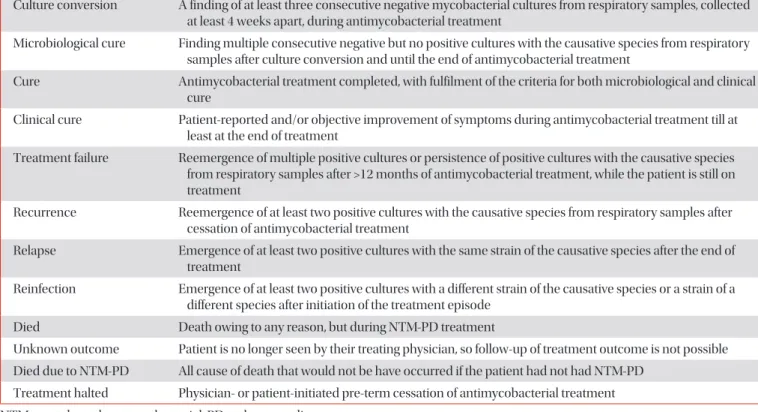
Treatment outcomes will be assessed after completion of the study. The proportion of cured patients (clinical cure and microbiological cure), patients with treatment failure, patients with recurrence, patients with relapse or reinfection, and pa- tients who died will be calculated. The definitions for outcome parameters follow an NTM-NET consensus statement
12. The definition for treatment outcomes is in Table 1.
6. Mycobacterial sample collection
A drug susceptibility test from mycobacterial isolates are
generally requested before the initiation of treatment or dur-
ing the treatment when culture conversion is not achieved
or when relapse/reinfection are suspected, according to the
current treatment policy. The isolates for which drug suscepti-
bility tests are requested will be stored at the Korea Institute of Tuberculosis (KIT).
7. Estimated number of participants
The sample size was empirically determined from the ex- perience of our previous cohort study. About 50–70 patients were enrolled in the prospective cohort (NCT01616745) in South Korea each year and half of them received antibiotic treatment. Therefore, at each institute, at least 20 patients could be enrolled in the cohort each year, and the recruiting goal is 100 patients per year across the country.
8. Ethics approval
The ethics approval from each institutional review board will be obtained. This project is conducted in accordance with the principles of Good Clinical Practice.
9. Data management and quality control
Data will be collected using a web-based electronic case report form (eCRF) developed by the Medical Research Col- laborating Center of Seoul National University Hospital. The eCRFs are collected at the time of enrollment and at follow-up visits at 1-year intervals.
During the study, medical personnel not participating in this investigation will monitor the study. Monitors will visit sites to check all aspects of the study per protocol including adherence to the protocol and Good Clinical Practice, protec- tion of study participants, and data accuracy of the study.
10. Confidentiality of the data
All data are anonymized and secured in the web-based eCRF, operated by the Medical Research Collaborating Center of Seoul National University Hospital. The access to data is restricted to authorized personnel only. Paper files containing participants’ data (including personally identifiable informa- tion and copies of signed consent forms) will be securely stored in a locked office on-site in locked filing cabinets. Data sharing is possible for stakeholders with the approval of the NTM-KOREA committee.
11. Safety assessment
As the study design is observational and intervention is not allowed, no benefit or harm to participants is expected in this study.
Table 1. List of definitions
Culture conversion A finding of at least three consecutive negative mycobacterial cultures from respiratory samples, collected at least 4 weeks apart, during antimycobacterial treatment
Microbiological cure Finding multiple consecutive negative but no positive cultures with the causative species from respiratory samples after culture conversion and until the end of antimycobacterial treatment
Cure Antimycobacterial treatment completed, with fulfilment of the criteria for both microbiological and clinical cure
Clinical cure Patient-reported and/or objective improvement of symptoms during antimycobacterial treatment till at least at the end of treatment
Treatment failure Reemergence of multiple positive cultures or persistence of positive cultures with the causative species from respiratory samples after >12 months of antimycobacterial treatment, while the patient is still on treatment
Recurrence Reemergence of at least two positive cultures with the causative species from respiratory samples after cessation of antimycobacterial treatment
Relapse Emergence of at least two positive cultures with the same strain of the causative species after the end of treatment
Reinfection Emergence of at least two positive cultures with a different strain of the causative species or a strain of a different species after initiation of the treatment episode
Died Death owing to any reason, but during NTM-PD treatment
Unknown outcome Patient is no longer seen by their treating physician, so follow-up of treatment outcome is not possible Died due to NTM-PD All cause of death that would not be have occurred if the patient had not had NTM-PD
Treatment halted Physician- or patient-initiated pre-term cessation of antimycobacterial treatment
NTM: nontuberculous mycobacterial; PD: pulmonary disease.
12. Participant drop-out
Drop-out from the study is allowed when participants wish to withdraw from the study. These participants will be regard- ed as “dropped-out”. Patients who die during the study will be counted in the same manner. All data before drop-out will be secured.
13. Statistical analysis
The epidemiologic, clinical, radiographic, and microbio- logical characteristics, as well as treatment outcomes, will be analyzed and compared by subgroup, using the Student t-test, Mann-Whitney test, and Fisher exact test. Multivariable logis- tic regression will be used to estimate the effect of each drug use and duration on treatment outcomes.
Discussion
The NTM-KOREA will be the first nationwide observational cohort for NTM-PD in South Korea. In this cohort, seven in- stitutions, distributed across the country, will participate in patient enrollment and about 500 patients with NTM-PD who need treatment are expected to be enrolled. During the follow- up period, up to 10 years, participants’ clinical course will be tracked and their clinical data will be collected. Moreover, NTM isolates will be stored for future study.
The relatively low incidence of and lack of an antibiotic pipeline designed for NTM-PD has resulted in NTM-PD being considered an orphan disease
13. However, the atten- tion surrounding this neglected disease has increased, and several registries have been launched globally. Registries for NTM-PD have been founded in Italy (ClinicalTrials.gov ID:
NCT03339063)
14and Singapore (NCT02355015). The non- cystic fibrosis bronchiectasis registry, called the Bronchiecta- sis Research Registry, has recruited participants in the United States and reports that 63% of the population has a history of NTM-PD or NTM infection
15. The EMBARC European Bron- chiectasis Registry seeks to collect data of NTM-PD as a spe- cific subgroup analysis
16. In South Korea, where the incidence of NTM-PD is increasing dramatically
2-5, this prospective cohort study could provide valuable epidemiological, clinical, and bacteriological data for South Korea.
When participants enroll in the study, their demographic, laboratory, radiographic, and microbiologic information will be collected. Initial treatment regimens will be recorded and changes in microbiological and clinical outcomes will be as- sessed. Adverse events as well as treatment outcomes are to be collected. In addition, changes in functional capacity and HRQL will be tracked longitudinally. Long-term outcomes after treatment completion will also be analyzed. In particular, differentiation between relapse and reinfection will be made
by comparing stored NTM isolates.
The data gathered through NTM-KOREA will provide ac- curate treatment outcomes, their predictors, and the impact of and adverse events owing to each drug. Follow-up beyond the treatment period will also help in understanding the long- term prognosis of patients with NTM-PD. The information from NTM-KOREA will be the cornerstone of optimizing treatment modalities, duration, and follow-up of patients with NTM-PD in South Korea.
In conclusion, the NTM-KOREA will be launched as the first nationwide prospective observational study of NTM-PD in South Korea. This cohort aims to recruit a total of 500 patients for 5 years, with an additional 5-year observational period. The NTM-KOREA cohort will provide deeper understanding of the treatment outcomes and long-term prognosis in patients with NTM-PD in South Korea.
*Author Affiliations
1
Division of Pulmonary and Critical Care Medicine, Department of Internal Medicine, Seoul National University College of Medicine, Seoul,
2Research Center, Korean Institute of Tuberculosis, Cheongju,
3Division of Pulmonary and Critical Care Medicine, Department of Internal Medicine, Pusan National University Yangsan Hospital, Yangsan,
4Division of Pulmonary and Critical Care Medicine, Department of Medicine, Samsung Medical Center, Sungkyunkwan University School of Medicine, Seoul,
5