http://dx.doi.org/10.7841/ksbbj.2016.31.2.100 ISSN 1225-7117 / eISSN 2288-8268
저장 기간 중 돌산갓 피클의 폴리페놀, 플라보노이드 및 항산화 활성에 대한 변화
손혜련, 오선경, 최명락*
Total Polyphenol, Flavonoid Contents and Antioxidant Activities of Dolsan Leaf Mustard Pickle during Storage
Hae Reon Son, Sun Kyung Oh, and Myeong Rak Choi*
Received: 7 March 2016 / Revised: 6 May 2016 / Accepted: 18 May 2016
© 2016 The Korean Society for Biotechnology and Bioengineering
Abstract: Dolsan leaf mustard has various biological func- tions, including those in the immune system and cancer pre- vention. It contains high amounts of nutritional and medicinal compounds, which are important for maintaining optimum health. The objective of this study was to determine the total phenolics contents and antioxidant activity in Dolsan leaf mus- tard pickle (DLMP) during storage. DLMP methanol extracts had the highest total polyphenol and flavonoid contents of 35.56±0.01 GAE mg/g and 4.54±0.03 QE mg/g, respectively.
The DPPH and ABTS radical scavenging activities in the DLMP methanol extracts showed the highest activities of 79.4 and 85.36%, respectively. The ferric reducing antioxidant po- wer (FRAP) assay showed 2.24-3.82 mM FeSO
4eq. (p<0.05) in DLMP extracts. Overall, storage at day 14 showed the highest antioxidant activity.
Keywords: Dolsan leaf mustard, Pickle, Antioxidant activity, Polyphenol, Flavonoid
1. INTRODUCTION
Pickles are produced for the long-term storage of many sea-
sonal and local vegetables. Pickled vegetables are prepared using edible acid (which is added or formed in situ by fermen- tation) and vegetable preservation is due, at least partially, to the presence of this acid [1]. Leaf mustard (Brassica juncea) is a member of the Brassicaceae family, and mustard seeds are used as a spice. Dolsan leaf mustard is larger than traditional leaf mustard, and has abundant glucosinolates, polyphenols, and sulfur compounds [2]. Leaf mustard on the surface of pic- kles influences released of isothiocyanate by the action of my- rosinase [3]. Other released components such as yeasts, molds, and various bacteria have antimicrobial activities; therefore, food prepared with leaf mustard has increased storability. In addition, leaf mustard is a rich source of iron, phosphorus, calcium, potassium, proteins, and minerals [4]. Dolsan leaf mustard strengthens the immune system and helps to prevent cancer [3]. Phenolic contents in plants play an important role as primary antioxidants or free radical terminators, suggesting their use in preventing the oxidative breakdown of lipids and in preventing chronic diseases resulting from reactive oxygen species (ROS). Enzymatic ROS scavenging includes superoxide dismutase (SOD), ascorbate peroxidase (APX), and glutathione peroxidase (GPX) activities. In contrast, non-enzymatic ROS scavenging includes cellular redox buffers, ascorbate and glu- tathione (GSH), tocopherol, flavonoids, and carotenoids [5].
The potential antioxidant activity of food and medicinal plants is associated with phenolic contents, type, and structure [6].
Recently, extensive progress has been made in studying the
전남대학교 바이오전자메디컬공학 협동과정Department of Biomedical and Electronic Engineering, Chonnam Na- tional University, Yeosu 550-749, Korea
Tel: +82-61-659-7303, Fax: +82-61-659-7309 e-mail: [email protected]
연구논문
antioxidant activity during the storage of pickles using tea lea- ves [1], garlic [6], bitter melon [7], and mountain herbs [8];
however, to the best of our knowledge, antioxidant activity during storage of Dolsan leaf mustard has not been researched.
Hence, this study aims to examine the total phenolic and fla- vonoid contents and antioxidant activities of Dolsan leaf mus- tard pickles (DLMP) during storage.
2. MATERIALS AND METHODS
2.1. Materials
Dolsan leaf mustard was produced at Yeosu-si, Dolsan-eup, Korea and harvested in October 2015. Dolsan leaf mustard was blanched at 80
oC for 10 s. DLMP were prepared using Dolsan leaf mustard (65%), soy (10%), apple vinegar (7%), water (12
%), garlic (1%) and condiment sauce (5%), and stored at 4
oC for 28 days after preparation. DLMP was used for the experi- ment after a 7 day interval.
2.2. Reagents
Folin-Ciocalteu’s phenol reagent, 2,20-azino-bis (3-ethylbenzo- thiazoline-6-sulfonic acid) diammonium salt (ABTS), 2,2-diphe- nyl-1-picrylhydrazyl (DPPH), gallic acid, quercetin, BHA (2 [3]-t-Butyl-4-hydroxyanisole), ascorbic acid, ferrous and ferric chloride were purchased from Sigma Chemical Co. (St, Louis, MO, USA). All other reagents were of the highest grade com- mercially available.
2.3. Preparation of extracts from DLMP
DLMP were ground to a particle size of 5-10 mm using a high speed mixer (Blender, Hanil, HNF-340, Seoul, Korea). DLMP samples (10 g) were placed in a Soxhlet extractor with 200 mL 50% (v/v) acetonitrile in a round flask extracted at 93-94
oC and 80% (v/v) methanol, 80% (v/v) ethanol in a round flask extrac- ted at 60
oC for 24 h. After cooling at room temperature (RT) of 25
oC, the extracts were filtered with Whatman No. 2. The filt- rate was evaporated by an evaporator (EYELA, Tokyo, Japan) at 60
oC, the extracts were transferred to a freeze-drying tube and lyophilized. The dried extracts were weighed and stored at 0
oC prior to analysis. The absorbance of all extracts (300 µL) was analyzed in a 96-well plate (SPL Lifescience Co., Pocheon, Korea) using a Microplate Reader (UVM340, Biochrom, Cam- bridge, UK).
2.4. Determination of total polyphenol contents
Total phenolic contents were determined using a Folin-Ciocal- teau assay [9]. The DLMP extracts were dissolved in methanol (1 mg/mL) and aliquot (100 µL) mixed with 20 mL of 2%
aqueous sodium carbonate solution. After 3 min, 100 µL of 50% (v/v) Folin-Ciocalteau reagent was added to the mixture.
After 30 min of standing, the extract was measured at 750 nm.
Gallic acid was used as a standard to construct the calibration curve and the total polyphenol contents of DLMP extracts were expressed in milligram gallic acid equivalents (GAE) per gram of extract (dry weight).
2.5. Determination of total flavonoid contents
Total flavonoid contents were determined using the aluminum chloride colorimetric method [10]. DLMP extracts were dissol- ved in methanol (1 mg/mL) and solution (0.5 mL) and were mixed with 1.5 mL of 95% ethanol, 0.1 mL of 10% aluminum chloride, 0.1 mL of 1 M potassium acetate, and 2.8 mL of dis- tilled water. The mixture was then incubate at 25
oC for 30 min.
After 30 min of standing, the extract was measured at 750 nm.
Quercetin as a standard was used to construct the calibration curve and the total flavonoid contents were expressed in millig- ram quercetin equivalents (QE) per gram of extract (dry weight).
2.6. DPPH radical scavenging activity
The electron donation ability of the obtained methanol extracts was measured by bleaching the purple-colored solution of DPPH radicals based on the method of Blois [11]. Briefly, the DLMP extracts were dissolved in methanol (1 mg/mL) and were added to a 1 mL DPPH radical solution in methanol (the final concen- tration of DPPH was 0.2 mM). The solution was incubated for 30 min in the dark at RT, and the mixture absorbance was mea- sured using at 517 nm. The control absorbance was measured 0.02% BHA (v/v). The DPPH radical scavenging activity was calculated according to the following equation:
DPPH scavenging activity (%) = (1 − sample absorbance/
control absorbance) × 100
2.7. ABTS radical scavenging activity
The total antioxidant activities of the DLMP extracts dissolved
in methanol (1 mg/mL) were measured by the ABTS
.+radical
cation decolorization assay, which involves the preformed
ABTS
.+radical cation [12,13]. ABTS was dissolved in water to
a 7 mM concentration, and the ABTS radical action (ABTS
.+)
was produced by mixing the ABTS stock solution with 2.45 mM
potassium persulfate (K
2S
2O
8), and allowing the mixture to
stand in the dark at RT. for 14 h before use. Oxidation of ABTS
commenced immediately, but absorbance was not maximal and
stable in this form for more than 2 days of storage in the dark
at R.T. After the mixture was kept in the dark at R.T for 14 h,
to allow the completion of radical generation, it was diluted
with ethanol to an absorbance of 0.70±0.05 at 734 nm. To deter-
mine the scavenging activity, 0.9 mL ABTS reagent was mixed with 0.1 mL extract and the absorbance was measured at 734 nm after 6 min of reaction at R.T, using ethanol as a control [14].The control absorbance was measured at 0.02% ascorbic acid (v/v). The ABTS radical scavenging activity was calculated according to the following equation:
ABTS scavenging activity (%) = (1 − sample absorbance/
control absorbance) × 100
2.8. Ferric reducing antioxidant power (FRAP) assay To obtain the antioxidant capacity, the FRAP method was con- ducted, following the previously described [15]. For the assay, a 3 mL FRAP reagent aliquot, a mixture of 0.3 M acetate buf- fer, 10 mM TPTZ in 40 mM HCl, and 20 mM ferric chloride [10:1:1 (v/v/v)], were combined with 1 mL DLMP extracts dis- solved in methanol (1 mg/mL). The antioxidant capacity values were expressed as mM FeSO
4equivalents per gram extract (mM FeSO
4eq.) per gram of extract (dry weight).
2.9. Statistical analysis
All tests and analyses were repeated at least three times. The results are expressed as mean±standard deviation (SD). A one way analysis of variance (ANOVA) and Duncan’s test were used for multiple comparisons using SPSS version 21.0 (SPSS Institute, Chicago, IL, USA). The values were considered to differ significantly if the P value was less than 0.05.
3. RESULTS AND DISCUSSION
3.1. Total polyphenol and total flavonoid contents The total polyphenol contents of DLMP extracts are shown in
Table 1. Total polyphenol contents were significantly different (p<0.05) among the different DLMP extracts, ranged 7.96 to 35.56 GAE mg/g. DLMP Methanol extracts had the highest total polyphenol content of 35.56±0.01 GAE mg/g at day 14 and DLMP ethanol extracts had the lowest total polyphenol content of 7.96±0.01 GAE mg/g at day 0. The results were consistent with those from a previous report [16], which saw that total polyphenol content of Dolsan leaf mustard was 0.42 mg/g and DLMP extracts had the higher polyphenol contents than Dolsan leaf mustard. Total flavonoid contents of DLMP extracts are shown in Table 2. Total flavonoid contents were significantly different (p<0.05) among the different DLMP extracts, ranged from 1.96 to 4.54 QE mg/g. DLMP methanol extracts had the highest total flavonoid content of 4.54±0.03 QE mg/g at day 14 and DLMP ethanol extracts had the lowest total flavonoid content of 1.96±0.01 QE mg/g at day 0. Solvent extraction is a useful technique for the isolation of plant anti- oxidant compounds. However, resulting antioxidant activities and extract yields of plant materials depend on the extraction solv- ent, due to different chemical characteristics and polarities that may or may not be soluble in a particular solvent. Polar solvents, such as aqueous mixtures containing ethanol, methanol, acetone, and ethyl acetate, have been used frequently to extract pheno- lics from a plant matrixes [5]. In the present study, methanol extract was the most suitable solvent for extracting phenolic compounds from DLMP. Analysis of the physiological activi- ties of Yangha [17] showed the highest of phenolic compounds at day 15 of storage; these results showed a similar trend.
3.2. Antioxidant activities
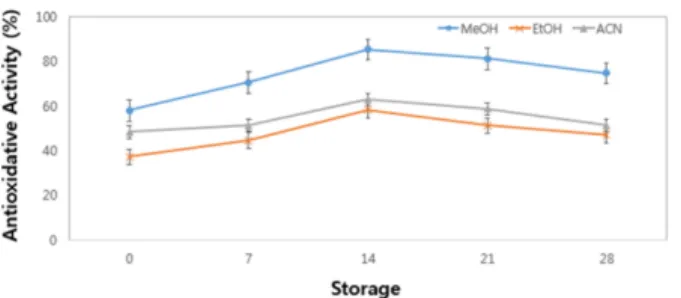
The DPPH radical scavenging activity was measured to deter- mine antioxidant activities of DLMP extracts (Fig. 1), which were 34.15-79.4% (p<0.05). The antioxidant activities measured Table 1. Total polyphenol contents of Dolsan leaf mustard pickle (DLMP) extracts
Extract Total polyphenol contents (GAE mg/g)
01) 7 14 21 28
MeOH 15.06±0.03Ba2) 25.66±0.02Ca 35.56±0.01Ca 27.46±0.04Aa 16.56±0.02Da
EtOH 7.96±0.01Ab 9.56±0.01Cb 12.76±0.02Bb 12.66±0.01Bb 8.86±0.01Db
ACN 10.86±0.02Bc 13.06±0.01Bc 14.96±0.03Dc 13.86±0.01Cc 12.36±0.03Ac
1)
Storage.
2)All values are mean ±SD of the triplicate determination. The mean in row (a-c) and a column (A-E) followed by different superscripts are significantly different at p<0.05 by Duncan's range test.
Table 2. Total flavonoid contents of Dolsan leaf mustard pickle (DLMP) extracts
Extract Total flavonoid contents (QE mg/g)
01) 7 14 21 28
MeOH 2.60±0.01Ca2) 3.25±0.02Aa 4.54±0.03Ea 4.09±0.01Ca 3.68±0.01Da
EtOH 1.96±0.01Db 2.50±0.03Db 2.69±0.01Ab 1.81±0.01Cb 1.56±0.02Db
ACN 2.23±0.02Ec 2.72±0.01Bc 3.22±0.02Dc 2.83±0.02Cc 2.56±0.02Dc
1)
Storage.
2)All values are mean ±SD of the triplicate determination. The mean in row (a-c) and a column (A-E) followed by different superscripts are
significantly different at p<0.05 by Duncan's range test.
84.5% control in 0.02% BHA (v/v) (data not shown). The anti- oxidant activities from previous studies measured 11.0% in roots, 11.6% in stems and 80.4% in leaves of Dolsan leaf mus- tard, respectively [3]. When compared to this result, the anti- oxidant activity in Dolsan leaf mustard in the present study was higher than it was in the roots and stem, but lower than that ob- served in the leaves. DLMP methanol extracts at day 14 showed the highest antioxidant activity of 79.4%, whereas the DLMP ethanol extract at day 0 showed the lowest antioxidant activity of 34.15%. The ABTS radical scavenging activity was meas- ured to determine antioxidant activities of DLMP extracts (Fig.
2). The range of antioxidant activities 37.25-85.36%. Moreover, DLMP methanol extracts at day 14 showed the highest anti- oxidant activity of 85.36%, and the DLMP ethanol extracts at day 0 showed the lowest antioxidant activity of 37.25%. In a previous study [1], tea leaf pickles (10% vinegar content) dec- reased at day 5 of storage. However, the same vinegar contents used for DLMP increased the antioxidant activity from day 0 to 15. ABTS radical scavenging activity was DPPH radical scavenging activity probably because the ABTS method could measure the ability of hydrogen-donating and chain-breaking antioxidants. Moreover, the ABTS method is advantageous as it can be applied to both water-soluble substances and fat-solu- ble substances [17]. Therefore, ABTS radical scavenging acti- vity was more highly represented. Boo et al. [18] determined the total polyphenol and flavonoid contents was high based on the ABTS radical scavenging activity. These results suggest that higher polyphenol and flavonoid contents showed higher ABTS radical scavenging activity. The FRAP assay measured
the antioxidant effect of any substance in the reaction medium as a reducing ability. The antioxidant capacities of the DLMP extract are shown in Table 3, from 2.24-3.82 mM FeSO
4eq.
(p<0.05). The antioxidant activity of bitter melon pickle inc- reased only slightly during storage [7]. Similarly, there was no significant difference in the antioxidant activity during storage in the present study. The FRAP measured 1.24-2.65 mM FeSO
4eq. at day 0 and 1.97-2.60 at day 28. The ethanol extract showed lower antioxidant activity then the methanol extract; and over- all, storage at day 14 showed the highest antioxidant activity.
The could be explained by the antioxidants found in fresh leas- ves of the Brassicaceae family, including p-hydroxybenzoic, vanillic, protocatechuic, hydroxybenzoic, hydroxycinnamic, p- coumaric, ferulic, caffeic and sinapic acids [19,20]. Phenolic acids such as p-coumaric and ferulic acid have vinyl deriva- tives through the reaction of microorganisms, increasing the
Fig. 1. DPPH radical antioxidant activities of DLMP extracts. Fig. 2. ABTS radical antioxidant activities of DLMP extracts.Table 3. FRAP(ferric reducing antioxidant power) assay of Dolsan leaf mustard pickle (DLMP) extracts
Extract Total flavonoid contents (QE mg/g)
01) 7 14 21 28
MeOH 2.65±0.01Da2) 2.54±0.02Ea 3.82±0.01Aa 3.56±0.01Aa 2.59±0.03Ba
EtOH 1.24±0.01Bb 2.05±0.03Db 2.80±0.01Cb 2.59±0.01Eb 1.97±0.01Eb
ACN 2.61±0.02Ac 3.22±0.01Bc 3.46±0.02Cc 3.23±0.02Cc 2.60±0.01Ac
1)
Storage.
2)
All values are mean ±SD of the triplicate determination. The mean in row (a-c) and a column (A-E) followed by different superscripts are significantly different at p<0.05 by Duncan's range test.
Fig. 3. Relationship between total flavonoid contents and antioxi- dant activities base on DPPH and ABTS radicals analysis of DLMP extracts.
total phenolic content of leafy vegetables during fermentation is increased. Generally, there is a correlation between phenolic content and antioxidant activities. Similar results were found were found in the present study; there was a high correlation between flavonoid contents and DPPH, and ABTS antioxidant activity in the DLMP methanol extracts (Fig. 3).
4. CONCLUSION
It is concluded that various extracts from DLMP, exhibited a wide range of antioxidant capacities, thus making them valuable sources of natural antioxidant, both for preparation of crude extracts and further isolation and purification of antioxidant components. Significant correlations were found between the antioxidant capacities and total phenolic contents indicating that phenolic compounds are the major contributor of antioxidant capacities of these plant samples [21]. Therefore, the results could provide the basis for improving the availability and qua- lity of Dolsan leaf mustard.
ACKNOWLEDGEMENTS
This work was supported by the BK21 program.
REFERENCES
1. Park, B. R., J. J. Park, I. G. Hwang, H. M. Han, M. S. Shin, D. S.
Shin, and S. M. Yoo (2014) Quality and antioxidant activity char- acteristics during storage of tea leaf pickles with different vinegar contents. Korean J. Food cook. SCI. 30: 402-411.
2. Cho, Y. S., B. S. Ha, S. K. Park, and S. S. Chun (1993) Contents of carotenoids and chlorophylls in Dolsan leaf mustard (Brassica jun- cea). Korean J. Diet. Cult. 8: 153-157.
3. Choi, M. R., E. J. Yoo, S. H. Song, D. S. Kang, J. C. Park, and H.
S. Lim (2001) Comparison of physiological activity in different parts of Dolsan leaf mustard. Korean J. Soc. Food Nutr. 30: 721- 725.
4. Jun, H. I., P. W. Dennis, and Y. S. Kim (2014) Antioxidant activity of phenolic compounds from canola seed. Food Sci. Biotechnol.
23: 1753-1760.
5. Beak, Y. S., Y. J. Kim, M. Y. Baik, D. O. Kim, and H. J. Lee (2015) Total phenolic contents and antioxidant activities of korean domestic honey from different floral sources. Food Sci. Biotech- nol. 24: 1453-1457.
6. Song, M. R., M. J. Kim, O. Y. Kwon, H. R. Kim, and M. R. Kim (2009) Quality charaoteristics and antioxidative activity of garlic pickles prepared with persimmon vinegar and maesil juice. J. East
Asian Soc Diet. Life. 19: 981-986.
7. Lee, H. Y., K. S. Park, O. S. Joo, J. E. Hwang, M. J. Ahn, Y. S.
Jeong, S. Y. Hong, O. K. Kwon, S. S. Kang, H. J. Yuk, H. R. Kim, D. S. Park, and K. M. Cho (2015) Change in quality characteris- tics and antioxidant activity of bitter melon pickle during ageing. J Korean Soc Food Sci Nutr. 44: 401-411.
8. Kim, D. J. (2015) Quality characteristics and physiological activi- ties of jangachi using mountain herbs. M.D. Thesis. University of Andong, Andong, Korea.
9. Jeong, C. H., J. H. Kwak, J. H. Kim, G. N. Choi, D. O. Kim, and H. J. Heo (2011) Neuronal cell protective and antioxidant effects of phenolics obtained from Zanthoxylum piperium leaf using in vitro model. Food Chem. 125: 417-422.
10. Woisky, R. and A. Salatino (1988) Analysis of propolis: Some paramenters and procedures for chemical quality control. J. Api- cult. Res. 37: 99-105.
11. Blois, M. S. (1958) Antioxidant determination by the use of a sta- ble free radical. Nature 26: 1199-1201.
12. Re, R., N. Pellegrini, A. Proteggente, A. Pannala, M. Yang, and C.
Rice-Evans (1999) Antioxidant activity applying an improved ABTS radical cation decolorization assay. Free Radic. Biol. Med.
26: 1231-1237.
13. Erkan, N. and G. Ayranci (2008) Antioxidant activities of rosemary (Rosmarinus Officinalic L.) extract, blackseed (Nigella sativa L.) essential oil, carnosic acid, rosmarinic acid and sesamol. Food Chem. 110: 76-82.
14. Kim, Y. S., J. W. Hwang, S. E. Kim, E. H. Kim, Y. J. Jeon, S. H.
Moon, T. B. Jeon, and P. J. Park (2012) Antioxidant acivity and protective effects of Uncaria rhtnchophylla extracts on t-BHP- induced oxidative stress in chang cells. Biotechnol. Bioprocess Eng. 17: 1213-1222.
15. BenZie, I. F. F. and J. J. Strain (1996) The ferric reducing ability of plasma (FRAP) as a measure of “Antioxidant Power”: The FRAP assay. Anal. Biochem. 239: 70-76.
16. Kim, S. H. (2010) Comparison of nutrition components of Bras- sica juncea in Yeosu. Ph. D. Thesis. University of Chonnam, Yeosu, Korea.
17. Kim, M. H. (2015) Analysis of physiological activities of yangha (Zingiber mioga Rosc) and quality characteristics of yangha pickle.
Ph. D. Thesis. University of Sookmyung Women’s, Seoul, Korea.
18. Boo, H. O., H. H. Lee, J. W. Lee, S. J. Hwang, and S. U. Park (2009) Different of total phenolics and flavonoids, radical scaveng- ing activities and nitrite scavenging effects of Momordica charan- tia L. according to cultivars. Korean J Medicinal Crop Sci. 17: 15- 29.
19. Uda, Y., Y. Ozawa, M. Takayama, K. Suzuki, and Y. Maeda (1988) Free and soluble bound phenolic acids in some cruciferous vegeta- bles. Nipp on Shok uhin Kogyo Gakkaishi. 35: 360.
20. Hemeda, H. M. and B. P. Klein (1990) Effect of naturally occur- ring antioxidants on peroxidase activity of vegetables extracts. J.
Food Sci. 55: 184.
21. Arslan, S., A. Topcu, I. Saldamli, and G. Koksal (2010) Utilization of interesterified fat in the production of Turkish white cheese.
Food Sci. Biotechnol. 19: 89-98.