434
Open Access
Subclinical Coronary Artery Disease as Detected by Coronary
Computed Tomography Angiography in an Asymptomatic Population
Sahmin Lee, MD
1, Eue-Keun Choi, MD¹, Hyuk-Jae Chang, MD², Chi-Hoon Kim, MD
1, Won-Woo Seo, MD
1, Jin Joo Park, MD
1, Sang Il Choi, MD³, Eun-Ju Chun, MD³, Sung-A Chang, MD¹, Hyung-Kwan Kim, MD¹, Yong-Jin Kim, MD¹, Bon-Kwon Koo, MD
1, Dong-Joo Choi, MD² and Byunghee Oh, MD¹
¹Department of Internal Medicine, Seoul National University College of Medicine, Seoul,
²Divisions of Cardiology and ³Radiology, Cardiovascular Center Seoul National University Bundang Hospital, Seongnam, Korea ABSTRACT
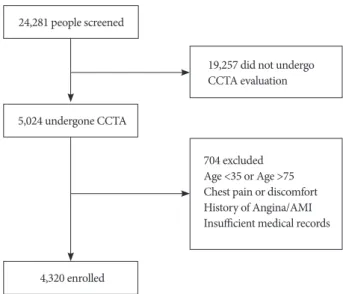
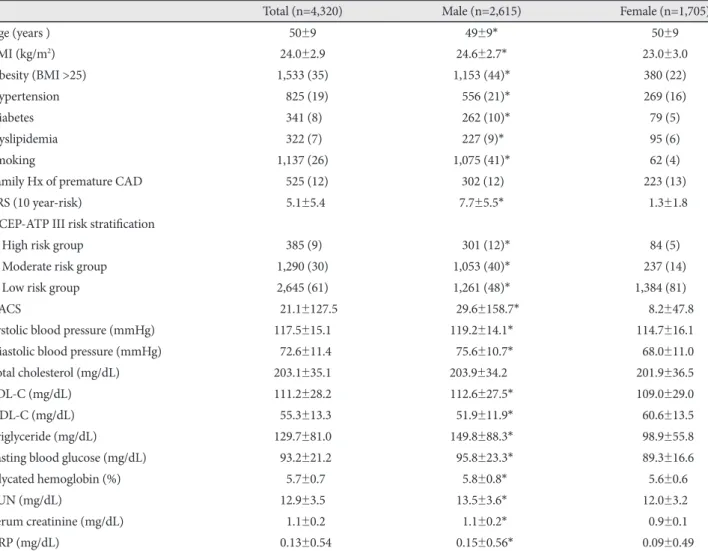
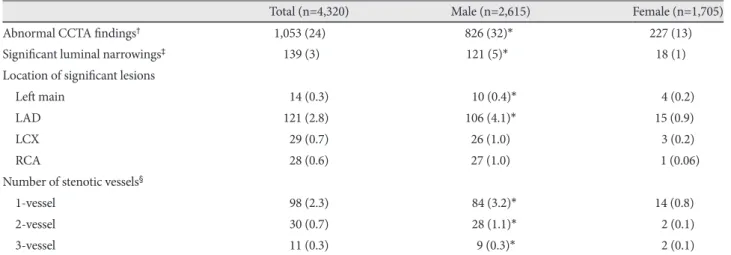
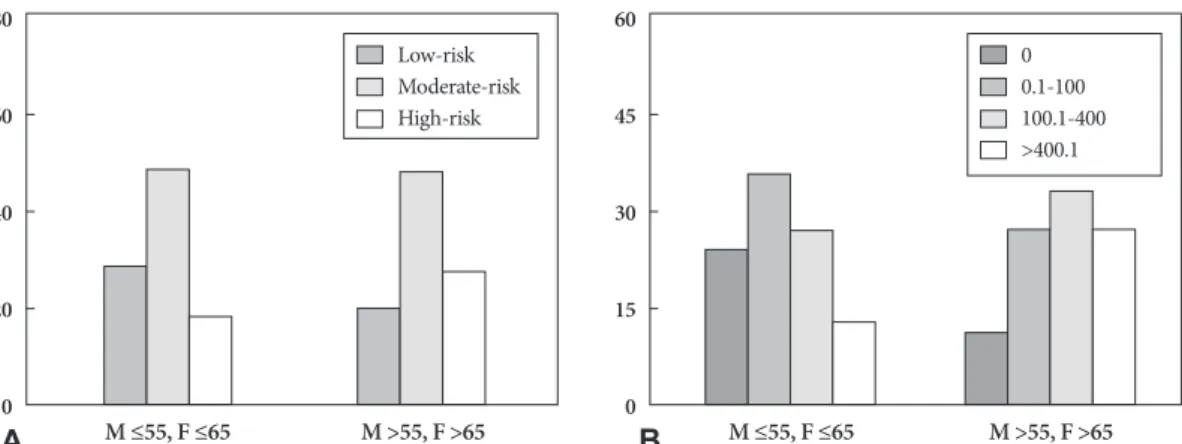
Background and Objectives: Primary prevention of coronary artery disease (CAD) has become a public health issue, ac- cording to increasing awareness of the substantial risks posed by asymptomatic atherosclerosis. The aims of this study were to determine the prevalence and characteristics of subclinical CAD using coronary computed tomography angiography (CCTA), and to evaluate the role of this advanced technology in identifying subclinical CAD in asymptomatic Korean indi- viduals, compared with conventional risk stratification. Subjects and Methods: We enrolled 4,320 consecutive asymptom- atic individuals (61% males, aged 50±9 years), who underwent 64-slice CCTA during a routine health check. Results: Coro- nary artery plaques were present in 1,053 (24%) individuals. Significant stenosis (diameter stenosis ≥50%) was identified in 139 (3%) subjects, and most of the significant lesions (87%) were located in the left anterior descending artery. CCTA revealed non- calcified plaques in 5% of subjects with a coronary calcium score of zero (n=801). Although 25% (n=10) of those with noncal- cified plaque had significant stenosis, most of them (90%) were classified into low- or moderate-risk groups according to Na- tional Cholesterol Education Program risk stratification guidelines. In a young population (age ≤55 years for males, ≤65 years for females), 30% of subjects with significant stenosis were classified into a low-risk group and 60% had low (0 to 100) calcium scores. Conclusion: Subclinical CAD in asymptomatic individuals cannot be ignored for its considerable prevalence, CCTA may be helpful in identifying at-risk subclinical CAD in a noninvasive manner, especially in the young and traditionally low- risk population. (Korean Circ J 2010;40:434-441)
KEY WORDS: Coronary artery disease; Primary prevention; Tomography scanners, X-ray computed.
Received: November 10, 2009 Accepted: March 30, 2010
Correspondence: Byunghee Oh, MD, Department of Internal Medi- cine, Seoul National University College of Medicine, 101 Daehak-ro, Jongno- gu, Seoul 110-744, Korea
Tel: 82-2-2072-2500, Fax: 82-2-2072-3757 E-mail: [email protected]
cc