Abbreviated chemotherapy for limited-stage diffuse large B-cell lymphoma after complete resection
Jungmin Jo
1#, Dok Hyun Yoon
1#, Sang Wook Lee
2, Chan-Sik Park
3, Jooryung Huh
3, Kyoungmin Lee
1, Eun Hee Kang
1, Shin Kim
1, Cheolwon Suh
1Departments of 1Oncology, 2Radiation Oncology and 3Pathology, Asan Medical Center, University of Ulsan College of Medicine, Seoul, Korea
p-ISSN 2287-979X / e-ISSN 2288-0011 http://dx.doi.org/10.5045/br.2014.49.2.115 Blood Res 2014;49:115-9.
Received on January 5, 2014 Revised on February 21, 2014 Accepted on May 15, 2014
#J.J and DH.Y contributed equally to this work.
Background
Abbreviated chemotherapy followed by radiotherapy or full cycles of chemotherapy is recommended as a standard treatment for limited-stage (LS) diffuse large B-cell lympho- ma (DLBCL). After complete resection of tumors, however, Burkitt and childhood B-cell Non-Hodgkin lymphoma show favorable outcomes, even after abbreviated chemo- therapy of only 2 or 3 cycles. We investigated the effectiveness of abbreviated chemo- therapy in patients with LS DLBCL after complete tumor resection.
Methods
We retrospectively reviewed 18 patients with LS DLBCL who underwent complete tumor resection followed by either 3 or 4 cycles of chemotherapy between March 2002 and May 2010.
Results
With a median follow-up period of 57.9 months (range, 31.8‒130.2 months), no patients experienced disease relapse or progression; however, 1 patient experienced secondary acute myeloid leukemia during follow-up. The 5-year progression-free survival rate and overall survival rate were 93.3% and 94.1%, respectively.
Conclusion
These results warrant further investigation into abbreviated chemotherapy as an alter- native treatment for patients who have undergone complete resection of LS DLBCL.
Key Words Diffuse large B-cell lymphoma, Limited Stage, Resection, Abbreviated chemotherapy
Correspondence to Cheolwon Suh, M.D., Ph.D.
Department of Oncology, Asan Medical Center, University of Ulsan College of Medicine, 88, Olympic-ro 43-gil, Songpa-gu, Seoul 138-736, Korea Tel: +82-2-3010-3209
Fax: +82-2-3010-6961 E-mail: [email protected]
Ⓒ 2014 Korean Society of Hematology
INTRODUCTION
Diffuse large B-cell lymphoma (DLBCL) is the most com- mon histological subtype of non-Hodgkin lymphoma (NHL) in adults [1]. Standard treatments for limited-stage (LS) DLBCL include both abbreviated systemic chemotherapy followed by involved-field radiotherapy (IFRT) and full-course chemotherapy [2].
In many cases, lesions are completely excised during the diagnostic process, especially in patients with stage I disease, as the diagnosis is best made based on histologic examination of tissues from an excisional biopsy. In addition, in the treat- ment of small bowel and ileocecal lymphomas with LS dis- ease, initial surgical resection of the involved area is often
performed due to the risk of obstruction or perforation of the bowel [3-5]. Although surgical resection is the most effective local therapy for the treatment of most cancers, full cycles of chemotherapy or combined treatment of che- motherapy and radiotherapy are still recommended for pa- tients with completely resected DLBCL, similar to patients with gross tumors.
Despite being a very aggressive variant of B-cell NHL, stage I Burkitt lymphoma is treated with only 3 cycles of chemotherapy after complete surgical resection [6, 7]. In the NHL-BFM 90 study, 2 courses of chemotherapy were sufficient to treat patients with childhood B-cell neoplasms after complete resection [8].
For patients with completely resected DLBCL, the number of cycles of chemotherapy has not been questioned so far.
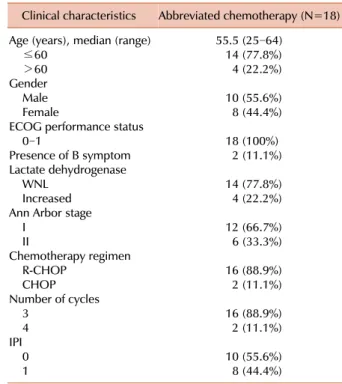
Table 1. Patient characteristics.
Clinical characteristics Abbreviated chemotherapy (N=18) Age (years), median (range) 55.5 (25‒64)
≤60 14 (77.8%)
>60 4 (22.2%)
Gender
Male 10 (55.6%)
Female 8 (44.4%)
ECOG performance status
0‒1 18 (100%)
Presence of B symptom 2 (11.1%) Lactate dehydrogenase
WNL 14 (77.8%)
Increased 4 (22.2%)
Ann Arbor stage
I 12 (66.7%)
II 6 (33.3%)
Chemotherapy regimen
R-CHOP 16 (88.9%)
CHOP 2 (11.1%)
Number of cycles
3 16 (88.9%)
4 2 (11.1%)
IPI
0 10 (55.6%)
1 8 (44.4%)
Abbreviations: ECOG, Eastern Cooperative Oncology Group;
WNL, within normal limits; IPI, International prognostic index;
R-CHOP, ritixumab, cyclophosphamide, doxorubicin, vincristine, prednisolone.
Table 2. Involvement sites.
Sites Abbreviated chemotherapy
(N=18)
Ileum and colon 11 (61.1%)
With regional lymph nodes 5 (27.8%) Without regional lymph nodes 6 (33.3%)
Tonsil 3 (16.7%)
Cervical lymph nodes 2 (11.1%)
Stomach with regional lymph nodes 1 (5.6%)
Axillary lymph nodes 1 (5.6%)
primary CNS lymphoma or mediastinal large B-cell lympho- ma, involvement of the breast or testis, positive serology for HIV, previous organ transplantation, and concomitant or previous cancers were excluded. The institutional review board of the Asan Medical Center approved this study.
Treatment
A cycle of R-CHOP consisted of 375 mg/m2 rituximab, 750 mg/m2 cyclophosphamide, 50 mg/m2 doxorubicin and 1.4 mg/m2 vincristine (maximal dose of 2 mg), all on day 1. Patients also received 100 mg/day prednisolone orally on days 1–5. This cycle was repeated every 21 days. Patients diagnosed before 2003 were treated without rituximab.
tomography (PET) scan.
Statistical analyses
Progression-free survival (PFS) was defined as the time from diagnosis to relapse or death from any cause. Overall survival (OS) was defined as the time from diagnosis to death from any cause. Survival was calculated using the Kaplan-Meier method. SPSS software version 17.0 (SPSS Inc., Chicago, IL, USA) was used for all statistical analyses.
RESULTS
Patient characteristics
Patient characteristics are shown in Table 1. The median age was 55.5 years (range, 25–64 years) at diagnosis and all patients were classified into the low-risk group according to the international prognostic index (IPI). The most com- monly involved site was the ileocecum (Table 2). Out of the 18 patients, 6 (33.3%) had stage II disease. The colon or ileum was the primary disease site in 5 patients and the stomach was the primary site in the remaining patient; in this case, the patient was initially diagnosed with gastric adenocarcinoma and underwent gastrectomy. However, the diagnosis was revised to DLBCL after gastrectomy. One pa- tient had a bulky disease in the small bowel and 2 patients had an approximately 10-cm mass at the same site. Out of 18 patients, 2 patients underwent 4 cycles of chemo- therapy, and all the others had 3 cycles at the discretion
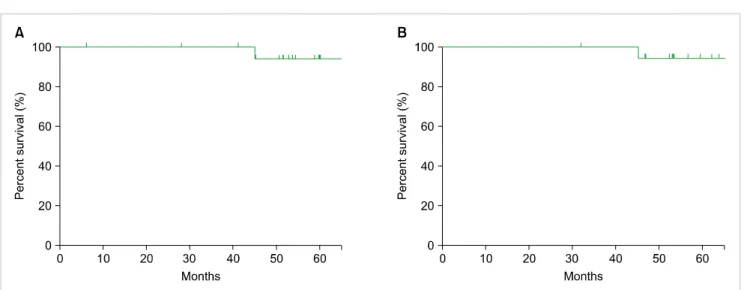
Fig. 1. Kaplan-Meier curves of (A) progression-free survival and (B) overall survival.
Table 3. Profile of adverse events during treatment.
Adverse event Abbreviated chemotherapy (N=18), N (%) Leukopenia
All Grades 14 (77.8)
Grade 3/4 8 (44.4)
Neutropenia
All Grades 14 (77.8)
Grade 3/4 9 (50.0)
Anemia
All Grades 10 (55.6)
Grade 3/4 -
Thrombocytopenia
All Grades 4 (22.2)
Grade 3/4 -
Azotemia
All Grades -
Grade 3/4 -
Hypoalbuminemia
All Grades 2 (11.1)
Grade 3/4 -
AST/ALT elevation
All Grades 4 (22.2)
Grade 3/4 -
Hyperbilirubinemia
All Grades 2 (11.1)
Grade 3/4 -
Abbreviations: AST, Aspartate Aminotransferase; ALT, Alanine Aminotransferase.
of the physicians.
Three patients had tonsil lymphoma and 2 patients had lymphoma in the submandibular and cervical lymph node, respectively. The patient with lymphoma in the sub- mandibular lymph node underwent an excisional biopsy at an outside hospital and no lesion was observed on CT or PET-CT scans after the biopsy. Another patient had a large 8-cm cervical lymphadenopathy and underwent left radical neck dissection, which was confirmed to be an R0 resection.
One patient had axillary lymph node involvement and under- went axillary lymph node dissection. A 5-cm mass was found, and no residual lesion was observed in a post-operative stag- ing workup.
Treatment outcomes
The median follow-up duration was 57.9 months (range, 31.8–130.2 months). None of the patients experienced relapse or progression of lymphoma. However, 1 patient developed AML after 28 months from completion of the treatment and died of AML progression. The 5-year PFS and OS were 93.3% and 94.1%, respectively, in the cohort (Fig. 1). The median PFS and OS had not yet been reached at the time of this analysis.
Treatment-related toxicities
Nine patients (50.0%) suffered from grade 3 or 4 neutro- penia. Of them, 1 patient experienced febrile neutropenia after the first cycle of R-CHOP. During follow-up, none of the patients experienced heart failure or grade 3/4 infections. Adverse events are summarized in Table 3.
DISCUSSION
This study sought to determine if patients without any residual tumor require the same treatment as those with gross tumors. According to the current practice guidelines, every patient with LS DLBCL should be given full cycles
of chemotherapy or a few cycles of chemotherapy followed by radiotherapy, even after complete resection of their tumor.
Some aggressive lymphomas, such as Burkitt and child- hood B-cell NHL, show very favorable outcomes with only 2 or 3 cycles of chemotherapy after tumor resection [6, 8]. Thus, we treated some of our patients with abbreviated cycles of chemotherapy after full discussion with the patients.
None of the patients experienced relapse or progressive disease and only 1 died of secondary AML resulting in the 5-year PFS of 93.3% and the 5-year OS of 94.1%. These
with aggressive B-cell lymphoma in the rituximab era, the 3-year EFS, PFS and OS in patients with an original IPI of 0 or 1 were 81%, 87%, and 91%, respectively [14]. Our results showed similar outcomes compared with these trials including the same IPI score or stages.
There were several trials for abbreviated chemotherapy without radiotherapy in patients with LS DLBCL. In a study by Sehn et al., older patients (median age 67 years; range 31–88 years) with LS DLBCL were just treated with a total of 4 cycles of R-CHOP chemotherapy if a complete metabolic response was achieved, as determined by PET analysis after 3 cycles of chemotherapy. The 2-year PFS and OS for PET-negative patients (N=49) were 93% and 97%, respectively. The GELA study for LS aggressive lymphoma in elderly patients (>60 years) compared 4 cycles of CHOP alone with 4 cycles of CHOP followed by radiotherapy [15].
In this trial, EFS and OS did not differ between the groups, and the 5-year EFS and OS of chemotherapy-alone group were 61% and 72%, respectively.
Although R-CHOP is a relatively tolerable regimen, in a phase III trial of CHOP vs. R-CHOP as treatment for DLBCL in the elderly, the median nadir of the neutrophil count after the first cycle fell to 400/mm3. In this trial, 37% of patients required treatment with G-CSF for neu- tropenia, and 12% of patients experienced grade 3/4 in- fections during treatment [16]. In the MInT trial, 37% of patients experienced grade 3/4 toxicities, including leucocy- topenia (7%), even though G-CSF could be given at the treating physician’s discretion for the alleviation or prophy- laxis of neutropenia [12]. However, other trials that compared a brief course of R-CHOP/CHOP followed by IFRT to R-CHOP/CHOP alone showed more frequent episodes of grade 3/4 neutropenia in the prolonged chemotherapy arms [1, 2]. We infer from these results that abbreviated chemo- therapy might reduce the frequency of severe toxicities.
Patients with NHL are at a higher risk for secondary malig- nant neoplasms (SMNs) than the general population and a combined modality of treatment was significantly asso- ciated with the risk for overall SMNs in a meta-analysis [17]. In our study, 1 patient developed AML during follow-up after treatment, even though he was given only abbreviated chemotherapy. In addition, cardiotoxicity is associated with
with 300–400 mg/m, which might potentially reduce the risk of cardiac failure rates. In addition, abbreviated R-CHOP would be advantageous in terms of convenience as well as the cost of treatment.
This study has several limitations, stemming from its small sample size, relatively short follow-up period, and retro- spective design. We are currently undertaking a prospective phase II trial to validate these data. In conclusion, the current results suggest that patients with LS DLBCL given only 3–4 cycles of chemotherapy after complete resection may have comparable efficacy outcomes to those given conventional treatment, which warrants a validation in prospective trials.
These results indicate that more may not be always better.
AuthorsÊ Disclosures of Potential Conflicts of Interest
No potential conflicts of interest relevant to this article were reported.
REFERENCES
1. Miller TP, Dahlberg S, Cassady JR, et al. Chemotherapy alone compared with chemotherapy plus radiotherapy for localized intermediate- and high-grade non-Hodgkin's lymphoma. N Engl J Med 1998;339:21-6.
2. Hong J, Kim AJ, Park JS, et al. Additional rituximab-CHOP (R-CHOP) versus involved-field radiotherapy after a brief course of R-CHOP in limited, non-bulky diffuse large B-cell lymphoma:
a retrospective analysis. Korean J Hematol 2010;45:253-9.
3. Kim SJ, Kang HJ, Kim JS, et al. Comparison of treatment strategies for patients with intestinal diffuse large B-cell lymphoma: surgical resection followed by chemotherapy versus chemotherapy alone.
Blood 2011;117:1958-65.
4. Koch P, del Valle F, Berdel WE, et al. Primary gastrointestinal non-Hodgkin's lymphoma: I. Anatomic and histologic distribution, clinical features, and survival data of 371 patients registered in the German Multicenter Study GIT NHL 01/92. J Clin Oncol 2001;19:3861-73.
5. Rawls RA, Vega KJ, Trotman BW. Small Bowel Lymphoma. Curr Treat Options Gastroenterol 2003;6:27-34.
6. Divine M, Casassus P, Koscielny S, et al. Burkitt lymphoma in adults: a prospective study of 72 patients treated with an adapted pediatric LMB protocol. Ann Oncol 2005;16:1928-35.
7. Mead GM, Sydes MR, Walewski J, et al. An international evaluation of CODOX-M and CODOX-M alternating with IVAC in adult Burkitt's lymphoma: results of United Kingdom Lymphoma Group LY06 study. Ann Oncol 2002;13:1264-74.
8. Reiter A, Schrappe M, Tiemann M, et al. Improved treatment results in childhood B-cell neoplasms with tailored intensification of therapy: A report of the Berlin-Frankfurt-Münster Group Trial NHL-BFM 90. Blood 1999;94:3294-306.
9. Vardiman JW, Thiele J, Arber DA, et al. The 2008 revision of the World Health Organization (WHO) classification of myeloid neoplasms and acute leukemia: rationale and important changes.
Blood 2009;114:937-51.
10. Cheson BD, Pfistner B, Juweid ME, et al. Revised response criteria for malignant lymphoma. J Clin Oncol 2007;25:579-86.
11. Persky DO, Unger JM, Spier CM, et al. Phase II study of rituximab plus three cycles of CHOP and involved-field radiotherapy for patients with limited-stage aggressive B-cell lymphoma: South- west Oncology Group study 0014. J Clin Oncol 2008;26:2258-63.
12. Pfreundschuh M, Trumper L, Osterborg A, et al. CHOP-like chemotherapy plus rituximab versus CHOP-like chemotherapy alone in young patients with good-prognosis diffuse large-B-cell lymphoma: a randomised controlled trial by the MabThera International Trial (MInT) Group. Lancet Oncol 2006;7:379-91.
13. Pfreundschuh M, Kuhnt E, Trumper L, et al. CHOP-like chemotherapy with or without rituximab in young patients with good-prognosis diffuse large-B-cell lymphoma: 6-year results of an open-label randomised study of the MabThera International Trial (MInT) Group. Lancet Oncol 2011;12:1013-22.
14. Ziepert M, Hasenclever D, Kuhnt E, et al. Standard International prognostic index remains a valid predictor of outcome for patients
with aggressive CD20+ B-cell lymphoma in the rituximab era. J Clin Oncol 2010;28:2373-80.
15. Bonnet C, Fillet G, Mounier N, et al. CHOP alone compared with CHOP plus radiotherapy for localized aggressive lymphoma in elderly patients: a study by the Groupe d'Etude des Lymphomes de l'Adulte. J Clin Oncol 2007;25:787-92.
16. Coiffier B, Lepage E, Briere J, et al. CHOP chemotherapy plus rituximab compared with CHOP alone in elderly patients with diffuse large-B-cell lymphoma. N Engl J Med 2002;346:235-42.
17. Pirani M, Marcheselli R, Marcheselli L, Bari A, Federico M, Sacchi S. Risk for second malignancies in non-Hodgkin's lymphoma survivors: a meta-analysis. Ann Oncol 2011;22:1845-58.
18. Praga C, Beretta G, Vigo PL, et al. Adriamycin cardiotoxicity: a survey of 1273 patients. Cancer Treat Rep 1979;63:827-34.
19. Von Hoff DD, Layard MW, Basa P, et al. Risk factors for doxorubicin-induced congestive heart failure. Ann Intern Med 1979;91:710-7.
20. Bristow MR, Mason JW, Billingham ME, Daniels JR. Dose-effect and structure-function relationships in doxorubicin cardiomyo- pathy. Am Heart J 1981;102:709-18.
21. Swain SM, Whaley FS, Ewer MS. Congestive heart failure in patients treated with doxorubicin: a retrospective analysis of three trials. Cancer 2003;97:2869-79.
22. Shan K, Lincoff AM, Young JB. Anthracycline-induced cardio- toxicity. Ann Intern Med 1996;125:47-58.
23. Blanco JG, Sun CL, Landier W, et al. Anthracycline-related cardiomyopathy after childhood cancer: role of polymorphisms in carbonyl reductase genes-a report from the Children's Oncology Group. J Clin Oncol 2012;30:1415-21.
24. Hershman DL, McBride RB, Eisenberger A, Tsai WY, Grann VR, Jacobson JS. Doxorubicin, cardiac risk factors, and cardiac toxicity in elderly patients with diffuse B-cell non-Hodgkin's lymphoma.
J Clin Oncol 2008;26:3159-65.