ORIGINAL ARTICLE
J Korean Surg Soc 2011;81:115-121
DOI: 10.4174/jkss.2011.81.2.115
JKSS
Journal of the Korean Surgical Society pISSN 2233-7903ㆍeISSN 2093-0488
Received October 8, 2010, Accepted May 7, 2011 Correspondence to: Kyung Jong Kim
Department of Surgery, Chosun University School of Medicine, 375 Seosuk-dong, Dong-gu, Gwangju 501-759, Korea Tel: +82-62-220-3068, Fax: +82-62-228-3441, E-mail: [email protected]
cc Journal of the Korean Surgical Society is an Open Access Journal. All articles are distributed under the terms of the Creative Commons Attribution Non-Commercial License (http://creativecommons.org/licenses/by-nc/3.0/) which permits unrestricted non-commercial use, distribution, and reproduction in any medium, provided the original work is properly cited.
Up-regulation of cyclooxygenase-2-derived
prostaglandin E 2 in colon cancer cells resistant to 5-fluorouracil
Cheol Hee Choi, Tae Bum Lee, Yeon Ah Lee
1, Suk Choi
2, Kyung Jong Kim
1Research Center for Resistant Cells, Departments of 1Surgery and 2Physiology, Chosun University School of Medicine, Gwangju, Korea
Purpose: It has been suggested that constitutive up-regulation of cyclooxygenase (COX)-2 is associated with resistance to apoptosis, increased angiogenesis, and increased tumor invasiveness in various cancers including colon cancer. There are many factors involved in the resistance to 5-fluorouracil (5-FU) in colon cancer. However, little is known about the role of COX-2 in acquired resistance to 5-FU in colon cancer. Methods: Hence we investigated whether COX-2 contribute to ac- quired resistance to 5-FU in colon cancer cells, using cytotoxicity assay for cell survival, reverse transcription-polymerase chain reaction (RT-PCR) for vascular endothelial growth factor (VEGF), quantitative RT-PCR for COX-1 and COX-2, and en- zyme-linked immunosorbent assay for PGE2. Results: The 5-FU resistant colon cancer cells, SNU-C5/5FUR, showed in- creased expression of COX-2, prostaglandin E2 (PGE2), and VEGF, compared to its parental cell (SNU-C5). By treatment with meloxicam, the expression of PGE2 and VEGF was reduced significantly in the resistant cells, but not in the parent cells.
Conclusion: These results demonstrate that COX-2 derived PGE2 is up-regulated and COX-2 inhibitor may have an anti-an- giogenic effect in the colon cancer cells resistant to 5-FU.
Key Words: Cyclooxygenase-2, Prostaglandin E2, 5-Fluorouracil, Acquired resistance, Colon neoplasms
INTRODUCTION
5-Fluorouracil (5-FU) is a widely used chemothera- peutic agent that inhibits cancer cell growth and initiates apoptosis by targeting thymidylate synthase (TS), and by direct incorporation of 5-FU metabolites into DNA and RNA [1]. 5-FU-based chemotherapy improves the overall and disease-free survival of patients with solid cancers, in- cluding colorectal cancer. However, de novo and acquired
chemoresistance are major obstacles to the success of 5-FU-based chemotherapy. The overexpression of TS has been shown to be a major 5-FU resistance-inducing factor [2]. However, the overexpression of TS does not account for all non-responding tumors in colorectal cancer pa- tients treated with 5-FU [3]. High expression levels of di- hydropyrimidine dehydrogenase (DPD), the genetic sta- tus of p53, NF-kB, DNA mismatch-repair genes, and cell cycle disturbance have also been reported to be associated
with 5-FU resistance [3-7]. Thus, the mechanisms of resist- ance to 5-FU are believed to be multi-factorial.
The up-regulation of cyclooxygenase (COX)-2 ex- pression is an early and key oncogenic event in human co- lon neoplasia, and occurs in 85% of colon cancers and in 50% of colon adenomas [8]. It has also been suggested that the overexpression of COX-2 in colorectal cancer is asso- ciated with tumor growth, angiogenesis, lymphatic in- vasion, and metastasis [9]. Nonsteroidal anti-inflam- matory drugs (NSAIDs) targeting COX-2 have been shown to directly shrink colon adenomas in some patients and to mediate cancer cell apoptosis [10,11]. Similarly, in mice, the genetic inactivation of COX-2 blocks murine in- testinal adenoma development [12,13]. Most actions of COX-2 are known to be mediated by prostaglandin E2
(PGE2). Furthermore, it has been reported that the anti- tumor effects of 5-FU are increased when it is co-treated with COX-2 inhibitors [14,15]. However, little is known about the role of COX-2 in acquired resistance to 5-FU in colon cancer cells.
In the present study, we investigated whether COX- 2-derived PGE2 contributes to acquired resistance to 5-FU in colon cancer cells.
METHODS
Cell culture
The SNU-C5 colon cancer cell line (KCLB no. 0000C5) was obtained from the Korean Cell Line Bank (Seoul, Korea) and cultured at 37oC in a 5% CO2 atmosphere using Roswell Park Memorial Institute (RPMI) 1640 medium (Invitrogen, Gland Island, NY, USA) with 10% heat in- activated fetal bovine serum (FBS, Sigma-Aldrich Co., St.
Louis, MO, USA). The 5-fluorouracil-resistant SNU-C5 subline, SNU-C5/5FUR, was selected from its parental cell line, SNU-C5, after chronic exposure to an intermittent dose schedule of 5-FU (Sigma-Aldrich Co.) in order to fa- cilitate the expression of the resistant phenotype. 5-FU was initially added at 1 × IC50 (50% inhibitory concentration, 17.5 μM), and subsequently increased at a rate of 50%.
Finally, the cells were cultured in a fixed 5-FU concen- tration (140 μM) [16]. When the sensitivities of SNU-C5
and SNU-C5/5FUR cells to 5-FU were determined using 3-(4, 5-dimethylthiazol-2-yl)-2,5-diphenyl tetrazolium bromide (MTT) assays, the IC50 values of SNU-C5 and SNU-C5/5FUR cells were 7.8 μM and 337.4 μM, respec- tively, i.e., SNU-C5/5FUR cells were 43.6 times more re- sistant to 5-FU than SNU-C5 cells.
Cytotoxicity assays
The in vitro cytotoxicities of 5-FU and/or meloxicam (COX-2 inhibitor, Sigma-Aldrich Co.) were determined by using MTT assays [17]. Ninety-μL aliquots of cell suspen- sions, at 1 × 10⁵ cells/mL in a RPMI 1640 medium contain- ing 10% FBS, were seeded into a 96-well microplate con- taining 10 μL/well of a drug. Wells containing no drugs were used as cell viability control. A stock solution of 5 mg/mL of MTT (Sigma-Aldrich Co.) was prepared in nor- mal saline and then stored at -20oC. After cells had been in- cubated at 37oC for 3 days, an aliquot of 10 μL of MTT sol- ution was added to each well, shaken for 1 minute, and in- cubated for 4 hours. Formazan crystals were dissolved with dimethylsulfoxide. The optical density of the wells was measured using a microplate reader at a wavelength of 540 nm. The IC50 of a drug was defined as the concen- tration that caused a 50% reduction in cell number versus the untreated control. IC50 values were directly deter- mined from semi-logarithmic dose-response curves. All experiments were carried out at least in triplicate.
Determination of mRNA levels by quantitative re- verse transcription-polymerase chain reaction (RT- PCR)
Quantitative real-time RT- PCR for COX-1 and COX-2 Extraction of mRNA from SNU-C5/WT and SNU-C5/
5FUR was performed using the RNeasy protocol (Qiagen, Hilden, Germany). One microgram of total RNA was re- verse transcribed into cDNA in a volume of 20 μL using avian myeloma leukemia virus reverse transcriptase and oligo dT primers (Promega, Madison, WI, USA), accord- ing to the manufacturer's instructions. Real-time PCR measures of COX-1, COX-2, and b-actin cDNA expression were obtained using a Light Cycler (Roche Diagnostics, Mannheim, Germany) with a Fast Start DNA Master SYBR
Green I Kit (Roche Diagnostics). To verify amplification products, PCR products were analyzed on 2% agarose gel and stained with ethidium bromide. The sequences of the primers used were as follows: for β-actin, 5'-GACTATG- ACTTAGTTGCGTTA-3' and 5'-GTTGAACTCTCTACA- TACTTCCG-3'; for COX-2, 5'-ATGATCTACCCTCCT- CAA-3' and 5'-GAACAACTGCTCATCAC-3'; for COX-1, 5'-CATCAAGATGTACGTGGT-3' and 5'-GGAGTAGAC- GAAGCCC-3'. Each reaction (20 μL) contained 4 μL cDNA (5-fold dilution), 2.5 mM MgCl2, 10 pmol of each primer and 2 μL of Fast Starter Mix (containing buffer, dNTPs, SYBR Green dye and Tag polymerase). Target genes were amplified using the following conditions: pre-denaturing at 95oC for 10 minutes, 40 cycles of denaturing at 95oC for 15 seconds, annealing for COX-2 at 59oC; COX-1 at 60oC; β- ac- tin at 55oC for 5 seconds, and extension at 72oC for 7 sec- onds (β-actin for 21 seconds). Melting curve analysis was performed to confirm the production of single PCR pro- ducts. Negative controls without template were produced for each run. Gene expression values (relative mRNA lev- els) are expressed as ratios (differences between cycle threshold values) between the gene of interest (COX-1, COX-2 mRNA) and β-actin (internal control). These pro- vided a normalization factor for the amount of RNA iso- lated from a given specimen. Analysis of data was per- formed using Light Cycler software version 4.0.
RT-PCR analysis for vascular endothelial growth factor (VEGF)
RT-PCR was used to analyze the expression of VEGF and β-actin mRNAs. One microgram of total RNA was re- verse transcribed into cDNA in a volume of 20 μL contain- ing Taq polymerase and 10 pmole of each primer in a GeneAmp PCR2400 (Perkin-Elmer, Boston, MA, USA). To confirm amplification products, PCRs were analyzed on 2% agarose gel and stained with ethidium bromide. Gels were documented using a Kodak Imaging Station 4000 MM (Eastman Kodak, Rochester, NY, USA) and digitized using UN-SCAN-IT software (SilK Scientific, Orem, UT, USA). The sequences of the primers used were follows: for β-actin, 5'-GACTATGACTTAGTTGCGTTA-3' and 5'- GTTGAACTCTCTACATACTTCCG-3'; for VEGF, 5'-AYG- CGGATCAAACCTCACCAAG-3' and 5'-ACAGCAGC-
GGGCACCAAC-3'. Each reaction (20 μL) contained 1.25 μL cDNA, 2.5 mM MgCl2, 10 pmol of each primer and Taq polymerase (Perkin-Elmer-Cetus, Norwalk, CT, USA).
The amplification of target genes were as follows: pre-de- naturing at 94oC for 5 minutes, 35 cycles of denaturing at 94oC for 30 seconds, annealing for VEGF at 62oC (β-actin at 55°C) for 30 seconds, and extension at 72oC for 1 minute (β-actin for 21 seconds).
Enzyme-linked immunosorbent assay (ELISA) for PGE
2PGE2 levels in culture media were measured by using a general radioimmunoassay procedure adapted from Cetta and Goetz [18]. Briefly, in preliminary studies, pros- taglandin was recovered from culture media using ex- traction fluid (ethyl acetate:isopropanol:0.05 N HCl = 3:
3:1); the recovery rate was relatively constant (92 ± 3%, n = 9). When PGE2 was assayed in increasing aliquots of un- extracted medium (25, 50 and 100 μL), potency estimates were parallel to a linearly transformed dose response curve. Accordingly, medium samples were assayed di- rectly without extraction. Samples were quantified using a liquid scintillation analyzer. Duplicate hormone stand- ards (5 to 1,000 pg) were included in each assay. The be- tween- and within-assay variation coefficients for PGE2
were 7.3% and 6.5%, respectively.
Statistical analysis
Statistically significant differences between multiple groups were analyzed using the Student’s t-test or the paired Student’s t-test (SPSS version 12.0, SPSS Inc., Chicago, IL, USA). The level of significance was set at P < 0.05 in all cases.
RESULTS
Expression of COX-1, COX-2 in SNU-C5 and SNU-C5/5FUR cells
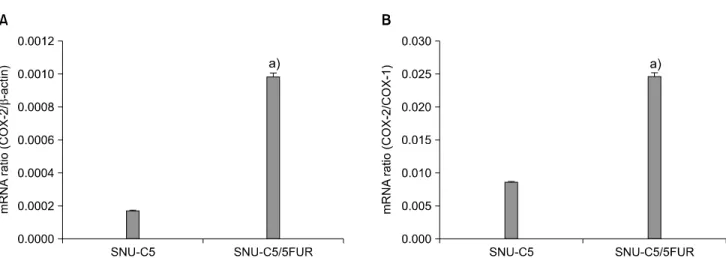
By quantitative RT-PCR, the expression levels of COX-1 and COX-2 were significantly higher in SNU-C5/5FUR than in SNU-C5. Also the ratio of COX-2 to COX-1 was higher in the resistant cells than in the parental cells (Fig. 1).
Fig. 1. mRNA expression patterns of cyclooxygenase (COX)-2 in SNU-C5 and SNU-C5/5FUR determined by quantitative reverse transcription- polymerase chain reaction. (A) Significant difference in the ratio of COX-2/β-actin between SNU-C5 and SNU-C5/5FUR (P = 0.000727)a), (B) Significant difference in the ratio COX-2/COX-1 between SNU-C5 and SNU-C5/5FUR (P = 0.00117).a)
Fig. 2. Comparison of prostaglandin E2 (PGE2) levels between SNU-C5 and SNU-C5/5FUR. PGE2 levels present in the supernatant of the culture medium were determined by enzyme-linked im- munosorbent assay using PGE2 monoclonal antibody. a)Compare PGE2 levels between SNU-C5 and SNU-C5/5FUR at basal state.
b)Compare PGE2 levels after 12 hours treatment of meloxicam (10 μM) with control in SNU-C5/5FUR. c)Compare PGE2 levels after meloxicam (100 μM) with control in SNU-C5/5FUR, all of which have P-values less than 0.01.
Up-regulation of PGE
2levels in SNU-C5/5FUR and inhibitory effect of meloxicam on PGE
2syn- thesis
PGE2 levels present in culture media supernatants after incubation for 12 hours were determined by ELISA. For untreated cells, PGE2 levels were significantly higher in SNU-C5/5FUR than in SNU-C5 (P < 0.01). After treatment
with meloxicam, PGE2 levels were significantly and dose-dependently reduced in SNU-C5/5FUR cells (P < 0.01), but not in SNU-C5 cells (Fig. 2).
Cytotoxicities of SNU-C5 and SNU-C5/5FUR to 5- FU and/or meloxicam
To investigate whether or not meloxicam can potentiate the cytotoxic effect of 5-FU in the two cell lines, MTT as- says were conducted. Meloxicam did not have any poten- tiating effect on 5-FU sensitivity in either cell line (Fig. 3).
Up-regulation of VEGF mRNA expression in SNU- C5/5FUR and the inhibitory effect of melox- icam on VEGF mRNA expression
Despite the above-mentioned PGE2 level increases in SNU-C5/5FUR cells, meloxicam showed little effect on overcoming resistance to 5-FU in cell culture. Thus, we in- vestigated VEGF expression, as VEGF is the most power- ful stimulator for angiogenesis, and is required for tumor growth and metastasis. VEGF mRNA levels in untreated SNU-C5/5FUR cells were higher than that in SNU-C5 cells, Ten μM to 500 μM of meloxicam down-regulated these lev- els in SNU-C5/5FUR cells in a dose-dependent manner.
However, paradoxically meloxicam dose-dependently in- creased VEGF mRNA levels in SNU-C5/WT cells (Fig. 4).
Fig. 3. Cytotoxic effect of 5-fluorouracil (5-FU) alone and/or in combination with meloxicam in SNU-C5 (A) and SNU-C5/5FUR (B). 3-(4, 5-dimethylthiazol- 2-yl)-2,5-diphenyl tetrazolium bromide assay was used to analyze cell viability.
Fig. 4. Expression patterns of vascular endothelial growth factor (VEGF) mRNA in SNU-C5 and SNU-C5/5FUR at basal state and after treatment of meloxicam (10, 100 and 500 μM) for 24 hours by transcription-polymerase chain reaction method.
DISCUSSION
The present study demonstrates that the expressions of COX-2, PGE2, and VEGF were up-regulated in the 5-FU re- sistant colon cancer cells rather than in the parental cells.
Although meloxicam, a COX-2 inhibitor, showed little an- titumor effect on both cells, it was found to have an an- ti-angiogenic effect by down-regulating VEGF mRNA lev- els in the 5-FU resistant colon cancer cells, but not in the parental cells. The expressions of TS (thymidylate syn- thase) and DPD, which have been suggested to be in- volved in 5-FU resistance, were not found to be sig- nificantly changed by cDNA microarray analysis (data not shown). It has been suggested that wild type p53 sig- nificantly improves response to 5-FU in vitro and in vivo [19,20]. In the present study, we used the colon cancer cell line, SNU-C5, and its 5-FU resistant derivative, the SNU- C5/5FUR cell line. It is known that p53 is mutated and non-functional in SNU-C5 cells [21].
It is known that COX-2 is induced by a variety of stim- uli, such as, oncogenes (HER-2/neu), growth factors (EGF), tumor promoters (phorbol esters and bile acid), and chemotherapy [12]. Moreover, microtubule- interfer- ing agents (paclitaxel, vincristine, etc) are known to induce COX-2 in cancer cells [22,23]. However, it has not been de- termined as to whether COX-2 is induced by 5-FU in 5- FU-resistant cancer cells. It has been reported that COX-2 mRNA expression is increased by 5-FU alone or in combi- nation in human solid tumors, e.g., esophageal, breast, ovarian, and colorectal tumors [24]. In addition, sig- nificant increases in COX-2 expression have been reported in rectal cancer after preoperative chemoradiotherapy
[25]. The present study also demonstrates that COX-2 and PGE2 levels are up-regulated in colon cancer cells with ac- quired resistance to 5-FU (SNU-C5/5FUR cells), which suggests that COX-2 inhibitors play a beneficial role in overcoming the resistance of SNU-C5/5FUR cells to 5-FU.
Clinically, 5-FU is used as a primary, secondary or even tertiary chemotherapy in colorectal cancer (CRC). When used as a first line chemotherapy or adjuvant therapy, 5- FU is usually used in combination with folinic acid in CRC. On the other hand, in cases that experience recur- rence after treatment with the regimen, 5-FU is used again in combination with oxaliplatin (FOLFOX regimen) or iri- notecan (FOLFIRI regimen). Theoretically, in cases of re- currence the effects of 5-FU are likely to be limited, and thus, some means of overcoming acquired resistance to 5-FU is required.
Irie et al. [26] reported that celecoxib (a selective COX-2 inhibitor) synergistically potentiates the antitumor effect of 5-FU in an IFN-gamma dependent manner in an in vivo study of colon cancer cells. Other reports suggested that NSAIDs could be the modulators of fluorouracil-based chemotherapy, especially in high COX-2 expressing tu- mors, and that combined therapy with S-1 and a COX-2 in- hibitor might hold promise for prophylaxis of liver meta- stasis of colorectal cancer [27,28]. A similar finding was re- ported for ultraviolet B-induced skin tumors in mice [15].
However, we did not find that meloxicam synergistically potentiates the antitumor effect of 5-FU in either a chemo- naïve colon cancer cell line and in an acquired 5-FU re- sistant colon cancer cell line.
It is believed that neovascularization is required for a tumor to grow to >2 to 3 mm [29]. Chang et al. [30] re- ported that PGE2 stimulates the expressions of angiogenic regulatory genes in mammary tumor cells isolated from COX-2 transgenic mice, which demonstrates that COX- 2-derived PGE2 is a potent inducer of angiogenic switch during mammary cancer progression. In the present study, VEGF up-regulation was observed in SNU-C5/
5FUR cells, and this up-regulation was recovered adding meloxicam, a COX-2 inhibitor, which suggests that COX- 2-derived PGE2 plays an important role in the angiogenic switching that occurs during the acquisition of 5-FU resist- ance in colon cancer. Furthermore, the present study dem-
onstrates that meloxicam exerts an anti-angiogenic effect by inhibiting PGE2 synthesis at a dose of 10 μM, which is relatively compatible with therapeutic levels. However, we had one unexpected result, i.e., SNU-C5 cells (which are chemonaïve colon cancer cells) express little VEGF or COX-2 in the basal state, but these cells were found to ex- press VEGF after meloxicam treatment. Similarly, Ueno et al. [31] reported that treatment with celecoxib (a COX-2 in- hibitor) decreased VEGF serum levels immediately after treatment but later increased its levels in serum and plas- ma in breast cancer patients. Thus further studies are re- quired to determine how COX-2 inhibitors participate in VEGF production in cancer cells and tissues that do not ex- press COX-2.
In conclusion, the authors demonstrate that COX-2 de- rived PGE2 is up-regulated and COX-2 inhibitor may have anti-angiogenic effect in the colon cancer cells resistant to 5-FU.
CONFLICTS OF INTEREST
No potential conflict of interest relevant to this article was reported.
ACKNOWLEDGEMENTS
This work was supported by National Research Foundation of Korea (NRF) grant funded by the Ministry of Education, Science and Technology (MEST) through the Research Center for Resistant Cells (R13-2003-009).
REFERENCES
1. Longley DB, Harkin DP, Johnston PG. 5-fluorouracil: me- chanisms of action and clinical strategies. Nat Rev Cancer 2003;3:330-8.
2. Popat S, Matakidou A, Houlston RS. Thymidylate syn- thase expression and prognosis in colorectal cancer: a sys- tematic review and meta-analysis. J Clin Oncol 2004;22:
529-36.
3. Salonga D, Danenberg KD, Johnson M, Metzger R, Groshen S, Tsao-Wei DD, et al. Colorectal tumors respond-
ing to 5-fluorouracil have low gene expression levels of di- hydropyrimidine dehydrogenase, thymidylate synthase, and thymidine phosphorylase. Clin Cancer Res 2000;6:
1322-7.
4. Boyer J, McLean EG, Aroori S, Wilson P, McCulla A, Carey PD, et al. Characterization of p53 wild-type and null iso- genic colorectal cancer cell lines resistant to 5-fluorouracil, oxaliplatin, and irinotecan. Clin Cancer Res 2004;10:2158- 67.
5. Wang W, McLeod HL, Cassidy J. Disulfiram-mediated in- hibition of NF-kappaB activity enhances cytotoxicity of 5-fluorouracil in human colorectal cancer cell lines. Int J Cancer 2003;104:504-11.
6. Meyers M, Wagner MW, Hwang HS, Kinsella TJ, Boothman DA. Role of the hMLH1 DNA mismatch repair protein in fluoropyrimidine-mediated cell death and cell cycle responses. Cancer Res 2001;61:5193-201.
7. Mirjolet JF, Didelot C, Barberi-Heyob M, Merlin JL. G(1)/S but not G(0)/G(1)cell fraction is related to 5-fluorouracil cytotoxicity. Cytometry 2002;48:6-13.
8. Brown JR, DuBois RN. COX-2: a molecular target for color- ectal cancer prevention. J Clin Oncol 2005;23:2840-55.
9. Yamauchi T, Watanabe M, Kubota T, Hasegawa H, Ishii Y, Endo T, et al. Cyclooxygenase-2 expression as a new mark- er for patients with colorectal cancer. Dis Colon Rectum 2002;45:98-103.
10. Williams CS, Mann M, DuBois RN. The role of cyclo- oxygenases in inflammation, cancer, and development.
Oncogene 1999;18:7908-16.
11. Fosslien E. Biochemistry of cyclooxygenase (COX)-2 in- hibitors and molecular pathology of COX-2 in neoplasia.
Crit Rev Clin Lab Sci 2000;37:431-502.
12. Subbaramaiah K, Dannenberg AJ. Cyclooxygenase 2: a mo- lecular target for cancer prevention and treatment. Trends Pharmacol Sci 2003;24:96-102.
13. Jacoby RF, Seibert K, Cole CE, Kelloff G, Lubet RA. The cy- clooxygenase-2 inhibitor celecoxib is a potent preventive and therapeutic agent in the min mouse model of ad- enomatous polyposis. Cancer Res 2000;60:5040-4.
14. Mizutani Y, Kamoi K, Ukimura O, Kawauchi A, Miki T.
Synergistic cytotoxicity and apoptosis of JTE-522, a se- lective cyclooxygenase-2 inhibitor, and 5-fluorouracil against bladder cancer. J Urol 2002;168:2650-4.
15. Wilgus TA, Breza TS Jr, Tober KL, Oberyszyn TM.
Treatment with 5-fluorouracil and celecoxib displays syn- ergistic regression of ultraviolet light B-induced skin tumors. J Invest Dermatol 2004;122:1488-94.
16. Jung GR, Kim KJ, Choi CH, Lee TB, Han SI, Han HK, et al.
Effect of betulinic acid on anticancer drug-resistant colon cancer cells. Basic Clin Pharmacol Toxicol 2007;101:277-85.
17. Pieters R, Huismans DR, Leyva A, Veerman AJ. Adapta- tion of the rapid automated tetrazolium dye based (MTT) assay for chemosensitivity testing in childhood leukemia.
Cancer Lett 1988;41:323-32.
18. Cetta F, Goetz FW. Ovarian and plasma prostaglandin E and F levels in brook trout (Salvelinus fontinalis) during pituitary-induced ovulation. Biol Reprod 1982;27:1216-21.
19. Arango D, Corner GA, Wadler S, Catalano PJ, Augenlicht LH. c-myc/p53 interaction determines sensitivity of human colon carcinoma cells to 5-fluorouracil in vitro and in vivo.
Cancer Res 2001;61:4910-5.
20. Kim HJ, Lee SC, Lee IK, Kang WK, Oh ST, Chang SK. The synergistic cell killing effects by the transduction of the w-p53 Gene and 5-FU administration in colon cancer cell lines. J Korean Surg Soc 2007;73:481-9.
21. Rand A, Glenn KS, Alvares CP, White MB, Thibodeau SM, Karnes WE Jr. p53 functional loss in a colon cancer cell line with two missense mutations (218leu and 248trp) on sepa- rate alleles. Cancer Lett 1996;98:183-91.
22. Subbaramaiah K, Hart JC, Norton L, Dannenberg AJ.
Microtubule-interfering agents stimulate the transcription of cyclooxygenase-2. Evidence for involvement of ERK1/2 AND p38 mitogen-activated protein kinase pathways. J Biol Chem 2000;275:14838-45.
23. Mathieu A, Remmelink M, D'Haene N, Penant S, Gaussin JF, Van Ginckel R, et al. Development of a chemoresistant orthotopic human nonsmall cell lung carcinoma model in nude mice: analyses of tumor heterogenity in relation to the immunohistochemical levels of expression of cyclo- oxygenase-2, ornithine decarboxylase, lung-related resist- ance protein, prostaglandin E synthetase, and glutathione- S-transferase-alpha (GST)-alpha, GST-mu, and GST-pi.
Cancer 2004;101:1908-18.
24. Mercer SJ, Di Nicolantonio F, Knight LA, Gabriel FG, Whitehouse PA, Sharma S, et al. Rapid up-regulation of cy- clooxygenase-2 by 5-fluorouracil in human solid tumors.
Anticancer Drugs 2005;16:495-500.
25. Debucquoy A, Goethals L, Geboes K, Roels S, Mc Bride WH, Haustermans K. Molecular responses of rectal cancer to preoperative chemoradiation. Radiother Oncol 2006;80:
172-7.
26. Irie T, Tsujii M, Tsuji S, Yoshio T, Ishii S, Shinzaki S, et al.
Synergistic antitumor effects of celecoxib with 5-fluorour- acil depend on IFN-gamma. Int J Cancer 2007;121:878-83.
27. Réti A, Pap E, Zalatnai A, Jeney A, Kralovánszky J, Budai B. Co-inhibition of cyclooxygenase-2 and dihydropyr- imidine dehydrogenase by non-steroidal anti-inflamma- tory drugs in tumor cells and xenografts. Anticancer Res 2009;29:3095-101.
28. Tachimori A, Yamada N, Amano R, Ohira M, Hirakawa K.
Combination therapy of S-1 with selective cyclooxy- genase-2 inhibitor for liver metastasis of colorectal car- cinoma. Anticancer Res 2008;28(2A):629-38.
29. Wang D, DuBois RN. Cyclooxygenase 2-derived prosta- glandin E2 regulates the angiogenic switch. Proc Natl Acad Sci U S A 2004;101:415-6.
30. Chang SH, Liu CH, Conway R, Han DK, Nithipatikom K, Trifan OC, et al. Role of prostaglandin E2-dependent an- giogenic switch in cyclooxygenase 2-induced breast cancer progression. Proc Natl Acad Sci U S A 2004;101:591-6.
31. Ueno T, Chow LW, Toi M. Increases in circulating VEGF levels during COX-2 inhibitor treatment in breast cancer patients. Biomed Pharmacother 2006;60:277-9.