Aged Garlic Extract and Its Components Inhibit Platelet Aggregation in Rat
You Hee Choi
1, Hyung Min Jeong
1, Kyu Hang Kyung
2, Beung-Ho Ryu
3* and Kwang Youl Lee
1*
1
College of Pharmacy and Research Institute of Drug Development, Chonnam National University, Gwangju 500-757, Korea
2
Deptment of Food Science, Sejong University, Kwangjinku, Seoul 143-747, Korea
3
DOUL Agircultural Farming Corp., Namhae, Gyeongsangnamdo 158-885, Korea
Received August 16, 2011 /Revised September 28, 2011 /Accepted September 28, 2011
Many clinical trials have demonstrated the beneficial effects of garlic (Allium sativum) on general car- diovascular health. Aged garlic extract (AGE) is known to display diverse biological activities such as in antioxidant, anti-inflammatory and anticancer activities. However, few studies have been di- rected on the effect of AGE on cardiovascular function. In this study, we aimed to investigate the ef- fect of AGE and its components on platelet activation, a key contributor in thrombotic diseases. In freshly isolated rat platelets, AGE and its components have shown inhibitory activities on throm- bin-induced platelet aggregation. These in vitro results were further confirmed in an in vivo platelet aggregation measurement where tail vein injection of garlic oil and S-Allylmercapto-cysteine (SAMC) significantly reduced thrombin and ADP-induced platelet aggregation. Potential active components for antiplatelet effects of AGE were identified to be SAMC and diallyl sulphide through agonist-induced platelet aggregation assay. These results indicate that aged garlic extract can be a novel dietary sup- plement for the prevention of cardiovascular risks and the improvement of blood circulation.
Key words : Aged garlic extract (AGE), antiplatelet activity, diallyl sulphide, S-Allylmercapto-cysteine (SAMC)
*To whom correspondence should be addressed:
*Tel:+82-55-863-2166, Fax:+82-55-863-2478
*E-mail : [email protected]
*Tel:82-62-530-2939, Fax:+82-62-530-2949
*E-mail : [email protected]
ISSN : 1225-9918 Journal of Life Science 2011 Vol. 21. No. 10. 1355~1363 DOI : http://dx.doi.org/10.5352/JLS.2011.21.10.1355
Introduction
Garlic has been used for many centuries, as both a flavor- ing and a folk medicine. At present, the potential therapeutic and health promoting effects of garlic are attracting consid- erable interest. The pharmacological effects of garlic are as- sociated with antihypertensive, antimicrobial, anticancer, an- ticoagulant, as well as, hypoglycemic effects [5,25,33,36].
Aged garlic extract (AGE) is well known for its ability to decrease parameters associated with cardiovascular disease [25]. It has been shown to protect the oxidation of human LDL and to reduce oxidative stress [11,12,21] and blood pres- sure in smokers [3]. AGE has also been shown to be effective in lowering plasma cholesterol and triglycerides and LDL cholesterol in hyperlipidemic subjects [29].
Platelets can be stimulated by various agonists, including adenosine diphosphate (ADP), and have 3 receptors to which ADP can bind [14,15]. Platelets adhere to the exposed collagen, laminin, and von Willebrand factor in the injured vessel, a process that is known as platelet activation. This
result can also be achieved through agonists, such as ADP, collagen, and thrombin. Once ADP binds to these receptors, platelets change shape and aggregation takes place, includ- ing the secretory processes and the liberation of arachodoinic acid, which is rapidly converted to prostaglandins and lip- oxygenase products such as thromboxane A
2(TXA
2).
It is now recognized that garlic and its various compo- nents have the ability to inhibit platelet aggregation both in vivo and in vitro [3,13,26]. The antiplatelet activity of gar- lic has usually been studies with raw, dehydrated, or ex- tracted preparations. Aqueous extracts of raw garlic, garlic oils, and other components of garlic inhibited human plate- let aggregation in vitro [1,6,35]. In vivo, chronic intake of raw garlic, garlic powder, garlic oil, and AGE inhibited platelet aggregation in human subjects [7,16,20,21]. A single dose of garlic powder also demonstrated significant in vivo anti- platelet activity in humans [20]. Animal feeding studies re- ported in vitro and in vivo platelet inhibitory activity, in- duced by raw extracts of garlic [32]. One such garlic compo- nent is an AGE, which inhibits platelet aggregation in vivo [5, 31]. AGE also inhibits platelet aggregation when platelets are stimulated by agonists such as ADP, collagen, and epi- nephrine [24,29,30,31].
However, it remains unknown which components of
AGE are able to inhibit platelet aggregation. Our objective
was to study the protective effect of S-allylmercapto-L-cys- teine (SAMC) and diallyl sulphides from AGE against thrombin, collagen and adenosine 5'-diphosphate (ADP)-induced platelet aggregation. The results will pro- vide further insight into the medical benefit of these sulfur agents on diabetic complications.
Materials and Methods Materials
Trisodium citrate, ethanol, ethyl acetate, methanol, di- methyl sulfoxide, adenosine, NaCl, KCl, MgCl
2, HEPES, glu- cose, NaHCO
3, Na
2HPO
4, CaCl
2, glutaraldehyde, EDTA, ure- thane, and bovine serum albumin were obtained from Sigma-Aldrich Chemical (St. Louis, MO, USA). Collagen was from Chrono-log (Harvertown, PA, USA). AGE was donated by Do-Wool nongsan. Diallyl sulphide (DAS) was obtained from Fluka and diallyl disulphide (DADS) was obtained from Sigma-Aldrich Chemical (St. Louis, MO, USA). Diallyl trisulphide (DATS) was obtained from LKT. S-allylmercapto- cysteine (SAMC) was obtained from Sejong University (Prof.
Kyung).
Experimental animals
Male Sprague-Dawley rats, 5-6 weeks old, weighing 250-300 g (Orientbio, Seoul, Korea), were used for in vitro aggregation. Animals were housed in polyethylene cages in the animal room with controlled temperature at 24±2°C, a constant humidity of 50±10%, and a 12 hr light-dark cycle.
Animals had free access to a standard diet from Purina Korea and UV-sterilized tap water ad libitum. The animals were acclimatized for at last 1 week prior to experiments and were randomly assigned to treatment groups. Protocols were approved by the institutional animal care and use com- mittee (IACUC) of Amorepacific R&D Center prior to every experiment.
Preparation of rat platelets
Rat blood was collected male Sprague-Dawley rats, 5-6 weeks old, weighing 250-300 g. Blood was anti- coagulated with 3.8% trisodium citrate solution (1:9 cit- rate/blood, v/v). All procedures were conducted at room temperature, and the use of glass containers and pipettes was avoided. Platelet-rich plasma (PRP) was prepared by centrifugation at room temperature for 15 min at 150× g.
Platelet-poor plasma (PPP) was obtained from the pre-
cipitated fraction of PRP by centrifugation at room temper- ature for 20 min at 2,000× g. The platelet count in PRP was adjusted to 3×10
8platelets/ml using PPP.
Platelet aggregation measurement
Platelet aggregation was determined by the turbidometric method using an aggregometer (Chrono-log). After in- cubation with soybean extracts or fractions for 10 min at 37°C, PRP was loaded on the aggregometer and stimulated with various agoinsts for 5 min. Platelet aggregation was measured by light transmission, with 100% calibrated as the absorbance of PPP and 0% calibrated as the absorbance of PRP.
In vivo experiments
Male Sprague–Dawley rats (SamTako, Osan, Korea) weighing 200-300 g were used for animal studies. Before the experiments, animals were acclimated for 1 week, and food and water were provided ad libitum. All the protocols were approved by the ethics committee of the Chonnam National University Animal Service Center. SAMC (150 mg/kg body weight), Garlic oil (1 and 3 ml/kg body weight) and control as corn oil was administered through tail vein injection. For measurement of in vivo platelet aggregation, 3 day after sin- gle oral administration of SAMC and garlic oil, whole blood was collected from abdominal aorta anticoagulated with 3.8% trisodium citrate solution (1:9 citrate/blood, v/v) un- der anesthesia. PRP preparation and platelet aggregation measurements were done as described above except for the concentration of ADP used (8-10 μg/ml).
Statistical analyses
All experiments were performed with triplicate in- dependent samples and were repeated at least twice, giving qualitatively identical results. Results are expressed as mean±standard error of the mean. Data were analyzed using Student’s t-test, with p values <0.05 taken to indicate stat- istical significance.
Results
In vitro antiplatelet effects of fractions of AGE
To examine the effect of fractions of AGE on platelet ag-
gregation, we treated freshly isolated rat platelets with vari-
ous fraction of AGE for 5 min and then initiated platelet
aggregation with thrombin (0.3 U). AGE showed inhibitory
Journal of Life Science 2011, Vol. 21. No. 10 1357
A B
C D
E
0 20 40 60 80 100
Control 0.01 0.1 1 2.5 5 (mg/ml)
Mean Total Aggregation (%)
0 20 40 60 80 100
Control 0.01 0.1 1 2.5 5 % (v/v)
Mean Total Aggregation (%)
0 20 40 60 80 100
Control 0.01 0.1 1 5 10 % (v/v)
Mean Total Aggregation (%)
Figure 1
SAC
Oil fraction AGE
*
* * * *
*
* *
*
Fig. 1. Inhibition of thrombin induced platelet aggregation by aged garlic extract and its components. Washed platelets were pre- treated with various concentrations of garlic compounds in aggregometer for 5 minutes. And thrombin (0.3 U) was treated.
(A) AGE, dose dependently, inhibited thrombin-induced-platelet aggregation. (B) SAC weakly inhibited thrombin induced platelet aggregation. (C) AGE (#5, 2%), water-soluble fraction (#4) and oil fraction (#3) of AGE inhibited thrombin-induced platelet aggregation. (D) Oil fraction of AGE, dose dependently, inhibited thrombin-induced platelet aggregation. (E) AGE, SAC and oil fraction of AGE, dose dependently, inhibited thrombin-induced platelet aggregation. Values are mean±SD of six determinations. *
p
<0.05 vs. agonist-induced control.effect against thrombin induced platelet aggregation in a concentration dependent manner and achieved significance between 1-10% (v:v) (Fig. 1A and E upper panel). Notably, S-allylcysteine (SAC), major sulfur compound, showed very weak inhibitory effect against thrombin induced platelet ag- gregation (Fig. 1B and E middle panel). But, water soluble fraction and oil fraction of AGE showed the strongest in- hibitory effect against thrombin-induced platelet ag- gregation than other extraction conditions (Fig. 1C and D).
Oil fraction of AGE inhibited thrombin-induced platelet ag- gregation significantly in a concentration-dependent manner (Fig. 1E lower panel).
Identification of active compoenets of AGE
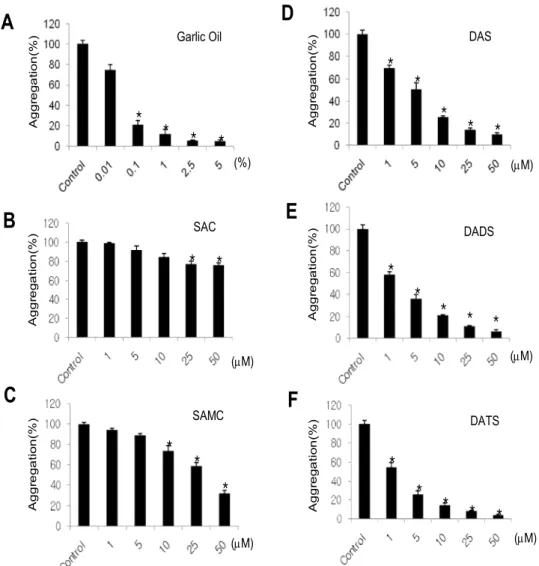
For the identification of active components for antiplatelet effects of AGE, individual components of AGE (garlic oil, SAC, SAMC, DAS, DADS, DATS) were tested for their ef- fects on thrombin induced platelet aggregation. Total per- centage aggregation of platelet was reduced concen-
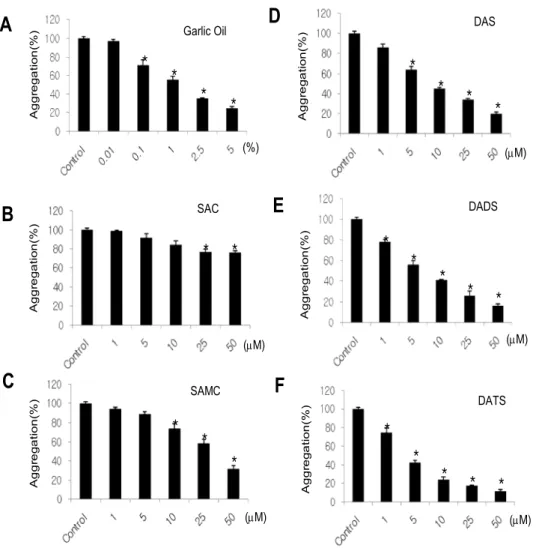
tration-dependent manner (Fig. 2). Garlic oil and DATS showed that the significant inhibitory effect on platelet ag- gregation than DAS, DADS. Water soluble sulfur compound, S-allylmerceptocysteine (SMAC) showed that the inhibitory effect on platelet aggregation than followed by SAC. Also, individual components of AGE were tested for their effects on ADP or collagen induced platelet aggregation. SAMC, garlic oil and three dially sulphides inhibited ADP induced platelet aggregation in a dose-dependent manner (Fig. 3).
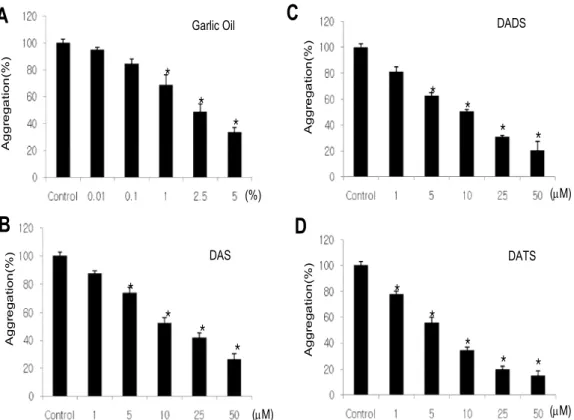
And garlic oil and three dially sulphides inhibited collagen induced platelet aggregation (Fig. 4). As a result, water solu- ble sulfur compound, SMAC and three dially sulphides showed the most potent inhibitory effect on agonists-in- duced platelet aggregation.
In vivo antiplatelet effects of SAMC and garlic oil
To confirm the antiplatelet effect of SAMC and garlic oil,
we conducted an in vivo platelet aggregation measurement
after single or multiple oral administration of SAMC (150
Aggregation(%)
(%) Garlic Oil
Aggregation(%) DAS
(mM)
Aggregation(%) DADS
(mM)
Aggregation(%) DATS
(mM)
Aggregation(%) SAC
(mM)
Aggregation(%) SAMC
(mM)
A
B
C
D
E
F
* * * *
*
* *
* *
*
* * * *
*
* * * *
*
*
* * *
Fig. 2. Effect of Garlic oil and components of AGE on thrombin-induced platelet aggregation (A-F). Washed platelets were pretreated with various concentrations of garlic compounds in aggregometer for 5 minutes. And thrombin (0.3 U) was treated. Values are mean±SD of six determinations. *
p
<0.05 vs. agonist-induced control.μ g/kg body weight once daily) and garlic oil (1 ml or 3 ml/kg body weight once daily) as control corn oil. As a re- sult, thrombin and ADP-induced platelet aggregation was significantly inhibited by SAMC and garlic oil (Fig. 5A and B). However, treatment of SAMC, AGE and garlic oil not inhibited food intake and body weight (Table 1).
Discussion
In this study, we demonstrated that AGE and its compo- nents can inhibit agoinsts-induced platelet aggregation.
These in vitro results were further confirmed in an in vivo platelet aggregation where single oral administration of gar- lic oil reduced platelet aggregation. In addition, we identi- fied SAMC and three diallyl surphies as a potential active
ingredient for antiplatelet effects of AGE through agoinsts-induced platelet aggregation.
Commonly used antithrombotic drugs are frequently as-
sociated with adverse effects, and their benefit for pre-
vention of cardiovascular risks is often being questioned
[4,18]. In support of this concern, an analysis of 22 clinical
trials using aspirin, a representative antiplatelet drug, as a
preventive treatment for thrombosis has demonstrated that
bleeding risk increased by aspirin intake from 0.07% to 0.1%,
while the rate of serious thrombotic events decreased mi-
nutely from 0.57% to 0.51% [2]. For this reason, food materi-
als have gathered huge attention as an alternative and pre-
ventive measure against cardiovascular risks, especially for
thrombotic events, and many efforts have been made to de-
velop functional foods with antithrombotic activities. In 7
Journal of Life Science 2011, Vol. 21. No. 10 1359
Aggregation(%)
(%) Garlic Oil
Aggregation(%) DAS
(mM)
Aggregation(%)
DADS
(mM)
Aggregation(%) DATS
(mM)
Aggregation(%)
SAC
(mM)
Aggregation(%) SAMC
(mM)
A
B
C
D
E
F Figure 3
* *
* *
*
*
*
* *
*
* *
*
*
* *
* *
*
*
* * *
Fig. 3. The effect of garlic oil (A), water soluble sulfer compound, SAC (B), SAMC (C) and diallyl sulphide, DAS (D), DADS (E) and DATS (F) on ADP (50 μM) induced platelet aggregation at various concentrations. Garlic oil, water soluble sulfer compounds, and diallyl sulphide was incubated with platelets for 5 min. Platelet aggregation was initiated by ADP and aggregation was measured for 5 min in aggregometer. Values are mean±SD of six determinatios. *
p
<0.05 vs. agonist-induced control.clinical trials, garlic (Allium sativum), a common spice, has shown antiplatelet activity in both healthy people and pa- tients with cardiovascular disease [27,28]. The antith- rombotic effect of onions (Allium cepa) has been also demon- strated in in vivo thrombosis animal models [9,38].
AGE has many biochemical properties associated with a reduction in risk factors for cardiovascular disease. One of risk factors in this disease is the increased ability of platelets to aggregate. Previous report shown that dietary supple- mentation with AGE reduces the ability of platelets to ag- gregate in healthy subjects. AGE is a complex mixture with relatively high concentrations of water-soluble compounds and low concentrations of oil-soluble compounds, and it is standardized by SAC, its major organosulfur constituent. In
this study, AGE significantly inhibited platelet aggregation between 1–10% (v:v) (Fig. 1A and E upper panel). Because water-soluble fraction and oil fraction of AGE show in- hibition of thrombin-induced platelet aggregation, it is high- ly likely that the water-soluble compounds and oil soluble compounds present in AGE are the ones responsible for its antiplatelet aggregation reaction. The SAC, water-soluble major organosulfur compound failed to show any significant inhibition of platelet aggregation.
Other studies have indicated that DAS, DADS and DAT
were able to inhibit thrombin, collagen and ADP induced
platelet aggregation via interfering intracellular Ca
2+mobi-
lization [8,19,23]. Our present study clearly showed that
three test diallyl sulphides could markedly inhibit thrombin,
Aggregation(%)
(%) Garlic Oil
A
*
*
*
Aggregation(%)DADS
(mM)
C
* *
* *
Aggregation(%) DATS
(mM)
D
* *
*
*
*
Aggregation(%) DAS
(mM)
B
*
* *
*
Fig. 4. The effect of garlic oil (A) and diallyl sulphide, DAS (B), DADS (C) and DATS (D) on collagen (0.5 mg/ml) induced platelet aggregation at various concentrations. Garlic oil and diallyl sulphide was incubated with platelets for 5 min. Platelet ag- gregation was initiated by collagen and aggregation was measured for 5 min in aggregometer. Values are mean±SD of six determinatios. *
p
<0.05 vs. agonist-induced control.Fig. 5.
In vivo
effect of SAMC and garlic oil on agoinst induced platelet aggregation. (A) The effect of SAMC (150 μg/kg) and garlic oil (1 ml/kg or 3 ml/kg) on various concentrations of ADP (μM) induced platelet aggregation. Garlic oil was incubated with platelets for 5 min. Platelet aggregation was initiated by ADP and aggregation was measured for 5 min in aggregometer.(B) The effect of SAMC (150 μg/kg) and garlic oil (1 ml/kg or 3 ml/kg) on thrombin (U) induced platelet aggregation.
Platelet aggregation was initiated by thrombin and aggregation was measured for 5 min in aggregometer. Values are mean±SD of three determinatios.
Journal of Life Science 2011, Vol. 21. No. 10 1361
Table 1. Food intake and body weight in Sprague-Dawley rats treated with SAMC, AGE and garlic oil
Food intake
(g/day) Body weight (g) Control (n=3)
Garlic oil (1 ml/kg) AGE (3 ml/kg) SAMC
20.36±0.53 18.26±0.89 18.26±0.89 19.89±0.21
272.52±12.05 276.21±16.25 276.21±16.25 270.2±11.56
ADP and collagen-induced human platelet aggregation. It is known that collagen, ADP and thrombin are three of the most important agonists of platelet aggregation [22].
Therefore, our present study and those previous studies sup- ported that both DADS and DAT than DAS were effective agents in antiplatelet aggregation. Our present study found that three test diallyl sulphides were effective antiplatelet agents; therefore, use of these agents could benefit throm- botic prevention and therapy. Like α-tocopherol, the three test agents were natural lipid-soluble antioxidants, and these agents (DAS, DADS and DAT) are compounds naturally formed in garlic, Chinese leek and onion [13,17,37]. The con- tent of DAS, DADS and DAT in garlic was 250-480, 2,600-4,100 and 1,250-1,970 μg/kg of garlic, respectively [34].
In other words, 28-45 g of garlic could provide 10 μM of DAT. Therefore, based on the natural and dietary property, the use of these agents at these concentrations as anti- oxidative and/or antiplatelet agents should be safe and acceptable.
In summary, we have demonstrated that AGE and its compoenents inhibited agonists-induced platelet ag- gregation and activation, leading to reduced thrombus formation. In addition, repeated oral administration of SAMC and garlic oil manifested more potent antiplatelet ag- gregation effects in vivo, indicating that long-term intake of SAMC and garlic oil could be more effective in the pre- vention of thrombotic events. More importantly, this study has provided, we believe, important evidence for the utility of the common food materials for the effective prevention of cardiovascular diseases.
Acknowledgment
This research was supported by Korea Institute of Planning and Evaluation for Technology of Agriculture, Foresty and Fisheries and Food (2009).
References
1. Apitz-Castro, R., S. Cabrera, M. R. Cruz, E. Ledezma, and M. K. Jain. 1983. Effects of garlic extract and of three pure components isolated from it on human platelet aggregation, arachidonate metabolism, release reaction and platelet ultrastructure.
Thromb. Res.
32, 155-169.2. Baigent, C., L. Blackwell, R. Collins, J. Emberson, J. Godwin, R. Peto, J. Buring, C. Hennekens, P. Kearney, T. Meade, C.
Patrono, M. C. Roncaglioni, and A. Zanchetti. 2009. Aspirin in the primary and secondary prevention of vascular dis- ease: collaborative meta-analysis of individual participant data from randomised trials.
Lancet
373, 1849-1860.3. Banerjee, S. K. and S. K. Maulik. 2002. Effect of garlic on cardiovascular disorders: a review.
Nutr. J.
1, 4.4. Barrett, N. E., L. Holbrook, S. Jones, W. J. Kaiser, L. A.
Moraes, R. Rana, T. Sage, R. G. Stanley, K. L. Tucker, B.
Wright, and J. M. Gibbins. 2008. Future innovations in an- ti-platelet therapies.
Br. J. Pharmacol.
154, 918-939.5. Block, E. 1996. Recent results in the organosulfur and orga- noselenium chemistry of genus Allium and Brassica plants.
Relevance for cancer prevention.
Adv. Exp. Med. Biol.
401, 155-169.6. Bordia, A. 1978. Effect of garlic on human platelet ag- gregation in vitro.
Atherosclerosis
30, 355-360.7. Bordia, A., S. K. Verma, and K. C. Srivastava. 1996. Effect of garlic on platelet aggregation in humans: a study in healthy subjects and patients with coronary artery disease.
Prostaglandins Leukot. Essent. Fatty Acids
55, 201-205.8. Bordia, A., S. K. Verma, and K. C. Srivastava. 1998. Effect of garlic (Allium sativum) on blood lipids, blood sugar, fi- brinogen and fibrinolytic activity in patients with coronary artery disease.
Prostaglandins Leukot. Essent. Fatty Acids
58, 257-263.9. Briggs, W. H., J. D. Folts, H. E. Osman, and I. L. Goldman.
2001. Administration of raw onion inhibits platelet-medi- ated thrombosis in dogs.
J. Nutr.
131, 2619-2622.10. Chang, H. S, O. Yamato, Y. Sakai, M. Yamasaki, and Y.
Maede. 2004. Acceleration of superoxide generation in poly- morphonuclear leukocytes and inhibition of platelet ag- gregation by alk(en)yl thiosulfates derived from onion and garlic in dogs and humans.
Prostaglandins Leukot. Essent.
Fatty Acids
70, 77-83.11. Dillon, S. A., G. M. Lowe, D. Billington, and K. Rahman.
2002. Dietary supplementation with aged garlic extract re- duces plasma and urine concentrations of 8-iso-prosta- glandin F(2 alpha) in smoking and nonsmoking men and women.
J. Nutr.
132, 168-171.12. Dillon, S. A., R. S. Burmi, G. M. Lowe, D. Billington, and K. Rahman. 2003. Antioxidant properties of aged garlic ex- tract: an in vitro study incorporating human low density lipoprotein.
Life Sci.
72, 1583-1594.13. Dwivedi, C., A. Abu-Ghazaleh, and J. Guenther. 1996.
Effects of diallyl sulfide and diallyl disulfide on cisplatin-in- duced changes in glutathione and glutathione-S-transferase
activity.
Anticancer Drugs
7, 792-794.14. Gachet, C. 2001. ADP receptors of platelets and their inhibition.
Thromb. Haemost.
86, 222-232.15. Gachet, C. 2001. Identification, characterization, and in- hibition of the platelet ADP receptors.
Int. J. Hematol.
74, 375-381.16. Gadkari, J. V. and V. D. Joshi. 1991. Effect of ingestion of raw garlic on serum cholesterol level, clotting time and fi- brinolytic activity in normal subjects.
J. Postgrad. Med.
37, 128-131.17. Haber, D., M. H. Siess, M. C. Canivenc-Lavier, A. M. Le Bon, and M. Suschetet. 1995. Differential effects of dietary diallyl sulfide and diallyl disulfide on rat intestinal and hep- atic drug-metabolizing enzymes.
J. Toxicol. Environ. Health
44, 423-434.18. Jackson, S. P. and S. M. Schoenwaelder. 2003. Antiplatelet therapy: in search of the 'magic bullet'.
Nat. Rev. Drug Discov.
2, 775-789.19. Lawson, L. D., D. K. Ransom, and B. G. Hughes. 1992.
Inhibition of whole blood platelet-aggregation by com- pounds in garlic clove extracts and commercial garlic products.
Thromb. Res.
65, 141-156.20. Legnani, C., M. Frascaro, G. Guazzaloca, S. Ludovici, G.
Cesarano, and S. Coccheri. 1993. Effects of a dried garlic preparation on fibrinolysis and platelet aggregation in healthy subjects.
Arzneimittelforschung
43, 119-122.21. Munday, J. S., K. A. James, L. M. Fray, S. W. Kirkwood, and K. G. Thompson. 1999. Daily supplementation with aged garlic extract, but not raw garlic, protects low density lipoprotein against
in vitro
oxidation.Atherosclerosis
143, 399-404.22. Puri, R. N. 1998. Phospholipase A2: its role in ADP- and thrombin-induced platelet activation mechanisms.
Int. J.
Biochem. Cell Biol.
30, 1107-1122.23. Qi, R., F. Liao, K. Inoue, Y. Yatomi, K. Sato, and Y. Ozaki.
2000. Inhibition by diallyl trisulfide, a garlic component, of intracellular Ca(2+) mobilization without affecting in- ositol-1,4, 5-trisphosphate (IP(3)) formation in activated platelets.
Biochem. Pharmacol.
60, 1475-1483.24. Rahman, K. and D. Billington. 2000. Dietary supplementa- tion with aged garlic extract inhibits ADP-induced platelet aggregation in humans.
J. Nutr.
130, 2662-2665.25. Rahman, K. 2001. Historical perspective on garlic and car- diovascular disease.
J. Nutr.
131, 977S-979S.26. Rahman, K. 2003. Garlic and aging: new insights into an old remedy.
Ageing Res. Rev.
2, 39-56.27. Rahman, K. and G. M. Lowe. 2006. Garlic and cardiovascular disease: a critical review.
J. Nutr.
136, 736S-740S.28. Rahman, K. 2007. Effects of garlic on platelet biochemistry and physiology.
Mol. Nutr. Food Res.
51, 1335-1344.29. Steiner, M., A. H. Khan, D. Holbert, and R. I. Lin. 1996.
A double-blind crossover study in moderately hyper- cholesterolemic men that compared the effect of aged garlic extract and placebo administration on blood lipids.
Am. J.
Clin. Nutr.
64, 866-870.30. Steiner, M. and R. S. Lin. 1998. Changes in platelet function and susceptibility of lipoproteins to oxidation associated with administration of aged garlic extract.
J. Cardiovasc.
Pharmacol.
31, 904-908.31. Steiner, M. and W. Li. 2001. Aged garlic extract, a modulator of cardiovascular risk factors: a dose-finding study on the effects of AGE on platelet functions.
J. Nutr.
131, 980S-984S.32. Srivastava, K. C. 1984. Aqueous extracts of onion, garlic and ginger inhibit platelet aggregation and alter arachidonic acid metabolism.
Biomed. Biochim. Acta.
43, S335-346.33. Superko, H. R. and R. M. Krauss. 2000. Garlic powder, effect on plasma lipids, postprandial lipemia, low-density lip- oprotein particle size, high-density lipoprotein subclass dis- tribution and lipoprotein(a).
J. Am. Coll. Cardiol.
35, 321-326.34. Tsao, S. M. and M. C. Yin. 2001.
In-vitro
antimicrobial activ- ity of four diallyl sulphides occurring naturally in garlic and Chinese leek oils.J. Med. Microbiol.
50, 646-649.35. Vanderhoek, J. Y., A. N. Makheja, and J. M. Bailey. 1980.
Inhibition of fatty acid oxygenases by onion and garlic oils.
Evidence for the mechanism by which these oils inhibit pla- telet aggregation.
Biochem. Pharmacol.
29,3169-3173.36. Wang, H. X. and T. B. Ng. 1999. Natural products with hy- poglycemic, hypotensive, hypocholesterolemic, antiathero- sclerotic and antithrombotic activities.
Life Sci.
65, 2663-2677.37. Wu, C. C., L. Y. Sheen, H. W. Chen, S. J. Tsai, and C. K.
Lii. 2001. Effects of organosulfur compounds from garlic oil on the antioxidation system in rat liver and red blood cells.
Food Chem. Toxicol.
39, 563-569.38. Yamada, K., A. Naemura, N. Sawashita, Y. Noguchi, and J. Yamamoto. 2004. An onion variety has natural antith- rombotic effect as assessed by thrombosis/thrombolysis models in rodents.
Thromb. Res.
114, 213-220.Journal of Life Science 2011, Vol. 21. No. 10 1363