INTRODUCTION
Dance is the body’s response to the feelings created by a particular situation and can be said to be the most basic form of expression for humans (Jang, 2007). The jumping movement in dance is an essential part of every piece and as a basic movement technique, makes possible various forms of expression (Choi, 2001). According to advanced re- search, it is apparent that the foot type affects how the jumping tech- nique was performed (Yoo, 2015). The shape of the foot can be divided into three forms according to the height of the medial arch: pes rectus, pes cavus, and pes planus. Among the pes planus form, there is a flexible pes planus that occurs due to the over-pronation through weight-bearing (Kadakia & Haddad, 2003; Ker et al., 1987), and a rigid pes planus (Rodriguez, Choung, & Dobbs, 2009). That has no relation to weight-bearing. The inner arch of the foot is higher, and has a more flexible and elastic structure than the outer arch, and it plays an important part in absorbing the impact upon touching ground (Park, 2008; Richie, 2007). Furthermore, being the primary support structure for weight-bearing, the inner arch of the foot plays an important role in absorbing impact during various movements, such as walking or running (Nawoczenski & Flemister, 2006).
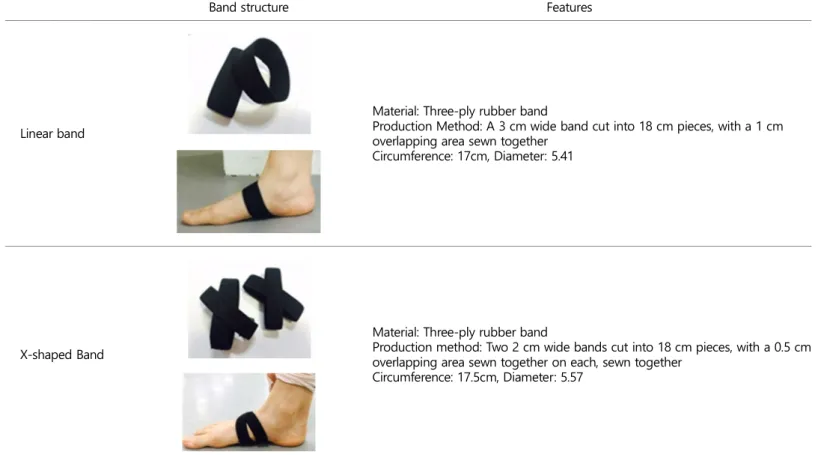
There are various treatments for the collapsed arch in the case of pes planus (Jacobs, 2007), but among them, the taping method has the positive sides of being economical, convenient and standardized (Kim, 2011). Recently there have been many studies where elastic bands have been used, but they have been limited to determining the use of the elastic bands and to physical workout programs. The inner arch support band has been produced in two structures by grafting the taping method for holding the inner arch of the foot onto the elastic band.
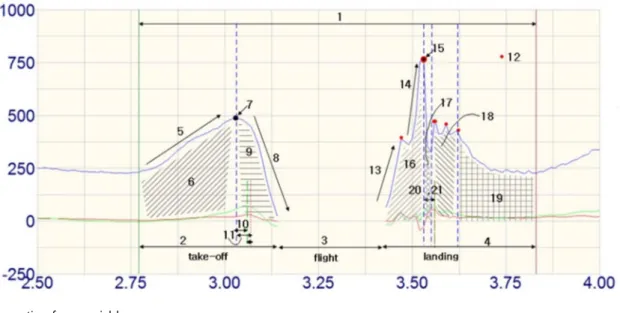
Thus, the purpose of this study establishes the differences of ground reaction force variables and relative sensations according to the second position vertical jump in ballet.
METHODS 1. Participants
The subjects of this study were made up of 12 ballet majors who have danced professionally for more than ten years (age: 24.33±2.96 years, height: 165.33±3.75 cm, weight: 49.83±4.47 kg). Before the experi- ment, the purpose of the research, the sequence of the experiment and movements were explained to the subjects and after confirming in-
http://e-kjsb.org eISSN 2093-9752 ORIGINAL
The Effects of the Foot Types and Structures of the Inner Arch Support Bands on Ground Reaction Force Variables
and Sensations during 2 nd Vertical Ballet Jump
Juhyun Kim 1 , Kyungock Yi 2
1
Major in physical Education The Graduate School of Education Ewha Womans University, Seoul, South Korea
2