This is an Open Access article distributed under the terms of the Creative Commons Attribution Non-Commercial License (http: //creativecommons.org/licenses/by- nc/4.0/) which permits unrestricted non-commercial use, distribution, and reproduction in any medium, provided the original work is properly cited.
© 2019 THE KOREAN SOCIETY OF MYCOLOGY.
https://doi.org/10.4489/KJM.20190007 Accepted: March 19, 2019 Revised: March 13, 2019 Received: February 11, 2019 Kor. J. Mycol. 2019 March, 47(1): 51-61
OPEN ACCESS pISSN : 0253-651X eISSN : 2383-5249
RESEARCH ARTICLE
세종특별자치시 주변의 금강 중류 물과 토양에서 야생 효모의 분리 및 국내 미기록 효모의 특성
한상민, 김지윤, 이종수* 배재대학교 바이오·의생명공학과
Isolation of Wild Yeasts from the Water and Riverside Soil of Geumgang Midstream in Sejong City, Korea, and Characterization of Unrecorded Wild Yeasts
Sang-Min Han, Ji-Yoon Kim, Jong-Soo Lee*
Department of Biomedicinal Science and Biotechnology, Paichai University, Daejeon 35345, Korea
*Corresponding author: [email protected]
ABSTRACT
The goal of this study was to elucidate wild yeast diversity of Geumgang midstream near Sejong metropolitan autonomous city, Korea. Thirty-seven strains of 32 species of wild yeasts were isolated from 43 water and soil samples under the Bulti bridge of Sejong city, Korea. Seven yeasts of each Candida spp. and Cryptococcus spp. were the predominant species isolated from samples near the Bulti bridge. Holtermanniella takashimae SW048 (NNIBRFG9314), Cystofilobasidium infirmominiatum SW013 (NNIBRFG9310), Mrakia cryoconite SW015 (NNIBRFG9316), Pichia sporocuriosa SW085 (NNIBRFG9326) and Cryptococcus aspenensis SW008 (NNIBRFG9309) represented novel yeast strains found in Korea for the first time. All of these previously unrecorded yeasts, except for Mrakia cryoconite SW015 had ascospores and grew well in yeast extract-peptone-dextrose (YPD), yeast extract-malt extract (YM) and potato-extrose (PD) media. Pichia sporocuriosa SW085 grew well in vitamin-free medium and Holtermanniella takashimae SW048, which was a halotolerant wild yeast, grew well YPD medium containing 5 % NaCl. Twenty-six strains representing eight species of wild yeast were isolated from 22 water and soil samples under the Haetmuri bridge of Sejong city, Korea. Candida pseudolambica (12 strains) and Aureobasidium pullulans (11 strains) were the predominant isolates from samples near the Haetmuri bridge. Occultifur kilbournensis HB060 (NNIBRFG9317), Sampaiozyma vanillica HB014 (NNIBRFG9332), Xenoramularia neerlandica HB039 (NNIBRFG9335), Candida norvegica HB315 (NNIBRFG9306), C. melibiosica HB316 (NNIBRFG9305), C. quercuum GB014 (NNIBRFG9307), and C. succiphila GB015 (NNIBRFG9308) represented novel yeast strains recorded in Korea for the first time. O. kilbournensis HB060 and X. neerlandica HB039 did not form ascospores or pseudo-mycelia. All of these previously unrecorded yeasts, except S. vanillica HB014 and X. neerlandica HB039, grew well in vitamin- free medium, and C. norvegica HB315 and C. succiphila GB015, which were halotolerant wild yeasts, which grew well in YPD medium containing 5 % NaCl.
Keywords: Geumgang midstream, Riverside soil, Water, Unrecorded wild yeasts, Wild yeasts
서론
최근, 우리나라 자연환경에 분포하고 있는 야생 효모들의 종 다양성을 확립하고, 이들 중 유용한 야 생 효모들을 산업적으로 활용하기 위하여 필자 등은 각종 야생화 등으로부터 다양한 야생 효모들 과 이들의 몇 가지 생리활성들을 측정하였고, 특히 이들 야생 효모들 중 아직까지 국내에 보고되지 않은 미기록 효모들의 균학적 특성을 조사하여 보고하였다[1-11].
또한, 우리나라 주요 강과 하천 등의 물이나 주변 토양과 각종 부식물 등에서 수생 균류들과 같 이 다양한 유기물들의 분해에 관여하고 있을 것으로 추정되는 야생 효모들의 분포특성을 확인하고 자 장성호수 주변의 꽃과 토양, 낙동강과 영산강 물과 주변 토양으로부터 야생 효모들을 분리하여 보고하였다[12]. 대전광역시 주요하천인 대전천과 갑천의 물과 토양으로부터 야생 효모들을 분리, 동정한 결과 Candida속균과 Cryptococcus속균들이 우점균으로 나타났고[13], 이들로부터
DebaryomycesudeniJSF601등 9종의 국내 미기록 효모들을 선별하여 이들의 균학적 특성을 보고하 였다[14].
최근에는 금강과 그 주변에 분포하고 있는 야생 효모 종에 대한 다양한 특성을 알아보기 위하여 먼저 금강 중류-하류지역인 공주시 백제보와 청벽대교를 흐르는 금강의 물과 주변 토양들로부터 51균주의 야생 효모들을 분리·동정하였고, CandidachauliodesWJSF-0201등 4균주들을 국내 미기록 효모 균주들로 선별하여 이들의 균학적 특성을 조사하였다[15].
본 연구에서는 금강의 중류-상류지역 및 그 주변환경에 분포하고 있는 야생 효모들의 종 특성을 알아보기 위하여 세종특별자치시 불티교와 햇무리교를 흐르는 금강의 물과 주변 토양들로부터 야 생 효모들을 분리, 동정하였고 이들 중 국내 미기록 효모들을 선별하여 이들의 균학적 특성을 조사 하였다.
재료 및 방법
야생 효모의 분리 및 동정
세종특별자치시 금남면 도담리 불티교와 세종특별자치시 연기면 세종리 햇무리교로 흐르는 금강 중류의 물과 주변 토양들을 2018년 3월과 5월에 총 65점을 채취하여 멸균 튜브에 넣고, 5mL의 멸 균수를 첨가한 후 2시간 동안 진탕하였다. 이들 현탁액 일부를 스트렙토마이신(100µg/mL)과 앰피 실린(100µg/mL)이 들어 있는 YPD (yeastextract-peptone-dextrose) 한천배지에 도말하고, 30℃ 에서 48 시간 배양한 후 형성된 효모 집락들을 분리하였다[12].
분리 효모들의 분자유전학적 동정을 위하여 LN1 (5' GCATATCAATAAGCGGAGGAAAAG 3')과 NL4 (5' GGTCCGTGTTTCAAGACGG3') 프라이머들을 이용하여 PCR 반응을 수행하여 26SrDNA의 D1/D2의 부위를 증폭한 후 염기서열들을 결정하였다(Cosmogenetch, Daejeon, Korea).
결정된 염기서열들을 NCBI의 BLAST (http://blast.ncbi.nlm.nih.gov)를 사용하여 데이터베이스에 등 록되어 있는 효모들과의 상동성을 비교한 후 분자생물학적 유연관계를 분석하여 동정하였다[10- 12].
국내 미기록 효모들의 선별 및 균학적 특성
위와 같이 분리한 야생 효모들은 국립 생물자원관 DB와 한국 진균관련 학술자료들을 이용하여 국내 미기록효모들을 선별하고 일반 미생물 실험방법 등을 이용하여 이들의 몇 가지 균학적 특성 등을 조 사하였다[9, 12].
결과 및 고찰
세종특별자치시 불티교 주변의 물과 토양들로부터 야생 효모의 분리 및 국내 미기록 효모들의 특성
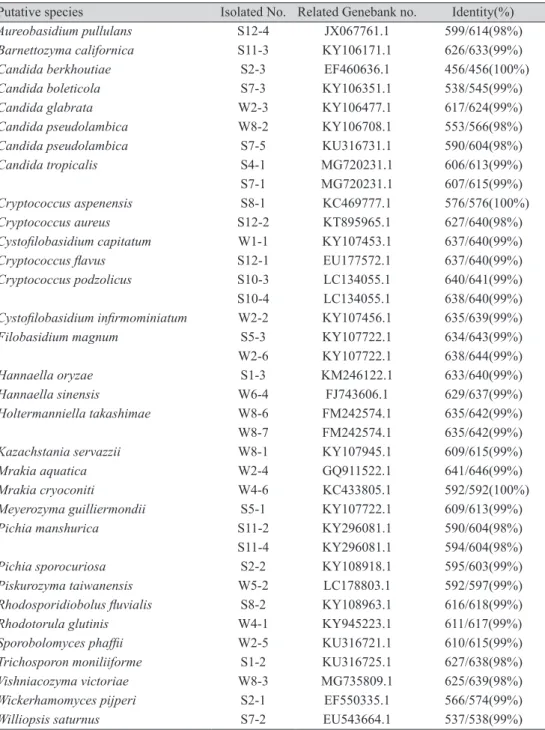
금강 중류지역인 공주시에서 상류 쪽으로 약 5Km 떨어진 세종특별자치시 장군면 도담리 산림박 물관입구 불티교(N36.439595, E127.227345) 밑을 흐르는 금강의 물과 주변 토양 43점에서 야생 효 모들을 분리, 동정한 결과 Table1과 같이 모두 종 37균주의 야생 효모들을 동정하였다.
이들 중 Candidatropicalis2주를 포함하는 Candida속균과 Cryptococcuspodzolicus2주를 포함하는 Cryptococcus속균들이 각각 7주씩 가장 많이 분리, 동정되었고 적은 시료임에도 불구하고 Occultifur kilbournensisHB060등의 Occultifur 속균들과, Sampaiozyma 속균, Xenoramularia 속균 등 전보[1-7]의 야생화들에서 분리되지 않은 다양한 야생효모들이 분리되었다.
한편, 위와 같이 금강 중류 세종시 불티교 밑에서 채취한 물과 주변토양에서 분리한 야생효모들 중 Holtermanniella takashimae SW048 (NNIBRFG9314), Cystofilobasidium infirmominiatum SW013
(NNIBRFG9310), MrakiacryoconiteSW015(NNIBRFG9316), PichiasporocuriosaSW085(NNIBRFG9326) 와 CryptococcusaspenensisSW008(NNIBRFG9309)5균주들이 국내 미기록 효모 균주들로 최종 선 별하였다.
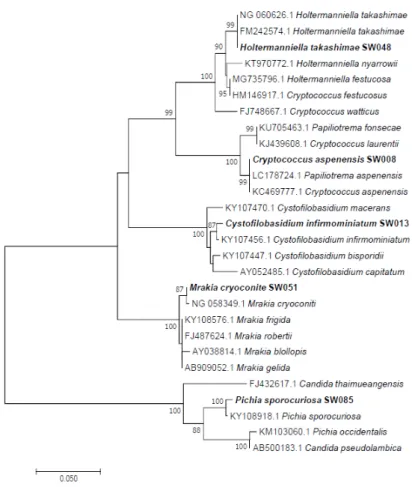
이들 국내 미기록 효모 균주들의 균학적 특성과 계통수는 Table2와 Fig. 1과 같다. 이들 세포의 형 태는 구형-난형으로 출아에 의해 영양증식을 하였고, M. cryoconiteSW015 외 모두 자낭포자를 형성 하는 유포자 효모들이었으며 H. takashimaeSW048외 4균주는 YPD배지와 YM, PD 배지에서 잘 생 육하였다. 또한, P. sporocuriosaSW085 와 C. aspenensisSW008 균주는 20 % 포도당을 함유한 YPD 배지에서도 생육하는 내당성 야생 효모들이었고 H. takashimaeSW048 균주는 비타민이 없는 YPD 배지에서는 생육하지 못하였으나 5 % NaCl를 함유한 YPD 배지에서 생육이 왕성한 호염성 효모이 었다.
우리나라에는 처음 보고되는 이들 국내 미기록 효모들에 대한 외국 보고로 H. takashimae는 Wuczkowski등[16]에 의하여 흰목이강 효모로 재분류, 동정되었고 C. infirmominiatum는 저온환경에 서 분리된 효모로 pectinase를 생산하는 것으로 보고되었다[17]. M. cryoconite 균주도 북극이나 고산 지대의 저온성 담자 효모로 처음 보고되었고[18], P. sporocuriosa는 말레이시아가 원산인 무환자나 무과의 람부탄에서 분리, 보고되었으며[19], C. aspenensis균은 브라질, 캐나다, 미국 등지에서 분리 한 C. laurentii 균주의 일부가 Ferreira등[20]에 의하여 분자계통학적으로 재분류된 균이다.
세종특별자치시 햇무리교 주변의 물과 토양들로부터 야생효모의 분리 및 국내 미기록 야생효모들의 특성
세종특별자치시 금남면 반곡리 햇무리교(GPS 위치: N; 36.498649, E;127.299875)를 흐르는 금강의 물과 주변 토양 22점에서 야생 효모들을 분리, 동정한 결과 Table3과 같이 모두 8종 26균주의 야생 효
모들을 분리, 동정하였다.
이들 중 Candida pseudolambica12균주와 Aureobasidium pullulans 11 균주가 주로 분리되었고 Candida 속 균과 Cryptococcus 속 균들이 8종중 7종으로 대부분을 차지하였다.
한편, 위와 같이 금강 중류 세종시 햇무리교 물과 주변토양에서 분리한 야생효모들 중Occultifur kilbournensisHB060(NNIBRFG9317), SampaiozymavanillicaHB014(NNIBRFG9332), Xenoramularia neerlandicaHB039(NNIBRFG9335), CandidanorvegicaHB315(NNIBRFG9306), C. melibiosicaHB316 (NNIBRFG9305), C. quercuumGB014 (NNIBRFG9307)와 C. succiphilaGB015(NNIBRFG9308)7균주 들이 국내 미기록 효모 균주들로 최종 선별하였다.
Table 1. Wild yeast species isolated from water and soil samples under the Bulti bridge in Sejong city, Korea
Putative species Isolated No. Related Genebank no. Identity(%)
Aureobasidium pullulans S12-4 JX067761.1 599/614(98%)
Barnettozyma californica S11-3 KY106171.1 626/633(99%)
Candida berkhoutiae S2-3 EF460636.1 456/456(100%)
Candida boleticola S7-3 KY106351.1 538/545(99%)
Candida glabrata W2-3 KY106477.1 617/624(99%)
Candida pseudolambica W8-2 KY106708.1 553/566(98%)
Candida pseudolambica S7-5 KU316731.1 590/604(98%)
Candida tropicalis S4-1 MG720231.1 606/613(99%)
S7-1 MG720231.1 607/615(99%)
Cryptococcus aspenensis S8-1 KC469777.1 576/576(100%)
Cryptococcus aureus S12-2 KT895965.1 627/640(98%)
Cystofilobasidium capitatum W1-1 KY107453.1 637/640(99%)
Cryptococcus flavus S12-1 EU177572.1 637/640(99%)
Cryptococcus podzolicus S10-3 LC134055.1 640/641(99%)
S10-4 LC134055.1 638/640(99%)
Cystofilobasidium infirmominiatum W2-2 KY107456.1 635/639(99%)
Filobasidium magnum S5-3 KY107722.1 634/643(99%)
W2-6 KY107722.1 638/644(99%)
Hannaella oryzae S1-3 KM246122.1 633/640(99%)
Hannaella sinensis W6-4 FJ743606.1 629/637(99%)
Holtermanniella takashimae W8-6 FM242574.1 635/642(99%)
W8-7 FM242574.1 635/642(99%)
Kazachstania servazzii W8-1 KY107945.1 609/615(99%)
Mrakia aquatica W2-4 GQ911522.1 641/646(99%)
Mrakia cryoconiti W4-6 KC433805.1 592/592(100%)
Meyerozyma guilliermondii S5-1 KY107722.1 609/613(99%)
Pichia manshurica S11-2 KY296081.1 590/604(98%)
S11-4 KY296081.1 594/604(98%)
Pichia sporocuriosa S2-2 KY108918.1 595/603(99%)
Piskurozyma taiwanensis W5-2 LC178803.1 592/597(99%)
Rhodosporidiobolus fluvialis S8-2 KY108963.1 616/618(99%)
Rhodotorula glutinis W4-1 KY945223.1 611/617(99%)
Sporobolomyces phaffii W2-5 KU316721.1 610/615(99%)
Trichosporon moniliiforme S1-2 KU316725.1 627/638(98%)
Vishniacozyma victoriae W8-3 MG735809.1 625/639(98%)
Wickerhamomyces pijperi S2-1 EF550335.1 566/574(99%)
Williopsis saturnus S7-2 EU543664.1 537/538(99%)
Table 2. Characteristics of the unrecorded yeasts from water and soil samples under the Bulti bridge in Sejong city, Korea
Strains Holtermanniella
takashimae Cystofilobasidium
infirmominiatum Mrakia cryoconiti Pichia sporocuriosa Cryptococcus aspenensis
Isolated No. SW048 SW013 SW051 SW085 SW008
Morphological characteristics
Shape Oval Oval Global Oval Global
Vegetative reproduction Budding Budding Budding Budding Budding
size(㎛) 1.0~1.7 0.9~1.5 1.0~1.1 0.8~1.7 1.3~1.3
Ascospore +1) + - + +
Pseudomycelium − + - + +
Cultural characteristics
Growth on YPD /YM/PD media +++/+/-2) +++/++/+ +++/++/++ +++/+++/+++ +++/++/++
Color on YPD medium Cream Cream White White Cream
Growth on Vitamin-free medium − ++ − +++ +
Growth on 10%/20%
glucose-YPD medium -/- -/- -/- ++/+ +/+
Growth on 5%/15%
NaCl-YPD medium ++/- -/- +/− −/− +/−
Growth on temp (℃) 20-30 20-30 25-30 20-30 20-30
pH range pH 5-8 pH 5-8 pH 5-8 pH 5-8 pH 5-8
1) +; formed, -; not formed, 2) +++; very good grew, ++; good grew, +; grew, -; not grew
Fig. 1. Phylogenetic tree of the unrecorded yeasts isolated from water and soil samples under the Bulti bridge in Sejong city, Korea, based on the nucleotide sequences of large subunit 26S ribosomal DNA D1/D2 region. The tree was generated by the neighbor-joining method, using MEGA7.
Table 3. Wild yeast species isolated from water and soil samples under the Haetmuri bridge in Sejong city, Korea
Putative species Isolated No. Related Genebank no. Identity(%)
Aureobasidium pullulans G4-2 KC160604.1 569/571(99%)
G4-4 KX958050.1 601/614(98%)
G4-5 KX958050.1 606/615(99%)
G10-1 KX958050.1 603/615(98%)
G10-2 KX958050.1 602/615(98%)
G10-3 KC160604.1 567/567(100%)
G10-4 KX958050.1 604/616(98%)
G23-1 KX958050.1 608/616(99%)
KK13-1 KX958050.1 602/617(98%)
KK25-1 KX893322.1 564/566(99%)
KK42-2 KX958050.1 603/614(98%)
Candida pseudolambica G14-2 KU316731.1 595/605(98%)
G16-2 KU316731.1 591/603(98%)
G18-2 KU316731.1 594/604(98%)
G18-4 KY106706.1 594/607(98%)
G20-1 KU316731.1 599/605(99%)
G22-4 KU316731.1 596/604(99%)
KK35-2 KU316731.1 588/603(98%)
Candida quercuum G14-3 EF550292.1 580/586(99%)
Candida succiphila G13-3 NG_055129.1 569/572(99%)
Candida vartiovaarae G7-1 KU316734.1 610/618(99%)
G8-1 KY106865.1 579/581(99%)
KK3-1 KY106865.1 611/619(99%)
Cryptococcus carnescens G23-2 KR632591.1 581/589(99%)
Cryptococcus laurentii KK9-1 AJ876597.1 636/641(99%)
Cryptococcus sp. KK38-1 AB462336.1 579/585(99%)
Cryptococcus tephrensis KK22-2 JX188134.1 627/640(98%)
Cyberlindnera saturnus KK2-2 KU316712.1 606/619(98%)
Filobasidium magnum KK4-1 KY107722.1 632/644(98%)
KK24-3 KY107722.1 639/644(99%)
KK30-2 KY107722.1 640/643(99%)
KK41-2 KY107722.1 631/643(98%)
Kazachstania servazzii KK2-3 KY107945.1 603/616(98%)
Kazachstania unispora KK35-1 LC215949.1 559/567(99%)
Leucosporidium golubevii KK17-1 KY108283.1 620/635(98%)
KK24-1 KY108283.1 621/632(98%)
Metschnikowia reukaufii KK16-1 MH047200.1 546/559(98%)
KK16-2 MH047200.1 545/556(98%)
KK22-1 MH047200.1 547/557(98%)
KK41-1 MH047200.1 548/557(98%)
Moesziomyces antarcticus G6-3 MH185804.1 638/648(98%)
Occultifur kilbournensis KK45-1 KP413160.1 574/575(99%)
Papiliotrema aurea G10-5 KY108729.1 592/592(100%)
Papiliotrema fuscus KK25-2 KY108736.1 637/640(99%)
Pichia spartinae G22-2 FJ468448.1 562/563(99%)
Pseudomicrostroma phylloplanum G10-7 KY108550.1 630/642(98%)
Rhodotorula taiwanensis KK10-2 AB863557.1 537/539(99%)
Saccharomyces cerevisiae G22-3 CP029160.1 609/618(99%)
Sampaiozyma vanillica KK38-2 KY109537.1 618/631(98%)
Sporidiobolus pararoseus KK21-1 KY109715.1 611/615(99%)
Sporobolomyces phaffii KK1-1 KU316719.1 571/572(99%)
KK1-2 KY109760.1 613/618(99%)
KK42-1 KU316719.1 603/615(98%)
Tilletiopsis washingtonensis KK21-3 AM160640.1 639/644(99%)
Wickerhamomyces anomalus KK37-2 KY296073.1 611/617(99%)
G16-1 KY296073.1 608/617(99%)
Wickerhamomyces silvicola G13-2 KY110133.1 606/616(98%)
Xenoramularia neerlandica KK29-1 KX287261.1 556/557(99%)
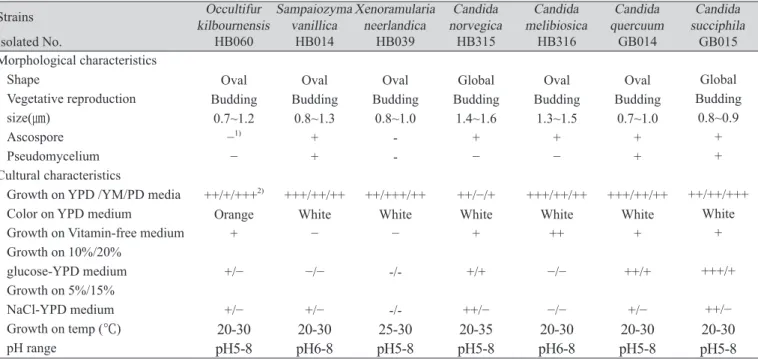
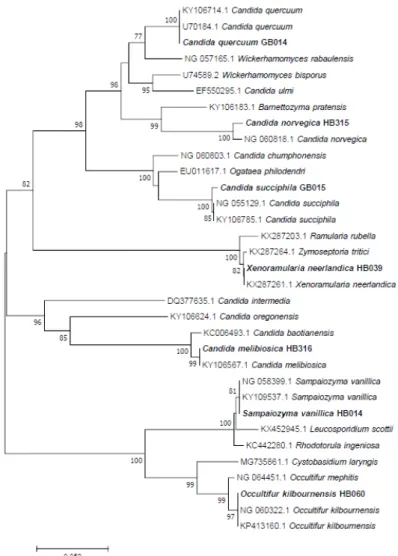
이들 국내 미기록 효모 균주들의 이들의 균학적 특성과 계통수는 Table4와 Fig. 2와 같다. 세포의 형태는 계란모양으로 출아에 의해 영양증식을 하였고 O. kilbournensisHB060와 X. neerlandicaHB039 는 자낭포자와 의균사를 형성하지 못하는 무포자 효모들이었다. 또한, C. norvegicaHB315는 YM 배지에서 생육하지 못하였으나 나머지 효모들은 모두 YPD, YM, PD배지에서 생육이 양호하였고 O. kilbournensisHB060 등5균주들이 비타민을 첨가하지 않은 YPD 배지에서도 생육하였다. 특히 C. succiphilaGB015는 20% 포도당을 함유한 YPD 배지에서도 잘 생육하는 내당성 효모이었고 C. norvegicaHB315와 C. succiphilaGB015는 5% NaCl을 함유한 YPD 배지에서 잘 생육하는 호염성을 보였다.
이들 국내 미기록 효모들에 대한 외국 학술지 보고로 O. kilbournensis는 미국의 옥수수 밭에서 red yeast로 분리, 보고되었고[21], S. vanillica 효모균주는 Wang등[22]에 의하여 Pucciniomycotina의 분자 계통학적 동정으로 재분류 되었다. X. neerlandica는 보리와 딸기 등의 수확량을 떨어뜨리는 식물 병 원성 효모로 Ramularia속에서 재분류, 동정[23] 되었고. C. norvegica는 캔디다증 항생제 개발을 위한 시험 균주로 활용한 연구 등[24]이 있다. 또한, C. melibiosica 이를 과당만 함유된 영양 결핍 배지에 서 편극 생물전지하에 배양하였을 때 phytase 활성이 증가하였음이 보고되었고[25], C. quercuum는 유비퀴논 7 생성균주로[26], C. succiphila는 효율적인 5탄당 발효를 위한 xylose의 세포내 통과에 유 용한 효모로 보고되었다[16].
지금까지 금강 중류를 비롯한 전 금강유역에서의 미생물 특히 효모 종 다양성에 대한 연구는 전 보[15]의 공주시 주변 금강에서 분리, 동정 후 두 번째 금강 상류 방향으로 시도된 것으로 본 연구에 서도 병원성 효모들로 알려진 Cryptococcus 속 균들과 Candida 속 균들이 각각 4종씩 분리되었으나 이들은 비 병원성 효모들이었다. 비록 시료 수가 적었지만 이러한 결과들은 아직까지 금강 중류 지 역이 비교적 깨끗하게 유지되고 있음을 의미하는 것으로 사료되었고, 앞으로 순차적으로 금강 상
Table 4. Characteristics of the unrecorded yeasts from water and soil samples under the Haetmuri bridge in Sejong city, Korea
Strains Occultifur
kilbournensis Sampaiozyma
vanillica Xenoramularia
neerlandica Candida
norvegica Candida
melibiosica Candida
quercuum Candida succiphila
Isolated No. HB060 HB014 HB039 HB315 HB316 GB014 GB015
Morphological characteristics
Shape Oval Oval Oval Global Oval Oval Global
Vegetative reproduction Budding Budding Budding Budding Budding Budding Budding
size(㎛) 0.7~1.2 0.8~1.3 0.8~1.0 1.4~1.6 1.3~1.5 0.7~1.0 0.8~0.9
Ascospore −1) + - + + + +
Pseudomycelium − + - − − + +
Cultural characteristics
Growth on YPD /YM/PD media ++/+/+++2) +++/++/++ ++/+++/++ ++/−/+ +++/++/++ +++/++/++ ++/++/+++
Color on YPD medium Orange White White White White White White
Growth on Vitamin-free medium + − − + ++ + +
Growth on 10%/20%
glucose-YPD medium +/− −/− -/- +/+ −/− ++/+ +++/+
Growth on 5%/15%
NaCl-YPD medium +/− +/− -/- ++/− −/− +/− ++/−
Growth on temp (℃) 20-30 20-30 25-30 20-35 20-30 20-30 20-30
pH range pH5-8 pH6-8 pH5-8 pH5-8 pH6-8 pH5-8 pH5-8
1) +; formed, -; not formed, 2) +++; very good grew, ++; good grew, +; grew, -; not grew
류에 대한 야생 효모 종 발굴 연구를 지속적으로 실시하여 금강 야생 효모들의 종 다양성을 확립하 고 국내 미기록 효모들을 발굴하며 나아가 환경 보존 상태 등에 대하여도 고찰하여 보고할 계획이 다.
적요
우리나라 금강의 물과 주변 토양에 분포하는 야생 효모들의 종 다양성을 확립하고자 세종특별자치 시 불티교와 햇무리교를 흐르는 금강 중류의 물과 주변 토양에서 야생 효모들을 분리, 동정하였고 이들 중 국내 미기록 효모들을 선별하여 이들의 균학적 특성을 조사하였다. 세종시 불티교 밑의 물
과 주변 토양들로부터 32종, 37균주의 야생 효모들을 분리, 동정하였다. 이들 중 Holtermanniella takashimae SW048 (NNIBRFG9314), Cystofilobasidium infirmominiatum SW013 (NNIBRFG9310), MrakiacryoconiteSW015(NNIBRFG9316), PichiasporocuriosaSW085(NNIBRFG9326) 와 Cryptococcus
Fig. 2. Phylogenetic tree of the unrecorded yeasts isolated from water and soil samples under the Haetmuri bridge in Sejong city, Korea, based on the nucleotide sequences of large subunit 26S ribosomal DNA D1/D2 region. The tree was generated by the neighbor-joining method, using MEGA7.
aspenensisSW008(NNIBRFG9309) 5균주들을 국내 미기록 효모 균주들로 최종 선별하였고, 이들은 구형-난형으로 출아에 의해 영양증식을 하였다. M. cryoconiteSW015 외 모두 자낭포자를 형성하였 고, P. sporocuriosaSW085 와 C. aspenensisSW008 균주는 20% 포도당을 함유한 YPD 배지에서도 생 육하는 내당성 야생 효모들이었다. 또한, 세종시 햇무리교의 물과 주변 토양시료에서 모두 8종 26 균주의 야생 효모들을 분리, 동정하였고 이들 야생 효모들 중 Occultifur kilbournensis HB060 (NNIBRFG9317), Sampaiozymavanillica HB014(NNIBRFG9332), XenoramularianeerlandicaHB039 (NNIBRFG9335), CandidanorvegicaHB315(NNIBRFG9306), C. melibiosicaHB316(NNIBRFG9305), C. quercuumGB014(NNIBRFG9307)와 C. succiphilaGB015(NNIBRFG9308) 7균주 국내 미기록 효모들 로 분류되었다. O. kilbournensisHB060와 X. neerlandicaHB039는 자낭포자와 의균사를 형성하지 못 하였고 C. norvegicaHB315는 5 % NaCl를 함유한 YPD 배지에서 생육하는 내염성을 보였다. 본 연 구결과는 앞으로 금강의 야생 효모 종 다양성 확립에 귀중한 자료로 활용될 것이다.
ACKNOWLEDGEMENTS
Thisresearchwassupportedbythe“TheSurveyandDiscoveryofFreshwaterBioresources” (NNIBR, 2018) researchprogramoftheNakdonggangNationalInstituteofBiologicalResources.
REFERENCES
1. Min JH, Ryu JJ, Kim HK, Lee JS. Isolataion and identification of yeasts from wild flowers in Gyejoksan, Oseosan and Baekamsan of Korea. Kor J Mycol 2013;41:47-51.
2. Hyun SH, Mun HY, Lee HB, Kim HK, Lee JS. Isolation of yeasts from wild flowers in Gyeonggi-do province and Jeju island in Korea and the production of anti-gout xanthine oxidase inhibitor. Kor J Microbiol Biotechnol 2013;41:383-90.
3. Hyun SH, Min JH, Lee HB, Kim HK, Lee JS. Isolation and diversity of yeasts from wild flowers in Ulleungdo and Yokjido, Korea. Kor J Mycol 2014;42:28-33.
4. Hyun SH, Lee JK, Park WJ, Kim HK, Lee JS. Isolation and diversity of yeasts from fruits and flowers of orchard in Sinam-myeon of Yesan-gun, Chungcheongnam-do, Korea Kor J Mycol 2014;42:21-7.
5. Hyun SH, Han SM, Lee JS. Isolation and physiological functionality of yeasts from wild flowers in Seonyudo of Gogunsanyeoldo, Jeollabuk-do, Korea. Kor J Mycol 2014;42:201-6.
6. Han SM, Hyun SH, Lee JS. Isolation and identification of yeasts from wild flowers in Deogyu mountain and their physiological functionalities. Kor J Mycol 2015;43:47-52.
7. Han SM, Hyun SH, Lee HB, Lee HW, Kim HK, Lee JS. Isolation and identification of yeasts from wild flowers collected around Jangseong lake in Jeollanam-do, Republic of Korea, and characterization of the unrecorded yeast Bullera coprosmaensis. Mycobiology 2015;43:266- 71.
8. Han SM, Han JW, Bae SM, Park WJ, Lee JS. Isolation and identification of wild yeasts from soils of paddy fields in Daejeon metropolitan city and Chungcheongnam-do, Korea. Kor J Mycol 2016;44:1-7.
9. Han SM, Lee JS. Isolation and identification of wild yeasts from soils of an herb park in Seoul metropolitan city and characteristics of unrecorded yeasts. Kor J Mycol 2016;44:108 10. Han SM, Lee SY, Kim HK, Lee JS. Characterization of wild yeasts isolated from leaves
obtained from Mt. Daedun and Mt. Chilgap, Korea. Kor J Mycol 2017;45:31-42.
11. Han SM, Lee JS. Characterization of unrecorded yeasts Isolated from leaves of trees of Oknyeobong peak and Yeonjasan mountains in Daejeon, Korea. Kor J Mycol 2017;45:23-30.
12. Han SM, Kim HK, Lee HB, Lee JS. Isolation and identification of wild yeasts from freshwaters and soils of Nakdong and Yeongsan river, Korea, with characterization of two unrecorded yeasts. Kor J Mycol 2016;44:350-4.
13. Han SM, Lee SY, Kim HK, Lee JS. Isolation and diversity of wild yeasts from the waters and bank soils of Daejeoncheon, Gapcheon, and Yudeungcheon in Daejeon metropolitan city, Korea. Kor J Mycol 2017;45:259-69.
14. Han SM, Lee SY, Kim HK, Lee JS. Characterization of the unrecorded wild yeasts from the water and riverside soils of Daejeoncheon and Gapcheon in Daejeon Metropolitan city, Korea. Kor J Mycol 2017;45:153-9.
15. Han SM, Kim JY, Lee HB, Kim HK, Lee JS. Isolation and characterization of wild yeasts from water and riverside soils of Geumgang midstream in Gongju city, Korea. Kor J Mycol 2018;46:98-104.
16. Wuczkowski M, Passoth V, Turchetti B, Andersson AC, Olstorpe M, Laitila A, Theelen B, van Broock M, Buzzini P, Prillinger H, Sterflinger K, Schnürer J, Boekhout T, Libkind D. Description of Holtermanniella gen. nov., including Holtermanniella takashimae sp. nov.
and four new combinations, and proposal of the order Holtermanniales to accommodate tremellomycetous yeasts of the Holtermannia clade. Int J Syst Evol Microbiol 2011;61:680-9.
17. Cavello I, Albanesi A, Fratebianchi D, Garmedia G, Vero S, Cavalitto S. Pectinolytic yeasts from cold environments: novel findings of Guehomyces pullulans, Cystofilobasidium infirmominiatum and Cryptococcus adeliensis producing pectinases. Extremophiles 2017;21:319-29.
18. Margesin R, Fell JW. Mrakiella cryoconiti gen. nov., sp. nov., a psychrophilic, anamorphic, basidiomycetous yeast from alpine and arctic habitats. Int J Syst Evol Microbiol 2008;58:2977-82.
19. Péter G, Tornai-Lehoczki J, Dlauchy D, Vitányi G. Pichia sporocuriosa sp. nov., a new yeast isolated from rambutan. Antonie Van Leeuwenhoek 2000;77:37-42.
20. Ferreira-Paim K, Ferreira TB, Andrade-Silva L, Mora DJ, Springer DJ, Heitman J, Fonseca FM, Matos D, Melhem MS, Silva-Vergara ML. Phylogenetic analysis of phenotypically characterized Cryptococcus laurentii isolates reveals high frequency of cryptic species. PLoS One 2014;24.
21. Kurtzman CP, Robnett CJ. Occultifur kilbournensis f.a. sp. nov., a new member of the Cystobasidiales associated with maize (Zea mays) cultivation. Antonie Van Leeuwenhoek 2015;107:1323-9.
22. Wang QM, Yurkov AM, Göker M, Lumbsch HT, Leavitt SD, Groenewald M, Theelen B, Liu XZ, Boekhout T, Bai FY. Phylogenetic classification of yeasts and related taxa within Pucciniomycotina. Stud Mycol 2015;81:149-89.
23. Videira SI, Groenewald JZ, Braun U, Shin HD4, Crous PW. All that glitters is not Ramularia.
Stud Mycol 2016;83:49-163.
24. Galgóczy L, Bácsi A, Homa M, Virágh M, Papp T, Vágvölgyi C. In vitro antifungal activity of phenothiazines and their combination with amphotericin B against different Candida species. Mycoses 2011;54:737-43.
25. Hubenova Y, Georgiev D, Mitov M. Enhanced phytate dephosphorylation by using Candida melibiosica yeast-based biofuel cell. Biotechnol Lett 2014;36:1993-7.
26. Suzuki M, Nakase T. A phylogenetic study of ubiquinone-7 species of the genus Candida
based on 18S ribosomal DNA sequence divergence. J Gen Appl Microbiol 2002;48:55-65.
27. Stambuk BU, Franden MA, Singh A, Zhang M. D-Xylose transport by Candida succiphila and Kluyveromyces marxianus. Appl Biochem Biotechnol 2003;105:255-63.