DOI 10.17480/psk.2015.59.3.120
3차 병원에서 HAART 치료를 받은 HIV 환자의 처방패턴 및 이상지질혈증 발생 빈도 분석
박선희*,** · 양영모* · 최인** · 윤현옥*** · 최은주*,#
*조선대학교 약학대학, **조선대학교병원 약제팀, ***경상대학교 약학대학
(Received February 9, 2015; Revised April 9, 2015; Accepted May 31, 2015)
An Analysis of Prescription Patterns and Incidence of Dyslipidemia in a Korean Tertiary Hospital HIV Patients Receiving High Active Antiretroviral Therapy
Sun Hee Park*,**, Young-Mo Yang*, In Choe**, Hyonok Yoon*** and Eun Joo Choi*,#
*College of Pharmacy, Chosun University, Gwangju 501-759, Korea
**Department of Pharmacy, Chosun University Hospital, Gwangju 501-717, Korea
***College of Pharmacy, Gyeongsang National University, Jinju 660-701, Korea
Abstract — Highly active antiretroviral therapy (HAART) has reduced AIDS-related morbidity and mortality; however, it has been associated with metabolic abnormalities including dyslipidemia and dysglycemia depending on the regimens used.
The aims of this study were to analyze the prescription patterns of antiretroviral agents and to examine the prevalence of lipid abnormalities among the prescriptions of HAART. The electronic medical records (EMR) of HIV patients were ret- rospectively reviewed from January 2007 to September 2012 based on our inclusion criteria. The patients who had taken HAART for at least 3 months were included in this study. The lipid profiles of patients on antiretrovirals (ARTs) were col- lected from his or her laboratory data, and dyslipidemia was defined as total cholesterol (TC) ≥240 mg/dL and triglycerides (TG) >200 mg/dL. Eighty-four prescriptions were discovered during the study period. Twenty-three prescriptions were the combination of two nucleoside reverse transcriptase inhibitors (NRTIs) and one non-nucleoside reverse transcriptase inhib- itor (NNRTI). Fifty-three prescriptions were the combination of two NRTIs and one protease inhibitor (PI) and thirty-nine prescriptions of them included a PI booster. Eight prescriptions were the combination of two NRTIs and one integrase inhib- itor. The Incidence of hypertriglyceridemia among the patients receiving HAART was totally about 41.7% (2NRTIs+PI reg- imen vs. 2NRTIs+NNRTI regimen vs. 2 NRTIs+integrase inhibitor regimen, 52% vs. 12.5% vs. 25%), but there was no incidence of hypercholesterolemia. This study investigated that the prescription medication patterns and dyslipidemia asso- ciated with lipid abnormalities among HIV patients receiving HAART. The types of HAART prescription regimens had an effect on the occurrence of hypertriglycemia. Further studies related to metabolic abnormalities and adverse effects of HIV patients on ARTs are needed in the near future.
Keywords □ HIV, HAART, prescription, NRTI, NNRTI, PI, INSTI, dyslipidemia
HIV 감염환자의 치료에 쓰이는 항레트로바이러스 다제요법 (highly active antiretroviral therapy, HAART)은 1990년대 중반 에 소개된 이후, HIV 감염환자의 바이러스 혈중 농도를 효과적 으로 감소시키고, 기회감염의 발병률을 감소시킴으로 인해 HIV
감염에 의한 사망률을 현저하게 감소시키는 효과를 가져왔다.1-4) HAART는 뉴클레오시드 역전사효소 억제제(nucleoside reverse transcriptase inhibitor, NRTI), 비뉴클레오시드 역전사효소 억제 제(nonnucleoside reverse transcriptase inhibitor, NNRTI), 단 백분해효소 억제제(protease inhibitor, PI), 통합효소 억제제 (integrase inhibitor, INSTI), chemokine receptor-5 antagonist (CCR5)을 병합하는 일종의 칵테일 요법으로 2종류의 NRTI 약 물에 1~2종류의 PI 약물을 환자에게 병용 투여하거나, 2종류의 NRTI 약물에 1종류의 NNRTI 약물을 병용 투여하는 것이 일반 적이다. 만약 이러한 초기 치료가 실패하면, 약물 전체를 바꾸어
#
Corresponding Author Eun Joo Choi
College of Pharmacy, Chosun University, 309 Pilmun-daero, Dong-gu, Gwangju 501-759, Korea
Tel.: 062-230-6382 Fax.: 062-222-5414 E-mail: [email protected]
Short Report
종설다시 시도하는 것이 원칙이다.5)
하지만, 다양한 자료들이 축적됨에 따라 HAART에 의한 단기 부작용뿐만 아니라, 이상지질혈증(dyslipidemia) 및 인슐린 저항성 (insulin resistance)과 체지방 분포 이상(body fat abnormalities) 과 같은 대사이상증후군의 부작용이 여러 연구들에서 보고되고
있다.1-4,6)이상지질혈증은 관상동맥성 심질환(coronary heart
disease, CHD)과 같은 심혈관계 질환의 위험성을 증가시켜, 이 러한 질환으로 인한 HIV 감염환자의 사망률을 증가시키는 것으 로 알려져 있다.4,7-9)최근 연구에서 ritonavir와 같은 PI와 NRTI 를 병용 투여하였을 경우 중성지방(triglycerides, TG)과 총 콜레 스테롤(total cholesterol, TC)의 수치가 상승하는 이상지질혈증 의 발생률이 높은 것으로 나타났으나, nevirapine 또는 efavirenz 와 같은 NNRTI를 NRTI와 병용투여 시 이상지질혈증의 발생률 이 낮아 동맥경화와 같은 심혈관계 질환의 위험성을 낮추는 것 으로 보고되었다.3,4,10-13)
HAART를 사용하는 HIV 감염환자에서 이상지질혈증이 발생 하였을 경우, 미국보건부(Department of Health and Human Service, DHHS) 2012년 HIV/AIDS 치료 가이드라인에 따르면 statin계 약물이나 fibrate를 우선 사용하도록 권고하고 있다.1,3,14,15) 최근 이러한 가이드라인에 근거해 HAART를 실시하는 HIV 감 염환자의 TG 및 TC와 저밀도 지단백질 콜레스테롤(low density lipoprotein cholesterol, LDL-C)의 변화에 관한 연구와 statin이 나 fibrate 등의 약물을 추가한 후 lipid profile의 변화 양상 및 항레트로바이러스 약물과의 상호작용에 관한 다양한 연구가 이 루어지고 있다.11,12,16-20)
그러나, 이러한 대부분의 연구들은 주로 백인이나 HIV 감염환 자가 많은 아프리카를 중심으로 이루어진 반면에, 2013년 국내 HIV 감염환자가 8,662명(남자 92.1%, 여자 7.9%)에 도달함에도 불구하고, 한국인을 중심으로 한 연구는 부족한 상황이다.21)따 라서, 국내 HIV 감염환자를 대상으로 한 연구의 필요성이 대두 되고 있다. 이에 본 연구에서는 한국인을 대상으로 HIV 감염으 로 인해 HAART를 시행하고 있는 환자의 이상지질혈증의 양상 을 알아보기 위하여, 거점 지역의 한 3차 병원의 HIV 감염환자 의 처방 양상을 살펴보고, HAART에 따른 이상지질혈증의 발생 빈도를 후향적으로 비교 · 분석 해보고자 하였다.
연구 방법
연구 대상
2007년 1월 1일부터 2012년 9월 30일까지 광주소재 3차종합 병원 감염내과 외래에서 HIV 감염이나 후천성 면역결핍증 (Acquired Immune Deficiency Syndrome, AIDS)을 진단받은 환자들 중 항레트로바이러스 다제요법을 3개월 이상 지속적으로 복용한 환자를 대상으로 후향적인 방법으로 연구하였다. 18세 미
만의 소아환자 또는 지속적으로 혈액검사를 시행하지 않은 환자 는 연구대상에서 제외하였다. 본 연구는 본원의 임상시험심사위 원회(IRB)의 심의 면제 승인을 받아 시행되었다(2012-11-001).
자료 수집 및 연구 방법
환자의 외래 의무 기록 및 전산화 시스템에 저장된 자료에 근 거해 환자의 나이, 성별, 항레트로바이러스 다제요법, 몸무게, 항 바이러스 약제 이외의 복용약물 및 동반질환을 조사하였다. 항레 트로바이러스 다제요법이 TC 및 TG와 혈중 당 농도(glucose, GL) 에 미치는 영향을 조사하기 위해 환자들이 복용한 다제요법을 3 개의 군(NRTI+PI군, NRTI+NNRTI군, NRTI+INSTI군)으로 나 누어 다제요법 실시전과 3개월 후에 혈중농도를 조사하였다. 또 한, 항레트로바이러스 다제요법의 독성을 조사하기 위하여 creatine kinase, AST 및 ALT, T-bilirubin의 농도도 함께 수집하였다.
항레트로바이러스 약물을 복용한 후 이상지질혈증의 발생빈도 를 다제요법에 따라 분류하기 위해 다음과 같은 정의를 사용하 였다. 추적 관찰 기간 중 측정한 TC가 240 mg/dL 이상이거나 TG가 200 mg/dL 이상인 경우를 이상지질혈증으로 정의하였다.
고혈당증은 추적 관찰 기간 중 측정한 GL이 200 mg/dL 이상인 경우로 정의하였다.
통계 분석
SPSS 18.0을 활용하여 범주형 변수는 빈도 및 백분율로 표시 하였으며, 연속변수는 평균±표준편차로 나타내었다. 조사대상의 임상적 특징 비교는 one-way ANOVA를 사용하였고, 각 항레트 로바이러스 처방과 고지질혈증과의 관계는 교차분석을 사용하여 분석하였다. 모든 분석은 p-value가 0.05 미만일 경우 통계적으 로 유의한 차이가 있는 것으로 판단하였다.
연구 결과
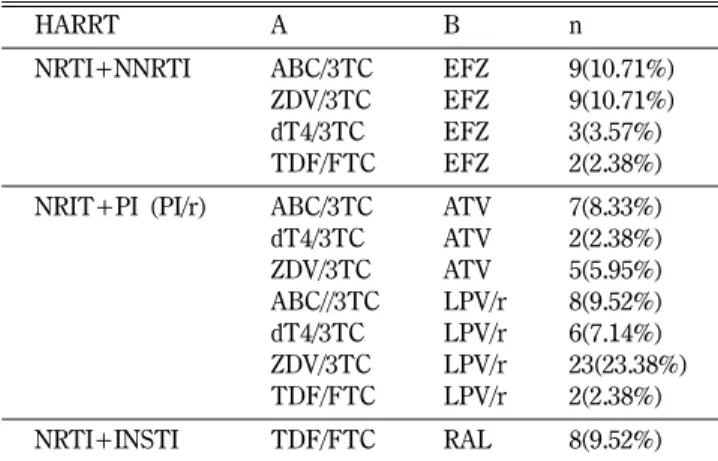
Table I에서 제시하는 바와 같이, 연구에 참여한 HIV 감염환 자는 총 84명으로 모두 남자였으며, 평균 나이는 48.7세였다. 나 이는 40세 미만에 속하는 환자가 26명(31.0%)으로 가장 많았으 며, 다음으로 50~59세에 속하는 환자들이었다. 환자들이 가장 많이 처방 받은 HAART 요법은 NRTI+PI로 약 60% 이상의 환 자들에서 이 요법을 실시되고 있었으나, 나이에 따라 처방양상 의 차이점은 보이지 않았다. 본원에서 가장 많이 처방된 NRTI+
PI 요법에 주로 사용된 약물은 lamivudine/zidovudine 또는 lamivudine/abacavir를 NRTI backbone으로 하여 ritonavir- boosted lopinavir나 atazanavir였다. 또한, 본원에서는 efavirenz 만이 NNRTI로 처방되고 있었으며, INSTI인 raltegravir를 처방 한 경우도 8건이 조사되었다(Table II).
HAART 요법 실시 3개월 후에 TC 및 TG와 GL의 변화를
Table III에 제시하였다. HAART 요법에 PI를 포함시켰을 경우, TC와 TG가 각각 157.25 mg/dL에서 173.75 mg/dL, 192.49 mg/dL
Table I − Characteristics of study subjects
Variable Category n %
Gender Male 84 100.0
Age group <40 26 031.0
40-49 16 019.0
50-59 22 026.2
≥60 20 023.8
HAART NRTI+NNRTI 23 027.4
NRTI+PI 53 063.1
NRTI+INSTI 08 009.5
HAART, high active antiretroviral therapy; NRTI, nucleoside reverse transcriptase inhibitor; NNRTI, nonnucleoside reverse transcriptase inhibitor; PI, protease inhibitor; INSTI, integrase inhibitor.
Table II − The patterns of HAART regimens prescribed in the study institution
HARRT A B n
NRTI+NNRTI ABC/3TC EFZ 9(10.71%)
ZDV/3TC EFZ 9(10.71%)
dT4/3TC EFZ 3(3.57%)
TDF/FTC EFZ 2(2.38%)
NRIT+PI (PI/r) ABC/3TC ATV 7(8.33%)
dT4/3TC ATV 2(2.38%)
ZDV/3TC ATV 5(5.95%)
ABC//3TC LPV/r 8(9.52%) dT4/3TC LPV/r 6(7.14%) ZDV/3TC LPV/r 23(23.38%) TDF/FTC LPV/r 2(2.38%)
NRTI+INSTI TDF/FTC RAL 8(9.52%)
NRTI, nucleoside reverse transcriptase inhibitor; NNRTI, nonnucleoside reverse transcriptase inhibitor; PI, protease inhibitor; ABC, abacavir; 3TC, lamivudine; ZDV, zidovudine; ddI, didanosine; dT4, stavudine; TDF, tenofovir; FTC, emtricitabin;
EFZ, efavirenz; ATV, atazanivir; LPV/r, lopinavir/ritonavir; RAL, raltegravir; INSTI, integrase inhibitor.
Table III − Changes in serum lipid and glucose levels
Var. Category Baseline 12Wks 12 Wks-Baseline p
TC NRTI+NNRTI 162.43±36.530 166.13±37.550 3.70±23.00 <0.449
NRTI+PI 157.25±38.450 173.75±40.360 16.51±28.700 <0.001
NRTI+INSTI 150.88±25.650 155.63±29.200 4.75±28.60 <0.737
TG NRTI+NNRTI 207.48±122.35 152.17±79.310 −55.30±117.890 <0.035
NRTI+PI 192.49±142.06 261.43±174.50 68.94±117.29 <0.006
NRTI+INSTI 183.63±84.100 154.38±93.620 −29.25±77.2300 <0.320
GL NRTI+NNRTI 98.14±19.66 96.00±15.56 −2.14±26.050 <0.698
NRTI+PI 93.15±15.04 94.08±16.95 0.93±20.39 <0.740
NRTI+INSTI 95.63±19.11 93.05±20.93 −2.58±22.140 <0.768
TC, total cholesterol; TG, triglyceride; GL, glucose; NRTI, nucleoside reverse transcriptase inhibitor; NNRTI, nonnucleoside reverse transcriptase inhibitor; PI, protease inhibitor.
Fig. 1 − Changes in total cholesterol levels according to HAART regimens. NRTI, nucleoside reverse transcriptase inhibitor;
NNRTI, nonnucleoside reverse transcriptase inhibitor; PI, protease inhibitor.
Fig. 2 − Changes in triglyceride levels according to HAART regimens.
NRTI, nucleoside reverse transcriptase inhibitor; NNRTI, nonnucleoside reverse transcriptase inhibitor; PI, protease inhibitor.
에서 261.43 mg/dL로 통계적으로 유의하게 증가하였다. 반면에, NNRTI나 INSTI를 NRTI와 병용 투여했을 시 TG가 감소하는 경 향을 보여주었는데, 특히 이러한 변화는 NNRTI를 포함했을 때 두드러졌다(p<0.035)(Fig. 1과 Fig. 2). 3개월 후에 GL의 변화를 분석한 결과, PI를 포함 경우에는 GL이 증가하였으나, NNRTI와
INSTI를 투여했을 때는 GL이 감소하는 경향을 보여주었다. 하지 만, 세 군 모두에서 통계적인 유의성은 발견할 수 없었다.
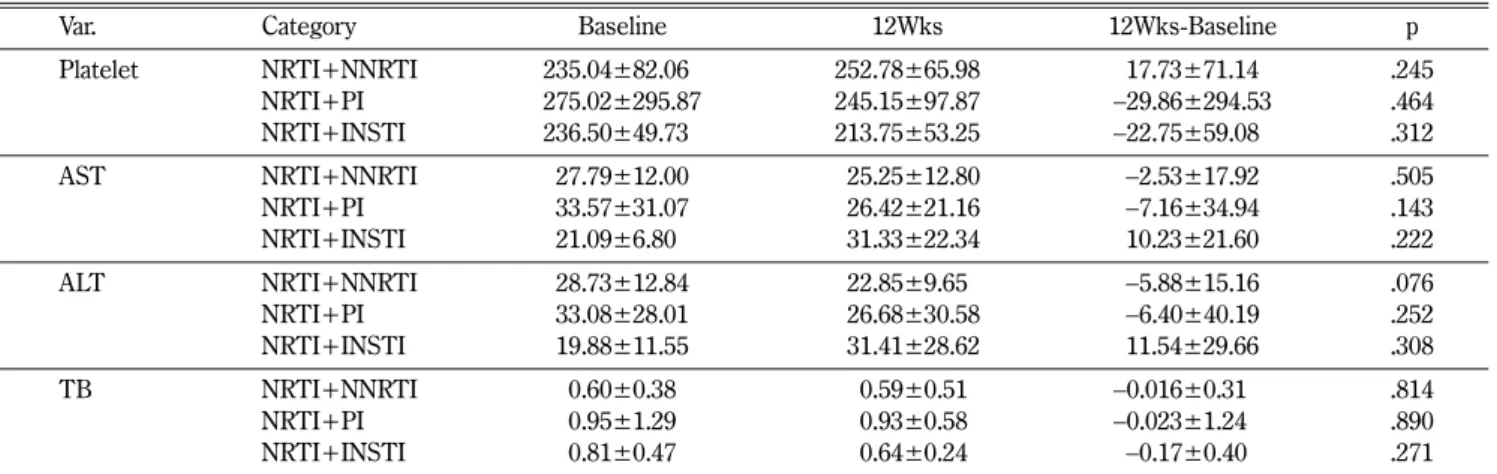
HAART 요법이 간 기능에 미치는 영향을 분석한 결과, NRTI 와 INSTI를 병용 투여했을 경우 AST와 ALT 수치가 증가하는 경향을 보여주었으나, 통계적으로 유의하지는 않았다. 반면에, NRTI에 NNRTI나 PI를 병용할 경우 AST와 ALT가 감소하였으 나, 또한 통계적인 유의성은 발견할 수 없었다. NRTI+NNRTI 요법은 혈소판 수치를 증가시켰으나, NRTI+PI와 NRTI+INSTI 요법은 이를 감소시키는 경향을 보여주었다. 하지만, 세 군 모두 에서 이러한 변화는 통계적으로 유의하지 않았다. 그 외의 자료 는 Table IV에 제시하였다.
HAART 요법에 따른 이상지질혈증의 발생빈도를 분석한 결과, TC 수치가 240 mg/dL 이상인 경우는 없었다. 하지만, TG 수치가 200 mg/dL 이상인 경우는 NRTI+PI에서 52.8%, NRTI+NNRTI 와 NRTI+INSTI에서 각각 21.7%와 25.0%로 나타났다. 그 외 의 자료는 Table V에 제시하였다.
고찰 및 결론
HIV 감염으로 인해 HAART 요법으로 치료 받는 환자들에서 이상지질혈증이나 당대사이상의 대사합병증의 발생빈도가 증가
하고 있다. 국외에서는 HAART 요법을 실시하는 HIV 감염환자 의 TG 및 LDL과 TC의 변화에 관한 다양한 연구들이 이루어졌 으나, 이러한 대부분의 연구들은 백인이나 HIV 감염환자의 이환 율이 높은 아프리카 지역에서 실시되었다. 따라서, 국내 HIV 감 염환자의 수가 약 8천 명임에도 불구하고, 국내 HIV 감염환자를 대상으로 한 연구가 부족한 시점에서 본 연구는 HIV 감염으로 인해 HAART 요법을 시행하고 있는 국내 환자들의 이상지질혈 증의 발생빈도와 항레트로바이러스 약제의 처방 양상을 분석하 였다는데 그 의의가 있다고 할 수 있다.
본원에서 처방된 HAART 요법의 양상을 분석한 결과, zidovudine/lamivudine(ZDV/3TC) 또는 abacavir/lamivudine(ABC/
3TC)을 기본으로 하여 NNRTI로 efavirenz(EFZ), PI로 atazanavir (ATV)나 lopinavir/low dose ritonavir(LPV/r)를 병용 투여하는 삼제요법이 보편적으로 사용되고 있었다. 이러한 삼제요법은 2009 년 항레트로바이러스 다제요법의 가이드라인에서 대체요법 (alternative regimen)으로 추천되는 것과 일치하였다.22)동일한 가이드라인에서는 선호되는 요법(preferred regimen)으로 tenofovir/emtricitabine(TDF/FTC)을 NRTI로 추천하고 있지만, 본원에 TDF/FTC를 도입한 시점이 2012년이라는 점을 감안할 때, 추적 관찰 기간 중에 본원에서는 가이드라인에 따라 HAART 요법이 제대로 시행되고 있었던 것으로 사료된다.
Table IV − Changes in liver functions and platelet levels
Var. Category Baseline 12Wks 12Wks-Baseline p
Platelet NRTI+NNRTI 235.04±82.060 252.78±65.98 17.73±71.14 .245
NRTI+PI 275.02±295.87 245.15±97.87 −29.86±294.53 .464
NRTI+INSTI 236.50±49.730 213.75±53.25 −22.75±59.080 .312
AST NRTI+NNRTI 27.79±12.00 025.25±12.80 −2.53±17.92 .505
NRTI+PI 33.57±31.07 026.42±21.16 −7.16±34.94 .143
NRTI+INSTI 21.09±6.800 031.33±22.34 10.23±21.60 .222
ALT NRTI+NNRTI 28.73±12.84 22.85±9.65 −5.88±15.16 .076
NRTI+PI 33.08±28.01 026.68±30.58 −6.40±40.19 .252
NRTI+INSTI 19.88±11.55 031.41±28.62 11.54±29.66 .308
TB NRTI+NNRTI 0.60±0.38 00.59±0.51 −0.016±0.31 00 .814
NRTI+PI 0.95±1.29 00.93±0.58 −0.023±1.2400 .890
NRTI+INSTI 0.81±0.47 00.64±0.24 −0.17±0.400 .271
AST, aspartate aminotransferase; ALT, alanine aminotransferase; TB, T-biliribin ; NRTI, nucleoside reverse transcriptase inhibitor;
NNRTI, nonnucleoside reverse transcriptase inhibitor; PI, protease inhibitor; INSTI, integrase inhibitor.
Table V − Incidence of hypertriglyceridemia
HAART N (%)
Total
0~200 201~500 501~750 750 이상
NRTI+PI 25 (47.2%) 22 (41.5%) 5 (9.4%) 1 (1.9%) 53 (100.0%)
NRTI+NNRTI 18 (78.3%) 05 (21.7%) 0 (0.0%) 0 (0.0%) 23 (100.0%)
NRTI+INSTI 06 (75.0%) 02 (25.0%) 0 (0.0%) 0 (0.0%) 08 (100.0%)
Total 49 (58.3%) 29 (34.5%) 5 (6.0%) 1 (1.2%) 84 (100.0%)
NRTI, nucleoside reverse transcriptase inhibitors; NNRTI, nonnucleoside reverse transcriptase inhibitors; PI, protease inhibitors;
INSTI, integrase inhibitor.
연구에 의하면, abacavir 과민반응은 HLA-B*5701 양성 반응 자에서 주로 나타나는 것으로 알려져 있기 때문에, abacavir를 처 방하기 전 HLA-B*5701 유전자 검사를 시행하도록 권장하고 있 다.23)추적 관찰 기간 중에 abacavir를 포함한 HAART 요법을 처방 받은 HIV 감염환자는 모두 24명으로 조사되었으나, 이 환 자들이 abacavir 투여 전에 HLA-B*5701 유전자 검사를 받았는 지 여부는 확인할 수 없었다. 하지만, 2009년 국내에서 534명의 HIV 환자들을 대상으로 이루어진 연구에 의하면, HLA-B*5701 유전자 검사를 실시하였을 경우 양성률이 0%(95 신뢰구간 0~
0.7%)로 나타나 한국인에서 HLA-B*5701 양성률이 현저하게 낮 은 것으로 보고되었다.24)하지만, HLA-B*5701 음성환자에서도 과민성을 완전히 배제할 수 없으며, 현재 국내의 HIV치료 가이 드라인에서도 abacavir를 처방하기전 환자에게 HLA-B*5701 유 전자 검사를 시행하도록 권장하고 있다. 따라서, 국내에서 avacavir 를 복용하려는 HIV 환자의 HLA-B*5701 유전자 검사와 관련하 여, 대규모 연관된 연구 및 비용-효과적인 측면을 고려한 후속 연구들이 필요하다고 사료된다.
HAART 요법에서 NRTI와 관련된 간독성은 lactic acidosis와 간부전을 야기할 수 있어, HIV 감염환자의 생명을 위협하는 심 각한 부작용으로 인식되어 왔다.25)본 연구의 결과는 NRTI+
NNRTI군과 NRTI+PI군에서 AST와 ALT 수치가 통계적인 유 의성은 없었지만, 약물을 복용한 3개월 후에 감소하는 경향을 보 여주었다. 하지만, NRTI+INSTI(raltegravir)군에서는 동일한 기 간 동안 AST와 ALT 수치가 상승하였는데, 통계적인 유의성은 발견할 수 없었다. 이는 raltegravir가 NNRTI와 비슷한 간독성 을 보인다는 Surgers 등의 연구 결과와 상이하다고 할 수 있다.26) HAART 요법 중 PI에 의한 이상지질혈증(예: 고콜레스테롤혈 증과 고중성지방혈증)은 HIV 감염환자가 약물치료를 시작한지 1년후에 약 25%정도 환자에서 발생하는 것으로 알려져 있는데, 이는 항바이러스제뿐만 아니라 호르몬이나 유전적 요인 등과 같 은 복합적인 위험인자에 의해 발생한다고 한다.1,2,27) 또한, 2013 년 미국에서 실시된 항바이러스제 치료를 받는 HIV 감염 환자 를 대상으로 한 연구에 의하면, 이상지질혈증의 경우 여성 환자 (67.3%)에 비해 남성 환자(81.2%)에서 발생빈도가 높은 것으로 나타났다.28)이러한 이상지질혈증이 HIV 감염환자에서 발생하 였을 경우, 우선 식이요법이나 운동용법으로 지질 이상을 개선 하려고 노력하고, 그렇지 않으면 statin계 약물이나 fibrate를권장 하고 있다.1,3,14,15)
본 연구 결과에 의하면, NRTI+PI군에서 TC와 TG가 유의하 게 증가하는 경향을 보여주었으며, 반면에 NRTI+NNRTI군에서 TG가 유의하게 감소하는 양상을 보여주었다. 하지만, 이상지질 혈증의 기준에 적합한 TC 수치가 240 mg/dL 이상인 환자들은 없었으며, TG 수치가 200 mg/dL 이상인 경우는 NRTI+PI에서 52.8%, NRTI+NNRTI와 NRTI+INSTI에서 각각 21.7%와
25.0%로 나타났다. 이러한 이상지질혈증이 항레트로바이러스 약 제 복용 중에 발생하였을 경우, HAART 처방을 변경한 경우가 대부분이었으며, fibrate와 같은 약물을 사용한 경우는 4건에 불 과하였다.
최근에 ritonavir-boosted atazanavir 또는 ritonavir-boosted darunavir가 ritonavir-boosted lopinavir와 비교해 비슷한 치료 효 과를 보이며, 반면에 부작용이 적다는 연구결과가 발표되었다.29) 또한, INSTI인 raltegravir는 현재 축적된 임상자료가 상대적으 로 충분하지 않으며 하루 2번 복용해야 한다는 단점에도 불구하 고, 대사적 합병증이나 약물상호작용의 발생률이 적다는 장점이 있다고 한다.27)따라서, 2013년 국내 HIV 감염환자의 HIV/AIDS 진단 및 치료에 관한 임상진료지침 권고안은 기존에 2차 치료제 로 분류했던 raltegravir를 1차 치료제로 새로 추가하였다.30)현 재 본원에서도 HAART 요법 처방 시 제2의 약제를 raltegravir 로 변경하는 사례가 증가하고 있다.
또한, 대한에이즈학회에서 발간한 HIV 치료가이드라인에 의 하면, B형 간염 바이러스(hepatitis B virus, HBV)에 동시에 감 염된 HIV 감염환자에 HBV와 HIV 모두에 효과가 있는 항레트 로바이러스 약제의 조합인 tenofovir+lamivudine이나 tenofovir+
emtricitabine을 사용하도록 권장하고 있다.31)본원의 경우, HBV 와 HIV에 동시에 감염된 환자들의 수가 충분하지 않아, 이러한 처방 권고사항을 제대로 따르고 있는지 여부를 파악할 수 없었 으며, 또한 HBV와 HIV 동시 감염자에서 HAART 요법의 시행 으로 인한 임상 수치(예: TC, TG, GL, AST, ALT)의 변화에 대 해 분석을 할 수 없었다. 따라서, 다기관 연구를 통해 HBV에 동 시에 감염된 HIV 감염환자에서 HAART 요법의 처방 양상과 부 작용에 대한 추가적인 연구가 이루어져야 할 것으로 사료된다.
HIV 감염에서 결핵은 흔하게 발생하는 기회감염의 하나로 우 리나라에서도 HIV 기회감염 중 12.5~26%를 차지하고 있으며, 2001년 10만 명당 0.025에서 2005년 0.095로 증가하는 경향을 보여주었다.30) 본원에서도 HIV 감염환자의 처방 양상을 조사하 는 과정에서 HIV에 감염된 3명의 결핵환자를 발견하였는데, 이 들 중 2명에게는 1차 결핵약물이 처방되었으며, 나머지 1명에게 는 2차 결핵약물이 6개월 이상 처방되었다.
본 연구가 갖는 몇 가지 한계점은 환자의 의무기록지만을 활 용하여 후향적으로 분석하였기 때문에 일부 환자들의 자료에 통 일성을 확보하기 어려웠다는 점이다. 특히, 환자들의 이상지질혈 증을 조사하기 위해 항바이러스 약물 복용 3개월 후의 TC와 TG 수치를 조사하였지만, 해당기관의 감염내과를 방문하는 외래 환 자들을 대상으로 하였기 때문에 정확하게 follow-up 기간을 조정 할 수가 없었다. 또한, 연구기간 동안 해당기관의 감염내과 외래 를 HIV 감염의 약물치료를 목적으로 방문한 환자군이 모두 남 성들이었고, 이 부분이 아마도 항바이러스 약물 복용으로 인한 이상지질혈증 발생률에 영향을 미쳤을 것으로 사료된다.28)따라
서, 복용한 항바이러스 약물이 성별에 따라 이상지질혈증에 어떻 게 영향을 미치는지 알아보기 위한 추가 연구가 필요하다. 마지 막으로, HIV 감염 치료가이드라인에서는 선호하는 HAART 요 법으로 tenofovir+emitricitabine을 NRTI로 처방할 것을 권장하 고 있으나, 본원에서는 이 2가지 약제를 2012년에 도입하였기 때 문에, 이전에는 대체 HAART 요법을 환자들에게 처방하였다는 것이다. 따라서, tenofovir+emitricitabine의 약물 사용 평가와 다 른 HAART 요법간의 효과를 최신 HIV가이드라인에 근거하여 향후 비교 · 분석할 필요가 있을 것으로 사료된다.
감사의 글
이 논문은 2015년도 조선대학교 학술연구비의 지원을 받아 연 구되었음(This study was supported by research fund from Chosun University, 2015).
References
1) Lo, J. : Dyslipidemia and lipid management in HIV-infected patients. Curr. Opin. Endocrinol. Diabetes Obes. 18, 144 (2011).
2) Sprinz, E., Lazzaretti, R. K., Kuhmmer, R. and Ribeiro, J. P. : Dyslipidemia in HIV-infected individuals. Braz. J. Infect. Dis.
14, 575 (2010).
3) Estrada, V. and Portilla, J. : Dyslipidemia related to antiretroviral therapy. AIDS Rev. 13, 49 (2011).
4) Grinspoon, S. and Carr, A. : Cardiovascular risk and body-fat abnormalities in HIV-infected adults. N. Engl. J. Med. 352, 48 (2005).
5) Imamura, A. : Antiretroviral therapy of HIV infection. Nihon.
Rinsho. 70, 601 (2012).
6) Stanley, T. L. and Grinspoon, S. K. : Body composition and metabolic changes in HIV-infected patients. J. Infect. Dis. 205 Suppl 3, S383 (2012).
7) Fichtenbaum, C. J. : Coronary heart disease risk, dyslipidemia, and management in HIV-infected persons. HIV Clin. Trials 5, 416 (2004).
8) Friis-Moller, N., Weber, R., Reiss, P., Thiebaut, R., Kirk, O., d’Arminio Monforte, A., Pradier, C., Morfeldt, L., Mateu, S., Law, M., El-Sadr, W., De Wit, S., Sabin, C. A., Phillips, A. N.
and Lundgren, J. D. : Cardiovascular disease risk factors in HIV patients-association with antiretroviral therapy. Results from the DAD study. AIDS 17, 1179 (2003).
9) Villarroya, F., Domingo, P. and Giralt, M. : Drug-induced lipotoxicity: lipodystrophy associated with HIV-1 infection and antiretroviral treatment. Biochim. Biophys. Acta 1801, 392 (2010).
10) Croxtall, J. D. and Perry, C. M. : Lopinavir/Ritonavir: a review
of its use in the management of HIV-1 infection. Drugs 70, 1885 (2010).
11) Podzamczer, D., Andrade-Villanueva, J. Clotet, B., Taylor, S., Rockstroh, J. K., Reiss, P., Domingo, P., Gellermann, H. J., de Rossi, L., Cairns, V. and Soriano, V. : Lipid profiles for nevirapine vs. atazanavir/ritonavir, both combined with tenofovir disoproxil fumarate and emtricitabine over 48 weeks, in treatment-naive HIV-1-infected patients (the ARTEN study). HIV Med. 12, 374 (2011).
12) Lu, C. L., Lin, Y. H., Wong, W. W., Lin, H. H., Ho, M. W., Wang, N. C., Hsieh, S. M., Sheng, W. H., Hung, C. C. and Chen, M. Y. : Outcomes of switch to atazanavir-containing combination antiretroviral therapy in HIV-1-infected patients with hyperlipidemia. J. Microbiol. Immunol. Infect. 44, 258 (2011).
13) Kramer, A. S., Lazzarotto, A. R., Sprinz, E. and Manfroi, W. C. : Metabolic abnormalities, antiretroviral therapy and cardiovascular disease in elderly patients with HIV. Arq. Bras. Cardiol. 93, 561 (2009).
14) Guidelines for the use of antiretroviral agents in HIV-1- infected adults and adolescents (2012). Available at: http://
aidsinfo.nih.gov/contentfiles/adultandadolescentgl003093.pdf (Accessed on February 5, 2015).
15) Grundy, S. M., Cleeman, J. I., Merz, C. N., Brewer, H. B. Jr., Clark, L. T., Hunninghake, D. B., Pasternak, R. C., Smith, S. C.
Jr. and Stone, N. J. : Implications of recent clinical trials for the national cholesterol education program adult treatment panel III guidelines. Circulation 110, 227 (2004).
16) Giuntini, R., Martinelli, C., Ricci, E., Vichi, F., Gianelli, E., Madeddu, G., Abeli, C., Palvarini, L., Penco, G., Marconi, P., Grosso, C., Pellicano, G., Bonfanti, P. and Quirino, T. : Efficacy and safety of boosted and unboosted atazanavir-containing antiretroviral regimens in real life: results from a multicentre cohort study. HIV Med. 11, 40 (2010).
17) Vrouenraets, S. M., Wit, F. W., Fernandez Garcia, E., Moyle, G. J., Jackson, A. G., Allavena, C., Raffi, F., Jayaweera, D. T., Mauss, S., Katlama, C., Fisher, M., Slama, L., Hardy, W. D., Dejesus, E., van Eeden, A. and Reiss, P. : Randomized comparison of metabolic and renal effects of saquinavir/r or atazanavir/r plus tenofovir/emtricitabine in treatment-naive HIV-1-infected patients. HIV Med. 12, 620 (2011).
18) Bonnet, F., Aurillac-Lavignolle, V., Breilh, D., Thiébaut, R., Peuchant, E., Bernard, N., Lacoste, D., Dabis, F., Beylot, J., Chêne, G. and Morlat, P. : Pravastatin in HIV-infected patients treated with protease inhibitors: a placebo-controlled randomized study. HIV Clin. Trials 8, 53 (2007).
19) Singh, S., Willig, J. H., Mugavero, M. J., Crane, P. K., Harrington, R. D., Knopp, R. H., Kosel, B. W., Saag, M. S., Kitahata, M. M. and Crane, H. M. : Comparative effectiveness
and toxicity of statins among HIV-infected patients. Clin.
Infect. Dis. 52, 387 (2011).
20) Aslangul, E., Assoumou, L., Bittar, R., Valantin, M. A., Kalmykova, O., Peytavin, G., Fiévet, M. H., Boccara, F., Bonnefont-Rousselot, D., Melchior, J. C., Giral, P. and Costagliola, D. : Rosuvastatin versus pravastatin in dyslipidemic HIV-1-infected patients received protease inhibitors: a randomized trial. AIDS 24, 77 (2010).
21) Korea Center for Disease Control and Prevention. Annual report on the notified HIV/AIDS in Korea. Available at:
www.cdc.go.kr (accessed on February 4, 2015).
22) Guidelines for the use of antiretroviral agents in HIV-1- infected adults and adolescents (2009). Available at: http://
aidsinfo.nih.gov/contentfiles/adultandadolescentgl001419.pdf (accessed on February 3, 2015).
23) Saag, M., Balu, R., Phillips, E., Brachman, P., Martorell, C., Burman, W., Stancil, B., Mosteller, M., Brothers, C., Wannamaker, P., Hughes, A., Sutherland-Phillips, D., Mallal, S.
and Shaefer, M. : High sensitivity of human leukocyte antigen- b*5701 as a marker for immunologically confirmed abacavir hypersensitivity in white and black patients. Clin. Infect. Dis.
46, 1111 (2008).
24) Park, W. B., Choe, P. G., Song, K. H., Lee, S., Jang, H. C., Jeon, J. H., Park, S. W., Park, M. H., Oh, M. D. and Choe, K. W. : Should HLA*5701 screening be performed in every ethnic group before starting abacavir?. Clin. Infect. Dis. 48, 365 (2009).
25) Duong Van Huyen, J. P., Batisse, D., Bélair, M. F. and Bruneval, P. : Mitochondrial hepatic toxicity associated with antiretroviral treatment. Ann. Pathol. 25, 299 (2005).
26) Surgers, L. and Lacombe, K. : Hepatoxicity of new antiretrovirals: a systematic review. Clin. Res. Hepatol.
Gastroenterol. 37, 126 (2013).
27) Lennox, J. L., Dejesus, E., Berger, D. S., Lazzarin, A., Pollard, R. B., Ramalho Madruga, J. V., Zhao, J., Wan, H., Gilbert, C. L., Teppler, H., Rodgers, A. J., Barnard, R. J., Miller, M. D., Dinubile, M. J., Nguyen, B. Y., Leavitt, R. and Sklar, P. : Raltegravir versus Efavirenz regimens in treatment-naïve HIV-1-infected patients: 96-week efficacy, durability, subgroup, safety, and metabolic analyses. J. Acquir. Immune. Defic. Syndr.
55, 39 (2010).
28) Buchacz, K., Baker, R. K., Palella, F. J., Shaw, L., Patel, P., Lichtenstein, K. A., Chmiel, J. S., Vellozzi, C., Debes, R., Henry, K., Overton, E. T., Bush, T. J., Tedaldi, E., Carpenter, C., Mayer, K. H. and Brooks, J. H. : Disparities in prevalence of key chronic diseases by gender and race/ethnicity among antiretroviral-treated HIV-infected adults in the US. Antivir.
Ther. 18, 65 (2013).
29) Orkin, C., DeJesus, E., Khanlou, H., Stoehr, A., Supparatpinyo, K., Lathouwers, E., Lefebvre, E., Opsomer, M., van de Casteele, T. and Tomaka, F. : Final 192-week efficacy and safety of once-daily darunavir/ritonavir compared with lopinavir/ritonavir in HIV-1-infected treatment-naive patients in the ARTEMIS trial. HIV Med. 14, 49 (2013).
30) Korean Society for AIDS : The 2013 clinical guidelines for the diagnosis and treatment of HIV/AIDS in HIV-infected Koreans.
Infect. Chemother. 45, 455 (2013).
31) Korean Society for AIDS : Clinical guidelines for the diagnosis and treatment of HIV/AIDS in HIV-infected Koreans. Infect.
Chemother. 43, 89 (2011).