Received: 2012.5.3. Revised: 2012.10.4. Accepted: 2012.10.9.
Corresponding author: Won Gyu Kim
Department of Obstetrics and Gynecology, Kosin University Gospel Hospital, Kosin University College of Medicine, 262 Gamcheon-ro, Seo-gu, Busan 602-702, Korea
Tel: +82-51-990-6227 Fax: +82-51-244-6939 E-mail: [email protected]
Articles published in Obstet Gynecol Sci are open-access, distributed under the terms of the Creative Commons Attribution Non-Commercial License (http://creativecommons.
org/licenses/by-nc/3.0/) which permits unrestricted non-commercial use, distribution, and reproduction in any medium, provided the original work is properly cited.
Copyright © 2013 Korean Society of Obstetrics and Gynecology
Introduction
Stage IB cervical cancer has a relatively favorable prognosis but the 20% treatment failure has yet remains. The survival of patients with early stage cervical cancer after radical hysterectomy and pel- vic lymphadenectomy depends on the presence or absence of sev- eral poor prognostic clinicopathologic risk factors. High-risk factors for recurrent disease are as follow: positive lymph nodes, positive or close surgical margins, parametrial involvement. Intermediate risk factors for recurrent disease are as follow: large tumor size, deep cervical stromal invasion, lymphovascular space invasion.
PROMISING TREATMENT RESULTS OF ADJUVANT
CHEMOTHERAPY FOLLOWING RADICAL HYSTERECTOMY FOR INTERMEDIATE RISK STAGE 1B CERVICAL CANCER
Tae Yeon Lee, Yi Jo Jeung, Chun Jun Lee, Heung Yeol Kim, Sung Han Kim, Won Gyu Kim
Department of Obstetrics and Gynecology, Kosin University College of Medicine, Busan, Korea
Objective
The aim of this retrospective study is to evaluate the efficacy of adjuvant chemotherapy following radical hysterectomy for intermediate risk stage IB cervical cancer.
Methods
From January 1993 to December 2007, a total of 100 patients of stage IB were enrolled in this study who had at least two of the following three intermediate risk factors (deep stromal invasion, lymphovascular space involvement, and large tumor size) after radical hysterectomy and all patients had no high risk factors and no radiotherapy. Of these patients, 22 patients had surgery only and 78 patients had cisplatin-based combination chemotherapy as adjuvant therapy postoperatively to improve survival. Kaplan- Meier survival curves and Cox’s proportional-hazards regression model and log-rank test were used for survival analysis and to estimate the impact of prognostic factors on survival.
Results
The mean age was 52 years (range, 28 to 76 years). The overall survival rate of all intermediate tumors are 92% (92/100). Surgery only group is 81.8% (18/22) and adjuvant chemotherapy group is 94.9% (74/78). Comparison of survival between two groups revealed significant statistical difference in both univariant and multivariant survival analysis (P<0.05). The main toxicities of adjuvant chemotherapy were bone marrow suppression (18%), nausea and vomiting (5.2%) and alopecia in etoposide-cisplatin chemotherapy group (100%) but most side effects of postoperative adjuvant chemotherapy were transient, reversible and within acceptable limits to all patients.
Conclusion
Cisplatin based combined adjuvant chemotherapy for intermediate risk tumors after radical hysterectomy is promising with significant improvement of overall survival and with acceptable toxicity profile.
Keywords: Uterine cervical neoplasm; Chemotherapy, Adjuvant; Cisplatin; Survival analysis http://dx.doi.org/10.5468/OGS.2013.56.1.15
pISSN 2287-8572 · eISSN 2287-8580
Adjuvant therapy is recommended for both these intermediate and high risk patients to improve survival [1-5]. For high risk tumors, concurrent chemoradiotherapy is now regarded as the standard of treatment [6-8].
But for intermediate risk cervical cancer patients, method of adjuvant therapy has been debating. Radiotherapy has been used as postoperative adjuvant therapy to reduce recurrence in patients with intermediate risk tumors and the effectiveness of radiother- apy has been widely accepted, based on the results of a random- ized studies reported by Sedlis et al. [9]. But radiotherapy have lo- cal effects only, so are not effective in distant metastatic diseases, and have high incidence of morbidity and mortality in patients receiving full course radiotherapy following radical surgery [10,11].
Several studies have suggested that chemotherapy alone is prom- ising as postoperative adjuvant therapy for intermediate risk cervi- cal cancer patients. Postoperative adjuvant chemotherapy without radiotherapy is expected to have several advantages including ef- ficacy for control of both microscopic local and distant metastatic diseases, preservation of ovarian function in young female and avoidance of long term serious radiation sequelae. Also the toxici-
ties of chemotherapy were mostly reversible and within acceptable limits [12-14].
Cisplatin-based chemotherapy usually has been accepted as ef- fective adjuvant therapy against cervical carcinomas. So we have applied postoperative adjuvant cisplatin based combination che- motherapy to the patients who had at least two of the intermedi- ate risk factors and who had no high risk factors and who refused radiotherapy to avoid serious postoperative radiation complication.
Materials and Methods
1. Patients
In this retrospective study we reviewed the medical records of stage IB cervical cancer patients who had radical hysterectomy and pelvic lymphadenectomy at the Gospel Hospital, Busan, Korea from January 1993 to December 2007. Among them, 100 inter- mediate risk tumors were eligible. Of these patients, 22 patients had surgery only and 78 patients had cisplatin based combination chemotherapy postoperatively as adjuvant therapy to improve
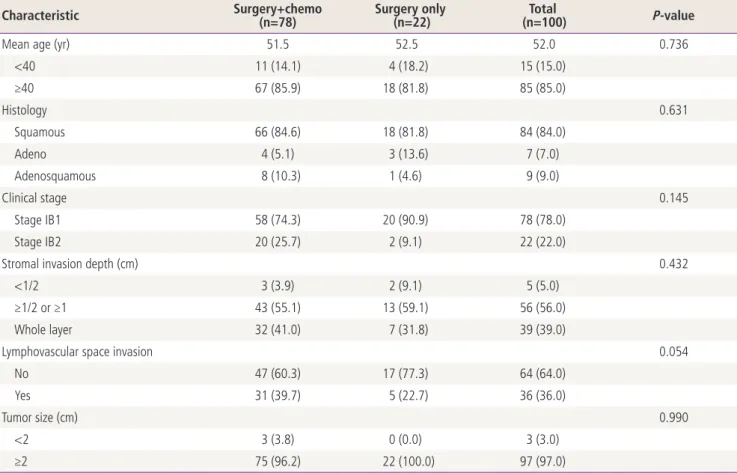
Table 1. Clinicopathologic characteristics of 100 patients with postoperation intermediate risk factors
Characteristic Surgery+chemo
(n=78) Surgery only
(n=22) Total
(n=100) P-value
Mean age (yr) 51.5 52.5 52.0 0.736
<40 11 (14.1) 4 (18.2) 15 (15.0)
≥40 67 (85.9) 18 (81.8) 85 (85.0)
Histology 0.631
Squamous 66 (84.6) 18 (81.8) 84 (84.0)
Adeno 4 (5.1) 3 (13.6) 7 (7.0)
Adenosquamous 8 (10.3) 1 (4.6) 9 (9.0)
Clinical stage 0.145
Stage IB1 58 (74.3) 20 (90.9) 78 (78.0)
Stage IB2 20 (25.7) 2 (9.1) 22 (22.0)
Stromal invasion depth (cm) 0.432
<1/2 3 (3.9) 2 (9.1) 5 (5.0)
≥1/2 or ≥1 43 (55.1) 13 (59.1) 56 (56.0)
Whole layer 32 (41.0) 7 (31.8) 39 (39.0)
Lymphovascular space invasion 0.054
No 47 (60.3) 17 (77.3) 64 (64.0)
Yes 31 (39.7) 5 (22.7) 36 (36.0)
Tumor size (cm) 0.990
<2 3 (3.8) 0 (0.0) 3 (3.0)
≥2 75 (96.2) 22 (100.0) 97 (97.0)
survival. Patient characteristics are listed in Table 1. Criteria for intermediate risk group are still debating and there are two com- monly used criterias for intermediate risk tumors now; Classic vs.
gynecological oncology group (GOG) 92 criteria (Table 2).
We applied classic criteria for our intermediate risk tumors because of its simplicity and usefulness. Our eligible criteria for intermediate risk tumors are stage IB cervical cancer patients who had type III radical hysterectomy and pelvic lymphadenectomy and who had at least two of the following three intermediate risk fac- tors (deep stromal invasion ≥1/2 or ≥1 cm, lymphovascular space involvement, large tumor size ≥2 cm) and all patients had no high risk factors and no obious any residual tumors.
2. Surgery and chemotherapy
All eligible 100 patients had type III radical hysterectomy with pelvic/paraaortic lymph node dissection. Among them, total 78 (78%) patients received postoperative cisplatin based combination adjuvant chemotherapy (1 to 6 cycles/patient, total 300 cycles/78 patients; average 3.8 cycles/patient). The schedules of the cisplatin based combination chemotherapy are as follows. Five-fluorouracil- cisplatin combination chemotherapy regimen consisted of cisplatin 50 mg/m
2on day 1 and followed by 5-fluorouracil 1,000 mg/m
2/day given intravenously from day 2 to day 5 daily with 3 weekly intervals (total 127 cycles/34 patients) and etoposide-cisplatin combination chemotherapy regimen consisted of cisplatin 30 mg/m
2and etopo- side 60 mg/m
2given intravenously daily for 3 days with 3 weekly intervals (total 173 cycles/44 patients). Toxicities were recorded and categorized using the National Cancer Institute Common Toxicity Criteria (ver. 3.0, 2003) and chemotherapy was withheld
if any of the following criteria were observed: leukocytes <3,000/
mm
3, granulocytes <1,500 mm
3, platelets <100,000/mm
3, serum creatinine level >2.0 mg/dL. In case of severe toxicity, chemother- apy was delayed until the symptoms of toxicities had disappeared.
3. Follow-up and statistics
Median follow-up period is 109 months. Overall survival was of- fered by the Korean National Stastistical Office. Patient selections between two groups (surgery only and postoperative adjuvant chemotherapy group) were done randomly and Kaplan-Meier survival curves and Cox’s proportional-hazards regression model and log-rank test were used for survival analysis and to estimate the impact of prognostic factors on survival and SPSS PASW ver.
18.0 software (IBM, Armonk, NY, USA) was used for the statistical analysis. P-value less than 0.05 was considered significant.
Results
The mean age of patients at diagnosis was 52 years (range, 28 to 76 years), and 84.0% (84/100) had squamous cell type, and 78.0% (78/100) had stage IB1, and 56.0% (56/100) had stromal invasion ≥1/2 or ≥1 cm but not whole layer, and 36.0% (36/100) had lymphovascular space invasion, and 97.0% (97/100) had tu- mor size ≥2 cm (Table 1).
Comparison of patient characteristics between two groups re- vealed no significant differences. In overall survival, there are 8 deaths (4 deaths in surgery only group, and 4 deaths in adjuvant chemotherapy group), the overall survival rate of all intermediate
Table 2. Criterias of intermediate risk tumors: Classic vs. GOG criteria
Classic criteria GOG 92 (Sedlis) criteria
Lymphovascular space involvement CLS (+), stromal invasion deep 1/3, any tumor size Deep stromal invasion CLS (+), stromal invasion middle 1/3, tumor size >2 cm
Tumor size ≥2 cm CLS (+), stromal invasion superficial 1/3, tumor size >5 cm
CLS (-), stromal invasion deep or middle 1/3, tumor size >4 cm GOG, gynecological oncology group; CLS, capillary lymphatic space invasion.
Table 3. Deaths analysis of 100 patients with intermediate risk factors
Status Surgery + chemotherapy (n=78) Surgery only (n=22)
Alive 74 (94.9) 18 (81.8)
Dead 4 (5.1): 3 (EP), 1 (FP) 4 (18.2)
Mean survival time to death (mo) 38 26
Values are presented as number (%).
EP, etoposide-cisplatin; FP, 5-fluorouracil-cisplatin.
tumors are 92% (92/100); surgery only group is 81.8% (18/22) and postoperative adjuvant chemotherapy group is 94.9% (74/78), respectively. Mean survival time from disease diagnosis to death are 26 months in surgery only group and 38 months in postradical adjuvant chemotherapy group. Comparison of survival curves be- tween two groups revealed significant statistical difference in both univariant and multivariant survival analysis (P<0.05) (Tables 3-5;
Fig. 1).
Toxicities of adjuvant chemotherapy were mostly transient, re- versible and within acceptable limits. Grade 3 or 4 myelosuppres- sion was observed in 18%, grade 3 or 4 gastrointestinal toxicity was observed in 5.2%, grade 3 or 4 hepatotoxicity was observed in two cases, and cardiac toxicity was observed in one case in etoposide-cisplatin group. Grade 3 or 4 alopecia was observed in all patients in etoposide-cisplatin group but was not observed in 5-fluorouracil-cisplatin group.
Table 4. Survival analysis of 100 patients with intermediate risk factors (Kaplan Meier)
Characteristic Survival
P-value
Alive (n=92) Death (n=8)
Mean age 0.853
<40 13 (14.1) 1 (12.5)
≥40 79 (85.9) 7 (87.5)
Treatment type 0.045
Surgery only 18 (19.6) 4 (50.0)
Surgery+chemo 74 (80.4) 4 (50.0)
Histology 0.466
Squamous 79 (85.9) 6 (75.0)
Adeno 5 (5.4) 2 (25.0)
Adenosquamous 8 (8.7) 0 (0.0)
Clinical stage 0.291
Stage IB1 73 (79.3) 5 (62.5)
Stage IB2 19 (20.7) 3 (37.5)
Stromal invasion depth (cm) 0.317
<1/2 3 (3.3) 2 (25.0)
≥1/2 or ≥1 54 (58.7) 2 (25.0)
Whole layer 35 (38.0) 4 (50.0)
Lymphovascular 0.871
No 54 (58.7) 5 (62.5)
Yes 38 (41.3) 3 (37.5)
Tumor size (cm) 0.629
<2 3 (3.3) 0 (0.0)
≥2 89 (96.7) 8 (100.0)
Table 5. Cox proportional hazard regression model for survival
Variable Odd ratio 95% confidence interval for odd ratio
P-value
Lower Upper
Treatment type 0.173 0.032 0.939 0.042
Tumor size 0.258 0.521 1.280 0.097
Lymphovascular invasion 0.960 0.185 5.911 0.960
Stromal invasion 0.250 0.028 4.075 0.392
Discussion
The survival of patients with stage IB cervical cancer after radi- cal hysterectomy and pelvic lymphadenectomy depends on the presence or absence of several poor prognostic clinicopathologic risk factors. The poor risk factors are now classified into two groups: classic high risk and newly developed intermediate risk factors [1-5]. In 1989 and 1990, the GOG published the results of prospective clinicopathologic studies of patients with stage IB cervical carcinoma treated by radical hysterectomy and bilateral pelvic lymphadenectomy. These studies revealed that certain patients with poor prognostic factors related to the primary tu- mor but without classic high risk factors had a risk of recurrence after radical hysterectomy and pelvic lymphadenectomy. The poor prognostic factors related to the primary tumor are as follow: clini- cal tumor size, presence or absence of capillary lymphatic space invasion, depth of tumor stromal invasion; the so called newly developed intermediate risk factors [4,5]. Postoperative adjuvant therapy is recommended for these poor risk tumors to reduce re- currence and to prolong survival. Concurrent chemoradiotherapy is now regarded as the standard of treatment for high risk tumors [6-8].
But adjuvant treatment modalities for intermediate risk tumors have been debating. Use of radiotherapy postoperatively for stage IB, intermediate risk tumors was shown to be beneficial in reduc- ing the risk of recurrence by various studies [9,10]. In 1999, Sedlis et al. [9] showed that adjuvant pelvic radiotherapy reduced recur- rence from 28% to 15% at 2 years after treatment and had better
2-year disease free survival than no treatment group in their pro- spective study for intermediate risk cervical cancer. This result sug- gested that radiotherapy has a role in adjuvant therapy, and after this report radiotherapy has been used as postoperative adjuvant therapy for stages Ib intermediate risk cervical cancer patients [9].
In 2006, Rotman et al. [11] reported the final results of this study, in which adjuvant pelvic radiotherapy significantly prolonged dis- ease free survival but the improvement in overall survival did not reach statistical significance (Hazard ratio, 0.70; 90% confidence interval [CI], 0.45 to 1.05). Possible reasons of Rotman’s results are that radiotherapy have local effects only, so are not effective in distant metastatic disease, and have high incidence of morbidity and mortality in patients receiving full course radiotherapy follow- ing radical surgery [11].
The use of cisplatin based combination chemotherapy was found to improve overall survival in women with advanced cervical can- cers (large IB2 tumors, high risk early stage diseases and recurrent or metastatic cancer of the cervix) [12-21]. Experiences with ad- juvant chemotherapy for poor risk cervical carcinomas suggested that cisplatin-based combination chemotherapy was effective not only in local tumor and may also reduce the incidence of lymph node metastasis and even eradicate microscopic metastasis in dis- tant organs [12-14].
In 1998, Iwasaka et al. [12] performed postoperative adjuvant chemotherapy only for high risk cervical cancer and compared their patients with those from another hospital where postoperative ad- juvant radiotherapy was performed during the same period. All eli- gible patients had no obvious residual lesions after radical surgery.
The results of chemotherapy were similar to those of radiotherapy (83% vs. 81.7% 5-year survival rate). But in the adjuvant chemo- therapy group, 5 of 11 (45%) patients with pelvic recurrences sur- vived more than 5 years after retreatment with irradiation to sites of recurrence, which suggests that adjuvant chemotherapy might be preferable because unnecessary irradiation can be avoided and radiotherapy can be reserved for late locoregional recurrence [12].
In 2006, Takeshima et al. [13] have reported a favorable outcome for intermediate and high risk patients treated with adjuvant chemotherapy following radical hysterectomy. They consistently treated their patients with adjuvant chemotherapy alone for poor risk cervical carcinomas postoperatively for several reasons. First, distant metastasis is a major problem when radiotherapy alone is used, and chemotherapy is considered the most powerful means of eradicating subclinical distant metastastic lesions. Second, their chemotherapy regimen yielded good response rate in patients with recurrent cervical cancer with an acceptable incidence of side Fig. 1. Overall survival by treatment type.
Survival (mo)
Surgery+chemo Surgery only
0 50 100 150 200 250 1.0
0.8
0.6
0.4
0.2
0.0
P = 0.045