ARTICLE
http://dx.doi.org/10.11106/cet.2014.7.2.172Received August 10, 2014 / Revised October 24, 2014 / Accepted November 8, 2014
Correspondence: Seok Man Son, MD, PhD, Department of Internal Medicine, Pusan National University School of Medicine, 49 Busandaehak-ro, Mulgeum-up, Yangsan 626-870, Korea
Tel: 82-55-360-1444, Fax: 82-55-360-1565, E-mail: [email protected]
This study was supported for two years by Pusan National University Research Grant.
Copyright ⓒ 2014, the Korean Thyroid Association. All rights reserved.
This is an open-access article distributed under the terms of the Creative Commons Attribution Non-Commercial License (http:// creative- commons.org/licenses/by-nc/3.0/), which permits unrestricted non-commercial use, distribution, and reproduction in any medium, provided the original work is properly cited.
방사성요오드 치료 전 단기간 갑상선기능저하 상태가 혈청 지질인자 및 심혈관계 위험인자에 미치는 영향
부산대학교 의학전문대학원 내과학교실
여혜주, 조아라, 이혜원, 이동원, 강양호, 손석만
Effect of Short-Term Hypothyroid State on Lipid Profile and Cardiovascular Risk Markers in Subjects Preparing Radioactive Iodine Therapy
Hye Ju Yeo, A Ra Jo, Hye Won Lee, Dong Won Yi, Yang Ho Kang and Seok Man Son Department of Internal Medicine, Pusan National University School of Medicine, Yangsan, Korea
Background and Objectives: The relationship between short-term hypothyroidism due to levothyroxine (LT4) withdrawal for radioactive iodine (RI) therapy in patients with differentiated thyroid cancer (DTC) and risk of cardiovascular disease is not clear. In this study, we evaluated the impact of short-term overt hypothyroidism on lipid profiles and cardiovascular parameters in patients with DTC. Materials and Methods: We recruited 195 patients with DTC who were preparing RI therapy from March 2008 to February 2012. We analyzed the effect of thyroid stimulating hormone (TSH) level on the clinical, biochemical, and cardiovascular risk markers at the end of LT4 withdrawal protocol (P2). Results: After LT4 withdrawal (P2), TSH and total cholesterol (TC) levels were significantly increased (p<0.005). After adjustment for multiple factors such as age, sex, body mass index (BMI), hypertension and diabetes mellitus (DM), the positive relationship between TSH and TC remained significant (p=0.04). Mean levels of homocysteine, low density lipoprotein-cholesterol, triglyceride were increased.
However, levels of high density lipoprotein-cholesterol, cystatin C, C-reactive protein, apolipoprotein B (ApoB), apolipoprotein A1 (Apo A1), lipoprotein (a) (Lp[a]), aspartate transaminase, alanine aminotransferase, total bilirubin, uric acid remained within normal range. Splitting the whole cohort into the three different age groups, serum Apo B, Lp(a) levels and BMI increased with increasing age (p<0.05). And splitting into three different TSH level groups (1st group; <79 μIU/mL, 2nd group; 79-121 μIU/mL, 3rd group; >121 μIU/mL), all values did not have a statistical significant meaning except Apo A1. Conclusion: Short-term hypothyroidism induced worsening of lipid metabolic parameters, but not enough to induce the cardiovascular risk in patients with thyroid cancer.
Key Words: Short-term hypothyroidism, Thyroid cancer, Cardiovascular risk markers, Radioactive iodine therapy
Fig. 1. Study protocols for evaluation of effect of short- term hypothyroid state on lipid and cardiovascular risk markers in subjects with thyroid cancer preparing radioiodine therapy.
서 론
갑상선분화암은 전 세계적으로 발생이 증가하고 있 으며, 2010년 보건복지부 통계에 따르면 연령표준화발 생률이 10만 명당 52.7명으로 우리나라 암 발생 1위를 차지하고 있다.1) 갑상선분화암의 치료는 수술과 잔여 갑상선 및 남은 갑상선암을 제거하기 위한 방사성요오 드 치료로 이루어진다.2) 효과적인 방사성요오드 치료 를 위해서는 혈청 갑상선자극호르몬(thyroid stimulating hormone, TSH) 농도를 적어도 30 μIU/mL 이상으로 상승시켜야 한다. 이를 위해서 갑상선호르몬의 투여중 단을 통해 단기간 갑상선기능저하 상태를 유도하거나, 인간 재조합 갑상선자극호르몬을 투여할 수 있다. 임 상에서는 전자가 일반적으로 행해지고 있으며, 그에 따라 대부분 환자들은 불현성 갑상선기능저하증부터 심한 급성 갑상선기능저하증까지 다양한 상태를 경험 하게 된다.3) 갑상선기능저하증은 동맥경화 발생의 잘 알려진 위험인자로서, 총 콜레스테롤과 저밀도지단백- 콜레스테롤(low-density lipoprotein-cholesterol, LDLc) 수치를 높이며, 이완기 고혈압 발생, 내피세포 기능이 상을 동반한 대혈관의 강직도 증가와 혈전 생성 증가 로 심혈관질환의 위험도를 증가시킨다.4,5) 단기간 갑상 선기능저하 상태에서도 이와 관련된 몇몇 보고가 있었
지만,6-11) 그 관련성은 분명하지 않다. 따라서 지속적인
방사성요오드 치료를 받아야 하는 환자의 경우 심혈관 계 위험성이 증가될 가능성을 배제할 수 없다. 본 연구 에서는 방사성요오드 치료를 위해 갑상선호르몬 투여 를 중단하여 발생된 단기간 갑상선기능저하 상태가 TSH 농도에 따라 혈청 지질인자 및 심혈관 위험인자 들에 미치는 영향을 알아보고자 하였다.
대상 및 방법
연구 대상
2008년 3월부터 2012년 2월까지 갑상선분화암으로 갑상선전절제술을 시행받고, 잔류 갑상선 조직과 잔존 암의 방사성요오드 치료를 위해 입원한 195명(남자 29 명, 여자 166명, 평균 연령 47.38±12세)을 대상으로 후 향적으로 의무기록을 분석하였다. 간질환, 신질환 등의 의미 있는 병력이 있거나 갑상선기능에 영향을 줄 수 있는 약물을 복용하는 사람과 흡연자는 제외하였다.
잘 조절된 당뇨병은 지질인자 변화에 중대한 영향을 미치지 않음을 전제로 하여, 등록시점에 지질강하제를 복용하지 않았고, 최근 3개월 동안 당화혈색소 7% 이 하로 조절이 되었던 당뇨병 환자들(15명)과, 최근 6개 월 동안 약물로 혈압조절이 잘 되었던 고혈압 환자들 (45명)이 포함되었다.
방법
방사성요오드 치료의 전처치로 갑상선호르몬의 복 용을 4주간 중지하여, TSH를 30 μIU/mL 이상 상승시 켰다. 대상자들은 각각 갑상선호르몬 투여 중단 직전 (P1), 갑상선호르몬 투여 중단 4주 후(P2) 병원을 방문 하였고, 매 방문 시마다 신체검사 및 혈액검사를 시행 하였고(Fig. 1), TSH값에 따라 세 군(1군; <79 μIU/mL, 2군; 79-121 μIU/mL, 3군; >121 μIU/mL)으로 분류 하여 단기간 갑상선기능저하 상태에 따른 혈청 지질인 자 및 심혈관 위험인자들의 수치를 비교하였다.
모든 대상자에서 키, 몸무게, 수축기, 이완기 혈압을 측정하였으며 혈압 측정은 최소 5분 이상 안정을 취한 후 표준혈압계를 사용하여 상완에서 수동으로 측정하 였다. 체질량지수(body mass index, BMI)는 공식(kg/m2)
Table 1. Basal characteristics of subjects Mean±SD Age, years
Female, % BMI, kg/m2 SBP, mmHg DBP, mmHg Hypertension, % Diabetes, % FBS, mg/dL
47.6±12.4 85.1 (n=166)
24.7±3.7 118.7±14.8 75.9±11.3 23.1 (n=45) 7.1 (n=14) 90.8±18.2
BMI: body mass index, DBP: diastolic blood pressure, FBS:
fasting blood sugar, SBP: systolic blood pressure 에 의해 계산하였다.
매 방문 시 모든 대상자에서 10시간 공복 후 채혈하 여, 갑상선자극호르몬 및 T3, 유리 T4, 총 콜레스테롤, 중성지방, 저밀도지단백-콜레스테롤, 고밀도지단백-콜 레스테롤(high-density lipoprotein cholesterol, HDLc) 수치를 측정하였다. 또한, 단기간 갑상선기능저하 상태 (P2)에서 10시간 공복 후 호모시스테인(homocysteine), cystatin C, 아포지단백 B (apolipoprotein B, apoB), 아포 지단백 A1 (apolipoprotein A1, apoA1), aspartate amino- transferase (AST), alanine aminotransferase (ALT), 총 빌리루빈(total bilirubin), 요산, 리포지단백(a) (lipopro- tein[a], Lp[a]), 고감도 C-반응성 단백질(high sensitivity C-reactive protein, hsCRP)을 측정하였다.
혈청 T3 (정상범위, 0.58-1.59 ng/mL), 유리 T4 (정상 범위, 0.7-1.48 ng/dL), TSH (정상범위, 0.27-4.2 μIU/mL) 농도는 화학발광 면역측정법(Archotect i4000SR, Abbott, Chicago, IL, USA)으로 측정하였다. Anti-TG antibody 는 화학발광 면역측정법(Lumipulse G1200, Fujirebio, Tokyo, Japan)으로 측정하였다. 콜레스테롤 측정은 효 소비색법으로 측정하였으며 고밀도지단백-콜레스테롤 과 저밀도지단백-콜레스테롤은 직접측정법을, 중성지 방은 글리세롤소거법(TBA-200 FR NEO, Toshiba, Tokyo, Japan)으로 측정하였다. 아포지단백 A1과 아포 지단백 B는 비탁계면역분석법(Cobas 6000ce, Roche, Chicago, IL, USA)을 사용하였으며 호모시스테인은 효 소법(TBA-200 FR NEO, Toshiba, Tokyo, Japan)으로 측정하였다. Cystatin C와 hsCRP는 라텍스 응집 면역 비탁법(TBA-200 FR NEO, Toshiba, Tokyo, Japan)을 사용하였으며, AST와 ALT는 JSCC법(TBA-200 FR NEO, Toshiba, Tokyo, Japan)을, 총 빌리루빈은 Van- adate 산화법(TBA-200 FR NEO, Toshiba, Tokyo, Japan) 을, 요산은 uricase 비색효소법(TBA-200 FR NEO, Toshiba, Tokyo, Japan)을 사용하여 측정하였다.
통계 분석
통계학적 분석은 SPSS 18판(PWSA Statistics 18;
SPSS Inc., Chicago, IL, USA)을 이용하였다. 연속변수 의 비교 분석을 위해 Pearson correlation coefficients를 이용하였고, 명목변수의 비교 분석을 위해 Chi-square test를 사용하였다. 측정치는 빈도와 백분율, 평균±표 준편차로 나타내었고, 평균 분석은 t-test, 빈도분석은 χ2-test, Fisher’s exact test를 사용하였다. 결과는 단기 간 갑상선기능저하 상태에서 갑상선기능 및 지질, 임 상화학적 지표들의 평균값을 제시하였다. 갑상선호르
몬 및 총 콜레스테롤의 변화를 살펴보기 위해 paired t-test와 unpaired t-test를 사용하였다. LT4 중단 전후의 총 콜레스테롤 델타값과 이에 미치는 인자들과의 관계 를 알아보고자 다중 로지스틱 회귀분석을 사용하였다.
또한 나이(1군, <40세; 2군, 40–50세; 3군, >50세)에 따 른 각 군의 평균치 비교는 analysis of variance (ANOVA)를 사용하였다. TSH값에 따라 3분위 수로 나누어 세 군으로 분류하였으며(1군, <79 μIU/mL; 2 군, 79-121 μIU/mL; 3군, >121 μIU/mL), 각 군의 평 균치 비교는 ANOVA를 사용하였고, post hoc 분석은 Scheffe 방법을 사용하였다. p값이 0.05 미만인 경우 통 계적으로 유의한 관계가 있는 것으로 정의하였다.
결 과
대상군의 임상 특징
대상군 195명은 남자 29명과 여자 166명으로 평균 연령은 47.6±12.4세였다. 대상군의 평균 BMI는 24.7±
3.7이었다. 수축기 혈압은 118.7±14.8 mmHg, 이완기 혈압은 75.9±11.3 mmHg였고 고혈압 환자는 45명 (23%)이 포함되었다. 당뇨병 환자는 14명(7%)이었으며 당뇨병 환자의 평균 공복혈당은 90.8 mg/dL였다(Table 1).
갑상선호르몬 중단 전후 갑상선기능검사 및 총콜레스 테롤 수치의 변화
갑상선호르몬 중단 4주 후(P2) 평균 TSH 수치는 중 단 전(P1)과 비교하여 3.9 μIU/mL에서 102.8 μIU/mL 로 유의하게 증가하였고, 평균 T3는 1.3 ng/mL에서 0.4 ng/mL, 평균 FT4는 1.2 ng/dL에서 0.5 ng/dL로 유의한 감소를 보여 갑상선기능저하 상태에 합당한 소견을 보 였다. 혈청 평균 총 콜레스테롤은 198 mg/dL에서 262
Table 2. Changes in parameters during follow-up
P1 P2 p value
TSH, μIU/mL T3, ng/mL FT4, ng/dL TC, mg/dL LDLc, mg/dL HDLc, mg/dL TG, mg/dL SBP, mmHg DBP, mmHg BMI, kg/m2
3.9±14.1 1.3±0.2 1.2±0.3 198.8±43.4
152±53.6 59.6±15.6 205.9±108.6
118.7±14.8 75.9±11.3 24.7±3.7
102.8±47.6 0.4±0.2 0.5±0.2 262.1±56.7 169.7±50.3 63.4±20.9 212.0±128.1
115.7±16.9 77.5±10.2 24.8±3.8
<0.001
<0.001
<0.001
<0.001 0.059 0.090 0.068 0.017 0.015 0.312
BMI: body mass index, DBP: diastolic blood pressure, P1: the last day on levothyroxine (LT4) at their usual TSH-suppressive doses, P2: 4 weeks after withdrawal of LT4, SBP: systolic blood pressure
Table 3. Delta correlation of total cholesterol associated with variables
R Total cholesterol p value Mean BP
Body mass index T3
FT4 TSH
0.131 0.019 -0.257 -0.292 0.305
0.276 0.687 0.054 0.067 0.029 BP: blood pressure, FT4: free T4, TSH: thyroid stimulating hormone
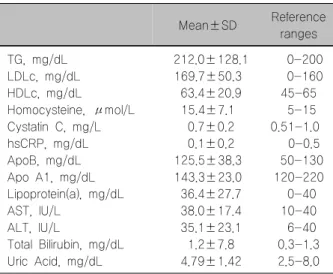
Table 4. Biochemical findings during hypothyroid states (P2)
Mean±SD Reference ranges TG, mg/dL
LDLc, mg/dL HDLc, mg/dL
Homocysteine, μmol/L Cystatin C, mg/L hsCRP, mg/dL ApoB, mg/dL Apo A1, mg/dL Lipoprotein(a), mg/dL AST, IU/L
ALT, IU/L
Total Bilirubin, mg/dL Uric Acid, mg/dL
212.0±128.1 169.7±50.3 63.4±20.9 15.4±7.1 0.7±0.2 0.1±0.2 125.5±38.3 143.3±23.0 36.4±27.7 38.0±17.4 35.1±23.1 1.2±7.8 4.79±1.42
0-200 0-160 45-65 5-15 0.51-1.0
0-0.5 50-130 120-220 0-40 10-40 6-40 0.3-1.3 2.5-8.0 Apo A1: apolipoprotein A1, Apo B: apolipoprotein B, ALT:
alanine aminotransferase, AST: aspartate aminotransferase, HDLc: high-density lipoprotein cholesterol, hsCRP: C-reactive protein, LDLc: low-density lipoprotein cholesterol, TG: trigl- ycerides
mg/dL로 유의하게 증가하였다(p<0.05). 단기간 갑상 선기능저하 시기에는 수축기혈압은 감소하고(p=0.017), 이완기혈압은 증가하였으며(p=0.015) 갑상선기능 변 화와 의미 있는 상관관계를 보였다. 그러나 BMI의 변 화는 유의하지 않았다(Table 2).
총 콜레스테롤과 TSH와의 델타 상관관계
단기간 갑상선기능저하 상태에서 총 콜레스테롤의 델타값은 TSH 델타값과 의미 있는 상관관계를 보였지 만, T3와 FT4 델타값과는 통계적으로 유의한 상관관 계는 없었다. 이 외에도 총 콜레스테롤에 영향을 미칠 수 있는 체질량지수와 혈압과의 관계를 살펴보았을 때 유의한 상관관계를 보이지 않았다(Table 3).
단기간 갑상선기능저하 상태에서 혈청 지질 검사를 포함한 심혈관 질환 위험인자
갑상선호르몬 중단 4주 후(P2) 단기간 갑상선기능저 하 상태에서 호모시스테인(15.4±7.1), 저밀도지단백-콜 레스테롤(169.7±50.3), 중성지방(212.0±128.1), 총 콜레 스테롤(262.1±56.7)은 정상보다 높은 수치를 보였으나, 그 외 값들은 정상범위를 보였다(Table 4).
단기간 갑상선기능저하 상태에서 나이에 따른 지질인 자 및 심혈관 위험인자들의 값
나이에 따라 세 군(1군, <40세; 2군, 40-50세; 3군,
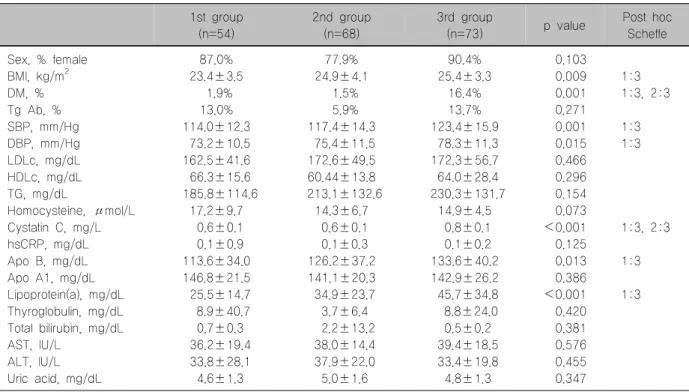
>50세)으로 나누어 단기간 갑상선기능저하 상태에 따 른 혈청 지질 및 심혈관 위험인자들의 수치를 비교하 였다. 세 군간 성별차이는 없었으며(p=0.100), 고혈압 (p<0.001) 및 당뇨병(p=0.001)과 BMI (p=0.009)는 나 이가 증가함에 따라 증가하였다. Cystatin C (p<0.001) 와 아포지단백 B (p=0.013), Lp(a) (p<0.001)는 나이에 따라 증가하는 양상을 보였다. 반면 그 외 값들은 유의 한 차이가 없었다(Table 5).
Table 5. Clinical and biochemical parameters (P2) in the three different age groups 1st group
(n=54)
2nd group (n=68)
3rd group
(n=73) p value Post hoc Scheffe Sex, % female
BMI, kg/m2 DM, % Tg Ab, % SBP, mm/Hg DBP, mm/Hg LDLc, mg/dL HDLc, mg/dL TG, mg/dL
Homocysteine, μmol/L Cystatin C, mg/L hsCRP, mg/dL Apo B, mg/dL Apo A1, mg/dL Lipoprotein(a), mg/dL Thyroglobulin, mg/dL Total bilirubin, mg/dL AST, IU/L
ALT, IU/L Uric acid, mg/dL
87.0%
23.4±3.5 1.9%
13.0%
114.0±12.3 73.2±10.5 162.5±41.6 66.3±15.6 185.8±114.6
17.2±9.7 0.6±0.1 0.1±0.9 113.6±34.0 146.8±21.5 25.5±14.7 8.9±40.7 0.7±0.3 36.2±19.4 33.8±28.1 4.6±1.3
77.9%
24.9±4.1 1.5%
5.9%
117.4±14.3 75.4±11.5 172.6±49.5 60.44±13.8 213.1±132.6
14.3±6.7 0.6±0.1 0.1±0.3 126.2±37.2 141.1±20.3 34.9±23.7 3.7±6.4 2.2±13.2 38.0±14.4 37.9±22.0 5.0±1.6
90.4%
25.4±3.3 16.4%
13.7%
123.4±15.9 78.3±11.3 172.3±56.7 64.0±28.4 230.3±131.7
14.9±4.5 0.8±0.1 0.1±0.2 133.6±40.2 142.9±26.2 45.7±34.8 8.8±24.0 0.5±0.2 39.4±18.5 33.4±19.8 4.8±1.3
0.103 0.009 0.001 0.271 0.001 0.015 0.466 0.296 0.154 0.073
<0.001 0.125 0.013 0.386
<0.001 0.420 0.381 0.576 0.455 0.347
1:3 1:3, 2:3
1:3 1:3
1:3, 2:3
1:3
1:3
Age groups were defined as: 1st group; <39 years, 2nd group; 40–49 years, 3rd group; >50 years
Apo A1: apolipoprotein A1, Apo B: apolipoprotein B, ALT: alanine aminotransferase, AST: aspartate aminotransferase, BMI:
body mass index, DBP: diastolic blood pressure, HDLc: high-density lipoprotein cholesterol, hsCRP: C-reactive protein, LDLc:
low-density lipoprotein cholesterol, SBP: systolic blood pressure, TG: triglycerides
단기간 갑상선기능저하 상태에서 TSH에 따른 지질인 자 및 심혈관 위험인자들의 값
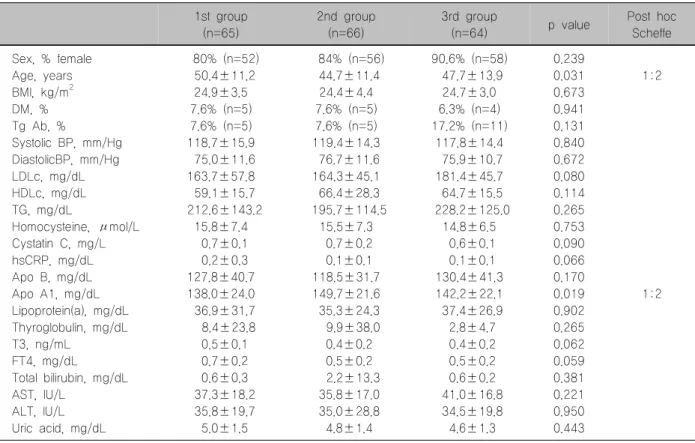
TSH값에 따라 세 군(1군, <79 μIU/mL; 2군, 79-121 μIU/mL; 3군, >121 μIU/mL)으로 분류하여 단기간 갑상선기능저하 상태에 따른 혈청 지질 및 심 혈관 위험인자들의 수치를 비교하였다. 혈청 아포지단 백 A1 (p=0.019) 및 나이(p=0.031)는 TSH 농도변화와 유의한 상관관계가 있었다. 그러나 다른 지질인자 및 간기능 수치, Lp(a) 등 다른 심혈관 위험인자들은 유의 한 차이가 없었다(Table 6).
고 찰
본 연구는 갑상선분화암 환자에서 단기간 갑상선기 능저하 상태에서 TSH의 변화가 지질 및 심혈관계 질 환 인자들에 미치는 영향을 알아보고자 하였다. 갑상 선호르몬을 중단하였을 때 전체 대상군에서 단기간 갑 상선기능저하 상태(평균값: TSH 102.8 μIU/mL, FT4 0.5 ng/dL, T3 0.4 ng/mL)가 유발되었으며, TSH 농도 의 증가는 총 콜레스테롤 수치 변화를 증가시켰다. 총
콜레스테롤은 나이, 성별, 체질량지수, 혈압, 당뇨병 등 의 인자와 비교하였을 때 유의한 관계를 보이지 않아 서, 성별, 연령 및 체격의 변화에 따른 영향을 받지 않 고 TSH에 따라 증가하는 양상을 보였다. 갑상선기능 저하증의 경우 고콜레스테롤혈증과 함께 초저밀도 지 질 단백질, 저밀도지단백 콜레스테롤, 중성지방, 아포 지단백 A1, 아포지단백 B, Lp(a) 등이 증가될 수 있으 며, 고밀도 지단백 콜레스테롤은 감소 혹은 증가되는 등 다양한 양상을 보인다.4,5) 그러나 단기간 갑상선기 능저하 상태의 경우 혈청 지질 농도의 변화는 보고자 들마다 차이가 있으며, 이러한 지질 성분의 변화와 심 혈관 질환의 위험성 증가와의 관련성은 확실치 않
다.6,7,12,13) 지금까지 단기간 갑상선기능저하 상태에서
심혈관계에 미치는 영향에 관한 여러 연구가 있었으나 대부분 심전도 변화나 혈압 변화, 심초음파를 통한 수 축력이나 이완기 기능 평가 등에 국한되어 있었다.14-17) 일부는 본 연구와 같이 지질성분 변화와 심혈관 질환 과의 관계에 대해 연구하였으나,8,9) 아직까지 확실한 결론이 없는 실정이다. 이는 단기간 갑상선기능저하 상태가 심혈관계에 미치는 영향을 평가하는 것이 어렵 기 때문이다.
Table 6. Clinical and biochemical features of the whole cohort according to three different TSH level groups 1st group
(n=65)
2nd group (n=66)
3rd group
(n=64) p value Post hoc Scheffe Sex, % female
Age, years BMI, kg/m2 DM, % Tg Ab, %
Systolic BP, mm/Hg DiastolicBP, mm/Hg LDLc, mg/dL HDLc, mg/dL TG, mg/dL
Homocysteine, μmol/L Cystatin C, mg/L hsCRP, mg/dL Apo B, mg/dL Apo A1, mg/dL Lipoprotein(a), mg/dL Thyroglobulin, mg/dL T3, ng/mL
FT4, mg/dL
Total bilirubin, mg/dL AST, IU/L
ALT, IU/L Uric acid, mg/dL
80% (n=52) 50.4±11.2
24.9±3.5 7.6% (n=5) 7.6% (n=5) 118.7±15.9 75.0±11.6 163.7±57.8 59.1±15.7 212.6±143.2
15.8±7.4 0.7±0.1 0.2±0.3 127.8±40.7 138.0±24.0 36.9±31.7 8.4±23.8 0.5±0.1 0.7±0.2 0.6±0.3 37.3±18.2 35.8±19.7 5.0±1.5
84% (n=56) 44.7±11.4
24.4±4.4 7.6% (n=5) 7.6% (n=5) 119.4±14.3 76.7±11.6 164.3±45.1 66.4±28.3 195.7±114.5
15.5±7.3 0.7±0.2 0.1±0.1 118.5±31.7 149.7±21.6 35.3±24.3 9.9±38.0 0.4±0.2 0.5±0.2 2.2±13.3 35.8±17.0 35.0±28.8 4.8±1.4
90.6% (n=58) 47.7±13.9
24.7±3.0 6.3% (n=4) 17.2% (n=11)
117.8±14.4 75.9±10.7 181.4±45.7 64.7±15.5 228.2±125.0
14.8±6.5 0.6±0.1 0.1±0.1 130.4±41.3 142.2±22.1 37.4±26.9 2.8±4.7 0.4±0.2 0.5±0.2 0.6±0.2 41.0±16.8 34.5±19.8 4.6±1.3
0.239 0.031 0.673 0.941 0.131 0.840 0.672 0.080 0.114 0.265 0.753 0.090 0.066 0.170 0.019 0.902 0.265 0.062 0.059 0.381 0.221 0.950 0.443
1:2
1:2
TSH groups were defined as: 1st group; <79 μIU/mL, 2nd group; 79-121 μIU/mL, 3rd group; <121 μIU/mL Apo A1: apolipoprotein A1, Apo B: apolipoprotein B, ALT: alanine aminotransferase, AST: aspartate aminotransferase, BMI:
body mass index, DBP: diastolic blood pressure, HDLc: high-density lipoprotein cholesterol, hsCRP: C-reactive protein, LDLc:
low-density lipoprotein cholesterol, SBP: systolic bloodpressure, TG: triglycerides
갑상선기능저하증에서 심혈관 질환은 주로 동맥경 화성 변화에 의해 일어나며, 이는 지질성분의 변화뿐 만 아니라, 인슐린 저항성, 혈압의 증가, 동맥벽의 강도 증가 등 내피세포의 기능이상 및 염증과정을 통해 가 속화된다.4,6,7) 이러한 내피세포의 기능은 간접적으로 hsCRP, 호모시스테인, cystatin C 등을 통해 평가할 수 있다. 단기간 갑상선기능저하 상태에서 지질 성분 및 내피세포 기능인자들의 평균값을 살펴보았을 때, 혈청 총 콜레스테롤, 저밀도지단백-콜레스테롤, 중성지방, 호모시스테인이 증가하였다. 이는 기존의 연구결과들
8,9)과 일치하였으며, 고밀도 지단백-콜레스테롤은 높지 않아 기존 연구들8-10)과는 다른 결과를 보였다. 또한 관 상동맥질환의 존재를 예측하는 독립적인 인자인 아포 지단백 A1, 아포지단백 B 및 hsCRP, Cystatin C, Lp(a) 는 증가하지 않았고, 호모시스테인은 증가하였으나 TSH와 유의한 상관관계는 없었다. Catargi 등18)이 갑 상선기능저하에서 호모시스테인의 증가 및 TSH와의 유의한 관계를 보고한 것과는 대조된다. 본 연구에 앞 서 Erbil 등11)은 단기간 갑상선기능저하에서 지질인자
의 악화가 내피세포의 기능이상 및 심혈관 질환 위험 증가와 관련된다고 보고하였다. 그러나 본 연구에서는 앞서 언급한 것처럼 콜레스테롤과 저밀도지단백 콜레 스테롤은 증가하였으나, TSH와 콜레스테롤 외 다른 인자들과는 의미 있는 상관관계는 없었다. 갑상선기능 저하증에서 아포지단백 A와 B의 증가를 보고한 것19)과 는 달리 단기간 갑상선기능저하 상태에서 아포지단백 A1과 아포지단백 B 모두 정상 범위였다. Lp(a) 또한 죽 상 동맥경화증과 관상동맥질환의 독립적인 위험인자 로 알려진 지단백으로, 갑상선기능저하증에서 높았던 혈청 Lp(a) 농도가 갑상선호르몬 투여 후 감소함이 보 고되었으며,20) 이와 달리 변화가 없다는 보고도 있으 나,21) 단기간 갑상선기능저하 상태에서 이에 대한 연구 는 없다. 혈청 Lp(a) 농도는 성별, 연령의 변화 및 BMI 의 영향을 받지 않으나 간질환 및 신질환에 영향을 받 을 수 있어 본 연구에서는 이들을 연구대상에서 제외 하였고,21) Lp(a) 농도는 정상범위를 보였다. hsCRP 농 도는 많은 연구에서 죽상동맥경화증과의 관련성이 밝 혀지고 있으나,22-26) 갑상선기능저하증과의 관련성에
대해서는 논란이 있다. Miller 등22)에 의하면 hsCRP는 염증인자로서 심혈관 위험의 강력한 예측인자로 사용 되지만 현성 갑상선기능저하증에서 CRP는 상반된 결 과를 보였다. 일부는 갑상선기능저하증에서 hsCRP가 높음을 보고하였으나,23-25) Erbil 등11)과 Lee 등26)은 차 이가 없음을 보고하였다. 본 연구 결과에서도 정상값 을 보였다.
갑상선기능저하 상태에서는 지질 검사 외에도 여러 가지 임상 화학 검사결과에 변화가 생기는데 간기능 중 특히 담즙의 배출지연을 가져오며 지방성분의 축적 과정과 간기능 유지에 필요한 효소의 활성화가 낮아져 AST, ALT, 포합형 빌리루빈 등 화학적 지표들의 수치 가 상승될 수 있다.8,26,27) 앞서 Jeong 등28)은 중증 갑상선 기능저하증에서 총 빌리루빈 수치의 증가 및 상대적으 로 비포합형 빌리루빈 수치가 높음을 보고하였으나, 본 연구에서는 AST, ALT 및 총 빌리루빈 수치는 정상 값을 보였다.
본 연구의 제한점으로 대상군이 남성에 비해 여성이 많이 포함되고 연령군 분포에 차이가 있으며, 단일 병 원의 적은 수를 대상으로 한 연구이므로 일반화하기는 어렵다. 또한, 환자를 추적 관찰하지 않았기 때문에 실 제 갑상선호르몬의 변화가 심혈관 질환의 위험인자가 될 가능성을 배제할 수 없는 단면 연구로서의 제한점 을 가진다.
결 론
본 연구결과 갑상선암 환자에서 수술 후 방사성요오 드 치료를 위해 유발된 단기간 갑상선기능저하 상태에 서 TSH 범위에 따라(1군, <79 mIU/mL; 2군, 79-121 mIU/mL; 3군, >121 mIU/mL) 심혈관계 질환의 위험 도에 관한 혈액지표들(아포지단백, Lp(a), homocysteine, cystatin C, hsCRP)을 비교하였을 때 의미 있는 차이가 없었다. 하지만 갑상선암 환자에서 방사성요오드 치료 기간 동안 갑상선호르몬 제제를 중단하는 기간과 TSH 농도의 변화에 따른 심혈관 질환 발생의 위험성에 대 해서는 더 많은 연구가 필요할 것으로 생각된다.
중심 단어: 단기간 갑상선기능저하, 갑상선암, 심혈 관계 위험인자, 방사성요오드 치료.
References
1) Jung KW, Won YJ, Kong HJ, Oh CM, Seo HG, Lee JS.
Cancer statistics in Korea: incidence, mortality, survival and prevalence in 2010. Cancer Res Treat 2013;45(1):1-14.
2) American Thyroid Association (ATA) Guidelines Taskforce on Thyroid Nodules and Differentiated Thyroid Cancer, Cooper DS, Doherty GM, Haugen BR, Kloos RT, Lee SL, et al.
Revised American Thyroid Association management guidelines for patients with thyroid nodules and differentiated thyroid cancer. Thyroid 2009;19(11): 1167-214.
3) Hilts SV, Hellman D, Anderson J, Woolfenden J, Van Antwerp J, Patton D. Serial TSH determination after T3 withdrawal or thyroidectomy in the therapy of thyroid carcinoma. J Nucl Med 1979;20(9):928-32.
4) Peppa M, Betsi G, Dimitriadis G. Lipid abnormalities and cardiometabolic risk in patients with overt and subclinical thyroid disease. J Lipids 2011;2011:575840.
5) Kutluturk F, Yuce S, Tasliyurt T, Yelken BM, Aytan P, Ozturk B, et al. Changes in metabolic and cardiovascular risk factors before and after treatment in overt hypothyroidism. Med Glas (Zenica) 2013;10(2):348-53.
6) Regalbuto C, Alagona C, Maiorana R, Di Paola R, Cianci M, Alagona G, et al. Acute changes in clinical parameters and thyroid function peripheral markers following L-T4 withdrawal in patients totally thyroidectomized for thyroid cancer. J Endocrinol Invest 2006;29(1):32-40.
7) Duntas LH, Biondi B. Short-term hypothyroidism after Levothyroxine-withdrawal in patients with differentiated thyroid cancer: clinical and quality of life consequences. Eur J Endocrinol 2007;156(1):13-9.
8) Lien EA, Nedrebo BG, Varhaug JE, Nygard O, Aakvaag A, Ueland PM. Plasma total homocysteine levels during short-term iatrogenic hypothyroidism. J Clin Endocrinol Metab 2000;85(3):
1049-53.
9) Bicikova M, Hampl R, Hill M, Stanicka S, Tallova J, Vondra K. Steroids, sex hormone-binding globulin, homocysteine, selected hormones and markers of lipid and carbohydrate metabolism in patients with severe hypothyroidism and their changes following thyroid hormone supplementation. Clin Chem Lab Med 2003;
41(3):284-92.
10) Chrisoulidou A, Pazaitou-Panayiotou K, Kaprara A, Platoyiannis D, Lafaras C, Boudina M, et al. Effects of thyroxine withdrawal in biochemical parameters and cardiac function and structure in patients with differentiated thyroid cancer. Minerva Endocrinol 2006;31(2):173-8.
11) Erbil Y, Ozbey N, Giris M, Salmaslioglu A, Ozarmagan S, Tezelman S. Effects of thyroxine replacement on lipid profile and endothelial function after thyroidectomy. Br J Surg 2007;94(12):1485-90.
12) Chang HJ, Kim KW, Choi SH, Lim S, Park KU, Park do J, et al. Endothelial function is not changed during short-term withdrawal of thyroxine in patients with differentiated thyroid cancer and low cardiovascular risk. Yonsei Med J 2010;51(4):
492-8.
13) Botella-Carretero JI, Alvarez-Blasco F, Sancho J, Escobar- Morreale HF. Effects of thyroid hormones on serum levels of adipokines as studied in patients with differentiated thyroid carcinoma during thyroxine withdrawal. Thyroid 2006;16(4):
397-402.
14) Mazzaferri EL, Massoll N. Management of papillary and follicular (differentiated) thyroid cancer: new paradigms using recombinant human thyrotropin. Endocr Relat Cancer 2002;
9(4):227-47.
15) Botella-Carretero JI, Gomez-Bueno M, Barrios V, Caballero C, Garcia-Robles R, Sancho J, et al. Chronic thyrotropin- suppressive therapy with levothyroxine and short-term overt hypothyroidism after thyroxine withdrawal are associated with undesirable cardiovascular effects in patients with differentiated thyroid carcinoma. Endocr Relat Cancer 2004;11(2):345-56.
16) Di Paola R, Alagona C, Pezzino V, Mangiameli S, Regalbuto C. Left ventricular function in acute hypothyroidism: a Doppler echocardiography study. Ital Heart J 2004;5(11):857-63.
17) Fommei E, Iervasi G. The role of thyroid hormone in blood pressure homeostasis: evidence from short-term hypothyroidism in humans. J Clin Endocrinol Metab 2002;87(5):1996-2000.
18) Catargi B, Parrot-Roulaud F, Cochet C, Ducassou D, Roger P, Tabarin A. Homocysteine, hypothyroidism, and effect of thyroid hormone replacement. Thyroid 1999;9(12):1163-6.
19) Shong YK, Ryu JS, Lee KU, Kim GS, Lee M. Serum lipids and apolipoproteins in subclinical and overt hypothyroidism and their changes with thyroxine therapy. J Korean Soc Endocrinol 1992;7(1):31-8.
20) Engler H, Riesen WF. Effect of thyroid hormones on Lp(a) and lipid metabolism. Clin Chem Lab Med 1998;36(9):731-5.
21) Sharma AK, Arya R, Mehta R, Sharma R, Sharma AK.
Hypothyroidism and cardiovascular disease: factors, mechanism and future perspectives. Curr Med Chem 2013;20(35):4411-8.
22) Miller VM, Redfield MM, McConnell JP. Use of BNP and
CRP as biomarkers in assessing cardiovascular disease: diagnosis versus risk. Curr Vasc Pharmacol 2007;5(1):15-25.
23) Christ-Crain M, Meier C, Guglielmetti M, Huber PR, Riesen W, Staub JJ, et al. Elevated C-reactive protein and homocysteine values: cardiovascular risk factors in hypothyroidism? A cross- sectional and a double-blind, placebo-controlled trial. Athero- sclerosis 2003;166(2):379-86.
24) Jublanc C, Bruckert E, Giral P, Chapman MJ, Leenhardt L, Carreau V, et al. Relationship of circulating C-reactive protein levels to thyroid status and cardiovascular risk in hyperlipidemic euthyroid subjects: low free thyroxine is associated with elevated hsCRP. Atherosclerosis 2004;172(1):7-11.
25) Nagasaki T, Inaba M, Shirakawa K, Hiura Y, Tahara H, Kumeda Y, et al. Increased levels of C-reactive protein in hypothyroid patients and its correlation with arterial stiffness in the common carotid artery. Biomed Pharmacother 2007;61(2-3):
167-72.
26) Lee WY, Suh JY, Rhee EJ, Park JS, Sung KC, Kim SW.
Plasma CRP, apolipoprotein A-1, apolipoprotein B and Lpa levels according to thyroid function status. Arch Med Res 2004;35(6):540-5.
27) Bayraktar M, Van Thiel DH. Abnormalities in measures of liver function and injury in thyroid disorders. Hepatogastroenterology 1997;44(18):1614-8.
28) Jeong HJ, Kim CG, Lee KM, Jeong SJ, Song HC, Bom HS.
Reversible changes of clinical chemical tests in severe hypothyroid patients with differentiated thyroid cancer who were admitted for radioiodine therapy. J Korean Surg Soc 2004;66(1):10-3.