685 https://doi.org/10.9713/kcer.2017.55.5.685
PISSN 0304-128X, EISSN 2233-9558
Examination of an Algerian Clay in the Retention of Zinc Ions Charged in Brackish Water
Ammar Fadel† and Saci Nacef*
Department of industrial Chemical, University of Biskra, ALGERIA
*Laboratory of Chemical Process Engineering (LGPC), Department of Chemical Engineering, Ferhat Abbas University of Setif, Algeria (Received 10 April 2017; Received in revised form 14 June 2017; accepted 14 June 2017)
Abstract − We studied the removal of zinc ions from synthetic brackish water by an adsorption method using natural Algerian Bentonite (NAB). The effect of the main physico chemical parameters-contact time, pH, temperature, ionic strength, clay weight and initial metal ion concentrations on the removal of Zn+2-were investigated. The results showed that equilibrium was attained within 10 min of stirring time. The retention capacity of Zn+2 increased with the increase of pH, the adsorbent dose and ionic strength. A modelization study showed that the adsorption follows Langmuir isotherm, while its kinetics was pseudo-second-order. Based on the results, it was concluded that NAB, which is natural and avail- able, could be used as an alternative for the removal of zinc from saline aqueous solutions.
Key words: Zinc removal, Brackish water, Adsorption, Bentonite
1. Introduction
Zinc is one of the most important heavy metal contaminants for surface and ground water despite the fact that trace amounts are con- sidered as an essential element for life acting as a micronutrient [1].
Industrial activities such as mining, mineral processing, and extractive metallurgy of zinc, lead, and cadmium ores, steel production, coal burning, and waste incineration are the main causes for zinc pollu- tion. Free zinc ion in solution is highly harmful to plants and inverte- brates. Trace amounts of free zinc ions can cause heavy damage to the environment and even kill some organisms. Moreover, excessive intake of zinc can promote deficiency in other dietary minerals [2].
The World Health Organization (WHO) recommends the maximum acceptable concentration of zinc in drinking water as 3 mg/l [3].
Therefore, it is necessary to remove this hazardous metal ion from liquid wastes at least to the limit accepted by national and interna- tional regulatory agencies before its discharge to the environment [4].
Literature survey concerning the treatment of water containing heavy metals by the electrodialysis technique shows that in most cases the effluents treated contain high concentrations of metal ions [5].
In this study, prior to electrodialysis, a pretreatment process which consisted of an adsorption on local clay using high concentrations was prepared from an aqueous model solution containing a fixed amount of sodium chloride salt.
Clays are particularly noteworthy nanoparticles because of their
ubiquity and their reactivity. Their nanometric size and sheet struc- ture provides a large specific surface area for adsorption and gives them a crucial role in the retention of a large number of industrial pollutants, The interest in these materials is justified by the impor- tance of their developed surface, by the presence of charges on their surface, and their ability to exchange cations and a wide availability in nature [6,7]. Though all clay minerals have similar compositions, bentonite is superior with its unique cation chemistry and surface area. It is mainly composed of montmorillonite with a chemical composition of SiO2, Al2O3, CaO, MgO, Fe2O3, Na2O, K2O [8]. The selection of using raw bentonite is justified by the fact that it is both a low cost and environmentally friendly adsorbent material. The influ- ence of key physico-chemical parameters such as stirring time, stirring rate, mass of the adsorbent, temperature, initial feed concentration, initial pH and ionic strength on the removal of zinc from adsorption process was studied.
2. Materials and Methods
2-1. Bentonite
The bentonite used, which is rich in montmorillonite, was obtained from Hammam Boughrara mine (Maghnia, west Algeria).The char- acteristics of this sodium based bentonite which were determined by the laboratory analysis carried out by the Bentonite Unit of the National Company of non-ferrous mineral products are summarized in the Table 1.
†To whom correspondence should be addressed.
E-mail: [email protected]
This is an Open-Access article distributed under the terms of the Creative Com- mons Attribution Non-Commercial License (http://creativecommons.org/licenses/by- nc/3.0) which permits unrestricted non-commercial use, distribution, and reproduc- tion in any medium, provided the original work is properly cited.
Table 1. Physical and chemical characteristics of bentonite of Maghnia Surface area (m2/g) pH Exchangeable cation (meq/100g)
Ca2+ Mg2+ Na+ K+
80 6.2 30.6 12.8 36.2 9.5
3. Equilibrium Isotherms
Equilibrium isotherm experiments were carried out using the opti- mum concentration of all the adsorbents and the optimum pH of Zn+2 solutions for each adsorbent. 250 mL Zn2+ ion solutions with different initial concentrations (11.25, 23.5, 47 and 94 mg/L) and containing the optimum adsorbent weight and the optimum pH of solution. The bottles were stirred at a fixed speed of 250 rpm in a rotating stirrer water bath at different temperatures of 30, 35 and 40 °C for 2 hours. The solutions were then filtered and the remaining Zn+2 ion concentrations in the filtrate were determined by using the atomic- absorption spectrophotometer.
The adsorption of metal ions onto the adsorbent surface at a spe- cific time was estimated from the mass balance equation [9]. The amount of zinc adsorbed by bentonite mass unit was calculated by the following formula:
where qt, C0, Ce, v and m are the amount adsorbed at time t (mg/g), initial metal ion concentration (mg/L), equilibrium metal ion con- centration (mg/L), volume of the solution (L) and mass of the adsorbent (g), respectively. The results may be expressed in per- centage removal as given by the following formula [10].
4. Results and Discussion
The study of the adsorption of Zn+2 ions on Maghnia bentonite requires knowledge of the parameters that influence this phenome- non: temperature, ionic strength, stirring rate, stirring time, initial concentration, pH and adsorbent concentration.
4-1. Effect of temperature
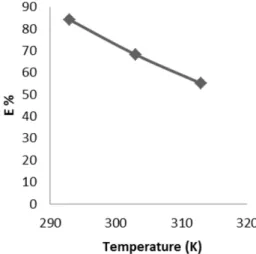
The temperature dependence of Zn+2 by adsorption on natural bentonite was investigated with a constant concentration of metal zinc ions of 23.5 mg/L at different temperatures (293.15 K, 303.15 K and 313, 15 K). The results, which are shown in Fig. 1, show that the efficiency of the adsorption of Zn+2 decreases with increasing tem- perature. For example, for an increase in temperature from 293.15 K to 313.15 K, the adsorption rate decreased from 84% to 55%.
The percentage decrease of adsorption with the temperature may be due to the desorption caused by an increase of the thermal energy available. The increase in temperature induces greater mobility
desorption. This indicates that the adsorption process is spontaneous and exothermic.
4-2. Effect of ionic strength
According to Fig. 2, the rate and adsorption capacity of zinc by the bentonite in a chloride solution were better than those in a non-saline medium. This is explained by the activation of the bentonite adsorp- tion sites by the Na+, leading to the creation of new adsorption sites.
Since this effect was more pronounced with increasing the initial concentration of zinc, we can therefore conclude that the adsorption capacity increased with increasing the ionic strength of the solution.
4-3. Effect of the stirring rate
As shown in Fig. 3, the removal rate and the adsorption capacity of zinc by sodium bentonite increase with the increase of the agitation rate; this effect is attributed to the fact that the resistance to transfer from the liquid phase to the surface of the solid decreases with stirring.
4-4. Effect of the stirring time
The zinc adsorption kinetics was monitored for an initial zinc con- qt (Co Ce– ).v
---m
=
E %( ) (Co Ce– ) --- 100Co ⋅
=
Fig. 1. Variation of elimination rate with temperature.
Fig. 2. Variation of elimination rate with ionic Strength.
tent of 23.5 mg/L and to a constant weight of the adsorbent (1 g/L) and a pH equal to 6. The results (Fig. 4) show that the zinc removal efficiency varies with stirring time and the maximum efficiency was obtained after 10 minutes. Indeed the maximum value of elimina- tion corresponding to this time was 94.24 ℅, for a stirring speed of 250 rpm, above which the adsorption rate became practically very slow and started decreasing after 90 min, The difference in the degree of adsorption may be due to the fact that at the beginning of adsorp- tion, all the sites of the surface of the adsorbent are clear and the sol- ute concentration gradient is relatively high. Accordingly, the degree of zinc removal decreased with increasing contact time, which depends on the number of vacant sites on the surface of the bentonite.
4-5. Effect of initial solute concentration
The effect of the solute concentration was investigated for an ini- tial zinc content ranging from 11.25 to 94 mg/L and a concentration of the bentonite introduced of 1 g/L. The results presented in Fig. 5 show that the efficiency gradually decreased with increasing the initial zinc content of Maghnia bentonite. Note that Zhang et al. 2011 [11]
also found a reduction in processing efficiency by varying the initial content of Zn+2 between 30 and 250 mg/L and setting the concentra- tion of bentonite to 1 g/L.
4-6. Effect of pH
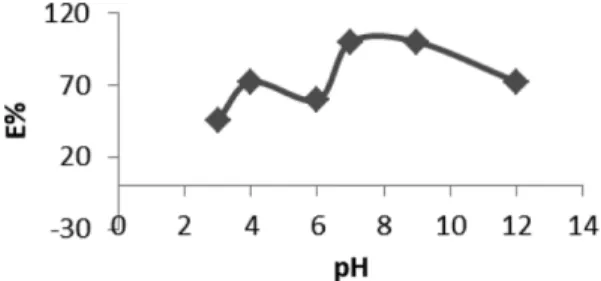
The results of variation of the zinc ions removal rate by bentonite at 17 °C and a fixed concentration of zinc solution (23.5 mg/L) as a
function of pH are shown in Fig. 6. The zinc adsorption tests were carried out in the presence of a constant dose of the adsorbent equal to 1 g/L and the pH of the solutions was adjusted to 3, 4, 6, 7, 9 and 12 using (0.1 N) NaOH (1310-73-2) and (0,1N) HCl (7647-01-01) solutions. The results which are presented in Fig. 6 show that the elimination rate of Zn ions increases when the pH increases. It appears that the elimination rate of Zn ions was affected by the sur- face charges of the adsorbent, which are variable depending on the pH. For Maghnia bentonite the highest efficiency was obtained in a basic medium, and the best performance was achieved at a pH of 7 and 10, with an elimination rate equal to 100 ℅. Mohammadi - AZIZI et al. 2013 [12] reported an increase in the zinc removal effi- ciency of bentonite with increasing pH. On the other hand, Gupta and Battacharyya, 2008 [13] reported also that the adsorption of metal ions on a sodium bentonite decreases with decreasing pH.
According to Abollino et al. 2003 [14], the low amounts of ions adsorbed at pH lower than 4 are due to the repulsive competition between the Zn ions in solution and the more mobile hydronium ions to interact with adsorption sites available. In addition to the Si-O- and Al-O- group less deprotonated and hardly form complexes with divalent and trivalent ions have shown that the elimination of Zinc using bentonite as adsorbent is strongly dependent on pH. The per- cent removal increases with increasing pH from pH from 1 to 4.
Then decreases from 72 to 59% in the pH range between 4 and 6;
this decrease may be due to the reduction of the amount of negative charges on the surface of the clay. The positively charged metallic ions are retained on the surface of the clay by the Coulomb forces. It is explained by the increase of hydroxyl sites of the water that could attach to the silicon atoms of the incomplete tetrahedrons and the SiOH groups formed.
Fig. 3. Variation of elimination rate with stirring speed.
Fig. 4. Variation of elimination rate with time.
Fig. 5. Variation of elimination rate with initial solute concentra- tion.
Fig. 6. Variation of elimination rate with pH.
By increasing the pH, the number of negative charges sites increases, which facilitates the adsorption of more Znions at pH > 7. Precipita- tion of Zn (OH)2 plays the main role in the elimination of zinc.
Accordingly, the predominant ionic species is Zn2+ for pH < 7, but Zn2+ is present mainly and to a less important amount as Zn (OH)+ at a pH between 8 and 9. Since all experiments were performed at a maximum pH of 7, Zn2+ species would be present predominantly in solution and adsorbed onto the bentonite surface.
4-7. Effect of adsorbent concentration
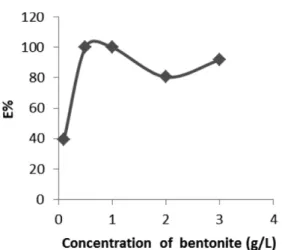
We followed the evolution of the removal efficiency of zinc at a constant initial concentration of zinc (23.5 mg/L) and varying ben- tonite concentration from 0.1 to 3 g/L.
The residual zinc content for each treated sample was measured after 2 hours contact time with bentonite.
From the results shown in Fig. 7, we can see that the zinc removal efficiency increases with the increase of the introduced amount of the adsorbent (bentonite of Maghnia) until the optimal dose 0.5 g/l at which the performance achieved 100% and then decreases slightly.
According to Zhang et al. 2011 [11], zinc removal efficiency (100 mg/L) increases with increase of the bentonite dose (0.2 to 2 g/L).
5. Adsorption Isotherms of Zinc Ions on the Bentonite
We used the results according to the linear form of the model of Freundlich, Langmuir and Temkin, considering the following oper- ating conditions:
cluded that the Langmuir model yields a better fit to the experimental data than the Freundlich and Temkin models.
6. Zinc adsorption kinetics
To determine the constants of adsorption rate, kinetic data were analyzed using two kinetic models [15]: the model of Lagergren pseudo-first-order, which is expressed as:
log
And the pseudo-second-order model, which is expressed as:
The most representative data model was selected based on the cor- relation coefficient R2, as shown in Table 3.
Accordingly, the kinetic model of pseudo-second-order is very suitable for the adsorption of zinc ions on the bentonite.
7. Conclusions
The results obtained in this study confirm the interest of the use of the Algerian clay (bentonite of Maghnia) for the adsorption of pollut- ing metallic cations from an aqueous solution.
The zinc elimination efficiency increased with the increase of the introduced dose of adsorbent (bentonite of Maghnia) up to the opti- mal dose of 0.5 g/L at which performance achieved 100%. It also increased when the pH increased. The best performance was obtained at pH 7 and 10, with an elimination rate equal to 100℅.
The removal efficiency, which increased with increasing agitation speed, exhibited a maximum value of 94.24℅ after 10 minutes for a rate of 250 rpm.
The elimination rate of Zn ions decreased gradually with increas- ing the initial zinc content in the bentonite and decreased also with increasing temperature, meaning that the adsorption process was exothermic.
qe qt– ---qe K1⋅t
---2.3 –
=
t qt---- 1
2 K2qe2 --- t
qe--- +
= Fig. 7. Variation of elimination rate with concentration of bentonite.
Table 2. Isotherm Constants for Adsorption of Zn+2 onto Maghnia bentonite
Langmuir Freundlich Temkin
qm (mg/g) b (L/mg) RL R2 n K (mg/g) R2 B (J/mol) A (L/g) R2
16.94 2.35 0.018 0.996 6.80 23.5 0.95 2.957 0.00037 0.962
Table 3. Values of the coefficients of the two linearized kinetic models with experimental results
Kinetics of the pseudo-first-order Kinetics of the pseudo-second-order
qe.cal (mg/g) K1 (L·min-1) R2 qe.cal(mg/g) K2 (g·mg-1·min-1) h (mg/g.min) R2
not calculated not calculated 0. 069 18.86 0.021 0.398 0.993
The rate and adsorption capacity of zinc by the bentonite in a chlo- ride solution were better than those in a non-saline medium.
The experimental results were in accordance with the Langmuir model and the kinetics revealed its compliance with the pseudo-sec- ond-order model.
List of symbols
A : Temkin isotherm equilibrium binding constant [L/g]
b : Affinity parameter of Langmuir [L/mg]
B : Constant related to heat of sorption [J/mol]
C0 : Initial solute concentration [mg/L]
Ce : Concentration of solute at time t [mg/L]
E : Elimination rate [%]
h : Initial rate of adsorption [mg/g·min]
k : Freundlich adsorption capacity [mg/g]
K1 : Rate constant of the pseudo first order adsorption [L·min-1] K2 : Second order rate constant of the pseudo-order adsorption
[g·mg-1·min-1]
m : Mass of the adsorbent [g]
n : Freundlich adsorption intensity qt : Amount adsorbed at time t [mg/g]
qe : Amount of solute adsorbed per unit weight of adsorbent at equilibrium [mg/g]
qm : Maximum capacity [mg/g]
RL : Separation factor R2 : Correlation coefficient t : Time [mn]
V : Volume of the solution [L]
References
1. Arabyarmohammadi, H., Salarirad, M. M. and Behnamfard, A.,
“Characterization and Utilization of Clay-Based Construction and Demolition Wastes as Adsorbents for Zinc (II) Removal from Aqueous Solutions: an Equilibrium and Kinetic Study,” Environ.
Prog. Sustain Energy., 33(3), 777-789(2014).
2. Dinesh, K. S., Santhanam, P., Jayalakshmi, T., Nandakumar, R.,
Ananth, S., Shenbaga, D. A. and Balaji, P., “Optimisation of pH and Retention Time on the removal of Nutrients and Heavy Metal (Zinc) Using Immobilized Marine Microalga Chlorella Marina,”
Biol. Sci., 13(5), 400-405(2013).
3. WHO, “Guidelines for Drinking-Water Quality,” fourth ed., World Health Organization, Switzerland(2011).
4. Coruh, S., The removal of zinc ions by natural and conditioned clinoptilolites, Desalination, 225(1-3), 41-57(2008).
5. Fadel, A., Lafi, R., Aouni, A. A., Hafiane, A. and Nacef, S.,
“Separation of Zinc Ions from Synthetically Prepared Brackish Water Using Electrodialysis: Effect of Operating Parameters,”
Desalin Water Treat, 57(38), 17852-17860(2016).
6. Schulze, D. G., “Clay Minerals,” Purdue University, West Lafay- ette, IN, USA(2005).
7. Onal, M., “Physicochimical Properties of Bentonites: an Over- view,” Commun. Fac. Sci. Univ. Ank. Series B, 52(2), 7-21(2006).
8. Basava Rao., V. V., Mohan Rao., T., “Thermodynamic and Iso- thermal Studies of Congo Red Adsorption onto Modified Benton- ite,” Korean Chem. Eng. Res., 53(6), 770-775(2015).
9. Grassi, M., Kaykioglu, G., Belgiorno, V. and Lofrano, G., “Removal of Emerging Contaminants from Water and Wastewater by Adsorp- tion Process,” Editor, G. Lofrano, Springer, New York (2012).
10. Oliveria, E. A., Montanher, S. F., Andrader, A. D., Nobrega, J.
A. and Rollemberg, M. C., “Equilibrium Studies for the Sorption of Chromiumand Nickel from Aqueous Solution Using Rice Bran Process,” Process Biochem., 40(11), 3485-3490(2005).
11. Zhang, H., Tong, Z., Wei, T. and Tang, Y., “Removal Character- istics of Zn (II) from Aqueous Solution by Alkaline Ca-Benton- ite,” Desalination, 276(1-3), 103-105(2011).
12. Mohammed-Azizi, F., Dib, S. and Boufatit, M., “Removal of Heavy Metals from Aqueous Solutions by Algerian Bentonite,” Desalin Water Treat. 51(22-24), 4447-4458(2013).
13. Bhattacharyya, K. G. and Gupta, S. S., “Adsorption of a Few Heavy Metals on Natural and Modified Kaolinite and Montmo- rillonite,” Adv Colloid Interface Sci., 140(2), 114-131(2008).
14. Abollino, O., Aceto, M., Malandrino, M., Sarzanini, C. and Men- tasti, E., “Adsorption of Heavy Metals on Na-montmorillonite.
Effect of pH and Organic Substances,” Water Res., 37(7), 1619- 1627(2003).
15. Ho, Y. S. and McKay, G. A., “Comparison of Chemisorption Kinetic Models Applied to Pollutant Removal on Various Sor- bents,” Process Saf Environ Prot., 76(4), 332-340(1998).