301 https://doi.org/10.9713/kcer.2020.58.2.301
PISSN 0304-128X, EISSN 2233-9558
Isothermal and Kinetic Studies of the Adsorption Removal of Pb(II), Cu(II), and Ni(II) Ions from Aqueous Solutions using Modified Chara Sp. Algae
Khairi R. Kalash*, Hayder A. Alalwan**,†, Mustafa H. Al-Furaiji*, Alaa. H. Alminshid*** and Basma I. Waisi****
*Environment and Water Directorate, Ministry of Science and Technology, Baghdad, Iraq
**Department of Petrochemical Techniques, Kut Technical Institute, Middle Technical University, Baghdad, Iraq
***Department of Chemistry, Wasit University, Kut, Wasit, Iraq
****Department of Chemical Engineering, College of Engineering, University of Baghdad, Baghdad, Iraq (Received 27 October 2019; Received in revised form 23 December 2019; accepted 30 December 2019)
Abstract − We investigated the individual biosorption removal of lead, copper, and nickel ions from aqueous solutions using Chara sp. algae powder in a batch mode. The impact of several parameters, such as initial concentration of the metal ions, contacting time, sorbent dose, and pH on the removal efficiency, was investigated. The maximum removal efficiency at optimum conditions was found to be 98% for Pb(II) at pH = 4, 90% for Cu(II) at pH = 5, and 80% for Ni(II) at pH = 5. The isotherm study was done under the optimum conditions for each metal by applying the experimental results onto the well-known Freundlich and Langmuir models. The results show that the Langmuir is better in describing the isotherm adsorption of Pb(II) and Ni(II), while the Freundlich is a better fit in the case of Cu(II). Similarly, a kinetic study was performed by using the pseudo-first and second-order equations. Our results show that the pseudo-second- order is better in representing the kinetic adsorption of the three metal ions.
Key words: Biosorption, Isotherm, Kinetic, Chara Sp. Algae, Metal Ions, Wastewater Treatment
1. Introduction
The pollution of water sources by heavy metals due to industrial activities is a serious issue due to the high toxicity of these metals to all forms of life, especially humans. Among the toxic heavy metals, lead (Pb), copper (Cu), and nickel (Ni), are of high concern due to their serious harmful on humans and aquatic life. Several industries and manufacturing processes, such as metal finishing, fertilizers, metallurgical processes, battery storage, pigment, paints, mining, electronics, glass, and tanneries, release those heavy metals into the wastewater streams [1]. Permissible limits for nickel, copper, and lead in drinking water are 0.07, 2.0, and 0.05 mg/L, respectively [2-3].
Several physicochemical treatment methods, such as chemical oxidation- reduction, adsorption, solidification, precipitation, reverse osmosis, electrolytic recovery, ultra-filtration, and ion exchange, are being used for metal removal [4-9]. However, the use of some of these methods is sometimes restricted due to technical or economic issues [9].
Biological metal removal (biosorption) has important advantages over other methods, including its high efficiency and selectivity as well as its ease of operation, which enhances its high cost-effectiveness for treatment of large quantities of wastewaters containing different levels of metal [10].
Numerous biomass materials, including agriculture wastes and
microbial biomass, have shown promising efficiency as less expensive adsorbent materials for metal removal [11-14]. Algae, which are photosynthetic eukaryotic organisms that include different species such as Chara, Chlorella, kelp, and seaweed, have shown high efficiency in metal removal [15-18]. Chara species, which exist at the lowest parts of rivers, lakes, ponds, and ditches, have been used to adsorb fabric dyes and showed high removal efficiency [19-20]. Chemical modification enhances the adsorption capacity of the alga species by block the leaching out of the adsorbate [21]. It also increases the stability of adsorbent material, which is a remarkable criterion for the commercial development of adsorbent materials [22].
Thus, this study evaluated the performance of modified Chara sp.
for Pb(II), Cu(II), and Ni(II) removal from aqueous solutions. For this purpose, isotherm and kinetic studies were done after a careful investigation of the impact of several parameters, such as the initial concentrations of those metal ions, contacting time, adsorbent amount, and solution pH on the removal efficiency using a batch process.
There is a lack in knowledge of the kinetic study of using algae in the removal of these metal ions. In fact, biosorption process using algae species has not developed to the industrial level yet and is still in need of more work. Therefore, the results of this investigation could be useful for fulling this gap and developing pilot- and industrial- scale studies.
2. Materials and Methods 2-1. Metal Solutions
Stock solutions (1000 mg/L) of Pb(II), Cu(II), and Ni(II) were
†To whom correspondence should be addressed.
E-mail: [email protected]
This is an Open-Access article distributed under the terms of the Creative Com- mons Attribution Non-Commercial License (http://creativecommons.org/licenses/by- nc/3.0) which permits unrestricted non-commercial use, distribution, and reproduc- tion in any medium, provided the original work is properly cited.
after diluting to the desired concentration (i.e. from 20 to 60 mg/L).
2-2. Preparation and Modification of the Chara Sp.
Samples of Chara sp. used in this study were collected from the Tigris river in Iraq. Chara sp. was washed by deionized (DI) water several times and kept on sieve to reduce water content and then dried under sunshine for two days. After this process, the dried Chara sp. was ground by a mill.
The Chara sp. was chemically altered to increase active sites and surface inflexibility with CaCl2, which was conducted as follows. A sample of 5 g of Chara sp. was mixed with 50 ml of 0.1 M CaCl2 solution at pH of 5.0, which is the optimum pH value for CaCl2 stimulation of algae [23]. The mixture was shaken for 8h on a shaker at 175 rpm. After this process, modified algae were then filtered and washed with deionized (DI) water to remove the excess amount of CaCl2 and later dried in an oven at 50 °C for 24 h. Modified algae was saved in containers at 4 °C for additional use.
2-3. Analytical Methods
The concentrations of Pb(II), Cu(II), and Ni(II) in all experiments were measured by a flame automatic adsorption spectrometry (SpectrAA-10, Varian plus). To study the surface morphology of Chara sp., a scanning electron microscope SEM (Type: VEGA 3 LM, Origin: Germany) was used. The pore volume, and specific surface area (BET) of Chara sp. powder were measured using apparatus (Q- surf 9600, Origin: USA).
2-4. Biosorption Studies
All experiments were conducted at room temperature (25 ± 3 °C).
The pH tests were accomplished at different pH conditions (2-9) adjusted using 0.1 M NaOH or 0.1 M HCl. The isotherm and kinetic studies were performed at optimum conditions for each metal ion.
The adsorption study was done by adding a specific amount of Chara sp. to Erlenmeyer flasks (100 mL) mixed individually with 90 mL of the three metal ion solutions, which have ion concentration range from 20 to 60 mg/L and pH solution adjusted using 0.1M of NaOH
filtered using 0.45 μm pore size cellulose nitrate membrane filter, and the remaining concentration in the liquid of Pb(II), Cu(II), and Ni(II), metals was determined using automatic adsorption spectrometry.
Metal ions uptake q was determined from Equation (1),
q = v(Ci- Ceq)/m (1)
where q is the amount of the metal adsorbed on Chara sp. (mg/g), v (L) the volume of containing solution, Ci and Ce (mg/L) are the initial and equilibrium pollutant concentrations, and m (g) is the mass of Chara sp.
3. Results and Discussion
3-1. Characterization of Chara Sp.
SEM images of Chara sp. powder used in this work (Fig. 1) show the morphological surface, which consists of a brick type, plate-like structure. These images confirm the existence of agglomerated and irregular surface particles, which provides the Chara sp. with its high porosity and allows it to be a good adsorbent. BET surface area and pore volume of Chara sp. were found to be at 1.07 (m2/g) and 0.003 (cm3/g), respectively. The surface functional group of Chara sp.
powder was examined by FTIR technique to identify the active groups responsible for adsorption of metal ions. The FTIR spectrum of Chara sp. (Fig. 2) shows several peaks at wave numbers 3305, 2925,
Fig. 1. SEM image of modified Chara sp. powder.
Fig. 2. FTIR spectrum of Chara sp. powder.
2850, 1645,1500, 1100, 1049, 1030, and 1006 cm-1. Peaks at 3305 and 1645 cm-1 are assigned to N-H group from amide, while peaks at 2925 and 2850 cm-1 are assigned to C-H stretching vibrations and O-H group, respectively [24]. The other major bands are assigned as follows: 1500 and 1100 cm-1 (-CN stretching), 1049 cm-1 (C-O stretching vibrations), 1030 cm-1 (C-O and C-C stretching vibrations), and 1006 cm-1 (-C-O and -OH stretching vibrations) [24,25]. Results of FTIR spectroscopy indicate the presence of amine and amide groups on the surface of Chara sp. Powder, and these groups play a significant role in the sorption of metal ions [25].
3-2. Effect of pH Solution on Removal Percentage
Fig. 3 shows the results of the heavy metal removal by Chara sp. at different pH with keeping other parameters constant (ion concentration
= 20 mg/L, contact time = 240 min, and Chara sp. dose = 1.0 g). The highest removal percentage of Pb(II) by Chara sp. was found to be 98%
at pH = 4, while for Cu (II) and Ni(II) were 90 and 80%, respectively, at pH = 5. Sharply increasing the removal efficiencies of all metal ions was observed when increasing the pH solution from 2 to the optimum point, thereafter decreasing sharply with further increasing in pH value, indicating that Chara sp. more effectively adsorbs those ions at acidic conditions.
This can be interpreted based on zero point of charge, pHPZC, for algae, which falls between pH = 3 to 4 [25]. The surface of algae powder is positively charged in a pH lower than pHPZC, and negatively charged above it. When the surface is positively charged, the adsorption sites are enclosed by hydronium ions (H3O+), which decreases the interaction of metal ions with adsorbent surfaces due to the repulsive forces [26]. Therefore, the adsorption is better done in a pH higher than pHPZC. However, increasing the pH value near or above six leads to precipitate the metal ions as salts, which prevents the adsorption process [27].
3-3. Effect of Initial Metal Concentration on the Removal Efficiency
The impact of increasing the initial concentration of metal ions on the adsorption efficiency was examined in the range between 20 to
60 mg/L with an interval of 10 mg/L. As seen in Fig. 4, increasing the initial concentration decreases the removal percentages for all metal ions. This behavior is attributed to the limit of adsorption capacity represented by active adsorption sites while increasing the introduced amount of metal ions by increasing the initial concentration.
The best removal efficiency was observed at the lowest concentration of all metal ions. Specifically, the removal efficiencies of Pb(II), Cu(II), and Ni(II) at initial concentration of 20 mg/L and pH = 5 using 1 g of Chara sp. powder were 98%, 90%, and 80%, respectively.
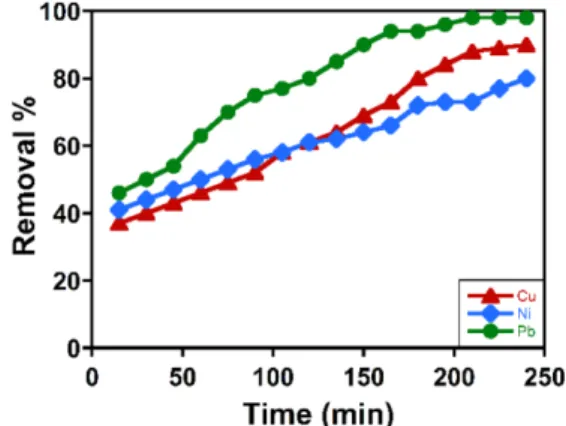
3-4. Impact of Contacting Time on Metal Ions Removal The impact of increasing the contact time between adsorbent powder and metal ions on the removal efficiency was investigated in the range between 15 to 240 minutes with 15 min intervals. As seen in Fig. 5, increasing the adsorbent time enhances the removal percentages for all metal ions. Increasing the contacting time allows metal ions to reach the bottom layers of the adsorption sites after filling the surface layers. Therefore, the removal percentages increase rapidly in the first stage of the process because of the availability of high number of surface adsorbing sites to adsorb metal ions. Gradually, the removal percentage decreases with time due to the saturations of Fig. 3. Impact of pH on the adsorption of Pb(II), Cu(II), and Ni(II)
ions (initial concentration = 20 mg/L, contacting time = 240 min, and dose = 1 g).
Fig. 4. Impact of metal concentration on the adsorption of Pb(II), Cu(II), and Ni(II) ions (pH = 5 for Pb(II) and 4 for Cu(II) and Ni(II), time = 240 min, and dose = 1 g).
Fig. 5. Impact of contact time on the adsorption of Pb(II), Cu(II), and Ni(II) ions (initial concentration = 20 mg/L, pH = 5 for Pb(II) and 4 for Cu(II) and Ni(II), and dose = 1 g).
those sites. The removal percentages increase slowly in the second stage of the adsorption process due to filling the surface adsorption sites and the hardness of filling the bottom layers of the adsorption sites because of the repulsive forces between adsorbing ions and those still in the solution. At 225 minutes the removal percentage for Pb(II), Cu(II), and Ni(II) is 98, 89, and 77%, respectively. No efficient change was noticed in the removal percentages of Pb(II) and Cu(II) between 225 to 240 minutes, while there was only a 3% increase for Ni(II) adsorption. The slow adsorption rate in this stage is attributed to achieving the saturation equilibrium of the adsorbent.
3-5. Impact of Adsorbent (Chara sp.) Dose on the Adsorption of Metal Ions
The impact of increasing the amount of adsorbent powder (Chara sp.) on the removal efficiency was investigated in the range between 0.1 to 1.0 g. As seen in Fig. 6, increasing the adsorbent amount enhances the removal percentages for all metal ions to reach their maximum values at 1 g of powder. The maximum removal percentages for Pb(II), Cu(II), and Ni(II) are 98, 90, and 80%, respectively. The better removal efficiency with higher dose is attributed to increasing adsorbent sites. Thus, 1 gram of adsorbent was adopted in this investigation.
3-6. Isotherm Model Study
The isotherm study was done under the optimum conditions for each metal ion. The most commonly used isotherm models to identify the equilibrium behavior of heavy metal adsorption are the well- known Freundlich and Langmuir. Thus, these two models were applied onto the data of this study. The Langmuir model is described in Equation (2) [28]:
equilibrium, qmax is the maximum amount of metal adsorbed per unit weight of algae powder (mg/g) that occurs when the adsorbent surface is fully covered with metal, Ce is the final concentration which occurs at equilibrium (mg/L), and b is an empirical constant related to the affinity between the biosorbent (algae powder) and metal ions. The low values of b indicate a high affinity of algae powder to metal ions. Equation (2) is written in a linearized form, as shown in Equation (3),
(Ce/q) = (1/Q × b) + (Ce/Q) (3)
where qmax and b can be determined from the linear plot of Ce-q versus Ce [28]. The Freundlich model, which describes heteroge- neous adsorption, is presented in Equation (4),
q = K × Ce(1/n) (4)
where K and n are Freundlich adsorption capacity and adsorption intensity constants of the algae powder (in this study), respectively.
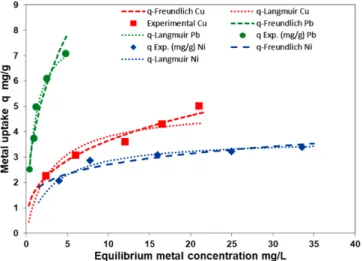
Higher values for these constants indicate a higher affinity of adsorbent material to metal ions. Fig. 7 shows Langmuir and Fre- undlich adsorption models of the three-metal ion adsorption on algae powder. The constant coefficients of both Langmuir and Freun- dlich models obtained in this study as well as biosorption capacity and isotherm constants (b, n, and K) for all metals are summa- rized in Table 1. Identifying the best model that describes the adsorption of each metal is done based on the higher regression coefficient (R2) obtained from each model. Table 1 shows that higher Fig. 6. Impact of Chara sp. dose on the removal of Pb(II), Cu(II),
and Ni(II) ions (initial concentration = 20 mg/L, time = 240 min, and pH = 5 for Pb(II) and 4 for Cu(II) and Ni(II)).
Fig. 7. Biosorption isotherms of different metal ions (a) Pb(II), (b) Ni(II), and (c) Cu(II).
Table 1. Comparison of the Langmuir and Freundlich adsorption constants for Pb(II), Cu(II), and Ni(II)
Langmuir Freundlich
qmax (mg/g) b (L/mg) R2 K (mg/g) n R2
Pb 8.340 1.063 0.9835 3.997 2.378 0.947
Ni 3.725 0.323 0.9659 1.658 4.6926 0.8725
Cu 4.935 0.339 0.9369 1.6452 2.888 0.9736
regression coefficients for the Langmuir isotherm model were observed for Pb(II) and Ni(II), while a higher regression coeffi- cient for the Freundlich model was observed for Cu(II). The Langmuir model considers many assumptions, such as constant sorption potential and adsorption energy, that make it suitable for monolayer coverage onto a homogeneous surface with limited number of identical sites [1]. On the other hand, the Freundlich model focuses on the physicochemical adsorption aspects of the heterogeneous surfaces of adsorption [28]. Unlike the monolayer adsorption assumption of the Langmuir model, the Freundlich model assumes that multi-layer adsorption of molecules occurs on the adsorbent surface. However, the applicability of both mod- els, which can be noticed from the close values of R2 in Pb(II) and Cu(II) cases, as also observed by other researchers [1], indi- cates that both kinetics (i.e., monolayer adsorption and heteroge- neous surface situations) occur under the experimental conditions of this investigation.
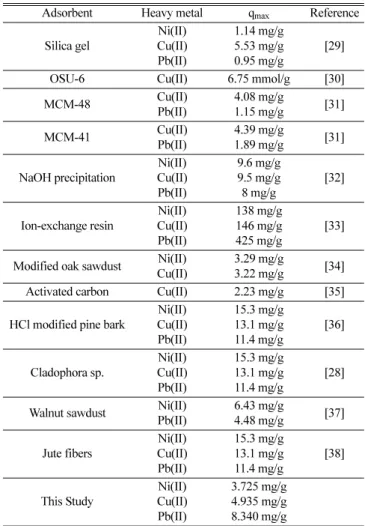
To compare the performance of Chara Sp. Algae in heavy metal removal, we summarized in Table 2 the adsorbent capacity of some of the well-known adsorbents. It can be seen that Chara Sp. Algae has a comparable performance compared to the reported adsorbents in the literature.
3-7. Kinetics of Adsorption
The adsorption mechanism of the three metal ions was investigated by identifying the characteristic constants of the sorption rate of algae powder by using a pseudo-first- and second-order equations. In the pseudo-first-order kinetic model, it is assumed that metal ions are bound only to one binding site on the cell surface of the bio-adsorbent.
However, pseudo-second-order kinetic model assumes that the rate- limiting step is most likely to involve chemical interactions leading to binding of the ions to the surface by bonding as strong as covalent bonding.
Equation (5) represents the pseudo-first-order, which is based on adsorbent capacity, while Equation (6) represents the pseudo-second- order equation which is relied on solid phase adsorption.
ln(qe-qt) = ln qe - K1 × t (5)
t/qt = (1/(K2 × qe2)) + (t/qe) (6)
qt and qe (mg/g) are the masses of the metal ions adsorbed at a specific time (t (minutes)) and at equilibrium, respectively, while K1 (min-1) and K2 (g/mg min) are the biosorption rate constants of the first- and second-order equations, respectively. K1 constant was determined experimentally by plotting of ln (qe - qt) vs. time. Table 3 summarizes the kinetic model constants gained from applying the experimental data on the pseudo-first- and second-order models. The comparison of R2 values shows that pseudo-second-order best fit the adsorption kinetics of the three metal ions. This is in agreement with literature which shows that the biosorption of these metals on different Table 2. A comparison between the performance of Chara Sp. Algae
and some of the reported adsorbents in the literature Adsorbent Heavy metal qmax Reference
Silica gel
Ni(II) Cu(II) Pb(II)
1.14 mg/g 5.53 mg/g 0.95 mg/g
[29]
OSU-6 Cu(II) 6.75 mmol/g [30]
MCM-48 Cu(II)
Pb(II)
4.08 mg/g
1.15 mg/g [31]
MCM-41 Cu(II)
Pb(II)
4.39 mg/g
1.89 mg/g [31]
NaOH precipitation
Ni(II) Cu(II) Pb(II)
9.6 mg/g 9.5 mg/g 8 mg/g
[32]
Ion-exchange resin
Ni(II) Cu(II) Pb(II)
138 mg/g 146 mg/g 425 mg/g
[33]
Modified oak sawdust Ni(II) Cu(II)
3.29 mg/g
3.22 mg/g [34]
Activated carbon Cu(II) 2.23 mg/g [35]
HCl modified pine bark
Ni(II) Cu(II) Pb(II)
15.3 mg/g 13.1 mg/g 11.4 mg/g
[36]
Cladophora sp.
Ni(II) Cu(II) Pb(II)
15.3 mg/g 13.1 mg/g 11.4 mg/g
[28]
Walnut sawdust Ni(II) Pb(II)
6.43 mg/g
4.48 mg/g [37]
Jute fibers
Ni(II) Cu(II) Pb(II)
15.3 mg/g 13.1 mg/g 11.4 mg/g
[38]
This Study
Ni(II) Cu(II) Pb(II)
3.725 mg/g 4.935 mg/g 8.340 mg/g
Fig. 8. Biosorption kinetic of Chara sp. towards Pb(II), Cu(II), and Ni(II).
bacteria and aquatic living best fits the pseudo-second-order model, while first-order better fits the biosorption kinetic with chemical sorption being the rate-controlling step [1].
4. Conclusions
The results obtained from this investigation show that algae Chara sp. is a good adsorbing material for removing the three studied metal ions from aqueous solution. We found that the adsorption process depends mainly on pH, as well as ion initial concentration, contacting time, and adsorbent dose. Acidic media was found to be more active for the adsorption of the three metal ions, where the maximum removal efficiency of Pb(II) by Chara sp. was found to be 98% at pH = 4, while for Cu(II) and Ni(II) was 90 and 80%, respectively at pH = 5.
Isotherm study shows that Langmuir kinetic model is better at describing the adsorption kinetic of Cu(II) and Ni(II) ions, while the Freundlich model is better fitting Pb(II) adsorption. However, the close values of the regression coefficient indicate that both kinetics (i.e., monolayer adsorption and heterogeneous surface situations) occur under the experimental conditions of this investigation.
References
1. Özdemir,S., Kilinc, E., Poli, A., Nicolaus, B. and Güven, K., Chem. Eng. J., 152, 195-206(2009).
2. World Health Organization, Lead in drinking-water: background document for development of WHO guidelines for drinking- water quality (2003).
3. World Health Organization, Guidelines for drinking-water quality, 4th ed., (2011).
4. Chen, S. Z., Yan, J. T., Li, J. F., Zhang, Y. and Lu, D. B., Micro- chim. Acta, 184, 2797-2803(2017).
5. Hassanien, M. M., Mortada, W. I., Kenawy, I. M. and El-Daly, H., Appl. Spectrosc., 71, 288-299(2017).
6. Liu, W., Zhang, P., Borthwick, A., Chen, H. and Ni, J., J. Colloid Interface Sci., 423, 67-75(2014).
7. Cankara, S., Ozkutuk, E., Ozturk, O., Ersoz, A. and Say, R., Sep.
Sci. Technol., 51, 901-908(2016).
8. Yang, L., Xiao, J., Shen, Y., Liu, X., Li, W., Wang, W. and Yang, Y., Environ. Sci. and Pollut. Res., 24, 24214-24222(2017).
9. Puranik, P. and Paknikar, K., Biotechnol. Prog., 15, 228-237(1999).
10. Ungureanu, G., Santos, S., Boaventura, R. and Botelho, C., J. of Environ. Manage., 151, 326-342(2015).
11. Alalwan, H. A., Abbas, M. N., Abudi, Z. N. and Alminshid, A.
H., Environ. Technol. & Innovation, 12, 1-13(2018).
12. Alalwan, H. A., Abbas, M. N. and Alminshid, A. H., Indian Chem.
Eng., 1-12(2019).
13. Abbas, M. N. and Alalwan, H. A., Korean Chem. Eng. Res., 57,
283-288(2019).
14. Garcia-Reyes, R. B. and Rangel-Mendez, J. R., Bioresour. Technol., 101, 8099-8108(2010).
15. Alalwan, H. A., Alminshid, A. H. and Aljaafari, H. A., Renewable Energy Focus, 28, 127-139(2019).
16. Gupta, S. and Bux, F., Application of Microalgae in Wastewater Treatment., 1st ed., Springer, Switzerland(2019).
17. Sooksawat, N., Meetam, M., Kruatrachue, M., Pokethitiyook, P.
and Inthorn, D., J. Environ. Sci. Health, Part A, 52, 539-546(2017).
18. Amirnia, S., Asaeda, T., Takeuchi, C. and Kaneko, Y., Sci. Total Environ., 646, 661-669(2019).
19. Scheffer, M. and van Nes, E. Hydrobiologia, 584, 455-466 (2007).
20. Kishore, J., Patil, R. and Hitendra, K., J. Chem. Pharma. Res., 7, 783-791(2015).
21. Lodeiro, P., Cordero, B., Grille, Z., Herrero, R. and Sastre de Vicente, M., Biotechnol. Bioeng., 88, 237-247(2004).
22. Matheickal, J., Yu, Q. and Woodburn, G., Water Res., 33, 335-342 (1999).
23. Rubín, E., Rodríguez, P., Herrero, R. and Sastre de Vicente, M., J. Chem. Technol. Biotechnol., 81, 1093-1099(2006).
24. Çelekli, A. and Geyik, F., Bioresour. Technol., 102, 5634-5638(2011).
25. Khataee, A., Dehghan, G., Ebadi, A., Zarei, M. and Pourhassan, M., Bioresour. Technol., 101, 2252-2258(2010).
26. Kowanga, K. D., Gatebe, E., Mauti, G. O. and Mauti, E. M., J.
Phytopharmacol., 5, 71-78(2016).
27. Fiol, N., Villaescusa, I., Martínez, M., Miralles, N., J. Poch, and J. Serarols, Sep. Purif. Technol., 50, 132-140(2006).
28. Elmaci, A., Yonar, T. and Özengin, N., Water Environ. Res., 79, 1000-1005(2007).
29. Tzvetkova, P. and Nickolov, R., J. of the Univ. of Chem. Technol. &
Metall., 47, (2012).
30. Alothman, Z. A. and Apblett, A. W., J. Hazard. Mater., 182, 581- 590(2010).
31. Benhamou, A., Baudu, M., Derriche, Z. and Basly, J., J. Hazard.
Mater., 171, 1001-1008(2009).
32. Meunier, N., Drogui, P., Montané, C., Hausler, R., Mercier, G.
and Blais, J., J. Hazard. Mater., 137, 581-590(2006).
33. Tor, A., Büyükerkek, T., Çengelolu, Y. and Ersöz, M., Desalina- tion, 171, 233-241(2005).
34. Argun, M., Dursun, S., Ozdemir, C. and Karatas, M., J. Hazard.
Mater., 141, 77-85(2007).
35. Üçer, A., Uyanik, A. and Aygün, Ş., Sep. Purif. Technol., 47, 113-118(2006).
36. Argun, M., Dursun, S. and Karatas, M., Desalination, 249, 519- 527(2009).
37. Bulut, Y. and Tez, Z., Fresenius Environ. Bull., 12, 1499-1504 (2003).
38. Shukla, S. and Pai, R., Bioresour. Technol., 96, 1430-1438(2005).
Pb 2.52 2.870 0.0118 0.9525 3.155 0.01395 0.9959
Cu 2.314 2.75 0.0142 0.8645 3.142 0.009245 0.9803
Ni 1.98 2.118 0.0145 0.9504 2.501 0.0118 0.9928