711 Korean Chem. Eng. Res., 55(5), 711-717 (2017)
https://doi.org/10.9713/kcer.2017.55.5.711 PISSN 0304-128X, EISSN 2233-9558
Dissolution of North Korean Magnesite by using Hydrochloric Acid
Ui-Hyun Baek*, Hyungkyu Park*, Jin-Young Lee*,** and Jungshin Kang*,**,†
*Strategic Minerals Utilization Research Department, Korea Institute of Geoscience and Mineral Resources, 124, Gwahak-ro, Yuseong-gu, Daejeon, 34132, Korea
**Department of Resources Recycling, University of Science and Technology, 217, Gajeong-ro, Yuseong-gu, Daejeon, 34113, Korea (Received 10 May 2017; Received in revised form 30 May 2017; accepted 7 June 2017)
Abstract − A fundamental study was conducted on the dissolution of North Korean magnesite using hydrochloric acid to understand the dissolution behavior of the magnesium and impurities. The influence of the acid concentration, particle size of the magnesite, reaction temperature, and pulp density on the dissolution of magnesium, iron, calcium, aluminum, and silicon dioxide was studied. The experimental results showed that 98.5% of magnesium, 86.9% of iron, 87.3% of calcium, 23.6% of aluminum, and 20.4% of silicon dioxide were dissolved when magnesite particle sizes within the range of 75~105 µm were reacted using 3 M HCl solution under 6% pulp density at 363 K for 3 h. The residues that remained after the dissolution were silicon dioxide, talc, and clinochlore.
Key words: North Korean magnesite, Dissolution of magnesite using HCl, Dissolution of magnesium, Dissolution of impurities
1. Introduction
Magnesite (MgCO3) is one of the most important mineral resources for the production of magnesium (Mg) using the electrolytic process.
According to the United States Geological Survey (USGS) report shown in Fig. 1(a), China produced 70% of the global magnesite production in 2014 [1]. Although, North Korea has 18% of the global reserves of magnesite as shown in Fig. 1(b), the country’s magnesite production is limited to only 0.83% of the global production in 2014.
These results imply the potential of the North Korea to become one of the magnesite suppliers in the future.
Generally, concentrated hydrochloric acid (HCl) is used for the dissolution of magnesite to produce magnesium chloride (MgCl2) solution [2,3]. After the removal of impurities in MgCl2 solution, anhydrous MgCl2 is produced through the condensation of MgCl2 solution followed by the dehydration of magnesium chloride hexahydrate (MgCl2·6H2O). This anhydrous MgCl2 is used as a feedstock for the electrolytic process.
When the removal of the impurities to prepare high-purity MgCl2 solution is considered, it is important to understand not only the dissolution of Mg in magnesite but also the dissolution of impurities by the concentrated HCl solution. The dissolution of impurities is affected by the mineral types of the impurities in the magnesite and the dissolution conditions. In addition, the mineral types of the impurities vary depending on the mining site.
The dissolution of magnesite feed, mined in several countries, in
various types of acid has been reported by researchers in the past [4- 12]. Most of these studies investigated the dissolution kinetics of Mg in the magnesite feed using acids to determine the rate-controlling step [10-12]. However, the dissolution of Mg and impurities from North Korean magnesite using HCl solution is seldom reported except for the preliminary study carried out by Park and co-workers;
nevertheless, any systematic investigation was not conducted [4].
†To whom correspondence should be addressed.
E-mail: [email protected], [email protected]
‡This article is dedicated to Prof. Choon Han on the occasion of his retire- ment from Kwangwoon University.
This is an Open-Access article distributed under the terms of the Creative Com- mons Attribution Non-Commercial License (http://creativecommons.org/licenses/by- nc/3.0) which permits unrestricted non-commercial use, distribution, and reproduc-
tion in any medium, provided the original work is properly cited. Fig. 1. Global (a) production and (b) reserves of magnesite in 2014.
Fig. 2 shows the process flowchart for the preparation of anhydrous MgCl2 from North Korean magnesite produced in the Ryongyang mine.
The purpose of this study was to investigate the influence of the acid concentration, particle size of the magnesite, reaction temperature, and pulp density on the dissolution of Mg and impurities such as iron (Fe), calcium (Ca), aluminum (Al), and silicon dioxide (SiO2) in North Korean magnesite. In addition, the optimum conditions for the preparation of MgCl2 solution from North Korean magnesite through dissolution by HCl solution were determined. The results of this study can be used to produce high-purity MgCl2 solution through the removal of the impurities when the North Korean magnesite is used as feedstock.
2. Experimental
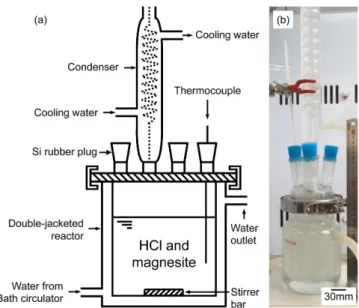
Fig. 3 shows a schematic and a photograph of the experimental apparatus used in this study. The magnesite sample was pulverized and sieved before use. Table 2 shows the particle size distribution after the pulverization. For the experiment preparation, 500 ml of HCl (guaranteed reagent, JUNSEI CHEMICAL Co. Ltd.) solution was placed in the double-jacketed reactor as shown in Fig. 3. Before increasing the temperature of HCl solution, 50 sccm of Ar gas (purity: 99.999%) was injected through a quartz tube into the HCl solution for 0.5 h, and the tube was removed from the reactor after the bubbling was finished. The temperature of the HCl solution was increased to reach the reaction temperature by supplying hot water through the bath circulator (model No.: CW-10G, JEIO TECH, CO., Fig. 2. Process flowchart for the preparation of anhydrous magne-
sium chloride from North Korean magnesite in Korea Insti- tute of Geoscience and Mineral Resources.
Fig. 3. (a) Schematic and (b) photograph of experimental apparatus for the dissolution of the magnesite.
Table 1. Analytical results of the magnesite feed from North Korea
Feedstock Mass percentage of element i, Ci (mass %)
Mga Feb Cub Nib Cab Alb Sia
Magnesite 28.68 0.09 N.D N.D 0.72 0.13 0.31
aDetermined by wet analysis (gravimetric analysis)
bDetermined by ICP-OES analysis, N.D: Not Detected (< 0.010 mass %)
Table 2. Analysis results for the particle size distribution of North Korean magnesite
Size fraction (µm) Cumulative volume fraction (%)a
under 45 11.52
45~75 21.54 75~105 30.48 105~150 40.52 150~300 67.46
over 300
300~425 83.43
425~600 95.31 600~710 98.58
710~1000 100.00
aDetermined by particle size analyzer
Dissolution of North Korean Magnesite by using Hydrochloric Acid 713
LTD.). A condenser was used to prevent evaporation of the reactor contents.
In the dissolution experiments, 30 g of North Korean magnesite produced in Ryongyang mine was added to the HCl solution, in order to conduct the experiments that investigate the influence of the acid concentration, particle size of the magnesite, and reaction temperature on the dissolution. On the other hand, when experiments on the influence of the pulp density on the dissolution were conducted, 30 g, 50 g, 70 g, or 90 g of the magnesite were added to the HCl solution, respectively. The HCl solution was continuously stirred at 500 rpm.
During the dissolution, 5 ml of the solution was taken from the reactor at predetermined time intervals, then the sample was filtered by using a syringe filter unit (pore size: 0.20 μm, ADVANTEC®) for the analysis.
The concentrations of Mg and the impurities in liquid samples were analyzed with inductively coupled plasma optical emission spectroscopy (ICP-OES: Perkin Elmer, Optima 5300DV and Thermo Fisher Scientific, ICAP 6500). The crystalline phases of the residues that remained after the dissolution were identified by X-ray diffrac- tion (XRD: Rigaku, SmartLab, Cu-Kα radiation). In addition, the particle size distribution of the magnesite was analyzed by using a particle size analyzer (Malvern Instruments, Mastersizer200).
3. Results and Discussion
3-1. North Korean magnesite feed
Table 1 and Figure 4 show the results of composition analysis and XRD analysis of the magnesite, respectively. The analysis results revealed that the main phase of North Korean magnesite was MgCO3, while other phases were not identified by XRD analysis. In addition, the main impurities found in the magnesite were Fe, Ca, Al, and Si, as shown in Table 1. Even though the phases of the main impurities were not identified by the results of XRD analysis, the literature indicates that silicon dioxide, talc, chlorites, dolomite, and calcite are the main phases of the impurities contained in North Korean magnesite produced in Ryongyang mine [20].
Hanawalt et al. reported that Fe, copper (Cu), and nickel (Ni) accelerate the corrosion rate of Mg alloys [13,21]. These elements should be removed during the preparation of high-purity MgCl2 solution. In addition, Fe in anhydrous MgCl2 decreases the current efficiency of the electrolytic process [3]. As shown in Table 1, Cu and Ni were not contained in North Korean magnesite. Therefore, the dissolution and removal of Fe are important when the use of North
Korean magnesite is considered.
3-2. Observation
Bubble generation was observed during the dissolution of the magnesite by HCl solution. The chemical reaction between the magnesite and HCl solution is expressed by Eq. (1) [6,10]. Therefore, carbon dioxide (CO2) gas is expected to be generated by the dissolution of the magnesite by HCl solution.
MgCO3 (s) + 2 HCl (l) = MgCl2 (aq.) + H2O (l) + CO2 (g) (1) 3-3. Influence of the concentration of HCl solution on the dissolution
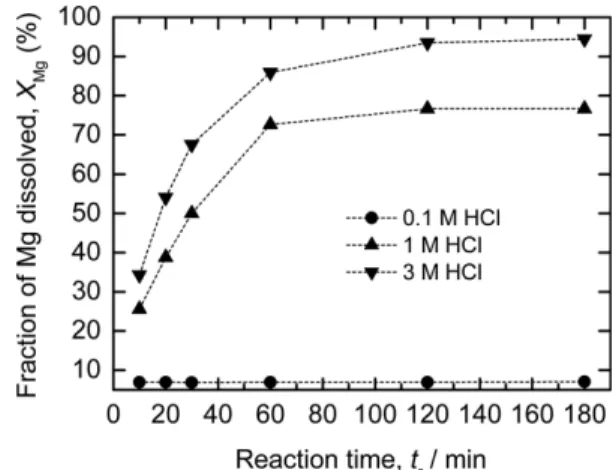
Fig. 5 shows the fraction of Mg dissolved when the experiments were conducted using the magnesite with particle sizes in the range of 45~75 μm at 343 K under 6% pulp density. As shown in Fig. 5, the Mg dissolution rate increased when the concentration of HCl solution increased in the range of 0.1 M~3 M. The experimental results showed that the fractions of Mg dissolved reached 93.5~94.4% after 2 h when 3 M HCl solution was used. The fractions of Mg dissolved were increased by 16.8~17.7% point compared to the results obtained when 1 M HCl solution was used.
The pH for the Mg2+/Mg(OH)2 eq. is 8.37 at 298 K [14]. This indicates the possibility of the dissolution of Mg even in weak acids depending on the types of feedstock. Ranjitham and Khangaonkar reported that calcined magnesite began to dissolve at pH 4.5 and the fraction of MgO dissolved was 90% at pH 6.7 when ammonium chloride was used [15]. However, as shown in Fig. 5, the fraction of Mg dissolved was 0.71% even though 0.1 M HCl solution was used when the magnesite was used as the feedstock. Therefore, the concentration of HCl solution required for the sufficient dissolution of the magnesite with particle sizes ranging between 45~75 μm at 343 K under 6% pulp density should be at least 3 M.
3-4. Influence of particle size on the dissolution
To investigate the influence of the particle size, various particle sizes of the magnesite ranging from below 45 μm to above 300 μm at
Fig. 4. XRD analysis result of the magnesite feed from North Korea.
Fig. 5. Fractions of Mg dissolved when the experiments were con- ducted using the magnesite with particle sizes in the ranges of 45~75 µm at 343 K under 6% pulp density.
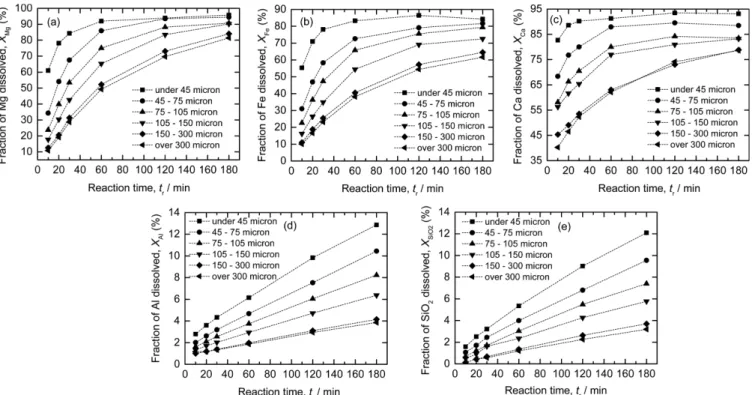
343 K under 6% pulp density were used to conduct the experiments using 3 M HCl solution. The dissolution rate of Mg increased when the particle size of the magnesite decreased in the range of below 45 μm
~above 300 μm, as shown in Fig. 6(a). The fractions of Mg dissolved were 94.4~95.8% and 90.8% after 3 h when magnesite with particle sizes below 75 μm and 75~105 μm was used, respectively. Therefore, when the dissolution of the magnesite is conducted using 3 M HCl solution at 343 K under 6% pulp density, it is more effective to use feedstock particle sizes below 75 μm.
Fig. 7 shows the XRD results of the residues after the dissolution of the magnesite feed when the experiments were conducted using 3 M HCl solution at 343 K after 3 h under 6% pulp density. As shown in Fig. 7(a), although magnesite with small particle sizes (within the range below 45 μm) was used, MgCO3 was still identified. However, it seems that the fraction of Mg dissolved was saturated when the dissolution was conducted at 343 K. Therefore, it is required to increase the dissolution rate of Mg by increasing the reaction temperature to ensure the complete dissolution of Mg from the magnesite.
Figs. 6(b)~(e) show the fractions of Fe, Ca, Al, and SiO2 dissolved when the dissolution of the magnesite is conducted. The figures illustrate that the dissolution rates of the impurities increased when the particle size of the feedstock decreased in the range of below 45 μm - above 300 μm. The fractions of Fe and Ca dissolved were 81.6~84.3% and 88.5~93.1%, respectively, after 3 h when particle sizes below 75 μm were used. These results indicate that most of Fe and Ca in the magnesite dissolved, and it is necessary to remove Fe and Ca to obtain high-purity MgCl2 solution.
The fractions of Al and SiO2 dissolved were 10.4~12.9% and
Fig. 6. Fractions of (a) Mg, (b) Fe, (c) Ca, (d) Al, and (e) SiO2 dissolved when the experiments were conducted using 3 M HCl solution with the various particle sizes of the magnesite from below 45 µm to above 300 µm at 343 K under 6% pulp density.
Fig. 7. XRD results of the residues obtained after the dissolution of the various particle sizes of the magnesite when the experi- ments were conducted using 3 M HCl solution at 343 K under 6% pulp density.
Dissolution of North Korean Magnesite by using Hydrochloric Acid 715
9.6~12.1%, respectively, after 3 h when particle sizes below 75 μm were used. Figs. 6(d), 6(e), and 7 show that most of the Al and SiO2 remained as SiO2, Mg3Si4O10(OH)2 (talc), and (Mg, Al)6(Si, Al)4O10(OH)8 (clinochlore in chlorites). The phases of these impurities aligned with the results of the literature [20] (as mentioned in section 3.1). Even though the dissolved amount of Al and SiO2 in the magnesite was small, it is also necessary to remove those impurities to produce high-purity MgCl2 solution.
Ross reported the dissolution of clinochlore ((Al1.05Fe0.22+3Fe0.27+2 Mg4.34)(Si2.98 Al1.02)O10(OH)8) using 2 N HCl at 298~373 K [16]. It was estimated that almost 100% of the Mg, Fe, and Al in the clinochlore was dissolved at 373 K after 2 h, while about 50% of Mg was dissolved at 333 K after about 2 h. Therefore, in this study, some of the dissolution of Al is anticipated to be caused by the dissolution of clinochlore by 3 M HCl solution at 343 K. In addition, it is also anticipated that the dissolution of Mg and Al will increase when the reaction temperature increases owing to the increase of the dissolution rate of the clinochlore in the magnesite [16].
It is also reported that the fraction of amorphous silica dissolved is higher than that of quartz dissolved under the identical conditions [18,19]. Therefore, if amorphous silica exists in the magnesite, the dissolution of SiO2 can be caused by the dissolution of the amorphous silica by 3 M HCl solution since talc is difficult to dissolve by acid [17,18]. However, the exact reason for the dissolution of SiO2 is still under investigation.
3-5. Influence of reaction temperature on the dissolution To evaluate the influence of the reaction temperature on the dissolution of the magnesite, particle sizes within the range of 75~
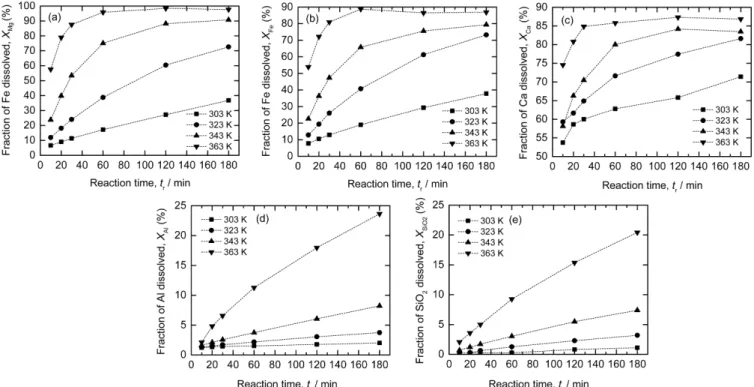
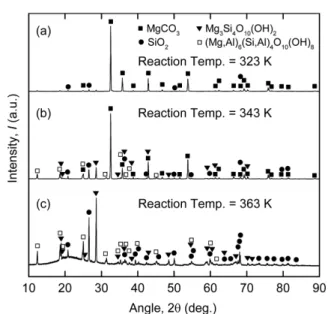
105 μm were used since the fractions of Mg dissolved were 90.8 % at 343 K after 3 h, as previously described in section 3.4. As shown in Fig. 8(a), the dissolution rate of Mg increased when the reaction temperature increased in the range of 303~363 K. In addition, the fractions of Mg dissolved reached 97.7~98.5% when the dissolution was conducted using 3 M HCl solution at 363 K after 2 h. Furthermore, MgCO3 was not identified in the residues obtained after the dissolution of the magnesite at 363 K, as shown in Fig. 9(c). The maximum fraction of Mg dissolved could be obtained by increasing the reaction temperature owing to the increase of reaction rate.
Figs. 8(b)~(e) show that the dissolution rate of impurities such as Fe, Ca, Al, and SiO2 also increased when the reaction temperature increased in the range of 303~363 K. Figs. 8(b) and (c) show the fractions of Fe and Ca dissolved from the magnesite with particle sizes in the range of 75~105 μm when the experiments were conducted using 3 M HCl solution at 303~363 K. The obtained fractions of Fe and Ca dissolved were 86.5~86.9% and 86.9~87.3% after 2 h, respectively.
Even though the reaction temperature was increased, the fractions of Fe and Ca dissolved showed about 10% point difference compared to that of Mg.
The fractions of Al and SiO2 dissolved reached 23.6% and 20.4%, respectively, at 363 K after 3 h. Although about 76% of Al and 80%
of SiO2 were not dissolved by HCl solution at 363 K, and remained as SiO2, talc, and clinochlore as shown in Fig. 9(c), it is necessary to remove the dissolved amount of Al and SiO2 to produce high-purity MgCl2 solution. In addition, as shown in Fig. 8(d) and (e), the fractions of Al and SiO2 dissolved at 363 K were not saturated until 3 h.
As a result, it is anticipated that the dissolved amount of Al and SiO2 will increase as the reaction time increases.
Fig. 8. Fractions of (a) Mg, (b) Fe, (c) Ca, (d) Al, and (e) SiO2 dissolved when the experiments were conducted using the magnesite with par- ticle sizes in the range of 75~105 µm in 3 M HCl solution at 303~363 K under 6% pulp density.
3-6. Influence of pulp density on the dissolution
The influence of pulp density on the dissolution of the magnesite with particle sizes in the range of 75~105 μm in 3 M HCl solution at 363 K after 3 h was investigated. The pulp density is expressed by Eq. (2) in this study. The fractions of the magnesite feed dissolved were 99.1%, 99.0%, and 92.2% when the pulp densities were 6%, 10%, and 14%, respectively, as shown in Fig. 10. Based on these experimental results, the appropriate pulp density is 10%.
Pulp density (%) = weight of feed (g) * 100 / volume of solution (ml) (2) When the pulp densities were 10%, 14%, and 18%, the obtained pH values of the leachate were below 0, 2.80, and 2.81, respectively.
In addition, when the pulp densities were 14% and 18%, the concentrations of Mg in the leachate were 37600 mg/l and 37500 mg/l, respectively.
These results indicate that the dissolution of the magnesite by HCl solution is difficult when the pH of the acid solution is higher than around 2.80, and the maximum concentration of Mg is around 37500 mg/l under the dissolution of the magnesite with particle sizes in the range of 75~105 μm in 3 M HCl solution at 363 K after 3 h. Therefore, on the basis of the experimental results, the optimum pulp density is calculated as 13.07%.
4. Conclusions
A fundamental study on the dissolution of North Korean magnesite by HCl solution was carried out. The influence of the acid concentration, particle size of the magnesite, reaction temperature, and pulp density on the dissolution of the Mg and impurities such as Fe, Ca, Al, and SiO2 from the magnesite was investigated.
When 0.1~3 M HCl solution was used at 343 K for 3 h under 6%
pulp density, the fraction of Mg dissolved from the magnesite with particle sizes ranging between 45~75 μm was 94.4% in 3 M HCl solution.
When the influence of the magnesite particle size was investigated using 3 M HCl solution at 343 K for 3 h under 6% pulp density, the obtained fractions of Mg, Fe, Ca, Al, and SiO2 dissolved from the magnesite with particle sizes below 75 μm were 94.4~95.8%, 81.6~
84.3%, 88.5~93.1%, 10.4~12.9%, and 9.6~12.1%, respectively. In addition, the residues that remained after the dissolution were mainly SiO2, talc, and clinochlore.
When the dissolution was conducted at 303~363 K using 3 M HCl solution for 3 h under 6% pulp density, the reported fractions of Mg, Fe, Ca, Al, and SiO2 dissolved from the magnesite with particle sizes ranging between 75 μm and 105 μm were 98.5%, 86.9%, 87.3%, 23.6%, and 20.4%, respectively, at 363 K.
When the dissolution was conducted under the pulp density ranging from 6% to 18% using 3 M HCl solution at 363 K for 3 h, the achieved fraction of the dissolved magnesite with particle sizes in the range of 75 μm to 105 μm was 99.0% under 10% pulp density. In addition, the optimum pulp density was calculated to be 13.07%.
Acknowledgments
This research was supported by the National Research Council of Science & Technology (NST) grant provided by the Korean govern- ment (MSIP) (No. CRC-15-06-KIGAM) of Korea.
References
1. U.S. Geological Survey, Mineral Commodity Summaries 2016, U.S. Geological Survey, Reston, Virginia, USA (2016).
2. Friedrich, H. E. and Mordike, B. L., Magnesium Technology, Springer-Verlag, Berlin Heidelberg, Germany (2016).
3. Kipouros, G. J. and Sadoway, D. R., The Chemistry and Electrochemistry of Magnesium Production, in: G. Mamantov, C.B. Mamantov, and J. Braunstein (Eds.), Advances in Molten Salt Chemistry 6, Elsevier Fig. 9. XRD results of the residues obtained after the dissolution of the
magnesite at 323~363 K when the experiments were conducted using the feed with particle sizes in the ranges of 75~105 µm in 3 M HCl solution under under 6% pulp density.
Fig. 10. Influence of pulp density on the fractions of the dissolved mag- nesite with particle sizes in the range of 75~105 µm when the experiments were conducted using 3 M HCl solution at 363 K for 3 h.
Dissolution of North Korean Magnesite by using Hydrochloric Acid 717
Science Publishers B.V., Netherlands (1987).
4. Eom, H.-C., Park, H., Kim, C., Kim, S., Yoon, H., J. of Korean Inst. of Resources Recycling, 18, 38 (2009).
5. Tveten, K. W., Mejdell, G. T. and Marcussen, J. B., United States Patent, 5120514 (1992).
6. Mejdell, G. T., Baumann, H. M. and Tveten, K. W., United States Patent, 5112584 (1992).
7. White, C. and Berube, M., United States Patent, 5980854 (1999).
8. Harris, G. B., Peacey, J. G. and Monette, S., United States Patent, 4743347 (1988).
9. Jenkins, D. H., Sheehan, G. J. and Frost, M. T., Trans. Inst. Min Metall. C, 118, 205 (2009).
10. Hosgun, H. L. and Kurama, H., Ind. Eng. Chem. Res., 51, 1087 (2012).
11. Lacin, O., Donmez, B. and Demir, F., Int. J. Miner. Process., 75, 91 (2005).
12. Bakan, F., Lacin, O., Bayrak, B. and Sarac, H., Int. J. Miner. Process.,
80, 27 (2006).
13. Hanawalt, J. D., Nelson, C. E. and Peloubet, J. A., Trans. AIME, 147, 273 (1942).
14. Wagman, D. D., Evans, W. H., Parker, V. B., Schumm, R. H., Halow, I., Bailey, S. M., Churney, K. L. and Nuttall, R. L., J. Phvs.
Chem. Ref. Data., Supplement No.2, 11, 2-1 (1982).
15. Ranjitham, A. M. and Khangaonkar, P. R., Hydrometallurgy, 23, 177 (1990).
16. Ross, G. J., Can. J. Chem., 45, 3031 (1967).
17. Mase, H., Bulletin of the Chemical Society of Japan, 34, 214 (1961).
18. Park, K.-H., Nam, C.-W. and Kim, H.-H., J. of Korean Inst. of Resources Recycling, 24, 3 (2015).
19. Fournier, R. O. and Rowe, J. J., Am. Mineral., 62, 1052 (1977).
20. Kim, C. W., et al., Deposits in North Korea (3), Science Encyclopedia Publishers, Pyongyang, North Korea (1991).
21. Song, G. L. and Atrens, A., Advanced Engineering Materials, 1, 11 (1999).