36 http://dx.doi.org/10.9713/kcer.2016.54.1.36
PISSN 0304-128X, EISSN 2233-9558
Synthesis And Ionic Conductivity of Siloxane Based Polymer Electrolytes with Propyl Butyrate Pendant Groups
Natia Jalagonia*,**, Tamara Tatrishvili*,**, Eliza Markarashvili*,**, Jimsher Aneli**, Jouzas Vidas Gražulevičius*** and Omar Mukbaniani*,**,†
*Iv. Javakhishvili Tbilisi State University, I. Chavchavadze Ave., 1, Tbilisi 0179, Georgia
**Institute of Macromolecular Chemistry and Polymeric Materials, Iv. Javakhishvili Tbilisi State University, I. Chavchavadze Ave., 13, Tbilisi 0179, Georgia
***Department of Organic Technology, Kaunas University of Technology, Radvilenu pl. 19, LT-50254 Kaunas, Lithuania (Received 24 November 2014; Received in revised form 11 January 2015; accepted 9 June 2015)
Abstract − Hydrosilylation reactions of 2.4.6.8-tetrahydro-2.4.6.8-tetramethylcyclotetrasiloxane with allyl butyrate catalyzed by Karstedt’s, H2PtCl6 and Pt/C catalyst were studied and 2.4.6.8-tetra (propyl butyrate)-2.4.6.8-tetrameth- ylcyclotetrasiloxane was obtained. The reaction order, activation energies and rate constants were determined. Ring- opening polymerization of 2.4.6.8-tetra (propyl butyrate)-2.4.6.8-tetramethylcyclotetrasiloxane in the presence of CaF2, LiF, KF and anhydrous potassium hydroxide in 60-70oC temperature range was carried out and methylsilox- ane oligomers with regular arrangement of propyl butyrate pendant groups were obtained. The synthesized products were studied by FTIR and NMR spectroscopy. The polysiloxanes were characterized by wide-angle X-ray, gel-per- meation chromatography and DSC analyses. Via sol-gel processes of oligomers doped with lithium trifluoromethyl- sulfonate or lithium bis (trifluoromethylsulfonyl)imide, solid polymer electrolyte membranes were obtained. The dependences of ionic conductivity of obtained polyelectrolytes on temperature and salt concentration were investi- gated, and it was shown that electric conductivity of the polymer electrolyte membranes at room temperature changed in the range 3.5×10⁻⁴~6.4×10⁻⁷ S/cm.
Key words: Polysiloxanes, Membranes, Cross-Linking, Polymer Electrolyte, Ionic Conductivity
1. Introduction
Hybrid organic-inorganic materials, where molecular organic and inorganic fragments are combined, have been considered poten- tially attractive for developing new materials with a broad spec- trum of interesting properties. In comparison with organic and inorganic constituents and polymers separately, hybrid organic- inorganic materials have many advantages [1-4].
Polymer electrolytes (PE) play an important part in electrochem- ical devices such as batteries and fuel cells. To achieve optimal per- formance, the PE must maintain a high ionic conductivity and mechanical stability at both high and low relative humidity. The polymer electrolyte also needs to have excellent chemical stability for long product life and robustness.
According to the prevailing theory, ionic conduction in polymer electrolytes is facilitated by the large-scale segmental motion of the polymer backbone, and primarily occurs in the amorphous regions of the polymer electrolyte. Crystallinity restricts polymer backbone segmental motion and significantly reduces conductivity. Conse- quently, polymer electrolytes with high conductivity at room tem-
perature have been sought through polymers which have highly flexible backbones and have largely amorphous morphology.
The interest in polymer electrolytes was increased also by poten- tial applications of solid polymer electrolytes in high energy den- sity solid state batteries, gas sensors and electrochromic windows.
Conductivity of 10-3 S/cm is commonly regarded as a necessary minimum value for practical applications in batteries [4,5]. At present, polyethylene oxide (PEO)-based systems are most thoroughly investi- gated, reaching room temperature conductivities of 10-7 S/cm in some cross-linked salt in polymer systems based on amorphous PEO-polypropylene oxide copolymers. However, conductivity with such value unfortunately is low, resulting from the semicrystalline character of the polymer as well as from the increase on the glass transition temperature of the system. It is widely accepted that amor- phous polymers with low glass transition temperatures Tg and a high segmental mobility are important prerequisites for high ionic conductivities. Another necessary condition for high ionic conduc- tivity is a high salt solubility in the polymer, which is most often achieved by donors such as ether oxygen or imide groups on the main chain or on the side groups of the PE. It is well established also that lithium ion coordination takes place predominantly in the amorphous domain, and that the segmental mobility of the polymer is an important factor in determining the ionic mobility.
Great attention was pointed to PEO-based amorphous electrolyte obtained by synthesis of comb-like polymers, by attaching short
†To whom correspondence should be addressed.
E-mail: [email protected]
This is an Open-Access article distributed under the terms of the Creative Com- mons Attribution Non-Commercial License (http://creativecommons.org/licenses/by- nc/3.0) which permits unrestricted non-commercial use, distribution, and reproduc- tion in any medium, provided the original work is properly cited.
ethylene oxide unit sequences to an existing amorphous polymer backbone.
Comb-like polysiloxanes solid PE systems incorporating differ- ent lithium salts nowadays attract much more attention because of relatively high conductivity of about 10-4 S/cm [5-7] and 5×10⁻⁴ S/cm for double comb polysiloxanes PE having two oligoether side groups per silicon and dissolved lithium bis(trifluoromethylsulphonyl)imide.
Synthesis and conductivity studies were published for another series of oligoether-substituted mono-comb polysiloxane PE, which was additionally cross-linked by α,ω-diallylpolyethyleneglycol [8,9].
Careful analysis of these and other results conducted in [10] con- firms that there is no significant conductivity loss at transfer from double-comb to mono-comb polydisiloxanes.
It was observed that the dependence of materials conductivity s on the inverse temperature is described by one of the following types of regularities: 1) Vogel-Tammann-Fulcher (VTF) and 2) Arrhenius formula with two activation energies [11,12].
The aim of the present work was to obtain new solid polymer electrolyte membranes on the base of comb-like methylsiloxane matrix with regular arrangement of propyl butyrate pendant groups and to investigate their electric conducting properties.
2. Experimental
2-1. Materials
2.4.6.8-tetrahydro-2.4.6.8-tetramethylcyclotetrasiloxane (D4H) (Aldrich), platinum hydrochloric acid (Aldrich), Karstedt’s catalyst (Pt2[(Vin- SiMe2)2O]3) or platinum(0)-1,3-divinyl-1,1,3,3-tetramethyldisiloxane complex (2% solution in xylene) (Aldrich), platinum hydrochloric acid (Aldrich), Pt/C (10%) (Aldrich) and allyl butyrate (Aldrich) were used as received. Toluene was dried over and distilled from sodium under an atmosphere of dry nitrogen. Tetrahydrofuran (THF) was dried over and distilled from K-Na alloy under an atmosphere of dry nitrogen. 0.1 M solution of platinum hydrochloric acid in THF was prepared and kept under nitrogen at low temperature.
2-2. Characterization
FTIR spectra were recorded on a Nicolet Nexus 470 machine with MCTB detector. 1H, 13C NMR and 29Si NMR spectra were recorded on a Varian Mercury 300VX NMR spectrometer, using DMSO and CCl4 as the solvent and an internal standard.
Differential scanning calorimetric investigation (DSC) was per- formed on a Netzsch DSC 200 F3 Maia apparatus. The temperatures of thermal transitions including glass transition temperatures Tg cor- responded to the maxima of the peaks. The heating and cooling scanning rates were 10K/min.
Gel-permeation chromatographic investigation involved the use of Waters Model 6000A chromatograph with an R 401 differential refractometer detector. The column set comprised 103 and 104 Å Ultrastyragel columns. Sample concentration was approximately 3% by weight in toluene and typical injection volume for the silox-
ane was 5 μL flow rate - 1.0 ml/min. The GPC was standardized by the use of styrene or polydimethylsiloxane standards with the known molecular weight.
Wide-angle X-ray analyses were performed on a Dron-2 (Burevest- nik, Saint Petersburg, Russia) instrument. CuKα radiation was used with graphitic monochromator; the angular velocity of the motor was ω ≈ 2 o/min.
The content of active ≡Si-H groups in hydroorganosiloxanes was calculated according to the literature data [13].
2-3. Hydrosilylation reaction of D4H with allyl butyrate in the presence of Karstedt’s catalyst
D4H (2.00 g, 8.316 mmol) were transferred into a 100 ml flask under nitrogen using standard Schlenk techniques. High vacuum was applied to the flask for half an hour before the addition of allyl butyrate (4.4764 g, 0.03493 mol). The mixture was then dissolved in 3 ml of toluene, and 3 µL Karstedt’s catalyst was syringed in to the flask. The homoge- neous mixture was degassed and placed into an oil bath, which was previously set to 50 oC and reaction continued at 50 oC. The reac- tion was controlled by decrease of intensity of active ≡Si-H groups.
Then 0.1% activated carbon was added and refluxed for 3 h for deactivation of catalysts.
All volatiles were removed by rotary evaporation, and the obtained product was precipitated at least three times into pentane to remove side products. Finally, all volatiles were removed under vacuum and further evacuated under high vacuum for 24 h to isolate the color- less viscous product, 6.0 g (93%). FTIR (KBr, cm-1): no -Si-H absorp- tion at 2169; 1079, 1149, 1265, 1735 and 2800-3100. 1H NMR (d- DMSO, CCl4), δ (ppm): singlet signal δ=0.14 (≡Si-Me); multiplet signals with center of chemical shifts δ=0.6, 0.9, 1.65, 2.22 and 3.90 ppm characteristic for protons in ≡Si-C1H2-, C7H3, C6H2, C2H2 and C3H2 groups accordingly. 13C NMR (d-DMSO, CCl4), δ (ppm):
Signals with chemical shifts δ=13.11, 17.53, 21.57, 35.3, 36.67, 65.16 and 171.53 ppm correspond to C7,C2, C1, C6, C5, C3 and C4.
29Si NMR δ (ppm): -22.0 ppm.
The hydrosilylation reactions in the presence of other catalysts were carried out according to the above-mentioned method.
2-4. Ring-opening polymerization reaction of D4R
The 1.1470 g (1.5232 mmol) of compound D4R was transferred into 50 ml flask under nitrogen. High vacuum was applied to the flask for half an hour. Then the compound was dissolved in 1.8 ml dry toluene, and 0.01% of total mass powder-like potassium hydroxide was added. The mixture was degassed and placed in an oil bath which was previously set to 60oC and was polymerized under nitrogen for 25 h. After that, 7 ml of toluene was added to the mixture and the product was washed by water at least four times, filtered, evaporated and the oligomer was precipitated at least three times into pentane to remove side products. Finally, all volatiles were removed under vacuum to isolate 1.06 g (93%) colorless viscous oligomer (II).
FTIR (KBr, cm-1): absorption at 1095, 1033, 1188, 1265, 1735-1743,
2800-3100 and 3457. 1H NMR (d-DMSO, CCl4), δ (ppm): δ=0.14 (s - ≡Si-Me); δ=0.55 (m - ≡Si-C1H2-), 0.9 (m - C7H3), 1.65 (m - C6H2), 2.22 (m - C2H2) and 3.90 (m - C3H2) accordingly. 13C NMR (d-DMSO, CCl4), δ (ppm): 13.11, 17.53, 21.57, 35.3, 36.67, 65.16 and 171.53 for C7, C2, C1, C6, C5, C3 and C4. 29Si NMR δ (ppm): -19.8 ppm.
Ring-opening co-polymerization reaction of compound I with various amount of hexamethyldisiloxane as a terminating agent was carried out by the same manner.
2-5. General Procedure for Preparation of Cross-Linked Polymer Electrolytes
The 0.75 g of oligomer II was dissolved in 4 ml of dry THF and thoroughly mixed for half an hour before the addition of catalytic amount of acid (one drop of 0.1 N HCl solution in ethyl alcohol) and five drops tetraethoxysilane to initiate the cross-linking process.
After stirring for another 3 h, the required amount of lithium triflate from the previously prepared stock solution in THF was added to the mixture and further stirred for 1 h. The mixture was then poured onto a Teflon mould with a diameter of 4 cm and solvent was allowed to evaporate slowly overnight. Finally, the membrane was dried in an oven at 70oC for 3 days and at 100oC for 1 h. Homogeneous and transparent films with average thickness of 200 µm were obtained in this way. These films were insoluble in all solvents, only swollen in THF.
2-6. AC Impedance Measurements
The total ionic conductivity of samples was determined by locating a membrane between two disk-like bronze electrodes with 10 mm diameter and a thickness of 2 mm. The electrode/electrolyte assem- bly was secured in a suitable constant volume support which allowed extremely reproducible measurements of conductivity to be obtained between repeated heating-cooling cycles. The cell support was placed in an oven and the change of sample temperature was measured by a thermocouple close to the electrolyte disk. The bulk conductivities of the electrolytes were obtained during a heating cycle using the impedance technique (Impedance meter BM 507-TESLA for frequencies 50 Hz-500 kHz) over a temperature range between
20 and 110oC. Voltamograms measured at room temperatures were obtained by use of simple arrangement allowing the registra- tion of the value of current passing true the electrolyte sample at gradual increase of the voltage.
3. Results and Discussion
It’s known that hydrosilylation reaction of D4H with allyl butyrate and vinyltriethoxysilane in melt condition proceeds vigorously, which changes the direction of hydride addition and with obtaining of partially substituted cyclotetrasiloxanes [14].
For obtaining of full addition product, hydrosilylation reactions of D4H with allyl butyrate at molar ratio 1:4.1 of initial compounds in dilute solution of dry toluene at 50oC have been carried out.
Separately, preliminary heating of initial compounds with catalysts at temperatures 50~60oC showed that in these conditions polymer- ization of D4H, or allyl butyrate and destruction of siloxane backbone does not take place. No changes in the NMR and FTIR spectra of initial compounds were found. So, hydrosilylation reaction of D4H with allyl butyrate proceeds according to the following Scheme 1.
The obtained organocyclotetrasiloxane I-D4R is a transparent, viscous products well soluble in ordinary organic solvents.
The structure and composition of the obtained compounds were studied by determination of molecular masses, FTIR, 1H, 13C and 29Si NMR spectra data. Some physical chemical properties of organo- cyclotetrasiloxanes are presented in Table 1.
The obtained organocyclotetrasiloxane I-D4R is a transparent, viscous products well soluble in ordinary organic solvents. In 29Si NMR spectra of compounds I, one can see resonance signal with chemical shift δ = -22 ppm corresponds to the presence of RR’SiO (D) units.
In 1H NMR spectra of D4R the multiplet signal with center of chemical shift δ = 1.2 ppm corresponds to methin protons in =CH- CH3 group, which proves that hydrosilylation partially proceeds according to the Markovnikov rule. From these spectra it’s evident that the hydosilylation reaction mainly proceeds accordingly to the anti-Markovnikov rule.
Scheme 1. Hydrosilylation reaction of D4H with allyl butyrate. Where: n=4.1. 50oC-I, 40oC-I1, 30oC-I2.
Table 1. Some physical chemical properties of organocyclotetrasiloxanes
# Reaction Temp-re, oC Yield, % nD20 d420 M*RD M
Calcul. Found Calcul. Found
I 50 93 1.441 1.0734 187.64 187.72 753 735
I1 40 91 1.441 - - - 753 -
I2 30 90 1.441 1.0734 - - - -
*Molecular refraction.
During the hydrosilylation reaction of D4H with allyl butyrate in dry toluene solution (C=0.1272 mol/l), a decrease of active ≡Si-H groups’
concentration with the time was observed. As evident from Fig. 1, all active ≡Si-H groups participate in hydrosilylation reaction. With an increase of temperature the reaction rate increases.
The hydrosilylation reaction runs vigorously during the first 10 minutes and after is weakened. Hydrosilylation reaction in the pres- ence of platinum hydrochloric acid proceeds with the same rate as in the presence of Karstedt’s catalyst, but in case of Pt/C the hydro- silylation reaction proceeds less actively. So Fig. 1 allows conclud- ing that the activity of catalysts for hydrosilylation reactions of D4H with allyl butyrate decreases in the next rank: Karstedt’s catalyst
≈ H2PtCl6 > Pt/C.
One can see that at the initial stages the hydrosilylation reaction is of second order in case of stoichiometric relationships between initial compounds in view of ≡Si-H bonds.
The reaction rate constants of hydrosilylation reactions of D4H with allyl butyrate at various temperatures were determined with following values: k50 °C≈ 0.9657, k40 °C≈ 0.6494 and k30 °C≈ 0.4663 l/mol·s.
From the dependence of reaction rate constants’ logarithm on the reciprocal temperature, the activation energy of hydrosilylation reaction was calculated, which is equal to Eact≈ 29.96 kJ/mol.
For obtaining linear methylsiloxane oligomers with propyl butyrate side groups the ring opening polymerization reactions of D4R were carried out. As a catalysts alkali fluorides, tetramethyl ammonium hydroxide and powder-like dry potassium hydroxides were used.
It is known that ionic fluorides show high catalytic activity, similar to typical nucleophils such as potassium hydroxide to catalysts in reactions of siliconorganic compounds: reduction [15], dehydro- condensation [16], hydrolysis [17] and polymerization reactions of organocyclosiloxanes [18]. In last case polymerization eighth cycle proceeds very slowly.
Polymerization reactions were carried out in inert atmosphere, in temperature range 50~120oC and in toluene solution at 50~110oC.
By gas-liquid chromatography (GLC) it was established that alkali fluorides in this condition do not promote obtaining of polymers and only 25~30% of initial compounds take place in ring opening polymerization in case of KF. So the yield of polymers is very low.
It was shown that catalytic activity of various ionic fluorides in relation of polymerization of organocyclotetrasiloxanes decreases in as CaF2< LiF < KF.
So this type of catalyst is not convenient for polymerization of these types of organocyclotetrasiloxanes with such substituted donor type side groups.
Ring-opening polymerization and co-polymerization reactions of D4R in the presence of terminated agent hexamethyldisiloxane and without it have been studied in inert atmosphere, in toluene solution in the temperature range 60~70oC, in the presence of powder-like anhydrous potassium hydroxide (0.05~0.01% of total mass). It was established that ring-opening polymerization in the presence of potassium hydroxide proceeds during 48~64 h. The optimal condi- tion of polymerization reaction was determined and it was estab- lished that it’s better to carry out the polymerization reactions in solution in temperature range 50~60oC in the presence of 0.01%
(mass) dry potassium hydroxide. Polymerization reactions proceed according to the following Scheme 2.
The synthesized oligomers are vitreous viscous products, which are well soluble in organic solvents with the specific viscosity ηsp ≈ 0.062~0.2. Structures and compositions of the oligomers were determined by elemental and functional analyses, FTIR, 1H, 13C and
29Si NMR spectral data.
In FTIR spectra of oligomer II and III one can observe absorption bands at 3457 cm-1 characteristic for ≡Si-OH groups. In oligomer III this absorption bond was not observed.
The resonance signals of C6H2 and C2H2 protons overlap. In the spectrum the multiplet signal with center of chemical shift δ=1.2 ppm is preserved, which corresponds to methine protons (product Fig. 1. Dependence of changes of concentration of active ≡Si-H groups
on the time, during hydrosilylation reactions of D4H with allyl butyrate, where curve B represents the values obtained at 50oC (Pt/C Catalyst - the curve is presented partialy), curve C represents the values obtained at 30oC, curve D - 40oC and curve E - 50oC (Karstedt’s catalyst).
Scheme 2. Ring-opening polymerization of D4R in the presence of potassium hydroxide. Where: m=0, Z=H-II (P) (50oC), II1 (60oC). m>0, Z=SiMe3, n : m: -4 : 0.8-III1 (60oC), 4 : 0.65- III2 (60oC), 4 : 0.5-III3 (60oC), 4 : 0.4-III4 (50 oC).
of Markovnikov addition) in fragment = CH-CH3.
It was established that the ratio of initial cyclotetrasiloxane com- pound and TA in copolymerization reactions performs considerable influence on the molecular mass of obtained polymers. By changing of ratio of D4R and TA it is possible to regulate molecular masses of obtained oligomers. In Table 2 some characteristics of synthesized oligomers are presented.
In Table 2 molecular masses of oligomers are presented. By GPC method it was shown that the oligomer II has trimodal molecular weight distribution. The average number molecular mass is equal to Mn=1.887×10³ and the average weight molecular mass - Mω ≈ 5.666×10⁴. Thus, the polydispersity index is equal to D=4.08.
For obtained oligomers wide angle X-ray analyses were carried out, and it was shown that oligomers are represented as one-phase amorphous systems. On the diffractogram one can observe two dif- fraction maximums at 2θ0≈ 11.7 5~12.000 and 2θ0≈ 20.50 ÷ 20.750. The first maximum corresponds to interchain distances es d1 which changes in the range d1 = 7.37~7.53 Å. This value of d1 is near to interchain distances of polymethylalkylsiloxanes [3] and second one at d2= 4.28~4.33 Å, which characterizes both intra- and inter- chain atomic interactions.
Synthesized oligomers were investigated by DSC analyses, and it was shown that they are characterized with only single endother- mic peak, which corresponds to the glass transition temperature Tg
≈ -83oC for oligomer II and Tg≈ -78oC for oligomer III2.
The Tg values of the membranes each complexed with 20 and 15 wt% lithium triflate show that they slightly rise -62oC (PS1-15%) with an increase of the amount of lithium triflate -58oC (PS1-20%).
Preparation of polymer electrolyte membranes has been realized by the following way. The oligomer II (P) was dissolved in dry THF in glass-ware and certain amount of 0.1 M solution of lithium salts CF3SO3Li - S1 or CF3(SO2)N-(Li+)(SO2)CF3-S2 in THF was added and stirred for 30 minutes with a magnetic stirrer. Then five drops of tetraethoxysilane and one drop 0.1 M solution of HCl in methyl alcohol was added for initiation of sol-gel processes.
Obtaining of polymer electrolyte membranes from oligomer P proceeds according to the following Scheme 3.
It is known that electric conductivity of the polyelectrolytes is highly dependent on the content of different salts with slight decrease at relatively high temperatures, which may be due to formation of the
ion-pairs [19].
The salts S1 and S2 were introduced to the polymers with con- centrations of 5, 10, 15 20 and 25 mass % of each salt.
First, it was necessary to define the character of dependence of compounds’ electric conductivity on the concentration of Li salts.
The curve in Fig. 2 show that these dependences have extreme character, the conductivity rises with an increase of the salt concen- tration, reaches a maximum value and after declines. Obviously this fact may be described with increasing of charge carrier’s num- ber. The maximum of ionic conductivity can be described by two opposing processes, which are in accordance with conceptions noted in [9]: 1) increasing of the number of charge carriers (ions) in result of increasing of the salt concentration; and 2) increasing of possi- bility of the formation of ion pairs, thanks to which ion migration will be prevented in the electrolyte network.
In accordance with Fig. 2 data the above noted maximums on the curves for systems PS1 and PS2 appear at concentrations near 17~18 wt% of salt, respectively.
The quantitative difference between curves in Fig. 3 leads to the Scheme 3. Cross-linking reaction of oligomers.
Table 2. Some characterizations of oligomers obtained via polymerization and copolymerization reactions of D4R and hexamethyldisiloxane (HMDS)
# Monomers Molar ratio
Monomer: TA
Reaction Tem-re ToC
Degree of polymerization 4n Molecular
masses* ηsp Yield, %
Cyclic products Terminated agent Expect Value n Found Value n
II D4R - 1:0 50 - - 1887** 0.082 93
II1 D4R - 1:0 60 - - 1800** 0.062 92
III1 D4R HMDS 4:0.8 60 5 4.9 3922 3847 0.085 90
III 2 D4R HMDS 4:0.65 60 6.2 6.3 4901 4790 0.090 91
III 3 D4R HMDS 4:05 60 8 7.7 6178 5990 0.092 89
III 4 D4R HMDS 4:0.4 50 10 9.8 7682 7532 0.10 92
*In numerator there are calculated values, in denominator - found values.
**Molecular masses are obtained via ebullioscopy method.
Fig. 2. Ionic conductivity of the systems based on polymer P as a function of salt S1 (1) and S2 (2) concentrations at 25oC tem- perature.
conclusion that in the electrolyte PS1 ions of the salt S1 having rel- atively small anions is characterized with more high mobility, than that for the salt S2. Therefore the maximum of conductivity for PS1 is higher to some extent than for PS2 having anions with less mobility. Decreasing of conductivity of both electrolytes at rela- tively high concentrations of both types of salts is due to above men- tioned phenomenon - increasing of probability of formation of ion pairs at high ion concentrations.
On the basis of well known experimental results about the effect of the length of side groups on the value of conductivity of polye- lectrolytes, it would be expected that the conducting complexes containing the molecules with long side groups would be more conductive than ones with relatively short side chains. However, the literature data obtained by other authors and by us shows that, as a rule, it is no direct correlation between side chains lengths and conductivity of polyelectrolytes [15-18]. For the main reason for these deviations, we can find not only in the side chain lengths.
There are also other factors (e.g., molecular morphology, content of salts, distribution of salt molecules between polymer chains and the character of interactions between them), which influence simulta- neously the electrical conductivity of polyelectrolytes and creates the difficulties in unique establishment of real nature of the polye- lectrolytes conductivity. At establishment of the effect of micro- structure of the polymer system on the mobility of Li ion, it must be taken into account the effect of the free volume between macromol- ecules and salt molecules. Therefore, it is very difficult to define the effect of the influence of the length of side chains on the free vol- ume, because at increasing of side chain length on last apparently has non linear character. The exact estimation of the free volume with different methods would be introducing some definition to this problem.
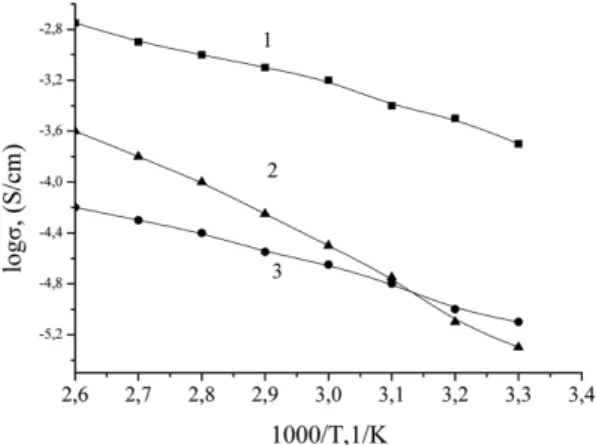
Usually, coming from practical interests, the dependence of the conductivity on temperature of polyelectrolytes one defines mainly in the range of about 30~90oC [6,7]. The conductivities of the inves- tigated compounds defined on these limits are given in Table 3.
The dependence log s -1/T has nearly linear character and obeys the Arrhenius law (Figs. 3 and 4). These curves were designed after several measuring of this dependence and the data of conductivi- ties were obtained after averaging of them.
As seen from Figs. 3 and 4, the conductivity of the investigated compounds rises with an increase of temperature. Main factor which defines such character of these dependences must be found in increasing of charge carriers (ions) mobility at increasing of tem- perature. This conclusion on the temperature dependence of con- ductivity of PE is in good agreement with experimental data presented on Fig. 3 and the Table 3.
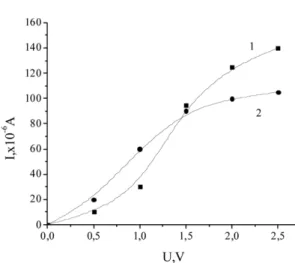
It was interesting to define the dependence of current - voltage for investigated PE. On Fig. 5 the curves of I-V functional depen- dences (so called the voltamograms) for some obtained membranes are presented.
The dependences I-U, i.e., voltamograms (Fig. 5), show that in the used interval of changes of constant voltage the value of the current increases with definite deviation from linearity. The behav- ior of the curves corresponds to character of dependence of carri- ers transport on the nature of salt ions. As noted above, the second salt ions differ from first ones with more high volume to some extent and relatively low mobility. Therefore, at increasing of the voltage accelerated ions after charge-phonons scattering are gradually slowed, which is reflected in the deviation from the linearity of V-A charac- teristics.
At this time appears the Joule heat, which is one of the reasons of destruction of the conducting channels due to heat scattering of charges leading to decreasing of the electrical current passing through
Table 3. The conductivities of investigated compounds PS1 and PS2, defined at 30 and 90oC
Salt S1 S2
Concentr. wt% 5 10 15 20 25 5 10 15 20 25
S(30oC), S/cm 6.3×10⁻⁶ 1.2×10⁻⁵ 3.2×10⁻⁴ 3.5×10⁻⁴ 1.6×10⁻⁵ 6.4×10⁻⁷ 6.6×10⁻⁶ 1.5×10⁻⁵ 1.3×10⁻⁴ 7.2×10⁻⁶ S(90oC), S/cm 2.5×10⁻⁴ 5.2×10⁻⁵ 7.9×10⁻⁴ 1.1×10⁻³ 2.4×10⁻⁴ 3.3×10⁻⁵ 2.3×10⁻⁵ 6.2×10⁻⁵ 3.4×10⁻⁴ 2.6×10⁻⁵
Fig. 3. Arrhenius plots of ionic conductivity for polymer electrolytes PS1 containing 20 (1), 5 (2) and 10 wt% (3) of salt S1.
Fig. 4. Arrhenius plots of ionic conductivity for polymer electro- lytes PS2 containing 20 (1), 10 (2) and 5 wt% (3) Li salt S2.
material. This deviation appears for the membrane PS2 earlier than for PS1 at containing one and same concentration of the salts because of difference in sizes and mobility of the compared ions.
For estimation of the effect of free volume in polyelectrolyte compounds on the ion conductivity, we provided experiments on investigation of the influence of external pressure on the conduc- tivity for the investigated polyelectrolytes (Fig. 6).
The curves on Fig. 6 show that this dependence of resistance on the pressure has exponential character in relatively narrow interval of pressures. This result is unexpected to some extent, because, as it is well known, the free volume in the polymer matrix under increasing pressure decreases and, consequently, the transport of Li ions must be decreased. However, it may be suggested that at same time the segmental mobility of side chains of oligoesters signifi- cantly decreases, which in general presents a definite barrier on the way of Li ions thanks to interactions between charge carriers and phonons corresponding to side group vibrations.
Therefore, the noted barrier will be decreased at increasing of pressure. Probably from two effects (decreasing of free volume and
simultaneously the phonon- charge carrier’s interaction), the sec- ond is more effective than the first one in the considered case. Gen- erally, the conductivity of polyelectrolytes will depend significantly on the ratio of these factors.
4. Conclusions
By hydrosilylation reaction of D4H with allyl butyrate in the presence of platinum catalyst, 2.4.6.8-tetra (propyl butyrate)-2.4.6.8-tetramethylcy- clotetrasiloxane in a quantitative amount have been obtained. Via polymerization and co-polymerization reactions of 2.4.6.8-tetra (propyl butyrate)-2.4.6.8-tetramethylcyclotetrasiloxane with hexamethyld- isiloxane or without it, comb-like methylsiloxane oligomers with regular arrangement of propyl butyrate in a side chain have been obtained.
The experiments on the establishment of dependences of con- ductivity of the comb-like polysiloxanes electrolytes on the Li salt concentration show that these dependences have an extreme char- acter. Decreasing of conductivity at increasing of salt concentra- tion after definite value of last is described by formation of ion pairs, which decreases the charge transfer through the molecular matrix. Conductivity of the noted materials increases at increasing of temperature because of increasing of charge carriers (ions) mobility.
The conductivity of the obtained PE increases at increasing of pres- sure in dependence of salt types due to decreasing of mobility of molec- ular segments and decreasing of charge-phonon interactions.
Acknowledgment
The financial support of Lithuania Research Council is grate- fully acknowledged.
References
1. Cardiano, P., Sergi, S. and Lazzari, M., P. Piraino, Polymer, 43, 6635(2002).
2. Guizard, C., Bac, A., Barboiu, M. and Hovnanian, N., Sep Purif.
Tech., 25, 167(2001).
3. Mukbaniani, O., Tatrishvili, T., Titvinidze, G. and Mukbaniani, N., J. Appl. Polym. Sci., 104, 2168(2007).
4. Gray, F. M. and Armand, M., Polymer electrolytes, in Handbook of Battery Materials. Besenhard J. O., Ed., Wiley-VCH, Weinheim (1999).
5. Karatas, Y., Kaskhedikar, N., Burjanadze, M. and Wiemhofer, H.- D., Macromol. Chem. Phys., 207, 419(2006).
6. Morales, E. and Acosta, J. L., Electrochim. Acta, 45, 1007(1999).
7. Zhang, Z. C., Sherlock, D., West, R., Amine, K. and Lyons, L. J., Macromol., 36, 8907(2003).
8. Funke, K., Heimann, B., Vereing, M. and Wilmer, D. J., Electro- chem. Soc., 148, A395(2001).
9. Allcock, H. R., Olmeijer, D. L. and O’Connor, S. J. M., Macro- mol., 31, 753(1998).
10. Gray, F. M. and Armand, M., Polymer electrolytes, in Handbook of Fig. 5. Voltamograms for membranes containing 20% S1 (1) and
same amount of S2 (2).
Fig. 6. Dependence of the resistance of electrolytes based on PS1 with 10 (1) and 20 (2) wt% S1 on the loading of the films with square 1 cm2. Ro-resistance of the samples at normal pressure.
Battery Materials. J.O. Besenhard, Ed., Wiley-VCH, Weinheim (1999).
11. Hooper, R., Lyons, L. J., Moline, D. A. and West, R., Silicon Chem- istry, 1, 121(2002).
12. Hooper, R., Lyons, L. J., Moline, D. A. and West, R., Organometal- lics, 18, 3249(1999).
13. Iwahara, T., Kusakabe, M., Chiba, M. and Yonezawa, K., J. Polym.
Sci. A, 31, 2617(1993).
14. Mukbaniani, O., Tatrishvili, T., Markarashhvili, E. and Esartia, I., Georgian Chem. J., 2, 153(2011).
15. Tartakovskaia, L. M., Makarov, I. G., Kazakova, V. M., Kopilov, V. M. and Zhdanov, A. A., Izv. AN USSR, Ser. Chim., 12, 2818 (1980).
16. Andrianov, K. A., Tartakovskaia, L. M., Kopilov, V. M. and Sementsova, Zh. N., Zhur. Obshch. Khim., 45, 112(1975).
17. Corey, E. J. and Snider, B. B., J. Amer. Chem. Soc., 94, 6190 (1972).
18. Tartakovskaia, L. M., Kopilov, V. M. and Zhdanov, A. A., Vyso- komol. Soed., 26, 234(1984).
19. Zhang, Z. and Fang, Sh., Electrochim Acta, 45, 2131(2000).