• 검색 결과가 없습니다.

Antenatal Magnesium Sulfate for Neuroprotective Effects InPreterm Infants

N/A
N/A
Protected

Academic year: 2021

Share "Antenatal Magnesium Sulfate for Neuroprotective Effects InPreterm Infants"

Copied!
8
0
0

로드 중.... (전체 텍스트 보기)

전체 글

(1)

Antenatal Magnesium Sulfate for Neuroprotective Effects In Preterm Infants

조산아에서 신경보호효과를 위한 산전 마그네슘 투여

Young lim Oh

Perinatal brain injury can cause lifelong motor, sen- sory, and cognitive dysfunctions. Such brain damages are caused by cerebral ischemia, hemorrhage, infec- tion, or injury. Preterm delivery is the most significant risk factor of neurological damages. Although sur- vival rate for preterm infants has improved with ad-

vances in perinatal care over the past few decades, but the rates of neurologic abnormalities in survivors, particularly motor disorders such as cerebral palsy, have increased further, because infants who would previously have expired, now survive with their cere- bral pathology.

오영림

Department of Obstetrics and Gynecology, College of Medicine, Kosin University, Busan, Korea

고신대학교 의과대학 산부인과학교실

Fetal or neonatal brain injury can result in lifelong neurologic disability. Although survival rates for preterm infants have increased dramatically with the advent of modern perinatal and neonatal intensive care, but the rates of neurologic abnormalities in survivors, particularly motor disorders such as cerebral palsy, have not diminished.

Antenatal magnesium sulfate may reduce the rates of cerebral palsy in survivors of preterm birth.

There are five randomized controlled trials of magnesium sulfate administered to women at risk of preterm de- livery before 34 weeks of gestation which have reported neurological outcomes for the child.

From meta-analysis of these randomized trials, the rate of cerebral palsy was reduced by magnesium sulfate (RR, 0.69; 95% CI, 0.54-0.87; five trials; 6,145 infants) as did the moderate/severe cerebral palsy incidence (RR, 0.64;

95% CI, 0.44-0.92; three trials; 4387 infants). There was no statistically significant difference between the rates of neonatal adverse outcomes of the magnesium administration group and the control group. In most prospective randomized studies, no significant difference in the severe mother-side side effects between the magnesium sul- fate administration group and the control group.

Antenatal magnesium sulfate therapy is neuroprotective against motor dysfunction in offspring for the preterm infant; however the possibility of an increase in the fetal or neonatal death rate was not completely excluded.

Key Words: Cerebral Palsy, Magnesium Sulfate, Mortality, Neroprotection, preterm birth

Corresponding Author : Young Lim Oh, Department of Obstetrics and Gynecology, College of Medicine, Kosin University, 262, Kamcheon-ro, Seo-gu, Busan, 602-702, Korea

Received : October 10, 2014

Revised : October 10, 2014

(2)

Despite the many efforts of the physicians, it is cur- rently impossible to cure of cerebral palsy, its preven- tion is most important.

Magnesium sulfate has been used in obstetrics to prevent and treat convulsions in pregnancyinduced hypertension patients, and to inhibit uterine contrac- tion in preterm labor patients.

Major medical organizations worldwide consistently recommend magnesium sulfate as a drug of choice for the prevention of eclampsia. 1

The first report that prenatal magnesium sulphate was associated with a reduction in risk of IVH, was by Kuban and colleagues in 1992. 2 A significantly lower risk of IVH, from 18.9% to 4.4%, was found among babies born to mothers who had received mag- nesium sulphate regardless of whether they had preeclampsia.

In 1995, Grether and Nelson later described an asso- ciation between antenatal magnesium sulphate and a reduced risk of cerebral palsy in VLBW infants (less than 1500 g). [odds ratio (OR), 0.14; 95% confidence interval (CI), 0.05-0.51]. 3

Since then, studies on the effects of magnesium sul- fate on the development of cerebral palsy have been actively conducted. In 2002, Mittendorf et al. reported that the use of magnesium as a tocolytics in preterm labor was associated with worse, not better adverse outcomes such as neonatal intraventricular hemor- rhage, periventricular leukomalacia, death and cere- bral palsy in dose-response fasion. 4 According to Scudiero et al., the perinatal death rate of immature infants may increase when high-dose magnesium is used as tocolytics. 5 In some research results, whereas, the neonatal mortality rate did not associated with the use of antenatal magnesium administration. 6,7 In a study on very immature infants (less than 1,000 g), Kimberlin et al. analyzed the immature infant prog- noses such as cerebral hemorrhage, convulsion, ab- normal neurological findings, and the death rate according to the use of prenatal magnesium, and no

specific association was confirmed. As described, the study results have not been consistent. In this prospective randomized controlled study, the effects of magnesium sulfate on the prevention of cerebral palsy were investigated.

1. Magnesium Sulfate for

Neuroprotection in Animal Model The neuroprotective effects of magnesium sulfate has been reported in many animal models of brain injury.

In 1995, Marret et al. administered magnesium sulfate to mice with brain damages on the 5th day and the 10th day after their birth. They used excitotoxin dis- turbances during brain development in mice, by in- tracerebral injection of ibotenate, ecitotoxin from Muscaria, a kind of a mushroom. , In this cerebral to- colytic arm experiment, ibotanated injected mice at 5 days after birth, white-matter damate accompanied by cystic change, similar periventricular leukmalacia in human was observed, whereas, no inhibition of a cere- bral-infarction-like lesion was observed when magne- sium sulfate was administered 10days after birth. 8 Considering the various excitotoxin pathologies of mice according to their brain maturity stage, the neu- roprotective effect of magnesium in humans may be most effective on the 26th to the 34th week of preg- nancy, and the effect may be less in the full term. 9 The neuroprotective effect of magnesium sulfate had also been reported in hypoxic-ischemic models.

When seven-day-old mice with hypoxic-ischemic damage were administered magnesium sulfate, their apoptosis was reduced. 10

2. Mechanism of the Neuroprotective

Effects of Magnesium Sulfate

Temporary cerebral ischemia is known to cause per-

(3)

manent neural damages due to its reactions such as its release of excitatory neurotransmitters, the move- ment of calcium ions into the nerve cells, the forma- tion of free radicals, lipid peroxidation, and protein dissolution.

Glutamate, a neurotransmitter, combines with the N- methyl-D-aspartate (NMDA) receptor to abruptly in- crease the intracellular influx of calcium ions that promote the endonuclease functions, and eventually results in cell destruction. 11

Although the change in the magnesium concentration cannot affect the recovery of the cell functions in their early stage, magnesium ions are antagonistic to cal- cium ions and play important roles in the physiolog- ical functions of normal nerve cells. 12

The mechanism of the neuroprotective effect of mag- nesium sulfate is associated with the following in vivo functions of magnesium. First, magnesium reduces the synthesis of proinflammatory cytokines and free rad- icals to perform anti-inflammatory functions, and eventually decreases apoptosis. 13 Second, magnesium blocks the NMDA receptor to reduce the transfer of excitory stimuli. 14 Third, magnesium sulfate inhibits smooth muscle contractions to dilate the brain blood vessels and improve the cerebral blood flow, which decrease hypoxia and ischemic tissue damages. 15 Due to these magnesium functions, neuroprotective effects are expected when magnesium sulfate is used.

3. Results of the Prospective Randomized Controlled Study 1) The Magnesium and Neurological Endpoints Trial

(MagNET) (1995-1997, USA)

In the MagNET trial,16 patients who had experi- enced preterm labor or premature rupture of their membranes on their 24th to 33rd week of pregnancy were assigned to either the group for the evaluation of the neuroprotective effects of magnesium sulfate (the

neuroprotection arm) or the group for the evaluation of the uterine contraction (the tocolytic arm). When the uterine contraction (the tocolytic arm) group and the neuroprotective effect group were analyzed sepa- rately, no significant difference from the control group was observed. In the analysis of both groups together, the combined hazard ratio in the magnesium sulfate administration group was 32%, and in the placebo group, 19%, which showed no statistical significance (OR, 2.0; 95% CI, 0.99-4.1; P = 0.07), but the mag- nesium sulfate administration group showed worse re- sults than the placebo group. During the analysis of the infant death rate, the issue on the safety of mag- nesium sulfate administration was raised, and eventu- ally, the study was terminated earlier than scheduled.

2) The Australasian Collaborative Trial of Magnesium Sulfate (ACTOMgSO4) (1996-2000, Australia/New Zealand)

The ACTOMgSO4 trial 17 was a multi-institutional study conducted in 16 hospitals in Australia and New Zealand. Unlike the MagNET study, the infant death rate of the magnesium sulfate group did not increase (13.8% vs. 17.1%; RR, 0.83; 95% CI, 0.64-1.09; P = 0.19), and no significant difference in the rates of in- cidence of cerebral palsy was observed between the two groups, but the incidence tended to decrease in the magnesium sulfate group (6.8% vs. 8.2%; RR, 0.83; 95% CI, 0.54-1.27; P = 0.38), and the combined results of death or cerebral palsy showed a similar ten- dency (19.8% vs. 24.0%; RR, 0.83; 95% CI, 0.66- 1.03; P = 0.09). In terms of the combined outcome of death or substantial motor dysfunction(17% vs.

22.7%; RR, 0.75; 95% CI, 0.59-0.96; P = 0.02), or substantial motor dysfunction as serious as being un- able to walk independently until two years after birth(3.4% vs. 6.6%; RR, 0.51; 95% CI, 0.29-0.91; P

= 0.02), the magnesium sulfate group showed a more

statistically significant decrease than the placebo

group did.

(4)

3) PREMAG (1997-2003, France)

In the PREMAG trial, 18 which was a multi-institu- tional study conducted in France, enrolled 573 women less than 33 weeks of gestation who were ex- pected to deliver within 24 hours. They received a single injection 4g loading dose of magnesium or iso- tonic 0.9% saline over 30 minutes, with no mainte- nance infusion.

Primarily, cases of severe white matter injury and in- fant mortality were analyzed. Two years later, the rates of infant mortality, cerebral palsy, and motor and cognitive impairments were analyzed during the fol- low-up period. 19 The protective effects of magnesium sulfate on cerebral palsy or death were found to have been significant (OR, 0.65; 95% CI, 0.42-1.03; P = 0.07) The decreases in the cerebral palsy and death rates, though statistically insignificant, were recog- nized as clinically important. In the magnesium sul- fate group, the protective effects on severe motor disturbance or death were also confirmed (OR, 0.62;

95% CI, 0.41- 0.93; P = 0.02).

4) The Beneficial Effects of theAntenatal Magnesium Sulfate (BEAM) Trial (1997-2004, USA)

In the BEAM trial, 20 2,241 preterm delivery mothers on their 24th to 31st week of pregnancy who were ex- pecting impending delivery were randomly assigned to the magnesium sulfate group or the placebo group in 20 US hospitals. In the cases of intermediate or se- vere cerebral palsy or death, no significant difference was observed between the magnesium sulfate group and the placebo group (11.3% vs. 11.7%; RR, 0.97;

95% CI, 0.77-1.23); but the incidence of moderate to severe cerebral palsy (1.9% vs. 3.5%; RR, 0.55;

95% CI, 0.32-0.95; P = 0.03) in the magnesium sul- fate group significantly decreased. In both groups, no significant difference in the perinatal-period death rate was observed (9.5% vs. 8.5%; RR, 1.12; 95%

CI0, 0.85- 1.47).

5) The Magnesium Sulfate for the Prevention of Eclampsia (Magpie) Trial (1998-2001, International) The Magpie trial 21 was conducted to evaluate the preventive effects of magnesium sulfate on eclamp- sia. At the 18-month corrected age, the long-term ef- fects of magnesium sulfate on fetuses were evaluated.

No significant difference in the incidence rates of death or neurosensory disability (15.0% vs. 14.1%;

RR, 1.06; 95% CI, 0.90-1.25), death (13.8% vs.

12.5%; RR, 1.11; 95% CI, 0.93-1.32), and sensory neural disturbance (1.3% vs. 1.9%; RR, 0.72; 95%

CI, 0.40-1.29) was observed.

I summarizes the approximate summary of each study and the method of administration of magnesium sulfate in Table 1.

4. Meta-analysis

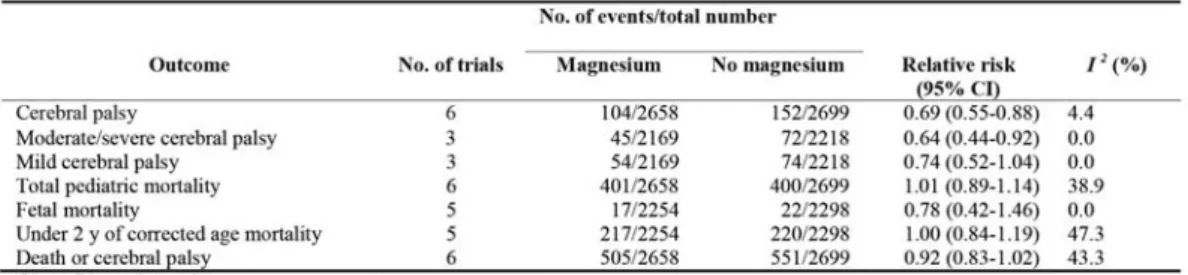
After the BEAM trial results were published in 2008, meta-analyses were conducted in five prospective ran- domized studies. According to the meta-analyses of women of gestational age less than 37 weeks, which was conducted in 2009, no overall significant difference in the pediatric mortality rates was confirmed (RR, 1.01; 95% CI, 0.82-1.23; five trials; 6,145infants). 22-23 (Table 2). However, the incidence of cerebral palsy de- creased after the magnesium administration (RR, 0.69;

95% CI, 0.54-0.87; five trials; 6,145 infants), as did the moderate/severe cerebral palsy incidence (RR, 0.64;

95% CI, 0.44-0.92; three trials; 4387infants) (Table 3).

There was no statistically significant difference be-

tween the rates of neonatal blindness, deafness, devel-

opmental retardation, and lower Apgar score at birth of

the magnesium administration group and the control

group 23 (Table 4). In addition, the risks of intraventric-

ular hemorrhage, periventricular leukomalacia, and

neonatal seizures, and the need for respiratory support,

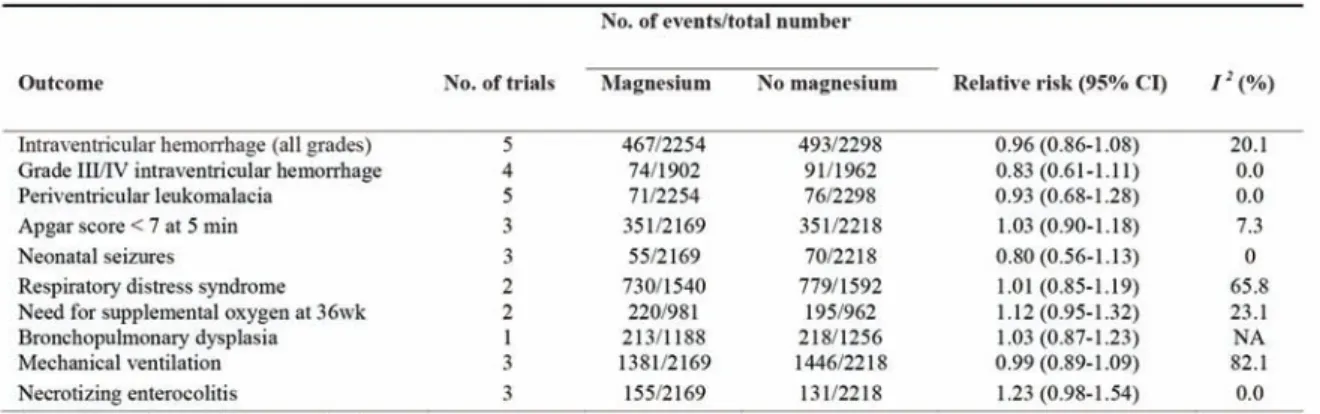
did not decrease 24 (Table 5). The same results were ob-

tained in two groups of gestational age, less than 30

(5)

Table 1. Characteristics of Included Studies

CI: Confidence Interval; CP: Cerebral Palsy; OR: Odds ratio; RR: Relative risk

Table 2 . Meta-Analysis of Mortality, Cerebral Palsy, Substantial Gross Motor Dysfunction an Combined Out- come by Subcategory of Intent 23

Table 3. Effect of magnesium sulfate on cerebral palsy and pediatric mortality 24

RR, relative risk; CI, confidence interval; NA, not applicable.

* Values obtained from meta-analysis, which is not obtained simply by comparing pooled rates of events.

† One study4 represented in both subgroups; hence, there are only five studies overall.

(6)

weeks(3,107 subjects) versus 32 to 34 weeks(5,235 subjects). The effects of the magnesium administration on the preterm delivered earlier than the 34th week were not significant. 24

5. Side Effects of Magnesium Sulfate The maternal outcomes of magnesium, including flush, sweating, nausea, vomiting, and pain in the in- Table 4. Meta-Analysis of Other Neurologic Outcomes 23

RR, relative risk; CI, confidence interval.

* Values obtained from meta-analysis, which is not obtained simply by comparing pooled rates of events.

Table 5. Effect of magnesium sulfate on neonatal outcomes

24

Table 6. Effect of magnesium sulfate on maternal outcomes 24 CI, confidence interval; NA, not applicable.

CI, confidence interval; NA, not applicable.

(7)

jection site is mild. Severe side effects of excessive administration include deterioration of respiratory functions due to breathing-muscle paralysis. Cardiac arrest or death may occur, but in most prospective ran- domized studies, no significant difference in the se- vere mother-side side effects such as cardiac arrest and death was observed between the magnesium sulfate administration group and the control group. In the magnesium administration group, the administration was often interrupted due to the side effects(Table 6).

Regarding the neonatal death rate, the MagNET trial reported a higher rate in the magnesium sulfate ad- ministration group than in the control group. Since then, however, all the studies confirmed no increase in the death rate. 16-18,20-21

In 2013, the US FDA recommended that pregnant women not be administered magnesium for longer than five to seven days because of the risk of hypermagne- semia and hypocalcemia that can induce bone prob- lems, including fracture. This recommendation was based on many case study results, not on long-term monitoring. However, the US FDA announced that the use of magnesium sulfate as a preterm-labor treatment agent would be prohibited, and its deformity risk grade would be changed from Grade A to Grade D. 25-26

6. Conclusion

The results of previous studies have shown that the administration of magnesium sulfate to women ex- pecting imminent preterm birth has neuroprotective effects. In the case of women at risk of preterm de- livery, magnesium sulfate is necessary for neuropro- tective purposes.

When magnesium sulfate was administered to women who were expecting a preterm birth within 24 hours, the risk of cerebral palsy or severe motor dysfunction was reduced, but the possibility of an increase in the fetal or neonatal death rate was not completely ex-

cluded.

• Magnesium sulfate can be used on the verge of de- livery for preterm delivery cases with preterm pre- mature rupture of membranes or intact membrane, an indications of preterm delivery.

• The neuroprotective effect of magnesium sulfate is limited to the gestation age range of 24-32 weeks.

• When magnesium sulfate is used for neuroprotec- tion, its loading dose is 4 g, which is instilled for 20 minutes, and its maintenance dose is 1 g per hour.

Its administration must be stopped when delivery does not occur within 24 hours.

Considering the risks involved in magnesium sulfate administration, its retreatment have to be avoided after initial course of magnesium sulfate therapy, when delivery is delayed. Since magnesium pene- trates the placenta well, it is detected in the fetal blood within one hour after its administration, and in the amniotic fluid, within three hours. Further studies on the appropriate magnesium sulfate administration dose and period and its repeated administration may be needed in the future.

REFERENCES

1. American College of Obstetricians and Gynecologists, Task Force on Hypertension in Pregnancy. Hypertension in preg- nancy. Report of the American College of Obstetricians and Gynecologists’ Task Force on Hypertension in Pregnancy.

Obstet Gynecol 2013;122:1122.

2. Kuban K, Leviton A, Pagano M, Fenton T, Strasfeld R, Wolff M. Maternal toxemia is associated with reduced incidence of germinal matrix hemorrhage in premature babies. Journal of Child Neurology 1992;7:70-6.

3. Nelson KB, Grether JK. Can magnesium sulfate reduce the risk of cerebral palsy in very low birthweight infants? Pedi- atrics 1995; 95:263-9.

4. Mittendorf R, Dambrosia J, Pryde PG, Lee KS, Gianopoulos JG, Besinger RE, et al. Association between the use of ante- natal magnesium sulfate in preterm labor and adverse health outcomes in infants. Am J Obstet Gynecol 2002;186:1111-8.

5. Scudiero R, Khoshnood B, Pryde PG, Lee KS, Wall S, Mit-

tendorf R. Perinatal death and tocolytic magnesium sulfate.

(8)

6. Kimberlin DF, Hauth JC, Goldenberg RL, Bottoms SF, Iams JD, Mercer B, et al. The effect of maternal magnesium sulfate treatment on neonatal morbidity in < or = 1000-gram infants.

Am J Perinatol 1998;15:635-41.

7. Farkouh LJ, Thorp JA, Jones PG, Clark RH, Knox GE. Ante- natal magnesium exposure and neonatal demise. Am J Obstet Gynecol 2001;185:869-72.

8. Marret S, Gressens P, Gadisseux JF, Evrard P. Prevention by magnesium of excitotoxic neuronal death in the developing brain: an animal model for clinical intervention studies. Dev Med Child Neurol 1995;37:473-84.

9. Marret S, Doyle LW, Crowther CA, Middleton P. Antenatal magnesium sulphate neuroprotection in the preterm infant.

Semin Fetal Neonatal Med. 2007;2:311-7.

10. Turkyilmaz C, Turkyilmaz Z, Atalay Y, Soylemezoglu F, Celasun B. Magnesium pretreatment reduces neuronal apop- tosis in newborn rats in hypoxiaeischemia. Brain Res 2002;955:133-7.

11. Choi DW, Maulucci-Gedde M, Kriegstein AR. Glutamate neu- rotoxicity in cortical cell culture. J Neurosci 1967;7:357-68.

12. Marinov MB, Harbaugh KS, Hoopers PJ, et al. Neuroprotective effects of preischemia intraarterial magnesium sulfate in re- versible focal cerebral ischemia. J Neurosurg 1996;85:117-24.

13. Shogi T, Miyamoto A, Ishiguro S, Nishio A. Enhanced release of IL-1beta and TNF-alpha following endotoxin challenge from rat alveolar macrophages cultured in low-Mg(2þ) medium. Magnes Res 2003;16:111-9.

14. Ovbiagele B, Kidwell CS, Starkman S, Saver JL. Neuropro- tective agents for the treatment of acute ischemic stroke.Curr Neurol Neurosci Rep 2003;3:9-20.

15. MacDonald RL, Curry DJ, Aihara Y, Zhang ZD, Jahromi BS, Yassari R. Magnesium and experimental vasospasm. J Neu- rosurg 2004;100:106-10.

16. Mittendorf R, Dambrosia J, Pryde PG, Lee KS, Gianopoulos JG, Besinger RE, et al. Association between the use of ante- natal magnesium sulfate in preterm labor and adverse health outcomes in infants. Am J Obstet Gynecol 2002;186:1111-8.

17. Crowther CA, Hiller JE, Doyle LW, Haslam RR. Australasian Collaborative Trial of Magnesium Sulphate (ACTOMgSO4) Collaborative Group. Effect of magnesium sulfate given for neuroprotection before preterm birth: a randomized controlled trial. JAMA 2003;290:2669-76.

18. Marret S, Marpeau L, Zupan-Simunek V, Eurin D, Léêue C, Hellot MF, et al, PREMAG Trial Group. Magnesium sulphate given before very-preterm birth to protect infant brain: the ran- domized controlled PREMAG trial. BJOG 2007;114:310-8.

19. Marret S, Marpeau L, Follet-Bouhamed C, Cambonie G, As- truc D, Delaporte B, et al, PREMAG Trial Group. Effect of magnesium sulphate on mortality and neurologic morbidity of the very-preterm newborn with two-year neurologic out- come: results of the prospective PREMAG trial. Gynecol Ob- stet Fertil 2008;36:278-88.

20. Rouse DJ, Hirtz DG, Thom E, Varner MW, Spong CY, Mercer BM, et al, Eunice Kennedy Shriver NICHD Maternal-Fetal Medicine Units Network. A randomized trial of magnesium sulfate for the prevention of cerebral palsy. N Engl J Med 2008;359:895-905.

21. Magpie Trial Follow-Up Study Collaborative Group. The Magpie Trial: a randomized trial comparing magnesium sul- phate with placebo for pre-eclampsia. Outcome for children at 18 months. BJOG 2007;114:289-99.

22. Doyle LW, Crowther CA, Middleton P, Marret S, Rouse D.

Magnesium sulphate for women at risk of preterm birth for neuroprotection of the fetus. Cochrane Database Syst Rev 2009;1:CD004661.

23. Doyle LW. Antenatal magnesium sulfate and neuroprotection.

Curr Opin Pediatr 2012;24:154-9.

24. Conde-Agudelo A, Romero R. Antenatal magnesium sulfate for the prevention of cerebral palsy in preterm infants less than 34 weeks’ gestation: a systematic review and metaanaly- sis. Am J Obstet Gynecol 2009;200:595-609.

25. Food and Drug Administration. FDA recommends against pro- longed use of magnesium sulfate to stop pre-term labor due to bone changes in exposed babies. FDA Drug Safety Commu- nication. Silver Spring (MD): FDA; 2013. Available from:

http://www.fda.gov/downloads/Drugs/DrugSafety/UCM3533 35.pdf.

26. Amerian College of Obstetricians and Gynecologists Com- mittee on Obstetric Practice Society for Matemal-Fetal Med- icine. Committee opinion no. 573: Magnesium sulfate use in obstetrics. Obstet Gynecol 2013;122:727-8.

Fetal or neonatal brain injury can result in lifelong neurologic disability. Although survival rate for preterm infants have increased dramatically with the advent of modern perinatal and neonatal intensive care, but the rates of neurological abnormalities in survivors, particularly motor disorders such as cerebral palsy, have not diminished. Antenatal magnesium sulfate therapy is neuroprotective against motor dysfunction in offspring for the preterm infant; however the possibility of an increase in the fatal or neonatal death rate was not completely excluded. In this review, summarized the recent study of magnesium for the neuroprotective effect of prematurity, which was to be used more useful clinically.

Peer Reviewers' Commentary

수치

Table 3. Effect of magnesium sulfate on cerebral palsy and pediatric mortality 24
Table 6. Effect of magnesium sulfate on maternal outcomes 24CI, confidence interval; NA, not applicable.

참조

관련 문서

Magnesium alloys that derive their strength from precipitation hardening are usually considered the most promising for such applications and the thermal stability of

This study was conducted from 24 May to 3 November in Cheju to investigate the effects of planting date and plant distance on the grain yield of black

The purpose of this study was to investigate how obese middle-aged women performed jumping diet exercise for 8 weeks to determine how they affected body composition and risk

Globally was common sense that modernity was the opportunity for women to acquire the right of education, political activity and social labor.. The independence from

The purpose of this study was to examine the effects of 8 weeks of Zumba dance exercise for obese middle-aged women on blood lipid index and vascular aging.. The subjects of

Consequently, the present study was designed to investigate the effect of adding 60 mg of raloxifene hydrochloride daily to women treated with GnRH-a for severe endometriosis

Through an empirical analysis of employability of persons with cerebral palsy this study aims to examine the factors affecting their employability and

In this study, 12 weeks of aerobic exercise was conducted in middle-aged women aged 45 to 55 years with a body fat rate of 30% or more to determine the effects of blood