Introduction
Cardiac resynchronization therapy (CRT) is currently rec- ommended in drug-refractory heart failure with reduced left ventricular (LV) ejection fraction (LVEF) and prolonged QRS duration. CRT improves heart failure symptoms as well as LV function and size and is associated with a reduction in morbid- ity and mortality.1) Especially in patients who show LV reverse remodeling after 6 months of CRT implantation, improved
ORIGINAL ARTICLE J Cardiovasc Ultrasound 2017;25(2):63-69
• Received: April 20, 2017 • Revised: May 23, 2017 • Accepted: May 23, 2017
• Address for Correspondence: Ho-Joong Youn, Division of Cardiology, Department of Internal Medicine, Seoul St. Mary’s Hospital, College of Medicine, The Catholic University of Korea, 222 Banpo-daero, Seocho-gu, Seoul 06591, Korea Tel: +82-2-2258-6029, Fax: +82-2-599-3589, E-mail: [email protected]
• This is an Open Access article distributed under the terms of the Creative Commons Attribution Non-Commercial License (http://creativecommons.org/licenses/by-nc/4.0) which permits unrestricted non-commercial use, distribution, and reproduction in any medium, provided the original work is properly cited.
survival and quality of life have been reported.2) Patients who achieve the abovementioned benefits from CRT are termed
“responders”, and many studies have been performed to define the characteristics of such individuals. In the previous litera- ture, the response criteria occasionally included improved clini- cal status or echocardiographic findings of reduction in left ventricular end-systolic volume (LVESV) or increase in LVEF.
The majority of these studies classified responders at 6 months
Echocardiographic, Electrocardiographic Changes and Clinical Outcomes
of Patients Who Respond to Cardiac
Resynchronization Therapy after One Year
Young Choi, MD1, Jaeho Byeon, MD1, Mi-Hyang Jung, MD2, Hae Ok Jung, MD, PhD1, and Ho-Joong Youn, MD, PhD1
1Division of Cardiology, Department of Internal Medicine, Seoul St. Mary’s Hospital, College of Medicine, The Catholic University of Korea, Seoul, Korea
2Cardiovascular Center, Chuncheon Sacred Heart Hospital, Hallym University College of Medicine, Chuncheon, Korea
Background: Response to cardiac resynchronization therapy (CRT) is commonly assessed after 6 or 12 months. We evaluated subsequent echocardiographic changes, serial QRS duration, and clinical outcomes in patients showing delayed responses to CRT after 12 months.
Methods: Among all patients who received CRT in Seoul St. Mary’s Hospital, 36 one-year survivors were enrolled. Indicators of a positive CRT response were ≥ 15% reduction in left ventricular end-systolic volume (LVESV) or ≥ 10% increase in left ventricu- lar ejection fraction (LVEF) on any follow up echocardiogram. We defined the early responders as patients responding before one year, the late responders as patients responding after one year, and the non-responders as patients who did not respond on any fol- low-up echocardiogram.
Results: We identified 17 early responders, 10 late responders, and 9 non-responders. The late responders showed modest im- provement in LVESV and LVEF at two years after CRT. QRS duration was shortened the day after CRT in all three groups. Nar- rowed QRS was maintained for two years in early and late responders, whereas it was continuously prolonged over time in non- responders. Incidence of all-cause death or heart failure hospitalization was comparable between early and late responders, while non-responders showed worst prognosis.
Conclusion: Patients responding to CRT after one year show modest echocardiographic improvement but clinical outcome is similar to early responders. Shorter baseline QRS duration and long-term maintenance of QRS duration shortening are important features of the late responders to CRT.
KEY WORDS: Cardiac resynchronization therapy · QRS duration · Echocardiography · Prognosis.
or 12 months after CRT.3-5) However, LV reverse remodeling as a result of CRT appears not to be limited to 12 months. In a multi-center large trial, serial echocardiogram revealed a con- stant decrease in mean LVESV and an increase in mean LVEF up to 29 months after CRT implantation.6) Accordingly, some initial non-responders showed delayed echocardiographic re- sponses one year after CRT implantation.7) Currently, there are limited data regarding the characteristics of the late respond- ers to CRT and no factor has been found to predict later response in non-responders at one year. Since baseline QRS duration and QRS shortening after CRT are thought to be important features of CRT responders,8) we hypothesized that long-term changes in QRS duration after CRT may affect later LV reverse remodeling.
Thus, the present study aimed to investigate the echocardio- graphic changes, serial QRS duration, and long-term clinical outcomes in patients showing late responses to CRT after one year. To identify distinct characteristics of the late responders, we compared the data of the late responders to the early (< one year) responders and persistent non-responders.
Methods
Study population
We performed a retrospective, single center study in patients who were followed up after CRT at Seoul St. Mary’s Hospital between February 2006 and March 2015. Patient data were analyzed using medical records, echocardiograms, and electro- cardiographic (ECG) data. The indications for CRT were drug- refractory symptomatic [New York Heart Association (NYHA) class ≥ 3] heart failure with LVEF ≤ 35% and QRS duration ≥ 120 ms. Among 44 subjects, patients who expired within 12 months (n = 1) or lost to follow up within 12 months (n = 5) af- ter CRT were excluded because we could not differentiate them between late responders and non-responders. Additionally, two patients who were missing echocardiographic data after 12 months of CRT were excluded. The remaining 36 patients formed the final study group. The Institutional Review Board of Seoul St. Mary’s Hospital, College of Medicine, The Catholic University of Korea approved this study (No. KC16RISI0779) and waived the need for informed consent.
Device implantation
All procedures were done under deep sedation. After subcu- taneous dissection above the left pectoralis muscle, a pacing lead was inserted transvenously via a subclavian or axillary route. The right atrial lead was positioned in the right atrial appendage or side wall and the right ventricular lead was posi- tioned in the right ventricular apex or septum with the best pacing and sensing threshold. The LV lead was positioned in the lateral wall of the LV through the coronary sinus and later- al vein. Of the 36 subjects, 34 received CRT combined with im- plantable cardioverter defibrillator (CRT-D). The CRT device was newly implanted in 28 patients and upgraded from a prior
pacemaker in 8 patients.
Electrocardiographic and echocardiographic data
All patients routinely visited the clinic at a maximal inter- val of 6 months for assessment of 12-lead surface ECG. ECG data obtained pre-implantation and after one day, 6, 12, and 24 months of CRT implantation were analyzed. The QRS du- ration was measured as global QRS duration, defined as the maximal duration of the QRS waveform in any lead. QRS du- ration and morphology were determined by two experienced physicians and averaged.
Transthoracic echocardiographic data obtained before and after 6, 12, and 24 months of CRT implantation were analyzed in a Core Echo Laboratory by experienced physicians in Seoul St. Mary’s Hospital. LVESV and LVEF were calculated using biplane Simpson’s method and the severity of mitral regurgita- tion was assessed as the area of the color Doppler regurgitation jet divided by the area of the left atrium in systole. Serial change in QRS duration and echocardiographic parameters were com- pared among the three groups.
Definitions and outcomes
A positive response to CRT was defined as ≥ 15% reduction in LVESV or ≥ 10% increase in LVEF on any follow-up echocar- diogram after CRT implantation. The patients who did not meet those criteria were classified as non-responders. We defined early responders as patients who responded before one year and late responders as patients who responded after one year. The protocol for the optimization of the CRT device was not stan- dardized, so the timing or the manner of optimization was left to each physician’s discretion. Generally, there were two elec- trophysiology specialists working in Seoul St. Mary’s Hospital and they preferably optimized the CRT device based on the ECG features.
Adverse clinical outcomes were defined as all-cause death or heart failure events requiring hospitalization during whole fol- low-up period. A heart failure event was confirmed when a pa- tient had signs and symptoms of congestion requiring intrave- nous diuretics or emergent hemofiltration in cases of renal failure.
The composite of adverse clinical outcomes and the number of annual heart failure events requiring hospitalization were com- pared in the three groups.
Statistical analysis
Continuous variables are presented as mean ± SD for normal- ly distributed data or median (25th, 75th percentiles) for non- normally distributed data. Categorical variables are presented as count (percentage). The baseline characteristics of the three groups were compared using χ2 tests for categorical values and Kruskall-Wallis tests for non-normally distributed continuous variables. Changes in LVESV, LVEF, and QRS duration in each group were verified using the Wilcoxon signed-rank test. Ka-
plan-Meier analysis and Cox regression were used to analyze survival in the three groups, and the results were analyzed by the log rank test. Number of heart failure events requiring hospi- talization per year was compared using the Kruskall Wallis test with post-hoc analysis using a Mann-Whitney U-test. A p value of < 0.05 was considered statistically significant. All sta- tistical analyses were performed using SPSS version 22 (IBM SPSS Statistics, IBM Corp., Armonk, NY, USA).
Results
Baseline characteristics
Among 36 study subjects, 17 (47.2%) were early responders, 10 (27.8%) were late responders and 9 (25.0%) were non-re- sponders. Of the 2 patients who received CRT-pacemaker, one was in the early responder group and the other was in the late responder group. The majority of patients who were upgraded from a prior pacemaker were early responders (5/8, 62.5%).
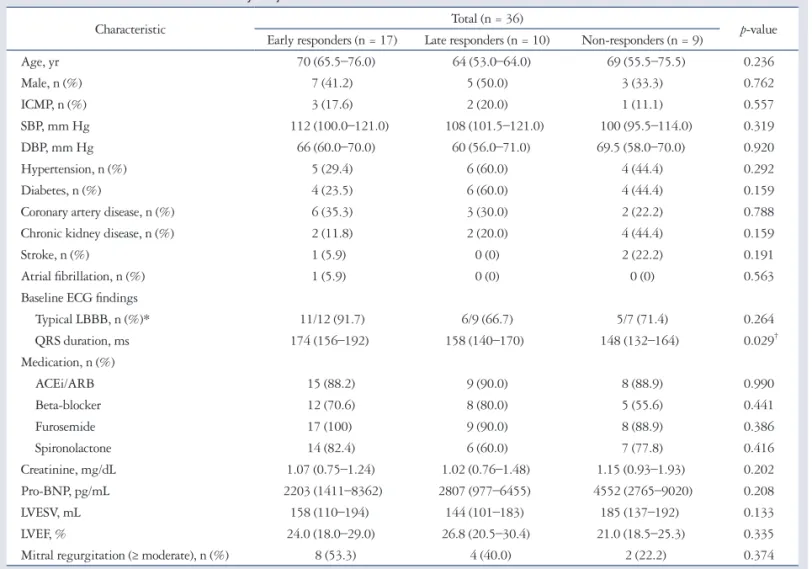
The baseline clinical characteristics of the subjects are shown in Table 1. There was no significant difference in age, gender, heart
failure etiology or underlying comorbidities among the three groups. On the baseline ECG, the late responders showed a trend toward a lower prevalence of typical left bundle branch block (LBBB) (91.7% vs. 66.7% vs. 71.4%, in early, late and non-re- sponders, respectively, p = 0.264) compared to early respond- ers. Pre-implant QRS duration of the late responders was shorter than the early responders and not significantly different to non- responders [174 ms (156–192 ms) vs. 158 ms (140–170 ms) vs. 148 ms (132–164 ms), p = 0.029 (p = 0.021 for early vs. late responders and p = 0.497 for late vs. non-responders)]. On the baseline echocardiogram, the late responders showed the low- est LVESV [158 mL (110–194 mL) vs. 144 mL (101–183 mL) vs. 185 mL (137–192 mL), p = 0.133] and highest LVEF [24.0% (18.0–29.0%) vs. 26.8% (20.5–30.4%) vs. 21.0%
(18.5–25.3%), p = 0.335] among the three groups. Medica- tions prescribed prior to CRT implantation did not signifi- cantly differ between groups. During 2 years after CRT, device optimization was performed in 5/17 (29.4%) in early respond- ers, 6/10 (60.0%) in late responders, and 7/9 (77.8%) in non-re- sponders.
Table 1. Baseline characteristics of the study subjects
Characteristic Total (n = 36)
p-value Early responders (n = 17) Late responders (n = 10) Non-responders (n = 9)
Age, yr 70 (65.5–76.0) 64 (53.0–64.0) 69 (55.5–75.5) 0.236
Male, n (%) 7 (41.2) 5 (50.0) 3 (33.3) 0.762
ICMP, n (%) 3 (17.6) 2 (20.0) 1 (11.1) 0.557
SBP, mm Hg 112 (100.0–121.0) 108 (101.5–121.0) 100 (95.5–114.0) 0.319
DBP, mm Hg 66 (60.0–70.0) 60 (56.0–71.0) 69.5 (58.0–70.0) 0.920
Hypertension, n (%) 5 (29.4) 6 (60.0) 4 (44.4) 0.292
Diabetes, n (%) 4 (23.5) 6 (60.0) 4 (44.4) 0.159
Coronary artery disease, n (%) 6 (35.3) 3 (30.0) 2 (22.2) 0.788
Chronic kidney disease, n (%) 2 (11.8) 2 (20.0) 4 (44.4) 0.159
Stroke, n (%) 1 (5.9) 0 (0) 2 (22.2) 0.191
Atrial fibrillation, n (%) 1 (5.9) 0 (0) 0 (0) 0.563
Baseline ECG findings
Typical LBBB, n (%)* 11/12 (91.7) 6/9 (66.7) 5/7 (71.4) 0.264
QRS duration, ms 174 (156–192) 158 (140–170) 148 (132–164) 0.029†
Medication, n (%)
ACEi/ARB 15 (88.2) 9 (90.0) 8 (88.9) 0.990
Beta-blocker 12 (70.6) 8 (80.0) 5 (55.6) 0.441
Furosemide 17 (100) 9 (90.0) 8 (88.9) 0.386
Spironolactone 14 (82.4) 6 (60.0) 7 (77.8) 0.416
Creatinine, mg/dL 1.07 (0.75–1.24) 1.02 (0.76–1.48) 1.15 (0.93–1.93) 0.202
Pro-BNP, pg/mL 2203 (1411–8362) 2807 (977–6455) 4552 (2765–9020) 0.208
LVESV, mL 158 (110–194) 144 (101–183) 185 (137–192) 0.133
LVEF, % 24.0 (18.0–29.0) 26.8 (20.5–30.4) 21.0 (18.5–25.3) 0.335
Mitral regurgitation (≥ moderate), n (%) 8 (53.3) 4 (40.0) 2 (22.2) 0.374
Continuous values are presented as median (25–75th percentiles). p < 0.05 indicates a significant difference between the three groups. *Patients having paced rhythm at pre-implantation were excluded, †p = 0.021 for early vs. late responders, and p = 0.497 for late vs. non-responders. ICMP: ischemic cardiomyopathy, SBP: systolic blood pressure, DBP: diastolic blood pressure, ECG: electrocardiographic, LBBB: left bundle branch block, ACEi: angiotensin converting enzyme inhibitor, ARB: angiotensin receptor blocker, BNP: brain natriuretic peptide, LVESV: left ventricular end-systolic volume, LVEF: left ventricular ejection fraction
Echocardiographic and electrocardiographic changes
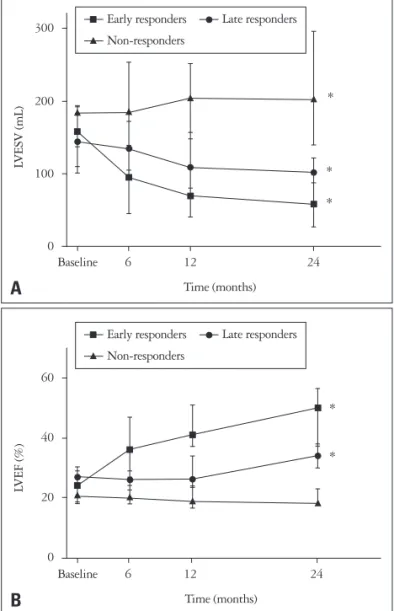
Changes in LVESV in the three groups are shown in Fig. 1A.
In early responders, reduction in LVESV was observed at 6 months with continuous decrease over the course of 24 months. In the late responders, a reduction in LVESV was not prominent at 6 months, but gradual decline in LVESV persisted to show a sig- nificant reduction at 24 months, which was smaller than early responders [percentage reduction in LVESV at 24 months:
66.3% (35.6–75.4%) vs. 34.4% (31.5–41.2%) for early and late responders, p = 0.035] (Fig. 2A). Non-responders showed a continuous increase in LVESV throughout 2-years of follow-up.
A similar trend was observed in LVEF (Fig. 1B). While early re- sponders showed rapid improvement in LVEF from 6 months, late responders did not show significant change in LVEF at 6 and 12 months. At 24 months, a modest increase in LVEF was shown in late responders [absolute increase in LVEF: 25.0%
(12.7–27.2%) vs. 8.6% (1.4–12.0%) for early and late respond- ers, p = 0.015] (Fig. 2B). In non-responders, LVEF was more decreased than baseline value at 24 months. In consequence, LVESV and LVEF in late responders were in between those of early responders and non-responders at 24 months.
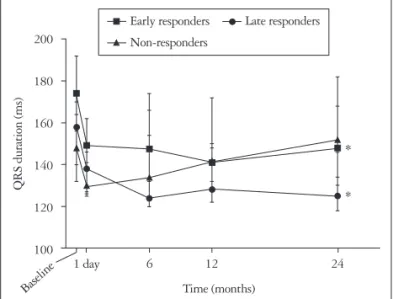
The changes in QRS duration in the three groups are shown in Fig. 3. The early responders had the longest QRS duration at baseline, and exhibited a pronounced reduction after CRT im- plantation; the shortening of QRS duration was maintained over the course of 24 months [174 ms (156–192 ms) and 148 ms (130–168 ms) at baseline and 24 months, p = 0.006]. In non-responders, QRS duration was immediately shortened af- ter CRT implantation but QRS duration became longer and reached a value similar to that at baseline at 24 months [148 ms (132–164 ms) and 152 ms (134–182 ms) at baseline and 24 months, p = 0.483]. On the other hand, in late responders, shortened QRS after CRT was further narrowed at 6 months and maintained for 24 months [158 ms (140–170 ms) and 125 ms (118–146 ms) at baseline and 24 months, p = 0.008].
Clinical outcomes
The mean follow up duration was 45.7 ± 28.3 months. The
Fig. 1. Serial changes in LVESV and LVEF in the three groups. Values represent medians (25–75th percentiles).*p < 0.05 compared to baseline. LVESV was significantly increased in non-responder group and reduced in early and late responder groups at 24 months (A). LVEF was significantly improved in early and late responder groups and not changed in non-responder group at 24 months (B). LVESV: left ventricular end-systolic volume, LVEF: left ventricular ejection fraction.
60
40
20
0
Baseline 6 12 24 Time (months)
LVEF (%)
*
* 300
200
100
0
Baseline 6 12 24 Time (months)
LVESV (mL) *
*
*
A
Early responders Late responders Non-responders
Early responders Late responders Non-responders
B
Fig. 2. Absolute changes in LVESV (A) and LVEF (B) at two years compared to the baseline values in the three groups. Values represent mean with standard deviation. LVESV: left ventricular end-systolic volume, LVEF: left ventricular ejection fraction.
100 50 0 -50 -100 -150 -200
LVESV change (mL)
A
p = 0.040
Early responders Late responders Non-responders
40
30
20
10
0
-10
LVEF change (%)
B
p = 0.006
Early responders Late responders Non-responders
incidence of adverse clinical outcome (a composite of all-cause death or heart failure hospitalization) was 4/17 (23.5%) in the early responder group, 3/10 (30.0%) in the late responder group, and 7/9 (77.8%) in the non-responder group (p = 0.021) (Table 2). The clinical outcome was similar between early and late responders, while non-responders showed significantly worse prognosis (p = 0.711 for early vs. late responders, and p = 0.037 for late vs. non-responders). There was no significant dif- ference in overall death rate in three groups but significantly higher number of patients in non-responder group experienced heart failure event requiring hospitalization than the other two groups (23.5% vs. 30.0% vs. 77.8% in early, late and non-respond- ers, p = 0.021). The number of heart failure hospitalizations per year among late responders was similar to that in early re- sponders and significantly lower than that in non-responders (0.05 ± 0.11 vs. 0.11 ± 0.23 vs. 0.95 ± 1.47 in early, late and non- responders, respectively, p = 0.006).
Discussion
In the present study, we identified patients showing late re- sponses to CRT after one year. Those subjects had relatively shorter QRS duration, smaller ventricular volume, and higher LV
contractility at baseline compared to early responders. Among such patients, echocardiographic improvement was blunted and later accelerated after 6 months of CRT. Furthermore, we found that shortening of QRS duration was maintained through- out the follow-up period in the late responders, while it was not observed for the non-responders. Long-term clinical out- come, as estimated by all-cause death or heart failure events requiring hospitalization was comparable between the early responders and the late responders, and the non-responders had the worst outcomes.
CRT significantly ameliorates symptoms and reduces death and the rate of hospitalization for heart failure. Besides, it also improves LV volume and contractility.9) However, approxi- mately 30% of patients did not respond to CRT when assessed at 6 or 12 months in previous studies.10)11) These non-respond- ers did not show an improvement in LV volume or function, and the risk of adverse clinical outcomes increased in that group.4) In general, two types of response criteria for CRT have been used:
one is the clinical endpoint, which includes death, hospitaliza- tion for heart failure, heart transplantation, subjective symp- tom (NYHA class), and capacity for exercise, while the second uses remodeling criteria via a reduction in LVESV or increase in LVEF. Those criteria have been used alone or in conjunction with one another in previous studies. According to a meta-analysis, the percentage of non-responders was lower when clinical end- point was used (20–27%) than when remodeling endpoint was used (40–47%).10) This result implies that clinical respond- ers could be included in the group of patients who do not show acceptable LV reverse remodeling at 6 or 12 months after CRT implantation. Ghio et al.6) reported a long-term study of echo- cardiographic reverse remodeling in patients enrolled in the CARE-HF trial. Of the 365 patients who received CRT, serial follow-up echocardiogram revealed a further reduction in mean LVESV and an increase in LVEF at 29 months. This long-term LV reverse remodeling effect was observed not only in the initial responders who meet the response criteria at 6 or 12 months, but also in some of the initial non-responders. Recently, van’t Sant et al.7) studied time-dependent responses to CRT after 6 months. Using the criteria of a 15% reduction in LVESV, 6/30 non-responders at 6 months became responders at 14 months.
Likewise, 43% of non-responders at one year showed delayed echocardiographic responses at three years in an observation study.12) In the current study, patients showing positive respons-
Table 2. Adverse clinical outcomes in the three groups
Outcome Early responders (n = 17) Late responders (n = 10) Non-responders (n = 9) p-value
Death or heart failure hospitalization, n (%) 4 (23.5) 3 (30.0) 7 (77.8) 0.021*
Death from any cause 1 (5.9) 1 (10.0) 3 (33.3) 0.144
Any heart failure hospitalization 4 (23.5) 3 (30.0) 7 (77.8) 0.021
Number of heart failure hospitalizations per year 0.05 ± 0.11 0.11 ± 0.23 0.95 ± 1.47 0.006† Continuous values are presented as medians (25–75th percentiles). p < 0.05 indicates significant differences between the three groups. *p = 0.711 for early vs.
late responders, and p = 0.037 for late vs. non-responders, †p = 0.625 for early vs. late responders, and p = 0.012 for late vs. non-responders Fig. 3. Serial changes in QRS duration in the three groups. Values
represent medians (25–75th percentiles). Baseline values are pre- implantation QRS duration, and one day indicates the day after CRT implantation. *p < 0.05 compared to baseline. QRS duration remained shortened at 24 months in early and late responders. In non-responders, QRS duration at 24 months was not significantly different to the pre- implant value. CRT: cardiac resynchronization therapy.
200
180
160
140
120
100
6 12 24 1 day
Baseline Time (months)
QRS duration (ms)
*
* Early responders Late responders Non-responders
es to CRT after one year had more favorable clinical outcomes than did sustained non-responders. Therefore, although most of the response to CRT occurs within the initial 12 months, we believe it is important to identify those who respond after 12 months amongst initial non-responders.
The major effect of CRT is ventricular resynchrony. So, longer QRS duration and LBBB morphology on baseline ECG plus QRS shortening after biventricular pacing are thought to pre- dict better response to CRT. Zhang et al.13) reported a significant positive correlation between a change in QRS duration and LV reverse remodeling in dilated cardiomyopathy patients who re- ceived CRT. Additionally, according to Molhoek et al.,8) QRS duration shortening after CRT was not found in non-respond- ers who were classified by clinical endpoints. The late respond- ers classified in the present study shared similar baseline ECG characteristics to the non-responders, but serial QRS duration was further reduced, in contrast to the non-responder group.
There are several possible explanations for this. First, it may be an effect of appropriate CRT optimization. Optimal ventriculo- ventricular delay may vary over time and repeated CRT opti- mization would contribute to maintaining the narrowest QRS duration. However, the relationship between CRT optimization and long term prognosis is inconsistent in previously published reports.14-16) In our study, although evaluating the accurate ef- fect of CRT optimization on the late response was difficult be- cause of the retrospective design, we generally performed ECG- based optimization in a routine manner in patients showing suboptimal responses. Especially in some of late responders whose QRS duration was more shortened after one year, one major contributing factor is thought to be later appropriate op- timization. However, the frequency of CRT optimization dur- ing 2 years in late responders was not higher than in non-re- sponders, and for 4 patients in late responders who did not receive CRT optimization during 2 years, a mechanism other than correct optimization should be responsible. Second, a less- er degree of pre-implant LV dyssynchrony may have resulted in blunted, slower echocardiographic response. Among pa- tients having smaller change in LV hemodynamics after LV re- synchrony, certain individuals who maintain this smaller posi- tive effect in long term (reflected by persistently narrowed QRS duration) would be expected to show later responses. To our knowledge, this group of patients has been paid only slight attention in clinical studies, and their characteristics have not been well reported. As our results show, though it is delayed, the LV remodeling response has a favorable effect on long-term prognosis. Baseline shorter QRS duration, lower LVESV, and higher LVEF might be the characteristics of late responders as those characteristics reflect less severe LV dyssynchrony.
The current study has some limitations. The main limitation is the small number of study subjects. Many of the differences between the three groups in baseline variables except QRS du- ration were not statistically significant. However, clinical out- comes and pattern of serial QRS duration change, which were
the major interests of current study, were significantly different between late responders and non-responders despite small sam- ple size in each group. Secondly, a retrospective design entails several confounding factors, such as the absence of a standard- ized CRT implantation procedure, follow-up protocol, and op- timization protocol. Nevertheless, our study clearly shows that the maintenance of shortened QRS duration, whether it is achieved by proper optimization or another mechanism, con- tributes to later echocardiographic response. Third, it is difficult to predict the accurate prevalence of late responders amongst all subjects who undergo CRT, since patients who expired be- fore one year were excluded from the analysis, and some patients who were classified as non-responders may show very late re- sponses after longer periods of follow up.
There are several important clinical implications in our study.
The possibility that patients who do not respond to CRT in one year can change to responders later (a total of 27.8% among one-year survivors in our study), may strengthen patient’s and physician’s motivation in non-responders. Our finding suggests serial examination of QRS duration would help to predict a de- layed response and select candidates for intensive CRT optimi- zation. Previous literature investigating response predictors often assessed CRT response at 6 or 12 months, but if late re- sponders are considered, a broader range of patients could be candidates for CRT.
In conclusion, patients who respond to CRT after one year show favorable long term clinical outcome similar to early re- sponders, although echocardiographic improvement is blunt- ed. Shorter baseline QRS duration and long-term maintenance of QRS duration shortening are important features of late re- sponders to CRT. Thus, patients showing suboptimal respons- es to CRT in one year should be carefully followed up with par- ticular attention paid to later echocardiographic changes and serial QRS duration. A further large-scale study is required to identify the precise characteristics of the late responders.
References
1. St John Sutton MG, Plappert T, Abraham WT, Smith AL, DeLurgio DB, Leon AR, Loh E, Kocovic DZ, Fisher WG, Ellestad M, Messen- ger J, Kruger K, Hilpisch KE, Hill MR; Multicenter InSync Ran- domized Clinical Evaluation (MIRACLE) Study Group. Effect of car- diac resynchronization therapy on left ventricular size and function in chronic heart failure. Circulation 2003;107:1985-90.
2. Yu CM, Bleeker GB, Fung JW, Schalij MJ, Zhang Q, van der Wall EE, Chan YS, Kong SL, Bax JJ. Left ventricular reverse remodeling but not clinical improvement predicts long-term survival after cardiac resynchroniza- tion therapy. Circulation 2005;112:1580-6.
3. Chung ES, Leon AR, Tavazzi L, Sun JP, Nihoyannopoulos P, Merlino J, Abraham WT, Ghio S, Leclercq C, Bax JJ, Yu CM, Gorcsan J 3rd, St John Sutton M, De Sutter J, Murillo J. Results of the Predictors of Re- sponse to CRT (PROSPECT) trial. Circulation 2008;117:2608-16.
4. Friedman DJ, Upadhyay GA, Rajabali A, Altman RK, Orencole M, Parks KA, Moore SA, Park MY, Picard MH, Ruskin JN, Singh JP, Heist EK. Progressive ventricular dysfunction among nonresponders to cardi- ac resynchronization therapy: baseline predictors and associated clinical out-
comes. Heart Rhythm 2014;11:1991-8.
5. Marfella R, Di Filippo C, Potenza N, Sardu C, Rizzo MR, Siniscal- chi M, Musacchio E, Barbieri M, Mauro C, Mosca N, Solimene F, Mottola MT, Russo A, Rossi F, Paolisso G, D’Amico M. Circulating microRNA changes in heart failure patients treated with cardiac resynchroni- zation therapy: responders vs. non-responders. Eur J Heart Fail 2013;15:
1277-88.
6. Ghio S, Freemantle N, Scelsi L, Serio A, Magrini G, Pasotti M, Shan- kar A, Cleland JG, Tavazzi L. Long-term left ventricular reverse remodel- ling with cardiac resynchronization therapy: results from the CARE-HF tri- al. Eur J Heart Fail 2009;11:480-8.
7. van’t Sant J, Fiolet AT, ter Horst IA, Cramer MJ, Mastenbroek MH, van Everdingen WM, Mast TP, Doevendans PA, Versteeg H, Meine M. Volumetric response beyond six months of cardiac resynchronization ther- apy and clinical outcome. PLoS One 2015;10:e0124323.
8. Molhoek SG, VAN Erven L, Bootsma M, Steendijk P, Van Der Wall EE, Schalij MJ. QRS duration and shortening to predict clinical response to cardiac resynchronization therapy in patients with end-stage heart failure.
Pacing Clin Electrophysiol 2004;27:308-13.
9. Abraham WT, Fisher WG, Smith AL, Delurgio DB, Leon AR, Loh E, Kocovic DZ, Packer M, Clavell AL, Hayes DL, Ellestad M, Trupp RJ, Underwood J, Pickering F, Truex C, McAtee P, Messenger J;
MIRACLE Study Group. Multicenter InSync Randomized Clinical Eval- uation. Cardiac resynchronization in chronic heart failure. N Engl J Med 2002;346:1845-53.
10. Birnie DH, Tang AS. The problem of non-response to cardiac resynchroni-
zation therapy. Curr Opin Cardiol 2006;21:20-6.
11. Bleeker GB, Bax JJ, Fung JW, van der Wall EE, Zhang Q, Schalij MJ, Chan JY, Yu CM. Clinical versus echocardiographic parameters to as- sess response to cardiac resynchronization therapy. Am J Cardiol 2006;97:
260-3.
12. Burns KV, Gage RM, Curtin AE, Bank AJ. Long-term echocardiographic response to cardiac resynchronization therapy in initial nonresponders. JACC Heart Fail 2015;3:990-7.
13. Zhang J, Zhang Y, Zhou X, Li J, Li Y, Zhang Y, Xu G, Xing Q, Lin S, Tang B. QRS duration shortening predicts left ventricular reverse remod- elling in patients with dilated cardiomyopathy after cardiac resynchronization therapy. Acta Cardiol 2015;70:307-13.
14. Brabham WW, Gold MR. The role of AV and VV optimization for CRT.
J Arrhythm 2013;29:153-61.
15. Ellenbogen KA, Gold MR, Meyer TE, Fernndez Lozano I, Mittal S, Waggoner AD, Lemke B, Singh JP, Spinale FG, Van Eyk JE, White- hill J, Weiner S, Bedi M, Rapkin J, Stein KM. Primary results from the SmartDelay determined AV optimization: a comparison to other AV delay methods used in cardiac resynchronization therapy (SMART-AV) trial: a randomized trial comparing empirical, echocardiography-guided, and algo- rithmic atrioventricular delay programming in cardiac resynchronization therapy. Circulation 2010;122:2660-8.
16. Kosmala W, Marwick TH. Meta-analysis of effects of optimization of cardiac resynchronization therapy on left ventricular function, exercise capaci- ty, and quality of life in patients with heart failure. Am J Cardiol 2014;113:
988-94.