• 검색 결과가 없습니다.

카자흐스탄의 인산업 기술 현황

N/A
N/A
Protected

Academic year: 2021

Share "카자흐스탄의 인산업 기술 현황"

Copied!
6
0
0

로드 중.... (전체 텍스트 보기)

전체 글

(1)

Current Situation and Impeding Factors of Innovation and Investment Activity of the Phosphate Industry of Kazakhstan

Muratbek KASSENOV, Ph.D in Economics, Professor

Director of R&D Center for Regional Economy, Taraz State University

Erke KASSENOV, Ph.D in Economics Head of Social-Economic Analysis Division, Senate of the Parliament, Republic of Kazakhstan

Chemical Industry is a strategic integral part of Kazakhstan’s industry and important for the devel- opment of the country’s economy. Its main priority for long-term and sustainable development is strengthening of competitive positions in domestic and overseas markets using its R&D.

To pursue this priority the following tasks should be done:

- to provide market with competitively strong products, export promotion and enhancement of import-substitution by advanced tech- nologies of raw materials deep processing, re- source saving and ecologically friendly system;

- to enlarge number of product items with good quality;

- to meet demand in materials of strategic and du- al use.

Main instruments for the task-solving will be the following:

- to stimulate innovative and investment activity in chemical industry;

- to improve customs and tariff policy for pro- tection of domestic producers inside and out- side the country;

- institutional improvement for an effective man- agement;

- to adopt required laws and regulations for the

development of chemical industry.

At present the phosphate sector of Kazakhstan’s chemical industry can be characterized by the following.

History. Kazakhstan owns enormous deposits of phosphate raw material. The richest phosphate de- posits are located in southern area along Karatau Mountains in Zhambyl Province and South Kaz- akhstan Province.

There are 50 phosphate deposits within the strip of land, which is of 25 ∼30 km width and 120∼130 km length. Total amount of the proved raw base is about 4 bln ton or 1 bln ton of the useful component of P

2

O

5

. The amount is equal to 30% of the total proved reserves of former Soviet Union (FSU) and that allows Kazakhstan to be the 5

th

largest country in terms of phosphate deposits. Top five countries posses 90% of the world’s stock. Major deposits at the Karatau Mountains are Zhanatas, Kokjon, Koksu, Chulaktau and Aksai (more than 90% of bal- anced ore). First exploration and production started in 1946 in Chulaktau Mine.

Phosphate industry gradually became a core in- dustry in Karatau-Zhambyl industrial area. Five big phosphate plants were built in near towns: “Kara- tau” company, “KhimProm” company, “Phospha- te” company in South-Kazakhstan Province, Taraz Chemical (Mineral) Fertilizers plant and New Zhambyl Phosphate plant.

The Zhambyl Super-Phosphate plant was built in 1950. In 1962 the plant, first ever in the history of Soviet Union started to produce Ammophos, com- plex chemical fertilizer of Nitrogen and Phosphate.

Later the plant was renamed as the Taraz Chemical

(Mineral) Fertilizers plant with wide-range product

카자흐스탄의 인산업 기술 현황

(2)

line, including chemical fertilizers (Ammophos, Double and Ammonized Super-phosphate), Conce- ntrated and Battery Sulphuric Acid, Fluorine-free Fodder Phosphates, Sulphonated Coal, Fluorsilicate Natrium and Sodium Fluoride.

The Zhambyl Double Super-Phosphate Plant was built during 1966 ∼1969 with two productions of Yellow Phosphorous and Thermal Phosphoric Acid.

Later the plant was renamed as the “KhimProm”

company (the name comes from Russian words of chemical - “khimicheskaya” and industry - “pro- myshlennost” like “GasProm”) with 20 more pro- ductions, including Elementary Phosphor, Phos- phoric Acid, Chemical Fertilizers, Fodder Phos- phates, Ferrophosphorus, Granular Cinder.

The New Zhambyl Phosphate plant is the newest.

It was built in 1979 with introduction of brand new technologies for processing of elementary phosphor to produce aglomerates using previous production wastes such as fines. Other main product items of the plant were Yellow Phosphorous, Phosphoric Acid, Sodium (natrium) Tripolyphosphate, Pumiced (stoned) Cinder, and Granular Cinder.

The phosphor industry was well developed until the Soviet Union collapsed. It took 18.2% of total industrial production in 1981. The best results were achieved in 1988 and 1989 when sales reached 830 mln. USD.

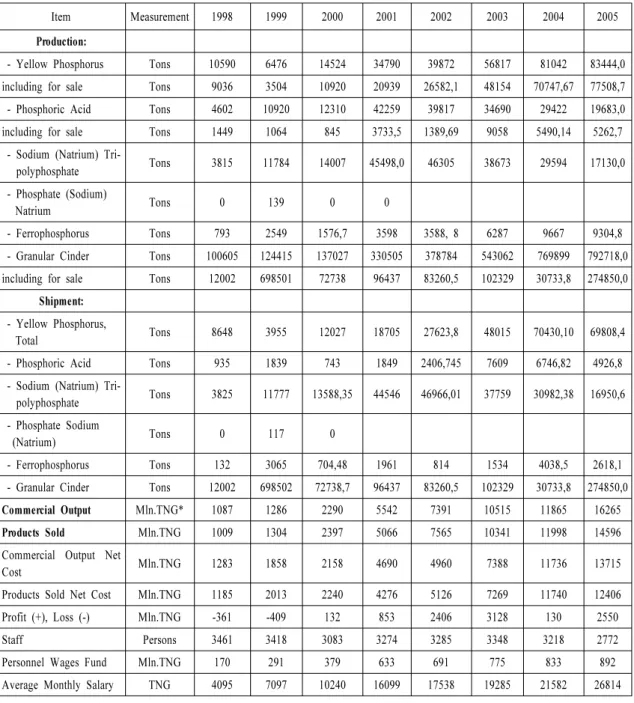
But with the collapse of the USSR and the rubble currency zone the neighboring market of CIS coun- tries (Commonwealth of Independent States) within the short of time squeezed significantly and the plants lost their operating capital. For instance, sales in 1991 estimated at 471 mln. USD, while in 1994 it fell to 106 mln. USD when the plants experienced huge debt/credit imbalances (pls. refer to table #1 and picture #1 with production output data).

Starting 1995 government introduced foreign management by shifting management rights to such companies as Russian Yutek-LukOil, American JBA

Traole, Indian MKK Texuna and 5 others in turn.

All those companies were not very strong and fo- cused only on immediate profits without strategic approach. In December 1999 local company Kaz- Phosphate Ltd. was named as the 9

th

managing com- pany in turn and actually the first real producer of Kazakh phosphor.

Since 2000 up to the present time KazPhosphate Ltd. rehabilitated production line and restored pre- viously lost markets. For instance, the production output at the New Zhambyl Phosphate plant in- creased 8 times from 10590 tons in 1995 to 83444 tons in 2005 (pls. refer to the Table 1 and Figure 1).

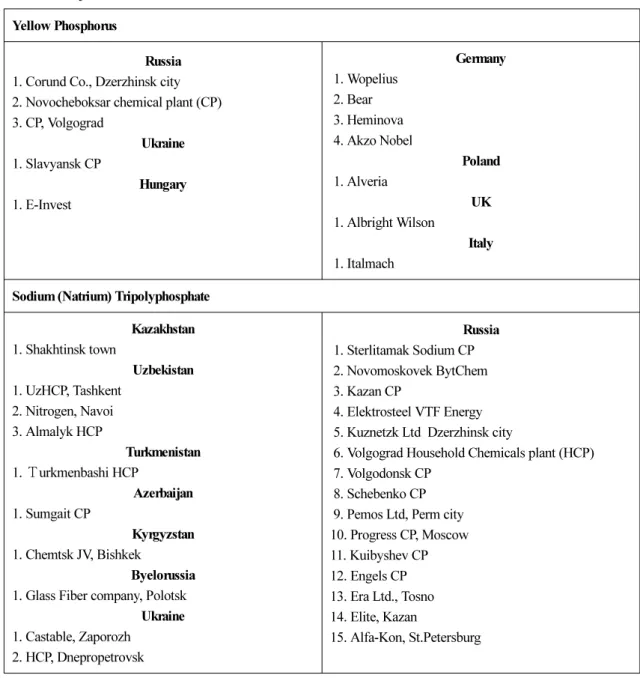
Nevertheless to the above mentioned positive sig- nificant changes there are five main impeding fac- tors for KazPhosphate’s growth as well as strong competition (pls. refer to list of competitors at- tached):

1. High rate of wear & tear of the equipment (it’s quite old) and out-dated technology. A significant part of the equipment has being already used for 20

∼25 years. On the contrary, in US the average peri- od of use of the same type of equipment is around 6 years.

2. Deficit of investment resources. Although fi- nancing has been increasing it is still quite low and is equal to the rate of 1991. The rate of equipment renovation is 4 times lower than the required minimum.

3. High prices for gas and electricity.

4. Unstable provisioning with basic commodities, especially hydrocarbons (Natural Gas, Liquefied Gas, Coke Breeze, Anthracite, etc.) as well as Sulphuric Acid.

5. Small domestic market. During last 10 years total domestic consumption hasn’t exceeded 10% of the required volume.

At the same time Kazakhstan has crucial advan-

tages for the success on the market. At first, it has

(3)

Table 1. Production Data for Yellow Phosphorus at the New Zhambyl Phosphate plant of KazPhosphate Ltd., 1998∼2005

Item Measurement 1998 1999 2000 2001 2002 2003 2004 2005

Production:

- Yellow Phosphorus Tons 10590 6476 14524 34790 39872 56817 81042 83444,0

including for sale Tons 9036 3504 10920 20939 26582,1 48154 70747,67 77508,7

- Phosphoric Acid Tons 4602 10920 12310 42259 39817 34690 29422 19683,0

including for sale Tons 1449 1064 845 3733,5 1389,69 9058 5490,14 5262,7

- Sodium (Natrium) Tri-

polyphosphate Tons 3815 11784 14007 45498,0 46305 38673 29594 17130,0

- Phosphate (Sodium)

Natrium Tons 0 139 0 0

- Ferrophosphorus Tons 793 2549 1576,7 3598 3588, 8 6287 9667 9304,8

- Granular Cinder Tons 100605 124415 137027 330505 378784 543062 769899 792718,0 including for sale Tons 12002 698501 72738 96437 83260,5 102329 30733,8 274850,0

Shipment:

- Yellow Phosphorus,

Total Tons 8648 3955 12027 18705 27623,8 48015 70430,10 69808,4

- Phosphoric Acid Tons 935 1839 743 1849 2406,745 7609 6746,82 4926,8

- Sodium (Natrium) Tri-

polyphosphate Tons 3825 11777 13588,35 44546 46966,01 37759 30982,38 16950,6 - Phosphate Sodium

(Natrium) Tons 0 117 0

- Ferrophosphorus Tons 132 3065 704,48 1961 814 1534 4038,5 2618,1

- Granular Cinder Tons 12002 698502 72738,7 96437 83260,5 102329 30733,8 274850,0

Commercial Output Mln.TNG* 1087 1286 2290 5542 7391 10515 11865 16265

Products Sold Mln.TNG 1009 1304 2397 5066 7565 10341 11998 14596

Commercial Output Net

Cost Mln.TNG 1283 1858 2158 4690 4960 7388 11736 13715

Products Sold Net Cost Mln.TNG 1185 2013 2240 4276 5126 7269 11740 12406

Profit (+), Loss (-) Mln.TNG -361 -409 132 853 2406 3128 130 2550

Staff Persons 3461 3418 3083 3274 3285 3348 3218 2772

Personnel Wages Fund Mln.TNG 170 291 379 633 691 775 833 892

Average Monthly Salary TNG 4095 7097 10240 16099 17538 19285 21582 26814

※ Tenge (TNG) is a national currency of Kazakhstan. Rate as of March 2007: 1USD = 124 TNG.

(4)

Yellow Phosphorus

Russia 1. Corund Co., Dzerzhinsk city 2. Novocheboksar chemical plant (CP) 3. CP, Volgograd

Ukraine 1. Slavyansk CP

Hungary 1. E-Invest

Germany 1. Wopelius

2. Bear 3. Heminova 4. Akzo Nobel

Poland 1. Alveria

UK 1. Albright Wilson

Italy 1. Italmach

Sodium (Natrium) Tripolyphosphate Kazakhstan 1. Shakhtinsk town

Uzbekistan 1. UzHCP, Tashkent

2. Nitrogen, Navoi 3. Almalyk HCP

Turkmenistan 1. Тurkmenbashi HCP

Azerbaijan 1. Sumgait CP

Kyrgyzstan 1. Chemtsk JV, Bishkek

Byelorussia 1. Glass Fiber company, Polotsk

Ukraine 1. Castable, Zaporozh

2. HCP, Dnepropetrovsk

Russia 1. Sterlitamak Sodium CP 2. Novomoskovek BytChem 3. Kazan CP

4. Elektrosteel VTF Energy 5. Kuznetzk Ltd Dzerzhinsk city

6. Volgograd Household Chemicals plant (HCP) 7. Volgodonsk CP

8. Schebenko CP 9. Pemos Ltd, Perm city 10. Progress CP, Moscow 11. Kuibyshev CP 12. Engels CP 13. Era Ltd., Tosno 14. Elite, Kazan

15. Alfa-Kon, St.Petersburg strong commodities’ base, abundant mineral re-

sources as well as qualified and relatively inex- pensive labor force. Another important factor is a growth of the local economy that will enlarge do- mestic market for this industry. Taking into consid- eration strong competition in the world market nowadays Kazakhstan’s chemical plants need to find out new markets and partners for innovation and steady growth.

As you can see from the Figure 1 the peak of pro- duction was in 1990 with 479.6 thousand ton, the worst result - in 1999 with tiny 6.5 thousand ton.

Production of Yellow Phosphorus in 2005 was 83.4 ton which is 13 times bigger than in 1999, but 6 times smaller than in 1990.

Major consumers of KazPhosphate Ltd. are listed in Table 2.

Table 2. Major Consumers

(5)

Orthophosphoric acid

Kazakhstan 1. KazCastable, Rudnyi

2. HCP, Aktobe

3. Ak-Tolkyn Co., Shakhtinsk 4. ChemMach, Pavlodar 5. KarMetKombinat, Temirtau

Ukraine 1. Reagents plant, Cheboksary 2. Almach, Dnepropetrovsk 3. Aircraft, Kiev

4. Castable, Zaporozh 5. Coke plant, Mariupol

Uzbekistan 1. Andizhan HydroMach 2. Almalyk HCP 3. Nitrogen, Ferghana

Russia 1. BioChem, Rasskazovo

2. Caoutchouc company, Sterlitamak 3. Corund Co., Dzerzhinsk

4. ChemTex, Perm

5. Novotroizk plant, Pervouralsk 6. CP, Volgograd

7. Castable, Semiluki TriSodiumPhosphate

Kazakhstan 1. KarMetKombinat, Temirtau 2. TselinEnergo, Astana

3. Power & Heat Station (PHS) # 2, Petropavlovsk 4. PHS #2, Almaty

5. Cable plant, Semipalatinsk

Georgia 1. MetKombinat, Rustavi

Tajikistan 1. Dushanbe

Ferrophosphorus

Russia 1. Motodetal, Kostroma 2. MachPlant, Bryansk 3. Asperm, Moscow

Byelorussia 1. Railway-carriage-repair plant, Gomel

Ukraine 1. KievTractorParts, Kiev 2. Lininskaya Kuznitza Co., Kiev

Luxemburg 1. Minrae

Major Competitors on the Yellow Phosphorus Market:

⋅In Russia: “Phosphor” Chemical Plant Joint Stock Company (JSC), Kuibyshev city. It is depended from KazPhosphate Ltd. raw commodities to produce Yellow Phosphorus.

⋅In Europe:

(1) German corporation Hoechst AG, which produces 60000 ton of Yellow Phospho- rus per year and its major consumers are:

Bayer AO, Germany

Ciba Geige, Switzerland Chemi Nova, Denmark AtoChen, France Albright Wilson, UK Italmafh, Italy

K гems Chemie, Austria Akzo Nobel, Germany CWP, Germany

Although prices of Hoechst AG corporation

are higher and not competitive to the Kaz-

Phosphate’s, the German corporation focuses on

high quality of phosphorus purification and de-

(6)

livery discipline. It helps Hoechst AG to stay on leading positions in Europe.

(2) Other strong competitors of KazPhosp- hate are 30 Chinese phosphorus-produc- ing plants. They sell Yellow Phosphorus on CIF terms in seaports of North Sea at 1200 ∼1300 USD per ton.

Major Competitors on the Sodium (Natrium) Tripolyphosphate Market:

⋅In Russia, 3 plants: Kuibyshev Phosphor CP JSC produces 40000 ton a year, Slavy- ansk Sodium CP produces 60000 ton a year, Volkhov CP, produces 10000 ton a

year.

⋅In Europe: PMC CP in Spain, Vidvoz in Poland, CPs in Bulgaria.

Major Competitors on the Ammophos Market:

The situation on the neighboring market of Uzbekistan is not favorable. Factories of Uzbek- istan, that previously widely consumed KazPhos- phate’s Ammophos, nowadays use local Uzbekis- tan-made Ammophos.

At the same time the competition on the market of phosphorus commodities of fine gr- inding is very low.

Figure 1. Yellow phosphorus production in Kazakhstan, 1985∼2005 [1000 ton].

수치

Table 1. Production Data for Yellow Phosphorus at the New Zhambyl Phosphate plant of KazPhosphate  Ltd., 1998∼2005
Table 2. Major Consumers
Figure 1. Yellow phosphorus production in Kazakhstan, 1985∼2005 [1000 ton].

참조

관련 문서

Clearly, the company secretary has an important role to play in ensuring that his/her company converts to IFRS reporting within the required timeline.. It is

Next week, 201 workers at pallet-hire company Chep South Africa will be in the labour appeal court, asking it to overturn an order saying they should not be made

• WISE KMA는 Search Formula-1 및 WISE CIMS에 기본 탑재되어 제공되며, 형태소분석기만 원하는 고객 에게도 독립적으로

광고나 캠페인이 아닌, 개발중인 자동차 자체의 디자인이나 색상, 스펙 등에 대한 소비자 반응 평가 실험도 가능함2. 브랜드

Company Policy Statements, Current through the November 2010 Update (“Participation in an investment or outside business opportunity that is related to

한국의 경우 OUT-IN 에서는 JF Asset Management Ltd, Capital Research & Management Company, Capital Research & Management Company, Standard Chartered plc, Citigroup

frame ·concept·logic·positioning McKinsey&Company frame·concept·logic·positioning McKinsey&Company frame·concept·logi positioning McKinsey &

엔티티 타입 EMPLOYEE는 Name, SSN, Sex, Address, Salary, BirthDate, Department, Supervisor 애트리뷰트들을 가진다.. 사용자가 사원 Name의