• 검색 결과가 없습니다.

Physical Therapy Application Development Using the App Inventor -Preliminary Research for the Realization of Tele-Physical Therapy-

N/A
N/A
Protected

Academic year: 2021

Share "Physical Therapy Application Development Using the App Inventor -Preliminary Research for the Realization of Tele-Physical Therapy-"

Copied!
9
0
0

로드 중.... (전체 텍스트 보기)

전체 글

(1)

| Abstract |

Purpose: The COVID-19 pandemic has changed how healthcare is delivered worldwide and has affected the environment of the healthcare. Physical therapy in traditional healthcare systems can be difficult in unusual circumstances, such as the COVID-19 pandemic. Tele-physical therapy, defined as “the delivery of the physical therapy at a distance using electronic information and telecommunication technologies,” will be a solution for this healthcare crisis. Thus, in this study, we proposed a mobile application for tele-physical therapy.

Methods: This study used the Chrome Browser version 83.0.4 based on the Windows 10 64Bit operating system to use the App Inventor. To operate the mobile application, we used the Samsung Galaxy Note 9. The design of the mobile application was based on the review of a system used in the physical therapy department.

Results: The graphical user interface (GUI) of the mobile application was displayed on three screens: selecting a painful joint (1st screen of the GUI); selecting a painful movement of the joint (2nd screen of the GUI); a self-manual therapy method and movie (3rd screen of the GUI). The proposed mobile application showed the stable repeatability of the self-manual therapy movie.

Conclusion: The results of this study demonstrated that the proposed mobile application using the App Inventor for android will be able to create easy to use and reliable tele-physical therapy.

Key Words: COVID-19, Tele-physical therapy, Healthcare crisis, App inventor

†Corresponding Author : Jong-Soon Kim ([email protected])

Original Article Open Access

앱인벤터를 이용한 물리치료 어플리케이션 개발 -원격 물리치료 구현을 위한 사전연구-

이민형⋅김종순 1†

1)

부산가톨릭대학교 대학원 물리치료학과, 1 부산가톨릭대학교 보건과학대학 물리치료학과

Physical Therapy Application Development Using the App Inventor
-Preliminary Research for the Realization of Tele-Physical Therapy- Min-Hyung Rhee, P.T, M.S.⋅Jong-Soon Kim, P.T., Ph.D. 1†

Department of Physical Therapy, Graduate School, Catholic University of Pusan

1 Department of Physical Therapy, College of Health Sciences, Catholic University of Pusan Received: August 6, 2020 / Revised: August 18, 2020 / Accepted: August 23, 2020

ⓒ 2020 Journal of Korea Proprioceptive Neuromuscular Facilitation Association

This is an Open Access article distributed under the terms of the Creative Commons Attribution Non-Commercial License

(http://creativecommons.org/licenses/by-nc/3.0) which permits unrestricted non-commercial use, distribution, and reproduction

in any medium, provided the original work is properly cited.

(2)

Ⅰ. 서 론

전 세계는 2020년에 들어 COVID-19라는 새로운 바이러스 감염병 위험에 직면해 있다. COVID-19는 SARS-CoV-2 감염에 의한 호흡기 증후군으로 발열, 권태감, 기침, 호흡곤란 및 폐렴 등 경증에서 중증까지 다양한 호흡기 감염증 증상이 나타난다(KCDC, 2020).

COVID-19는 치사율이 비교적 낮은 반면 비말을 통한 높은 전염력으로 인해 감염병 확산을 차단하기 위해 서는 증상을 보이는 환자나 혹은 무증상 환자와의 비 접촉 및 개인위생이 매우 중요하다. 이렇듯 COVID-19 의 전 세계적인 확산으로 인해 새롭게 등장한 인류의 생활 양상이 비접촉 혹은 비대면 삶의 방식 추구이다.

COVID-19로 대면 방식의 기존 의료체계에서 위험성 을 해결하고자, 다양한 환경에서의 물리치료의 방법 을 제안하고 있다(Alpalhão & Alpalhão, 2020; Dantas et al., 2020; Lee, 2020; Pedersini et al., 2020; Thomas et al., 2020; Turolla et al., 2020). 그러나 세계적인 COVID-19 감염병은 건강관리 기관에서 물리치료사 와 같은 의료⋅건강관리 제공자들이 어떠한 방법으로 감염병 확산을 막기 위해 환자와 사회적 거리 두기를 해야 하는지와 감염 확산 위험 없이 어떻게 의료 서비 스를 안전하게 제공할 수 있는지를 고민하도록 하고 있다(APTA, 2020). 이러한 고민의 연장선에 있는 것이 디지털 물리치료(digital physical therapy practice) 즉, 원격 건강관리(telehealth)이다.

원격 건강관리는 e-health, m (mobile)-health라고도 하는데 원격 진료(telemedicine), 원격 돌봄(telecare) 등 과 거의 비슷한 의미로 사용되고 있으나 원격 건강관 리가 보다 포괄적인 의미를 가지고 있다. 원격 건강관 리는 컴퓨터나 모바일 장치와 같은 디지털 정보통신 기술을 사용하여 원격으로 건강관리 서비스에 접근하 여 건강관리를 제공받는 것을 의미한다. 이러한 원격 건강관리에는 모든 의료 전문가들이 참여하게 된다 (Darkins & Cary, 2000). 원격 건강관리의 목표는 농촌 등 오지에 사는 사람들의 건강관리, 시간 또는 이동의 편이성이 제한되는 사람들의 서비스 접근 수월성 확

보, 의료 전문가와 만날 수 있는 기회 제공, 건강관리 팀 구성원과 환자 간 의사소통 및 협력 개선, 자가 건강관리 지원 등으로 요약 할 수 있다(Mayo clinic, 2020).

원격 건강관리는 물리치료 및 재활 영역에서는 원 격 물리치료(tele-physical therapy), 디지털 물리치료 혹 은 원격 재활(telerehabilitation)이라고 할 수 있을 것이 다. 원격 물리치료의 경우 세계 물리치료 연맹(World Confederation for Physical Therapy, WCPT)과 국제 물리 치료 규제기관 네트워크(International Network of Physiotherapy Regulatory Authorities, INPTRA)의 디지 털 물리치료 실무위원회가 2017년에 개최되어 주요 권장 사항을 개발하였으며 원격 물리치료를 정의하였 는데 이들의 정의에 따르면 원격 물리치료, 디지털 물리치료 혹은 원격 재활은 정보통신 기술을 통한 원 격 물리치료나 재활 서비스 지원 및 정보 제공이라고 할 수 있다(Brennan et al., 2010; Lee, 2020).

원격 물리치료에 대한 연구를 살펴보면 원격 물리 치료 제공에 의한 삶의 질 변화(Levy et al., 2015; Linder et al., 2015), 원격 물리치료에 대한 문헌 검토 연구 (Grona et al., 2018; Sarfo et al., 2018), 원격 물리치료의 효과(Gandolfi et al., 2017; Kline et al., 2019), 원격 물리 치료와 병원 내 물리치료의 효과 비교(Azma et al., 2018; Steven et al., 2019), 원격 물리치료 환경에서 물리 치료 평가의 타당성(Truter et al., 2014) 등에 대한 연구 들이 보고되고 있다. 하지만 임상 실무자가 현장에서 원격 물리치료를 시행하기 위해서는 어플리케이션 제 작을 위한 기술적인 문제와 비용적인 문제에서 어려 움이 따르고, 이런 원격 물리치료의 실질적 구현 및 접근 수월성의 확보를 위한 연구는 전무한 실정이다.

이에 본 연구는 원격 물리치료의 실질적 구현을 위한

방법인 모바일 환경에서의 어플리케이션 개발에 대한

연구를 실시하고자 한다.

(3)

Ⅱ. 연구 방법

1. 앱 인벤터(app inventor for android) 개발 과정

앱 인벤터는 오픈 소스 웹 어플리케이션으로, 그 래픽 인터페이스를 기반으로 안드로이드 기반 어플 리케이션을 제작할 수 있으며, 앱 인벤터를 통하여 사용자들은 시각적으로 구성된 객체들을 드래그 앤 드 드롭(Drag & Drop) 방식으로 간편하게 프로그래 밍 할 수 있다(Wang et al., 2017; Zhang, 2014). 앱 인 벤터는 초창기 시작은 구글에서 서비스를 제공하였 으나, 현재는 매사추세츠 공과대학교(MIT)에 의해 서 관리되고 있으며, 앱 인벤터 혹은 MIT 앱 인벤터 라고 부르고 있다.

앱 인벤터의 특징은 모바일 프로그램을 개발할 수 있는 도구로서, 기존의 텍스트 기반의 개발 접근 방식 이 아닌, 시각적으로 직관적인 프로그래밍 환경을 제 공하고, 시각적으로 블록의 조합만을 이용하여 어플 리케이션을 개발할 수 있기 때문에 비전공자들에 의 한 개발환경 접근성이 매우 편리해졌다(Lee & Oh, 2018).

본 연구에서 앱 인벤터를 이용하기 위한 개발환경 으로는 Windows 10 64Bit 운영체제를 기반으로 Chrome Browser 83.0.4 버전을 이용하였다. 모바일 어 플리케이션을 구동시키기 위한 장비로 삼성의 갤럭시 노트 9을 이용하여 시스템을 구성하였다. 앱 인벤터

개발을 위하여 앱 인벤터 개발 홈페이지(http://ai2.

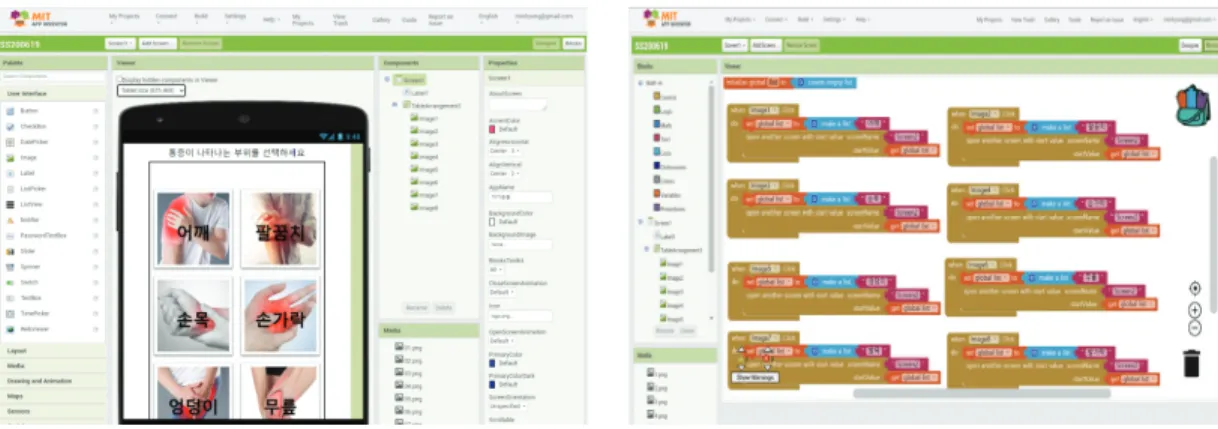
appinventor.mit.edu/)에 접속하여, 구글에서 제공하는 계정으로 로그인 하고, 새로운 프로젝트를 생성하고, 어플리케이션의 그래픽 화면을 구현하 기 위하 여, Designer 환경에서 Palette를 이용하여 화면구성에 필 요한 컴포넌트를 가져와서 드래그 앤드 드롭 방식으 로 화면을 구성하였다(Fig. 1). 이후 Blocks 환경에서 컴포넌트의 세부 기능에 해당하는 블록을 조합하고, 이벤트 및 함수를 설정하여 개발하였다(Fig. 2).

2. 개발 설계 및 알고리즘

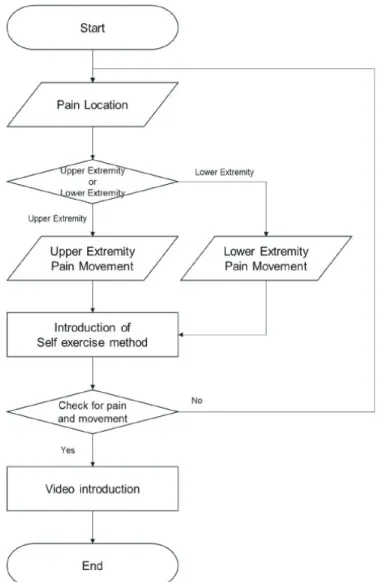
원격 물리치료용 모바일 어플리케이션의 설계는 기본적으로 물리치료실에 내원하는 환자의 문진 시스 템을 기초로 작성하였다. 어플리케이션 사용자가 통 증 위치를 선택하고, 선택된 통증 위치에 따라 통증을 유발하는 움직임을 선택하면, 자가 운동치료 방법을 설명하는 화면이 제시되고, 해당되는 자가 운동치료 안내 동영상을 제공하도록 하였다. 이러한 과정을 구 현하기 위하여 다음과 같은 알고리즘 흐름도에 따라 어플리케이션을 제작하였다(Fig. 3).

화면은 3개의 화면으로 구성되었다. 첫 번째 화면은 8개의 관절을 중심으로 통증의 위치를 선택할 수 있게 하였고, 두 번째 화면은 첫 번째 화면에서 선택된 관절 을 중심으로 움직임을 선택할 수 있도록 설정하였다.

세 번째 화면은 첫 번째 화면에서 선택된 관절과 두

Fig. 1. Designer editor for App inventor. Fig. 2. Blocks editor for App inventor.

(4)

번째 화면에서 선택된 움직임을 분석하여, 스스로 할 수 있는 운동치료 방법을 설명하고, 사용자가 관련 동영상 안내를 원하면, 해당 운동치료에 대한 본 서비 스를 위하여 미리 제작된 상세 자가 운동치료 동영상 을 제시하였다. 각 화면 사이의 선택된 데이터 값은 함수로 저장하여 다음 화면으로 넘기는 작업을 시행 하였으며, 이때 두 번째 화면에서 제공하는 관절의 움직임을 한 화면에 모두 제시하는데 어려움이 있어, 관절을 상지와 하지를 기준으로 다른 관절 움직임 목

록을 제시하도록 설정하였다.

선택된 움직임이 통증 재현 움직임과 관련이 없으 면, 이전 메뉴로 돌아가 다시 선택할 수 있도록 설정하 였다. 제작된 프로그램의 최적화를 위하여, 동영상은 프로그램에 삽입하지 않고, 외부 링크로, 제공하여 유 튜브(Youtube) 환경에서 제공할 수 있도록 설정하였 다. 이는 제작환경인 안드로이드 OS기반 스마트폰에 서는 기본적으로 제공하는 호환성에 문제가 없는 동 영상 프로그램이다.

Fig. 3. Application development data input algorithm.

(5)

Ⅲ. 연구 결과

1. 기본 그래픽 사용자 인터페이스 (graphical user interface)의 구성

기본 그래픽 사용자 인터페이스는 통증이 있는 관 절 부위를 선택하는 초기 화면(Fig. 4a), 선택된 관절을 확인하고, 선택된 관절의 통증 움직임을 선택하는 두 번째 화면(Fig. 4b, 4c), 앞에서 선택된 관절 및 통증 움직임을 바탕으로 자가 운동치료 방법과 그에 따른 동영상을 제공하는 세 번째 화면(Fig. 4d)으로 구성하 였다.

2. 어플리케이션 구현과 시뮬레이션(simulation) 결과

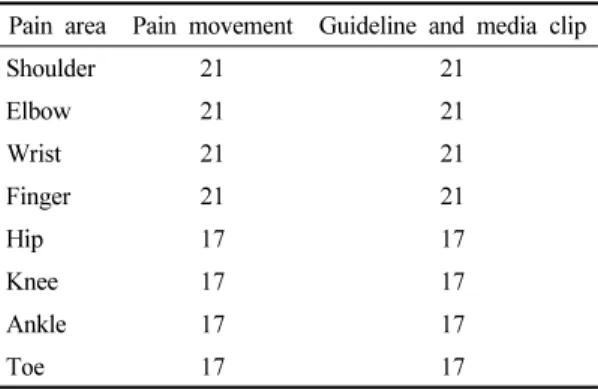
선택된 관절과 움직임에 따라 자가 운동치료 방법 은 일관되게 제시되었고, 안내되는 동영상도 일관되 게 적합한 영상이 제공되었다(Table 1).

Pain area Pain movement Guideline and media clip

Shoulder 21 21

Elbow 21 21

Wrist 21 21

Finger 21 21

Hip 17 17

Knee 17 17

Ankle 17 17

Toe 17 17

Unit=list

Table 1. Results of the application execution

Ⅳ. 고 찰

원격 물리치료에 대한 여러 효과 보고가 있었음에도 불구하고 COVID-19 전염병이 유행하고 있는 지금까 지 원격 물리치료의 광범위한 사용은 거의 이루어지지 않고 있다(Tanriverdi & Iacono, 1999; Wade et al., 2016).

이러한 원격 물리치료의 확산을 방해하는 주요 문제는 크게 비용적 문제와 기술적 문제로 구분할 수 있다.

Fig. 4. Operation result of Tele-physical therapy application.

(6)

먼저, 비용적인 면에서 원격 물리치료를 구현하기 위해서는 정보통신 인프라 확보에 초기 재정 지출을 필요로 한다(Moffatt & Eley, 2011). 기술적인 면에서는 원격 물리치료를 제공받는 환자의 경우 연령, 교육 수준 및 컴퓨터 활용 능력에 따라 원격 물리치료 접근 에 제약을 받을 수 있다(Kruse et al., 2018). 물리치료사 의 경우 소프트웨어 및 하드웨어 운용에 대한 지식 부족으로 원격 물리치료 구현에 필요한 프로그램 및 어플리케이션 개발 등을 물리치료에 대한 전문 지식 이 부족한 외부 전문가에게 의존할 수밖에 없다는 문 제점이 있다. 따라서 원격 물리치료의 구현을 위해서 는 비용적 문제와 기술적 문제를 극복할 수 있는 방안 이 필요하다.

앱 인벤터는 안드로이드 스마트폰 어플리케이션을 쉽게 개발할 수 있는 비주얼 프로그래밍 도구로써 앱 인벤터로 만든 어플리케이션은 안드로이드 스마트폰 설치는 물론 앱스토어에도 등록할 수도 있어 접근성 과 확산성이 매우 우수하며 컴퓨터 비전공자들도 본 인의 전공을 앱 인벤터를 사용하여 스마트폰 앱으로 쉽게 구현할 수가 있다(Park, 2013). 따라서 원격 물리 치료 구현을 위한 비용적 그리고 기술적 문제를 극복 할 수 있는 어플리케이션 개발 도구로 판단된다. 이에 본 연구는 원격 물리치료 구현을 위해 무료로 누구나 쉽게 사용할 수 있고 핸드폰 기반에서 운용이 가능한 앱 인벤터를 이용하여 어플리케이션을 개발하고자 하 였다.

본 연구와 같은 앱 인벤터를 사용하여 임상 물리치 료사가 기술적, 경제적 제한 없이 직접 물리치료 관련 자가 운동치료를 제공하는 어플리케이션을 개발한 연 구는 찾아볼 수 없었다. 모든 연구들이 어플리케이션 을 물리치료 영역에 도입하여 그 효과를 비교하는 연 구들이었다.

이들 연구들을 살펴보면 모바일 어플리케이션의 활용을 통한 신체 활동 조장이 체중 감량 효과가 있었 다고 보고(Flores Mateo et al., 2015), 모바일 어플리케 이션의 사용이 요통 환자의 자기 관리에 많은 도움을 준다는 보고(Irvine et al., 2015), 화학요법을 받는 진행

성 폐암 환자에게 모바일 어플리케이션을 이용한 심 폐 물리치료를 제공한 결과 환자의 운동 능력이 개선 되었다는 보고(Park et al., 2019), 근골격계 문제가 있는 환자들에게 원격 물리치료를 제공한 결과 전통적인 방식의 물리치료와 비교하여 신체 기능과 통증에서 유의한 효과가 있었다는 보고(Cottrell et al., 2016), 무 릎관절 완전 성형술(total knee arthroplasty)을 시행한 환자에게 원격 물리치료를 적용한 결과 통증과 기능 의 유의한 개선이 있었다는 보고(Jiang et al., 2018) 등 여러 질환에서 어플리케이션을 이용한 원격 물리 치료의 효과를 보고하고 있었다. 하지만 임상 실무자 가 이와 같은 어플리케이션을 직접 개발하기엔 기술 적, 경제적 제한점이 따르고 있다.

Han과 Huh (2015)는 앱 인벤터를 이용한 어플리케 이션은 환자가 의료진으로부터 치료에 관련된 정보를 제공받는 과정에서 소통과 이해를 증진시켜 치료 성 공에 기여한다고 하여 원격 건강관리의 목표를 충족 시키는 것으로 보고하였는데 본 연구에서는 근골격계 질환 환자를 가정하여 통증의 위치 선택, 통증을 유발 하는 움직임 선택, 자가 운동치료 설명, 자가 운동치료 안내 동영상의 순서로 프로그램을 설계하여 가상의 환자들이 물리치료사들이 미리 제작한 동영상에 따라 가정에서 자가 운동치료를 실시 할 수 있도록 하였다.

따라서 환자와 물리치료사의 원격 물리치료가 가능하 도록 설계하였다.

Chiu 등(2017)은 앱 인벤터를 이용하여 제작한 어플

리케이션은 만성 발목 불안정성이 있는 대상자의 자

세 제어 능력을 평가하기 위한 편리하고 신뢰할 수

있는 도구라고 보고하였는데 본 연구에서도 앱 인벤

터를 이용하여 개발한 어플리케이션을 모의 운용한

결과 일관되게 환자가 작성한 통증의 위치와 통증을

유발하는 움직임에 따라 자가 운동치료의 설명과 안

내 동영상이 일정하게 구동되어 안정적으로 어플리케

이션이 작동함을 확인 할 수 있었다. 본 연구에서는

원격 물리치료를 구현할 수 있는 어플리케이션 개발

을 중심으로 서술하였지만, 추후 연구에서는 개발된

어플리케이션을 바탕으로 일반 사용자를 통한 사용성

(7)

평가나, 임상적 효과를 검정하여, 이를 상용화된 프로 그램으로 가기 위한 절차가 필요한 것으로 사료된다.

또한 본 연구에서 개발한 어플리케이션이 환자의 상 태와 치료 경과를 실시간으로 물리치료사가 관찰할 수 없다는 한계는 있으나 원격 물리치료의 한 방법으 로 본 연구에서 개발한 어플리케이션을 사용할 수 있 을 것으로 사료된다. 추후 연구에서는 실시간 환자의 관찰, 평가 그리고 치료를 동시에 수행할 수 있는 어플 리케이션 개발이 필요한 것으로 사료된다.

Ⅴ. 결 론

본 연구를 통해 앱 인벤터를 이용하여 환자와 물리 치료사의 원격 물리치료를 구현할 수 있는 어플리케 이션을 개발하였다. 앱 인벤터의 사용은 원격 물리치 료 구현의 문제점인 비용 및 기술적 문제의 한계를 극복하는데 유용할 것으로 사료된다.

References

Alpalhão V, Alpalhão M. Impact of COVID-19 on physical therapist practice in Portugal. Physical Therapy.

2020;100(7):1052-1053.

APTA. Telehealth in physical therapy in light of COVID-19.

https://www.apta.org/news/2020/03/16/telehealth-in- physical-therapy-in-light-of-covid-19. 2020.

Azma K, RezaSoltani Z, Rezaeimoghaddam F, et al. Efficacy of tele-rehabilitation compared with office-based physical therapy in patients with knee osteoarthritis:

a randomized clinical trial. Journal of Telemedicine and Telecare. 2018;24(8):560-565.

Brennan D, Tindall L, Theodoros D, et al. A blueprint for telerehabilitation guidelines. International Journal of Telerehabilitation. 2010;2(2):31-34.

Chiu YL, Tsai YJ, Lin CH, et al. Evaluation of a smartphone-

based assessment system in subjects with chronic ankle instability. Computer Methods Programs in Biomedicine. 2017;139:191-195.

Cottrell M, Galea O, O’Leary S, et al. Real-time telerehabilitation for the treatment of musculoskeletal conditions is effective and comparable to standard practice: a systematic review and meta-analysis. Clinical Rehabilitation. 2017;31(5):625-638.

Cramer SC, Dodakian L, Le V, et al. Efficacy of home-based telerehabilitation vs in-clinic therapy for adults after stroke: a randomized clinical trial. Journal of American Medical Association Neurology. 2019;76(9): 1079- 1087.

Dantas LO, Barreto RPG, Ferreira CHJ. Digital physical therapy in the COVID-19 pandemic. Brazilian Journal of Physical Therapy. 2020;S1413-3555(20)30402-0.

Darkins A, Cary M. Telemedicine and telehealth: principles, policies, performance and pitfalls. London. Free Association Books. 2000.

Flores Mateo G, Granado-Font E, Ferré-Grau C, et al. Mobile phone Apps to promote weight loss and increase physical activity: a systematic review and meta- analysis. Journal of Medical Internet Research.

2015;17(11):e253.

Gandolfi M, Geroin C, Dimitrova E, et al. Virtual reality telerehabilitation for postural instability in Parkinson’s disease: a multicenter, single-blind, randomized, controlled trial. Biomedical Research International. 2017;7962826.

Grona SL, Bath B, Busch A, et al. Use of videoconferencing for physical therapy in people with musculoskeletal conditions: a systematic review. Journal of Telemedicine and Telecare. 2018;24(5):341-355.

Han YS, Huh WW. Application development that provide

contents for treatment of alcoholism using app

inventor. Asia-pacific Journal of Multimedia Services

Convergent with Art, Humanities, and Sociology.

(8)

2015;5(4):63-70.

Irvine AB, Russell H, Manocchia M, et al. Mobile-Web app to self-manage low back pain: randomized controlled trial. Journal of Medical Internet Research.

2015;17(1):e1.

Jiang S, Xiang J, Gao X, et al. The comparison of telerehabilitation and face-to-face rehabilitation after total knee arthroplasty: a systematic review and meta-analysis. Journal of Telemedicine and Telecare.

2018;24(4):257-262.

KCDC. What is COVID-19? http://ncov.mohw.go.kr/

baroView.do?brdId=4&brdGubun=41. 2020.

Kline PW, Melanson EL, Sullivan WJ, et al. Improving physical activity through adjunct telerehabilitation following total knee arthroplasty: randomized controlled trial protocol. Physical Therapy. 2019;99(1):37-45.

Kruse C, Karem P, Shifflett, et al. Evaluating barriers to adopting telemedicine worldwide: a systematic review. Journal of Telemedicine and Telecare. 2018;24(1):4-12.

Linder SM, Rosenfeldt AB, Bay RC, et al. Improving quality of life and depression after stroke through telerehabilitation. American journal of occupational therapy. 2015;69(2):1-10.

Lee CA. COVID-19 and the advancement of digital physical therapist practice and telehealth. Physical Therapy.

2020;100(7):1054-1057.

Lee HS, Oh JC. Design and development of health screening data input mobile application using App-inventor.

The Journal of the Korea Institute of Electronic Communication Sciences. 2018;13(1):193-198.

Levy CE, Silverman E, Jia H, et al. Effects of physical therapy delivery via home video telerehabilitation on functional and health-related quality of life outcomes.

Journal of Rehabilitation Research and Development.

2015;52(3):361-370.

Mayo Clinic. Telehealth: technology meets health care.

https://www.mayoclinic.org/healthy-lifestyle/consu

mer-health/in-depth/telehealth/art-20044878. 2020.

Moffatt J, Eley D. Barriers to the up-take of telemedicine in Australia-a view from providers. Rural and Remote Health. 2011;11(2):1581.

Park JS. A study on the effect of app inventor in introductory android programming course. Proceedings of the Korean Society of Computer Information Conference.

2013;21(2):287-288.

Park S, Kim JY, Lee JC, et al. Mobile phone App-based pulmonary rehabilitation for chemotherapy-treated patients with advanced lung cancer: pilot study.

Journal of Medical Internet Research Mhealth Uhealth. 2019;7(2):e11094.

Pedersini P, Corbellini C, Villafañe JH. Italian physical therapists’ response to the novel COVID-19 emergency. Physical Therapy. 2020;100(7):1049- 1051.

Sanders C, Rogers A, Bowen R, et al. Exploring barriers to participation and adoption of telehealth and telecare within the whole system demonstrator trial: a qualitative study. BMC Health Service Research.

2012;12:220.

Sarfo FS, Ulasavets U, Opare-Sem OK, et al. Tele-Rehabilitation after stroke: an updated systematic review of the literature. Journal of stroke and cerebrovascular diseases. 2018;27(9):2306-2318.

Tanriverdi H, Iacono CS. Diffusion of telemedicine: a knowledge barrier perspective. Telemedicine and e-Health. 1999;5(3):223-244.

Thomas P, Baldwin C, Bissett B, et al. Physiotherapy management for COVID-19 in the acute hospital setting: clinical practice recommendations. Journal of Physiotherapy. 2020;66(2):73-82.

Truter P, Russell T, Fary R. The validity of physical therapy

assessment of low back pain via telerehabilitation

in a clinical setting. Journal of Telemedicine and

Telecare. 2014;20(2):161-167.

(9)

Turolla A, Rossettini G, Viceconti A, et al. Musculoskeletal physical therapy during the COVID-19 pandemic:

is telerehabilitation the answer? Physical Therapy.

2020:pzaa093.

Wade V, Taylor A, Kidd M, et al. Transitioning a home telehealth project into a sustainable, large-scale service: a qualitative study. BMC Health Service Research.

2016;16:183.

Wang JM, Yang MT, Chen PL. Design and implementation of an intelligent windowsill system using smart handheld device and fuzzy microcontroller. Sensors (Basel). 2017;17(4):830.

Zhang C. Healthcare mobile App development with App Inventor in a health it course. SAIS 2014 Proceedings.

2014.

수치

Fig.  1.  Designer  editor  for  App  inventor. Fig.  2.  Blocks  editor  for  App  inventor.
Fig.  3.  Application  development  data  input  algorithm.
Table  1.  Results  of  the  application  execution

참조

관련 문서

 최대의 노력을 통한 편심성 활성동안 근육의 힘은 근육이 길어지는 속도에 비례한다.  근육의 최대힘과 짧아지는 속도

머리 가속 또는 감속 움직임시 TM joint 손상 탈구 시 연부조직 손상..

Department of Physical Therapy. Hwi-young

O: 손배뼈결절, 큰마름뼈, 굽힘근지지띠의 노쪽 앞면 I: 엄지손가락의 첫마디뼈 바닥 및 노쪽에 있는 종자뼈 지배신경 : 정중신경(C6∙C7)..

• The specialty of Clinical Electrophysiology physical therapy was approved and board certified in 1982 by the American Physical Therapy Association (APTA) House of

1 John Owen, Justification by Faith Alone, in The Works of John Owen, ed. John Bolt, trans. Scott Clark, "Do This and Live: Christ's Active Obedience as the

For changes in physical fitness, the physical fitness group showed a statistically significant difference in muscle strength, endurance, flexibility,

Taken together, by applying physical strength exercise program to the elite table tennis players we can conclude that physical strength exercise program has positive effects