http://dx.doi.org/10.12671/jkfs.2015.28.1.53
53
Copyright ⓒ 2015 The Korean Fracture Society. All rights reserved.
This is an Open Access article distributed under the terms of the Creative Commons Attribution Non-Commercial License (http://creativecommons.org/licenses/
by-nc/3.0) which permits unrestricted non-commercial use, distribution, and reproduction in any medium, provided the original work is properly cited.
Received October 26, 2014 Revised November 26, 2014 Accepted December 24, 2014
Address reprint requests to: Jai Hyung Park, M.D., Ph.D.
Department of Orthopaedic Surgery, Kangbuk Samsung Medical Center, Sungkyunkwan University School of Medicine, 29 Saemunan-ro, Jongno-gu, Seoul 110-746, Korea
Tel: 82-2-2001-2168ㆍFax: 82-2-2001-2176 E-mail: [email protected]
Financial support: None. Conflict of interest: None.
대퇴 전자간 골절의 금속정을 이용한 내고정술 후 실혈량:
위험 인자 분석
박재형 ⋅정화재⋅신헌규⋅김유진⋅박세진⋅고택수⋅박종현
성균관대학교 의과대학 강북삼성병원 정형외과학교실
Perioperative Blood Loss in Intramedullary Hip Screw for Intertrochanteric Fracture:
Analysis of Risk Factors
Jai Hyung Park, M.D., Ph.D. , Hwa Jae Jung, M.D., Ph.D., Hun Kyu Shin, M.D., Ph.D., Eugene Kim, M.D., Ph.D., Se-Jin Park, M.D., Ph.D., Taeg Su Ko, M.D., Jong-Hyon Park, M.D.
Department of Orthopaedic Surgery, Kangbuk Samsung Medical Center, Sungkyunkwan University School of Medicine, Seoul, Korea
Purpose: We compared visible blood loss and calculated blood loss after intramedullary fixation in intertrochanteric fracture, and evaluated correlation between blood loss and its risk factors.
Materials and Methods: A total of 256 patients who underwent closed reduction and intramedullary fixation in femoral intertrochanteric fracture between 2004 and 2013 were enrolled in this study. The total blood loss was calculated using the formula reported by Mercuiali and Brecher. We analyzed several factors, including fracture pattern (according to Evans classification), gender, age, body mass index (BMI), anesthesia method, cardiovascular and cerebrovascular disease, pre- operative anemia, American Society of Anesthesiologists (ASA) score and use of antithrombotic agents.
Results: Total calculated blood loss (2,100±1,632 ml) differed significantly from visible blood loss (564±319 ml). In addition, the blood loss of unstable fracture patient was 2,496±1,395 ml and multivariate analysis showed a significant relationship between blood loss and fracture pattern (p<0.01). However, other factors showed no statistically significant difference.
Conclusion: Total calculated blood loss was much greater than visible blood loss. Patients with unstable intertrochanteric fracture should be treated with care in order to reduce blood loss.
Key Words: Femur, Intertrochanteric fractures, Intramedullary nailing, Surgical blood loss, Risk factors
서 론
고관절의 대퇴 전자간 골절에 대해 근위 골수정을 이용 하여 고정술을 시행한 경우 수술 중에는 출혈이 심하지 않 으나 수술 후 경과 관찰 시 혈색소(hemoglobin, Hb) 감소 로 인해 수혈을 하는 경우가 흔하다. 이는 대퇴경부 골절 시 시행하는 양극성 반 인공 관절 치환술이나 전 치환술에 비해 비교적 짧은 시간에 끝나며 절개 부위가 적은 수술임 에도 불구하고 실혈이 종종 발생한다. 인공 관절 수술 후
에는 실혈량(visible blood loss)이 많으므로 이에 대해서는 이전에 많은 연구가 이루어졌으나1,2) 상대적으로 출혈량이 적은 대퇴 전자간 골절 수술의 경우의 실혈량에 대한 연구 는 부족하다. 수혈을 시행할 경우 여러 가지 합병증을 가 져올 수 있기 때문에 가장 효과적인 방법은 수술 전, 후로 실혈이 예상되는 환자를 사전에 예측하여 대비하는 것이 다.3-5) 술 후 수혈이 필요한 경우를 예측하기 위해 많은 연 구가 시행되었지만 대부분 Hb 수치를 이용한 연구이거나6) 실혈에 영향을 주는 위험 인자에 대해 명확한 결과를 나타 내지 못했다.7,8) 이에 대해 본 연구는 대퇴 전자간 골절에 서 시행한 금속정을 이용한 내고정술 시 계산된 총 실혈량 을 이용하여 측정된 실혈량과의 차이와 실혈량을 증가시키 는 위험 인자에 대해 알아보고자 하였다.
대상 및 방법
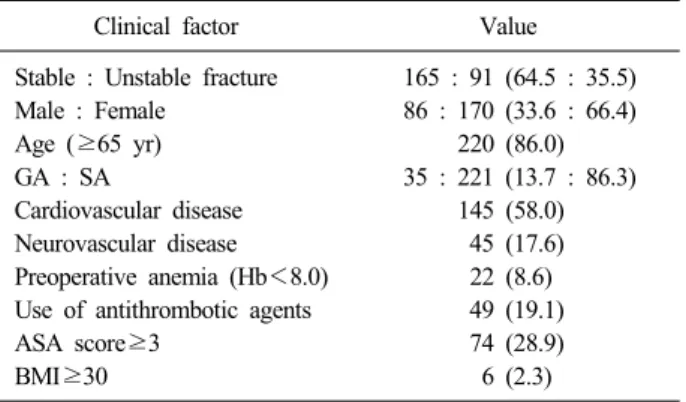
2004년부터 2013년까지 본원에서 시행한 대퇴 전자간 골절 후 비관혈적 정복술 및 근위 골수정을 이용한 내고정 술을 시행한 환자 중 암과 관련된 병적 골절 환자와 정보 가 불명확한 환자를 제외한 256예를 대상으로 하였다. 남 자 환자가 86예, 여자 환자가 170예였으며 평균 연령은 75.12±12.2세였다. 환자의 평균 체질량지수(body mass in- dex, BMI)는 21.96±3.53 kg/m2였으며 골절 분류는 Evans 분류를 기본으로 안정 골절과 불안정 골절로 구분하였으며 안정 골절이 165예, 불안정 골절이 91예였다.
측정된 실혈량은 수술 시 발생된 실혈량과 수술 후 흡입 배액량으로 측정하였다. 수술 시 발생된 실혈량은 흡입기 에 채워진 양에서 세척량을 제외한 양과 혈액이 충분히 적 셔진 4×4 cm 크기의 거즈를 10 ml 또는 개복술용 패드를 100-150 ml의 실혈로 간주하고 그 양을 합한 값으로, 마취 과 의사의 기록을 근거로 측정하였다. 계산된 총 실혈량 (total calculated blood loss)은 Orthopedic Surgery Transfusion Hemoglobin European Overview (OSTHEO) study group에 의해 제안된 Mercuriali와 Brecher에 의한 공식을 사용하였으며9) 다음과 같은 계산을 통하여 얻었다.
Total red blood cell (RBC) loss (ml)=uncompensated RBC loss (ml)+compensated RBC loss (ml)
Uncompensated RBC loss (ml)=initial RBC (ml)−final RBC (ml)
Compensated RBC loss=sum of RBCs received from the various sources of transfusion
Initial RBC=estimated blood volume (ml)−initial hema- tocrit level (%) at day−1
Final RBC (ml)=estimated bloodvolume (ml)−final hematocrit level (%) at day+3
측정된 혈액량(estimated blood volume) (ml)은 남자와 여자를 구분하여 다음과 같은 방법을 사용하였다.
Women: body surface area (m2)×2,430 Men: body surface area (m2)×2,530
체표면적(body surface area)은 다음과 같은 방법을 사용 하였다.
0.0235×height (cm)0.42246×weight (kg)0.51456
마지막으로 total blood loss (TBL) (ml)은 다음과 같은 방법을 사용하였다.
TBL (ml)=total RBC loss (ml)/0.35
실혈량을 증가시킬 수 있는 위험 인자로 성별, 나이, BMI, 마취 방법, 심혈관 질환이나 뇌혈관 질환 유무, 술 전 빈혈 여부, American Society of Anesthesiologists (ASA) 점수, 골절의 안정성 여부, aspirin 등의 항혈전제 사용 여 부를 비교 분석하였다.
각 환자의 PASW Statistics for Windows version 18.0 (IBM Co., Armonk, NY, USA)를 이용하여 통계 처리하였 고, 각 인자는 mean±standard deviation으로 표시하였으며 이에 대한 TBL의 평균 차이 검정은 Student t-test를 이용 하여 분석하였다. 또한 각 인자가 TBL에 미치는 영향을 살 펴보기 위해 multivariate linear regression analysis를 사용 하였다. 각 결과는 유의수준이 0.05보다 작을 경우 통계적 으로 유의하다고 판정하였다.
결 과
Mercuriali와 Brecher에 의한 공식에 의한 계산된 총 실 혈량은 2,100±1,632 ml, 측정된 실혈량은 564±319 ml로 계산된 총 실혈량이 측정된 실혈량과 큰 차이를 보였다 (p<0.001).
실혈량을 증가시킬 수 있는 위험 인자 중 성별은 남자 86예, 여자 170예로 총 실혈량에서 통계적으로 성별 간 유 의한 차이가 없었고 나이는 65세 이상의 환자에서도 유의 한 차이를 보이지 않았다. 수술 전 빈혈은 Hb 수치 8.0 이하를 기준으로 총 22예로 총 실혈량에서는 빈혈이 아닌 경우에 비해 유의한 차이를 보이지 않았으며 ASA score가 3 이상인 경우는 74예로 2 이하인 경우와 비교하여 차이를 보이지 않았다. 전신마취는 35예로 척추마취에 비교하여 통계적으로 유의한 차이를 보이지 않았으며, 심혈관 질환 을 가지고 있는 경우는 145예로 심혈관 질환이 없는 경우 에 비해 통계적으로 유의한 차이를 보이지 않았다. 뇌혈관 질환을 가지고 있는 경우는 45예로 통계적으로 유의한 차 이를 보이지 않았으며, 수술 전 aspirin을 포함한 항혈전제 를 사용한 경우는 49명으로 사용하지 않는 경우에 비해 통 계적으로 유의한 차이를 보이지 않았으며, BMI가 30 이상
Table 1. Characteristics of Studied Patients
Clinical factor Value
Stable : Unstable fracture Male : Female
Age (≥65 yr) GA : SA
Cardiovascular disease Neurovascular disease Preoperative anemia (Hb<8.0) Use of antithrombotic agents ASA score≥3
BMI≥30
165 : 91 (64.5 : 35.5) 86 : 170 (33.6 : 66.4)
220 (86.0) 35 : 221 (13.7 : 86.3)
145 (58.0) 45 (17.6) 22 (8.6) 49 (19.1) 74 (28.9) 6 (2.3)
Values are presented as number (%). GA: General anesthesia, SA: Spinal anesthesia, Hb: Hemoglobin, ASA: American Society of Anesthesiologists, BMI: Body mass index.
Table 2. Predictor of Total Blood Loss in Patients Who Underwent Intramedullary Fixation for Intertrochanteric Fracture in Student T-test
Clinical factor Mean volume (ml) p-value Stable : unstable fracture
Sex (male : female) Age (≥65 yr) GA : SA
Cardiovascular disease Neurovascular disease Preoperative anemia (Hb < 8.0) Use of antithrombotic agents ASA score>3
BMI>30
1,882±1,715/2,496±1,395 1,939±1,528/2,182±1,681 2,119±1,667/1,983±1,414 2,488±2056/2,039±1,551 2,102±1,707/2,097±1,528 1,891±1,192/2,145±1,710 2,124±1,618/1,849±1,802 2,108±1,734/2,068±1,120 2,418±2,122/1,971±1,371 2,630±525/2,087±1,648
0.002 0.262 0.642 0.222 0.982 0.237 0.451 0.844 0.097 0.054 Values are presented as mean±standard deviation. GA: General anesthesia, SA: Spinal anesthesia, Hb: Hemoglobin, ASA:
American Society of Anesthesiologists, BMI: Body mass index.
Table 3. Predictor of Total Blood Loss in Patients Underwent Intramedullary Fixation for Intertrochanteric Fracture in Multivariate Analysis
Variable Coefficient SE p-value 95% CI
Stable : unstable fracture Sex (male : female) Age (≥65 yr) GA : SA
Cardiovascular disease Neurovascular disease Preoperative anemia (Hb<8.0) Use of antithrombotic agents ASA score>3
BMI>30
Stable : unstable fracture
563.004 137.634 3.691 428.138
−415.810 299.301 378.077 −4.042 205.102 298.974 82.682
218.972 243.534 9.634 237.587 314.605 284.063 674.411 239.423 297.795 364.792 294.941
0.011 0.572 0.702 0.073 0.188 0.293 0.576 0.987 0.492 0.413 0.779
131.687-994.320 −342.063-617.331 −15.286-22.667 −39.846-896.122
−1035.498-203.878 −260.228-858.830 −950.332-1,706.487
−475.641-467.557 −381.476-791.679 −419.568-1,017.516
−498.273-663.637 SE: Standard error, CI: Confidence interval, GA: General anesthesia, SA: Spinal anesthesia, Hb: Hemoglobin, ASA: American Society of Anesthesiologists, BMI: Body mass index.
인 비만의 경우는 6예로 정상군에 비해 통계적으로 유의한 차이를 보이지 않았다. 반면 불안정성 골절의 경우는 91예 로 총실혈량이 2,496±1,395 ml로 1,882±1,715 ml인 안정 성 골절에 비해 통계적으로 유의한 차이를 보였다(p<0.05) (Table 1-3). 결론적으로 불안정성 골절의 경우에 총 실혈 량이 증가하였다.
고 찰
대퇴 전자간 골절 환자의 경우 대개 고령이므로 빈혈 및 순환 혈액량 감소 등에 더 취약할 수 있어 실혈량을 미리 예상하고 그에 대한 적절한 대처를 시행하는 것이 환자에 게 발생할 수 있는 수술 후 합병증을 최소화할 수 있다.
또한 수술 후 시행한 혈액 검사에서 수혈 적응증의 경계치
에 해당한다고 하여도 환자의 추가 실혈량을 예상하여 불 필요한 수혈을 막는 데 도움을 줄 수 있을 것이다.5) 인공 관절 치환술의 경우 이전 많은 연구들에서 다양한 원인들에 의해 실혈이 증가될 수 있다고 보고된 바 있
다.4,8,10-13) 본 연구에서는 척추마취14,15)나 비만,16,17) 항혈전
제 사용18) 등 이전에 규명되었던 출혈을 증가시킬 수 있는 요인들이 통계적으로 유의한 차이를 보이지 않았다. 이는 전자간 골절의 경우 수술 시의 출혈보다는 골절에 의한 골 출혈 및 고관절 주위 혈관 손상에 의한 출혈의 대부분을 차지하기 때문이라고 생각된다. 계산된 총 실혈량과 측정 된 실혈량의 차이가 큰 것도 이를 뒷받침한다고 볼 수 있 다. 이는 측정된 실혈 외에 다른 잠재된 실혈이 있는 것을
의미하며 그 원인은 조직 내로의 혈액 유출이나 주위 근육 내 잔류혈, 용혈로 인한 혈액 소실, 원위 대퇴부로의 혈종 으로 인해 발생될 수 있다.19) 또한 불안정성 골절의 경우 정복이 어려운 경우 골절부위에 최소 절개를 넣은 후 골절 부위를 일부 노출한 후 정복술을 시행하는 경우가 있어 안 정형 골절보다 절개부위가 크고 수술시간이 길어지는 것도 출혈이 증가하는 원인으로 생각해 볼 수 있다.
항혈전제 사용에 따른 출혈의 차이는 이론적으로는 가능 하나 본 연구결과에서는 차이가 없었던 것은 aspirin, clo- pidogrel, cilostazol, salpogrelate, warfarin 등을 기전 및 작용 등으로 나누어 분석하지 않았기 때문으로 생각된다.
항혈소판제의 경우 aspirin 23예, clopidogrel 6예, aspir- in+clopidogrel 6예, cilostazol이나 salpogrelate 등 기타 항 혈소판제 8예로 나타났으며 항혈소판제와 달리 항응고제로 분류되는 warfarin의 경우는 6예로 관찰되었다. 항응고제의 경우 대부분 antidote를 사용하거나 prothrombin time을 확인 후 수술하였기 때문에 오히려 출혈 경향에는 의미가 적었을 것으로 생각된다. 각각에 대해 통계적 분석을 시행 하기에는 그 숫자가 적었으며 이는 후향적 분석의 한계점 이라고 하겠다.
통상 고관절 골절의 경우 외래보다는 응급실을 통해 내 원하는 경우가 많으며 응급실에서 채혈 시 대부분의 경우 Hb 수치에 실혈이 반영되지 않는다. 이는 수술 시까지 일 정 시간 경과 후 수술 직전의 빈혈 수치를 반영하지 못해 과소 평가할 가능성이 있다. 또한 대부분의 골절 환자들은 수술 전 경구 섭취량 감소 등으로 인하여 탈수가 발생하고 이로 인하여 혈구 용적치가 높게 변화되어 증가되어 보일 수 있다. Hb 수치나 적혈구 용적치(hematocrit)는 탈수나 수분 공급 등의 여러 인자에 의해 변화될 수 있어 순간적 인 변화에 예민하지 못하고, 짧은 시간에 다량의 출혈이 일어나는 경우에는 실혈량을 정확히 대변해 주지는 못하는 것으로 알려져 있다.12)
실혈량에 대한 계산은 과거 여러 가지 방법을 이용하지 만 본 논문에서는 Mercuriali와 Brecher에 의한 공식으로 OSTHEO에 의해 추천되는 공식을 사용하였다. 이는 이전 연구에서 발표된 단순한 Hb 수치의 비교가 아닌 성별, 신 장, 몸무게, 수술과 관련된 수혈 등과 같은 실혈량 측정에 있어 영향을 줄 수 있는 요인을 대부분 반영하였기 때문이 다.9)
대퇴전자간 골절의 분류는 여러 학자 및 기관 들에 의해 이루어져 왔다. 본 연구에서는 Evans의 분류 체계를 통해 안정 골절과 불안정 골절로 구분하였다.20) 대퇴골의 후내 측 피질골의 분쇄 정도가 심하거나 및 역경사 골절인 경우 를 불안정 골절로 정의하였다. 전자하 골절의 경우 일반적 전자간 골절에 비하여 더 많은 출혈량이 발생한다고 보고
한 바 있다.21) 본 연구에서도 불안정 골절의 경우 안정 골 절의 경우보다 출혈량이 더 많은 것으로 유의한 결과를 얻 었다(p<0.05).
본 연구에서 시행한 계산된 총 실혈량은 간단한 계산으 로 전체 실혈량을 측정할 수 있는 장점이 있지만 수술 전 고령 환자들의 탈수와 같은 전신상태를 반영할 수 없었으 며 수상 당시 시행한 혈액 검사 시점이 다양하여 multi- variate analysis에도 불구하고 실혈량을 증가시킬 수 있는 위험 인자 분석 시 각 인자 간의 상호 작용을 고려하지 못 한 단점이 있다.
결 론
발생된 총 실혈량은 측정된 실혈량에 비해 많은 양이 측 정되므로 항상 숨겨진 실혈이 있을 수 있음을 염두해 두어 야 한다. 고관절 대퇴 전자간 골절 후 금속정을 이용한 내 고정술 시 총 실혈량은 특별한 유발인자에 의해 증가하지 않고 수술 전 골절의 양상에 의해 결정된다. 불안정 골절 의 경우 수상으로 인한 골 출혈과 혈관 손상, 경우에 따른 추가적인 절개로 인해 출혈이 많을 수 있다는 것에 대해 인지하고 수술 후 환자의 활력징후에 대한 보다 긴밀한 추 적관찰을 시행하여야 하겠다.
References
1) Sehat KR, Evans RL, Newman JH: Hidden blood loss following hip and knee arthroplasty. Correct management of blood loss should take hidden loss into account. J Bone Joint Surg Br, 86: 561-565, 2004.
2) Good L, Peterson E, Lisander B: Tranexamic acid de- creases external blood loss but not hidden blood loss in total knee replacement. Br J Anaesth, 90: 596-599, 2003.
3) Lemos MJ, Healy WL: Current concepts review: blood transfusion in orthopaedic operations. J Bone Joint Surg Am, 78: 1260-1271, 1996.
4) Keating EM, Meding JB: Perioperative blood manage- ment practices in elective orthopaedic surgery. J Am Acad Orthop Surg, 10: 393-400, 2002.
5) Lemaire R: Strategies for blood management in orthopae- dic and trauma surgery. J Bone Joint Surg Br, 90:
1128-1136, 2008.
6) Salido JA, Marín LA, Gómez LA, Zorrilla P, Martínez C: Preoperative hemoglobin levels and the need for trans- fusion after prosthetic hip and knee surgery: analysis of predictive factors. J Bone Joint Surg Am, 84: 216-220,
2002.
7) Bell TH, Berta D, Ralley F, et al: Factors affecting peri- operative blood loss and transfusion rates in primary total joint arthroplasty: a prospective analysis of 1642 patients.
Can J Surg, 52: 295-301, 2009.
8) Walker RW, Rosson JR, Bland JM: Blood loss during primary total hip arthroplasty: use of preoperative meas- urements to predict the need for transfusion. Ann R Coll Surg Engl, 79: 438-440, 1997.
9) Rosencher N, Kerkkamp HE, Macheras G; OSTHEO Investigation, et al: Orthopedic Surgery Transfusion Hemoglobin European Overview (OSTHEO) study: blood management in elective knee and hip arthroplasty in Europe. Transfusion, 43: 459-469, 2003.
10) Slappendel R, Dirksen R, Weber EW, van der Schaaf DB: An algorithm to reduce allogenic red blood cell transfusions for major orthopedic surgery. Acta Orthop Scand, 74: 569-575, 2003.
11) Bierbaum BE, Callaghan JJ, Galante JO, Rubash HE, Tooms RE, Welch RB: An analysis of blood manage- ment in patients having a total hip or knee arthroplasty. J Bone Joint Surg Am, 81: 2-10, 1999.
12) Nam WD, Kim IY, Rhyu KH: Blood loss and trans- fusion in primary total hip arthroplasty. J Korean Hip Soc, 18: 1-5, 2006.
13) Mylod AG Jr, France MP, Muser DE, Parsons JR:
Perioperative blood loss associated with total knee
arthroplasty. A comparison of procedures performed with and without cementing. J Bone Joint Surg Am, 72:
1010-1012, 1990.
14) Sharrock NE, Salvati EA: Hypotensive epidural anes- thesia for total hip arthroplasty: a review. Acta Orthop Scand, 67: 91-107, 1996.
15) Juelsgaard P, Larsen UT, Sørensen JV, Madsen F, Søballe K: Hypotensive epidural anesthesia in total knee replacement without tourniquet: reduced blood loss and transfusion. Reg Anesth Pain Med, 26: 105-110, 2001.
16) McLaughlin JR, Lee KR: The outcome of total hip re- placement in obese and non-obese patients at 10- to 18-years. J Bone Joint Surg Br, 88: 1286-1292, 2006.
17) Stickles B, Phillips L, Brox WT, Owens B, Lanzer WL: Defining the relationship between obesity and total joint arthroplasty. Obes Res, 9: 219-223, 2001.
18) Chechik O, Thein R, Fichman G, Haim A, Tov TB, Steinberg EL: The effect of clopidogrel and aspirin on blood loss in hip fracture surgery. Injury, 42: 1277-1282, 2011.
19) Foss NB, Kehlet H: Hidden blood loss after surgery for hip fracture. J Bone Joint Surg Br, 88: 1053-1059, 2006.
20) Jensen JS: Classification of trochanteric fractures. Acta Orthop Scand, 51: 803-810, 1980.
21) Dimon JH, Hughston JC: Unstable intertrochanteric frac- tures of the hip. J Bone Joint Surg Am, 49: 440-450, 1967.
Copyright ⓒ 2015 The Korean Fracture Society. All rights reserved.
This is an Open Access article distributed under the terms of the Creative Commons Attribution Non-Commercial License (http://creativecommons.org/licenses/
by-nc/3.0) which permits unrestricted non-commercial use, distribution, and reproduction in any medium, provided the original work is properly cited.
http://dx.doi.org/10.12671/jkfs.2015.28.1.53
대퇴 전자간 골절의 금속정을 이용한 내고정술 후 실혈량:
위험 인자 분석
박재형 ⋅정화재⋅신헌규⋅김유진⋅박세진⋅고택수⋅박종현
성균관대학교 의과대학 강북삼성병원 정형외과학교실
목 적: 고관절 대퇴 전자간 골절의 금속정을 이용한 내고정술 후 보이지 않는 실혈을 포함한 실질적인 총 실혈량을 계산하여 측정된 실혈량과의 차이를 알아보고 위험 인자가 수술 전, 후 실혈량에 미치는 영향을 알아보고자 한다.
대상 및 방법: 2004년부터 2013년까지 본원에서 내고정술을 시행한 환자 256예를 대상으로 하였고 총 실혈량의 계산은 Mercuriali와 Brecher에 의한 공식을 사용하였으며 실혈량에 미치는 위험 인자로 골절 유형(Evans 분류 기준), 성별, 나이, 체질량지수, 마취 방법, 심혈관 질환이나 뇌혈관 질환 유무, 술 전 빈혈 여부, American Society of Anesthesiologists 점수, 골절의 안정성 여부, aspirin 등의 항혈전제 사용 여부를 비교 분석하였다.
결 과: 계산된 총 실혈량은 2,100±1,632 ml이고 측정된 실혈량은 564±319 ml로 유의한 차이를 보였고 실혈량과 관련된 위험 인자 중 불안정 골절의 경우 2,496±1,395 ml로 안정형 골절에 비해 증가된 결과를 보였다. 다른 위험 인자들은 통계적으 로 유의한 차이를 보이지 않았다.
결 론: 고관절 대퇴 전자간 골절 후 수술 시 발생된 총실혈량은 측정된 실혈량에 비해 많은 양이 측정되었으며 특히 불안정 골절 환자의 수술 시에는 관찰되는 양보다 많은 실혈량이 예측되므로 수술 후 관리에 신경써야 한다.
색인 단어: 대퇴, 전자간 골절, 골수정 고정술, 실혈, 위험 인자
접수일 2014. 10. 26 수정일 2014. 11. 26 게재확정 2014. 12. 24 교신저자 박 재 형
서울시 종로구 새문안로 29, 성균관대학교 의과대학 강북삼성병원 정형외과학교실 Tel 02-2001-2168, Fax 02-2001-2176, E-mail [email protected]
58