KJTCVS
The Korean Journal of Thoracic and Cardiovascular SurgeryClinical Research
https://doi.org/10.5090/kjtcs.2020.53.2.53 pISSN: 2233-601X eISSN: 2093-6516
Korean J Thorac Cardiovasc Surg. 2020;53(2):53-57
Factors Affecting the Number of Stapler Cartridges in Complete Video-Assisted Thoracoscopic Surgery Lobectomy for Non-small Cell Lung Cancer
Young Ho Yang, M.D. 1 , Seokkee Lee, M.D. 2 , Chang Young Lee, M.D. 1 , Dae Joon Kim, M.D., Ph.D. 1 , Jin Gu Lee, M.D., Ph.D. 1 , Kyung-Young Chung, M.D., Ph.D. 1
1
Department of Thoracic and Cardiovascular Surgery, Yonsei University College of Medicine, Seoul;
2Department of Cardiovascular and Thoracic Surgery, Daejeon St. Mary’s Hospital, College of Medicine, The Catholic University of Korea, Daejeon, Korea
ARTICLE INFO
Received August 30, 2019 Revised October 6, 2019 Accepted October 22, 2019 Corresponding author Jin Gu Lee
Tel 82-2-2228-2140 Fax 82-2-393-6012 E-mail [email protected] ORCID
https://orcid.org/0000-0003-2767-6505
Background: Video-assisted thoracoscopic surgery (VATS) lobectomy has become the major surgical option for the treatment of non-small cell lung cancer (NSCLC). Endoscopic instruments such as stapler cartridges are essential for VATS procedures. In this study, we investigated the factors that affect the number of stapler cartridges used in VATS lobecto- my. Methods: A retrospective analysis was conducted of patients who underwent complete VATS lobectomy for NSCLC from January 2013 to December 2015.
Results: In total, 596 patients underwent complete VATS lobectomy. The average number of stapler cartridges used for VATS lobectomy was 5.3±1.9. The number of stapler cartridg- es used for VATS lobectomy was higher in men (5.5±1.9 vs. 5.0±18, p=0.006), those aged older than 70 years (5.5±2.1 vs. 5.1±1.7, p=0.038), those who underwent upper or middle lobectomy procedures (5.7±1.9 vs. 4.1±1.2, p<0.001), those with a higher fissure sum aver- age (p<0.001), and those in whom surgery was performed by a surgeon with a preference for staplers (5.6±2.0 vs. 4.9±1.6, p<0.001).
Conclusion: The number of stapler cartridges required to perform VATS lobectomy in NSCLC patients appears to be influenced by sex, age, the location of the tumor, the degree of fissure development, and the surgeon’s preference.
Keywords: Non-small-cell lung carcinoma, Video-assisted thoracic surgery, Fissure sum average, Stapler cartridges
Copyright © The Korean Society for Thoracic and Cardiovascular Surgery. 2020. All right reserved.
This is an Open Access article distributed under the terms of the Creative Commons Attribution Non-Commercial License (http://creativecommons.org/licenses/
Introduction
Lung cancer is currently the leading cause of cancer-re- lated death in both sexes [1]. Video-assisted thoracoscopic surgery (VATS) has been used with increasing frequency in daily practice to diagnose and treat lung diseases, especial- ly non-small cell lung cancer (NSCLC) [2,3]. VATS lobec- tomy is considered to be one of the major treatment op- tions for patients with NSCLC. Since the introduction of VATS in the 1990s, a paradigm shift has occurred in lung cancer surgery.
The drawbacks of VATS include higher equipment costs, a longer operative duration, and a steeper learning curve for surgeons and operating room personnel [4]. Its primary
advantages compared with conventional open thoracoto- my, aside from its reduced overall costs, are faster recovery, reduced pain, less morbidity, a shorter hospital stay, and a shorter chest tube duration [5].
In VATS lobectomy, the cost of surgery increases as more
stapler cartridges are used. To the best of our knowledge,
the number of stapler cartridges required for VATS lobec-
tomy and the factors affecting that number have not been
fully investigated. Therefore, the purpose of this study was
to investigate the factors that affect the number of stapler
cartridges used for VATS lobectomy in patients with NS-
CLC.
https://doi.org/10.5090/kjtcs.2020.53.2.53
KJTCVS
Methods
This study was approved by the Severance Hospital In- stitutional Review Board (IRB approval no., 4-2019-0678).
Written informed consent was obtained from the patient before the operation.
Patients
This study retrospectively analyzed patients who under- went complete VATS lobectomy for NSCLC between Janu- ary 2013 and December 2015. Consistent protocols were used for preoperative evaluations, surgery, and postopera- tive treatment, and the data were retrospectively collected from a single thoracic surgery unit with 6 consultant tho- racic surgeons, all experienced in VATS resection. Patients’
medical records were reviewed carefully, and variables in- cluding sex, age, the number of stapler cartridges used, and fissure development were evaluated.
During this period, 1,177 VATS procedures were per- formed at our institution. The exclusion criteria were as follows: the use of another surgical method (open thoracot- omy and robotic thoracotomy), preoperative treatment (preoperative neoadjuvant), another operation (pneumo- nectomy, bilobectomy, sleeve lobectomy, or other lobe wedge resection), a combined operation, and no available information on fissure development. In total, 596 patients who underwent complete lobectomy for NSCLC were in- cluded in the final analysis.
Operative technique and instruments
The vast majority of VATS procedures used 3 or 4 inci- sions, most often 3. The camera port (10 mm) was usually placed on the lower chest. A utility incision (4 to 6 cm) was usually made along the anterior axillary line. The third and/or fourth incision, usually 5 or 10 mm in length, was made through the auscultatory triangle on the low chest. A soft tissue retractor was often used at the utility incision.
All patients underwent lobectomy with extensive mediasti- nal lymph node dissection. VATS was used preferentially in nearly all patients. All operations were performed by 1 of the 6 surgeons of the thoracic surgery unit.
Three types of endoscopic stapler bodies and cartridges were used. The stapler bodies were Covidien Endo GIA Ul- tra Universal staplers (Medtronic, Minneapolis, MN, USA), Echelon Flex powered vascular staplers (Ethicon, Somer- ville, NJ, USA), or Echelon Flex powered articulating sta- plers (Ethicon), and the cartridges were Endo GIA Roticu-
lators (Medtronic), Endo Linear Cutter Cartridges (Ethicon), and Echelon Endoscopic Cartridges (Ethicon), respectively.
Surgeons were divided into 2 groups according to their stated preference of pulmonary fissure division methods.
One group tended to use staplers for fissure division, while the other group tended not to use staplers.
Fissure development score and fissure sum average
Pulmonary fissure status was quantified by the fissure development score (FDS; range, 0–3). Since 2007, FDSs have been recorded prospectively for all patients with re- sected lung cancer at Severance Hospital. Pulmonary fis- sures were grouped into 4 categories based on their ana- tomical location: E, area over the pulmonary artery; A, upper major fissure; B, lower major fissure; and C, minor fissure. Patients’ pulmonary fissure status was quantified by the FDS. Patients were divided into the following 4 groups, based on the FDS and the degree of fissure com- pleteness: grade 0, complete fissure; grade 1, fusion be- tween 0% and 30%; grade 2, fusion between 30% and 70%;
and grade 3, fusion more than 70%. At least 3 fissures were dissected and divided before lobectomy; therefore, the fis- sure sum average (FSA), calculated as the sum of 3 FDSs divided by 3 (range, 0–3) was used to assess patients’ status [6].
Statistics
We retrospectively analyzed the perioperative data of pa- tients who underwent VATS lobectomy. Continuous vari- ables were analyzed using the independent-samples t-test and presented as means with standard deviations, while categorical variables were analyzed using the chi-square test or the Fisher exact test and presented as frequencies and percentages. All statistical analyses were performed using IBM SPSS ver. 25.0 (IBM Corp., Armonk, NY, USA), and p-values <0.05 were considered to indicate statistical significance.
Results
In total, 1,177 patients underwent surgery for NSCLC
from January 2013 to December 2015, of whom 581 were
excluded. Therefore, 596 patients who underwent complete
VATS lobectomy were included in the final analysis. There
were 324 men (54.4%), and 375 patients (62.9%) were under
the age of 70 years (Table 1). Most of the procedures were
performed on the right lung; the right upper lobe (RUL)
Young Ho Yang, et al. Factors Affecting the Number of Stapler Cartridges KJTCVS
was the most common location, followed in order by the right lower lobe, left upper lobe (LUL), left lower lobe, and right middle lobe (RML). There were 488 (81.9%) incom- plete fissures, greatly exceeding the number of complete fissures. The most common FSA was 1, followed by 2 and 0.
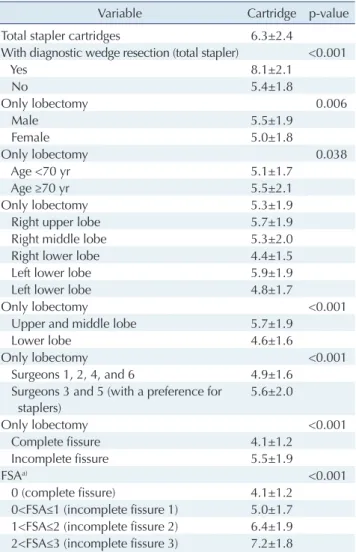
The total average number of stapler cartridges used was 6.3±2.4 (range, 2–17). The number of stapler cartridges used for VATS lobectomy, excluding the stapler cartridges used for diagnostic wedge resection, was 5.3±1.9 (range, 2–14). The number of stapler cartridges used to perform VATS lobectomy was higher in men (5.5±1.9 versus 5.0±18,
p=0.006), those aged older than 70 years (5.5±2.1 versus 5.1±1.7, p=0.038), those who underwent upper or middle lobectomy (5.7±1.9 versus 4.1±1.2, p<0.001), those with a higher FSA (p<0.001), and in those who underwent surgery performed by a surgeon who preferred to divide pulmo- nary fissures with a stapler (5.6±2.0 versus 4.9±1.6, p<0.001) (Table 2).
Discussion
The main findings of the present study are that RUL or RML lobectomy, a higher FSA, and the surgeon’s prefer- ence to divide pulmonary fissures with a stapler were asso- ciated with a higher number of stapler cartridges used for VATS lobectomy.
The number of stapler cartridges required to perform Table 1. Demographic and clinical characteristics of the 596 patients
Characteristic No. (%)
Sex
Male 324 (54.4)
Female 272 (45.6)
Age (yr)
<70 375 (62.9)
≥70 221 (37.1)
Smoking history
No 419 (70.3)
Yes 177 (29.7)
Tuberculosis
No 559 (93.8)
Yes 37 (6.2)
Side
Right 366 (61.4)
Left 230 (38.6)
Lobe
Right upper lobe 172 (28.9)
Right middle lobe 69 (11.6)
Right lower lobe 125 (21.0)
Left lower lobe 115 (19.3)
Left lower lobe 115 (19.3)
Pleural adhesion
No 408 (68.5)
Yes 188 (31.5)
Completeness of the fissure
Complete 108 (18.1)
Incomplete 488 (81.9)
FSA
0 (complete fissure) 108 (18.1)
0<FSA≤1 (incomplete fissure 1) 309 (51.8) 1<FSA≤2 (incomplete fissure 2) 163 (27.3) 2<FSA≤3 (incomplete fissure 3) 16 (2.7) Preoperative cancer confirmation
Unknown 274 (46.0)
Tissue-confirmed 322 (54.0)
Diagnostic wedge resection
Yes 192 (32.2)
No 404 (67.8)
FSA, fissure sum average
Table 2. The number of stapler cartridges used in the 596 patients
Variable Cartridge p-value
Total stapler cartridges 6.3±2.4
With diagnostic wedge resection (total stapler) <0.001
Yes 8.1±2.1
No 5.4±1.8
Only lobectomy 0.006
Male 5.5±1.9
Female 5.0±1.8
Only lobectomy 0.038
Age <70 yr 5.1±1.7
Age ≥70 yr 5.5±2.1
Only lobectomy 5.3±1.9
Right upper lobe 5.7±1.9
Right middle lobe 5.3±2.0
Right lower lobe 4.4±1.5
Left lower lobe 5.9±1.9
Left lower lobe 4.8±1.7
Only lobectomy <0.001
Upper and middle lobe 5.7±1.9
Lower lobe 4.6±1.6
Only lobectomy <0.001
Surgeons 1, 2, 4, and 6 4.9±1.6
Surgeons 3 and 5 (with a preference for staplers)
5.6±2.0
Only lobectomy <0.001
Complete fissure 4.1±1.2
Incomplete fissure 5.5±1.9
FSA
a)<0.001
0 (complete fissure) 4.1±1.2
0<FSA≤1 (incomplete fissure 1) 5.0±1.7 1<FSA≤2 (incomplete fissure 2) 6.4±1.9 2<FSA≤3 (incomplete fissure 3) 7.2±1.8 Values are presented as mean±standard deviation.
FSA, fissure sum average.
a)