Food Craving, Seeking, and Consumption Behaviors:
Conceptual Phases and Assessment Methods Used in Animal and Human Studies
Young Hee Lee1,2,3, Meelim Kim1,2,3, Miwoo Lee1,2,3, Dongju Shin1, Dong-Soo Ha1, Joon Seok Park1, You Bin Kim1,2,3, Hyung Jin Choi1,2,3,4,*
1Functional Neuroanatomy of Metabolism Regulation Laboratory, Department of Anatomy and Cell Biology, 2Department of Biomedical Science, and 3BK21Plus Biomedical Science Project Team, Seoul National University College of Medicine, Seoul; 4Wide River Institute of Immunology, Seoul National University, Hongcheon, Korea
What drives us to eat? It is one of the most fundamental questions in the obesity research field which have been investigated for centuries. Numerous novel in vivo technologies in the neuroscience field allows us to reevaluate the multiple components and phases of food-related behaviors. Focused on the cognitive, executive, behavioral and temporal aspects, food-related behaviors can be distinguished into appetitive phase (food craving→food seeking) and consummatory phase (food consumption). Food craving phase is an internal state or stage in which the animal has the motivation to eat the food but there is no actual food specific behaviors or actions.
Food seeking phase entails repeated behaviors with a food searching purpose until the animal discovers the food (or food-related cue) and the approach behavior stage after the discovery of food. Food consumption phase is the step that the animal grabs, chews and intake the food. This review will specifically focus on charac- teristics and evaluation methods for each phase of food-related behavior in rodent, non-human primates and human.
Key words: Hunger, Hypothalamus, Behavior
Received June 19, 2019 Reviewed July 11, 2019 Accepted August 10, 2019
* Corresponding author Hyung Jin Choi
https://orcid.org/0000-0003-0593-6978 Department of Biomedical Sciences and Department of Anatomy and Cell Biology, Seoul National University College of Medicine, 103 Daehak-ro, Jongno-gu, Seoul 03080, Korea Tel: +82-2-740-8204 Fax: +82-2-745-9528 E-mail: [email protected]
INTRODUCTION
Hunger is one of the strongest behavioral drive in the animal kingdom. Traditional neuronal paradigm for feeding behavior is that agouti-related peptide (AgRP) neurons which are located in the hypothalamus are critical for the whole sequence of food-relat- ed behavior (food craving→food seeking→food consumption).
1However, the neuronal activity of AgRP neurons was immediately inhibited when a pellet of chow was presented to fasted mice even before the mice approached and started to eat the chow.
2,3This landmark studies revealed that AgRP neurons are only responsible
for appetitive part of feeding behavior (food craving and seeking), but not the consumption part of feeding behavior.
The traditional assessment method for feeding behavior is mea- surement of the consumed food amount. However, feeding in- volves emotion (craving, motivation), cognition (learning, memory, decision making), sensory (visual, taste, olfactory) and motor be- haviors in an interdependent manner.
4To address this, several be- havior tests have been developed to dissect the respective roles of food-related behaviors. Moreover, optical recordings of neuronal activity in freely moving mice have been devised and applied to study the dynamics of hypothalamic neurons during feeding be-
Copyright © 2019 Korean Society for the Study of Obesity
This is an Open Access article distributed under the terms of the Creative Commons Attribution Non-Commercial License (http://creativecommons.org/licenses/by-nc/4.0/) which permits unrestricted non-commercial use, distribution, and reproduction in any medium, provided the original work is properly cited.
eISSN 2508-7576
2017-03-16 https://crossmark-cdn.crossref.org/widget/v2.0/logos/CROSSMARK_Color_square.svg
Review
Food Craving, Seeking, and Consumption Behaviors:
Conceptual Phases and Assessment Methods Used in Animal and Human Studies
Young Hee Lee1,2,3, Meelim Kim1,2,3, Miwoo Lee1,2,3, Dongju Shin1, Dong-Soo Ha1, Joon Seok Park1, You Bin Kim1,2,3, Hyung Jin Choi1,2,3,4,*
1Functional Neuroanatomy of Metabolism Regulation Laboratory, Department of Anatomy and Cell Biology, 2Department of Biomedical Science, and 3BK21Plus Biomedical Science Project Team, Seoul National University College of Medicine, Seoul; 4Wide River Institute of Immunology, Seoul National University, Hongcheon, Korea
What drives us to eat? It is one of the most fundamental questions in the obesity research field which have been investigated for centuries. Numerous novel in vivo technologies in the neuroscience field allows us to reevaluate the multiple components and phases of food-related behaviors. Focused on the cognitive, executive, behavioral and temporal aspects, food-related behaviors can be distinguished into appetitive phase (food craving→food seeking) and consummatory phase (food consumption). Food craving phase is an internal state or stage in which the animal has the motivation to eat the food but there is no actual food specific behaviors or actions.
Food seeking phase entails repeated behaviors with a food searching purpose until the animal discovers the food (or food-related cue) and the approach behavior stage after the discovery of food. Food consumption phase is the step that the animal grabs, chews and intake the food. This review will specifically focus on charac- teristics and evaluation methods for each phase of food-related behavior in rodent, non-human primates and human.
Key words: Hunger, Hypothalamus, Behavior
Received June 19, 2019 Reviewed July 11, 2019 Accepted August 10, 2019
* Corresponding author Hyung Jin Choi
https://orcid.org/0000-0003-0593-6978 Department of Biomedical Sciences and Department of Anatomy and Cell Biology, Seoul National University College of Medicine, 103 Daehak-ro, Jongno-gu, Seoul 03080, Korea Tel: +82-2-740-8204 Fax: +82-2-745-9528 E-mail: [email protected]
havior tests. In non-human primates and human studies, research- ers have used functional magnetic resonance imaging (fMRI), computerized tasks and noncomputerized behavioral tasks for in- vestigating food-related behavior and its neuronal regions.
Thus, in this review, we have dissected food-related behaviors and examined the assessment methods of each behavior by three phases; food craving, food seeking, and food consumption. Food craving phase is the brain state with high desire and preoccupation toward food but does not accompany specific foraging or searching action for food. On the other hand, food seeking phase starts and pursues navigating the putative area or device to obtaining food.
Food seeking phase is terminated when animal discovers the food
and approaches it. Food consumption phase begins when animal bites and swallows the food (Fig. 1).
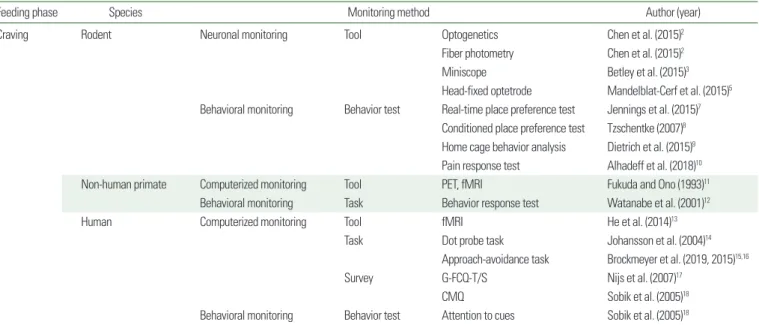
METHODS FOR EVALUATION OF FOOD CRAVING BEHAVIOR
Rodent
Food craving is a step in which the organism has the will to eat the food before the identification of food. Thus, mice do not know the existence of the food yet. Because craving is a step before oc- currence of actual behavior, it is hard to measure food craving di- rectly via behavior tests (Table 1).
Neuronal monitoring
The craving step is known to be associated with the AgRP neu- rons and pro-opiomelanocortin neurons in the arcuate nucleus.
Sensory detection of food leads to rapid inhibition of AgRP neu- rons by using optical or electrophysiological recordings.
5Behavioral monitoring
The most commonly known method that is known to be used to understand the motivational drive of mice is the operant cham- ber test (operant conditioning in Skinner box).
6Lever-pressing is a
Table 1. Methods for evaluation of food craving behavior
Feeding phase Species Monitoring method Author (year)
Craving Rodent Neuronal monitoring Tool Optogenetics Chen et al. (2015)2
Fiber photometry Chen et al. (2015)2
Miniscope Betley et al. (2015)3
Head-fixed optetrode Mandelblat-Cerf et al. (2015)5 Behavioral monitoring Behavior test Real-time place preference test Jennings et al. (2015)7
Conditioned place preference test Tzschentke (2007)8 Home cage behavior analysis Dietrich et al. (2015)9 Pain response test Alhadeff et al. (2018)10
Non-human primate Computerized monitoring Tool PET, fMRI Fukuda and Ono (1993)11
Behavioral monitoring Task Behavior response test Watanabe et al. (2001)12
Human Computerized monitoring Tool fMRI He et al. (2014)13
Task Dot probe task Johansson et al. (2004)14
Approach-avoidance task Brockmeyer et al. (2019, 2015)15,16
Survey G-FCQ-T/S Nijs et al. (2007)17
CMQ Sobik et al. (2005)18
Behavioral monitoring Behavior test Attention to cues Sobik et al. (2005)18
PET, positron emission tomography; fMRI, functional magnetic resonance imaging; G-FCQ-T/S, General Food Cravings Questionnaire-Trait/State; CMQ, Craving and Mood Question- naire.
Figure 1. Food craving, seeking, and consumption phases.
Appetitive behavior
Searching
Consummatory behavior
Food presentation Food
craving Food
seeking Food
consumption
conditioned behavior, and the act of pressing the lever has been as- sumed to be driven by motivation for food without the act of food seeking or consuming. However, such behaviors can be potentially categorized separately as seeking or consumption, and so were re- corded in the later parts of the review.
Real-time place preference test
This assay measures the motivational valence of the rodent in real time. In the test, one side of rectangular chamber is paired with optogenetic stimulation. When the stimulation is rewarding, the rodent spends more time on this side. This method can be used to as an indirect evidence of increased general motivation (including food specific motivation).
7Conditioned place preference test
Motivational valence of the experience can be measured by con- ditioned place preference test which involves three steps. The first step is habituation which gives the mouse a chance to explore the two sides of the chamber. The second phase is conditioning. In this step, mouse is allowed access only one side of the chamber which is paired with an unconditioned stimulus such as food. Third step is preference testing. In this phase, time spent of the mouse on each side of chamber without unconditioned stimulus is measured.
8Home cage behavior analysis
There is a study that analyzed the developed changes in home- cage behaviors (ambulatory activity) when food was not presented to mice.
9The cages were located in front of cameras of the Home Cage Scan System (CleverSys, Reston, VA, USA) with infrared ra- diation light panels. Interestingly, when AgRP neurons are activat- ed, mice showed increase in home cage behavior even though they were sated.
Pain response test
Time spent licking paw was quantified for behavior response to formalin paw injection. When AgRP neuron were activated, the in- flammatory pain response was significantly attenuated. Also food deprived mice showed reduced frequency and duration of the pain response. However, this assay did not affect food consumption. To- gether, this quantification method can be used to analyze the crav-
ing phase specific behavioral test.
10Non-human primate
In human studies, the extent of craving for food can be reported by the subjects through surveys. However, in non-human primates for whom verbal reports of craving are impossible, the assessment of the extent of food-craving is difficult. Some studies have implied that reward processes and their neural mechanisms can be studied about the subjective experience of the subjects without knowl- edge.
19Though, the incapability of subjects to report the self-diag- nosed extent of food craving necessitates the use of indirect mea- sures obtained from continual monitoring. Various measures were employed in the literature to quantify the extent of food-craving in non-human primates under different conditions. The assessment methods can be divided into two categories: computerized moni- toring and behavioral monitoring.
Computerized monitoring
The activity of neurons in different parts of the brain is usually recorded when non-human primates are performing behavioral tasks. Single unit activities of the area of interest are measured dur- ing operant feeding tasks to clarify the neural circuits involved in the feeding activities.
11,20With specific brain regions identified to be in correlation with food-craving, tools including fMRI and posi- tron emission tomography can be more actively employed to assess the motivational state of non-human primate subjects.
Behavioral monitoring
Besides the use of brain imaging, the observation of subject’s be-
havior is the most frequently used method to assess the motiva-
tional state of non-human primates. One study has presented a
form of behavioral response test where cynomolgus monkeys (Ma-
caca fascicularis), fixed in primate chair, were trained to press certainbuttons upon specific signals. After successful completion of the
task, the monkey would be given liquid food as reward, but some-
times the spout would not displace the reward. The rewarded and
unrewarded tasks were mixed randomly, maintaining a ratio of 3 to
2. Unrewarded task had to be completed for the monkey to prog-
ress to the rewarded task. In this study, the reaction time to expect-
ed liquid rewards and the duration of anticipatory licking were re-
corded.
12Such observations at an unrewarded trial could serve as a measure for food craving.
Human
There are several computerized tasks to assess food craving be- haviors for humans. Also, the studies using these computerized tasks with fMRI indicated that there are some typical brain regions related to the food craving of humans.
Food reward brain regions
Many fMRI studies investigated activation of reward-system and associated brain regions in response to food image. Previous studies revealed that insula, operculum, amygdala, anterior cingulate cor- tex, striatum, caudate, putamen and orbitofrontal cortex are signifi- cantly activated when encountered with high-calorie food images.
21Computerized monitoring Dot probe task
Dot probe paradigm assesses attentional bias.
14,22Two stimuli, one of which is target stimuli (i.e., food image) and the other is neutral, presented for predetermined length of time (most com- monly 500 ms). Dot probe is presented in the location of one for- mer stimulus. Subjects are instructed to response the location of dot probe quickly. Attentional bias score is calculated using reaction time for target cue and neutral cue.
Approach-avoidance task
Subjects push and pull the joy-stick to manipulate food picture stimuli on the screen to move away from or close to them.
15General Food Cravings Questionnaire-Trait/State
General Food Cravings Questionnaire-Trait is composed of nine subscales. Each subscale reflects an aspect of possible aberrant and consequences related to food craving by 39 items. These subscales are (1) motivation to consume food, (2) expectation of positive re- inforcement from eating, (3) anticipation of relieving from nega- tive feelings from eating, (4) feasible lack of control over eating, (5) obsession with food, (6) craving accounting for physiological con- dition, (7) emotions before or during craving or eating, (8) envi- ronmental stimulus causing food cravings, and (9) guilt that may
result from food cravings.
17,23General Food Craving Question- naire-State is to assess the degree of affirmation with each item at the moment of answering the questionnaire. It consists of five fac- tors: (1) excessive desire to eat, (2) prospect of positive reinforce- ment from eating, (3) anticipation of relieving from negative feel- ings from eating, (4) obsession with food or lack of control over eating, and (5) craving along with physiological condition.
17,23Craving and Mood Questionnaire
Craving and Mood Questionnaire (CMQ) is composed of elev- en items and were rated on a scale of 0–100. The items of CMQ were integrated to form a scale evaluating craving for food, adopted from the same items applied to assess craving for cigarettes.
18Behavioral monitoring
One study designed the experimental portion of the session us- ing attention to cues along with five trials: pencil cue (neutral stim- ulus cue), food cue (the preferred food of each individuals), and three eating trials. The purpose of the pencil cue trial is to assess a baseline measure of craving. In addition, participants were asked to focus on the food cue, imagining about what it would be like to eat during the food cue trial. Then the participants filled out forms which consist of craving, mood, and rating of the food.
18METHODS FOR EVALUATION OF FOOD SEEKING BEHAVIOR
Rodent
Detailed information regarding feeding circuits have been eluci-
dated by monitoring neuronal activity in awake behaving mice.
2Contrary to expectations, several calcium dynamics studies showed
lower activity of AgRP neurons when a mouse is actually eating a
food pellet compared to the phase before discovering the food pel-
let.
3,5It implies a possibility that AgRP neuron activation during
food craving phase transmits a sustained signal to a population of
its down-stream neurons.
24This sustained signal from AgRP neu-
rons could serve as a sustained drive to continue on consummatory
behavior (even after the rapid decline in AgRP neuron activity in-
duced by sensory detection of food) (Table 2).
2,3Neuronal monitoring
Several studies have been recently published regarding the prey- related hunting behaviors.
25,36During hunting, superior colliculus to the zona incerta (ZI) neurons temporally correlates with preda- tory attacks but not the prey consumption phase. Activation of ZI GABAergic neurons strongly increase hunting of both live and arti- ficial prey.
25However, these behaviors are more of predatory chas- ing behavior rather than food seeking one.
Behavioral monitoring High-risk exploration test
Foot shock associated side of chamber presented food to mice during habituation and training. Even though mice could not ac- cess the food on the test day, they spent more time in the shock conditioned side.
29Although behavior tests to assess food seeking have been developed by multiple research groups, there are no well-defined and described methods for food seeking behavior.
Some measured the time spent in food zone and latency to reach food zone.
37,38Other groups designated food-seeking as a lever pressing in operant conditioning. Recently, an assay to assess the ability to smell odorants has been developed, named as the buried food-seeking test which checks whether the mice could find the specific food hidden under the home cage bedding. There were tests that assessed foraging behavior in mice, although it was not di- rectly related to food-seeking. Cricket hunting task was used to as-
sess the latency of mouse to attack a cricket. Computer-controlled food-chasing task was a motor-driven task that involves a magnet glued to the bottom of the dish to assess initiation, chase, retrieval, consumption stage of mice. However, exact action of searching food has not been well assessed, which provides an opportunity for future researchers to develop.
Non-human primate
Computerized monitoring Go/NoGo visual discrimination test
A study has outlined a Go/NoGo visual discrimination test, where a computer-controlled shutter would open to reveal the con- ditioned stimuli, which indicates that licking the tube would result either in aversive hypertonic solution or rewarding fruit juice. The reversal of the test, where the stimuli and the outcomes were re- versed, was also performed. This task was selected for being known to be affected by lesions in orbitofrontal cortex. Neuron activities were studied during the task to see the involvement of orbitofrontal cortex in food seeking behaviors.
30Fixed-ratio bar-press feeding task
Frequently used operant task is a fixed-ratio bar-press feeding task. In some studies, the bar press task was divided into four stag- es: (1) the cue light stage where a red cue light indicates the begin- ning of the task, (2) the bar press stage where the subject has to
Table 2. Methods for evaluation of food seeking behaviorFeeding phase Species Monitoring method Author (year)
Seeking Rodent Neuronal monitoring Tool Optogenetics Shang et al. (2019)25
Optogenetics Jennings et al. (2015)7
Fiber photometry Shang et al. (2019)25 Behavioral monitoring Behavior test Cricket hunting test Zhao et al. (2019)26
Operant conditioning chamber Chen et al. (2019)27 Buried food seeking test Machado et al. (2018)28 High-risk exploration test Padilla et al. (2016)29 Non-human primate Computerized monitoring Behavior test Go/NoGo visual discrimination test Thorpe et al. (1983)30 Fixed-ratio bar-press feeding task Karádi et al. (1990)31 Behavioral monitoring Behavior test Taste reaction test Rolls et al. (1989)32
Human Computerized monitoring Task Stop signal reaction time task Meule et al. (2019)33
Go/NoGo task Batterink et al. (2010)34
Survey VARSEEK scale Lähteenmäki and van Trijp (1995)35
Behavioral monitoring - - -
VARSEEK, variety seeking tendency with respect to foods.
press the bar by a fixed number, usually 20–30 presses per reward, (3) the cue tone stage where a cue tone signifies the end of the task, and (4) the reward stage where food reward is given through food box.
31The firing rate of neurons were monitored during the task, and the behavioral response to stimuli were also recorded on paper chart. The bar press latency was observed and regarded to indicate the activeness of food seeking.
20Behavioral monitoring
Besides the willingness to perform an operant task, the taste re- actions of subjects upon specific taste stimuli can be observed. In a study, a cynomolgous monkey resting in monkey chair received five taste stimuli applied to the tongue. Of the five stimuli, four are prototypes of four basic tastes, provoked by glucose, NaCl, HCl, and quinine hydrochloride. The fifth taste stimulus is blackcurrant juice, chosen because of its palatability and complexity of taste, which enables it to activate many gustatory neurons. The reaction of the monkey was classified into five categories, ranging from maximum rejection, clear rejection, neutrality, clear acceptance to maximum acceptance. Behaviors such as acid licking, swallowing, pursing of lips, tongue movement to eject delivered solution were observed to assess the willingness of subject to seek food.
32Human
Computerized monitoring Stop signal reaction time task
It measures inhibition of a response that has already been initiat- ed, that is, the ability to stop. It provides an estimate of the time taken to stop a response, the stop signal reaction time task, from measurable task parameters, the go-trial reaction-time distribution, and the accuracy of stopping on stop trials.
33Go-NoGo task
It investigates inhibitory control ability and impulsivity. Subjects respond (i.e., pressing a key) when go cue is presented and with- hold a response (not pressing a key) in No-Go cue. Reaction time and error are measured and calculated to impulsivity and inhibitory control ability.
34VARSEEK (variety seeking tendency with respect to foods) scale VARSEEK scale precisely assess the variety seeking bias of con- sumers. It is specifically designed for the food consumption context implying that it is not a personality characteristic that is generaliz- able across all product categories. The VARSEEK scale is based on the construct defined as the motivational factor targeting to pro- vide variation in stimulant through diverse food product consump- tion, yet the instrumental or functional value of the food product alternatives.
35Behavioral monitoring
There is no behavioral experiment with noncomputerized task to measure only food seeking behavior of humans. Therefore, an appropriate behavioral experiment with noncomputerized task to assess food seeking behavior for humans needs to be devel- oped.
METHODS FOR EVALUATION OF FOOD CONSUMPTION BEHAVIOR
Rodent
Neuronal monitoring
Neuronal activity during food consumption behavior can be monitored accurately by in vivo calcium imaging in mice. Photome- try can measure bulk changes of calcium transients of genetically defined neurons.
39Furthermore, miniature microscope would help distinguish aspects of appetitive or consummatory behaviors in the same neuronal population (Table 3).
7Behavioral monitoring
Consummatory behavior of mice usually is measured by the
amount of food (or liquids) that has been consumed during certain
amount of time (seconds, minutes, and hours). The difference in
the weight of food (or food bowel) before and after the consum-
matory behavior is most frequently used method to measure the
quantity of food consummatory behavior. Lickometer, a special-
ized device to measure the timing and quantity of licking, is anoth-
er frequently used methods to measure the quantity of food con-
summatory behavior.
Non-human primate
Computerized monitoring
In several studies, the food intake of monkeys was monitored by automated feeder that displaces food pellets when active ted by ra- diofrequency chip implant.
41,46,47Each monkey has a subcutaneous implant of radiofrequency chip, which is read by the automated feeder which consequently displaces food pellet. The ship stores a nine-digit number, allowing the food intake of each monkey to be recorded. Additional monitoring such as video recording is in- volved to ensure that the monkey whose chip is read is actually the monkey who eats the food pellet.
Behavioral monitoring
Consummatory behavior in monkey is usually studied by moni- toring the mass of the given food taken. The distinction between low and high fat diet, low and high calorie diet, etc. could be ap- plied in the study design to study the effect of factors such as social stress and satiety on food intake.
Human
Computerized monitoring
There are no specific computerized tasks for human to assess food consumption behaviors.
Behavioral monitoring
The behavioral experiments with noncomputerized tasks for food consumption in human can be classified into two main categories;
direct measurement and indirect measurement of food consumption.
Direct measurement: Buffet test meal
Buffet test meal is also called laboratory test-meal. This offers a pragmatic and impartial measure of calorie intake that may better be related to frequent eating pattern.
48This study applied 1-hour dinner sessions that were set between 4:00 PM and 6:00 PM. The test meals were composed of high- or low-fat forms of the same food categories as well as palatable buffet meal such as sweets, sweet-fats, and savory-fats. The participants were asked to be fasted at least 2 hours before attending the test-meal sessions. The total amount of consumption for each food was measured from pre- to post-meal to determine total meal intake. Also, the nutrient values were calculated based on the nutrition facts label of each food.
Indirect measurement
This consists of camera-enabled cell phones with data transfer capability. Participants were instructed to take photos of their food choice and leftovers with the labels on the pictures with their cell phones. Then, they were asked to send those photos to the re- searchers. There were four to six automated alarms for participants giving prompts to take photographs and to send them to the re- searchers.
Using digital devices
Microelectromechanical gyroscope (MEMS) tracks the number of bites, type of meals by detecting the wrist roll motion. The study using MEMS investigated three different conditions: (1) fixed- sized pieces and menu (waffles), (2) relaxed condition (preferred food), and (3) outside of the lab (unrestricted settings; home, of-
Table 3. Methods for evaluation of food consumption behaviorFeeding phase Species Monitoring method Author (year)
Consumption Rodent Neuronal monitoring Tool Optogenetics Cassidy et al. (2019)40
Fiber photometry Cassidy et al. (2019)40
Miniscope Jennings et al. (2015)7
Behavioral monitoring Behavior test Daily food intake Dietrich et al. (2015)9 Non-human primate Computerized monitoring Behavior test Automated feeder Michopoulos et al. (2016)41
Behavioral monitoring Behavior test Daily food intake Ramsey et al. (2005)42
Human Computerized monitoring - - -
Behavioral monitoring Behavior test Buffet test meal Redman et al. (2008)43 Microelectromechanical gyroscope Dong et al. (2012)44 Bogus taste test Nijs et al. (2010)45