The objective was to evaluate the effectiveness and safety of acupuncture for patients with rotator cuff diseases.
There were 12 electronic databases and 3 trial registries searched up to November 30
th, 2019. All randomized trials were eligible, regardless of language, date of publication, or settings. The primary outcomes were pain, shoulder function, and proportion of improved participants assessed within 12 weeks of randomization of the trial. The Cochrane risk of bias for the studies was assessed. Effects sizes were presented as a risk ratio, mean difference, or standardized mean difference with a 95% confidence intervals. Grading of Recommendations Assessment, Development and Evaluation approach was adopted to rate certainty of evidence.
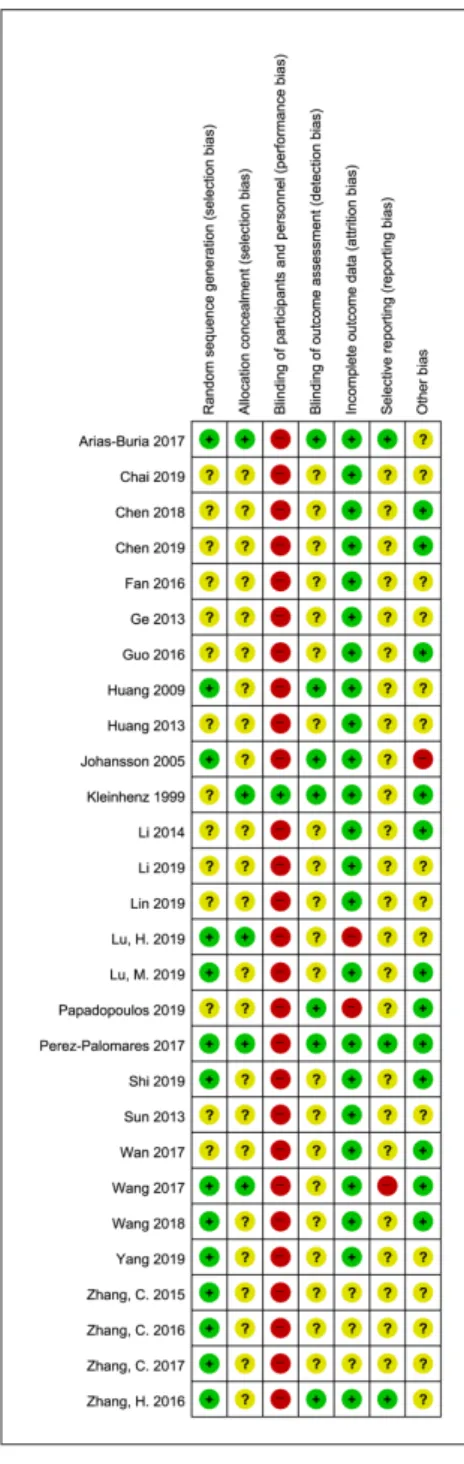
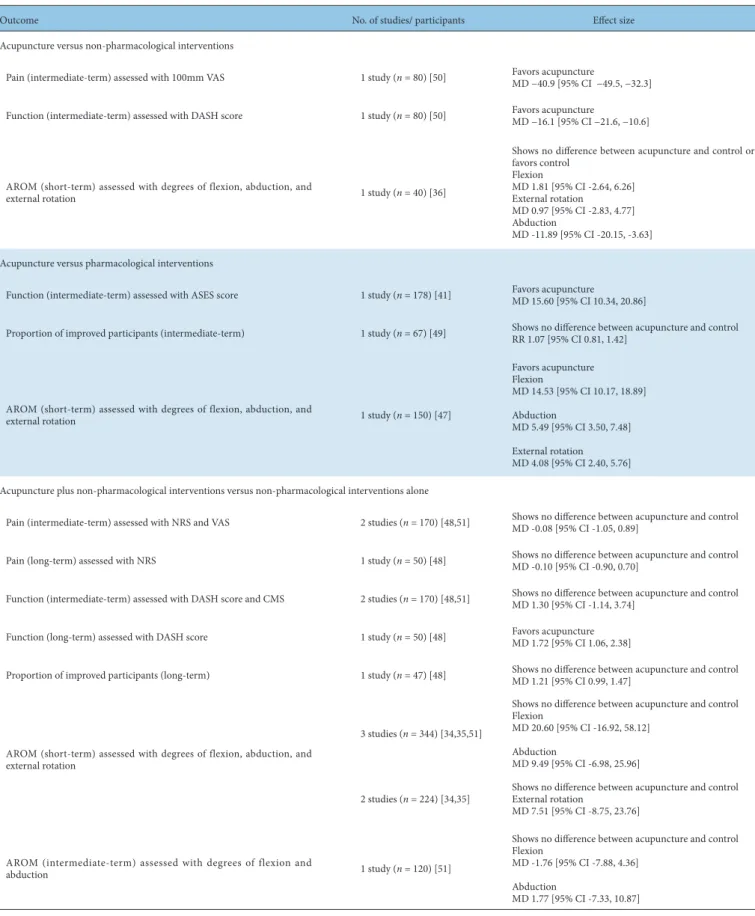
Of the 3,686 records screened, 28 randomized trials (2,216 participants) were included in this review. The types of acupuncture included manual acupuncture, dry needling, electroacupuncture, acupotomy, warm needle acupuncture, and fire needle acupuncture. All of the studies had an unclear or high risk of bias related to more than 1 domain. Significant benefits of acupuncture in terms of pain and shoulder function were observed in all comparisons, however, the proportion of improved participants was not described in 2 comparisons. There was substantial heterogeneity among meta-analyzed trials. No serious harm was observed. For primary outcomes, the overall certainty of evidence was very low.
There was very low certainty of evidence for the benefits of acupuncture for patients with rotator cuff diseases. The safety of acupuncture remains unclear due to the incompleteness of reporting. Future well- designed randomized trials with transparent reporting are required.
©2021 Korean Acupuncture & Moxibustion Medicine Society. This is an open access article under the CC BY- NC-ND license (http://creativecommons.org/licenses/by-nc-nd/4.0/).
Article history:
Submitted: November 30, 2020 Revised: December 30, 2020 Accepted: January 13, 2021 Keywords:
acupuncture, rotator cuff injuries, rotator cuff tear arthropathy, shoulder impingement syndrome
https://doi.org/10.13045/jar.2020.00458 pISSN 2586-288X eISSN 2586-2898
Review Article
Acupuncture for Symptomatic Rotator Cuff Disease:
A Systematic Review and Meta-Analysis
Seoyoung Choi 1 , Jisun Lee 1 , Seunghoon Lee 2 , Gi Young Yang 1, 3 , Kun Hyung Kim 1, 3, *
1 Department of Acupuncture and Moxibustion Medicine, Pusan National University Korean Medicine Hospital, Yangsan, Korea 2 Department of Acupuncture and Moxibustion, College of Korean Medicine, Kyung Hee University, Seoul, Korea
3 Division of Clinical Medicine, School of Korean Medicine, Pusan National University, Yangsan, Korea
ABSTRACT
Journal of Acupuncture Research
Journal homepage: http://www.e-jar.org
Introduction
Shoulder pain is a common musculoskeletal complaint, and an important medical and socioeconomic problem [1]. Rotator cuff diseases (RCDs) are the most common cause of shoulder pain [2], and encompass a broad spectrum of pathology and anatomical deformities, including shoulder impingement syndrome, rotator cuff (RC) tendinopathy or tendinitis, partial or full RC tear, calcific tendinitis, subacromial bursitis, and subacromial pain syndrome [3,4].
Pathogeneses of RCD incorporate repeated impingement of RC tendons against extrinsic factors such as acromial osteophytes, intrinsic RC tendon degeneration which makes itself susceptible
to impingement due to dynamic instability of the glenohumeral joint, or a combination of these factors [3,5]. Available treatments include analgesics, non-steroidal anti-inflammatory drugs, exercise, local corticosteroid injection, and surgery. Whether they are beneficial for functional recovery in the shoulder remains mostly inconclusive due to paucity of high-quality of evidence [6].
There is evidence to suggest that there are benefits of acupuncture for treating shoulder pain [7]. However, previous systematic reviews have included mixed groups of patients with shoulder pain which may have rendered study findings susceptible to clinical heterogeneity [8-10]. The various types of acupuncture, commonly practiced in East Asia, were not fully considered as intervention of interest, which implied limited scope of evidence,
* Corresponding author. Kun Hyung Kim
Department of Acupuncture and Moxibustion Medicine, Pusan National University Korean Medicine Hospital, Geumo-ro 20, Mulgeum-eup, Yangsan, 50612, Korea E-mail: [email protected]
ORCID: Seoyoung Choi https://orcid.org/0000-0003-0108-8617, Jisun Lee https://orcid.org/0000-0003-1019-1675, Seunghoon Lee https://orcid.org/0000-0003-0088-2296, Gi Young Yang https://orcid.org/0000-0002-9468-8904, Kun Hyung Kim https://orcid.org/0000-0002-3471-2431
©2021 Korean Acupuncture & Moxibustion Medicine Society. This is an open access article under the CC BY-NC-ND license (http://creativecommons.org/licenses/by-nc-
nd/4.0/).
and a gap between current practice [8,9,11]. Methodological limitation included exclusion of studies in languages other than English [8], and lack of prospective registration [11]. Collectively, caveats of evidence for the role of acupuncture for treatment of RCD justifies conducting an updated systematic review with clear focus on the RCD, comprehensive search strategy, and rigorous methodology.
The purpose of this systematic review was to assess the effectiveness and safety of acupuncture treatments for managing symptoms and shoulder function in patients with RCDs.
Materials and Methods
The protocol for this study was prospectively registered on the Open Science Framework (OSF) registries (available on osf.io/
n2e6t), and the International prospective register of systematic review (PROSPERO, registration no.: CRD42020154235). Details of the methods in this study have been reported previously [12].
Criteria of study selection
Randomized controlled trials (RCTs) of acupuncture, which were classified as a “needle stimulation” (penetration of the skin and the resultant de-qi sensation), regardless of the methods of stimulation or type of needles (e.g., electroacupuncture (EA), pharmacopuncture, thread-embedding therapy, and acupotomy), stimulating points (e.g., auricular points, scalp acupuncture points, and tender points), duration, or number of treatments were included. There were no restrictions by language, date of
publication, settings, or locations of the study. Patients who had been diagnosed with RCDs based on clinical assessments with or without radiological evidence (e.g., ultrasound, magnetic resonance imaging) were included. The trials of patients with pain in the shoulder or upper extremity due to pathologies not related to the rotator cuff, such as fractures, osteoarthritis, adhesive capsulitis, or hemiplegic shoulders were excluded. There were no restrictions on age, sex, or ethnic origin. Control interventions included active treatments other than different types of acupuncture or acupoint- related treatments, placebo, or no treatment. Quasi-randomized or non-RCTs were excluded.
Types of outcome measures
The collected data was classified for all the time points of assessment as short-term (up to 3 months post-randomization), intermediate-term (up to 6 months post-randomization), and long-term (more than 6 months post-randomization). The primary and secondary outcomes are presented in Table 1.
Search strategy
There were 12 electronic databases (Table 2) searched up to November 30
th, 2019. There were 3 trial registries checked, and references of the trials, and reviews. Study protocols or conference abstracts, were tracked to determine whether they had been published. The search strategies applied to each database are shown in Appendix A.
Primary outcomes
◆ Pain measured on assessment instruments, such as VAS or NRS, within 12 weeks.
◆ Shoulder function measured on assessment instruments, such as CMS, SPADI, DASH score, UCLA Shoulder rating scale, or ASES rating scale, within 12 weeks.
◆ Proportion of improved participants within 12 weeks.
Secondary outcomes
◆ Pain measured on assessment instruments, such as the VAS or NRS, over 12 weeks.
◆ Shoulder function measured on assessment instruments, such as the CMS, SPADI, DASH score, UCLA Shoulder rating scale, or the ASES rating scale, over 12 weeks.
◆ Health-related quality of life measured on assessment instruments such as SF-36 Health Survey or EQ-5D.
◆ Patient global assessment of treatment outcomes, such as Patient Global Impression of Change.
◆ Occurrence of adverse events.
◆ Active range of motion of shoulder joint.
◆ Muscle strength.
◆ Work disability, such as length or total days of sick leave.
◆ Proportion of patients who finally ended up receiving shoulder surgery.
VAS, visual analogue scale; NRS, numeric rating scale; CMS, Constant-Murley score; SPADI, Shoulder Pain and Disability Index; DASH, Disabilities of the Arm, Shoulder and Hand;
UCLA, University of California-Los Angeles; ASES, American Shoulder and Elbow Surgeons; SF-36, Short-Form 36; EQ-5D, EuroQoL-5D.
Table 1. Primary and Secondary Outcomes.
English databases
◆ MEDLINE, EMBASE, CENTRAL, CINAHL, AMED, & PEDro Chinese databases
◆ CAJ Korean databases
◆ KISS, NDSL, RISS, KMBASE, & OASIS Trial registries
◆ ClinicalTrials.gov, ISRCTN Registry, & WHO ICTRP
CENTRAL, Cochrane Central Register of Controlled Trials; CINAHL, Cumulative Index to Nursing and Allied Health Literature; AMED, Allied and Complementary Medicine;
PEDro, Physiotherapy Evidence Database; CAJ, China Academic Journal Full-text Database; KISS, Korean studies Information Service System; NDSL, National Digital Science Library; RISS, Research Information Sharing Service; KMBASE, Korean Medical Database; OASIS, Oriental Medicine Advanced Searching Integrated System; ISRCTN, International Standard Randomized Controlled Trials Number; ICTRP, International Clinical Trials Registry Platform.
Table 2. Electronic Databases Searched.
Data collection and analyses
One reviewer searched for the studies. Two reviewers independently assessed eligibility of studies. Disagreements between the two review authors were discussed with a third reviewer. One reviewer extracted the relevant data other than information on risk of bias assessment. The details of the intervention were summarized based on the revised Standards for Reporting Interventions in Clinical Trials of Acupuncture (STRICTA) [13]. Two reviewers independently assessed the risk of bias, according to the Cochrane Handbook for Systematic Reviews of Interventions [14].
Dichotomous outcomes were presented as risk ratios (RR), and continuous outcomes as the mean difference (MD) or standardized mean differences (SMD) with 95% confidence intervals. Multiple acupuncture groups in a trial were combined for pairwise comparison. In case of multiple outcome measurements within the same time frame (short, intermediate, or long term), the last measurement data within that time frame was used. An attempt to contact the corresponding author was made in each study to obtain missing or unclear information; missing values were not imputed other than sensitivity analysis. For the assessment of heterogeneity, we calculated the I
2statistic. An I² rate of less than 40% was categorized as low, 30-60% as moderate, 50-90% as substantial, and 75-100% as considerable heterogeneity [14]. RevMan software (Review Manager Version 5.4 for Windows, The Nordic Cochrane Centre, Copenhagen) was used to perform a meta- analysis. A random-effects model was used because substantial clinical heterogeneity amongst the included studies was expected.
The pooled effect estimates of all the comparisons were reported, regardless of the observed heterogeneity. A predefined subgroup analysis was performed for (1) diagnosis of the study population (i.e., RC tear or without tear), (2) type of acupuncture stimulation (i.e., manual, electrical, or other stimulation techniques, such as pharmacoacupuncture, acupotomy, or thread-embedding therapy), where meta-analyses of primary outcomes included at least 6
studies. Sensitivity analyses were performed to determine whether the results of the trials were affected by trials where the radiological diagnosis of an RCD was not mentioned in the participant eligibility criteria, or the measures of variance were missing, and by different methods of analysis (random-effects model or fixed- effect model). Where the data of variance were missing, sensitivity analysis was conducted by imputing the largest standard deviation within the same meta-analysis.
Assessing the certainty of evidence
The Grading of Recommendations Assessment, Development and Evaluation approach was adopted to assess the certainty of the evidence for each main outcome, and for reporting adverse events for the following domains: the risk of bias across studies, inconsistency, indirectness, imprecision, and publication bias [15].
The methods and recommendations described in the Cochrane Handbook for Systematic Reviews of Interventions were used for the judgments [14].
Results Search results
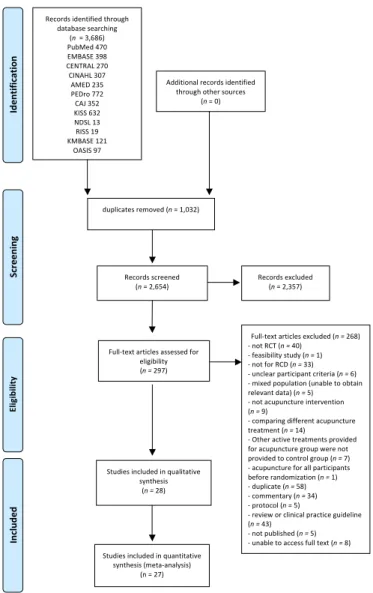
There were 3,686 records identified from English, Chinese, and Korean databases. After the removal of duplicates, the titles and abstracts of 2,654 records were screened. After screening 297 full-text articles, 28 RCTs were included which in total had 2216 participants in the qualitative syntheses, and 27 RCTs were included in the meta-analyses (Fig. 1). Contacting corresponding authors to verify the eligibility of the studies was not possible due to the absence of contact information in the published studies [16,17] or unanswered emails [18-21]. One RCT studying the feasibility of the Park sham needle was excluded because the purpose of the study was to assess the feasibility of the needle and it did not provide clinical outcome results [22]. One study was excluded from the meta-analysis due to errors on the sample size and an absence of reporting on variance of the outcomes [23].
One study was ongoing and was therefore not included in the this current review [24].
Included studies
All studies were parallel-group RCTs. Seven trials had multiple
acupuncture arms. Studies were conducted in China (n = 23), Spain
(n = 2), Sweden (n = 1), Germany (n = 1), and Greece (n = 1). The
number of participants in each study ranged from 30 to 178. The
trials included patients with RC (i.e., supraspinatus) tendinitis
(n = 9) [23,25-32], RC tear (n = 3) [33-35], RC injury (n = 5)
[36-40], impingement syndrome (n = 7) [41-47], subacromial
pain syndrome (n = 1) [48], subacromial bursitis (n = 1) [49],
and nonspecific shoulder pain (n = 2) [50,51]. Two studies with
nonspecific shoulder pain were included, since the eligibility
criteria for the trials were deemed consistent with a clinical or
radiological diagnosis of RCD [50,51]. Of the 28 trials, 13 studies
used both clinical and radiological criteria for the diagnosis of
RCD [23,27,29,33-36,39-41,43,49,51]. The types of acupuncture
conducted in the 28 studies included manual acupuncture (n = 7)
[25,27,33,40,45,49,50], dry needling of trigger points (n = 2) [48,51],
a mixture of manual acupuncture and EA (n = 6) [28,34-37,46],
EA (n = 2) [23,44], acupotomy (n = 10) [26,29-32,38,39,41-43],
warm needle acupuncture (n = 1) [47], and fire needle acupuncture
(n = 1) [30]. One RCT used two different styles of acupuncture
arms (i.e., fire needle acupuncture, acupotomy, and fire needle
acupuncture plus acupotomy) [30]. The details on the acupuncture characteristics of the included studies are presented in Table 3. A total of 15 trials reported both pain and shoulder function using validated scales. The most frequently used measurement scales for functional status of the shoulder were the Constant-Murley score [52] (n = 10) and the University of California-Los Angeles (UCLA) shoulder rating scale [53] (n = 9). Seventeen trials from the 23 Chinese studies reported the proportion of improved participants after treatment [25,26,28,30-33,37,39-44,46,47,49]. One trial reported a successful outcome defined by a 50% improvement in the disabilities of the arm, shoulder, and hand score [48]. Quality of life was reported in one trial using subdomains of the Short- Form 36 (SF-36) Health Survey [50]. Fourteen trials reported
Fig. 1. PRISMA flow diagram of study selection.
CENTRAL, Cochrane Central Register of Controlled Trials; CINAHL, Cumulative Index to Nursing and Allied Health Literature; AMED, Allied and Complementary Medicine; PEDro, Physiotherapy Evidence Database; CAJ, China Academic Journal Full-text Database; KISS, Korean studies Information Service System; NDSL, National Digital Science Library; RISS, Research Information Sharing Service; KMBASE, Korean Medical Database; OASIS, Oriental Medicine Advanced Searching Integrated System; RCT, randomized controlled trial; RCD, rotator cuff disease; PRISMA, Preferred Reporting Items for Systematic Reviews and Meta-analyses.
Figure 1. PRISMA flow diagram of study selection.
CENTRAL, Cochrane Central Register of Controlled Trials; CINAHL, Cumulative Index to Nursing and Allied Health Literature; AMED, Allied and Complementary Medicine; PEDro, Physiotherapy Evidence Database; CAJ, China Academic Journal Full-text Database; KISS, Korean studies Information Service System; NDSL, National Digital Science Library; RISS, Research Information Sharing Service; KMBASE, Korean Medical Database; OASIS, Oriental Medicine Advanced Searching Integrated System; RCT, Randomized controlled trial; RCD, Rotator cuff disease.
Records identified through database searching
(n = 3,686) PubMed 470 EMBASE 398 CENTRAL 270 CINAHL 307
AMED 235 PEDro 772 CAJ 352 KISS 632 NDSL 13 RISS 19 KMBASE 121
OASIS 97
Sc re ening Inc lude d
EligibilityIde ntif ic ation
Additional records identified through other sources
(n = 0)
duplicates removed (n = 1,032)
Full-‐text articles assessed for eligibility (n = 297)
Full-‐text articles excluded (n = 268) -‐ not RCT (n = 40)
-‐ feasibility study (n = 1) -‐ not for RCD (n = 33) -‐ unclear participant criteria (n = 6) -‐ mixed population (unable to obtain relevant data) (n = 5)
-‐ not acupuncture intervention (n = 9)
-‐ comparing different acupuncture treatment (n = 14)
-‐ Other active treatments provided for acupuncture group were not provided to control group (n = 7) -‐ acupuncture for all participants before randomization (n = 1) -‐ duplicate (n = 58) -‐ commentary (n = 34) -‐ protocol (n = 5)
-‐ review or clinical practice guideline (n = 43)
-‐ not published (n = 5) -‐ unable to access full text (n = 8) Studies included in qualitative
synthesis (n = 28)
Records excluded (n = 2,357) Records screened
(n = 2,654)
Studies included in quantitative synthesis (meta-‐analysis)
(n = 27)
Figure 1. PRISMA flow diagram of study selection.
CENTRAL, Cochrane Central Register of Controlled Trials; CINAHL, Cumulative Index to Nursing and Allied Health Literature; AMED, Allied and Complementary Medicine; PEDro, Physiotherapy Evidence Database; CAJ, China Academic Journal Full-text Database; KISS, Korean studies Information Service System; NDSL, National Digital Science Library; RISS, Research Information Sharing Service; KMBASE, Korean Medical Database; OASIS, Oriental Medicine Advanced Searching Integrated System; RCT, Randomized controlled trial; RCD, Rotator cuff disease.
Records identified through database searching
(n = 3,686) PubMed 470 EMBASE 398 CENTRAL 270 CINAHL 307 AMED 235 PEDro 772 CAJ 352 KISS 632 NDSL 13 RISS 19 KMBASE 121
OASIS 97
Sc re ening Inc lude d
EligibilityIde ntif ic ation
Additional records identified through other sources
(n = 0)
duplicates removed (n = 1,032)
Full-‐text articles assessed for eligibility (n = 297)
Full-‐text articles excluded (n = 268) -‐ not RCT (n = 40)
-‐ feasibility study (n = 1) -‐ not for RCD (n = 33) -‐ unclear participant criteria (n = 6) -‐ mixed population (unable to obtain relevant data) (n = 5)
-‐ not acupuncture intervention (n = 9)
-‐ comparing different acupuncture treatment (n = 14)
-‐ Other active treatments provided for acupuncture group were not provided to control group (n = 7) -‐ acupuncture for all participants before randomization (n = 1) -‐ duplicate (n = 58) -‐ commentary (n = 34) -‐ protocol (n = 5)
-‐ review or clinical practice guideline (n = 43)
-‐ not published (n = 5) -‐ unable to access full text (n = 8) Studies included in qualitative
synthesis (n = 28)
Records excluded (n = 2,357) Records screened
(n = 2,654)
Studies included in quantitative synthesis (meta-‐analysis)
(n = 27)