Early Rehabilitation in Elderly after Arthroplasty versus Internal Fixation for Unstable Intertrochanteric Fractures of Femur:
a Systematic Review and Meta-Analysis
The purpose of this study was to compare the outcomes focusing on the functional outcome and clinical results of replacement arthroplasty (AP) vs. internal fixation (IF) for the treatment of unstable intertrochanteric femoral fracture in elderly. Systematic review and meta-analysis were performed on 10 available clinical studies (2 randomized controlled trials and 8 comparative studies). Subgroup analysis was performed by type of
methodological quality. Partial weight bearing time in AP group was earlier than that in IF group (SMD = −0.86; 95% CI = −0.42, 1.29; P = 0.050). The overall outcomes such as mortality, reoperation rate, and complication showed no significant diffrence between the 2 groups (AP vs. IF). Therefore, this systematic review demonstrates that AP provides superior functional outcomes especially earlier mobilization, as compared to IF in elderly patients with an unstable intertrochanteric femoral fracture.
Keywords: Arthroplasty; Fracture Fixation; Meta-analysis; Hip Fractures Jun-Il Yoo,1 Yong-Chan Ha,2
Jae-young Lim,3 Hyun Kang,4 Byung-Ho Yoon,5 and Hyunho Kim2
1Department of Orthopaedic Surgery, School of Medicine, Gyeongsang National University Hospital, Jinju, Korea; 2Department of Orthopaedic Surgery, Chung-Ang University College of Medicine, Seoul, Korea; 3Department of Rehabilitation, Seoul National University Bundang Hospital, Seongnam, Korea; 4Department of Anesthesiology, Chung-Ang University College of Medicine, Seoul, Korea;
5Department of Orthopaedic Surgery, Inje University College of Medicine, Seoul, Korea
Received: 5 December 2016 Accepted: 27 January 2017 Address for Correspondence:
Yong-Chan Ha, MD
Department of Orthopaedic Surgery, Chung-Ang University College of Medicine, 102 Heukseok-ro, Dongjak-gu, Seoul 06973, Korea
E-mail: [email protected]
Funding: This research was supported by a grant of the Korea Health Technology R & D Project through the Korea Health Industry Development Institute (KHIDI), funded by the Ministry of Health and Welfare, Republic of Korea (Grant No.
HC15C1189).
https://doi.org/10.3346/jkms.2017.32.5.858 • J Korean Med Sci 2017; 32: 858-867
INTRODUCTION
Hip fractures are considered an important health problem in elderly populations, with considerable socioeconomic burden due to longer hospitalization, loss of independence, and incre- ased mortality. Recent epidemiologic study on hip fracture in- dicate that the absolute number of hip fractures is expected to increase in the following decades (1).
Patients with hip fracture mostly require hospitalization and surgical intervention to minimize morbidity and mortality (2- 5). Although surgical options for hip fractures are various, the main goals are early rehabilitation and return to previous social activities. Early stable fixation of hip fracture enables early reha- bilitation. It leads to improvement of the short-term clinical out- come including ability to return to independent living, short- ened length of stay and reduced risk for development of pres- sure ulcers, and possibly minimizes overall mortality rates and postoperative complications (6).
Currently, replacement arthroplasty (AP) or internal fixation (IF) are considered the 2 surgical options for stable fixation after hip fracture. Several meta-analysis studies report that replace- ment AP is a more suitable surgical option in patients with fe- mur neck fracture (7-9). Although few studies report the more suitable option for early rehabilitation in patients with unstable intertrochanteric fracture, replacement AP vs. IF remains con- troversial (10).
The purpose of this meta-analysis study was to compare the functional outcome and clinical results of replacement AP vs.
IF for the treatment of unstable intertrochanteric femoral frac- ture in elderly patients.
MATERIALS AND METHODS
Our current review and meta-analysis was performed accord- ing to the Preferred Reporting Items for Systematic Reviews and Meta-Analyses (PRISMA) guideline (11).
Study eligibility criteria
Studies were selected on the basis of the following criteria: 1) study design: randomized controlled trials (RCTs) or non-ran- domized comparative studies; 2) study population: patients with unstable intertrochanter fracture of the femur (Arbeitsge- meinschaft fur Osteosynthesefragen/Orthopaedic Trauma As- sociation [AO/OTA] classification: 2 and 3 or Evans classifica- tion: unstable); 3) intervention: including AP (total hip arthro- plasty (THA) or hemiarthroplasty) and IF such as an intramed- ullary nail or the sliding hip screw (control group); 4) follow-up time: 1 years at least; and 5) reporting at least 1 of the following main clinical outcomes: mortality, reoperations for any cause, complication-related medical condition or operation, function- al outcome and mobilization time. Studies were excluded if they failed to meet the above criteria.
Search methods for identification of studies
A comprehensive search of all relevant RCTs and comparative studies was conducted through PubMed central, OVID Med- line, Cochrane Collaboration Library, Web of Science, EMBASE, KoreaMed, and AHRQ, up to January 2016, with English and Korean language restriction. We used the following search terms:
‘‘arthroplasty,’’ ‘‘prosthetic replacement,’’ ‘‘internal fixation,’’ ‘‘femo- ral intertrochanteric fractures,’’ “unstable intertrochanteric frac- ture” and ‘‘randomized controlled study,” “comparative study.”
These keywords were used as MeSH headings and free text words, respectively (Appendix 1). Manual search of possibly related references was also conducted. Two investigators independent- ly reviewed the titles, abstracts, and full texts of all potentially relevant studies, as recommended by the Cochrane Collabora- tion (12).
Data extraction
The following data were extracted from the included articles:
authors, publication date, study design, participant characteris- tics, follow-up period, specific interventions, and outcome mea- surements. The outcomes pooled in this analysis included mor- tality, reoperation, complications-related general condition or operation, functional outcome and mobilization time (weight bearing or starting day of rehabilitation). For the data published as median, range and the size of the trial, mean difference (MD) and standard deviation (SD) were calculated by the method of Hozo (13).
Methodological quality assessment
Two authors independently assessed methodological quality of included studies using the same criteria for RCTs and as described in the Cochrane Handbook for Systematic Reviews of Interven- tions 5.2. The criteria included 10 items as follows: 1) Allocation concealment; 2) Were inclusion and exclusion criteria clearly defined?; 3) Were the outcomes of patients who withdrew or
were excluded after allocation described and included in an in- tention-to-treat analysis?; 4) Were the groups well matched, or appropriate covariate adjustment made?; 5) Did the surgeons have experience of the operations performed in the trial, prior to its commencement?; 6) Were the care programs other than the trial options identical?; 7) Were all the outcome measures clearly defined in the text with a definition of any ambiguous terms encountered?; 8) Were the outcome assessors blind to assignment status?; 9) Was the timing of outcome measures ap- propriate?; and 10) Was loss to follow-up reported and if so, was less than 5 percent of participants lost to follow-up?
The Newcastle-Ottawa scale was used to assess methodolog- ical quality of non-randomized studies. It contains 8 items, which are categorized into 3 dimensions: the selection of the study population, the comparability of the groups, and the ascertain- ment of the exposure (case-control study) or outcome (cohort study). Each dimension consists of subcategorized questions:
selection (a maximum of 4 stars), comparability (a maximum of 2 stars), and exposure or outcome (a maximum of 3 stars) (14,15) Thus, a study can be awarded a maximum of 9 stars, in- dicating the highest quality.
Two of the authors independently evaluated the quality of all the studies.
Data analysis
This meta-analysis was performed with Review Manager soft- ware (Rev Man 5.3; the Nordic Cochrane Centre, Copenhagen, Denmark) and the level of significance was set at P < 0.05. For dichotomous outcomes, odds ratio (OR) and 95% confidence interval (CI) were calculated. For continuous outcomes, stan- dardized mean difference (SMD) and 95% CI were calculated.
The size of heterogeneity across studies was estimated with I2 statistic and the χ2 test. A P value of > 0.10 and an I2≤ 50% were considered of no statistical heterogeneity (15). For the test of heterogeneity, we used Higgins I2 statistics. Significant hetero- geneity was observed in these studies, therefore, we reported the data from a random-effects. Random effect model or fixed effect model were adopted depending on the heterogeneity of the included studies. Subgroup analysis was performed by type of methodological quality (RCT vs. non-RCT). Sensitivity analy- sis was conducted by omitting one study in each turn and pool- ing the data of the remaining studies to explore the possible ex- planations for high heterogeneity and determine the stability of the outcomes.
RESULTS Search results
The initial search identified 301 references from the selected databases. Two hundred and seventy references were excluded by screening the abstracts and titles for duplicates, unrelated
articles, case reports, systematic reviews, and non-comparative studies. The remaining 31 studies underwent full text review. A further 21 studies were excluded. The details of identifying rele- vant studies were shown in the flow chart of study selection pro- cess (Fig. 1). Two randomized controlled studies and 8 compar- ative retrospective studies, 7 English articles (16-22) and 3 Ko- rean article (23-25) including 1,214 patients (614 from AP group, 610 from IF group), were finally selected for this meta-analysis.
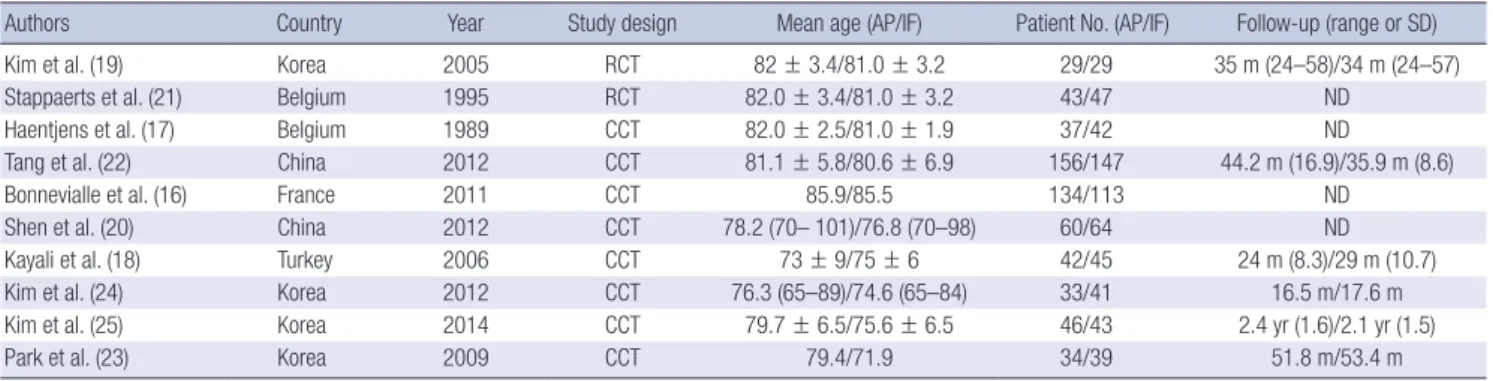
The main characteristics and outcomes of the studies included in the meta-analysis were presented in Table 1.
Meta-analysis results Mortality
Mortality rate (Fig. 2A): 6 studies (16-18,20,22,24) reported the mortality rate, a total of 914 participants with 462 patients assigned
to the AP group and 452 patients assigned to the IF group. There was low evidence of heterogeneity across the studies (I2= 0%;
P = 0.480) and the fixed model was performed. There was no statistically difference between AP group and IF group (OR = 1.20;
95% CI = 0.83, 1.73; P = 0.330; number needed to treat [NNT] =
−48).
Reoperations
Reoperation Rate (Fig. 2B): 4 studies (16,18,22,24) reported the reoperation, a total of 711 participants with 365 patients assigned to the AP group and 346 patients assigned to the IF group. There was low evidence of heterogeneity across the studies (I2= 52%;
P = 0.100) and the random model was performed. No statistical difference was observed between AP group and IF group (OR = 0.43; 95% CI = 0.12, 1.62; P = 0.210; NNT = 39).
Table 1. Characteristics of included studies and patients
Authors Country Year Study design Mean age (AP/IF) Patient No. (AP/IF) Follow-up (range or SD)
Kim et al. (19) Korea 2005 RCT 82 ± 3.4/81.0 ± 3.2 29/29 35 m (24–58)/34 m (24–57)
Stappaerts et al. (21) Belgium 1995 RCT 82.0 ± 3.4/81.0 ± 3.2 43/47 ND
Haentjens et al. (17) Belgium 1989 CCT 82.0 ± 2.5/81.0 ± 1.9 37/42 ND
Tang et al. (22) China 2012 CCT 81.1 ± 5.8/80.6 ± 6.9 156/147 44.2 m (16.9)/35.9 m (8.6)
Bonnevialle et al. (16) France 2011 CCT 85.9/85.5 134/113 ND
Shen et al. (20) China 2012 CCT 78.2 (70– 101)/76.8 (70–98) 60/64 ND
Kayali et al. (18) Turkey 2006 CCT 73 ± 9/75 ± 6 42/45 24 m (8.3)/29 m (10.7)
Kim et al. (24) Korea 2012 CCT 76.3 (65–89)/74.6 (65–84) 33/41 16.5 m/17.6 m
Kim et al. (25) Korea 2014 CCT 79.7 ± 6.5/75.6 ± 6.5 46/43 2.4 yr (1.6)/2.1 yr (1.5)
Park et al. (23) Korea 2009 CCT 79.4/71.9 34/39 51.8 m/53.4 m
AP = arthroplasty, IF = internal fixation, SD = standard deviation, RCT = randomized controlled trial, CCT = retrospective comparative control trial, ND = not documented.
Fig. 1. PRISMA flow diagram details the process of relevant clinical study selection.
PRISMA = Preferred Reporting Items for Systematic Reviews and Meta-Analyses.
Identification
Screening
Eligibility
Included
Initial results of publication searches (n = 301):
MEDLINE (n = 94) OVID Medline (n = 54) Cochrane Library (n = 17) Web of Science (n = 121) KoreaMed (n = 13) bibliographies (n = 2)
Exclude duplicated articles (n = 102) Records screened (n = 199)
Full-text articles assessed for eligibility (n = 31)
Exclude according to selection criteria (n = 168)
Studies (n = 21) excluded after reading the full-text articles:
Shared identical population (n = 3) Lesser than 1 year follow up (n = 5)
No information of main clinical outcomes (n = 13)
Studies included in quantitative synthesis (n = 10):
2 Randomized controlled studies 8 Comparative retrospective studies
Complication related medical condition
Complication related medical conditions such as deep vein thrombosis, urinary tract infection respiratory, cardiovascular, and neurologic complication (Fig. 2C): 7 studies (16-18,20,22,
24,25) reported the overall complication in a total of 1,003 par- ticipants with 508 patients assigned to AP group and 495 pati- ents assigned to the IF group. There was low evidence of hetero- geneity across the studies (I2= 14%; P = 0.320) and the fixed Fig. 2. The forest plot of the outcomes comparing AP with IF. (A) Mortality. (B) Reoperation. (C) Complication-related medical condition. (D) Complication-related operation.
AP = arthroplasty, IF = internal fixation, OR = odds ratio; CI = confidence interval, M-H = Mantal-Haenszel.
A
B
C
D
model was performed. There was no statistically difference be- tween AP group and IF group (OR = 0.75; 95% CI = 0.51, 1.11;
P = 0.150; NNT = 40).
Complication related operation
Complication related operation (Fig. 2D): 8 studies (16-24) re- ported the overall complication in a total of 1,076 participants with 542 patients assigned to AP group and 534 patients assign- ed to the IF group. No statistical difference was observed between AP group and IF group (OR = 0.54; 95% CI = 0.37, 0.79; P = 0.002;
NNT = 16).
Funtional outcomes
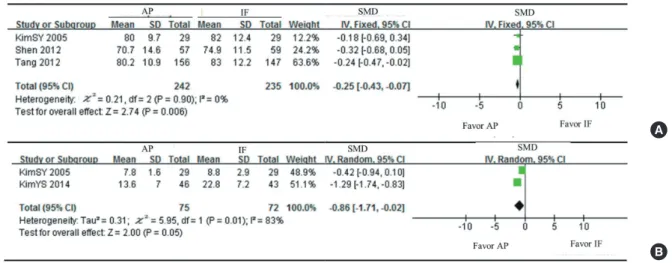
Three studies (19,20,22), with a total of 477 patients provided mean Harris hip scores and SD postoperatively. There was low evidence of heterogeneity across the studies (I2= 0%; P = 0.830) and the fixed model was performed. Function was significant difference between 2 groups in the Harris hip scores at latest follow-up (SMD = −2.97; 95% CI = −5.09, 0.84; P = 0.006) (Fig.
3A).
Stappaerts et al. (21) described a simple and easy workable scale of independence to estimate the functional status. This scale was based on amulatory capacity and on the abilities of performing activities of daily living. To be considered as inde- pendent, the patient was required to meet at least the following criteria: ability to walk outdoors > 50 m without waking aids, except one cane or crutch, and ability to dress him- or herself and get up from an armchair without assistance. They reported that there was no significant difference between the 2 groups.
The Merle d’Aubigne score was used for functional outcome measurement in one study (17). They reported that rehalbiliata- tion was easier and faster in the AP group. The Parker score and Postel Merle d’Aubigne (PMA) score were used for functional outcome measurement in other study (16). AP group showed
significantly better functional results after postoperative 6 months in terms of final Parker score, overall PMA score, and all 3 PMA items. Kayali et al. (18) evaluated functional outcome according to Merle d’Aubigne and Postel criteria at final follow-up. Patients with > 14 points were considered to have achieved a satisfacto- ry operative result. In AP group, the outcome of 8 patients was deemed unsatisfactory (6 fair, 2 poor). In IF group, clinical re- sults were deemed excellent in 11 patients and good in 15. The Merle d’Aubigne score was used for functional outcome mea- surement in another study (25). They reported that Merle d’Aub- igne and Postel score was not significantly different between the 2 groups.
Kim et al. (24) measured functional outcome using Koval score and modified Harris hip score. In the MD of Koval score and Modified Harris hip score, IF group (1.4 and 1.3) showed signif- icantly greater increase than that of AP group (1.9 and 6.0). How- ever, limp and waking aids of modified Harris hip demonstrat- ed that AP group (7.8 and 7.9) had significantly higher score than that of IF group (6.2 and 6.5).
Park et al. (23) evaluated functional outcome using the John- son daily activity of life score. At the final follow-up, the Johnson daily activity of life score showed more excellent results in AP group (P = 0.010).
Mobilization time
Two studies (19,25), with a total of 147 patients provided mean time of partial weight bearing with walking aids and SD at post- operatively. There was low evidence of heterogeneity across the studies (I2= 83%; P = 0.010) and the random model was per- formed. Partial weight bearing time was significant different be- tween the 2 groups (SMD = −0.86; 95% CI = −0.42, 1.29; P = 0.050) (Fig. 3B).
Kim et al. (19) reported that the patients in AP group were able to walk with a walker at a mean of 7.8 ± 1.6 days postoperative-
Fig. 3. The forest plot of the outcomes comparing AP with IF. (A) Functional outcome. (B) Mobilization time.
AP = arthroplasty, IF = internal fixation, SMD = standardized mean difference, SD = standard deviation, CI = confidence interval, MH = Mantal-Haenszel.
A
B
ly, and those in IF group at a mean of 8.8 ± 2.9 days (P = 0.069).
Kim et al. (25) reported that the AP group were able to begin partial weight-bearing earlier (13.6 ± 7.0 days in AP group vs.
22.8 ± 7.2 days in IF group, P < 0.001). Tang et al. (22) reported that the median time of starting partial weight-bearing using a walker was 10.0 days in IF group, and 4.0 days in AP group. Pa- tients in AP group were able to begin partial weight-bearing ear- lier (P < 0.001).
Shen et al. (20) recorded postoperative mobility status using walking ability (grade 1: no aid was needed; grade 2: aid was need, but patient was independent; and grade 3: patient was in need of assistance). Comparing mobility at 6 and 24 months post-operation with the pre-fracture status, they found that the IF group that contained the highest proportion of patients who maintained their preoperative status was satisfactory, followed by the AP group, and the unsatisfactory IF patients.
Kayali et al. (18) reported that the time to full weight bearing was significantly earlier in patients who underwent hemiarthro- plasty (4.0 ± 1.5 weeks in AP group vs. 10.0 ± 2.0 weeks in IF group, P < 0.001).
Kim et al. (24) reported that the time to free weight bearing without walking aids was significantly earlier in patients who un- derwent AP (AP: 15.3 days (range, 10–21) vs. IF: 19.1 days (range, 14–23), P < 0.050).
Subgroup and sensitivity analysis
Subgroup analysis according to type of methodological quality (RCT vs. non-RCT) showed similar results. However, functional outcome (Harris hip score, HHS) excepting results of non-RCTs was no significant differences between AP group and IF group (80.0 ± 9.7 vs. 82.0 ± 12.4, P = 0.282) Sensitivity analysis yielded similar results.
Risk bias
Only 2 RCTs were reported on this issue and the 8 included stud- ies were comparative studies. The Cochrane Handbook for Sys- tematic Reviews of Interventions was used to assess the quality of 2 RCTs. Scoring in 2 RCTs were 7 and 4, respectively (Appen- dix 2). The Newcastle-Ottawa scale was used to assess the qual- ity of the selected studies. All included studies scored 5–8 points, indicating relatively high quality (Appendix 3). A funnel plot was not applied to assess publication bias due to small size (< 10) of RCTs included in this meta-analysis.
DISCUSSION
To achive early rehabilitation and improved short-term outcomes, this meta-nalysis study demonstrated more excellent funtional assessment in AP and significantly earlier partial weight bear- ing time in AP group than in IF group. Previously, only one me- ta-anlysis compared replacement AP with IF for the treatment
of unstable intertrochanteric femoral fractures in elderly pati- ents (10). They performed meta-analysis using 2 RCTs includ- ing a total of 148 patients aged 70 years or over with unstable intertrochanteric femoral fracture. They reported that there were no significant differences between the 2 interventions for me- chanical complications, local wound complications, reopera- tion, general complications, mortality at 1 year or long-term func- tion. However, the review of only 2 clinical trials is not adequate for a definite conclusion and they recommended that larger well- designed randomised trials comparing AP vs. IF for the treat- ment of unstable fractures are required.
In terms of functional recovery and starting time for rehabili- tion, 2 studies reported that partial weight bearing time in re- placement AP groups was significantly better than IF groups (19,25). However, assessment tools of functional outcomes are not consistent. Merle d’Aubigne score was most frequently used functional score (15-17,24). Although meta-analysis could not be conducted as it did not provide both mean and SD, most stu- dies reported that rehabilitation treatments could be mobilized more easily, conveniently and faster in AP group.
Regarding surgical-related complications such as reopera- tion and mortality in patients after treatment of unstable inter- trochanteric fracture, this meta-anlysis indicated no statistical difference between AP and IF treatment for unstable intertro- chanteric fracture in elderly patients. These findings are consis- tent with previous meta-analysis.
This meta-analysis has some limitations. First, only 2 RCTs were included. Second, follow-up periods were not long enough to confirm the results (none of the included studies had more than 5-year follow-up). Third, all retrieved documents were Eng- lish or Korean, hence, there may be language bias. Well-report- ed, high-quality RCTs with long-term follow-up are needed to assess the safety and efficacy of AP compared to IF. Finally, we could not perform meta-analysis of the degradation between preoperative and postoperative functional outcomes. Difficulty of direct comparison of functional outcome is possibly due to deficiency of unified functional evaluation tools.
In conclusion, the present study suggests that AP provides superior functional outcomes especially earlier mobilization when compared with an IF in elderly patients with an unstable intertrochanteric femoral fracture.
DISCLOSURE
The authors have no potential conflicts of interest to disclose.
AUTHOR CONTRIBUTION
Conceptualization: Yoo JI, Ha YC, Lim JY. Data curation: Kang H, Yoon BH, Kim H. Investigation: Yoo JI, Ha YC. Writing - re- view & editing: Yoo JI, Ha YC.
ORCID
Jun-Il Yoo http://orcid.org/0000-0002-3575-4123 Yong-Chan Ha http://orcid.org/0000-0002-6249-0581 Jae-young Lim http://orcid.org/0000-0002-9454-0344 Hyun Kang http://orcid.org/0000-0003-2844-5880 Byung-Ho Yoon http://orcid.org/0000-0001-8518-6331 Hyunho Kim http://orcid.org/0000-0001-5664-8103 REFERENCES
1. Johnell O, Kanis JA. An estimate of the worldwide prevalence and disabil- ity associated with osteoporotic fractures. Osteoporos Int 2006; 17: 1726- 33.
2. Randell AG, Nguyen TV, Bhalerao N, Silverman SL, Sambrook PN, Eisman JA. Deterioration in quality of life following hip fracture: a prospective study. Osteoporos Int 2000; 11: 460-6.
3. Mullen JO, Mullen NL. Hip fracture mortality. A prospective, multifactori- al study to predict and minimize death risk. Clin Orthop Relat Res 1992:
214-22.
4. Lippuner K, Golder M, Greiner R. Epidemiology and direct medical costs of osteoporotic fractures in men and women in Switzerland. Osteoporos Int 2005; 16 Suppl 2: S8-17.
5. Kanis JA, Pitt FA. Epidemiology of osteoporosis. Bone 1992; 13 Suppl 1:
S7-15.
6. Al-Ani AN, Samuelsson B, Tidermark J, Norling A, Ekström W, Cederholm T, Hedström M. Early operation on patients with a hip fracture improved the ability to return to independent living. A prospective study of 850 pa- tients. J Bone Joint Surg Am 2008; 90: 1436-42.
7. Parker MJ, Gurusamy K. Internal fixation versus arthroplasty for intracap- sular proximal femoral fractures in adults. Cochrane Database Syst Rev 2006: CD001708.
8. Ye CY, Liu A, Xu MY, Nonso NS, He RX. Arthroplasty versus internal fixa- tion for displaced intracapsular femoral neck fracture in the elderly: sys- tematic review and meta-analysis of short- and long-term effectiveness.
Chin Med J (Engl) 2016; 129: 2630-8.
9. Gao H, Liu Z, Xing D, Gong M. Which is the best alternative for displaced femoral neck fractures in the elderly?: a meta-analysis. Clin Orthop Relat Res 2012; 470: 1782-91.
10. Parker MJ, Handoll HH. Replacement arthroplasty versus internal fixa- tion for extracapsular hip fractures in adults. Cochrane Database Syst Rev 2006: CD000086.
11. Liberati A, Altman DG, Tetzlaff J, Mulrow C, Gøtzsche PC, Ioannidis JP, Clarke M, Devereaux PJ, Kleijnen J, Moher D. The PRISMA statement for reporting systematic reviews and meta-analyses of studies that evaluate health care interventions: explanation and elaboration. J Clin Epidemiol 2009; 62: e1-34.
12. Cochrane (GB). The Cochrane database of systematic reviews [Internet].
Available at http://www.cochranelibrary.com/cochrane-database-of-sys- tematic-reviews [accessed on 13 January 2017].
13. Hozo SP, Djulbegovic B, Hozo I. Estimating the mean and variance from the median, range, and the size of a sample. BMC Med Res Methodol 2005;
5: 13.
14. Stang A. Critical evaluation of the Newcastle-Ottawa scale for the assess- ment of the quality of nonrandomized studies in meta-analyses. Eur J Epidemiol 2010; 25: 603-5.
15. Higgins JP, Thompson SG, Deeks JJ, Altman DG. Measuring inconsistency in meta-analyses. BMJ 2003; 327: 557-60.
16. Bonnevialle P, Saragaglia D, Ehlinger M, Tonetti J, Maisse N, Adam P, Le Gall C; French Hip and Knee Society (SFHG); Trauma Surgery Academy (GETRAUM). Trochanteric locking nail versus arthroplasty in unstable intertrochanteric fracture in patients aged over 75 years. Orthop Trau- matol Surg Res 2011; 97: S95-100.
17. Haentjens P, Casteleyn PP, De Boeck H, Handelberg F, Opdecam P. Treat- ment of unstable intertrochanteric and subtrochanteric fractures in el- derly patients. Primary bipolar arthroplasty compared with internal fixa- tion. J Bone Joint Surg Am 1989; 71: 1214-25.
18. Kayali C, Agus H, Ozluk S, Sanli C. Treatment for unstable intertrochan- teric fractures in elderly patients: internal fixation versus cone hemiarthro- plasty. J Orthop Surg (Hong Kong) 2006; 14: 240-4.
19. Kim SY, Kim YG, Hwang JK. Cementless calcar-replacement hemiarthro- plasty compared with intramedullary fixation of unstable intertrochan- teric fractures. A prospective, randomized study. J Bone Joint Surg Am 2005; 87: 2186-92.
20. Shen J, Wang DL, Chen GX, Yang HL, Li L, Wei MX, Cai XQ, Yu ZH, Cheng L, Zhang XX, et al. Bipolar hemiarthroplasty compared with internal fixa- tion for unstable intertrochanteric fractures in elderly patients. J Orthop Sci 2012; 17: 722-9.
21. Stappaerts KH, Deldycke J, Broos PL, Staes FF, Rommens PM, Claes P.
Treatment of unstable peritrochanteric fractures in elderly patients with a compression hip screw or with the Vandeputte (VDP) endoprosthesis:
a prospective randomized study. J Orthop Trauma 1995; 9: 292-7.
22. Tang P, Hu F, Shen J, Zhang L, Zhang L. Proximal femoral nail antirotation versus hemiarthroplasty: a study for the treatment of intertrochanteric fractures. Injury 2012; 43: 876-81.
23. Park MS, Jung WC, Park H, Hwang BY, Lim YJ, Jung MG, Cho HM. Treat- ment of unstable intertrochanteric fracture in elderly patients: compari- son between the results of internal fixation using compression hip screw and cemented bipolar hemiarthroplasty. J Korean Fract Soc 2009; 22: 138- 44.
24. Kim SH, Lee SW, Kong GM, JeaGal MU. Comparison between the results of internal fixation using proximal femur nail anti-rotation and bipolar hemiarthroplasty in treatment of unstable intertrochanteric fractures of elderly patients. J Korean Hip Soc 2012; 24: 45-52.
25. Kim YS, Hur JS, Hwang KT, Choi IY, Kim YH. The comparison of compres- sion hip screw and bipolar hemiarthroplasty for the treatment of AO Type A2 intertrochanteric fractures. Hip Pelvis 2014; 26: 99-106.
Appendix 1. Search Strategy for PubMed on October 15, 2016
No. Keyword Search category
1 Hip Fractures MeSH
2 Fracture Fixation, Internal MeSH
3 Fracture Fixation/*instrumentation MeSH
4 Femoral Intertrochanteric Fracture* All fields
5 Intertrochanteric Femur Fracture* All fields
6 Unstable Femoral Intertrochanteric Fracture* All fields
7 Unstable Intertrochanteric Femur Fracture* All fields
8 Unstable Intertrochanteric Fracture* of Femur All fields
9 Unstable Intertrochnanteric Fracture* All fields
10 Unstable Intertrochanteric Femoral Fracture* All fields
11 OR/1–10
12 AP MeSH
13 AP, Replacement, Hip MeSH
14 Hemiarthroplasty MeSH
15 Uniarthroplasty All fields
16 OR/12–15
17 IF All fields
18 Internal Fixators MeSH
19 OR/17–18
20 16 AND 19
22 Compression Hip Screw All fields
23 Prosthetic Replacement All fields
24 OR/20–22
25 20 OR 24
26 11 AND 25
AP = arthroplasty, IF = internal fixation.
Appendix 2. Methodological quality assessment of RCT studies measured by Cochrane Handbook for Systematic Reviews of Interventions
References 1 2 3 4 5 6 7 8 9 10 Total study
Kim et al. (19) 1 1 1 1 0 0 1 0 1 1 7
Stappaerts et al. (21) 1 1 0 1 0 0 0 0 1 0 4
RCT = randomized controlled trial.
Appendix 3. Methodological quality assessment of non-RCT studies measured by Newcastle-Ottawa scale
References Selection Comparability Exposure Total score
Haentjens et al. (17) 2 2 3 7
Tang et al. (22) 4 1 3 8
Bonnevialle et al. (16) 2 2 3 7
Shenet al. (20) 2 2 3 7
Kayali et al. (18) 1 2 2 5
Kim et al. (24) 2 2 1 5
Kim et al. (25) 3 2 1 6
Park et al. (23) 2 2 2 6
RCT = randomized controlled trial.