동아시아를 제외한 국가에서 보완대체의학 중재를 포함한 소아 대상 임상진료지침의 현황 보고
심수보1⋅이주아2⋅이혜림1*
1대전대학교 한의과대학 한방소아과학교실, 2화평통합의학연구소
Received: April 20, 2020 ∙ Revised: May 14, 2020 ∙ Accepted: May 18, 2020
*Corresponding Author: Hye Lim Lee
Department of Korean Pediatrics, Daejeon Korean Medicine Hospital of Daejeon, 75, Daedeok-daero 176beon-gil, Seo-gu, Daejeon, Republic of Korea
Tel: +82-42-470-9138 / Fax: +82-42-477-9007 E-mail: [email protected]
ⓒ The Association of Pediatrics of Korean Medicine. All rights reserved. This is an open-access article distributed under the tenus of the Creative Commons Attribution Non-Commercial License (http://creativecommons.org/licenses/by-nc/3.0/), which permits unrestricted non-commercial use, distribution, and reproduction in any medium, provided the original work is properly cited.
Abstract
The Current State of Clinical Practice Guidelines on Complementary and Alternative Medicine in Paediatrics in Countries except East Asia
Shim Soo Bo1⋅Lee Ju Ah2⋅Lee Hye Lim1*
1Department of Pediatrics, College of Korean Medicine, Daejeon University
2Hwa-pyeong Institute of Integrative Medicine Objectives
Although clinical practice guidelines (CPGs) are becoming crucial in medical decision-making worldwide, there are very few development guidelines for children. Therefore, this preliminary study aimed to assess the status of worldwide except east asia-CPGs recommending complementary and alternative medicine interventions (CAM-i) in children worldwide except east asia in order to help developing Korean medicine CPGs (KMCPGs) for children.
Methods
To identify the current status of CPGs including CAM-i that have been developed so far, the author searched the related databases, and selected CPGs for children. The data related to the status of evidence-based CPGs, the materials related to the characteristics of CAM-i, and the details of recommendations for CAM-i were selected from the obtained findings.
Results
A total of 106 CPGs were identified based on the searches, of which 11 were finally selected as pediatric CPGs.
These pediatric CPGs have been developed since 2007 to target various diseases. The countries developing these CPGs include the United Kingdom, Scotland, Australia, and the United States, with the U.K. having the largest share. The majority of CPGs used MEDLINE, Embase, and Cochrane library as databases. The most frequently recommended topic was acupuncture, followed by herbal medicine. Many CPGs suggested that more research was needed.
Conclusions
Through this study, the author was able to identify the characteristics of the developed pediatric CPGs that include CAM-i. More preceding studies are needed for the development of pediatric KMCPGs. It is hoped that this report can be used as the foundation for future development of pediatric KMCPGs.
Key words: Clinical practice guideline, Korean medicine clinical practice guideline, Paediatric clinical practice guideline, Complementary and alternative medicine
ISSN 2287-9463(Online), https://doi.org/10.7778/jpkm.2020.34.2.75
Ⅰ. Introduction
임상진료지침 (Clinical Practice Guideline; CPG)은 의료서비스의 질을 향상시킬 수 있는 도구로, “특정한 상황에서 임상의사와 환자의 의사결정을 돕기 위해 체 계적으로 정리하여 서술한 진술”로 정의할 수 있다1). 임상진료지침은 어떤 중재가 편익이 있는지를 알려 주고 이를 지지하는 과학적 근거를 제시함으로써 의사 에게 효과적인 치료법을 제시해준다. 동시에 위험한 치료에 대한 주의를 하게 하고, 불필요한 치료를 줄이 며, 치료의 일관성을 향상시켜 치료의 질을 높일 수 있 다. 또한, 가능한 결과의 크기를 객관적으로 제시하고, 권고사항을 명시하여 의사에게 최신의 정보를 제공할 수 있다. 임상진료지침은 환자에게도 도움을 주는데, 어떤 치료가 환자에게 이익이 되는지에 대한 정보를 제공하여 환자가 객관적 의학정보에 입각한 선택을 할 수 있게 된다2-4).
이와 같은 이유로 임상진료지침은 세계적으로 의료 의사결정의 중요한 자료로 여겨지고 있으며, 독일, 영 국, 유럽, 미국 등에서 임상진료지침의 개발이 증가하 고 있다. 임상진료지침의 개발이 증가하면서 임상진료 지침의 품질 향상 또한 향후 큰 관심사가 되고 있으며, 질이 높은 임상진료지침의 개발에 대한 연구 또한 전 세계적으로 진행중이다5-7).
우리나라에서도 2006년부터 대한의학회와 보건복 지부가 임상진료지침의 개발과 보급을 위한 활동을 시 작한 뒤로 근거기반의학에 도움이 될 임상진료지침의 개발이 활발히 이루어지고 있다. 대한의학회 임상진료 지침위원회는 임상진료지침의 개발과 보급을 위해 2008년 1월 임상진료지침 정보센터 (Korean Medical Guideline Information center: KoMGI) 웹 사이트 (www.
guideline.or.kr)를 설립하여 운영하고 있으며 근거창출 임상연구국가사업단 (National Strategic Coordinating Center for Clinical Research: NSCR)은 보건복지부의 지 원을 받아 Korean Guideline Clearinghouse (KGC) 웹 사 이트 (www.cpg.or.kr)를 구축하여 2009년 11월부터 임 상진료지침의 개발과 보급에 기여하고 있다8).
2016년 1월 보건복지부 한의약육성발전심의위원회 에서 한의임상진료지침 개발, 보급 및 확산을 제3차 한 의약육성발전종합계획의 주요 과제 중 하나로 발표함 에 따라 한의학계에서도 질환별로 30개의 임상진료지 침이 현재 개발중에 있다9).
지금까지 한의임상진료지침 개발을 위한 전자우편 설문조사, 한의사의 인식조사, 진료지침 개발 예비연 구, 기존 가이드라인을 분석하는 기초연구, 진료지침 개발을 위한 임상시험방법론 연구 등 여러 선행연구
10-18)가 이루어져 왔으며, 뇌졸중후 증상19,20), 화병21), 사
상인병증22), 각종 암23-25)에 대한 임상진료지침들이 개 발되어 왔다. 또한, 한국한의학연구원에서도 우울증, 비만, 특발성 안면신경마비, 족관절 염좌, 요추 추간판 탈출증, 아토피 피부염, 견비통에 대한 한의임상진료 지침을 발표했다26-32).
다양한 질환과 중재를 대상으로 한의임상진료지침 이 개발되고 있으나, 현재까지 발표된 한의임상진료 지침은 모두 성인을 대상으로 개발된 임상진료지침이 며, 아직까지 소아를 대상으로 개발된 한의임상진료 지침은 드물다. 소아를 대상으로 한 한의임상진료지 침이 개발되기 위해서는 기존 임상진료지침에 대한 조사, 설문연구 및 개발 예비연구 등이 필요하다고 생 각된다.
이에 본 연구에서는 동아시아 국가를 제외한 전세 계에서 개발된 보완대체의학 중재를 포함하는 소아 대 상 임상진료지침의 현황을 보고하여 향후 소아 대상 한의임상진료지침의 예비연구 및 개발을 위한 기초자 료를 제시하고자 한다.
Ⅱ. Materials & Methods
2018년 11월까지 발표된 모든 임상진료지침 중 소 아를 대상으로 하며 보완대체의학 중재 내용을 포함한 임상진료지침만을 선별하였다.
검색원으로는 NGC (National Guideline Clearinghouse), NICE (National Institute for Health and Care Excellence of U.K.), GIN (Guideline International Network) library, SIGN(The Scottish Intercollegiate Guidelines Network) guideline, MEDLINE, CENTRAL (Cochrane Central Register of Controlled Trials)을 이용하였다. 검색어의 형식은 Table 1에 수록되어 있다.
본 연구에서 문헌의 선정기준은 다음과 같다.
1) 보완대체의학 중재를 포함한 임상진료지침, 2) 권 고문과 그 근거를 포함한 임상진료지침, 3) 동아시아 지역을 제외한 국가에서 개발된 임상진료지침, 4) 소아 를 대상으로 한 임상진료지침
본 연구의 문헌 제외기준은 다음과 같다.
1) 제목에 임상진료지침이라 명시하지 않은 단순 문 헌, 2) 중국, 일본, 대만에서 개발된 임상진료지침, 3) 보완대체의학 중재에 대한 권고사항이 포함되지 않은 임상진료지침, 4) 소아에게서 나타나지 않는 질병을 대 상으로 한 임상진료지침, 5) 성인을 대상으로 한 임상 진료지침
두명의 연구자 (심수보, 이혜림)가 독립적으로 제목 을 통해 본 연구에 해당하지 않는 임상진료지침을 배 제했고, 나머지 문헌의 본문을 확인하여 연구 대상 문 헌을 선정하였다. 첫 번째 검토 후 두명의 연구자 사이 에 의견이 일치하지 않은 경우 토의를 거쳐 문헌을 선 정했으며, 그럼에도 불구하고 의견이 일치하지 않는 경우 세번째 검토자 (이주아)와 다시 토의하여 최종 선 정을 했다.
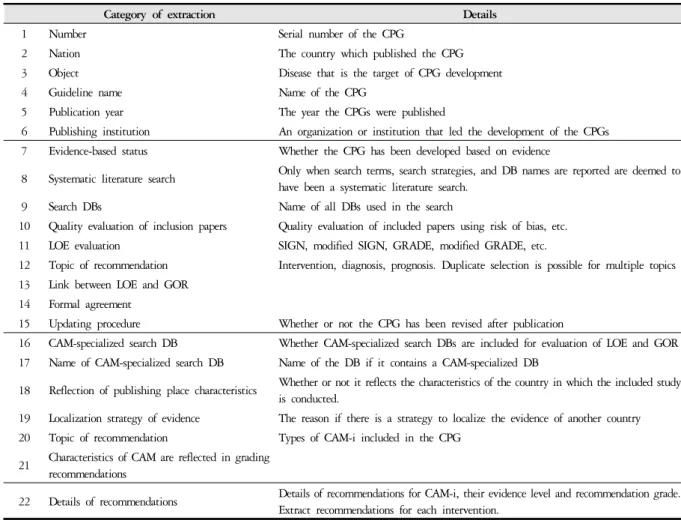
최종 선정된 문헌에서 개발 국가, 대상 질환명, 지침 명, 개발연도, 개발주체 등 일반 현황자료를 추출하였 고, 체계적 문헌검색 여부, 검색 database, 포함된 논문 의 질 평가 여부, 근거 수준의 평가, 권고등급과 근거수 준의 연계성 등 근거기반 현황 자료를 추출했다. 또한, 보완대체의학 관련 중재에 대한 현황을 알아보기 위해 보완대체의학 특화 검색원의 포함 여부, 보완대체의학 중재 관련 권고 대상, 권고 도출 시 보완대체의학의 특 성 반영 여부, 근거생산지의 특성 반영 여부를 추출했 으며, 마지막으로 근거수준과 권고등급, 관련 권고문 을 추출했다 (Table 2).
Ⅲ. Results
1. 문헌 선정
최초 검색 결과 NICE 364편, GIN library 33편, Medline 18편, NGC 7편, 그리고 SIGN 4편으로 총 426 편의 문헌이 검색되었다.
이 중 중복문헌 (n=76), 원문을 확보할 수 없는 문헌 (n=64), 임상진료지침이 아닌 문헌 (n=23), 한국에서 개 발된 임상진료지침 (n=7), 중국에서 개발된 임상진료 지침 (n=6), 보완대체의학 중재가 포함되지 않은 임상 진료지침 (n=144), 소아에서 나타나지 않는 질병을 대 상으로 한 문헌 (n=13), 성인만을 대상으로 한 지침 (n=56), 성인과 소아를 모두 다룬 지침 (n=26)를 제외 하고 최종 11건의 문헌이 선정되었다 (Figure 1).
2. 선정된 문헌의 일반적 특성
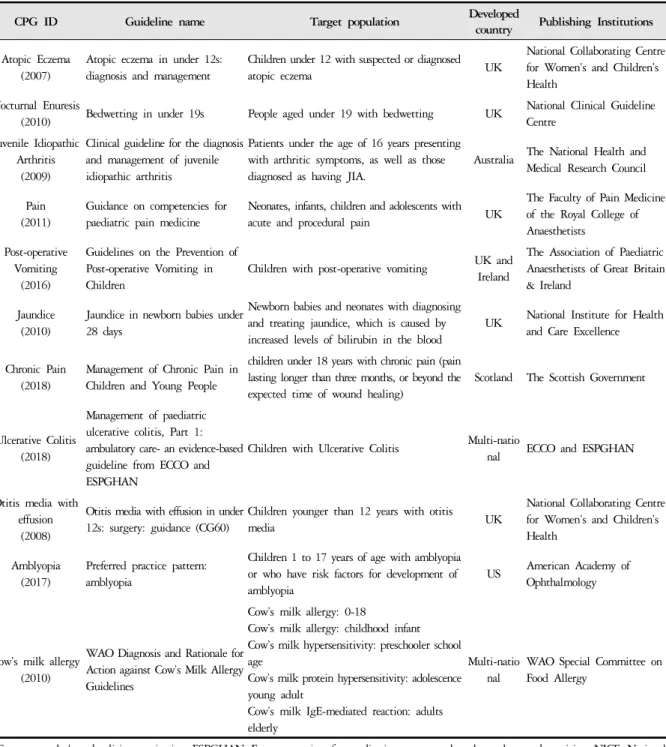
선정된 임상진료지침의 주제는 아토피 피부염, 야뇨 증, 소아 특발성 관절염, 통증, 수술 후 구역감, 신생아 황달, 만성통증, 소아 궤양성 대장염, 삼출물을 동반한 중이염, 약시, 우유 알레르기 등으로 다양했다.
임상진료지침의 대상 인구집단을 특정 나이 이하로 정의한 지침은 7건33-39) (63.6%) 이었다.
개발국가로는 영국이 5건34,35,38,40,41)으로 가장 많았 고, 호주, 스코틀랜드, 미국이 1건33,36,37)씩 개발했으며 여러 국가가 참여한 임상진료지침은 3건39,42,43)이 있었 다. 정부기관 주도로 개발된 임상진료지침은 영국에서 개발된 지침 4건34,35,38,41)
, 호주와 스코틀랜드에서 개발 된 지침 각 1건36,37)씩 총 6건이었고, 관련된 학회에서 개발을 주도한 임상진료지침은 총 5건33,39,40,42,43)이었다 (Table 3).
#7 #6 OR #5
#6 Search ((((Search plant$[Text Word]) OR Search herb$[Text Word]) OR Search herb$[Text Word]) OR (((traditional[Text Word] OR chinese[Text Word] OR korean[Text Word] OR kampo[Text Word] OR herbal) adj medicine)[Text Word])) OR (((oriental[Text Word] OR chinese[Text Word] OR korean[Text Word] OR kampo) adj tradition$)[Text Word])
#5 Search (#3 AND #4)
#4 Search ((traditional[Title]) OR alternative[Title]) OR integrative[Title]
#3 Search "clinical practice guideline"
#2 Search "clinical pratice guideline"
#1 Search "clinical guideline"[Title]
Table 1. Search Format
Category of extraction Details
1 Number Serial number of the CPG
2 Nation The country which published the CPG
3 Object Disease that is the target of CPG development
4 Guideline name Name of the CPG
5 Publication year The year the CPGs were published
6 Publishing institution An organization or institution that led the development of the CPGs 7 Evidence-based status Whether the CPG has been developed based on evidence
8 Systematic literature search Only when search terms, search strategies, and DB names are reported are deemed to have been a systematic literature search.
9 Search DBs Name of all DBs used in the search
10 Quality evaluation of inclusion papers Quality evaluation of included papers using risk of bias, etc.
11 LOE evaluation SIGN, modified SIGN, GRADE, modified GRADE, etc.
12 Topic of recommendation Intervention, diagnosis, prognosis. Duplicate selection is possible for multiple topics 13 Link between LOE and GOR
14 Formal agreement
15 Updating procedure Whether or not the CPG has been revised after publication
16 CAM-specialized search DB Whether CAM-specialized search DBs are included for evaluation of LOE and GOR 17 Name of CAM-specialized search DB Name of the DB if it contains a CAM-specialized DB
18 Reflection of publishing place characteristics Whether or not it reflects the characteristics of the country in which the included study is conducted.
19 Localization strategy of evidence The reason if there is a strategy to localize the evidence of another country 20 Topic of recommendation Types of CAM-i included in the CPG
21 Characteristics of CAM are reflected in grading recommendations
22 Details of recommendations Details of recommendations for CAM-i, their evidence level and recommendation grade.
Extract recommendations for each intervention.
CAM-i: Complementary and alternative medicine intervention, CPG: Clinical practice guideline, DB: Database, GRADE: Grading of Recommendations, Assessment, Development and Evaluation, GOR: Grade of recommendation, LOE: Level of evidence, SIGN: Scottish Intercollegiate Guidelines Network
Table 2. Data Extracted from the CPGs
CAM: Complementary and alternative medicine, CPG: Clinical practice guideline Figure 1. Flowchart of the selection process for paediatric CAM CPGs
3. 선정된 문헌의 근거기반 특성
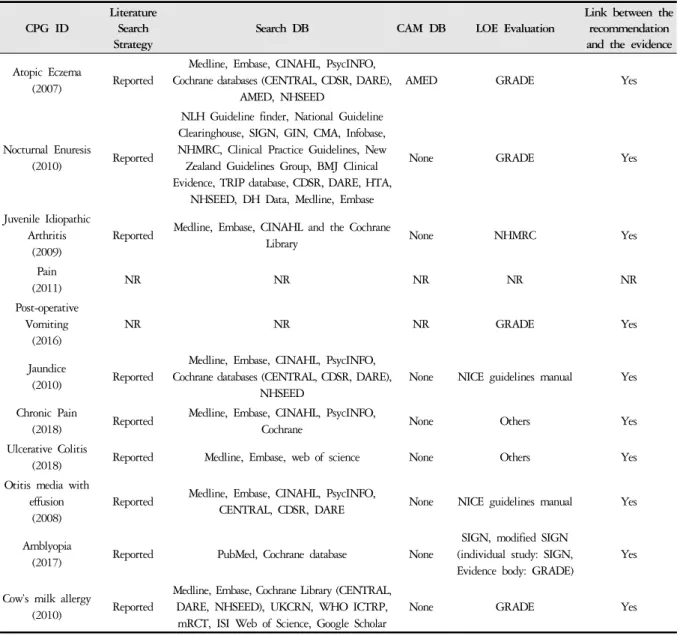
임상진료지침 개발 시 사용된 체계적 문헌검색 방 법에 대해 보고한 지침은 총 9건33-39,41,43)이었고, 2건
40,42)은 문헌검색 방법에 대해 기술하지 않았다.
검색에 사용된 데이터베이스는 Medline, Embase, CINAHL, PsycINFO, Cochrane databases (CENTRAL, CDSR, DARE), AMED, NHSEED, NLH Guideline find-
er, National Guideline clearhouse, SIGN, GIN, CMA, Infobase, NHMRC, Clinical Practice Guidelines, New Zealand Guidelines Group, BMJ Clinical Evidence, TRIP database, HTA, DH Data, UKCRN, WHO ICTRP, mRCT, ISI Web of Science, Google Scholar 등이 있었다.
Medline, Embase, Cochrane database가 각각 8회 언급 되었고, CINAHL은 5회, PsyINFO는 4회 언급되었다.
CPG ID Guideline name Target population Developed
country Publishing Institutions Atopic Eczema
(2007)
Atopic eczema in under 12s:
diagnosis and management
Children under 12 with suspected or diagnosed
atopic eczema UK
National Collaborating Centre for Women’s and Children’s Health
Nocturnal Enuresis
(2010) Bedwetting in under 19s People aged under 19 with bedwetting UK National Clinical Guideline Centre
Juvenile Idiopathic Arthritis
(2009)
Clinical guideline for the diagnosis and management of juvenile idiopathic arthritis
Patients under the age of 16 years presenting with arthritic symptoms, as well as those diagnosed as having JIA.
Australia The National Health and Medical Research Council
Pain (2011)
Guidance on competencies for paediatric pain medicine
Neonates, infants, children and adolescents with
acute and procedural pain UK
The Faculty of Pain Medicine of the Royal College of Anaesthetists
Post-operative Vomiting
(2016)
Guidelines on the Prevention of Post-operative Vomiting in Children
Children with post-operative vomiting UK and Ireland
The Association of Paediatric Anaesthetists of Great Britain
& Ireland Jaundice
(2010)
Jaundice in newborn babies under 28 days
Newborn babies and neonates with diagnosing and treating jaundice, which is caused by increased levels of bilirubin in the blood
UK National Institute for Health and Care Excellence
Chronic Pain (2018)
Management of Chronic Pain in Children and Young People
children under 18 years with chronic pain (pain lasting longer than three months, or beyond the expected time of wound healing)
Scotland The Scottish Government
Ulcerative Colitis (2018)
Management of paediatric ulcerative colitis, Part 1:
ambulatory care- an evidence-based guideline from ECCO and ESPGHAN
Children with Ulcerative Colitis Multi-natio
nal ECCO and ESPGHAN
Otitis media with effusion
(2008)
Otitis media with effusion in under 12s: surgery: guidance (CG60)
Children younger than 12 years with otitis
media UK
National Collaborating Centre for Women’s and Children’s Health
Amblyopia (2017)
Preferred practice pattern:
amblyopia
Children 1 to 17 years of age with amblyopia or who have risk factors for development of amblyopia
US American Academy of Ophthalmology
Cow’s milk allergy (2010)
WAO Diagnosis and Rationale for Action against Cow’s Milk Allergy Guidelines
Cow’s milk allergy: 0-18
Cow’s milk allergy: childhood infant Cow’s milk hypersensitivity: preschooler school age
Cow’s milk protein hypersensitivity: adolescence young adult
Cow’s milk IgE-mediated reaction: adults elderly
Multi-natio nal
WAO Special Committee on Food Allergy
: European crohn's and colitis organization, ESPGHAN: European society for paediatric gastroenterology hepatology and nutrition, NICE: National institute for health and care excellence, UK: United Kingdom, US: United States, WAO: World allergy organization
Table 3. General Status of the Included CPGs
Cochrane database 중 CENTRAL, CDSR은 4회씩 언급 되었고, DARE는 5회 언급되었다.
보완대체의학 관련 데이터베이스는 1건의 임상진료지 침34)에서 사용되었으며, AMED (Allied and Complementary Medicine)가 사용되었다.
근거수준을 평가하기 위한 방법으로는 GRADE (Grading of Recommendations, Assessment, Development and Evaluation)가 4건34,35,39,42)으로 가장 많이 쓰였으며,
NICE guidelines manual에서 권장하는 평가방법을 사 용한 문헌이 1건41), SIGN (Scottish Intercollegiate Guidelines Network)과 변형된 SIGN을 통해 근거수준 을 평가한 문헌이 1건33), NHMRC (National Health and Medical Research Council)에서 개발된 방법을 사용한 문헌이 1건36), 근거수준을 평가하지 않은 문헌이 1건40) 있었다 (Table 4).
CPG ID
Literature Search Strategy
Search DB CAM DB LOE Evaluation
Link between the recommendation and the evidence Atopic Eczema
(2007) Reported
Medline, Embase, CINAHL, PsycINFO, Cochrane databases (CENTRAL, CDSR, DARE),
AMED, NHSEED
AMED GRADE Yes
Nocturnal Enuresis
(2010) Reported
NLH Guideline finder, National Guideline Clearinghouse, SIGN, GIN, CMA, Infobase, NHMRC, Clinical Practice Guidelines, New Zealand Guidelines Group, BMJ Clinical Evidence, TRIP database, CDSR, DARE, HTA,
NHSEED, DH Data, Medline, Embase
None GRADE Yes
Juvenile Idiopathic Arthritis
(2009)
Reported Medline, Embase, CINAHL and the Cochrane
Library None NHMRC Yes
Pain
(2011) NR NR NR NR NR
Post-operative Vomiting
(2016)
NR NR NR GRADE Yes
Jaundice
(2010) Reported
Medline, Embase, CINAHL, PsycINFO, Cochrane databases (CENTRAL, CDSR, DARE),
NHSEED
None NICE guidelines manual Yes
Chronic Pain
(2018) Reported Medline, Embase, CINAHL, PsycINFO,
Cochrane None Others Yes
Ulcerative Colitis
(2018) Reported Medline, Embase, web of science None Others Yes
Otitis media with effusion
(2008)
Reported Medline, Embase, CINAHL, PsycINFO,
CENTRAL, CDSR, DARE None NICE guidelines manual Yes
Amblyopia
(2017) Reported PubMed, Cochrane database None
SIGN, modified SIGN (individual study: SIGN, Evidence body: GRADE)
Yes
Cow’s milk allergy
(2010) Reported
Medline, Embase, Cochrane Library (CENTRAL, DARE, NHSEED), UKCRN, WHO ICTRP, mRCT, ISI Web of Science, Google Scholar
None GRADE Yes
AMED: Allied and Complementary Medicine, CAM: Complementary and Alternative medicine, CDSR: Cochrane Database of Systematic Reviews, CENTRAL: Cochrane Central Register of Controlled Trials, CINAHL: Cumulative Index to Nursing and Allied Health Literature, CMA: Canadian Medical Association, CPG: Clinical Practice Guideline, DARE: Database of Abstracts of Reviews of Effects, DB: Database, GIN: Guidelines International Network, GRADE: Grading of Recommendations, Assessment, Development and Evaluation, HTA: Heath Technology Assessment Database, LOE:
Level of Evidence, NHMRC: National Health and Medical Research Council, NHSEED: National Health Service Economic Evaluations Database, NICE: National Institute for Health and Care Excellence, NLH: National Library for Health, NR: Not reported, SIGN: Scottish Intercollegiate Guidelines Network, UKCRN: the ULK Clinical Research Network Portfolio Database, WHO ICTRP: the World Health Organization International Clinical Trials Registry Platform
Table 4. Evidence Based Status of the Included CPGs
4. 보완대체의학 중재에 대한 권고사항
11건의 임상진료지침 중 7건33,35,37,38,40-42)의 문헌에 서 침치료를 권고했고, 그 중 2건35,42)은 침치료와 더불 어 전침, 레이저침, 혈위지압법 등 다양한 침치료기술 에 대해서도 권고했다.
5건34,36,39,41,43
)의 임상진료지침에서 한약치료를 권고 했으며, 1건43)에서는 한약과 더불어 알로에, 오메가-3, 커커민 등에 대해서도 권고했다. 한약명이 기재되거나 세부 한약에 대해 권고한 지침은 없었다.
2건35,38)의 임상진료지침에서는 카이로프락틱, 마사
지 등 수기치료를 권고했다 (Table 5).
5. 권고등급 및 근거수준
권고등급과 근거수준에 대해 모두 보고하지 않은 문헌은 5건33,34,39-41)이었다.
권고등급은 보고하지 않았으나 근거수준에 대해 평 가한 문헌은 4건35,37,38,43)이었다. 근거수준이 높다고 보 고한 문헌은 2건37,42)이었고, 근거수준이 낮다고 보고한 문헌은 3건35,36,43)이었으며, 근거로 삼을 수 있는 문헌 이 존재하지 않는다고 평가한 문헌이 1건38) 있었다.
근거수준이 높다고 기재한 임상진료지침은 2건37,42) 있었으며, 해당 임상진료지침의 권고사항은 모두 침치 료로 확인되었다 (Table 5).
Ⅳ. Discussion
동아시아 국가를 제외한 전세계적으로 개발된 보완 대체의학 중재를 포함한 소아 대상 임상진료지침을 살 펴보았을 때 임상진료지침 내에서 권고한 보완대체의 학 중재들의 근거 수준은 대부분 질이 낮은 편이었다.
근거수준이 높다고 평가된 항목은 모두 침치료에 국한
되었고37,42), 그 중 한 건의 지침37)에서는 근거 수준은
높으나 효과에 대한 평가가 필요하다고 언급하며 권고 등급을 매기지 않은 경우도 있었다.
또한 3건의 문헌에서는 권고문에 추가연구가 필요 하다는 언급을 했다. 아토피 피부염을 다룬 임상진료 지침34)에서는 효과와 안전성이 임상연구에서 아직 적 절하게 평가되지 않았다는 이유로 권고등급과 근거수 준을 평가하지 않았고, 소아기 특발성 관절염에 대한 임상진료지침36)에서는 성인에게는 여러가지 결과를
보이나 소아에는 어떤 이점이 있는지 분명하지 않다고 명시했으며, 약시에 대한 임상진료지침33)에서는 임상 에서 효과는 있으나 메커니즘은 아직 명확하지 않으며 효과에 대한 평가가 필요하다고 언급했다.
이는 보완대체의학 중재에 대한 근거가 부족하기 때문에 높은 권고등급을 매기기 어려움이 있다는 것을 의미한다9). 하지만 보완대체의학 분야에서 대규모 임 상시험을 바탕으로 한 질 높은 근거를 제시할 수 있는 경우는 많지 않다. 일본의료기능평가기구에서 발표한
“Minds 진료지침 작성 가이드라인 2014”에 따르면 개 별 연구의 결과에 의지하지 않고, 연구 전체에서 판단 될 근거의 “질”, 그리고 환자 입장에 입각한 의사-환자 간의 이해관계 등을 종합적으로 고려하여 근거수준과 권고등급을 매기도록 하고 있다. 위와 같은 기준을 향 후 소아 대상 한의임상진료지침을 개발할 때 고려한다 면 근거수준과 권고등급을 매기는 대 도움이 될 것으 로 여겨진다9,44).
본 연구는 제도적으로 보완대체의학을 사용하는 동 아시아 지역을 제외한 국가에서 소아 대상 보완대체의 학 중재가 어떻게 활용되는지를 파악하기 위해 시행되 었으며, 따라서 중의학, 캄포의학을 사용하는 중국, 대 만, 일본의 임상진료지침은 연구 대상에서 제외하였다.
동아시아 지역을 제외한 국가에 대하여 검색을 시 행한 결과 영국, 호주, 스코틀랜드, 미국 등 여러 국가 에서 임상진료지침을 개발한 것을 볼 수 있었고, 그 중 영국이 5건34,35,38,40,41)으로 가장 많은 비율을 차지했다.
영국에서 개발된 소아 대상 임상진료지침 5건 중 4건
34,35,38,41)은 정부 기관의 주도로 이루어졌으며, 이는 국
가가 모든 의료 서비스를 제공하는 영국 의료체계의 특성이 반영된 것으로 보인다. 영국에서는 개발이 필 요한 진료지침의 종류와 범위를 국가에서 정하고, 이 후 NICE에서 개발팀을 구성하는 방식으로 임상진료지 침의 개발이 진행된다45). 이를 통해 영국에서는 이미 소아를 대상으로 한 임상진료지침의 필요성을 인식하 고 있었다고 유추할 수 있다.
영국의 의료제도와 전문가집단의 문화는 우리나라 와 다르기 때문에 영국의 방식으로 소아 대상 한의임 상진료지침을 개발하기에는 어려운 점이 있으나, 영국 에서 소아 대상 임상진료지침의 필요성을 인식하여 개 발을 진행한 것처럼 우리나라에서도 소아 대상 한의임 상진료지침 개발의 필요성을 인식하고, 개발을 위한 노력을 기울이는 것이 중요하다고 생각된다.
CPG ID Recommended
intervention Related Recommendation GOR LOE
Atopic Eczema (2007)
Herbal medicine
Children with atopic eczema and their parents or carers should be informed that the effectiveness and safety of complementary therapies such as homeopathy, herbal medicine, massage and food supplements for the management of atopic eczema has not yet been adequately assessed in clinical studies.
NR NR
Nocturnal Enuresis
(2010)
Acupuncture No recommendations were made NR very low
Chiropractic
treatment No recommendations were made NR very low
Laser acupuncture No recommendations were made NR very low
Electro-acupunctu
re No recommendations were made NR very low
Juvenile Idiopathic
Arthritis (2009)
Complementary or alternative physical therapy
General practitioners could inform patients and their families who seek advice that there
is no research on complementary or alternative physical therapies in children with JIA. Grade D* Poor Complementary or
alternative medicines
General practitioners could inform patients and their families that, although there has been no research in children with JIA, there is limited or no evidence of effectiveness above placebo of complementary/alternative medicines in adult populations with arthritis.
Grade D Poor
Pain (2011)
TENS, acupuncture
Understand the provision of health, educational and social services for children and an appreciation of effective multidisciplinary working.
NR NR
Appreciation of appropriate skills mix for multidisciplinary pain management in children of different ages, abilities and social and educational needs.
Ability to participate in multidisciplinary management of complex and cancer pain in children.
Post-opera tive Vomiting
(2016)
Acupuncture, acupressure, or
electrical/laser stimulation
The use of acustimulation can be considered as an alternative to antiemetic medications for
surgery where there is a high-risk POV in children. UC+ 1+, 1++†
Jaundice (2010)
Acupuncture,
TCM Do not use any of the following to treat hyperbilirubinemia NR NR
Chronic Pain (2018)
Acupuncture Acupuncture may be considered for managing chronic pain in children and young people,
for back pain and headache. If used, efficacy should be formally assessed. NR 1-†
Qigong NR NR 1-†
Music therapy While evidence is very limited, music therapy may be considered for children and young
people with chronic migraine. NR 1+†
Ulcerative Colitis (2018)
Curcumin Curcumin may be considered as an add-on therapy for inducing and maintaining clinical
remission of mild-to-moderate UC. NR 4
Germinated barley foodstuff, omega-3, aloe
vera, herbal medicine
Germinated barley foodstuff, omega-3, aloe vera, herbal medicine, and intravenous
immunoglobulin are not recommended as primary treatment. NR 5
Otitis media with
effusion (2008)
Acupuncture, cranial osteopathy,
massage
Do not offer the following for OME: antibiotics, antihistamines, decongestants, steroids, homeopathy, cranial osteopathy, acupuncture, dietary modification, immunostimulants, massage
NR No
evidence
Amblyopia
(2017) Acupuncture
Two clinical trials have demonstrated some benefit of acupuncture in the treatment of anisometropic amblyopia. Acupuncture for amblyopia requires further investigation, including evaluation of cost-effectiveness. The effect of acupuncture on strabismic amblyopia has not been studied. The mechanism of action for acupuncture in the treatment of amblyopia is unknown.
NR NR
Cow’s milk allergy (2010)
Chinese herbal
medicines Another area of potential nutraceutical interest is the use of traditional Chinese herbal remedies. NR NR CPG: Clinical Practice Guideline, GOR: Grade of recommendation, LOE: Level of evidence, NR: Not reported
*: Grade D: Weak evidence - body of evidence is weak and recommendation must be applied with caution
+: UC: Unconditional: Strong evidence, no important drawbacks
†: 1++: High quality Meta-analyses, Systematic Reviews of RCTs, or RCTs with a very low risk of bias, 1+: Well conducted Meta-analyses, Systematic Reviews of RCTs, or RCTs with a low risk of bias, 1-: Meta-analyses, systematic reviews of RCTs, or RCTs with a high risk of bias Table 5. Recommendation, GOR, and LOE of the Included CPGs
임상진료지침의 데이터베이스 검색 방법을 보았을 때 아토피 피부염에 대한 임상진료지침34)에서만 보완 대체의학 전문 데이터베이스인 AMED를 검색에 사용 했고, 그 외 임상진료지침에서는 사용하지 않았다. 해 외에서는 보완대체의학 데이터베이스가 보편화되지 않았기에 사용에 어려움이 있었을 것으로 보이며, 추후 소아 대상 한의임상진료지침 개발 시 Acutrials (http://acutrials.ocom.edu), CAM-Quest (http://www.cam- quest. org/en) 등 많은 보완대체의학 데이터베이스를 사용하면 더욱 많은 근거를 모을 수 있을 것으로 사료 된다.
임상진료지침의 권고사항에 대해 살펴보았을 때, 침치료와 한약치료가 가장 많은 부분을 차지하고 있었 는데, 침치료의 경우 Acupuncture, acupressure, electro- acupuncture, laser-acupuncture 등 침치료에 대한 내용뿐 아니라 여러가지 침치료 기법에 대해서도 검색하고 권 고한 것을 볼 수 있는 반면에, 한약치료의 경우 TCM, Chinese herbal medicines, Herbal medicine, Complementary or alternative medicine등 한약제제 전체에 대한 권고를 하고 있었다. 이는 전세계적으로 침치료에 대한 연구 는 상당 수준 이루어지고 있고 검색하기 쉬우나, 개별 한약제제에 대한 연구는 아직 미비하며, 근거를 검색 하기 힘들다는 것을 의미한다. 이를 개선하기 위해서 는 한약에 대한 대규모 연구의 증가가 필요하며, 임상 진료지침 개발 시 개별 한약제제에 대한 근거 검토가 필요할 것으로 생각된다.
본 연구에서는 세계 임상진료지침 개발에서 보완대 체의학 중재의 위치 및 현황을 보다 객관적으로 파악 하기 위해 제도적으로 보완대체의학 사용이 보장되는 한국, 일본, 중국 등 동아시아 국가는 제외한 채 연구를 진행했으며, 이로 인해 연구 대상 임상진료지침의 범 위가 제한되었다는 것이 본 연구의 한계점이며, 추후 동아시아 국가를 포함한 후속연구가 필요할 것으로 보 인다. 또한, 각 나라의 다양한 의료문화와 제도의 차이 에서 발생하는 보완대체요법 중재에 대한 접근성에 대 한 고려가 부족했다는 점도 한계로 남는다.
그럼에도 불구하고, 본 연구는 지금까지 개발된 보 완대체의학 중재를 포함한 소아 임상진료지침의 현황 에 대해 보고했고, 임상진료지침 개발의 주체 및 사용 된 검색 데이터베이스를 파악했으며, 임상진료지침에 서의 보완대체의학의 현 위치와 추후 개선해야 할 방 향에 대해 확인할 수 있었기에 의미가 있다. 이 보고가 추후 소아 대상 한의임상진료지침의 개발을 위한 기초
자료로 활용될 것으로 기대된다.
Ⅴ. Counclusions
2018년 11월까지 발표된 동아시아 국가를 제외한 전세계 임상진료지침 중 소아를 대상으로 하며 보완대 체의학 중재를 포함한 임상진료지침의 현황을 평가하 여 다음과 같은 결론을 얻었다.
1. 보완대체의학 중재를 포함한 소아 대상 임상진료 지침 11건에서 임상진료지침 개발에 가장 많이 사용된 데이터베이스는 Medline, Embase, Cochrane database였으며, 오직 1건의 지침에서만 보완대체 의학 전문 데이터베이스인 AMED를 사용했다.
2. 11건의 임상진료지침 중 7건의 문헌에서 침치료 를 권고했으며, 5건의 문헌에서 한약치료를 권고 했고, 근거수준이 높다고 평가된 2건의 중재는 모두 침치료였다.
3. 소아 대상 한의임상진료지침 개발을 위해 침치료 및 한약치료에 대한 추가적인 연구를 통해 근거 수준을 높이며, 다양한 보완대체의학 데이터베이 스를 활용해 근거를 모으는 것이 필요할 것으로 사료된다.
Ⅵ. References
1. Choi J, Choi TY, Lee JA, Yun KJ, Lim HJ, Lee MS.
Perceptions on developing clinical practice guidelines for traditional medicine in korea_ results of a web-based survey. Eur J Integr Med. 2014;6:156-63.
2. Institute of Medicine. Clinical practice guidelines we can trust. Washington, DC: The National Academies Press;
2011.
3. Woolf SH, Grol R, Hutchinson A, Eccles M, Grimshaw J. Clinical guidelines: potential benefits, limitations, and harms of clinical guidelines. BMJ. 1999;318:527-30.
4. Field MJ, Lohr KN. Clinical practice guidelines: directions for a new program. Washington, D.C.: National Academy Press; 1990.
5. Shekelle PG, Woolf SH, Eccles M, Grimshaw J. Clinical
guidelines: developing guidelines. BMJ. 1999;318:
593-6.
6. Schunemann HJ, Fretheim A, Oxman AD. Improving the use of research evidence in guideline development:
1. guidelines for guidelines. Health Res Policy Syst.
2006;4:13.
7. Collaboration TA. Development and validation of an international appraisal instrument for assessing the qual- ity of clinical practice guidelines: the agree project.
Qual Saf Health Care. 2003;12:18-23.
8. Chun PS, Lee YS. An investigation of current status of the clinical practice guidelines in korea. Korean J Clin Pharm. 2015;25:178-86.
9. Sasaki Y, Huang CW, Kim KH, Park YL, Shim HJ, Park DS, Jeon YJ, Kim JH, Jang BH, Shin YC, Ko SG. Evidence-based clinical practice guidelines on kampo (japanese herbal) medicine : the current state of kampo clinical practice guidelines. J Soc Prev Kor Med.
2016;20:55-64.
10. Yun YH, Choi IH. A study on the development of traditional korean medicine clinical practice guideline for atopic dermatitis.J Korean Med Ophthalmol &
Otorhinolaryngol & Dermatol. 2012;25(2):38-48.
11. Park IH, Hwang EH, Hwang MS, Heo I, Kim BJ, Lim KT, Shin BC. A web-based survey on clinical practice patterns of korean medicine treatment for traffic injuries.
J Korean Med Rehabil. 2017;27(4):131-45.
12. Lee SH, Nam DW, Kang JW, Kim EJ, Kim HW, Song HS, Kim SW, Kim KS, Lee GM, Lee JD. E-mail survey for developing clinical guideline protocol on acu- puncture treatment for low back pain. J Kor Acupunct Moxibustion Soc. 2009;26:115-31.
13. Lee NH, Lee KW, Yoo HS, Lee JS. A preliminary study for development of clinical practice guidelines of korean medicine in breast cancer. J Orient Obstet Gynecol. 2016;29(2):47-66.
14. Lee DN, Kim HJ, Yu JS. A survey on korean medicine doctors’ recognition and treatment for developing korean medicine clinical practice guideline of coldness of hands and feet. J Kor Obstet Gynecol. 2017;30:92-116.
15. Kim SM, Lee JY, Lee SH, Chang GT. A basic study for development of clinical practice guidelines of korean medicine in autism spectrum disorder -based on pre-exist-
ing clinical practice guidelines of autism specturm disorder. J Pediatr Korean Med. 2017;31(1):52-62.
16. Kim SH, Park BR, Choi KA, Lim HJ, Lee SR, Jung DG, Kim RH, Kim TH, Kim KO, Jung IC. The system- atic review of clincal trial(s) intervening traditional kore- an herbal medicine: extension of developing clinical guideline for hwa-byung. J Orient Neuropsych. 2009;
20:163-76.
17. Kim JY, Yoo HS, Cho JH. A preliminary study for development of clinical practice guidelines of korean medicine in colorectal cancer. 2016.
18. Kim JS, Hwang MW, Lee JH, . Development of clinical practice guidelines for sasang constitutional medicine symptomatology - purpose, development strategy and procedure. J Sasang Constitut Med. 2013;25(1):23-33.
19. Lee JW, Shin BC, Lee MS, Lim SM, Yoo JH, Cho CS, Moon SK, Yook TH, Joo JC, Lee EJ. Clinical practice guideline for acupuncture in post-stroke urinary incontinence. J Sasang Constitut Med. 2017;29:317-25.
20. Lee JW, Lee EJ, Shin BC, Lee MS, Lim SM, Cho CS, Moon SK. Clinical practice guideline for acupuncture in post-stroke urinary retention. J Korean Med. 2016;
37(1):1-9.
21. Kim JW, Kim SY. Clinical guidelines for hwabyung I. (overview). J Orient Neuropsychiatry. 2013;24(spc1):
3-14.
22. Kim SH, Lee SW, Lee JH, Lee EJ. Clinical practice guideline for sasang constitutional medicine: the exami- nation of sasangin disease and diagnosis for sasang constitution. J Sasang Constit Med. 2015;27(1):110-24.
23. Song BK, Lee EJ, Yoo HS. Clinical practice guideline on prostate cancer in korean medicine. J Kor Trad Oncol.
2016;21:1-35.
24. Kim HR, Yoo HS, Baek DG, Park IH, Jang CY, Kim HY, Ha YJ, Moon G. Clinical practice guidelines in korean medicine for gastric cancer. J Int Korean Med.
2016;37:26-46.
25. Hong SH, Son HY. Clinical practice guidelines of korean medicine for hepatocellular carcinoma. J of Kor Traditional Oncology. 2015;20:55-79.
26. Korea Institute of Oriental Medicine. Depression_korean medicine clinical practice guideline. Seoul: Elsevier Korea L.L.C.; 2016.
27. Korea Institute of Oriental Medicine. Obesity_korean medi- cine clinical practice guideline. Seoul: Elsevier Korea L.L.C.;
2016.
28. Korea Institute of Oriental Medicine. Idiopathic facial palsy_korean medicine clinical practice guideline. Seoul: Elsevier Korea L.L.C.; 2015.
29. Korea Institute of Oriental Medicine. Ankle sprain_korean medicine clinical practice guideline. Seoul: Elsevier Korea L.L.C.; 2015.
30. Korea Institute of Oriental Medicine. Lumbar herniated intervertebral disc(hivd)_korean medicine clinical practice guideline. Seoul: Elsevier Korea L.L.C.; 2015.
31. Korea Institute of Oriental Medicine. Atopic dermatitis_ko- rean medicine clinical practice guideline. Seoul: Elsevier Korea L.L.C.; 2015.
32. Korea Institute of Oriental Medicine. Shoulder pain in adults_korean medicine clinical practice guideline. Seoul:
Elsevier Korea L.L.C.; 2015.
33. American Academy of Pediatric Ophthalmology. Amblyopia preferred practice pattern(r). American Academy of Ophthalmology. 2018;125(1):P105-P42.
34. National Collaborating Centre for Women's and Children's Health. Atopic eczema in under 12s: diagnosis and management : guidance (cg57). NICE. 2007.
35. National Clinical Guideline Centre. Bedwetting in under 19s - nice guideline. Royal College of Physicians of London - RCP. 2010.
36. The National Health and Medical Research Council.
Clinical uideline for the diagnosis and management of juvenile idiopathic arthritis. Royal Australian College of General Practitioners. 2009.
37. Scottish Government. Management of chronic pain in children and young pPeople: A National Clinical Guideline. Scottish Government. 2018.
38. National Collaborating Centre for Women's and Children's. Otitis media with effusion in under 12s:
surgery : guidance (cg60). National Institute for Health and Care Excellence - NICE. 2008.
39. World Allergy Organization Special Committee on Food Allergy. World allergy organization (wao) diagnosis and rationale for action against cow's milk allergy (dracma) guidelines. Pediatr Allergy Immunol. 2010;21(21):
1-125.
40. The Faculty of Pain Medicine of the Royal College of Anaesthetists. Guidance on competencies for paediatric pain medicine. Royal College of Anaesthetists (RCoA).
2011.
41. National institute for health and care excellence. Jaundice in newborn babies under 28 days : guidance (cg98).
NICE. 2010.
42. The Association of Paediatric Anaesthetists of Great Britain & Ireland. Guidelines on the prevention of post-operative vomiting in children. Association of Paediatric Anaesthetists of Great Britain and Ireland.
2016.
43. Turner D, Ruemmele FM, Orlanski-Meyer E, Griggiehts AM, Carpi JM, Bronsky J, Veres G, Aloi M, Strisciuglio C, Braegger CP, Assa A, Romano C, Hussey S, Stanton M, Pakarinen M, de Ridder L, Katsanos K, Croft N, Navas-Lopez V, Wilson DC, Lawrence S, Russell RK.
Management of paediatric ulcerative colitis, part 1: ambu- latory care- an evidence-based guideline from ecco and espghan. J Pediatr Gastroenterol Nutr. 2018.
44. Fukui T, Yamaguchi N. Minds handbook for clinical practice guideline development 2014. First Edition. Tokyo: IGAKU- HOIN; 2014.
45. Development of Clinical practice guidelines and team formation [Internet]. Korean Medical Guideline Information Center; 2008 [cited 2020 Apr 14]. Available from: https://www.guideline.or.kr/evaluation/index.php?
ub=5.