Effectiveness of acupuncture-type interventions to prevent nausea and vomiting during and after cesarean delivery under spinal anesthesia : A systematic review
Dept. of Oriental Gynecology, college of Oriental Medicine, Kyung Hee Univ.
Eun-Sook Kim, Jung-Hoon Cho, Jun-Bock Jang, Jin-Moo Lee, Chang-Hoon Lee, Kyung-Sub Lee
ABSTRACT
Effectiveness of acupuncture-type interventions to prevent nausea and vomiting during and after cesarean delivery under spinal anesthesia
: A systematic review
Eun-Sook Kim, Jung-Hoon Cho, Jun-Bock Jang, Jin-Moo Lee, Chang-Hoon Lee, Kyung-Sub Lee
Dept. of Oriental Gynecology, college of Oriental Medicine, Kyung Hee Univ.
목 적: 이 논문은 제왕절개 분만을 위한 척수마취로 인해 수술 중 또는 그 후 에 발생할 수 있는 오심 및 구토에 대한 침관련 치료의 항구토 효과를 규명하기 위한 계통적 리뷰 논문이다.
방 법: 제왕절개 분만을 위한 척수마취로 인해 발생할 수 있는 오심 및 구토 를 예방하기 위한 침관련 치료에 대한 randomized clinical trials(RCT's)를 검색하 기 위해 2008년 3월까지 수록된 6개의 데이터베이스(MEDLINE, EMBASE, The Cochrane Library, CINAHL, AMED and PsycINFO)를 검색하였다. 논문의 선정 기준은 원저이며, 플라시보 대조군을 설정한 무작위 임상시험이고, 오심 또는 구 토에 대한 결과가 실려 있는 것으로 하였다.
결 과: 총 5개의 논문을 선정하였으며 각 논문들의 연구방법은 일반적으로 좋은 편 이었다. 5개의 논문들을 종합한 결과는 수술중 오심 발생률(OR=0.468, 95%CI:0.250 -0.876, P=0.018), 수술 후 오심 발생률(OR=0.616, 95%CI:0.042-0.942, P=0.026), 수술 후 구토 발생률(OR=0.640, 95%CI:0.432-0.948, P=0.026)이 침관련 치료군 이 대조군에 비해서 통계적으로 의미있게 적었다.
결 론: 본 문헌 고찰을 통해 제왕절개 수술을 위해 시행한 척수 마취로 인해 수술중 또는 수술후 발생한 오심 및 구토에 대해 침관련 치료가 예방효과가 있음 을 밝힐 수 있었다.
Key Words: acupuncture, nausea, vomiting, cesarean delivery
14 )
교신저자(장준복) : 서울시 동대문구 회기동 1번지 경희의료원 한방병원 부인과
전화 : 02-958-9162 이메일 : [email protected]
Ⅰ. Introduction
Nausea and vomiting are major adverse effects during spinal anesthesia for cesarean delivery
1). The incidence of intraoperative emesis under spinal anesthesia is up to 50% to 80% of parturients who are not given prophylactic antiemetics
1-3). However, routine use of prophylactic antiemetics in this patient population is not recommended because of adverse effects
1,4).
Acupuncture is an important treatment modality of traditional Chinese medicine involving stimulation of specific points by manually inserting and manipulating fine needles with the aim of curing disease and/or promoting health. In addition to manual needling, several other methods are used for stimulation of acupuncture points, for example, electrical stimulation, acupressure
5).
Acupuncture-type interventions has been reported as a potential non-pharmacological method of preventing nausea and vomiting.
Studies have shown that acupuncture-type intervention can decrease the nausea due to morning sickness
6), general anaesthesia
7), cemotherapy
8)and motion sickness
9). Other studies of this technique which had unfavourable results include those by Yentis and Bissonnette
10)and Lewis and colleagues
11).
Several studies suggest that acupuncture-type intervention is effective for prevention of nausea and vomiting during and after spinal anaesthesia for caesarean section, but the evidence is contradictory. Therefore,
this systematic review was conducted to critically evaluate and summarize all the evidence from randomized clinical trials(RCTs) of acupuncture-type intervention for prevention of nausea and vomiting during and after spinal anaesthesia for caesarean section.
Ⅱ. Methods
Systematic literature searches were conducted in the following electronic databases: MEDLINE, EMBASE, The Cochrane Library, CINAHL, AMED, PsycINFO(all from their inception to March 2008). The search terms were acupuncture, electroacupuncture, acupressure, nausea, vomiting, anesthesia and cesarean section. Combinations of these key words were used and no language restriction was imposed. The references lists of the literature found were searched and our department's own files on acupuncture were hand-searched for further relevant articles.
Studies were included if they were prospective, randomized, clinical studies of acupuncture, electroacupuncture, acupressure intervention during and after cesarean delivery under spinal anesthesia, and had outcomes of nausea or vomiting.
The control interventions were usual
care only or placebo acupuncture. Data
extraction and validation were carried
out by using a predefined, standardized
form by 2 independent reviewers who
resolved differences by discussion.
Quality of reporting was assessed on the 5-point Jadad scale
12). The Jadad scale was used for quality assessment of the included papers. It addressed 3 major aspects of research study quality:
(1) randomization;(2) blinding; and (3) withdrawal. The scale consisted of 5 questions:
1. Was the study randomized?
2. Was the randomization adequately described?
3. Was the study double-blinded?
4. Was the blindedness described adequately?
5. Was there a description of withdrawals?
One (1) point was assigned for each question that received a “yes” answer. Research studies that were assigned a total of 1 – points were regarded as low quality, while trials with a total of 3 points or more were considered to be high quality
13). All statistical analysis was performed
with Comprehensive Meta-Analysis Version 2 software. If the heterogeneity was low, fixed effects model was used. And if not, random effects model was used to take into account the variation between the various studies. Furthermore, we calculated the pooled OR with the 95%
CI of intraoperative or postoperative nausea and vomiting in the treatment group and the control group. And we analysised the heterogeneity between trials.
Ⅲ. Result
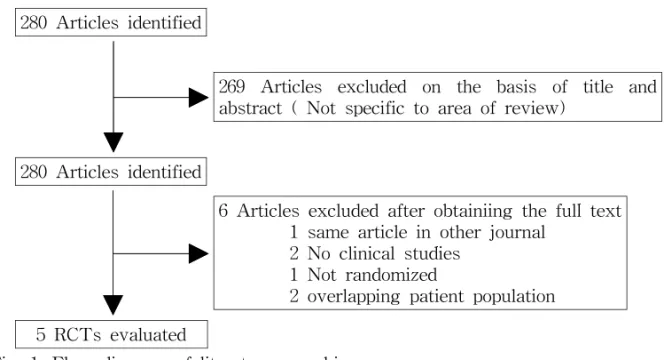
Our search identified 280 articles, of which we excluded 269 on the basis of the title and abstract and 6 studies on the basis of the full text(Fig. 1). In total 5 articles met the inclusion criteria and were included in our study. The trials were conducted between 1997 and 2006.
280 Articles identified
269 Articles excluded on the basis of title and abstract ( Not specific to area of review)
280 Articles identified
6 Articles excluded after obtainiing the full text 1 same article in other journal
2 No clinical studies 1 Not randomized
2 overlapping patient population 5 RCTs evaluated
Fig. 1. Flow diagram of literature searching
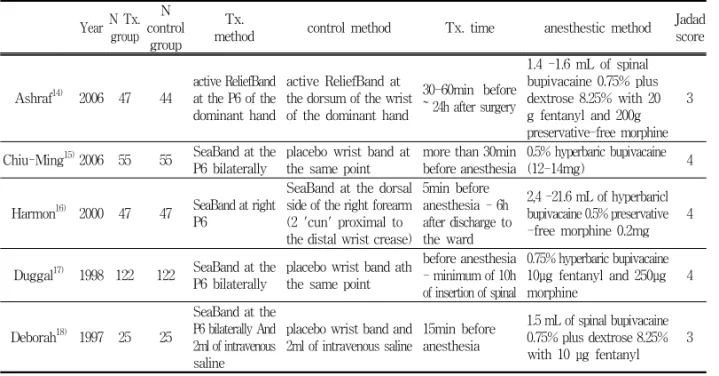
The characteristics of the included studies are shown in Table 1 and the outcomes of the individual studies are summarized in Table 2. Five RCTs were included with 589 parturients undergoing elective cesarean section received spinal anesthesia. Spinal anesthesa was performed using only bupivacaine or
bupivacaine with fentanyl or morphine.
Of the 589, 296 participants received acupuncture-type intervention in the treatment group and 293 participants acted as controls. In all studies participants in the treatment group received band at the P6 point
14-18).
Year N Tx.
group N control
group
Tx.
method control method Tx. time anesthestic method Jadad score
Ashraf
14)2006 47 44
active ReliefBand at the P6 of the dominant hand
active ReliefBand at the dorsum of the wrist of the dominant hand
30-60min before
~ 24h after surgery
1.4 -1.6 mL of spinal bupivacaine 0.75% plus dextrose 8.25% with 20 g fentanyl and 200g preservative-free morphine
3
Chiu-Ming
15)2006 55 55 SeaBand at the P6 bilaterally
placebo wrist band at the same point
more than 30min before anesthesia
0.5% hyperbaric bupivacaine
(12-14mg) 4
Harmon
16)2000 47 47 SeaBand at right P6
SeaBand at the dorsal side of the right forearm (2 'cun' proximal to the distal wrist crease)
5min before anesthesia - 6h after discharge to the ward
2,4 -21.6 mL of hyperbaricl bupivacaine 0.5% preservative -free morphine 0.2mg
4
Duggal
17)1998 122 122 SeaBand at the P6 bilaterally
placebo wrist band ath the same point
before anesthesia - minimum of 10h of insertion of spinal
0.75% hyperbaric bupivacaine 10
μg fentanyl and 250
μg morphine
4
Deborah
18)1997 25 25
SeaBand at the P6 bilaterally And 2ml of intravenous saline
placebo wrist band and 2ml of intravenous saline
15min before anesthesia
1.5 mL of spinal bupivacaine 0.75% plus dextrose 8.25%
with 10
μg fentanyl 3
Tx, Treatment; N, number of patients
Table 1. Summary of main features of RCTs
Author(y) N Tx.
group N control
group
n
Intraoperative nausea
n
Intraoperative vomiting
n postoperative nausea
n
postoperative vomiting Tx. control
Pvalue Tx. control
Pvalue Tx. control
Pvalue Tx. control
Pvalue
Ashraf
14)47 44 14
(29.79%) 19
(43.18%) 0.186 6 (12.77%)
4
(9.09%) 0.577 11 (23.40%)
18
(40.91%) 0.076 12 (25.53%)
16 (36.36%) 0.265 Chiu-Ming
15)55 55 35
(63.64%) 39
(70.91%) 0.417 12 (21.82%)
15
(27.27%) 0.507 - - - - - -
Harmon
16)47 47 7
(14.89%) 17
(36.17%) 0.021 4 (8.51%)
8
(17.02%) 0.225 4 (8.51%)
6
(12.77%) 0.506 13 (27.66%)
25 (53.19%) 0.013 Duggal
17)122 122 33
(27.05%) 37
(30.33%) 0.571 8 (6.56%)
8
(6.56%) 1.000 69 (56.56%)
80
(65.57%) 0.149 50 (40.98%)
56 (45.90%) 0.439
Deborah
18)25 25 6
(24.00%) 19
(76.00%) 0.000 3 (12.00%)
6
(24.00%) 0.278 - - - - - -
Significant differences: P<0.05, in bold. Tx, Treatment; N, number of patients; n, number of patients with the event; -, not reported
Table 2. Outcomes of the individual studies
One study used ReliefBand for transcutaneous acupoint electrical stimulation
14). And four studies used SeaBand at the P6 point
15-18). The SeaBand is a commercially available elastic wrist band with a small round plastic button on the inner side to pressure the acupoint. Two studies used active band at dorsum of the wrist or forearm in the control group
14,16). And three studies used placebo wrist band at the same point of the treatment group in the control group
15,17,18). All were conducted in a hospital setting. The methodologic quality was considered good: 3 points on the Jadad scale were given to 2 trials
14,18)and 4 points to 3 trials
15-17). Ashraf et al
14)conducted a randomized, double-blind controlled trial in 94 paturients. The treatment group who received active ReliefBand at the P6 of the dominant hand (n=47) was compared with the control group who received active ReliefBand at the dorsum of the wrist of the dominant hand(n=44). The incidence of nausea and vomiting was recorded and severity of nausea was assessed using a VRS (0-10). There was a trend towards less intraoperative and postoperative nausea, postoperative vomiting rate in the treatment group, but these differences did not achieve statistical significance.
As its sample size calculation was based on an expected decrease of 30%, statistically singnificant differences were not detected.
A randomized, double-blind controlled trial was performed by Chiu-Ming et al
15)in 110parturients. Paturients were randomly assigned to either receive Seaband(n=55) or placebo wrist band (n=55) bilaterally at the P6 acupoint.
Of the 55 parturients in the acupressure group, 1 received IV metoclopramide for intractable vomiting, whereas 2 of the 55 parturients in the control group required the same treatment (difference not statistically significant). The incidence of intraoperative nausea in the acupressure group was 64% compared with 71% in the control group(OR=0.718, 95%CI:
0.323-1.598, P=0.417); the incidence of intraoperative vomiting was 22% in the acupressure group and 27% in the control group(OR=0.744, 95%CI: 0.311-1.718, P=0.507). There were no statistically significant differences between two groups.
No adverse effect was noted after the use of either SeaBand or placebo wrist band.
Harmon et al
16)conducted a prospective, randomized, double-blind study in 94 parturients. The treatment group(n=47) received SeaBand at right P6 acupoint.
And the control group(n=47) received
SeaBand at the dorsal side of the right
forearm, 2 'cun' proximal to the distal
wrist crease. There was a statistically
significant reduction in intraoperative
nausea (OR=0.309, 95%CI: 0.114-0.839,
P=0.021) in the treatment group
compared with control group. After
operations there was a statistically
significant reduction in vomiting (OR=0.336, 95%CI: 0.143-0.794, P=0.013) in the treatment group. 23 patients (50%) in the control group and 12 (25%) in the treatment group required rescue anti- emetic in the study period (P=0.01).
There was a statistically significant difference in anti-emetic requirement during and after operations. If patients who received an anti-emetic intra-operatively were excluded, the protective effect of acupressure remained. With this analysis the use of acupressure reduced the incidence of nausea and vomiting(95%
CI 0.37-0.18, P=0.0002) from 87%(35/40) to 50%(23/46), and antiemetic requirement (95% CI 0.21-0.20, P=0.03) from 47%(19/40) to 26%(12/46) compared with placebo.
The side effect of acupressure band was some localized discomfort in a small number of women.
A randomized, double-blind controlled trial was performed by Duggal et al
17)in 244parturients. Paturients were randomly assigned to either receive Seaband(n=122) or placebo wrist band(n=122) bilaterally at the P6 acupoint. Number of bouts of dizziness, vomiting were recorded, and horizontal 10cm Visual Analogue Scale(VAS) was used to indicate the severity of nausea.
There was no statistically significant inter-group difference in the intraoperative incidence of nausea, vomiting, retching, or the amount of antiemetic medication administered. Thirty-seven patients in the control group and 33 in the
treatment group reported nausea intraoperatively (OR=0.852, 95%CI:
0.489-1.485, P=0.571). Only eight patients in each group vomited or retched during surgery, and incidence of 6.6%(OR=1.000, 95%CI: 0.363-2.756, P=1.000). The use of acupressure reduced the incidence of postoperative nausea(OR=0.683, 95%CI:
0.407-1.147, P=0.149) and vomiting (OR=0.818, 95%CI: 0.493-1.359, P=0.439) compared with placebo, but it is not statistically significant. However, postoperative nausea and vomiting were significantly reduced in a sub-group of patients who gave a history of previous PONV. Acupressure was associated with a statistically significant reduction in nausea postoperatively when compared with placebo (55.6% vs 85%, P<0.05) in the patients who had experienced nausea or vomiting after previous surgery. Furthermore, in the same group of patients the incidence of postoperative vomiting/retching was lower in the acupressure group (41.7% vs 67.5%, P<0.025). The most common side-effect reported(by 17.6% of patients overall) was swelling of the hands with prolonged wearing of the wristbands.
Deborah et al
18)conducted a prospective,
randomized, double-blind study in 75
healthy parturients. Patients were
randomized via an envelope system into
one of three groups, 25patients per
group. GroupⅠpatients received acupressure
bands and 2mL IV saline, GroupⅡ
Patients received placebo wrist bands
and 10mg IV metoclopramide, and GroupⅢ patients received placebo wrist bands and 2mL IV saline. In this review, we analysised only groupⅠ and groupⅢ. Because we limited the control interventions to usual care only or placebo acupuncture. GroupⅠpatients had much less intraoperative nausea than groupⅢ patients(OR=0.100, 95%CI:
0.027-0.365, P=0.000). Although groupⅠ patients had less intraoperavie vomiting than groupⅢ patients(OR=0.432, 95%CI: 0.095-1.966, P=0.278), it is not statistically significant. However, when the analysis was restricted to hypotensive patients (systolic blood pressuer<100mmHg), the proportion of patients with nausea was significatly less among groupI patients than among
groupⅢ patients(37.5% vs 78.9%, P<0.05).
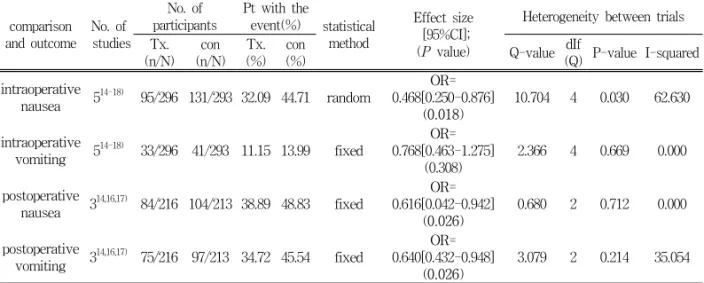
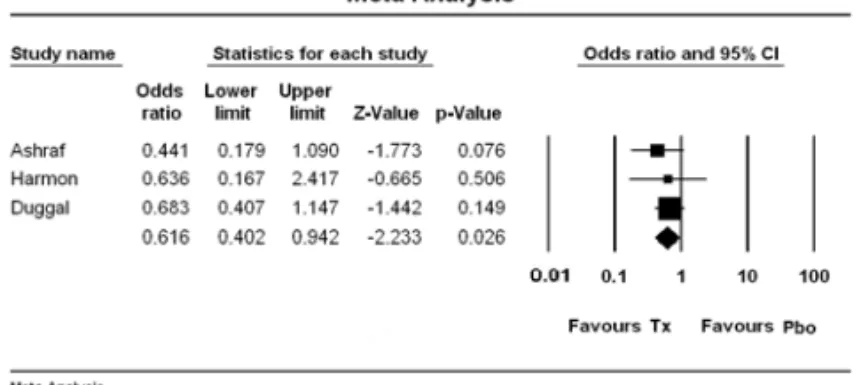
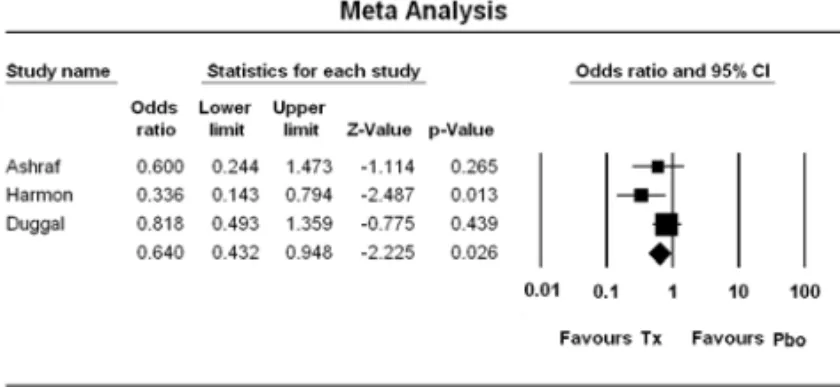
Table 3 and Fig. 2 - Fig. 5 show the comparisons of the available data and meta-analyses for the incidence of intraoperative or postoperative nausea and vomiting. Tests for significance and heterogeneity among trials are also prsented. There is a statistically significant reduction in intraoperative nausea (OR
=0.468, 95%CI: 0.250-0.876), postoperative nausea (OR=0.616, 95%CI: 0.042-0.942, P=0.026) and postoperative vomiting (OR=0.640, 95%CI: 0.432-0.948, P=0.026) in the treatment group compared with control group. But there is no statistically significant differences between two groups in intraoperative vomiting (OR=0.768, 95%CI: 0.463-1.275, P=0.308).
comparison and outcome
No. of studies
No. of participants
Pt with the
event(%) statistical method
Effect size [95%CI];
(P value)
Heterogeneity between trials Tx.
(n/N) con (n/N)
Tx.
(%) con
(%) Q-value dIf
(Q) P-value I-squared intraoperative
nausea 5
14-18)95/296 131/293 32.09 44.71 random
OR=
0.468[0.250-0.876]
(0.018)
10.704 4 0.030 62.630
intraoperative
vomiting 5
14-18)33/296 41/293 11.15 13.99 fixed
OR=
0.768[0.463-1.275]
(0.308)
2.366 4 0.669 0.000
postoperative
nausea 3
14,16,17)84/216 104/213 38.89 48.83 fixed
OR=
0.616[0.042-0.942]
(0.026)
0.680 2 0.712 0.000
postoperative
vomiting 3
14,16,17)75/216 97/213 34.72 45.54 fixed
OR=
0.640[0.432-0.948]
(0.026)
3.079 2 0.214 35.054
Significant differences: P<0.05, in bold. Tx, Treatment; N, number of patients; n, number of patients with the event
Table 3. Comparisons and pooled outcomes for which there are data showing the
effect size
Fig. 2. Odds ratio and 95% confidence intervals of intraoperative nausea
Odds ration and 95% confidence intervals of intraoperative nausea for individual study and the pooled results. In this plot the symbol for each study is proportional in area to that study's weight in the analysis.
Fig. 3. Odds ratio and 95% confidence intervals of intraoperative vomiting
Odds ration and 95% confidence intervals of intraoperative vomiting for individual study and the pooled results. In this plot the symbol for each study is proportional in area to that study's weight in the analysis.
Fig. 4. Odds ratio and 95% confidence intervals of postoperative nausea
Odds ration and 95% confidence intervals of postoperative nausea for individual study and the pooled results. In this plot the symbol for each study is proportional in area to that study's weight in the analysis.
Fig. 5. Odds ratio and 95% confidence intervals of postoperative vomiting
Odds ration and 95% confidence intervals of postoperative vomiting for individual study and the pooled results. In this plot the symbol for each study is proportional in area to that study's weight in the analysis.