고형암 환자의 수술 후 통증에 대한 침 치료 효과 : 체계적 문헌고찰 및 메타분석
윤성수․류한성․오혜경․이지영․윤성우*
강동경희대학교병원 한방암센터 한방내과
Abstract
The Efficacy of Acupuncture for Postoperative Pain in Patients with Solid Tumor :
A Systematic Review and Meta Analysis
Sung Soo Yoon, Han Sung Ryu, Hye Kyung Oh, Jee Young Lee, Seong Woo Yoon*
Department of Korean Internal Medicine, Korean Medicine Cancer Center, Kyung Hee University Hospital at Gangdong
Received 08 December 2017, accepted 20 December 2017Objectives: Postoperative pain is one of postoperative complications in patients with solid tumor.
This systematic review and meta-analysis were aimed to evaluate the efficacy of acupuncture for postoperative pain in solid tumor.
Methods: We searched for randomized controlled trials (RCTs) using acupuncture for postoperative pain in adult patients with solid tumor up to September 2016. Acupuncture was defined as manual acupuncture, electroacupuncture and pharmacopuncture. The following databases were searched: PubMed, EMBASE, Cochrane Library, CNKI, CiNii, KoreaMed, Kmbase, KISS, NDSL, KISTI. The results of the studies were meta-analyzed and the risk of bias was assessed.
Results: Five studies were included in this review. When acupuncture was compared with usual care, Prince-Henry pain scale score was significantly lower in acupuncture group (MD=-0.44, 95% CI: -0.62 to -0.26, P<0.001, I
2=87%) and 10 points pain score (including Numeric Rating Scale and Visual Analog Scale) was lower in acupuncture group but not significantly (MD=-1.00, 95% CI: -2.00 to -0.00, p=0.05). When acupuncture was compared with sham
*교신저자 : 윤성우(Seong Woo Yoon)
서울시 강동구 동남로 892 강동경희대학교병원 한방암센터 한방내과 Tel: 02-440-7279, Fax: 02-440-7287
E-mail: [email protected]
acupuncture, 10 points pain score was significantly lower in acupuncture group (MD=-0.39, 95%
CI: -0.65 to -0.14, p=0.002, I
2=0%). Any serious adverse events were not reported.
Conclusion: This review shows that acupuncture may be considered for postoperative pain in patients with solid tumor without serious adverse events. However, only a few studies were included in this study, further investigation is needed in this area.
Key words: Cancer, Postoperative pain, Acupuncture, Korean medicine, Complementary and alternative medicine
서 론
암은 전 세계적으로 두 번째로 높은 사망 원 인을 차지하며 지난 10년간 암 환자 발생수는 33% 증가하였다. 평생 암에 한 번이라도 걸릴 확률은 남성은 3명 중 1명, 여성은 4명 중 1명 꼴로 분석됐으며 세계보건기구(WHO) 산하 국 제암연구소는 인구 증가와 고령화 추세 등으로 암 발생 및 사망자 수가 매년 1%씩 증가할 것 으로 예상했다1). 국내에선 2016년 가장 높은 사망 원인을 차지했으며 전체 사망자의 27.8%
인 78,194명이 암으로 사망하였다2).
수술은 절제 가능한 암에서 일차적으로 적용 되는 유일한 완치적 치료법이다. 수술 후 80%
가 넘는 환자들이 수술 후 통증을 경험했으며 이들 중 74%는 퇴원 후에도 여전히 중등도 이 상의 통증을 호소한다3). 환자의 절반 이하에서 만 수술 후 적절한 통증 완화가 보고되기도 하 며4) 부적절한 통증 조절은 삶의 질, 기능 회복, 수술 후 합병증 위험성, 지속되는 수술 후 통증 위험성에 부정적인 영향을 미치므로5) 반드시 적절한 관리가 필요하다.
National Comprehensive Cancer Network (NCCN)의 암 환자 통증 관리 가이드라인에서 는 수술 후 통증에 급, 만성 모두 약물 치료를 권고하며 만성의 경우 침 치료를 포함한 인지 치료, 재활 치료 등의 비약물 치료를 권고하고
있다6). 약물 치료로는 아편 유사체(opioids)를 포 함한 마약성 진통제가 보편적이나 호흡 기능 저하, 졸음, 기면 등의 부작용을 유발하므로7) 약물 의존도 및 요구량을 줄이기 위한 보조요 법들이 시도되며 임상에서는 일반침, 전기침, 봉침을 포함하는 다양한 침 치료도 이용되고 있다.
임상 현장에서 고형암 환자의 수술 후 통증 관리를 위해 침 치료가 이용되고 있으나 아직 까지 이에 대한 체계적 고찰 및 메타분석이 시 행되지 않은 상태이다. 따라서 본 연구는 기존 의 무작위 대조 임상연구를 대상으로 체계적 고찰 및 메타분석을 시행하여 고형암 환자의 수술 후 통증에 대한 침 치료 효과에 대해 과 학적인 근거를 살펴보고자 하였다.
방 법
1. 검색 전략
2016년 9월까지 국내외에 발표된 논문을 대 상으로 국외 검색 databases (DB)는 PubMed, EMBASE, Cochrane Library, CNKI, CiNii를 선정 하였고, 국내 검색 DB는 KoreaMed, Kmbase, KISS, NDSL, KISTI를 선정하였다.
고형암 환자의 수술 후 통증에 대한 침 치료
연구를 검색하기 위해 “(Neoplasm OR cancer OR tumor OR malignant) AND (postoperative pain) AND (Acupuncture OR dry needling OR electroacupuncture OR pharmacopuncture OR herbal acupuncture OR bee venom)”을 검색어로 검색하였다.
포함된 연구의 참조 목록은 포함 기준을 충 족하는 추가 연구를 위해 조사되었다. 메타 분 석의 검색 전략 및 보고 방식은 preferred reporting items for systematic reviews and meta-analyses (PRISMA) 규정8)에 따라 수행하 였다.
2. 선정 기준 및 배제 기준
확인된 논문의 제목과 초록을 검토하여 다음 의 기준을 충족시킬 때 포함되었다. (1) 18세 이상 성인 고형암 수술 후 급, 만성 통증을 호 소하는 환자, (2) 수술 후 중재술로 일반침, 전 침, 약침, 봉침 등의 침구 치료를 사용, (3) 무 작위 대조 임상 연구(RCTs), (4) 결과값으로 수 술 후 통증을 지표로 삼은 것. 상기 기준을 충 족시키는 논문 중 한국어, 영어, 중국어, 일본어 로 작성된 전문 원고를 구할 수 있는 논문이 포함되었다. 제목과 초록에서 포함기준을 충족 시킬 가능성이 있을 경우엔 해당 논문의 전문 이 검토되었다. 다음의 기준에 해당할 경우 배 제되었다. (1) 예비연구, (2) 중재술이 지압 (acupressure)과 Transcutaneous electrical acupoint stimulation (TEAS)를 사용, (3) 병행치료. 포함 및 배제를 확인하는 과정은 두 명의 검토자 (RHS, OHK)가 독립적으로 수행하였다. 검토자 사이의 불일치는 합의를 도출하기 위해 자격 기준(eligibility criteria) 및 연구 정보에 대한 논 의를 거쳐 해결하였다.
3. 비뚤림 위험 평가
Cochrane Handbook의 비뚤림 위험(Risk of Bias) 평가법9)을 사용하여 무작위 배정 순서 생 성, 배정 순서 은폐, 연구 참여자와 연구자의 눈가림, 결과 평가자의 눈가림, 불완전한 결과 의 처리, 선택적 결과보고, 잠재적인 다른 비뚤 림 위험의 7가지 영역으로 평가하였으며, 세부 판정 기준은 NECA 체계적 문헌 고찰 매뉴얼10) 을 참고하였다.
각 문항에 대하여 문헌의 본문에 어떠한 내 용이 있는지에 따라 비뚤림 위험이 “높음(high risk of bias)”, “낮음(low risk of bias)”, “주어진 자료로 판단이 불가능한 경우(unclear risk of bias)”로 판정하였다. 검토자 사이에 의견 불일 치가 발생한 경우 재논의 하였으며 제3자로부 터 의견을 구하였다.
4. 자료 추출
두 명의 검토자(OHK, RHS)가 독립적으로 선정된 논문의 전문 원고를 검토하여 정보를 추출하였다. 환자의 특성, 연구 디자인, 연구 기 간, 적용된 중재법, 평가지표, 주요결과 이상반 응 등을 요약하여 정리하였다. 자료가 불충분하 거나 논란의 여지가 있는 경우 원저자와 연락 하려고 시도하였으며 회색 문헌은 배제되었다.
회색 문헌은 원시데이터, 레터, 통계문서, 기타 보고서, 아직 출판되지 않은 문헌 및 프로토콜 문헌으로 정의하였다. 검토자 사이에 의견 불일 치가 발생한 경우 재논의 하였으며 제3자로부 터 의견을 구하였다.
5. 자료 분석
개별 연구결과를 종합하여 분석하기 위해 연 구간 이질성이 예상될 때 변량 효과 모형 (random effects model)을 이용하여 메타분석을 수행하였으며 이분형 자료의 경우 상대위험도 (Risk ratio, RR)와 양측 95% 신뢰구간을 이용하
여 표시하였고 연속형 자료의 경우 평균차 (mean difference, MD)를 95% 신뢰구간과 함께 표시하였다. 개별 분석에서 이질성은 I2를 이용 하여 나타내었다. 통계분석은 Cochrane Collaboration Software인 Review Manager (RevMan) Version 5.3 for Windows11)를 이용하였다.
결 과
1. 문헌 선정
국내외 10개의 데이터베이스를 통해서 검색 된 1,265건의 논문과 원문을 읽는 과정에서 얻 어진 추가논문 1건을 포함하여 총 1,266건의 논문이 선정되었다. 먼저 중복된 148건의 논문
을 제외하였고 제목과 초록을 검토하여 본 연 구와 관련 없는 953건의 논문을 제외하였다. 남 은 165건의 논문은 원문을 검토하여 임상연구 가 아닌 경우(n=38), RCT가 아닌 경우(n=1), 수술과 관련되지 않은 경우(n=2), 수술 후 통증 이 아닌 경우(n=96), 장폐색과 관련된 통증인 경우(n=7), 중복 출판인 경우(n=5), 회색 문헌 인 경우(n=2), 선정 기준에 부합하지 않는 경우 (n=9)를 제외 후 최종적으로 5건의 논문이 선 정되었다(Figure 1).
2. 연구 특성
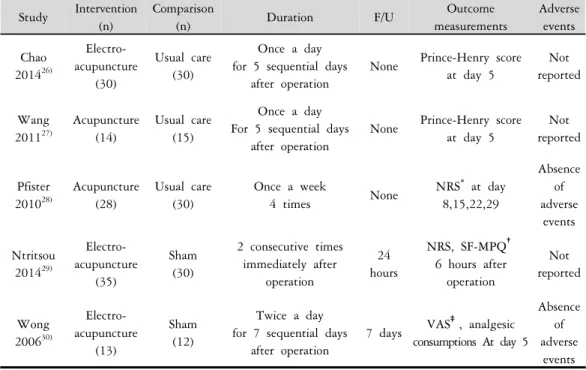
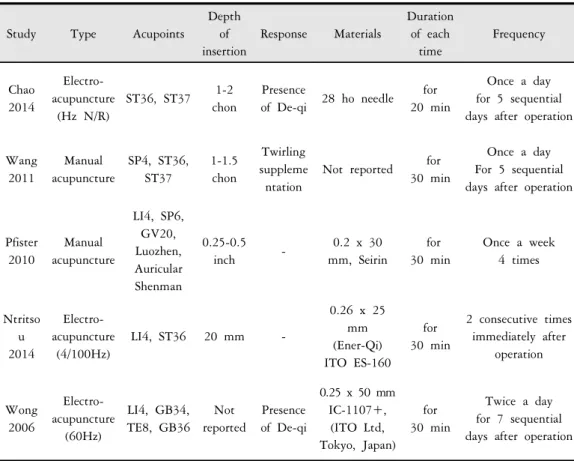
238명의 참가자가 포함된 5건의 선정 논문의 특성은 Table 1에 요약하였으며, 침 시술 방법 은 Table 2에 제시하였다. 시험군과 대조군을
Study Intervention (n)
Comparison
(n) Duration F/U Outcome
measurements
Adverse events Chao
2014
26)Electro- acupuncture
(30)
Usual care (30)
Once a day for 5 sequential days
after operation
None Prince-Henry score at day 5
Not reported
Wang 2011
27)Acupuncture (14)
Usual care (15)
Once a day For 5 sequential days
after operation
None Prince-Henry score at day 5
Not reported
Pfister 2010
28)Acupuncture (28)
Usual care (30)
Once a week
4 times None NRS
*at day 8,15,22,29
Absence of adverse
events Ntritsou
2014
29)Electro- acupuncture
(35)
Sham (30)
2 consecutive times immediately after
operation
24 hours
NRS, SF-MPQ
†6 hours after
operation
Not reported
Wong 2006
30)Electro- acupuncture
(13)
Sham (12)
Twice a day for 7 sequential days
after operation
7 days VAS
‡, analgesic consumptions At day 5
Absence of adverse
events
Abbreviation*NRS: Numerical Rating Scale, †SF-MPQ: Short Form-McGill Pain Questionnaire, ‡VAS : Visual Analogue Scale
Table 1. General Characteristics of Included Trials.
Study Type Acupoints
Depth of insertion
Response Materials
Duration of each
time
Frequency
Chao 2014
Electro- acupuncture
(Hz N/R)
ST36, ST37 1-2 chon
Presence
of De-qi 28 ho needle for 20 min
Once a day for 5 sequential days after operation
Wang 2011
Manual acupuncture
SP4, ST36, ST37
1-1.5 chon
Twirling suppleme ntation
Not reported for 30 min
Once a day For 5 sequential days after operation
Pfister 2010
Manual acupuncture
LI4, SP6, GV20, Luozhen, Auricular Shenman
0.25-0.5
inch - 0.2 x 30
mm, Seirin
for 30 min
Once a week 4 times
Ntritso u 2014
Electro- acupuncture
(4/100Hz)
LI4, ST36 20 mm -
0.26 x 25 mm (Ener-Qi) ITO ES-160
for 30 min
2 consecutive times immediately after
operation
Wong 2006
Electro- acupuncture
(60Hz)
LI4, GB34, TE8, GB36
Not reported
Presence of De-qi
0.25 x 50 mm IC-1107+,
(ITO Ltd, Tokyo, Japan)
for 30 min
Twice a day for 7 sequential days after operation
Table 2. Acupuncture Method of Included Trials.Study
Random sequence generation
Allocation concealment
Blinding of participants and personnel
Blinding of outcome assessment
Incomplete outcome
data
Selective reporting
Other bias
Chao
2014 Low Unclear High Unclear Low Unclear Low
Wang
2011 Low Unclear Unclear Unclear Low Unclear Low
Pfister
2010 Low Low Low Unclear Unclear Low Low
Ntritsou
2014 Low Unclear High Unclear Low Unclear Low
Wong
2006 Low Low Low Low Unclear Unclear Low
Table 3. Results of Risk of Bias Assessment for included studies.
살펴보면 전침을 통상치료(usual care)와 비교한 논문 1건27), 일반침을 통상치료와 비교한 논문
2건28),29), 전침을 sham침과 비교한 논문 2건이
30),31) 있었다. 치료기간은 짧게는 수술 후 1시간
에서 4주간으로 다양하였고 중앙값은 수술 후 5일간 이었다. 추적관찰은 없는 경우가 3건 수
Identification
Records identified through database searching
(n = 1265) PUBMED: 125
EMBASE: 299 CENTRAL: 94 CNKI: 331
CINII: 11 KISS: 27 KMBASE: 332
NDSL: 44 KISTI: 2 KOREAMED: 0
Additional records identified through other sources
(n=1)
↓ ↓
Screening
Records after duplicates removed (n=148)
↓ Records screened
(n=1118) → Records excluded
(n=953)
↓
Eligibility Full-text articles assessed for eligibility
(n=165) →
Full-text articles excluded, with reasons
(n=160) Not clinical trials: 38
Not RCT: 1 Not related to surgery: 2 No postoperative pain: 96 Pain related to ileus : 7 Duplicated publication : 5
Grey material : 2 Not inclusion criteria: 9
↓
Included
Studies included in qualitative synthesis
(n=5)
↓
Studies included in quantitative synthesis (meta-analysis)
(n=5)
Figure 1. Flowchart of the trials selection process.술 후 24시간, 7일간으로 분포했다.
5건의 논문에서 제1평가지표로 사용한 통증 척도로는 Prince-Henry가 2건, Numeric Rating Scale(NRS)가 2건, Visual Analog Scale(VAS)가 1 건이었고 통증척도 외에 Short Form-McGill Pain Questionnaire(SF-MPQ)나 진통제 소모량을 부가 적인 평가지표로 사용하였다.
3. 비뚤림 위험 평가
선정된 5건의 비뚤림 위험 평가 결과는 Table 3에 제시하였다. 무작위 배정 순서 생성 은 5건 모두 비뚤림 위험이 낮았다. 결과 평가
자의 눈가림과 선택적 결과보고 항목은 5건 중 4건이 주어진 자료로 판단이 불가능했다. 연구 참여자와 연구자의 눈가림은 5건 중 2건에서 비뚤림 위험이 높았다. 잠재적인 다른 비뚤림 위험은 낮았다.
4. 치료 효과
(1) 침치료와 통상치료 전후 Prince-Henry 점 수 비교
2건의 논문27),28)으로 메타분석을 시행하여 침 치료와 통상치료 전후의 Prince-Henry 점수를
Figure 2. PRINCE-HENRY score after intervention (acupuncture vs usual care)
Figure 3. 10-point scale pain score after intervention (acupuncture vs usual care)
Figure 4. 10-point scale pain score after intervention (acupuncture vs sham-acupuncture)
비교하여 분석한 결과 통상치료에 비하여 침치 료에서 점수가 유의하게 감소하였다(MD=-0.44, 95% CI: -0.62 to -0.26, P<0.001, I2=87%)(Figure 2).
(2) 침치료와 통상치료 전후 통증강도 점수 비교
1건의 논문29)으로 메타분석을 시행하여 침치 료와 통상치료 전후의 통증강도 점수를 비교하 여 분석한 결과 통상치료에 비하여 침치료에서 점수가 낮았으나 유의한 차이는 보이지 않았다 (MD=-1.00, 95% CI: -2.00 to -0.00, p=0.05)(Figure 3).
(3) 침치료와 sham침치료 전후 통증강도 점 수 비교
2건의 논문30),31)으로 메타분석을 시행하여 침 치료와 sham침치료 전후의 통증강도 점수를 비 교하여 분석한 결과 sham침치료에 비하여 침치 료에서 점수가 유의하게 감소하였다(MD=-0.39, 95% CI: -0.65 to -0.14, p=0.002, I2=0%)(Figure 4).
5. 이상 반응
선정된 5건의 논문 중 2건29),31)에서 부작용을 보고하였는데 2건의 논문 모두 침 치료로 인한 심각한 이상반응은 없었다.
고 찰
고형암 환자의 수술 후 통증에 있어 침구치 료의 효과를 종합 검토하고자 본 연구를 계획 하였다. 한국의 임상 환경을 고려하여 지압 (Acupressure)이나 Transcutaneous electrical acupoint
stimulation (TEAS)와 같이 다용되지 않는 침 시 술 방법은 배제하였으며 초기 연구 디자인에는 중재법에 뜸 치료를 포함하였으나 최종적으로 포함 기준을 충족시키는 뜸 관련 연구가 존재 하지 않았다.
최종적으로 선정된 5건의 논문을 종합해보면 침치료를 시행한 군은 통상치료만 시행한 군에 비하여 통증 점수가 유의하게 낮은 경향이 있 었으나 점수 척도별로 통계적 유의성이 확인된 군과 그렇지 않은 군이 있었다. Prince-Henry 점 수는 유의미하게 낮았고 10점 척도 통증 점수 (NRS)는 낮지만 통계적으로 유의하지는 않았다.
sham침치료를 시행한 군에 비교하였을 때도 치 료 종료 후 10점 척도 통증 점수(NRS, VAS)가 통계적으로 유의하게 낮아졌다. 따라서 침구치 료는 맹검 여부에 상관없이 수술 후 통증을 경 감시키는 데 효과가 있는 것으로 여겨진다.
5건의 논문 중 2건에서만 부작용을 보고하여 전체적으로 부작용 보고가 충분하지 않았다. 다 만 부작용을 보고한 논문은 모두 침치료로 인 한 심각한 이상반응은 없다고 하여 훈련된 전 문가에 의해 시행될 경우 침치료는 상대적으로 안전한 치료법이 될 수 있을 것으로 사료된다.
전통적인 동양의학에서는 체내 경락을 통해 순환하고 있는 기 흐름에 문제가 생기면 질병 이 발생하며 침구 치료를 통해 경락 상의 경혈 을 자극하면 음양의 균형이 회복되는 방식으로 치료에 접근하였다12).
신경생리학적인 측면에서 중추, 말초신경 모 두 침의 치료 효과에 기여할 수 있다13). 침 자 극은 신경의 말초부, 척수부, 척수 상위부의 세 가지 수준에서 효과를 발휘한다. 말초부에서는 림프구, 단핵구/대식세포, 과립구로부터 내인성 아편 유사체의 분비를 촉진하여 신경 말단에서 침해 수용을 억제한다. 척수부에서는 유해자극 입력 전달을 차단하며 opioid, noradrenaline, 5-hydroxytryptamine (5-HT) 수치를 증가시키는 효과가 있다. 척수 상위부에서는 대봉선핵(nucleus
raphe magnus), 수관주위 회색질(periaqueductal gray)을 포함한 다수의 세포핵을 통해 통증의 감각적이고 정서적인 요소를 억제한다14). 따라 서 침은 수술 후 통증을 포함한 다양한 통증 질환에 적용 가능하다.
본고에서는 국내 임상 환경을 고려하여 수술 후 단계로 국한하여 연구를 시행하였지만 침 치료는 수술 전, 중 단계에서도 적용 가능한 치 료법이다. 수술 전 단계에서는 수술 전 불안감 을 경감시키는데 적용 가능하며15) 수술 중 단계 에서는 마취제 및 진정제의 보조 수단으로 적 용 가능하다16).
수술 후 단계에서는 본고에서 논의한 수술 후 통증 외에도 오심, 구토에 적용이 가능하다.
이미 연구, 리뷰, 메타분석을 통해 수술 후 오 심, 구토 예방에 침 치료가 효과적임이 밝혀졌
으며17-19) NCCN은 암 환자의 항구토 가이드라
인에서 예방이 핵심적임을 말하며 오심, 구토가 예상되는 경우에 침 치료를 권고하고 있다20).
수술 주기의 침 치료는 단순히 마취제나 진 통제 사용량을 줄이는 것을 넘어서 마취제 관 련 합병증을 줄여주거나21) 장기를 보호하는 효
과도22,23) 있다. 고령 환자와 같이 특정 대상군
의 수술 후 합병증 및 사망률 감소와 수술 회 복 향상과 관련해서 침 치료를 적용할 수 있다
24).
임상에서 한의사가 암 환자에게 제공하는 치 료 수단으로 뜸, 한약, 약침과 같은 다양한 한 의학적 중재법들이 있지만25) 연구의 부재로 본 논문에서는 실제 임상의 일부만이 반영되었다.
또한 국내 연구가 전무하여 국내 임상을 정확 하게 반영하고 있는지 의문점이 있어 향후 이 와 같은 점을 반영하는 다양한 한의학적 중재 법이 포함된 양질의 추가 연구가 필요하다. 또 한 양질의 연구의 수가 많지 않아 수기침과 전 침을 하나의 중재로 판단하여 메타분석을 시행 하여, 중재의 정밀성 및 중재법 별 효과 정도의 차이를 명확하게 파악하기가 곤란하였으며 부
작용 보고가 충분하지 않아 추후에 보완할 필 요가 있다.
Acknowledgement
본 연구는 한국보건산업진흥원을 통해 보건 복지부 「한의약선도기술개발사업」의 재정 지원을 받아 수행된 연구임(과제고유번호: HB16C0067).
참고문헌
1. Global Burden of Disease Cancer Collaboration, Fitzmaurice C, Allen C, Barber RM, et al. Global, Regional, and National Cancer Incidence, Mortality, Years of Life Lost, Years Lived With Disability, and Disability-Adjusted Life-years for 32 Cancer Groups, 1990 to 2015: A Systematic Analysis for the Global Burden of Disease Study. JAMA Oncol.
2017;3(4):524-548.
2. 통계청. 2014년 사망원인통계. Available from: URL: http://kostat.go.kr
3. Gan TJ, Habib AS, Miller TE, et al.
Incidence, patient satisfaction, and perceptions of post-surgical pain: results from a US national survey. Curr Med Res Opin. 2014;30(1):149-60.
4. Apfelbaum JL, Chen C, Mehta SS, et al.
Postoperative pain experience: results from a national survey suggest postoperative pain continues to be undermanaged.
Anesth Analg. 2003;97(2):534-40.
5. Kehlet H, Jensen TS, Woolf CJ. Persistent postsurgical pain: risk factors and prevention.
Lancet. 2006;367(9522):1618-25.
6. NCCN. NCCN Clinical Practice Guidelines in Oncology (NCCN Guidelines®), Adult cancer pain. Version 2.2017—May 10, 2017.
Available from: URL: http://www.nccn.org 7. An LX, Chen X, Ren XJ, et al.
Electro-acupuncture decreases postoperative pain and improves recovery in patients undergoing a supratentorial craniotomy.
Am J Chin Med. 2014;42(5):1099-109.
8. Moher D, Liberati A, Tetzlaff J, et al.
Preferred reporting items for systematic reviews and meta-analyses: the PRISMA statement. PLoS Med. 2009;6(7):e1000097.
9. Higgins J, Green S. Cochrane Handbook for Systematic Reviews of Interventions Version 5.1.0 [updated March 2011]. The Cochrane Collaboration, 2011. Available from http://handbook-5-1.cochrane.org.
10. 김수영, 박지은, 서현주, 외. NECA 체계 적 문헌고찰 매뉴얼. p. 1-287. 한국보건 의료연구원. 2011.
11. Review Manager (RevMan) [Computer program]. Version 5.3. Copenhagen: The Nordic Cochrane Centre, The Cochrane Collaboration, 2014.
12. Kaptchuk TJ. Acupuncture: theory, efficacy, and practice. Ann Intern Med. 2002;136(5):374-83 13. Zhao ZQ. Neural mechanism underlying
acupuncture analgesia. Prog Neurobiol.
2008;85(4):355-375.
14. Zhang RX, Lao LX, Ren K, et al. Mechanisms of acupuncture- electroacupuncture on persistent pain. Anesthesiology. 2014;120(2):482-503.
15. Acar HV, Cuvaş O, Ceyhan A, et al.
Acupuncture on Yintang point decreases preoperative anxiety. J Altern Complement Med. 2013;19(5):420-4.
16. Greif R, Laciny S, Mokhtarani M, et al.
Transcutaneous electrical stimulation of an auricular acupuncture point decreases anesthetic requirement. Anesthesiology. 2002;96(2):306-12.
17. Shiao SY, Dune LS. Meta-analyses of acustimulations: effects on nausea and vomiting in postoperative adult patients.
Explore (NY). 2006;2(3):202-15.
18. Lee A, Fan LT. Stimulation of the wrist acupuncture point P6 for preventing postoperative nausea and vomiting.
Cochrane Database Syst Rev. 2009 Apr 15;(2):CD003281.
19. Cho HK, Park IJ, Jeong YM, et al. Can perioperative acupuncture reduce the pain and vomiting experienced after tonsillectomy? A meta-analysis. Laryngoscope. 2016;126(3):608-15.
20. NCCN. NCCN Clinical Practice Guidelines in Oncology (NCCN Guidelines®), Antiemesis.
Version 2.2017—March 28, 2017. Available from: URL: http://www.nccn.org
21. Chao HL, Miao SJ, Liu PF, et al. The beneficial effect of ST-36(Zusanli) acupressure on postoperative gastrointestinal function in patients with colorectal cancer. Oncol Nurs Forum. 2013;40(2):E61-8.
22. Maimer A, Remppis A, Sack FU, et al.
Objectifying acupuncture effects by lung function and numeric rating scale in patients undergoing heart surgery. Evid Based Complement Alternat Med.
2013;2013:219817.
23. Yang C, An L, Han R, et al. Effects of combining electroacupuncture with general anesthesia induced by sevoflurane in patients undergoing supratentorial craniotomy and improvements in their clinical recovery profile & blood enkephalin. Acupunct
Electrother Res. 2012;37:125-38.
24. Lu Z, Dong H, Wang Q, et al. Perioperative acupuncture modulation: more than anaesthesia.
Br J Anaesth. 2015;115(2):183-93.
25. 류한성, 이지영, 오혜경, 외. 한의 암 증 상 완화에 대한 한의사 대상 설문 조사.
대한암한의학회지. 2017;22(1):23-35.
26. 肖超. 电针促进结直肠癌术后胃肠功能 恢复的临床研究. 湖南中医药大学 中医 外科学. 2014. 硕士.
27. Wang H. The clinical study on gastrointestinal function recovery after colorectal carcinoma resection in Fast Track programme using acupuncture.
Nanjing University of Chinese Medicine, Master's Degree 2011.
28. Pfister DG, Cassileth BR, Deng GE, et
al. Acupuncture for pain and dysfunction after neck dissection: results of a randomized controlled trial. J Clin Oncol. 2010;28(15):
2565-70.
29. Ntritsou V, Mavrommatis C, Kostoglou C, et al. Effect of perioperative electroacupuncture as an adjunctive therapy on postoperative analgesia with tramadol and ketamine in prostatectomy: a randomised sham-controlled single-blind trial. Acupunct Med.
2014;32(3):215-22.
30. Wong RH, Lee TW, Sihoe AD, et al.
Analgesic effect of electroacupuncture in postthoracotomy pain: a prospective randomized trial. Ann Thorac Surg.
2006;81(6):2031-6.