INTRODUCTION
Since the laryngeal mask airway (LMA) Classic first became available, supraglottic airways have been widely utilized for air- way management in various clinical situations.
1,2Compared to tracheal intubation, supraglottic airways may be inserted ade- quately with relatively less education and training, and health-
care providers unskilled in tracheal intubation have thus re- cently attempted to insert supraglottic airways for urgent airway care.
3,4Insertion of supraglottic airways using the standard tech- nique based on Brain’s recommendation is not always success- ful. Previous studies have reported success rates of 67–93% for the first attempt at inserting supraglottic airways.
5-7In addition, a degree of skill is required to place supraglottic airways cor- rectly, and suboptimal positioning of the device can give rise to such problems as air leakage or airway obstruction.
8Given the popularity of supraglottic airways among operators with a wide range of experience, alternative methods are required to im- prove the likelihood of successful insertion and obtain optimal positioning.
9Various techniques have been described to ensure a high successful insertion rate.
2,10,11Among the alternative methods, the rotation technique derived from the back-to-front insertion technique of the Guedel airway and consists of inserting the
Standard versus Rotation Technique for Insertion of Supraglottic Airway Devices: Systematic Review and Meta-Analysis
Jin Ha Park, Jong Seok Lee, Sang Beom Nam, Jin Wu Ju, and Min-Soo Kim
Department of Anesthesiology and Pain Medicine, Anesthesia and Pain Research Institute, Yonsei University College of Medicine, Seoul, Korea.
Purpose: Supraglottic airway devices have been widely utilized as an alternative to tracheal intubation in various clinical situa-
tions. The rotation technique has been proposed to improve the insertion success rate of supraglottic airways. However, the clini- cal efficacy of this technique remains uncertain as previous results have been inconsistent, depending on the variable evaluated.
Materials and Methods: We systematically searched PubMed, Embase, and the Cochrane Central Register of Controlled Trials in
April 2015 for randomized controlled trials that compared the rotation and standard techniques for inserting supraglottic airways.
Results: Thirteen randomized controlled trials (1505 patients, 753 with the rotation technique) were included. The success rate at
the first attempt was significantly higher with the rotation technique than with the standard technique [relative risk (RR): 1.13;
95% confidence interval (CI): 1.05 to 1.23; p=0.002]. The rotation technique provided significantly higher overall success rates (RR:
1.06; 95% CI: 1.04 to 1.09; p<0.001). Device insertion was completed faster with the rotation technique (mean difference: -4.6 sec- onds; 95% CI: -7.37 to -1.74; p=0.002). The incidence of blood staining on the removed device (RR: 0.36; 95% CI: 0.27 to 0.47;
p<0.001) was significantly lower with the rotation technique.
Conclusion: The rotation technique provided higher first-attempt and overall success rates, faster insertion, and a lower inci-
dence of blood on the removed device, reflecting less mucosal trauma. Thus, it may be considered as an alternative to the stan- dard technique when predicting or encountering difficulty in inserting supraglottic airways.
Key Words: Airway management, complications, laryngeal masks, supraglottic airways Yonsei Med J 2016 Jul;57(4):987-997
http://dx.doi.org/10.3349/ymj.2016.57.4.987 pISSN: 0513-5796 · eISSN: 1976-2437
Received: July 29, 2015 Revised: October 27, 2015 Accepted: October 28, 2015
Corresponding author: Dr. Min-Soo Kim, Department of Anesthesiology and Pain Medicine, Anesthesia and Pain Research Institute, Yonsei University College of Medicine, 50-1 Yonsei-ro, Seodaemun-gu, Seoul 03722, Korea.
Tel: 82-2-2228-2420, Fax: 82-2-312-7185, E-mail: [email protected]
•The authors have no financial conflicts of interest.
© Copyright: Yonsei University College of Medicine 2016
This is an Open Access article distributed under the terms of the Creative Com- mons Attribution Non-Commercial License (http://creativecommons.org/licenses/
by-nc/3.0) which permits unrestricted non-commercial use, distribution, and repro- duction in any medium, provided the original work is properly cited.
device with a 90- or 180-degree rotation and then rotating it to the final position as it enters the hypopharynx. Several random- ized controlled trials of various types of supraglottic airways have compared the rotation technique to the standard tech- nique, and their results were inconsistent depending on the type of variable that was evaluated.
5,6,8,12-16The purpose of this systematic review and meta-analysis was to confirm the clinical efficacy of the rotation technique compared to the standard technique for inserting supraglottic airways.
MATERIALS AND METHODS
This systematic review and meta-analysis is reported in accor- dance with the Preferred Reporting Items for Systematic Re- views and Meta-Analyses (PRISMA) recommendations.
17A pro- tocol of our study was not registered.
Our systematic review and meta-analysis included prospec- tive randomized controlled trials (RCTs) (including those with crossover designs) that compared standard and 90- or 180-de- gree rotation techniques for placing supraglottic airways under general anesthesia in adults or children. The typical patterns of the rotation technique were summarized as follows. In the 90-de- gree rotation technique, the device was introduced into the mouth and then rotated 90 degrees anticlockwise. The device was advanced into the hypopharynx until resistance was felt and then re-rotated clockwise to the standard orientation. In the 180-degree rotation technique, the device was inserted with its lumen facing backwards. The device was advanced into the hy- popharynx until resistance was felt and then rotated anticlock- wise through 180 degrees.
Two authors (NSB and MSK) independently searched the PubMed, Embase, and Cochrane Central Register of Controlled Trials databases for eligible trials using the following search terms, with no language restriction: “rotation supraglottic air- way,” “rotational supraglottic airway,” “reverse supraglottic air- way,” “rotation laryngeal mask,” “rotational laryngeal mask,” “re- verse laryngeal mask,” “rotation i-gel,” “rotational i-gel,” and
“reverse i-gel.” The searches included all studies published up to April 2015. Both authors independently selected the eligible tri- als. Disagreements over trial selection were resolved via discus- sion with another author (JSL). References cited in the final se- lected articles were also examined to seek potentially eligible trials.
From the selected articles, two authors (JHP and JWJ) inde- pendently collected the following data: journal name, first au- thor’s name, publication year, study design, patient characteris- tics and number, descriptions of insertion method, first-attempt and overall success rates of insertion, insertion time, oropha- ryngeal leak pressure (OLP), fiberoptic view, blood staining on the removed device, and complications such as sore throat. The overall success rate was determined according to the criteria for insertion success, such as the number of insertion attempts or
time limitation, presented in each trial. When the outcomes were reported as median and total or interquartile range, the mean was estimated from the formula described by Hozo, et al.
18using the median and the high and low ends of the range for trials with a sample size of less than 25; the median itself was regarded as the mean value for trials with a sample size of more than 25. The standard deviation was also determined from the formula described by Hozo, et al.
18using the median and the high and low ends of the range for trials with a sample size of less than 15, calculated as the range/4 for trials with a sample size from 15 to 70 and as the range/6 for trials with a sample size greater than 70. Two authors (JHP and MSK) assessed the quality of the studies using the Cochrane Collaboration’s tool for grading the risk of bias in several domains, including selec- tion, performance, detection, attrition, and reporting bias.
19The bias was rated as “low risk,” “high risk,” or “unclear risk.”
Statistical analysis
Comprehensive Meta-Analysis software (version 2.0; Biostat, Englewood, NJ, USA) was used to perform the meta-analyses. If crossover trials were enrolled in this review, we extracted di- chotomous or continuous data, which could conservatively be analyzed as parallel group studies. These outcomes were ana- lyzed with outcomes obtained from parallel group studies on the assumption that there was no possibility of a carry-over ef- fect for the outcomes. All statistical outcomes were presented with 95% confidence intervals (CIs). For dichotomous vari- ables, we calculated the relative risk (RR) at the individual trial level and the pooled RR using the Mantel-Haenszel (M-H) meth- od. For continuous variables, we calculated the mean differ- ence (MD) at the individual trial level and the pooled MD using the inverse variance method or the DerSimonian-Laird (D-L) method in a random-effects model. The chi-squared test and the Q-test were conducted to evaluate heterogeneity. When a p value of less than 0.10 on the chi-squared test or an I
2value of more than 50% was observed, heterogeneity was regarded as substantial, and the random-effects model was applied. Other- wise, the fixed-effect model was applied. Subgroup analyses were performed based on the rotation angles and ages of the enrolled patients. In pooled analyses with substantial heteroge- neity (I
2more than 50%), sensitivity analyses to assess the effects of individual trials were conducted by removing each trial from the analysis. Visual observations of funnel plots and Egger’s lin- ear regression test were performed to assess the possibility of publication bias for outcomes obtained from more than three studies. An asymmetric funnel plot and a p value of less than 0.10 on Egger’s test indicated the possible presence of publication bias.
RESULTS
Our electronic database searching and study selection process
is described in Fig. 1. From the references cited in the 12 articles retrieved from the database searches, we found one additional eligible trial.
9Therefore, we included and analyzed 13 RCTs (1505 patients, 753 with the rotation technique),
5-10,12-16,20,21one of which was a crossover trial.
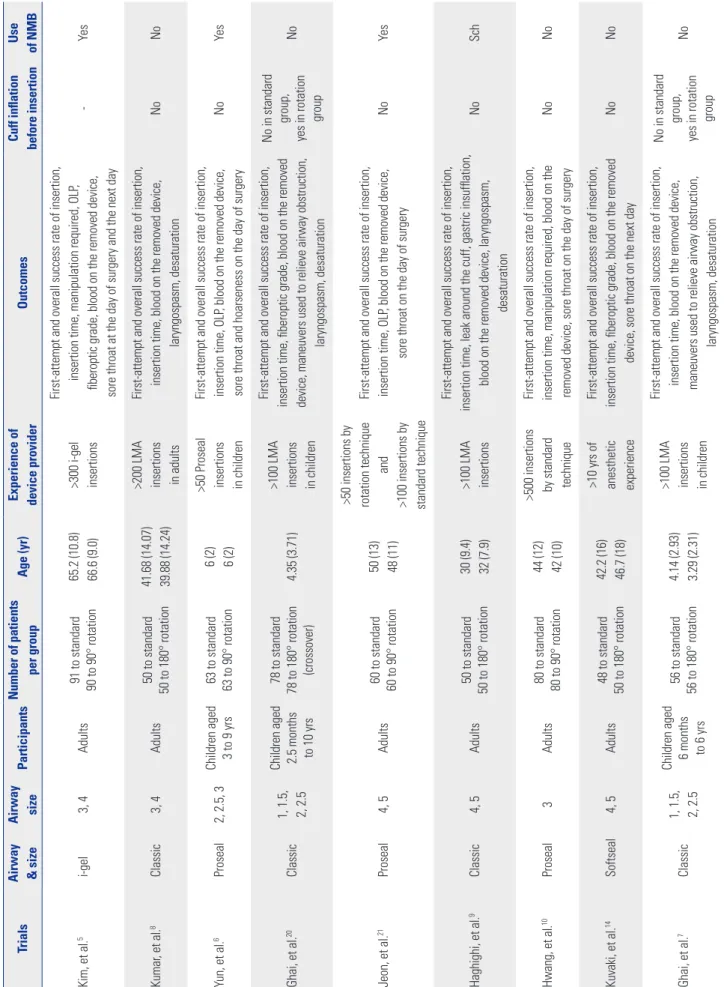
20Characteristics and outcomes of the included articles are summarized in Table 1. Four types of supraglottic airways were used in the included trials: LMA Classic,
7-9,12,13,16,20LMA Proseal,
6,10,15,21SoftSeal,
14and i-gel.
5In six trials conducted in pediatric patients, the rotation angles were 90 and 180 degrees in one
6and five studies,
7,12,13,15,20respectively.
In the remaining seven adult trials, the rotation angles were 90 and 180 degrees in three
5,10,21and four studies,
8,9,14,16respective- ly. In six enrolled trials, jaw relaxation
7,8,12-14,20or ventilation pat- tern
7,20was described as clinical judgment of adequate anes- thetic depth for device insertion. The sniffing position,
5,6,10head extension and neck flexion,
7,8,12,13,20the head resting on a 3-cm pillow,
21and the triple airway maneuver including head exten- sion, mouth opening, and jaw thrust
14were mentioned as the positions for device insertions in the enrolled studies.
In Ghai’s 2008 study,
7a lateral technique using a 45-degree rotation was also compared; however, outcomes from that tech- nique were not included in the current meta-analysis. One study, which was published as correspondence, did not specify
the rotation angle in the manuscript,
15although the angle was determined from the reference cited in the article.
12The risks of bias are summarized in Fig. 2.
Ten studies provided data regarding the insertion success rate at the first attempt.
5-10,12,14,20,21A pooled analysis from these studies showed that the insertion success rate at the first attempt using the rotation technique was significantly higher than that using the standard technique (RR: 1.13; 95% CI: 1.05 to 1.23;
p=0.002; I2
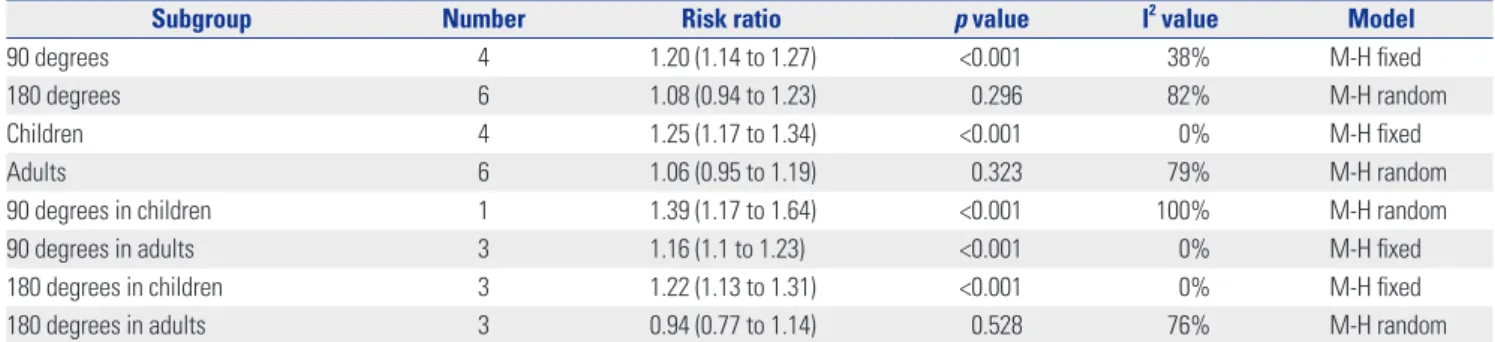
=74%; M-H random). We conducted subgroup anal- yses for the rotation angles and age (Table 2). Subgroup analy- ses of four studies using 90-degree rotation
5,6,10,21and the four studies conducted in children
6,7,12,20indicated superior results for the rotation technique and reduced heterogeneity. Howev- er, we did not know differences between the rotation and stan- dard insertion techniques in the subgroup analysis of the six studies using 180-degree rotation
7-9,12,14,20and the six studies conducted in adults.
5,8-10,14,21In the subgroup analysis of the three studies using 90-degree rotation in adult patients
5,10,21and the three studies using 180-degree rotation in children,
7,12,20better results with no heterogeneity were shown using the rotation technique. However, a subgroup analysis of the three studies using 180-degree rotation in adult patients
8,9,14did not demon- strate an improved success rate with the rotation technique. In the sensitivity analyses, removal of Kuvaki’s study
14from the pooled analysis reduced the heterogeneity (RR: 1.18; 95% CI:
1.13 to 1.23; p<0.001; I
2=26%; M-H fixed). All included studies reported overall insertion success rates. The rotation technique provided significantly higher overall success rates (RR: 1.06; 95%
CI: 1.04 to 1.09; p<0.001; I
2=10%; M-H fixed). Forest plots of the analyses of insertion success rates are depicted in Fig. 3.
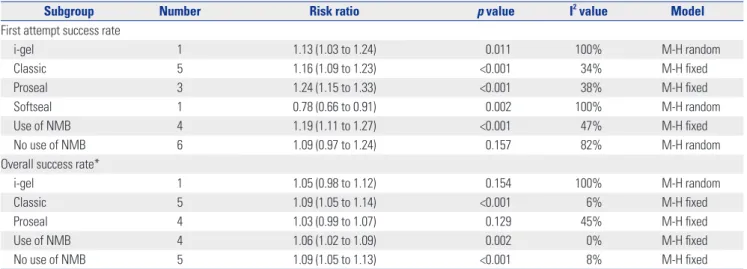
The results of subgroup analyses for the insertion success rate according to the type of supraglottic airway and the use of neu- romuscular blocking drugs are summarized in Table 3. In the subgroup analysis for no use of muscle relaxants, we could not confirm a better result for the insertion success rate at the first attempt in the rotation technique. When Kuvaki’s study
14was removed from this subgroup, a significantly better result with reduced heterogeneity was observed for the rotation technique (RR: 1.17; 95% CI: 1.11 to 1.24; p<0.001; I
2=23%; M-H fixed). In a pooled analysis of second-attempt insertions obtained from eight studies,
5-9,12,14,20a higher insertion success rate for the rota- tion technique was observed compared to the standard tech- nique (RR: 1.42; 95% CI: 1.08 to 1.86; p=0.011; I
2=0%; M-H fixed). The insertion failure rate in the rotation group was sig- nificantly lower than that in the standard group (RR: 0.25; 95%
CI: 0.13 to 0.47; p<0.001; I
2=33%; M-H fixed). The mean number of insertion attempts for successful device insertion in the rota- tion group was significantly lower than that in the standard group (1.17 vs. 1.60; p=0.001).
Insertion time was investigated in 11 studies.
5-10,12,14,15,20,21In one study,
8the outcomes were categorized using 30 seconds as the cut-off time, and there were no significant differences be- tween the two techniques. Thus, a pooled analysis was per-
Fig. 1. Flow diagram showing the trial selection process.555 records identified through database searching (PubMed=103, Embase=407,
Cochrane Library=45)
389 records after 166 duplicates removed
365 records excluded
Excluded (n=12) Conference poster (n=2) No randomized trial (n=10)
1 study added from references
cited in primarily included studies 389 records
screened with titles and abstracts
24 full-text articles assessed for eligibility
12 studies primarily included
13 studies finally included in meta-analysis
Table 1. Characteristics and Outcomes of Randomized Controlled Trials Included in the Meta-Analysis TrialsAirway & sizeAirway sizeParticipantsNumber of patients per groupAge (yr)Experience of device providerOutcomesCuff inflation before insertionUse of NMB Kim, et al.5i-gel 3, 4Adults91 to standard 90 to 90° rotation65.2 (10.8) 66.6 (9.0)>300 i-gel insertions First-attempt and overall success rate of insertion, insertion time, manipulation required, OLP, fiberoptic grade, blood on the removed device, sore throat at the day of surgery and the next day
-Yes Kumar, et al.8Classic3, 4Adults50 to standard 50 to 180° rotation41.68 (14.07) 39.88 (14.24)
>200 LMA insertions in adults
First-attempt and overall success rate of insertion, insertion time, blood on the removed device, laryngospasm, desaturationNoNo Yun, et al.6Proseal2, 2.5, 3Children aged 3 to 9 yrs63 to standard 63 to 90° rotation6 (2) 6 (2)
>50 Proseal insertions in children
First-attempt and overall success rate of insertion, insertion time, OLP, blood on the removed device, sore throat and hoarseness on the day of surgeryNoYes Ghai, et al.20Classic1, 1.5, 2, 2.5
Children aged 2.5 months to 10 yrs 78 to standard 78 to 180° rotation (crossover)4.35 (3.71)>100 LMA insertions in children First-attempt and overall success rate of insertion, insertion time, fiberoptic grade, blood on the removed device, maneuvers used to relieve airway obstruction, laryngospasm, desaturation
No in standard group, yes in rotation group
No Jeon, et al.21Proseal4, 5Adults60 to standard 60 to 90° rotation50 (13) 48 (11)
>50 insertions by rotation technique and >100 insertions by standard technique
First-attempt and overall success rate of insertion, insertion time, OLP, blood on the removed device, sore throat on the day of surgeryNoYes Haghighi, et al.9Classic4, 5Adults50 to standard 50 to 180° rotation30 (9.4) 32 (7.9)>100 LMA insertions First-attempt and overall success rate of insertion, insertion time, leak around the cuff, gastric insufflation, blood on the removed device, laryngospasm, desaturation
NoSch Hwang, et al.10Proseal3Adults80 to standard 80 to 90° rotation44 (12) 42 (10)
>500 insertions by standard technique
First-attempt and overall success rate of insertion, insertion time, manipulation required, blood on the removed device, sore throat on the day of surgery NoNo Kuvaki, et al.14Softseal4, 5Adults48 to standard 50 to 180° rotation42.2 (16) 46.7 (18)
>10 yrs of anesthetic experience
First-attempt and overall success rate of insertion, insertion time, fiberoptic grade, blood on the removed device, sore throat on the next dayNoNo Ghai, et al.7Classic1, 1.5, 2, 2.5
Children aged 6 months to 6 yrs 56 to standard 56 to 180° rotation4.14 (2.93) 3.29 (2.31)
>100 LMA insertions in children First-attempt and overall success rate of insertion, insertion time, blood on the removed device, maneuvers used to relieve airway obstruction, laryngospasm, desaturation
No in standard group, yes in rotation group
No
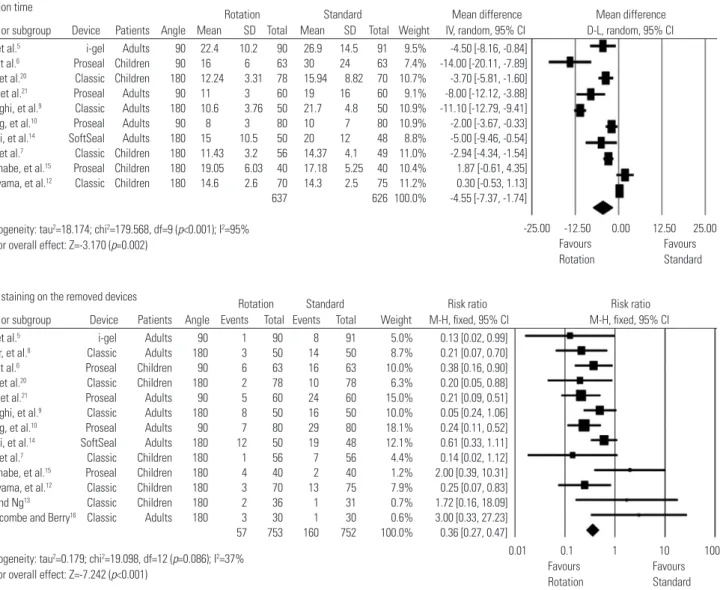
formed using the results of ten studies reporting insertion time as a continuous variable. When using the rotation technique, device insertion was established more rapidly (MD: -4.6 sec- onds; 95% CI: -7.37 to -1.74; p=0.002; I
2=95%; D-L random) (Fig.
4). A subgroup analysis of four studies with 90-degree rotation resulted in a greater MD yet similar heterogeneity (MD: -6.49 seconds; 95% CI: -10.97 to -2.01; p=0.005; I
2=84%; D-L ran- dom).
5,6,10,21A subgroup analysis of five adult studies showed similar results (MD: -6.14 seconds; 95% CI: -10.65 to -1.63;
p=0.008; I2
=93%; D-L random).
5,9,10,14,21However, we did not know differences in insertion time during subgroup analyses involv- ing 180-degree rotation
7,9,12,14,15,20and children.
6,7,12,15,20In addi- tion, the substantial heterogeneity of the pooled results was not resolved via sensitivity analyses. The incidence of manipula- tions required for successful insertion was reported in two stud- ies involving 90-degree rotation and adults;
5,10however, we did not know a decrease in the incidence in the rotation technique (RR: 0.59; 95% CI: 0.34 to 1.05; p=0.074; I
2=54%; M-H random).
Blood staining on the airway device at removal was investigated in 12 studies.
5-10,12-15,20,21One additional study
16evaluated the presence of blood via fiberoptic visualization, and their results were included in the pooled analysis. The incidence of blood staining using the rotation technique was significantly lower than that observed with the standard technique (RR: 0.36; 95%
CI: 0.27 to 0.47; p<0.001; I
2=37%; M-H fixed). Fig. 4 shows the forest plots for the pooled analyses of insertion time and blood staining on the removed airway device. The results of subgroup analyses for insertion time and blood staining on the removed device according to the type of supraglottic airway and the use of neuromuscular blocking drug are summarized in Table 4.
Three studies evaluated OLP,
5,6,21and we did not know a dif- ference in OLP between the two techniques (MD: 2.0 cmH
2O;
95% CI: -0.55 to 4.54; p=0.125; I
2=73%; IV random). One study
9assessed the incidence of gastric insufflation and leakage around the cuff, detected by applying 20 cmH
2O pressure instead of OLP measurement, and there were no differences in these variables between the rotation and standard techniques. Five studies graded the fiberoptic view.
5,13,14,16,20Due to differences in the grading scales among the studies, we analyzed the frequencies of the view in which only vocal cords were visible.
22The rotation technique produced superior results; however, we did not know a difference between the two techniques (RR: 1.54; 95% CI: 0.87 to 2.75; p=0.140; I
2=82%; M-H random).
Maneuvers used to relieve airway obstruction were reported in three studies involving 180-degree rotation and children,
7,12,20and the rotation technique significantly reduced the need for these maneuvers (RR: 0.32; 95% CI: 0.14 to 0.72; p=0.006; I
2=0%;
M-H fixed). The occurrence of laryngospasm was recorded in two studies involving 180-degree rotation and children;
7,20its incidence was significantly lower when using the rotation tech- nique (RR: 0.09; 95% CI: 0.01 to 0.69; p=0.021; I
2=0%; M-H fixed).
One study reported two desaturation events, both of which oc- curred with the standard technique.
20Table 1. Characteristics and Outcomes of Randomized Controlled Trials Included in the Meta-Analysis (Continued) TrialsAirway & SizeAirway sizeParticipantsNumber of patients per groupAge (yr)Experience of device providerOutcomesCuff inflation before insertionUse of NMB Watanabe, et al.15Proseal2Children using Proseal size 240 to standard 40 to 180° rotation 2.93 (1.34) 3.0 (1.13)UnknownOverall success rate of insertion, insertion time, blood on the removed deviceUnknownUnknown Nakayama, et al.12Classic2Children aged 10 months to 7 yrs 75 to standard 70 to 180° rotation3.0 (1.6) 3.0 (1.3) Insertion experience only by standard technique First-attempt and overall success rate of insertion, insertion time, blood on the removed device, maneuvers used to relieve airway obstruction, laryngospasm, desaturation
YesNo Soh and Ng13Classic1.5, 2, 2.5, 3Children aged 1 to 15 yrs31 to standard 36 to 180° rotation5.04 5.41Experienced providerOverall success rate of insertion, fiberoptic grading, blood on the removed deviceNoNo Brimacombe and Berry16Classic3, 4Adults30 to standard 30 to 180° rotation54 (24) 53 (21)
>500 LMA insertions with experience of both technique Overall success rate of insertion, fiberoptic grading, blood on the removed device, sore throat and hoarseness on the next dayNoNo NMB, neuromuscular blocking drug; OLP, oropharyngeal leak pressure; LMA, laryngeal mask airway; Sch, succinylcholine; SD, standard deviation. Values are number and mean (SD).
The incidence of postoperative sore throat on the day of sur- gery and the next day were assessed in four
5,6,10,21and three studies,
5,14,16respectively. We did not know differences in the in- cidences at both time points (RR: 0.66; 95% CI: 0.37 to 1.19;
p=0.163; I2
=66%; M-H random; and RR: 0.80; 95% CI: 0.56 to 1.15; p=0.230; I
2=0%; M-H fixed, respectively). Postoperative hoarseness was reported in one study,
16in which it was observed only in two patients with the rotation technique.
Egger’s test revealed that publication bias was not observed in the following outcomes: success rate of the first attempt (p=
0.423); overall insertion success rate (p=0.918); insertion time (p=0.135); fiberoptic views (p=0.261); maneuvers used to re- lieve airway obstruction (p=0.660); blood staining on the device at removal (p=0.905); and sore throat on the day after surgery
(p=0.604). However, the possibility of publication bias was identified for sore throat on the day of surgery (p=0.096).
DISCUSSION
Our meta-analysis revealed that the rotation technique for in- serting supraglottic airways produced a higher success rate of device insertion, a shorter insertion time, and a lower incidence of airway obstruction, laryngospasm, and blood staining on the removed device, compared to the standard technique. Howev- er, we could not confirm superior results for OLP, fiberoptic view, or postoperative sore throat.
Insertion success at the first attempt is an essential parameter in the evaluation of supraglottic airways when considering their critical role in maintaining airway patency and oxygenation.
During anesthesia induction, multiple attempts at device inser- tion can lead to prolonged apnea, insufficient depth of anes- thesia, and mucosal injury that may result in hypoxia, laryngo- spasm, or sore throat.
5,7A higher insertion success rate at the first attempt is particularly necessary in emergency situations in which the oxygen reserve is insufficient.
23In this regard, the success rates at the first attempt were assessed primarily in this review. In addition, comparisons of the second-attempt suc- cess rate and mean insertion attempts for insertion success were also performed to provide more detailed information.
Airway management after device insertion failure at the first at- tempt may be also important under general anesthesia with sufficient monitoring and oxygenation. Given the higher sec- ond attempt success rate and the fewer attempts for successful insertion in the rotation technique, the rotation technique could be more effective when device insertion is unsuccessful on the first attempt.
The primary cause of incorrect positioning and insertion fail- ure with supraglottic airways is impaction at the posterior por- tion of the tongue by posterior displacement or folding of the tongue, as supraglottic airways inserted using the standard technique with a midline path advance over the tongue.
7,10,24Rotation techniques using a 90- or 180-degree angle may allevi- ate this obstacle during airway insertion by decreasing resis- tance between the airway and the tongue.
12In this meta-analy- sis, most of the included studies reported higher or comparable success rates during the first attempt at insertion using a rota- tion technique, and only Kuvaki’s study using an adult-sized SoftSeal device reported a significantly lower success rate using a 180-degree rotation technique.
14Heterogeneity of the pooled analysis for the first attempt success rate (I
2=74%) may be de- rived from this contrasting result, as a substantial reduction in heterogeneity (I
2=26%) was noted in the sensitivity analysis performed without Kuvaki’s study. Structural features of SoftS- eal and differences in the insertion process could affect the het- erogeneity. SoftSeal differs from the LMA Classic in that it is produced from polyvinyl chloride and has a semi-rigid, wider,
Fig. 2. Investigations of the risk of bias in the included studies (light grey:low risk of bias, ash: uncertain risk of bias, grey: high risk of bias).
Kim, et al.5
Random sequence generation (selection bias) Allocation concealment (selection bias) Blinding of participants and personnel (performance bias) Blinding of outcome assessment (detection bias) Incomplete outcome data addressed (attrition bias) Selective reporting (reporting bias) Other bias
Kumar, et al.8 Yun, et al.6
Ghai, et al.20 Jeon, et al.21 Haghighi, et al.9 Hwang, et al.10 Kuvaki, et al.14 Ghai, et al.7 Watanabe, et al.15 Nakayama, et al.12 Soh and Ng13 Brimacombe and Berry16
and more curved shaft and a rounder cuff.
14,25For the included studies involving the LMA Classic or Proseal, the standard in- sertion technique was conducted using the index finger ac-
cording to Brain’s technique or the manufacturer’s instructions.
However, Kuvaki, et al.
14inserted the SoftSeal without intra-oral digital manipulation, using the method proposed by Brima-
Table 2. Subgroup Analyses for Insertion Success Rate at the First Attempt According to the Rotation Angles and AgeSubgroup Number Risk ratio p value I2 value Model
90 degrees 4 1.20 (1.14 to 1.27) <0.001 38% M-H fixed
180 degrees 6 1.08 (0.94 to 1.23) 0.296 82% M-H random
Children 4 1.25 (1.17 to 1.34) <0.001 0% M-H fixed
Adults 6 1.06 (0.95 to 1.19) 0.323 79% M-H random
90 degrees in children 1 1.39 (1.17 to 1.64) <0.001 100% M-H random
90 degrees in adults 3 1.16 (1.1 to 1.23) <0.001 0% M-H fixed
180 degrees in children 3 1.22 (1.13 to 1.31) <0.001 0% M-H fixed
180 degrees in adults 3 0.94 (0.77 to 1.14) 0.528 76% M-H random
M-H, Mantel-Haenszel.
Fig. 3. Forest plots of the first attempt (A) and overall (B) insertion success rate comparing the rotation and standard techniques. M-H, Mantel-Haenszel;
CI, confidence interval.
A
First attempt success rate
Rotation Standard Risk ratio Risk ratio
Study or subgroup Device Patients Angle Events Total Events Total Weight M-H, random, 95% CI M-H, random, 95% CI
Heterogeneity: tau2=0.012; chi2=34.598, df=9 (p<0.001); I2=74%
Test for overall effect: Z=3.059 (p=0.002)
Favours Favours Standard Rotation Kim, et al.5 i-gel Adults 90 87 90 78 91 11.8% 1.13 [1.03, 1.24]
Kumar, et al.8 Classic Adults 180 43 50 43 50 9.0% 1.00 [0.85, 1.17]
Yun, et al.6 Proseal Children 90 61 63 44 63 8.6% 1.39 [1.17, 1.64]
Ghai, et al.20 Classic Children 180 75 78 63 78 10.7% 1.19 [1.06, 1.34]
Jeon, et al.21 Proseal Adults 90 60 60 50 60 10.8% 1.20 [1.07, 1.35]
Haghighi, et al.9 Classic Adults 180 43 50 40 50 8.2% 1.08 [0.90, 1.29]
Hwang, et al.10 Proseal Adults 90 80 80 68 80 11.7% 1.18 [1.07, 1.29]
Kuvaki, et al.14 SoftSeal Adults 180 38 50 47 48 8.8% 0.78 [0.66, 0.91]
Ghai, et al.7 Classic Children 180 54 56 45 56 9.8% 1.20 [1.04, 1.38]
Nakayama, et al.12 Classic Children 180 69 70 59 75 10.6% 1.25 [1.11, 1.41]
Total 567 597 497 601 100.0% 1.13 [1.05, 1.23]
0.5 1 2
B
Overall success rate
Rotation Standard Risk ratio Risk ratio
Study or subgroup Device Patients Angle Events Total Events Total Weight M-H, fixed, 95% CI M-H, fixed, 95% CI
Heterogeneity: tau2=0.000; chi2=10.006, df=9 (p=0.350); I2=10%
Test for overall effect: Z=4.713 (p<0.001)
Favours Favours Standard Rotation
Kumar, et al.8 Classic Adults 180 50 50 50 50
Kuvaki, et al.14 SoftSeal Adults 180 50 50 48 48 Brimacombe and Berry16Classic Adults 180 30 30 30 30
Total 130 130 128 128
Kim, et al.5 i-gel Adults 90 88 90 85 91 14.5% 1.05 [0.98, 1.12]
Yun, et al.6 Proseal Children 90 63 63 60 63 10.4% 1.05 [0.99, 1.12]
Ghai, et al.20 Classic Children 180 78 78 70 78 12.1% 1.11 [1.03, 1.20]
Jeon, et al.21 Proseal Adults 90 60 60 57 60 9.9% 1.05 [0.99, 1.12]
Haghighi, et al.9 Classic Adults 180 50 50 46 50 8.0% 1.09 [0.99, 1.19]
Hwang, et al.10 Proseal Adults 90 80 80 75 80 12.9% 1.07 [1.00, 1.13]
Ghai, et al.7 Classic Children 180 56 56 49 56 8.5% 1.14 [1.03, 1.27]
Watanabe, et al.15 Proseal Children 180 34 40 38 40 6.5% 0.90 [0.77, 1.04]
Nakayama, et al.12 Classic Children 180 70 70 72 75 12.0% 1.04 [0.99, 1.10]
Soh and Ng13 Classic Children 180 36 36 28 31 5.2% 1.11 [0.98, 1.26]
Total 615 623 580 624 100% 1.06 [1.04, 1.09]
0.5 1 2
combe and Keller
26involving the triple airway maneuver (head extension, mouth opening, and jaw thrust). The authors stated that the use of this maneuver could facilitate placement of the LMA and thus improve the first-attempt success rate in the standard technique group.
14,27In addition, they also comment- ed on the point at which the supraglottic airway must be rotated toward its final direction as a factor influencing the insertion success in the rotation group. Device rotation should be at- tempted after the tip of the supraglottic airway has passed the tongue base or when the operator feels resistance while ad- vancing the device toward the hypopharynx.
14Hence, the unique results from Kuvaki’s study might have been attributed to their insertion method and time of rotation during the insertion pro- cess, which may have also accounted for the heterogeneity in the pooled analysis. In addition, no evidence of any difference in the insertion success rate at the first attempt during the sub- group analysis of the three studies using 180-degree rotation in adults could be derived from the conflicting results of Kuvaki’s study. From the remaining two studies included in this sub- group,
8,9the improved success rates were not observed at the individual trial level. Given these results, the clinical efficacy of the 180-degree rotation technique was not proven in this re- view.
Insertion time for the supraglottic airways is closely associat- ed with the number of insertion attempts, and accordingly, the higher first-attempt success rate may enable a shorter insertion time.
5In our meta-analysis, the use of the rotation technique reduced the time for insertion significantly, although there was substantial heterogeneity. Wide ranges of MD (-14.00 to 1.87 seconds) at the individual study level deriving from differences in patient characteristics, definition of insertion time, and the type and size of supraglottic airway might have been responsi- ble for the heterogeneity. Interestingly, device insertion in Ku- vaki’s study was established significantly faster in the rotation group despite its lower first-attempt success rate.
14The authors
suggested that insertion with the rotation technique was very fast if the airway was rotated at the proper time.
14Blood staining on the removed supraglottic airway has been investigated as an indicator of pharyngeal mucosal injury, which may promote the development of a postoperative sore throat.
12,28There might be the criticism that the rotation technique could increase the likelihood of mucosal injury.
5,12,29All of the includ- ed studies reported results regarding blood found on the re- moved device or observed during fiberoptic visualization, and the rotation technique significantly decreased the incidence of the presence of blood. Smooth advancement of a supraglottic device due to reduced resistance between the airway and the pharyngeal wall could be responsible for less injury to the up- per airway tissues. However, the lower incidence of detected blood did not lead to a reduced incidence of sore throat in this meta-analysis. Additional factors such as intracuff pressure, the use of lubrication, and the operator’s skill could also be associ- ated with the development of sore throat.
8,14Placement of a supraglottic airway into the correct position is important for several functions, such as ensuring adequate ventilation, sealing and protecting the airway, and acting as a conduit for tracheal intubation.
5,30,31The position of supraglottic airways in relation to the vocal cords has been evaluated by fi- beroptic visualization.
5,20,32Recently, improved fiberoptic views with only the vocal cords visible have been emphasized in or- der to allow utilization of these devices as conduits for tracheal intubation in difficult intubation situations.
33Smooth sliding during insertion with minimization of resistance and tongue folding during the rotation technique might help position su- praglottic airways correctly.
20However, significant improve- ment in the fiberoptic view using the rotation technique was not confirmed in our meta-analysis. Further evaluation regard- ing the device position after insertion using the rotation tech- nique is warranted, as significantly better results were reported by some of the included studies.
5,20Table 3. Subgroup Analyses for the Insertion Success Rate According to Type of Supraglottic Airway and Use of Neuromuscular Blocking Drug
Subgroup Number Risk ratio p value I2 value Model
First attempt success rate
i-gel 1 1.13 (1.03 to 1.24) 0.011 100% M-H random
Classic 5 1.16 (1.09 to 1.23) <0.001 34% M-H fixed
Proseal 3 1.24 (1.15 to 1.33) <0.001 38% M-H fixed
Softseal 1 0.78 (0.66 to 0.91) 0.002 100% M-H random
Use of NMB 4 1.19 (1.11 to 1.27) <0.001 47% M-H fixed
No use of NMB 6 1.09 (0.97 to 1.24) 0.157 82% M-H random
Overall success rate*
i-gel 1 1.05 (0.98 to 1.12) 0.154 100% M-H random
Classic 5 1.09 (1.05 to 1.14) <0.001 6% M-H fixed
Proseal 4 1.03 (0.99 to 1.07) 0.129 45% M-H fixed
Use of NMB 4 1.06 (1.02 to 1.09) 0.002 0% M-H fixed
No use of NMB 5 1.09 (1.05 to 1.13) <0.001 8% M-H fixed
NMB, neuromuscular blocking drug; M-H, Mantel-Haenszel.
*Overall insertion success rate between the two insertion methods was identical in the study with SoftSeal.
Fig. 4. Forest plots of insertion time (A) and blood staining on the removed devices (B) comparing the rotation and standard techniques. M-H, Mantel- Haenszel; CI, confidence interval.
A
B Insertion time
Blood staining on the removed devices
Rotation Standard Mean difference Mean difference
Rotation Standard Risk ratio Risk ratio
Study or subgroup Device Patients Angle Mean SD Total Mean SD Total Weight IV, random, 95% CI D-L, random, 95% CI
Study or subgroup Device Patients Angle Events Total Events Total Weight M-H, fixed, 95% CI M-H, fixed, 95% CI Heterogeneity: tau2=18.174; chi2=179.568, df=9 (p<0.001); I2=95%
Test for overall effect: Z=-3.170 (p=0.002)
Heterogeneity: tau2=0.179; chi2=19.098, df=12 (p=0.086); I2=37%
Test for overall effect: Z=-7.242 (p<0.001)
Favours Favours Rotation Standard
Favours Favours Rotation Standard Kim, et al.5 i-gel Adults 90 22.4 10.2 90 26.9 14.5 91 9.5% -4.50 [-8.16, -0.84]
Yun, et al.6 Proseal Children 90 16 6 63 30 24 63 7.4% -14.00 [-20.11, -7.89]
Ghai, et al.20 Classic Children 180 12.24 3.31 78 15.94 8.82 70 10.7% -3.70 [-5.81, -1.60]
Jeon, et al.21 Proseal Adults 90 11 3 60 19 16 60 9.1% -8.00 [-12.12, -3.88]
Haghighi, et al.9 Classic Adults 180 10.6 3.76 50 21.7 4.8 50 10.9% -11.10 [-12.79, -9.41]
Hwang, et al.10 Proseal Adults 90 8 3 80 10 7 80 10.9% -2.00 [-3.67, -0.33]
Kuvaki, et al.14 SoftSeal Adults 180 15 10.5 50 20 12 48 8.8% -5.00 [-9.46, -0.54]
Ghai, et al.7 Classic Children 180 11.43 3.2 56 14.37 4.1 49 11.0% -2.94 [-4.34, -1.54]
Watanabe, et al.15 Proseal Children 180 19.05 6.03 40 17.18 5.25 40 10.4% 1.87 [-0.61, 4.35]
Nakayama, et al.12 Classic Children 180 14.6 2.6 70 14.3 2.5 75 11.2% 0.30 [-0.53, 1.13]
Total 637 626 100.0% -4.55 [-7.37, -1.74]
Kim, et al.5 i-gel Adults 90 1 90 8 91 5.0% 0.13 [0.02, 0.99]
Kumar, et al.8 Classic Adults 180 3 50 14 50 8.7% 0.21 [0.07, 0.70]
Yun, et al.6 Proseal Children 90 6 63 16 63 10.0% 0.38 [0.16, 0.90]
Ghai, et al.20 Classic Children 180 2 78 10 78 6.3% 0.20 [0.05, 0.88]
Jeon, et al.21 Proseal Adults 90 5 60 24 60 15.0% 0.21 [0.09, 0.51]
Haghighi, et al.9 Classic Adults 180 8 50 16 50 10.0% 0.05 [0.24, 1.06]
Hwang, et al.10 Proseal Adults 90 7 80 29 80 18.1% 0.24 [0.11, 0.52]
Kuvaki, et al.14 SoftSeal Adults 180 12 50 19 48 12.1% 0.61 [0.33, 1.11]
Ghai, et al.7 Classic Children 180 1 56 7 56 4.4% 0.14 [0.02, 1.12]
Watanabe, et al.15 Proseal Children 180 4 40 2 40 1.2% 2.00 [0.39, 10.31]
Nakayama, et al.12 Classic Children 180 3 70 13 75 7.9% 0.25 [0.07, 0.83]
Soh and Ng13 Classic Children 180 2 36 1 31 0.7% 1.72 [0.16, 18.09]
Brimacombe and Berry16 Classic Adults 180 3 30 1 30 0.6% 3.00 [0.33, 27.23]
Total 57 753 160 752 100.0% 0.36 [0.27, 0.47]
-25.00 -12.50 0.00 12.50 25.00
0.01 0.1 1 10 100
Table 4. Subgroup Analyses for Insertion Time and Blood Staining on the Removed Devices According to Type of Supraglottic Airway and Use of Neuromuscular Blocking Drug
Subgroup Number Mean difference p value I2 value Model
Insertion time
i-gel 1 -4.50 (-8.16 to -0.84) 0.016 0% IV fixed
Classic 4 -4.33 (-9.19 to 0.53) 0.08 98% D-L random
Proseal 4 -4.84 (-9.82 to 0.14) 0.057 91% D-L random
SoftSeal 1 -5.00 (-9.46 to -0.54) 0.028 0% IV fixed
Use of NMB 4 -9.16 (-12.85 to -5.48) <0.001 77% D-L random
No use of NMB 5 -2.31 (-4.25 to -0.37) 0.02 85% D-L random
Subgroup Number Risk ratio p value I2 value Model
Blood staining on the removed devices
i-gel 1 0.13 (0.02 to 0.99) 0.049 0% M-H fixed
Classic 7 0.36 (0.23 to 0.57) <0.001 29% M-H fixed
Proseal 4 0.35 (0.17 to 0.71) 0.003 53% M-H random
SoftSeal 1 0.61 (0.33 to 1.11) 0.105 100% M-H random
Use of NMB 4 0.31 (0.20 to 0.50) <0.001 6% M-H fixed
No use of NMB 8 0.35 (0.24 to 0.50) <0.001 40% M-H fixed
NMB, neuromuscular blocking drug; D-L, DerSimonian-Laird; M-H, Mantel-Haenszel.
There are several limitations that should be considered in our systematic review and meta-analysis. First, this systematic re- view contained the results with substantial heterogeneity. Many factors including type of device, experience of provider, anes- thetic depth, use of neuromuscular blocking drugs, and patient age could cause heterogeneous outcomes of pooled analyses.
The trials included in this meta-analysis inserted four types of supraglottic airways, and the specific features of each device could have led to the heterogeneous results. The i-gel has a characteristic non-inflatable cuff which is slightly more rigid and bulkier than those of other devices before cuff inflation.
5However, the results from subgroup analyses of the i-gel were similar to those of the LMA Classic or Proseal. Although the trial inserting SoftSeal provided somewhat different results,
14the aforementioned issues such as the triple airway maneuver and the timing of rotation during the insertion process should be considered together. Given that devices were inserted by skilled anesthesiologists under general anesthesia, the impact of pro- vider skill and anesthetic depth might have been limited. Sub- group analyses showed that the rotation technique had signifi- cantly better results for overall success rate, insertion time, and blood staining on the removed device regardless of the use of muscle relaxant. In the analysis of the subgroup without neuro- muscular blocking drugs performed after removal of Kuvaki’s study, the significantly better result with reduced heterogeneity for insertion success rate at the first attempt was also confirmed in the rotation technique. Our review included the studies con- ducted in adults as well as children; thus, differences in airway anatomy depending on patient age could have had an effect on the results when comparing the two methods. Subgroup analy- ses according to patient age were performed for the insertion success rate at the first attempt and insertion time, considering anatomical differences between children and adults. However, the clinical significance of patient age and anatomical differ- ence was beyond the scope of this study and remains to be proven. Second, the avoidance of performance and detection bias was not possible in our enrolled studies. Blinding of opera- tors and investigators was not possible in situations of airway management.
34Third, in contrast to parameters such as the in- sertion success rate and blood staining on the device, the num- ber of studies available for the pooled analyses of OLP, fiberoptic view, and complications was relatively small. These parameters were mainly related to the performance of supraglottic airways.
Further evidence is needed to validate the usefulness of the ro- tation technique with respect to functional perspectives and complications. Fourth, outcomes from one crossover trial were analyzed as parallel group studies on the assumption that there was no carry-over effect. Fifth, we could not confirm detailed causes for insertion failure at each insertion attempt from en- rolled studies in this review. However, given that the device was successfully inserted with the rotation technique at the second or third attempt in most cases with insertion failure at the first attempt, it is assumed that the primary cause of insertion failure
in this review could also be impaction at the back of the mouth due to tongue folding, as described in previous articles.
24,35Fi- nally, the number of the articles included in this review was rel- atively small. In addition, undetected ongoing studies and pub- lished papers from the electronic databases may have altered the findings of our meta-analysis.
In conclusion, the rotation technique provided a higher suc- cess rate on the first attempt, a higher overall insertion success rate, more rapid insertion, and a lower incidence of blood on the removed device, reflecting less mucosal trauma. It, there- fore, may be considered as an alternative to the standard tech- nique when predicting or encountering difficulty with inserting supraglottic airways. However, the clinical efficacy of the 180-de- gree rotation technique in adult and the superiority of the rota- tion technique with respect to performance and complications were not confirmed in this meta-analysis, and additional evi- dence should be accumulated through further research.
REFERENCES
1. Ali A, Canturk S, Turkmen A, Turgut N, Altan A. Comparison of the laryngeal mask airway Supreme and laryngeal mask airway Classic in adults. Eur J Anaesthesiol 2009;26:1010-4.
2. An J, Shin SK, Kim KJ. Laryngeal mask airway insertion in adults:
comparison between fully deflated and partially inflated tech- nique. Yonsei Med J 2013;54:747-51.
3. Chen L, Hsiao AL. Randomized trial of endotracheal tube versus laryngeal mask airway in simulated prehospital pediatric arrest.
Pediatrics 2008;122:e294-7.
4. Goliasch G, Ruetzler A, Fischer H, Frass M, Sessler DI, Ruetzler K.
Evaluation of advanced airway management in absolutely inex- perienced hands: a randomized manikin trial. Eur J Emerg Med 2013;20:310-4.
5. Kim HC, Yoo DH, Kim HJ, Jeon YT, Hwang JW, Park HP. A pro- spective randomised comparison of two insertion methods for i- gel placement in anaesthetised paralysed patients: standard vs.
rotational technique. Anaesthesia 2014;69:729-34.
6. Yun MJ, Hwang JW, Park SH, Han SH, Park HP, Kim JH, et al. The 90° rotation technique improves the ease of insertion of the ProSealTM laryngeal mask airway in children. Can J Anaesth 2011;58:379-83.
7. Ghai B, Makkar JK, Bhardwaj N, Wig J. Laryngeal mask airway in- sertion in children: comparison between rotational, lateral and standard technique. Paediatr Anaesth 2008;18:308-12.
8. Kumar D, Khan M, Ishaq M. Rotational vs. standard smooth la- ryngeal mask airway insertion in adults. J Coll Physicians Surg Pak 2012;22:275-9.
9. Haghighi M, Mohammadzadeh A, Naderi B, Seddighinejad A, Movahedi H. Comparing two methods of LMA insertion; classic versus simplified (airway). Middle East J Anaesthesiol 2010;20:509- 14.
10. Hwang JW, Park HP, Lim YJ, Do SH, Lee SC, Jeon YT. Comparison of two insertion techniques of ProSeal laryngeal mask airway: stan- dard versus 90-degree rotation. Anesthesiology 2009;110:905-7.
11. Ghai B, Wig J. Comparison of different techniques of laryngeal mask placement in children. Curr Opin Anaesthesiol 2009;22:400-4.
12. Nakayama S, Osaka Y, Yamashita M. The rotational technique with a partially inflated laryngeal mask airway improves the ease of insertion in children. Paediatr Anaesth 2002;12:416-9.
13. Soh CR, Ng AS. Laryngeal mask airway insertion in paediatric an- aesthesia: comparison between the reverse and standard tech- niques. Anaesth Intensive Care 2001;29:515-9.
14. Kuvaki B, Küc¸ükgüc¸lü S, Iyilikc¸i L, Tuncali BE, Cinar O. The Soft Seal disposable laryngeal mask airway in adults: comparison of two insertion techniques without intra-oral manipulation. Anaes- thesia 2008;63:1131-4.
15. Watanabe K, Nakayama S, Yamashita M. The rotational technique with ProSeal laryngeal mask airway does not improve the ease of insertion in children. Paediatr Anaesth 2006;16:598-9.
16. Brimacombe J, Berry A. Insertion of the laryngeal mask airway--a prospective study of four techniques. Anaesth Intensive Care 1993;
21:89-92.
17. Moher D, Liberati A, Tetzlaff J, Altman DG; PRISMA Group. Pre- ferred reporting items for systematic reviews and meta-analyses:
the PRISMA statement. PLoS Med 2009;6:e1000097.
18. Hozo SP, Djulbegovic B, Hozo I. Estimating the mean and vari- ance from the median, range, and the size of a sample. BMC Med Res Methodol 2005;5:13.
19. Higgins JP, Altman DG, Gøtzsche PC, Jüni P, Moher D, Oxman AD, et al. The Cochrane Collaboration’s tool for assessing risk of bias in randomised trials. BMJ 2011;343:d5928.
20. Ghai B, Ram J, Makkar JK, Wig J. Fiber-optic assessment of LMA position in children: a randomized crossover comparison of two techniques. Paediatr Anaesth 2011;21:1142-7.
21. Jeon YT, Na HS, Park SH, Oh AY, Park HP, Yun MJ, et al. Insertion of the ProSeal laryngeal mask airway is more successful with the 90 degrees rotation technique. Can J Anaesth 2010;57:211-5.
22. Maitra S, Khanna P, Baidya DK. Comparison of laryngeal mask airway Supreme and laryngeal mask airway Pro-Seal for controlled ventilation during general anaesthesia in adult patients: system- atic review with meta-analysis. Eur J Anaesthesiol 2014;31:266-73.
23. Ruetzler K, Roessler B, Potura L, Priemayr A, Robak O, Schuster E, et al. Performance and skill retention of intubation by paramedics using seven different airway devices--a manikin study. Resuscita- tion 2011;82:593-7.
24. Taxak S, Gopinath A. Insertion of the i-gel airway obstructed by
the tongue. Anesthesiology 2010;112:500-1.
25. Cook TM, Trümpelmann P, Beringer R, Stedeford J. A randomised comparison of the Portex Softseal laryngeal mask airway with the LMA-Unique during anaesthesia. Anaesthesia 2005;60:1218-25.
26. Brimacombe J, Keller C. Insertion of the LMA-Unique with and without digital intraoral manipulation by inexperienced person- nel after manikin-only training. J Emerg Med 2004;26:1-5.
27. Aoyama K, Takenaka I, Sata T, Shigematsu A. The triple airway manoeuvre for insertion of the laryngeal mask airway in para- lyzed patients. Can J Anaesth 1995;42:1010-6.
28. Lee JJ. Laryngeal mask and trauma to uvula. Anaesthesia 1989;44:
1014-5.
29. Brain AI. An evaluation of the laryngeal mask airway during rou- tine paediatric anaesthesia. Paediatr Anaesth 1995;5:75.
30. Choi KW, Lee JR, Oh JT, Kim DW, Kim MS. The randomized crossover comparison of airway sealing with the laryngeal mask airway Supreme(TM) at three different intracuff pressures in chil- dren. Paediatr Anaesth 2014;24:1080-7.
31. Kim MS, Lee JH, Han SW, Im YJ, Kang HJ, Lee JR. A randomized comparison of the i-gel with the self-pressurized air-Q intubating laryngeal airway in children. Paediatr Anaesth 2015;25:405-12.
32. Brimacombe J, Berry A. A proposed fiber-optic scoring system to standardize the assessment of laryngeal mask airway position.
Anesth Analg 1993;76:457.
33. Jagannathan N, Sohn L, Ramsey M, Huang A, Sawardekar A, Se- quera-Ramos L, et al. A randomized comparison between the i- gelTM and the air-QTM supraglottic airways when used by anesthe- siology trainees as conduits for tracheal intubation in children.
Can J Anaesth 2015;62:587-94.
34. Maitra S, Baidya DK, Bhattacharjee S, Khanna P. Evaluation of i- gel(TM) airway in children: a meta-analysis. Paediatr Anaesth 2014;
24:1072-9.
35. Brimacombe J, Keller C. The ProSeal laryngeal mask airway: a randomized, crossover study with the standard laryngeal mask air- way in paralyzed, anesthetized patients. Anesthesiology 2000;
93:104-9.