Vol. 10, No. 4, December, 2003
ꠏꠏꠏꠏꠏꠏꠏꠏꠏꠏꠏꠏꠏꠏꠏꠏꠏꠏꠏꠏꠏꠏꠏꠏꠏꠏꠏꠏꠏꠏꠏꠏꠏꠏꠏꠏꠏꠏꠏꠏꠏꠏꠏꠏꠏꠏꠏꠏ
<접수일:2003년 5월 7일, 심사통과일:2003년 8월 18일>
※통신저자:박 성 환
서울시 서초구 반포동 505번지 강남성모병원 류마티스센터
Tel:02) 590-2278, Fax:02) 537-4673, E-mail:[email protected] 본 논문은 2000년도 한국 학술진흥재단의 연구비(KRF-2000-042-D00086)의 보조로 이루어졌음.
류마티스 관절염 환자의 혈중 아연 및 구리 농도와 질병 활성도와의 관계
가톨릭대학교 의과대학 내과학교실, 한양대학교 해부 세포 생물학교실*
이명수․강효종․홍승재․도주호․윤종현․김완욱 민도준․윤지희*․박성환․조철수․김호연
= Abstract =
Serum Levels of Zinc and Copper are Associated with Disease Activity in Patients with Rheumatoid Arthritis
Myeung-Su Lee, M.D., Hyo-Jong Kang, M.D., Seung-Jae Hong, M.D., Ju-Ho Do, M.D., Chong-Hyeon Yoon, M.D., Wan-Uk Kim, M.D., Do-June Min, M.D., Jee-hee Youn, Ph.D.*, Sung-Hwan Park, M.D.,
Chul-Soo Cho, M.D., Ho-Youn Kim, M.D.
Section of Rheumatology, Department of Internal Medicine, The Catholic University of Korea, School of Medicine, Seoul, Korea, Department of Anatomy and Cell Biology,
Collage of Medicine, Hanyang University, Seoul, Korea*
Objective: To investigate the relationship between serum trace element levels with disease activity in Korean patients with rheumatoid arthritis (RA).
Methods: The serum levels of zinc, copper and ceruloplasmin were measured by inductively coupled plasma atomic emission spectrometers in 80 patients with RA, 26 osteoarthritis (OA), and 30 healthy controls (HC). We also measured the levels of zinc and copper in the synovial fluid (SF) of patients with RA. We investigated the clinical parameters simultaneously obtained at sampling of serum and analyzed correlation between serum levels of trace elements and disease activity in RA.
Results: In RA, the levels of serum zinc were significantly lower than that of HC, and the levels of serum copper and ceruloplasmin were significantly higher than those of HC. In active
서 론
류마티스 관절염은 만성 염증성 관절염을 가지는 대표적인 질환으로서 질병의 경과 도중에 호전과 악 화를 반복할 수 있으며 이로 인하여 질병의 활성도 를 판단할 수 있는 여러 인자들이 보고되어 임상에 서 응용되고 있다.
아연이나 구리를 포함한 미량 원소 등은 콜라겐이 나 골 대사에 연관되어 있고1,2), 보체계와3) 대식 세 포 기능에 영향을 미치는 것으로 보고되었다.4) 또한 이들 미량원소가 염증의 진행에 중요한 자유기에 의 한 손상을 억제하는 항산화 효소의 중요한 보조인자 로 알려지고 있으며, 미량 원소의 결핍이 류마티스 관절염의 발병 및 질병의 경과와도 관계가 있다고 보고되면서5,6) 이들 미량 원소의 역할에 대한 관심이 증가하고 있다7-9). 류마티스 관절염 환자에서 혈청 아연과 구리 농도는 염증성 cytokines인 IL-1β와 TNF-1α 농도와 강한 연관성을 가지는 것이 보고되 었으나10) 질병 활성도와의 상관 관계에 대해서는 연 구자에 따라 차이가 있다2,11,12). 혈청 내 아연과 구리 의 농도는 나이, 성별, 영양 상태에 따라 영향을 받 으며 이러한 차이로 인해 연구자마다 약간의 다른 결과를 보고하였으나, 활동성 류마티스 관절염 환자 에서는 혈청 내 아연 농도가 감소하고 구리 농도가 증가하는 것으로 보고되고 있다. 이러한 차이의 원 인에 대해 Wanchu A 등은 혈장 내 아연 농도의 감 소와 구리 농도의 증가가 말초 혈액 단핵구 내의 아 연 및 구리 농도와 음의 상관관계를 보고하면서 미 량원소가 염증 조직으로 이동하여 나타나는 현상일 가능성을 제시하였다13).
이에 저자들은 한국인 류마티스 관절염 환자를 대 상으로 혈청에서 미량 원소인 아연, 구리 농도를 측 정하고, 혈청 내 구리와 주로 결합하고 급성기 반응 으로 증가하는 경향을 갖는 ceruloplasmin 농도를 함 께 측정하고 활액에서 아연과 구리 농도를 측정하여 골관절염 환자 및 정상인과의 미량 원소 수치와 비 교하였다. 혈청 및 활액 채취와 동시에 측정한 류마 티스 관절염 환자의 질병 활성도를 나타내는 임상 지표와 질병의 중증도와 관련된 임상 지표를 조사하 여, 미량 원소의 농도 변화가 류마티스 관절염의 활 성도 및 중증도와의 연관이 있는지를 조사하고 혈청 내의 농도와 활액 내 농도의 상관 관계를 조사하고 자 하였다.
대상 및 방법 1. 대상
미국류마티스학회에서 제정한 류마티스 관절염 진 단기준14)에 합당한 여자 환자 80명을 대상으로 하였 고 대상 환자의 평균 나이는 49.1±12.9세, 평균 유 병 기간은 8.06년이었다. 비교 대상으로, 임상 소견 과 방사선 검사를 기준으로 진단된 26명의 무릎 골 관절염 여자 환자(평균 연령 57.1±10.4세)와 30명의 건강검진 센터를 방문한 여성(평균 연령 52.3±8.1 세)을 대상으로 하였다. 류마티스 관절염 환자의 특 성은 표 1과 같다.
2. 연구 방법
류마티스 관절염 진단하에 외래 진료 중인 환자의 혈청을 채취하여 아연, 구리, ceruloplasmin을 측정하 였고 동시에 혈청 침강 속도(ESR), 급성기 반응 단 RA, the levels of serum zinc were more decreased , and the levels of serum copper and ceruloplasmin were more increased than those of inactive group of RA. The levels of both copper and ceruloplasmin showed positive correlation with the levels of serum ESR and CRP. On the other hand, the levels of serum zinc showed negative correlation with the levels of serum ESR and CRP.
Conclusion: Serum zinc levels are significantly lower and serum copper levels significantly higher in patients with active RA and these trace elements were useful parameter of disease activity in RA
ꠏꠏꠏꠏꠏꠏꠏꠏꠏꠏꠏꠏꠏꠏꠏꠏꠏꠏꠏꠏꠏꠏꠏꠏꠏꠏꠏꠏꠏꠏꠏꠏꠏꠏꠏꠏꠏꠏꠏꠏꠏꠏꠏꠏꠏꠏꠏꠏꠏꠏꠏꠏꠏꠏꠏꠏꠏꠏꠏꠏꠏꠏꠏꠏꠏꠏꠏꠏꠏꠏꠏꠏꠏꠏꠏꠏꠏꠏꠏꠏꠏꠏꠏꠏꠏꠏ Key Words: Rheumatoid arthritis, Zinc, Copper, Ceruloplasmin, Disease activity
백(CRP), 류마티스 인자(RF)를 측정하였다. 혈청 채 취 당시의 임상적인 질병 활성도 조사를 위해 동통 이 있는 관절 수와(tender joint count), 부종이 있는 관절 수(swollen joint count)를 측정하여 기록하였다.
류마티스 관절염 환자는 압통이 있는 관절 수와 부 종이 있는 관절 수가 각각 5개 이상이고 ESR이 45 mm/hr 이상인 환자를 활성군, 이를 만족시키지 못하 는 군을 비활성군으로 구분하였으며, 미량원소 농도
조사 당시의 방사선 기록을 토대로 골 미란 여부를 조사하였고, 미량원소의 농도에 직접적인 영향을 줄 수 있는 약물의 사용여부를 조사하였다. 또한 혈청 아연, 구리 농도와 활액 내의 아연과 구리의 농도를 비교하기 위해 혈청 채취 당시 관절에서 활액 채취 가 가능하였던 22명의 환자에서 미량 원소를 측정하 여 비교하였다. 혈청과 활액 내의 미량 원소들은, 원 자나 이온에 전기나 열을 가하여 전자가 높은 에너 지 상태로 뜨게 될 경우 원자나 이온이 불안정하여 바닥 상태로 되돌아가려는 성질로 인해 각 원자마다 에너지 방출량이 다른 점을 원리로 한 유도 결합 플 라스마 원자 방출 분광법(inductively coupled plasma atomic emission spectrometers)을 이용하여 측정하였다.
3. 통계
류마티스 관절염 환자와 골 관절염 환자, 정상인 사이의 혈청 아연, 구리, ceruloplasmin농도의 비교 와 혈청 미량 원소와 활액 내의 미량 원소 농도의 비교는 Mann-Whitney test를 이용하였다.
류마티스 관절염 환자의 혈청 아연, 구리, cerulo- plasmin농도와 질병의 활성도를 나타내는 인자들 간 의 상관 관계는 Pearson의 상관 계수를 사용하였다.
그리고 류마티스 인자 양성군과 음성군, 골미란 양 성군과 음성군, 특정 약물 투여군과 투여 받지 않는 군 간의 미량 원소 농도의 비교는 Mann-Whitney test
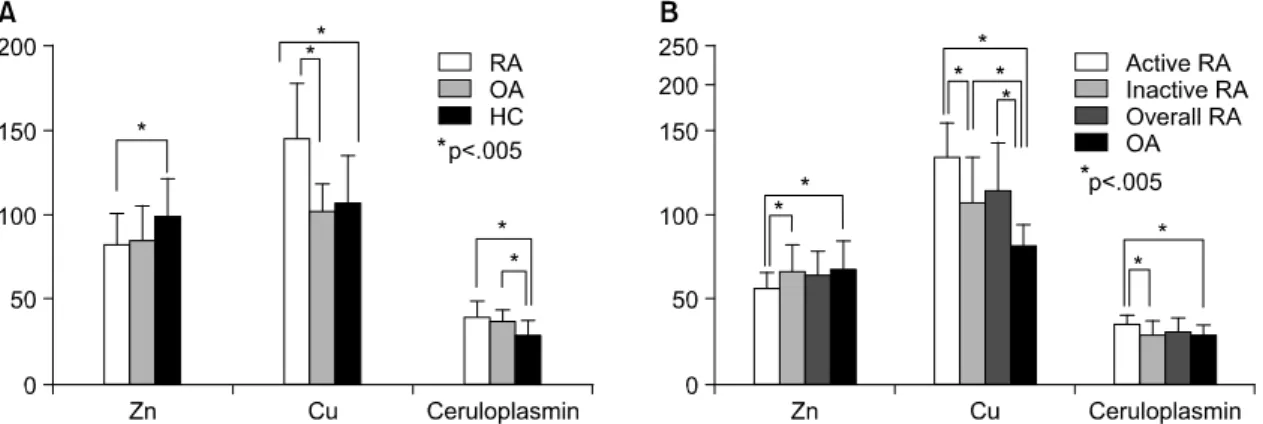
Fig. 1. Serum levels of trace elements in rheumatoid arthritis (RA), osteoarthritis (OA) and healthy controls (HC).
In RA, the levels of serum zinc were significantly lower than that of HC, and the levels of serum copper and ceruloplasmin were significantly higher than those of HC (A). In active RA group, the levels of serum zinc were significantly lower than that of inactive RA group and the levels of serum copper and ceruloplasmin were significantly higher than those of inactive RA group (B) (*: p<0.05).
Table 1. Characteristics of rheumatoid arthritis patients enrolled in this study
ꠧꠧꠧꠧꠧꠧꠧꠧꠧꠧꠧꠧꠧꠧꠧꠧꠧꠧꠧꠧꠧꠧꠧꠧꠧꠧꠧꠧꠧꠧꠧꠧꠧꠧꠧꠧꠧꠧꠧꠧꠧꠧꠧꠧꠧꠧꠧ
RA Active RA Inactive RA (n=80) (n=17) (n=40) ꠏꠏꠏꠏꠏꠏꠏꠏꠏꠏꠏꠏꠏꠏꠏꠏꠏꠏꠏꠏꠏꠏꠏꠏꠏꠏꠏꠏꠏꠏꠏꠏꠏꠏꠏꠏꠏꠏꠏꠏꠏꠏꠏꠏꠏꠏꠏ Age (yr) 49.1±12.9 45.6±12.2 51.8±13.0 Disease duration
7.8±6.3 8.8±6.7 7.5±6.1 (yr)
ESR, mm/hour 39.2±28.8 72.1±23.0 29.7±23.2 CRP, mg/L 22.2±26.7 41.9±32.0 14.0±20.6 Rheumatoid
73.7% 70.6% 72.5%
factor* (+) Tender joint
14.6±13.5 22.6±15.2 11.2±11.2 count
Swollen joint
7.6±8.5 14.0±10.3 4.8±5.8 count
ꠏꠏꠏꠏꠏꠏꠏꠏꠏꠏꠏꠏꠏꠏꠏꠏꠏꠏꠏꠏꠏꠏꠏꠏꠏꠏꠏꠏꠏꠏꠏꠏꠏꠏꠏꠏꠏꠏꠏꠏꠏꠏꠏꠏꠏꠏꠏ Mean±S.D., *Rheumatoid factor (+); > 20 IU/ml
를 이용하였다.
결 과
1. 류마티스 관절염, 골 관절염, 정상인의 혈청 아 연, 구리, ceruloplasmin의 농도
류마티스 관절염 환자(n=80)의 혈청 아연 농도는 82.1±18.7μg/dl로서 정상인(n=30)의 l99.2±22.2μg/dl 에 비해 의미 있게 낮았으나(p<0.01), 골 관절염 환 자(n=26)의 평균치인 84.9±21.0μg/dl과는 유의한 차 이를 보이지 않았다. 류마티스 관절염 환자의 혈청 내의 구리 농도는 평균 144.8±33.4μg/dl로 정상인 (107.5±27.8μg/dl)과 골 관절염 환자(102.1±16.3μg/
dl)에 비해서 유의하게 높았다(p<0.01). 류마티스 관 절염 환자의 혈청 ceruloplasmin농도는 평균 39.3±
9.7μg/dl로서 정상인(29.1±99.85μg/dl)에 비해 의미 있게 높았으나(p<0.01), 골 관절염 환자(37.0±7.6μg /dl)와는 유의한 차이를 보이지 않았다(그림 1A). 혈 청 내 미량 원소 측정 당시 압통이 있는 관절 수와 부종이 있는 관절 수, ESR의 평가가 가능하였던 57 명의 환자에서 압통이 있는 관절 수와 부종이 있는 관절 수가 각각 5개 이상이고 ESR이 45 mm/hr 이상 인 환자를 활성군, 이를 만족시키지 못하는 군을 비 활성군으로 구분하여 골 관절염 환자와 혈청 내 아 연, 구리, ceruloplasmin농도를 비교하였다(그림 1B).
류마티스 관절염 활성군의 혈청 아연농도(70.71±11.2
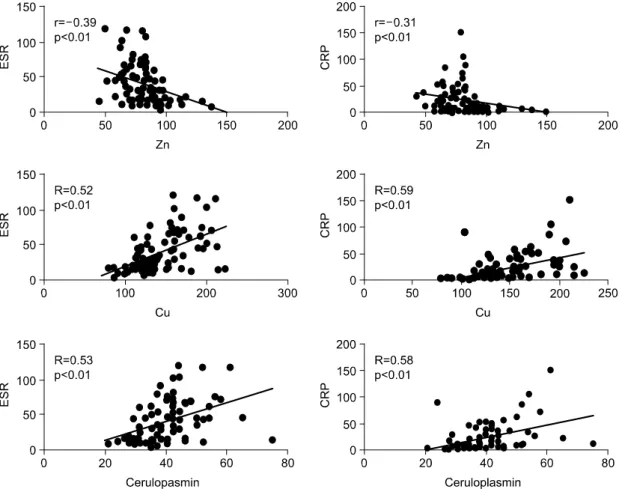
Fig. 2. The correlation between serum levels of trace elements and the markers of disease activity (ESR, CRP) in RA. Serum zinc levels showed negative correlation with ESR, CRP. The levels of both copper and ceruloplasmin showed positive correlation with the levels of serum ESR and CRP (*: p<0.05).
μg/dl)는 비활성군의 아연농도(83.2±19.8μg/dl), 골관 절염 환자의 아연 농도(84.9±21.0μg/dl)보다 통계적 으로 유의하게 낮았으며(p<0.05), 류마티스 관절염 활성군의 혈청 구리농도(167.6±25.9μg/dl)는 비활성 군의 구리농도(134.3±34.0μg/dl), 골관절염 환자의 구리농도(102.1±16.3μg/dl)보다 통계적으로 유의하게 높았다(p<0.05). 류마티스 관절염 활성군의 혈청 ceruloplasmin농도(44.3±7.3μg/dl)는 비활성군의 cerulo- plasmin농도(37.0±10.1μg/dl), 골관절염 환자의 cerulo- plasmin농도(37.0±7.6μg/dl)보다 통계적으로 유의하 게 높았다(p<0.05).
2. 류마티스 관절염 환자의 혈청 아연, 구리, cer- uloplasmin농도와 임상 지표와의 상관 관계
류마티스 관절염 환자에서 혈청 미량 원소 농도와 ESR, CRP의 상관 관계를 분석하였다. 그림 2와 같 이 혈청 아연의 농도는 ESR (r=-0.39, p<0.01), CRP(r=-0.31, p=0.028) 수치와 음의 상관 관계를 보 였으며, 구리의 농도는 ESR (r=0.52, p<0.01), CRP (r=0.59, p<0.01), ceruloplasmin농도는 ESR (r=0.53, p
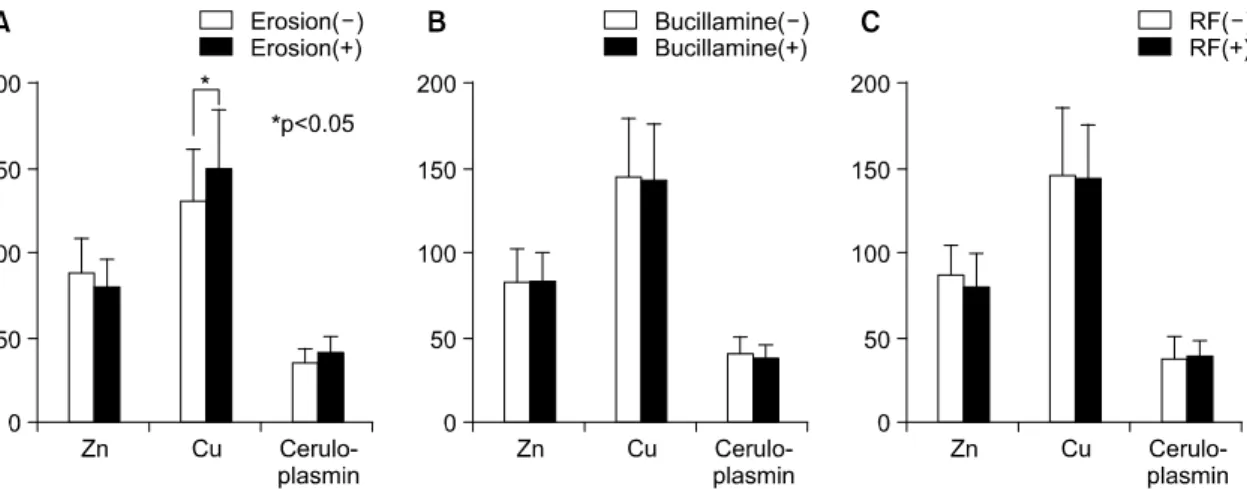
<0.01), CRP (r=0.58, p<0.01)로서 각각 양의 상관 관계를 보였다. 골 미란 유무에 따라 혈청 아연과 구리 농도, ceruloplasmin 농도를 비교한 결과 구리의 농도는 골 미란이 있는 환자군(150.5±33.5μg/dl)에서 골미란이 없는 환자군(131.4±29.6μg/dl)에 비해 의미
있게 증가하였으나 아연과 ceruloplasmin 농도는 의 미 있는 차이를 보이지 않았다(그림 3A). 류마티스 관절염의 치료제인 bucillamine의 사용 여부에 따라 아연과 구리, ceruloplasmin농도를 비교한 결과 두 환 자군 사이에서 각각의 농도는 의미 있는 차이가 없 었다(그림 3B). 또한 류마티스 인자 양성군에서 아 연의 농도(80.2±19.0μg/dl)가 류마티스 인자 음성군 (87.1±17.0μg/dl)에 비해 낮은 경향을 보였으나 통계 적으로 유의한 차이는 없었고(p=0.05) 구리와 cerulo- plasmin의 농도는 유의한 차이가 없었다(그림 3C).
3. 혈청 아연, 구리 농도와 활액 내의 아연, 구리 의 농도 비교
혈청과 활액을 같이 채취할 수 있었던 22명의 류 마티스 관절염 환자를 대상으로 각각의 아연과 구리 농도를 비교하였다. 혈청 아연 농도는 70.9±28.4μg/
dl였고, 활액 내의 농도는 131.1±83.8μg/dl로 아연 농도는 활액 내에서 유의하게 높았다(p<0.05). 혈청 구리 농도는 112.7±56.4μg/dl였고, 활액 내의 농도 는 131.8±71.8μg/dl로서 활액 내의 구리 농도가 높 았지만 통계적인 유의성은 보이지 않았다(p>0.05) (그림 4A). 혈청 및 활액 내 아연 농도의 상관 관계 조사에서 양의 상관 관계 경향(r=0.396, p=0.07)을 보 였고 혈청 및 활액의 구리의 농도는 양의 상관관계 (r=0.634, p<0.01)를 보였다(그림 4B). 이는 류마티스
Fig. 3. The serum levels of trace elements in RA according to bony erosion, bucillamine treatment and rheumatoid factor. In bony erosion group, serum copper level was significantly higher than absence of bony erosion group (A). bucillamine treatment did not showed significant difference on serum levels of trace elements (B). In rheumatoid factor positive group, serum zinc level was lower than negative group (C) (*: p<0.05).
관절염 환자의 질병 활성도에 따른 혈청 내 아연의 감소와 구리의 증가는 활액 내 이동의 직접적인 결 과가 아님을 시사해 준다.
고 찰
류마티스 관절염은 만성 염증성 질환으로 아연과 구리 등의 미량 원소 등이 콜라겐이나 골 대사뿐만 이 아니라 면역 기능에 관여하며15-17) 항 산화 방어 기능을 하는 것으로 알려짐으로 병인과 치료면에서 그 중요성이 최근 강조되고 있다. 또한 이러한 미량 원소들을 포함하고 있는 단백질이나 효소인 methal- lothioneins, ceruloplasmin과 Cu-Zn superoxide dismu- tase 등의 염증 및 면역 반응의 역할에 활발한 연구
가 진행되고 있는데 이 중 metallothioneins는 아연이 나 구리, 카드뮴 등의 중금속의 결합과 교환에 관여 하며 여러 염증 과정에 노출되면 nitric oxide 같은 가스 성분의 중간자를 분비시키고 apoptosis에도 관여 하여 염증 반응을 조절하는 것으로 알려져 있다18,19). 류마티스 관절염에서는 염증성 cytokine인 IL-6, IL-1β와 TNF-α 농도가 증가하여 금속 결합 단백인 metallothionein의 생산을 유발하고, 증가된 금속 결합 단백으로 인해 아연, 구리, 망간, 카드뮴 같은 금속 이온이 염증 조직과 면역세포에서 항산화 효소와 작 용하는 것을 방해하는 것으로 알려지고 있으나, 이 러한 미량 원소들의 생리적 역할과 염증 반응에서의 치료 효과에 대해서는 아직까지 잘 알려지지 않았다.
본 연구 결과, 류마티스 관절염 환자들의 혈중 아 Fig. 4. The trace element levels of serum and synovial fluid in RA (A). Correlation between the levels of serum
and synovial fluid (B). The mean levels of zinc in the SF were significantly increased than those of serum from patients with RA and there were positive correlation tendency between the zinc levels of SF and serum. The mean levels of copper in the SF were increased than those of serum from patients with RA and there were significant positive correlation (*: p<0.05).
연 농도가 정상인보다 현저하게 낮고, 활동성 류마 티스 관절염 환자에서 비활동성 류마티스 관절염 환 자나 골관절염 환자에 비해서는 현저하게 낮은 소견 을 보였다. 또한 급성 반응 단백인 C-반응 단백과 음의 상관 관계를, 류마티스 관절염의 활동성 지표 로 알려진 적혈구 침강속도와는 양의 상관 관계를 보여 질병 활성도를 잘 반영하는 것으로 생각된다.
류마티스 관절염 환자의 혈중 아연 농도가 낮은 이 유는 아연의 음식 섭취가 감소하거나, 관절염의 치 료로 사용되는 약물의 영향, 혈중의 아연이 다른 구 획으로 이동하거나, 요 중으로의 배설이 증가하는 것 등이 관련될 수 있다. 혈중 아연 감소의 주된 이 유는 염증이 있는 관절 부위 또는 간으로의 이동이 주 원인으로 생각되며 metallothionein과 관련하여 간 에 아연이 침착되기 때문이라 생각된다13,20). 일부에 서는 아연이 주로 혈중에서 알부민과 결합된 형태로 존재하기 때문에 혈중 아연이 감소되는 현상은 류마 티스 관절염에서 나타날 수 있는 저알부민 혈증의 2 차적인 현상이라는 주장도 있으나21), 인체 혈중에서 아연 운반에 관여하는 알부민은 전체의 1.1∼2.6%에 불과하며 실제로 아연이 알부민의 아연 결합능 중에 0.2% 미만을 차지하므로 혈중 알부민 치가 아연 감 소에 큰 영향을 주지 않는다는 주장이 더 설득력이 있다고 생각되며22) 저자들은 본 연구에서 혈중 알부 민 치를 고려하지 않았다. 일반적으로 관절염이 있 는 상태에서 혈중 농도보다 활액 내에서 미량 원소 들의 침착으로 인해 농도가 증가되어 있다고 알려져 있고, Buneaux F 등은 류마티스 관절염 환자에서 혈 중 아연 농도는 감소되지만 활액 내의 아연 농도는 증가한다고 보고하였다23). 본 연구에서도 활액 내 아연의 농도가 혈중 아연보다 증가되어 있어 염증 조직인 관절 내 이동을 고려할 수도 있으나, 상관 관계 조사에서 음의 상관 관계보다는 양의 상관 관 계 경향을 보여 활액 내 이동만으로 설명할 수는 없 으며, 활성기 류마티스 관절염의 혈중 아연 감소의 원인에 대한 추가 연구가 필요한 것으로 생각된다.
류마티스 관절염 환자의 혈중에서 구리 농도가 현 저하게 상승되어 있다고 알려져 있는데 저자들의 결 과도 동일하였다. 대부분의 구리는 특이 전달 단백 인 ceruloplasmin과 강하게 결합되어 있다. Cerulo- plasmin은 급성기 반응 단백의 일종으로서 염증 반
응에 대해 비특이적으로 증가하며24), 이러한 cer- uloplasmin의 증가가 혈중 구리 농도의 증가와 관련 이 있는 것으로 보고되고 있다. 또한 구리의 특이 전달 단백이면서 급성기 반응 단백인 ceruloplasmin 농도와 혈중 구리 농도 역시 적혈구 침강속도, C-반 응 단백 수치와 의미있게 비례하였다. 류마티스 관 절염이 있는 관절에서 탐식 과정에서 oxygen free radicals이 생성되는데 Lunec 등25)은 활액 내의 구리 농도가 활액 내에서 생성되는 free radical의 산화물 과 현저한 연관이 있다고 보고하였는데 이는 구리가 free radical reaction의 촉매제이기 때문이다. 본 연구 에서도 류마티스 관절염 환자의 활액 내의 구리농도 가, 동시에 측정한 같은 환자의 혈청 구리농도보다 높게 측정되었는데 이는 염증 반응으로 인한 국소 침착의 결과로 인한 것으로 생각된다.
Zoli 등은 혈중 아연 농도의 감소와 구리 농도의 증가가 류마티스 관절염의 질병 활성도와 관계가 있 을 뿐만이 아니라 류마티스 관절염의 병인과 과정에 밀접한 연관이 있는 TNF-α와 IL-1β과도 상관 관계 가 있고 염증 반응 시 증가된 IL-1에 의해 metallo- thionein의 합성이 증가되고 이로 인해 간에 아연의 침착이 증가한다고 보고하였다10). 아연의 부족은 mitogens에 대한 림프구의 반응이 느려지고 지연성 피부 과민성이 약해지는 세포성 면역 저하와 관련되 며26) 중성구의 화학 주성이 약해지고, NK cell기능이 감소되며 순환하는 CD4+세포 비율이 감소한다는
보고27,28)가 있으며 혈청 아연과 염증성 cytokine인
TNF-α와 IL-1β 농도는 음의 상관관계가 있음이 보 고되지만 면역 반응과 염증 반응에서 아연과 구리의 역할은 더욱 많은 연구가 필요할 것으로 생각된다.
질병 활성도를 나타내는 인자들과 미량 원소 농도 사이의 연관성은 보고자마다 차이가 있지만, 본 연 구에서는 류마티스 관절염의 활성도를 비교적 잘 반 영하는 것으로 생각된다. 그러나 혈중 구리의 농도 가 골미란이 있는 군에서 증가되고 아연의 감소가 골미란이 있는 군과 류마티스 인자 양성군에서 낮은 경향을 보이기는 하지만, 류마티스 관절염의 중증도 를 반영하는 지표로는 부족한 것으로 생각된다.
미량 원소 농도에 영향을 주는 요소 중 관절염에 사용하는 약물이 있다. Milanio 등은 비스테로이드성 항소염제나 스테로이드 제제의 사용이 혈중 아연의
농도에 영향을 미친다고 보고하였다29). 본 연구의 대상이 된 류마티스 관절염 환자는 모든 환자에서 비스테로이드성 항염제와 1일 7.5 mg 이하 용량의 스테로이드를 사용 중이었기 때문에 혈중 아연이나 구리 농도의 차이가 약물에 의한 차이는 배제할 수 있을 것으로 생각된다. 또한 류마티스 관절염의 치 료 약제 중 미량 원소, 특히 구리 농도에 영향을 미 칠 수 있는 것이 키일레이트 제제인 D-penicillamine 및 이와 화학 구조가 유사한 cystein 유도체인 bucillamine이다30). 류마티스 관절염 환자에서 D-peni- cillamine 투여 후에 혈청 아연이 증가하거나 변화가 없었다고 보고되고 있고31,32) 혈청 구리는 감소하거 나 유의한 변화가 없는 것으로 보고되었다33,34). 국 내에서는 류마티스 관절염 환자에서 bucillamine 투 여 전후 모발에서의 미량 원소를 측정하였으나 유의 한 차이가 없었음을 보고한 바 있다35). 본 연구에서 bucillamine을 투여 받고 있는 환자와 투여 받고 있 지 않는 환자를 나누어서 혈중 미량원소 농도를 측 정한 결과 유의한 차이는 없었다.
본 연구를 통해 한국인 류마티스 관절염 환자에서 아연과 구리 같은 미량 원소는 류마티스 관절염의 질병 활성도를 반영하는 표지자로 사용할 수 있을 것으로 생각하며, 구리와 아연 투여의 류마티스 관 절염 치료 효과에 대해서는 더욱 많은 연구가 필요 하리라 생각된다.
결 론
류마티스 관절염 환자의 질병 활성도가 증가함에 따라 혈중 아연의 감소, 구리의 증가, 구리의 결합 단백인 ceruloplasmin의 증가가 관찰되었다. 또한 혈 중 아연 농도는 CRP, ESR과 음의 상관관계를, 구리 와 ceruloplasmin의 농도는 CRP, ESR과 양의 상관 관계를 보여 질병 활성도를 반영하는 것으로 생각된 다. 활액 내 아연 및 구리의 농도는 혈중 아연 및 구리 농도보다 증가된 소견을 보여 염증 조직 내 미 량 원소가 축적되어 있는 것을 시사해 준다. 구리와 아연 같은 미량원소와 미량 원소들을 포함하는 단백 질인 metallothionein이나 효소인 Zn-Cu-SOD-Dismutase 등의 염증 반응에 대한 역할과 류마티스 관절염의 치료효과에 대해서는 더욱 많은 연구가 필요하다.
REFERENCES
1) Kirsch T, Harrison G, Worch KP, Golub EE. Reg- ulatory roles of zinc in matrix vesicle-mediated mineralization of growth plate cartilage. J Bone Miner Res 2000;15:261-70.
2) Kennedy AC, Fell GS, Steven WH, Dick WC, Buchanan WW. Zinc: its relationship to osteoporosis in rheumatoid arthritis. Scan J Rheumatol 1975;4:243- 45.
3) Yamamoto K, Takahashi H. Inhibition of the internal stage of compliment-mediated lysis (reactive lysis) by zinc and copper ions. Int Arch Allergy Appl Immunol 1975;48:653-63.
4) Karl L, Chvapil M, Zukoski CF. Effect of zinc on the viability and phagocytic capacity of peritoneal macro- phage. Proc Soc Exp Biol Med 1973;142:642-46.
5) Simpkin PA. Oral zinc sulphate in the rheumatoid arthritis. Lancet 1976;2:539-42.
6) Rainsford KD. Environmental ion perpetuation, espe- cially as they affect copper state, are a factor in the etiology of arthritic condition: an hypothesis. In:
Sorenson JRJ. Editor. Inflammatory disease and copper. Clifton NJ Humana Press 1982;137-43.
7) Rofe AM, Philcox JC, Haynes DR, Whitehouse MW, Coyle P. Changes in plasma zinc, copper, iron, and hepatic metallothionine in adjuvant-induced arthritis treated with cyclosporin. Boil Trace Elem Res 1992;34:237-48.
8) Milanino R, Marrella M, Gasperini R, Pasqualicchio M, Velo G: Copper and zinc body levels in inflammation. An overview of the data obtained from animal and human studies. Agents Actions 1993;39:
195-209.
9) Panush RS, Kramer N, Rosenstein ED. Assessment and prognosis of rheumatoid arthritis. Curr Opin Rheumatol 1992;4:355-64.
10) Zoli A, AltomonteL, Caricchio R, Galossi A, Mirone L, Ruffini MP, et al. Serum zinc and copper in active rheumatoid arthritis; Correlation with interleukin 1β and tumor necrosis factor-α. Clin Rheumatol 1998;
17:378-82.
11) Naveh Y, Schapira D, Ravel Y, Geller E, Scharf Y.
Zinc metabolism in rheumatoid arthritis. plasma and urinary zinc and relationship to disease activity. J Rheumatol 1997Apr;24:643-6.
12) Honkanen VE, Lamberg-Allardt CH, Vesterinen MK,
Lehto JH, Westermarck TW, Metsa-Ketela TK, et al.
Plasma zinc and copper concentration in rheumatoid arthritis: influence of dietary factors and disease activity. Am J Clin Nutr 1991;54:1082-86.
13) Wanchu A, Sud A, Bambery P, Prasad R, Kumar V.
Plasma and peripheral blood mononuclear cells levels of Zn and Cu among Indian patients with RA. Ann Rheum Dis 2002;61:88.
14) Arnett FC, Edworthy SM, Bloch DA, McShane DJ, Fries JF, Cooper NS, et al. The American Rheuma- tism Association 1987 revised criteria for the classi- fication of rheumatoid arthritis. Arthritis Rheum 1988;31:315-24.
15) Driessen C, Hirv K, Kinchner H, Rink L. Zinc regulates cytokine induction by superantigens and lipopolysaccharide. Immunology 1995;84:272-7.
16) Davis MA, Johnson WT, Briscke-Anderson M, Kramer TR. Lymphoid cell functions during copper de- ficiency. Nutr Res 1987;7:211-22.
17) Duff GW. Cytokine and anti-cytokines. Br J Rheu- matol 1993;32:15-20.
18) Simpkins CO. Metallothionein in human disease. Cell Mol Biol 2000;46:465-88.
19) Katakai K, Liu J, Nakajima K, Keefer LK, Waalkes MP. Nitric oxide induces metallothionein (MT) gene expression apparently by displacing zinc bound to MT. Toxicol Lett 2001;28:119:103-8.
20) Cousins RJ. Absorption, transport, and hepatic meta- bolism of copper and zinc. Special reference to metallothionein and ceruloplasmin. Physiol Rev 1985;
65:238-309.
21) Disilvestro RA, Cousins RJ. Physiololgical ligands for copper and zinc. Annu Rev Nutr. 1983;3:261-88.
22) Foote JW, Delves HT. Albumin bound and α2-mic- roglobulin bound zinc concentration in the sera of healthy adults. J Clin Pathol 1984;37:1050-4.
23) Buneaux F, Buneaux JJ, Fabiani P, Galmiche P. Zinc and enzymes in the synovial fluid and blood in various types of rheumatism. Rev Rheum Mal Osteoartic 1978;45:699-701.
24) Rice EW. Evaluation of the role of ceruloplasmin as a acute phase reactant. Clin Chem Acta 1961;6:
652-5.
25) Lunec J, Halloran SP, White AG, Dormandy TL.
Free-radical oxidation products in serum and synovial fluid in rheumatoid arthritis. J Rheumatol 1981;8:
233-45.
26) Chandra RK. Golden memorial lecture. Nutritional regulation of immunity and infection. J Pediatr Gas- troenterol Nutr 1986;5:844-52.
27) Chandra RK. Excessive intake of zinc impairs im- mune responses. JAMA 1984;252:1443-6.
28) Naveh Y, Lavy A, Suissa A. Effect of zinc and interferon-α on impaired natural killer cell activity in Crohn's disease. Trace Elem Med 1993;10:39-43.
29) Milanino R, Frigo A, Bambara LM, Marrella M, Moretti U, Pasqualicchio M, et al. Copper and zinc status in rheumatoid arthritis: studes of plasma, erythrocytes and urine, and their relationship with disease activity markers and pharmacological treat- ment. Clin Exp Rheumatol 1993;11:271-81.
30) Hirohata S, Lipsky PE. Regulation of B cell function by Bucillamine, novel disease modifying antirheu- matic drug. Clin Immunol Immunopathol 1993;66:
43-51.
31) Jepson LV, Pederson KH. Change in zinc dependent enzymes in rheumatoid patients during penicillamine treatment. Scand J Rheumatol 1984;13:282-8.
32) Balogh Z, El-Ghobarey AF, Fell GS, Brown DH, Dunlop J, Dick WC. Plasma zinc and its relationship to clinical symptoms and drug treatment in rheu- matoid arthritis. Ann Rheum Dis 1980;39:329-32.
33) Knudsen L, Weismann K. Taste dysfunction and changes in zinc and copper metabolism during penicil- lamine therapy for generalized scleroderma. Acta Med Scand 1978;204:75-9.
34) Aaseth JF, Munthe E, Steiness E. Trace elements in serum and urine of patients with rheumatoid arthritis.
Scand J Rheumatol 1978;7:237-40.
35) 전재범, 김동욱, 김태환, 김승영, 김평남, 정성수, 이인 홍, 배상철, 유대현, 김순길, 김성윤. 류마티스 관절염 환자에서 Bucillamine이 모발 미세 원소 농도에 미치는 영향. 대한류마티스학회지 1995;2:126-32.