Received:January 30, 2020, Revised:February 21, 2020, Accepted:March 10, 2020 Corresponding to:Young Ho Lee http://orcid.org/0000-0003-4213-1909
Division of Rheumatology, Department of Internal Medicine, Korea University Anam Hospital, Korea University College of Medicine, 73 Goryeodae-ro, Seongbuk-gu, Seoul 02841, Korea. E-mail:[email protected]
Copyright ⓒ 2020 by The Korean College of Rheumatology. All rights reserved.
This is an Open Access article, which permits unrestricted non-commerical use, distribution, and reproduction in any medium, provided the original work is properly cited.
Circulating Interleukin-37 Levels in Rheumatoid Arthritis and Systemic Lupus Erythematosus and Their Correlations With Disease Activity: A Meta-analysis
Young Ho Lee, M.D., Ph.D., Gwan Gyu Song, M.D., Ph.D.
Division of Rheumatology, Department of Internal Medicine, Korea University College of Medicine, Seoul, Korea
Objective. To assess the circulating levels of interleukin (IL)-37 in rheumatoid arthritis (RA) and systemic lupus erythematosus (SLE), and determine a correlation between plasma/serum IL-37 levels and disease activity. Methods. We performed a meta-analysis comparing plasma/serum IL-37 level between patients with RA or SLE and controls, and examined correlation co- efficients between circulating IL-37 levels and disease activity. Results. A total of 14 publications included 711 patients with RA and 394 controls, 522 patients with SLE and 259 controls. In the RA group, the IL-37 level was significantly higher than in the control group (standardized mean difference [SMD]=1.222, 95% confidence interval [CI]=0.722∼1.711, p<0.001).
Subgroup analysis by sample size showed a significantly higher IL-37 level in RA group of large (n>90) and small sample num- bers (n≤90) (SMD=0.994, 95% CI=0.323∼1.666, p<0.001; SMD=1.617, 95% CI=1.328∼1.906, p<0.001). In addition, IL-37 level in SLE group was significantly higher than in control group (SMD=1.096, 95% CI=0.635∼1.558, p<0.001). A strong association between circulating IL-37-level and RA activity based on Disease activity Score 28 was shown (correlation coefficients=0.547, 95% CI=0.355∼0.695, p<0.001). Meta-analysis of the coefficients for correlation indicated a positive correlation between the circulating level of IL-37 and SLE activity based on Systemic Lupus Erythematosus Disease Activity Index (coefficients for correlation<0.588, 95 % CI=0.270∼0.806, p=0.003). Conclusion. Our meta-analysis showed that cir- culating IL-37 levels are higher in RA and SLE patients, and there is a positive correlation between IL-37 and disease activity in RA and SLE. (J Rheum Dis 2020;27:152-158)
Key Words. IL37 protein, human, Rheumatoid arthritis, Systemic lupus erythematosus
INTRODUCTION
Rheumatoid arthritis (RA) is a chronic inflammatory autoimmune disease, which mainly affects the synovial joints and causes synovial cell hyperplasia and the devel- opment of new blood vessels; leading to bone erosion and joint deformation [1]. Systemic lupus erythematosus (SLE) is a prototypical autoimmune disease defined by B cell hyperactivity, high production of autoantibody, im- mune-complex deposition, and several organ damage [2].
While the cause of these diseases is not fully under- standable, the imbalance between anti-inflammatory and
pro-inflammatory cytokines by elevating pro-inflamma- tory cytokines and/or reducing anti-inflammatory cyto- kines lead to autoimmune pathogenesis like RA and SLE [3].
Interleukin-37 (IL-37), a member of the Interleukin-1 (IL-1) family, was first identified as a new molecule in the IL-1 family locus on chromosome 2q13 [4]. Initially it was known as IL-1 family member 7 (IL-1F7), but later its name was changed to IL-37 [5]. IL-37 is an anti-in- flammatory cytokine that suppress immune responses by reducing the production of pro-inflammatory cytokines like tumor necrosis factor-α, IL-1α, IL-1β, and IL-6 [6].
IL-37 can significantly reduce the production of in- flammatory cytokines in LPS-stimulated mouse primary macrophages [7]. The inhibitory impact of IL-37 in auto- immune disease pathogenesis was also confirmed in mice models of RA and SLE [8]. Nonetheless, IL-37’s role in pathogenesis of RA and SLE in human remains uncertain.
Studies have shown high circulating IL-37 levels in pa- tients with RA or SLE and the correlation between IL-37 levels and disease activity, but the results from individual studies varied in terms of the magnitude of the effect sizes [9-22]. This may be due to a small sample size, weak stat- istical power and/or clinical heterogeneity. We conducted this meta-analysis to overcome the limits in individual studies and to resolve the inconsistencies. IL-37 plays an important role IL-37 in a number of inflammatory and au- toimmune diseases and both RA and SLE share in- flammatory and autoimmune profiles and [6]. The aim of this research was to determine the circulating IL-37 levels in patients with RA or SLE relative to those in healthy controls and to assess their association with disease activity.
MATERIALS AND METHODS
Identification of eligible studies and data extraction
We conducted a literature search for studies that as- sessed the status of IL-37 in RA or SLE and controls and/or reports that measured the relationship between circulating levels of IL-37 (serum or plasma) and disease activity. To identify all previous articles available (up to November 2019), PUBMED, EMBASE and Cochrane da- tabases were checked for. In the search, the following key words and subject terms were used: “IL-37,” “level OR activity OR correlation,” “rheumatoid arthritis,” and“systemic lupus erythematosus.” Additional studies not identified by the above-mentioned online databases were also checked for all references cited. Studies were consid- ered eligible if: (1) case-control studies or cross-sectional trials were conducted; (2) data were given on IL-37 levels in case and control groups; and/or (3) data were provided on the relation between circulating IL-37 levels and dis- ease activity based on Disease Activity Score 28 (DAS28) or Systemic Lupus Erythematosus Disease Activity Index (SLEDAI). Studies were excluded if: (1) contained data that were overlapping or insufficient, or (2) review article or reported cases. Two independent researchers collected data on methodology and findings from the original studies.
Any discrepancies between reviewers were solved by con-
sensus, and the meta-analysis was carried out in accord- ance with the guidelines of PRISMA [23]. From each analysis, the following information was extracted: pri- mary author, year of publication, country ethnicity, num- ber of participants, mean and standard deviation (SD) of level IL-37, and coefficients of correlation between level IL-37 and level RA or SLE. When the data were medians, interquartile ranges or ranges, the mean and SD were de- termined using the formulae previously described [24,25].
Evaluation of statistical associations
We conducted a meta-analysis that examined the rela- tionship between levels of IL-37 and RA or SLE. Results were presented as standardized mean differences (SMDs) or as coefficients of correlation and confidence intervals (CIs) of 95% for data continuity. By dividing the mean dif- ference between two groups by the pooled SD, SMDs were measured and used when multiple scales were com- bined to quantify the same definition. This measurement compares case and arms based on standardized values.
This was the magnitude of SMD: 0.2∼0.5, small effect;
0.5∼0.8, medium effect; ≥0.8, large effect [26]. We also used Cochran's Q-statistics to test differences and hetero- geneities within and between the studies [27]. The heter- ogeneity method was used to determine the null hypoth- esis that the same effect was tested by all experiments.
The random effects model was chosen for meta-analysis, when the relevant Q-statistic (p<0.10) revealed hetero- geneity across studies [28]. Otherwise, the fixed effects model was used, assuming that all studies had the same underlying effect estimated and considered only variation within the study [27]. We quantified the impact of heter- ogeneity using I2=100 percent (Q–df)/Q [29], where I2 calculated the incoherence between studies and whether the percentage of total differences between studies was attributable to heterogeneity instead of chance. I2 ranged from 0% to 100%; I2 ranged from 25%, 50%, and 75%, re- spectively, from weak, moderate, and strong estimates [29]. The Comprehensive Meta-Analysis Computer Program (Biostat Inc., Englewood, NJ, USA) was used to perform statistical manipulations.
Evaluation of heterogeneity, sensitivity test, and publication bias
A subgroup analysis of sample size was carried out in or- der to examine possible sources of heterogeneity detected in the meta-analysis. A sensitivity test was performed in order to evaluate the influence of each study on the
Table 2. Meta-analysis of the association between circulating IL-37 levels and RA or SLE Disease Groups Population No. of
studies
Test of association Test of heterogeneity
SMD* 95% CI p-value Model p-value I2
RA All Overall 8 1.222 0.722∼1.711 <0.001 R <0.001 91.8
Sample size Large (n>90) 5 0.994 0.323∼1.666 0.004 R <0.001 94.2
Small (n≤90) 3 1.617 1.328∼1.906 <0.001 F 0.394 0
SLE All Overall 5 1.096 0.635∼1.558 <0.001 R <0.001 85.9
Sample size Large (n>90) 4 1.150 0.598∼1.702 <0.001 R <0.001 89.2
Small (n≤90) 1 0.858 0.329∼1.386 0.001 NA NA NA
IL: interleukin, RA: rheumatoid arthritis, SLE: systemic lupus erythematosus, SMD: standard mean difference, CI: confidence interval, R: random effect model, F: fixed effects model, NA: not available. *Magnitude of Cohen’s d effect size (SMD), where 0.2 to 0.5 is a small effect, 0.5 to 0.8 is a medium effect, and ≥0.8 is a large effect.
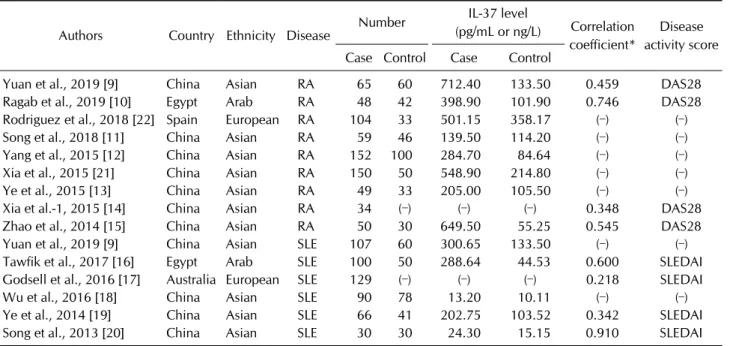
Table 1. Characteristics of individual studies included in the meta-analysis
Authors Country Ethnicity Disease Number IL-37 level
(pg/mL or ng/L) Correlation coefficient*
Disease activity score Case Control Case Control
Yuan et al., 2019 [9] China Asian RA 65 60 712.40 133.50 0.459 DAS28
Ragab et al., 2019 [10] Egypt Arab RA 48 42 398.90 101.90 0.746 DAS28
Rodriguez et al., 2018 [22] Spain European RA 104 33 501.15 358.17 (–) (–)
Song et al., 2018 [11] China Asian RA 59 46 139.50 114.20 (–) (–)
Yang et al., 2015 [12] China Asian RA 152 100 284.70 84.64 (–) (–)
Xia et al., 2015 [21] China Asian RA 150 50 548.90 214.80 (–) (–)
Ye et al., 2015 [13] China Asian RA 49 33 205.00 105.50 (–) (–)
Xia et al.-1, 2015 [14] China Asian RA 34 (–) (–) (–) 0.348 DAS28
Zhao et al., 2014 [15] China Asian RA 50 30 649.50 55.25 0.545 DAS28
Yuan et al., 2019 [9] China Asian SLE 107 60 300.65 133.50 (–) (–)
Tawfik et al., 2017 [16] Egypt Arab SLE 100 50 288.64 44.53 0.600 SLEDAI
Godsell et al., 2016 [17] Australia European SLE 129 (–) (–) (–) 0.218 SLEDAI
Wu et al., 2016 [18] China Asian SLE 90 78 13.20 10.11 (–) (–)
Ye et al., 2014 [19] China Asian SLE 66 41 202.75 103.52 0.342 SLEDAI
Song et al., 2013 [20] China Asian SLE 30 30 24.30 15.15 0.910 SLEDAI
IL: interleukin, RA: rheumatoid arthritis, SLE: systemic lupus erythematosus, (–): not available, DAS28: Disease Activity Score 28, SLEDAI: Systemic Lupus Erythematosus Disease Activity Index. *Correlation coefficient between IL-37 and disease activity in RA or SLE.
pooled odds ratio (OR) by ignoring each study. We ex- plored publication biases by using funnel plots and the linear regression test of Egger to calculate funnel plot asymmetry [30].
RESULTS
Studies included in the meta-analysis
We have identified 271 studies using manual and elec- tronic search methods. Seventeen of these studies have been chosen based on the title and abstract for full-text analysis. Of those 17 studies, 3 were excluded, because no
IL-37 data or duplicate data existed. Thus, 14 articles ful- filled the criteria for inclusion [9-22]. One of the eligible studies contained data from two separate groups [9].
These articles included 711 RA and 394 controls and 522 SLE and 259 controls (Table 1). Eight of these studies ex- amined RA and control groups for circulatory IL-37 lev- els, and four studies provided correlation coefficients be- tween IL-37 and RA activities. Six of these studies inves- tigated SLE and control groups in circulating IL-37 levels;
four studies provided correlation coefficients between IL-37 and the SLE activities. Table 1 summarizes selected characteristics of the association between IL-37 and stud-
Table 3. Meta-analysis of the correlation coefficient between circulating IL-37 levels and RA or SLE activity
Disease Disease activity
No. of studies
Test of association Test of heterogeneity Correlation
coefficient* 95% CI p-value Model p-value I2
RA DAS28 4 0.547 0.355∼0.695 <0.001 R 0.040 63.9
SLE SLEDAI 4 0.588 0.270∼0.806 0.003 R <0.001 93.0
IL: interleukin, RA: rheumatoid arthritis, SLE: systemic lupus erythematosus, CI: confidence interval, DAS28: Disease Activity Score 28, SLEDAI: Systemic Lupus Erythematosus Disease Activity Index, R: random effects model, *Correlation coefficient between IL-37 and disease activity in RA or SLE.
Figure 1. Meta-analysis of the relationship between interleukin- 37 levels and rheumatoid arthritis (RA) (A) or systemic lupus eryth- ematosus (SLE) (B). Std diff:
standard difference, CI: confidence interval.
ies of RA and SLE.
Meta-analysis comparing the circulating IL-37 level in RA, SLE, and controls
The RA group was significantly higher than the control group (SMD=1.222, 95% CI=0.722∼1.711, p<0.001) as compared to the control group (Table 2, Figure 1). The sample size subgroup test showed that the IL-37 levels in the large (n>90), and small size (n≤90). RA group were significantly higher than in the control group (SMD=
0.994, 95% CI=0.323∼1.666, p<0.001; SMD=1.617, 95% CI=1.328∼1.906, p<0,001) (Table 2). The level of IL-37 was also significantly higher within SLE than with- in the control group (SMD=1.096, 95% CI=0.635∼
1.558, p<0.001). The subgroup sample size analysis showed that in the SLE groups of large and small sample numbers the IL-37 level were significantly higher than that in the controls (SMD=1.150, 95% CI=0.598∼
1.702, p<0.001; SMD=0.858, 95% CI=0.329∼1.386, p=0.001) (Table 2).
Meta-analysis of the relationship between circulating IL-37 level and activity of RA and SLE
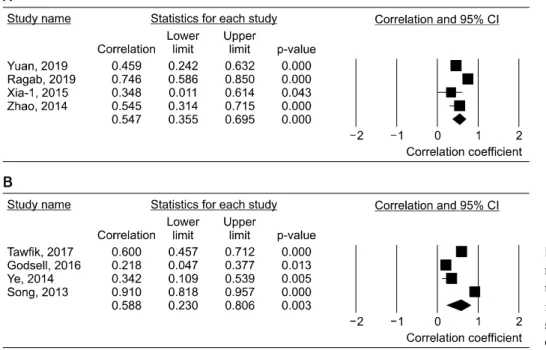
A substantially positive correlation between the IL-37 and DAS28-based RA activity was shown by meta-analy- sis of correlation coefficients (correlation coefficients=
0.547, 95% CI=0.355∼0.695, p<0.001) (Table 3, Figure 2). In addition, a substantially positive association of
Figure 2. Meta-analysis of cor- relation coefficients between in- terleukin-37 levels and the activ- ity of rheumatoid arthritis (A) or systemic lupus erythematosus (B).
CI: confidence interval.
IL-37 and SLE activity on the basis of SLEDAI has been demonstrated (correlation coefficients=0.588, 95%
CI=0.270∼0.806 and p=0.003) in meta-analysis (Table 3, Figure 2).
Heterogeneity, sensitivity test, and publication bias
During IL-37 status meta-analysis in RA and SLE, in- ter-study heterogeneity was reported (Tables 2 and 3).
Although high heterogeneity remained in the large sam- ple group following the sample size analysis of the sub- group, the directions of SMDs were the same and the main cause of heterogeneity was due to the difference in SMD magnitude. The analysis of the subgroup did not show any heterogeneity in the small sample size group (Table 2). Sensitivity analysis has shown that no single study affected the pooled SMD significantly, indicating that the results of this meta-analysis were robust.
Publication biases can lead to disproportionate numbers of positive studies and present a meta-analysis problem.
No evidence of publication bias (Egger regression test p-values>0.1) was recorded by the Egger regression test.
DISCUSSION
Autoimmune disorders are caused by immune re- sponses, which generate aberrant antibodies and attack the cells and tissues of the body [31]. IL-37 is an anti-in- flammatory cytokine expressed in a number of immune
and non-immune cells and IL-37 decreases both innate and acquired inflammation [4]. In regulating in- flammatory response, IL-37 is the key cytokine by inhibit- ing expression, production and function of proinflamma- tory cytokines [6]. Transgenic mice IL-37 can be secured against autoimmune disease development [8]. In a range of inflammatory and autoimmune diseases, IL-37 is thought to play its potential role by suppressing immune responses and inflammation [5]. However, its role is not well understood in RA and SLE. We have combined evi- dence for circulating IL-37 levels in RA and SLE, and the correlation between plasma/serum IL-37 and disease ac- tivity in this meta-analysis. The meta-analysis of 14 stud- ies showed that the circulating IL-37 levels in the RA or SLE group were significantly higher than in the control group. IL-37 had a positive correlation to RA or SLE, which showed an increased level of IL-37 activity. The meta-analysis evidence suggested that circulating IL-37 could influence the pathogenesis of RA and SLE unequivocally. It also supported the idea that IL-37 is in- volved in pathogenesis of RA and SLE.
Our results showed serum/plasma IL-37 levels in- creased in RA or SLE patients and were strongly and pos- itively linked to disease activity. It is therefore reasonable to speculate that proinflammatory cytokines in patients with RA or SLE can encourage IL-37 expression, since IL-37 mediates a negative feedback mechanism in these patients to suppress excessive pro-inflammatory cytokines.
The rise in anti-inflammatory cytokines such as IL-37 can
be a fundamental mechanism for alleviating inflammation.
Our results suggested that the inflammatory process in RA and SLE may trigger this cytokine, and high levels of IL-37 can decline the active inflammatory process. By eliminating the production of inflammatory cytokines, IL-37 may be an important cytokine in the control of both RA and SLE pathogeneses. These observations implied that IL-37 probably played an important role in inhibiting pathogenesis of RA and SLE. IL-37 can be a biomarker in RA or SLE through this meta-analysis, although the un- derline mechanism has not been understood. Future ef- forts are necessary in order to identify IL-37 regulatory mechanisms for mediating RA and SLE immune reactions.
IL-37 has anti-arthritic activity in RA patients and colla- gen-induced arthritis mice [13], and low doses of IL-37 decreased joint inflammation, and significantly reduced synovial IL-1β, TNF-α, IL-6, CCL3, CXCL1 or MIP-1α in mice [32]. Such reductions have been associated with recruiting less neutrophils into the joint, suggesting that IL-37 is a crucial anti-inflammatory cytokine in regulating pathogenesis of RA. In addition, plasma IL-37 levels in SLE patients were upregulated and associated with an- ti-Sm, anti-RNP and C3 [18], and the rise in IL-37 levels in SLE patients was correlated with inflammatory cyto- kines, elevated disease activity, and involvement in muco- cutaneous and renal conditions [16]. Furthermore, IL-37 has an important part to play in regulating SLE patho- genesis by inhibiting inflammatory cytokine production [19]. Thus, IL-37 could provide a new target for the study of pathogenesis and SLE treatment.
This meta-analysis has some drawbacks that must be taken into consideration. First, the majority of studies had small samples, and only a small number of studies have assessed the correlation of the IL-37 levels with the activity of the disease. The meta-analysis can therefore be underpowered. Second, the studies included in this meta-analysis were heterogeneous in population and clinical characteristics. Therefore, our results may have affected the heterogeneity, confounding factors and lim- ited clinical information provided by the study population.
Such limited data did not allow further research, although we performed a sensitivity test and evaluated several subgroups. This meta-analysis, however, also has its strength. Our meta-analysis is the first to provide compo- site evidence for IL-37 status in patients with RA or SLE, to the best of our knowledge. Our data on the relationship between IL-37 levels and RA or SLE achieved greater pre- cision compared to individual studies, due to the in-
creased statistical power and resolution of independent analytic results.
CONCLUSION
In conclusion, our meta-analysis has shown that IL-37 circulatory levels are higher in RA and SLE patients and that there is a considerably positive correlation between IL-37 and disease activity. Therefore, our meta-analysis shows that IL-37 is likely to play a role in RA and SLE, al- though further studies are needed to understand the mechanism by which IL-37 levels directly contribute to RA and SLE pathogenesis.
CONFLICT OF INTEREST
No potential conflict of interest relevant to this article was reported.
AUTHOR CONTRIBUTIONS
Y.H.L. was involved in conception and design of study, acquisition of data, analysis and/or interpretation of data, drafting the manuscript, revising the manuscript crit- ically for important intellectual content. G.G.S. was in- volved in conception and design of study, analysis and/or interpretation of data, drafting the manuscript.
REFERENCES
1. Mellado M, Martínez-Muñoz L, Cascio G, Lucas P, Pablos JL, Rodríguez-Frade JM. T cell migration in rheumatoid arthritis.
Front Immunol 2015;6:384.
2. Ruiz-Irastorza G, Khamashta MA, Castellino G, Hughes GR. Systemic lupus erythematosus. Lancet 2001;357:
1027-32.
3. Mateen S, Zafar A, Moin S, Khan AQ, Zubair S. Understand- ing the role of cytokines in the pathogenesis of rheumatoid arthritis. Clin Chim Acta 2016;455:161-71.
4. Boraschi D, Lucchesi D, Hainzl S, Leitner M, Maier E, Mangelberger D, et al. IL-37: a new anti-inflammatory cyto- kine of the IL-1 family. Eur Cytokine Netw 2011;22:127-47.
5. Dinarello CA. Overview of the IL-1 family in innate in- flammation and acquired immunity. Immunol Rev 2018;
281:8-27.
6. Jia H, Liu J, Han B. Reviews of interleukin-37: functions, re- ceptors, and roles in diseases. Biomed Res Int 2018;2018:
3058640.
7. Zhao M, Li Y, Guo C, Wang L, Chu H, Zhu F, et al. IL-37 iso- form D downregulates pro-inflammatory cytokines ex- pression in a Smad3-dependent manner. Cell Death Dis 2018;9:582.
8. Ye L, Huang Z. IL-37 restrains autoimmune diseases.
Oncotarget 2015;6:21775-6.
9. Yuan ZC, Wang JM, Huang AF, Su LC, Li SJ, Xu WD.
Elevated expression of interleukin-37 in patients with rheu- matoid arthritis. Int J Rheum Dis 2019;22:1123-9.
10. Ragab D, Mobasher S, Shabaan E. Elevated levels of IL-37 correlate with T cell activation status in rheumatoid arthri- tis patients. Cytokine 2019;113:305-10.
11. Song L, Wang Y, Sui Y, Sun J, Li D, Li G, et al. High inter- leukin-37 (IL-37) expression and increased mucin-domain containing-3 (TIM-3) on peripheral T cells in patients with rheumatoid arthritis. Med Sci Monit 2018;24:5660-7.
12. Yang L, Zhang J, Tao J, Lu T. Elevated serum levels of Interleukin-37 are associated with inflammatory cytokines and disease activity in rheumatoid arthritis. APMIS 2015;
123:1025-31.
13. Ye L, Jiang B, Deng J, Du J, Xiong W, Guan Y, et al. IL-37 alle- viates rheumatoid arthritis by suppressing IL-17 and IL-17-triggering cytokine production and limiting Th17 cell proliferation. J Immunol 2015;194:5110-9.
14. Xia T, Zheng XF, Qian BH, Fang H, Wang JJ, Zhang LL, et al.
Plasma interleukin-37 is elevated in patients with rheuma- toid arthritis: its correlation with disease activity and Th1/Th2/Th17-related cytokines. Dis Markers 2015;2015:
795043.
15. Zhao PW, Jiang WG, Wang L, Jiang ZY, Shan YX, Jiang YF.
Plasma levels of IL-37 and correlation with TNF-α, IL-17A, and disease activity during DMARD treatment of rheuma- toid arthritis. PLoS One 2014;9:e95346.
16. Tawfik MG, Nasef SI, Omar HH, Ghaly MS. Serum inter- leukin-37: a new player in lupus nephritis? Int J Rheum Dis 2017;20:996-1001.
17. Godsell J, Rudloff I, Kandane-Rathnayake R, Hoi A, Nold MF, Morand EF, et al. Clinical associations of IL-10 and IL-37 in systemic lupus erythematosus. Sci Rep 2016;6:
34604.
18. Wu GC, Li HM, Wang JB, Leng RX, Wang DG, Ye DQ.
Elevated plasma interleukin-37 levels in systemic lupus er- ythematosus patients. Lupus 2016;25:1377-80.
19. Ye L, Ji L, Wen Z, Zhou Y, Hu D, Li Y, et al. IL-37 inhibits the production of inflammatory cytokines in peripheral blood mononuclear cells of patients with systemic lupus eryth- ematosus: its correlation with disease activity. J Transl Med
2014;12:69.
20. Song L, Qiu F, Fan Y, Ding F, Liu H, Shu Q, et al.
Glucocorticoid regulates interleukin-37 in systemic lupus erythematosus. J Clin Immunol 2013;33:111-7.
21. Xia L, Shen H, Lu J. Elevated serum and synovial fluid levels of interleukin-37 in patients with rheumatoid arthritis: atte- nuated the production of inflammatory cytokines. Cytokine 2015;76:553-7.
22. Rodríguez-Carrio J, Alperi-López M, López P, Ballina-García FJ, Suárez A. Profiling of B-cell factors and their decoy re- ceptors in rheumatoid arthritis: association with clinical features and treatment outcomes. Front Immunol 2018;9:
2351.
23. Moher D, Liberati A, Tetzlaff J, Altman DG; PRISMA Group.
Preferred reporting items for systematic reviews and meta-analyses: the PRISMA statement. PLoS Med 2009;6:
e1000097.
24. Hozo SP, Djulbegovic B, Hozo I. Estimating the mean and variance from the median, range, and the size of a sample.
BMC Med Res Methodol 2005;5:13.
25. Ridout KK, Ridout SJ, Price LH, Sen S, Tyrka AR.
Depression and telomere length: a meta-analysis. J Affect Disord 2016;191:237-47.
26. Cohen J. Statistical power analysis for the behavioral sciences.
2nd ed. Hillsdale (NJ), Lawrence Erlbaum, 1988.
27. Egger M, Smith GD, Phillips AN. Meta-analysis: principles and procedures. BMJ 1997;315:1533-7.
28. DerSimonian R, Laird N. Meta-analysis in clinical trials.
Control Clin Trials 1986;7:177-88.
29. Higgins JP, Thompson SG. Quantifying heterogeneity in a meta-analysis. Stat Med 2002;21:1539-58.
30. Egger M, Davey Smith G, Schneider M, Minder C. Bias in meta-analysis detected by a simple, graphical test. BMJ 1997;315:629-34.
31. Bolon B. Cellular and molecular mechanisms of auto- immune disease. Toxicol Pathol 2012;40:216-29.
32. Cavalli G, Koenders M, Kalabokis V, Kim J, Tan AC, Garlanda C, et al. Treating experimental arthritis with the innate immune inhibitor interleukin-37 reduces joint and systemic inflammation. Rheumatology (Oxford) 2016;55:
2220-9.