Regulatory B Cells Are Inversely Associated with Disease Activity in Rheumatoid Arthritis
Jinhyun Kim,
1* Hyun Ji Lee,
1* In Seol Yoo,
1Seong Wook Kang,
1and Jae Ho Lee
2Departments of 1Internal Medicine and 2Paediatrics, Chungnam National University School of Medicine, Daejeon, Korea.
Received: December 19, 2013 Revised: March 7, 2014 Accepted: March 7, 2014
Corresponding author: Dr. Jae Ho Lee, Department of Paediatrics, Chungnam National University School of Medicine, 282 Munhwa-ro, Jung-gu,
Daejeon 301-721, Korea.
Tel: 82-42-280-7247, Fax: 82-42-255-3158 E-mail: [email protected]
*Jinhyun Kim and Hyun Ji Lee contributed equally to this work.
∙ The authors have no financial conflicts of interest.
© Copyright:
Yonsei University College of Medicine 2014 This is an Open Access article distributed under the terms of the Creative Commons Attribution Non- Commercial License (http://creativecommons.org/
licenses/by-nc/3.0) which permits unrestricted non- commercial use, distribution, and reproduction in any medium, provided the original work is properly cited.
Purpose: The function of regulatory B lymphocytes is known to be abnormal in in- flammatory diseases. However, a recent study indicates that IL-10+ B cells seem to be expanded in rheumatoid arthritis (RA). Therefore, the state of IL-10+ B cells in the peripheral blood from RA patients and healthy controls were investigated. Ma- terials and Methods: CD19+ cells in peripheral blood mononuclear cells were pu- rified from blood samples of RA patients and age and gender-matched healthy con- trols, and stimulated with CD40 ligand and CpG for 48 hours. Then, intracellular IL-10 in CD19+ cells was analyzed using flow cytometry. Results: There was no significant difference in the proportion of IL-10+ B cells between 10 RA patients and 10 healthy controls (RA, 0.300±0.07 vs. healthy control 0.459±0.07, p=0.114).
The proportion of induced IL-10+ B cells to total B cells in RA patients was signifi- cantly higher than those in controls (RA, 4.44±3.44% vs. healthy control 2.44±
1.64%, p=0.033). However, the proportion of IL-10+ B cells to total B cells corre- lated negatively with disease activity in RA patients (r=-0.398, p=0.040). Erythro- cyte sedimentation rate or C-reactive protein or medication was not associated with the proportion of IL-10+ B cells. Conclusion: The proportion of induced IL- 10+ B cell increased in RA patients compared to healthy control, however, nega- tively correlated with disease activity in RA.
Key Words: Regulatory B lymphocytes, rheumatoid arthritis, interleukin-10
INTRODUCTION
Rheumatoid arthritis (RA) is an autoimmune disease characterized by synovitis
and other system involvement. The pathogenesis of RA has mainly been attributed
to Th17 cells and its interaction with various cells including fibroblast-like synovi-
ocytes. However, B cells have a role in RA pathogenesis by secreting antibodies
such as rheumatoid factor and anti-cyclic citrullinated peptide antibody, and have
been a therapeutic target, as shown by B cell depletion therapy with anti-CD20 an-
tibody.
1,2In addition, the depletion of mature B cells in the mouse model of arthri-
tis delayed development of arthritis.
3However, in animal models of other inflam-
matory diseases such as experimental autoimmune encephalomyelitis or contact
hypersensitivity, B cell deficiency aggravated inflammation.
4,5In animal model of
CRP): <2.6, remission; ≤3.2, low disease activity; >3.2 and
≤5.1, moderate disease activity; >5.1, high disease activi- ty.
18,19This study protocol was reviewed and approved by the Institutional Review Board of Chungnam National Uni- versity Hospital (IRB No. 1101-31), and performed accord- ing to the Declaration of Helsinki. All subjects provided their informed written consent before participation.
Sample preparation and induction of IL-10+ B cells Peripheral blood mononuclear cells (PBMC) were isolated from heparinized blood samples of RA patients and healthy subjects by the Ficoll-density gradient methods (Ficoll-Pa- que
TMPlus, GE Healthcare, Uppsala, Sweden). B cells were purified from PBMC by positive selection using anti- CD19 MACS Microbeads (Miltenyi Biotec, Teterow, Ger- many). For IL-10+ B cell induction, purified CD19+ B cells (5×10
5cells) were incubated with CpG (ODN 2006, 10 μg/mL; Invivogen, San Diego, CA, USA) and CD40 li- gand (CD40L, 1 μg/mL; R&D Systems, Minneapolis, MN, USA) for 48 hours in Roswell Park Memorial Institute me- dium 1640 with 10% fetal bovine serum in a 96-well cul- ture plate at 37°C as previously described.
5Flow cytometric analysis
CD19+ cells were stimulated with phorbol 12-myristate 13-acetate (PMA; 50 ng/mL; Sigma-Aldrich, St. Louis, MO, USA) and ionomycin (250 ng/mL; Sigma-Aldrich) in the presence of monensin (Golgistop
TM; BD Biosciences, San Jose, CA, USA) for 5 hours immediately after purification or the last 5 hours after incubation of CD19+ cells for 2 days.
Then, cells were permeabilized with BD Cytofix/Cytoperm solution (BD Biosciences) according to the manufacturer’s instructions and stained with phycoerythrin-labeled anti-hu- man IL-10 (eBioscience, San Diego, CA, USA), and flow cytometry was performed with a FACSCanto (BD, Franklin Lakes, NJ, USA) to study surface markers and intracellular cytokine levels. FlowJo (version 8.8.4, Tree Star, Ashland, OR, USA) was used to analyze flow cytometry data.
Statistical analysis
The t-test and analysis of variance were used to compare the levels of cytokine-producing B cells between groups. The correlation of clinical characteristics and IL-10+ B cells was estimated by Pearson’s correlation analysis. Two-tailed null hypotheses of no difference were rejected if p values were less than 0.05. SPSS version 20 for Windows was used for all statistical tests (SPSS Inc., Chicago, IL, USA).
arthritis, a subset of B cells had anti-inflammatory func- tion.
6,7The regulatory function of B cells is beginning to be un- derstood, and several subsets of regulatory B cells have been suggested.
8,9B cell subsets with regulatory function have been designated as B-1 cell, marginal zone B cell, transitional-2 marginal zone precursor B cell or interleu- kin-10 (IL-10) secreting B cells.
9Although several surface markers such as CD19+CD24
hiCD38
hior CD24
hiCD27+
have been proposed,
10,11a definite cell surface phenotype has not yet been established. In mouse, IL-10 is produced mainly by the CD1d
hiCD5+ B-cells, which share character- istics of both B-1 and marginal zone B cells,
9and also by the CD19
lowCD5+ B cells in the blood of food allergy pa- tients.
12These IL-10 secreting B cells are called as B10 cells or Br1 cells.
9,13IL-10 secreting B cells have been shown to suppress T cell proliferation and T cell-dependent inflammatory func- tion.
14A recent functional study reported that IL-10 secret- ing B cells are increased in patients with RA and other in- flammatory diseases, and that these cells play a central role in immune regulatory function.
10Furthermore, the function of B cells is shown to be impaired in patients with systemic lupus erythematosus,
11and the regulatory B cell population decreased during early period of inflammation in mouse model of collagen-induced arthritis.
15However, the exact roles of regulatory B cells played in autoimmune disease remain unclear.
To evaluate the status of IL-10+ B cells in RA according to the disease activity, we induced the production of IL-10+
B cells after B cell activation and analyzed the relationship between IL-10+ B cells and disease severity in RA patients.
MATERIALS AND METHODS
Subjects
Twenty-eight RA patients and healthy controls were en-
rolled. RA was diagnosed according to the 1987 American
College of Rheumatology criteria or 2010 American Col-
lege of Rheumatology/European League Against Rheuma-
tism criteria.
16,17Data collected included tender joint count,
swollen joint count, patient’s global assessment, erythrocyte
sedimentation rate (ESR), C-reactive protein (CRP), rheu-
matoid factor or anti-cyclic citrullinated peptide antibody,
and current medication. RA patients could be grouped by
disease activity by DAS 28 calculated using CRP (DAS28-
age (±SD) was 57.0±14.6 year-old. Median disease dura- tion was 22 (range: 0--108) months, and rheumatoid factor was positive in 26 patients (92.9%).
Ten patients were diagnosed as RA for the first time at the time of the study. Laboratory characteristics were as fol- lows: ESR, 52.0±38.4 mm/hr; CRP, 2.59±3.62 mg/dL;
DAS28-ESR, 4.59±2.04; DAS28-CRP, 3.36±1.57. Using disease activity by DAS28-CRP, 9 RA patients were cate- gorized into remission group, 2 low disease activity group, 12 moderate disease activity group, and 5 high disease activ- ity group. Methotrexate was used in 10 RA patients, pred- nisolone in 19, or leflunomide in 2 for treatment of RA.
IL-10+ B cells in RA patients and controls
There was no significant difference in the proportion of IL- 10+ B cells between 10 RA patients and 10 healthy controls (RA, 0.300±0.07 vs. healthy control 0.459±0.07, p=0.114).
The proportion of IL-10+ B cells was not correlated with dis- ease activity, DAS28-CRP (r=0.065, p=0.858). Thus, induc- tion of IL-10+ B cell using CD40L and CpG was performed.
There was an increase of IL-10+ B cells induced by CD40L and CpG in 18 RA patents compared with age and gender- matched 18 healthy controls (RA, 4.44±3.44% vs. healthy control 2.44±1.64%, p=0.033, by t-test) (Fig. 1). To investi- gate the relationship of age and IL-10+ B cell induction, we analyzed normal controls, and found no significant relation- ship between age and IL-10+ B cells (r=0.035, p=0.895).
Correlation between IL-10+ B cells and clinical characteristics
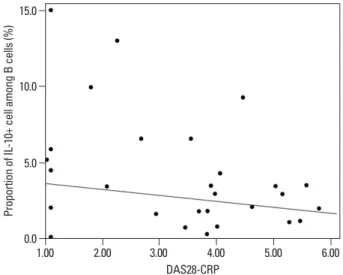
During this study, preliminary data on active RA patients revealed a low proportion of induced IL-10 producing B cells. Thus, 10 more RA patients were enrolled to investi- gate the relationship. Among the 28 RA patients, there was negative correlation between disease activity (DAS28-CRP) and induced IL-10+ B cells (r=-0.398, p=0.040, by correla- tion analysis) (Fig. 2). In addition, the RA patients group had a negative correlation between age and IL-10+ B cells (r=
-0.525, p=0.004, by correlation analysis), whereas age and activity in RA group was positively correlated (r=0.409, p=
0.031, by correlation analysis). The correlation of IL-10+ B cells with ESR or CRP was not significant (p=0.241 and p=0.314, respectively). We investigated the difference be- tween newly diagnosed patients (n=10) and patients with a flare-up of preexisting arthritis (moderate or high activity group, n=7), and found that the proportion of induced IL- 10+ B cells was not different between groups (newly diag-
RESULTS
Patient characteristics
Among 28 RA patients, 22 were female (78.6%) and mean
0
0.0 5.0 10.0 15.0 10 20
IL-10+ B cells (%)Proportion of IL-10+ cell among B cells (%)
RA
1.00 2.00 3.00 4.00 5.00 6.00
DAS28-CRP
Control
B A
Isotype RA
IL-10
Control
Fig. 1. The IL-10+ B cell was increased in RA patients compared to control patients. B cells from patients and controls were stimulated with CD40L and CpG for 48 hours and IL-10 intracellular staining was performed. (A) The representative plot of IL-10+ B cell in RA patients and healthy control.
(B) The proportion of IL-10+ B cells among B cells was elevated in RA pa- tients compared to normal control (p=0.033, by t-test). RA, rheumatoid ar- thritis; IL-10, interleukin-10.
Fig. 2. The correlation of IL-10+ B cell and DAS28-CRP. The proportion of IL- 10+ B cells was negatively correlated with RA disease activity measured using DAS28-CRP (r=-0.398, p=0.040, by correlation analysis). DAS28-CRP, 28-joint disease activity score calculated using C-reactive protein; RA, rheumatoid arthritis; IL-10, interleukin-10.
IL-10
0.461% IL-10
13.0% IL-10
3.14%
of regulatory B cell without induction is not different, the key issue of regulatory B cells in RA may be the impaired induction of regulatory B cells. Recently, Ma, et al.
22report- ed reduction of regulatory B cells in patients with new-onset RA. They showed that IL-10+CD5+CD1d+ B cell or IL10+TIM-1+ B cells without induction were decreased, although our results did not show the decrease of IL-10+ B cells without induction. The study by Ma, et al. may be supported by this study. However, it should be noted that CD5, CD1d, or TIM-1 has not been established as surface markers in human regulatory B cells as opposed to mouse regulatory B cells.
23,24The frequency of IL-10+ B cells was increased in RA pa- tients, particularly in patients with lower disease activity.
However, RA has an immunologic environment to stimu- late B cells in several aspects as follows; IL-10 secreting B cells are induced effectively by CD40L, and CpG. CD40L, also known as CD154, is implicated in RA pathogenesis.
The enhanced expression of CD40L on T cells of RA pa- tients was found to be responsible for the presence of high- ly activated B cells (CD80+CD86+), producing anti-cyclic citrullinated peptide antibodies in the synovial compart- ment of patients.
25,26B cell-activating factor (BAFF), which is increased in active RA, can also promote the production of IL-10 in B cells.
27,28Therefore, enhanced CD40L expres- sion on T cells, together with increased levels of BAFF in active arthritis, comprise an inflammatory milieu in RA that favors the production of IL-10+ regulatory B. Despite this, the fact that IL-10 was increased only in inactive arthritis is intriguing. Perhaps, IL-10+ B cell induction may be impaired in active arthritis. Moreover, in an animal model of human arthritis, collagen-induced arthritis showed decreased fre- quencies of IL-10 producing B cells in both spleen and drain- ing lymph nodes during the acute stage of disease, which is compatible with our present results.
15In addition, the adop- tive transfer of expanded IL-10+ B cells could ameliorate disease.
6,15Therefore, the therapeutic induction or transplan- tation of regulatory B cell population could be an effective therapeutic strategy in acute stage or early arthritis.
In conclusion, the proportion of induced IL-10+ B cell increased in RA patients compared to healthy control and was negatively correlated with disease activity in RA.
ACKNOWLEDGEMENTS
This work was supported by Chungnam National Universi- nosed patients, 3.10±2.41% vs. flareup patient, 2.51±2.18%,
p=0.621, by t-test). Moreover, methotrexate or predniso- lone use was not associated with IL-10 producing B cells (p=0.147 and p=0.325, respectively, by t-test).
DISCUSSION
In this study, we investigated the abnormality of B cells se- creting IL-10. A previous study showed that the proportion of IL-10+ B cell was elevated in RA or other rheumatic dis- eases, however, the study did not investigate the association with clinical characteristics. The proportion of IL-10+ B cells was not different between RA patients and healthy controls. We found that disease activity was negatively as- sociated with induction of IL-10 in B cells. The proportion of induced IL-10+ B cell was also associated with age in RA patients. However, the association of age and IL-10+ B cells in normal controls was not evident. Elderly people with RA may present with more severe manifestations than young patients.
20,21We recruited severe arthritis patients to investigate the association of activity and IL-10+ B cells.
Therefore, the patient group with severe arthritis was older and it would therefore be important to investigate the asso- ciation between age and disease activity in this cohort. Tak- ing these results into consideration, the differentiation to IL- 10+ B cells may be determined prior to CD40L and CpG stimulation or the interaction among various cells may be essential to induce IL-10.
Although human regulatory B cell has been elucidated, transcription factors or exact effector mechanism remain uncertain. Nevertheless, it is clear that IL-10 production is an important and unique characteristic of regulatory B cells compared to other B cell subsets. IL-10 secreting B cells can be detected by flow cytometry after PMA-ionomycin stimulation (B10 cell) or induced by stimulation of CD40 and toll-like receptor (B10pro).
10These cells can exert their regulatory function, through IL-10, on T cells, macro- phages, dendritic cells or plasma cells.
9It was reported that CD19+CD24
hiCD38
hiB cells include the majority of IL-10+
B cells, and that IL-10 secretion in these cells is impaired in
patients with systemic lupus erythematosus.
11However, we
report here that the proportion of IL-10+ B cell was signifi-
cantly increased in RA patients. Thus, it was not easy to un-
derstand the abnormality of IL-10+ B cell in RA. We found
in this study that disease activity was negatively associated
with IL-10+ B cells. Based on our results that the frequency
TF. A regulatory B cell subset with a unique CD1dhiCD5+ pheno- type controls T cell-dependent inflammatory responses. Immunity 2008;28:639-50.
15. Yang M, Deng J, Liu Y, Ko KH, Wang X, Jiao Z, et al. IL-10-pro- ducing regulatory B10 cells ameliorate collagen-induced arthritis via suppressing Th17 cell generation. Am J Pathol 2012;180:
2375-85.
16. Arnett FC, Edworthy SM, Bloch DA, McShane DJ, Fries JF, Coo- per NS, et al. The American Rheumatism Association 1987 re- vised criteria for the classification of rheumatoid arthritis. Arthritis Rheum 1988;31:315-24.
17. Aletaha D, Neogi T, Silman AJ, Funovits J, Felson DT, Bingham CO 3rd, et al. 2010 Rheumatoid arthritis classification criteria: an American College of Rheumatology/European League Against Rheumatism collaborative initiative. Arthritis Rheum 2010;62:
2569-81.
18. Prevoo ML, van’t Hof MA, Kuper HH, van Leeuwen MA, van de Putte LB, van Riel PL. Modified disease activity scores that in- clude twenty-eight-joint counts. Development and validation in a prospective longitudinal study of patients with rheumatoid arthri- tis. Arthritis Rheum 1995;38:44-8.
19. van Riel PL, van Gestel AM. Clinical outcome measures in rheu- matoid arthritis. Ann Rheum Dis 2000;59 Suppl 1:i28-31.
20. Calvo-Alén J, Corrales A, Sánchez-Andrada S, Fernández-Eche- varría MA, Peña JL, Rodríguez-Valverde V. Outcome of late-onset rheumatoid arthritis. Clin Rheumatol 2005;24:485-9.
21. Tamas MM, Felea I, Rednic S. How much difference does the age at onset make in early arthritis patients? Comparison between the ACR 1987 and the ACR/EULAR 2010 classification criteria for rheumatoid arthritis at the time of diagnosis. Rheumatol Int 2013;
33:2881-4.
22. Ma L, Liu B, Jiang Z, Jiang Y. Reduced numbers of regulatory B cells are negatively correlated with disease activity in patients with new-onset rheumatoid arthritis. Clin Rheumatol 2014;33:187-95.
23. Jeong YI, Hong SH, Cho SH, Lee WJ, Lee SE. Induction of IL- 10-producing CD1dhighCD5+ regulatory B cells following Babesia
microti-infection. PLoS One 2012;7:e46553.
24. Ding Q, Yeung M, Camirand G, Zeng Q, Akiba H, Yagita H, et al.
Regulatory B cells are identified by expression of TIM-1 and can be induced through TIM-1 ligation to promote tolerance in mice. J Clin Invest 2011;121:3645-56.
25. MacDonald KP, Nishioka Y, Lipsky PE, Thomas R. Functional CD40 ligand is expressed by T cells in rheumatoid arthritis. J Clin Invest 1997;100:2404-14.
26. Liu MF, Chao SC, Wang CR, Lei HY. Expression of CD40 and CD40 ligand among cell populations within rheumatoid synovial compartment. Autoimmunity 2001;34:107-13.
27. Yang M, Sun L, Wang S, Ko KH, Xu H, Zheng BJ, et al. Novel function of B cell-activating factor in the induction of IL-10-pro- ducing regulatory B cells. J Immunol 2010;184:3321-5.
28. Yehudai D, Snir A, Peri R, Halasz K, Haj T, Odeh M, et al. B cell- activating factor enhances interleukin-6 and interleukin-10 pro- duction by ODN-activated human B cells. Scand J Immunol 2012;76:371-7.
ty Hospital Research Fund 2010 and by Basic Science Re- search Program-through the National Research Foundation of Korea (NRF) funded-by the Ministry of Education, Sci- ence and Technology (2012-0008388).
REFERENCES
1. Nakken B, Munthe LA, Konttinen YT, Sandberg AK, Szekanecz Z, Alex P, et al. B-cells and their targeting in rheumatoid arthritis-- current concepts and future perspectives. Autoimmun Rev 2011;
11:28-34.
2. Moura RA, Graca L, Fonseca JE. To B or not to B the conductor of rheumatoid arthritis orchestra. Clin Rev Allergy Immunol 2012;43:281-91.
3. Yanaba K, Hamaguchi Y, Venturi GM, Steeber DA, St Clair EW, Tedder TF. B cell depletion delays collagen-induced arthritis in mice: arthritis induction requires synergy between humoral and cell-mediated immunity. J Immunol 2007;179:1369-80.
4. Wolf SD, Dittel BN, Hardardottir F, Janeway CA Jr. Experimental autoimmune encephalomyelitis induction in genetically B cell-de- ficient mice. J Exp Med 1996;184:2271-8.
5. Watanabe R, Fujimoto M, Ishiura N, Kuwano Y, Nakashima H, Yazawa N, et al. CD19 expression in B cells is important for sup- pression of contact hypersensitivity. Am J Pathol 2007;171:560-70.
6. Mauri C, Gray D, Mushtaq N, Londei M. Prevention of arthritis by interleukin 10-producing B cells. J Exp Med 2003;197:489- 501.
7. Evans JG, Chavez-Rueda KA, Eddaoudi A, Meyer-Bahlburg A, Rawlings DJ, Ehrenstein MR, et al. Novel suppressive function of transitional 2 B cells in experimental arthritis. J Immunol 2007;
178:7868-78.
8. Fillatreau S, Sweenie CH, McGeachy MJ, Gray D, Anderton SM.
B cells regulate autoimmunity by provision of IL-10. Nat Immu- nol 2002;3:944-50.
9. DiLillo DJ, Matsushita T, Tedder TF. B10 cells and regulatory B cells balance immune responses during inflammation, autoimmu- nity, and cancer. Ann N Y Acad Sci 2010;1183:38-57.
10. Iwata Y, Matsushita T, Horikawa M, Dilillo DJ, Yanaba K, Venturi GM, et al. Characterization of a rare IL-10-competent B-cell sub- set in humans that parallels mouse regulatory B10 cells. Blood 2011;117:530-41.
11. Blair PA, Noreña LY, Flores-Borja F, Rawlings DJ, Isenberg DA, Ehrenstein MR, et al. CD19+CD24hiCD38hi B cells exhibit regulato- ry capacity in healthy individuals but are functionally im paired in systemic lupus erythematosus patients. Immunity 2010;32:129-40.
12. Lee JH, Noh J, Noh G, Choi WS, Lee SS. IL-10 is predominantly produced by CD19(low)CD5(+) regulatory B cell subpopulation:
characterisation of CD19 (high) and CD19(low) subpopulations of CD5(+) B cells. Yonsei Med J 2011;52:851-5.
13. Noh G, Lee JH. Regulatory B cells and allergic diseases. Allergy Asthma Immunol Res 2011;3:168-77.
14. Yanaba K, Bouaziz JD, Haas KM, Poe JC, Fujimoto M, Tedder