© 2013 The Korean Academy of Medical Sciences.
This is an Open Access article distributed under the terms of the Creative Commons Attribution Non-Commercial License (http://creativecommons.org/licenses/by-nc/3.0) which permits unrestricted non-commercial use, distribution, and reproduction in any medium, provided the original work is properly cited.
pISSN 1011-8934 eISSN 1598-6357
High Serum Osteopontin Levels Are Associated with Low Bone Mineral Density in Postmenopausal Women
Osteopontin (OPN) is an acidic, noncollagenous matrix protein produced by the bone and kidneys. It is reportedly involved in bone resorption and formation. We examined the association between serum OPN levels and bone mineral density in postmenopausal women. Premenopausal women (n = 32) and postmenopausal women (n = 409) participated in the study. We measured serum osteopontin levels and their relationships with bone mineral density and previous total fragility fractures. The postmenopausal women had higher mean serum OPN levels compared to the premenopausal women (43.6 ± 25.9 vs 26.3 ± 18.6 ng/mL; P < 0.001). In the postmenopausal women, high serum OPN levels were negatively correlated with mean lumbar bone mineral density (BMD) (r = -0.113, P = 0.023). In a stepwise multiple linear regression model, serum OPN levels were associated with BMD of the spine, femoral neck, and total hip after adjustment for age, body mass index, smoking, and physical activity in postmenopausal women.
However, serum OPN levels did not differ between postmenopausal women with and without fractures. Postmenopausal women exhibit higher serum OPN levels than premenopausal women and higher serum OPN levels were associated with low BMD in postmenopausal women.
Key Words: Bone Mineral Density; Postmenopause; Serum Osteopontin Levels; Fragility Fracture
Eun-Hee Cho,1 Keun-Hyok Cho,1 Hyang Ah Lee,2 and Sang-Wook Kim1 Departments of 1Internal Medicine and 2Obstetrics and Gynecology, School of Medicine, Kangwon National University, Chuncheon, Korea Received: 11 July 2013
Accepted: 19 August 2013 Address for Correspondence:
Sang-Wook Kim, MD
Department of Internal Medicine, Kangwon National University Hospital, School of Medicine Kangwon National University, 26 Kangwondaehak-gil, Chuncheon 200-701, Korea Tel: +82.33-258-9241, Fax: +82.33-256-2455 E-mail: [email protected]
http://dx.doi.org/10.3346/jkms.2013.28.10.1496 • J Korean Med Sci 2013; 28: 1496-1499
ORIGINAL ARTICLE
Endocrinology, Nutrition & Metabolism
INTRODUCTION
Osteopontin (OPN) is an acidic, noncollagenous matrix protein produced by the bone and kidneys. Plasma osteopontin levels are elevated in many pathologic conditions, including cancer (1, 2), autoimmune disease, obesity (3, 4), and cardiovascular disease (5). OPN is reportedly involved in bone resorption and bone formation (6, 7). OPN -/- mice show resistance to ovariec- tomy-induced bone resorption compared to wild-type mice (-60% vs -10% reduction in bone volume, respectively), suggest- ing the pivotal role of OPN in postmenopausal osteoporosis (8).
We examined the association between serum OPN levels and bone mineral density in postmenopausal Korean women.
MATERIALS AND METHODS Study population
This study was performed from June 2009 to October 2010 in Kangwon National University Hospital. A total of 441 healthy female volunteers over the age of 50 yr satisfied the inclusion criteria. Menopause was defined as the absence of menstrua- tion for at least 1 yr. Excluded from this study were women tak- ing glucocorticoids and estrogen for more than 3 months prior or women with diseases that could affect bone metabolism,
such as Graves’ disease or Cushing’s syndrome. Hysterectomiz- ed women and premenopausal bilaterally ovariectomized wo- men were also excluded.
A self-administered questionnaire, interviews, and anthro- pometric measurements were used to collect data on lifestyle, physical activity, and previous medical and fracture histories.
Previous fragility fractures were low-trauma fractures involving femur, spine, and other sites such as wrist, ankle, foot, ribs and others. Smoking status was categorized as non-smoker, ex-smo- ker, and smoker. Daily physical activity (walking or cycling) was measured using the responses to the questionnaire (“How much time do you usually spend walking or on a bicycle outdoors each day?”) Possible response included none, less than 30 min, 30 min to 1 hr, or more than 1 hr.
Areal bone mineral density (BMD) (g/cm2) values were de- termined in the spine, femoral neck, and total hip in all subjects using a Lunar Prodigy Vision dual-emission X-ray absorptiom- etry system (Lunar Corp., Madison, WI, USA). According to the World Health Organization definition, osteoporosis was deter- mined as a T-score of ≤ -2.5 standard deviations (SD) at any site. One investigator performed all densitometry tests and anal- yses in all subjects. The precision of the equipment, presented as coefficients of variation (CV), was 0.90 and 1.14% at Kang- won National University for the lumbar spine and the femoral
Cho E-H, et al. • Serum Osteopontin Levels and Bone Mineral Density
http://jkms.org 1497
http://dx.doi.org/10.3346/jkms.2013.28.10.1496
neck, respectively in 20 volunteers at Kangwon National Uni- versity who were not enrolled in the study.
Measurement of serum OPN
Serum OPN levels were measured using the Quantikine Human OPN immunoassay kit (R&D Systems, Minneapolis, MN, USA) according to the manufacturer’s instructions. Intraassay coeffi- cient of variation (CV) was 4% and inter-assay CV was 6.6%.
Statistical analysis
Pearson correlation coefficients were calculated to analyze the relationship between serum OPN levels and clinical parame- ters, including BMD. Student’s t-tests or the chi-square test was used to compare baseline characteristics between premeno- pausal and postmenopausal women. Linear regression was used to investigate the association between serum OPN levels and BMD, adjusting for age, body mass index (BMI), smoking, and physical activity. A multiple logistic regression analysis with the stepwise forward method was used to evaluate inde- pendent variables. The history of fragility fractures was set as the dependent variable. A P value of < 0.05 was considered to be statistically significant.
Ethics statement
This study was approved by the institutional review board of Kangwon National University Hospital (IRB number 09-07). Writ- ten informed consent was obtained from each individual.
RESULTS
Overview of the study population
This study included 409 postmenopausal women with a mean age of 61.4 ± 7.8 yr and 32 premenopausal women with a mean
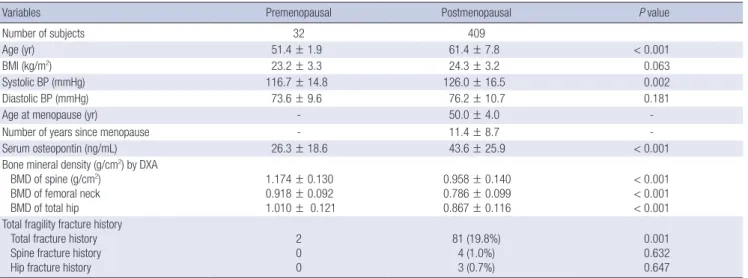
age of 51.4 ± 1.9 yr. In postmenopausal women, the mean num- ber of years after menopause was 11.4 ± 8.7. The postmenopaus- al group was about 10 yr older and had a higher systolic blood pressure compared to the premenopausal group. The postme- nopausal women had higher mean serum OPN levels compar- ed to the premenopausal women (43.6 ± 25.9 vs 26.3 ± 18.6 ng/
mL; P < 0.001, Table 1). The BMD of the spine, femoral neck, and total hip was significantly lower and the total fracture his- tory was significantly more frequent in postmenopausal wom- en compared to premenopausal women.
Correlation between serum OPN levels and clinical parameters
We studied the correlation between serum OPN levels and age, BMI, systolic blood pressure, BMD of the spine, femoral neck, and total hip and other clinical parameters in pre- and post- menopausal women. However, Pearson correlations failed to show any correlation between serum OPN levels and clinical parameters with the exception of some BMD values in post- menopausal women. In the postmenopausal women, high se- rum OPN levels were negatively correlated with mean lumbar BMD (r = -0.113, P = 0.023).
Table 1. Baseline clinical characteristics of study subjects (n = 441)
Variables Premenopausal Postmenopausal P value
Number of subjects 32 409
Age (yr) 51.4 ± 1.9 61.4 ± 7.8 < 0.001
BMI (kg/m2) 23.2 ± 3.3 24.3 ± 3.2 0.063
Systolic BP (mmHg) 116.7 ± 14.8 126.0 ± 16.5 0.002
Diastolic BP (mmHg) 73.6 ± 9.6 76.2 ± 10.7 0.181
Age at menopause (yr) - 50.0 ± 4.0 -
Number of years since menopause - 11.4 ± 8.7 -
Serum osteopontin (ng/mL) 26.3 ± 18.6 43.6 ± 25.9 < 0.001
Bone mineral density (g/cm2) by DXA BMD of spine (g/cm2)
BMD of femoral neck BMD of total hip
1.174 ± 0.130 0.918 ± 0.092 1.010 ± 0.121
0.958 ± 0.140 0.786 ± 0.099 0.867 ± 0.116
< 0.001
< 0.001
< 0.001 Total fragility fracture history
Total fracture history Spine fracture history Hip fracture history
2 0 0
81 (19.8%) 4 (1.0%) 3 (0.7%)
0.001 0.632 0.647 Data are presented as mean ± SD or No. (%)
BP, blood pressure; BMI, body mass index; DXA, dual-emission X-ray absorptiometry; BMD, bone mineral density.
Table 2. Multiple regression analysis showing the association between bone mineral density and serum osteopontin levels in postmenopausal women after adjusting co- variates
Bones Serum osteopontin levels
β P r 2 Modified r 2
Total spine -0.122 0.01 0.117 0.110
Femoral neck -0.097 0.03 0.222 0.217
Total hip -0.108 0.01 0.265 0.259
Covariates were adjusted for age, body mass index, smoking, and physical activity.
Cho E-H, et al. • Serum Osteopontin Levels and Bone Mineral Density
1498 http://jkms.org http://dx.doi.org/10.3346/jkms.2013.28.10.1496 Correlation between serum OPN levels and BMD
In the multiple linear regression model with stepwise forward method, serum OPN levels were associated with BMD of the spine, femoral neck, and total hip (Table 2) after adjustment for age, BMI, smoking, and physical activity in postmenopausal women. However, in the premenopausal group, there was no association between serum OPN levels and BMD of the spine, femoral neck, and total hip in the multiple linear regression mo- del with stepwise forward method.
Correlation between serum OPN levels and total fragility fractures
Postmenopausal women with previous fragility fractures were older, had a lower BMI, had a longer number of years after meno- pause, and had a lower BMD of the spine, femoral neck, and to- tal hip, compared to postmenopausal women without previous fragility fractures. However, serum OPN levels were not differ- ent between postmenopausal women with and without frac- tures.
DISCUSSION
Our study demonstrates that postmenopausal women have significantly higher levels of serum OPN compared to premeno- pausal women, and that in postmenopausal women, serum OPN levels are inversely associated with BMD of the spine, fem- oral neck, and total hip, implicating the physiologic role for OPN in postmenopausal bone loss.
OPN is a multifunctional protein that involves the regulation of inflammation, bone remodeling, and cell survival (9). OPN stimulates CD44 expression, thereby upregulating osteoclast motility and bone resorption (10). It plays a critical role in sym- pathetic control of bone mass through β2 adrenergic receptors/
c AMP signaling (11). OPN -/- mice show resistance to ovariec- tomy-induced bone resorption compared to wild-type mice (-60% vs -10% reduction in bone volume, respectively)(8), sug- gesting the pivotal role of OPN in postmenopausal osteoporosis.
A previous study involving 124 postmenopausal women has shown that the serum OPN levels were a risk factor for meno- pausal osteoporosis and serum OPN levels were positively cor- related with bone resorption marker such as carboxy-terminal collagen crosslinks (12). Our study reinforces the previous study with a larger sample size (n = 409 vs 124, respectively) in that high serum OPN levels were shown to be an independent risk factor for low BMD in postmenopausal women. Our study in- vestigated the relationship between serum OPN levels and total fragility fractures, although there was no association between them in postmenopausal women. In the previous study, there was a correlation between serum OPN levels and age or body weight, but our data failed to show a correlation between se- rum OPN levels and age or BMI. In another study showed that
the high serum levels of OPN were associated with low BMD and increased levels of bone turnover markers and that post- menopausal women with osteoporotic vertebral fractures had significantly higher levels of OPN than those without vertebral fractures (13). Our study differs from two previous studies (12, 13) in that we studied the association between the serum OPN levels and total fragility fractures. One of possible reason of lack of relationship in our study was that there were very low preva- lence of spine or hip fractures (0.7%-1.0%) in total fragility frac- tures. Therefore, the potential of serum OPN levels to predict major osteoporotic fractures remains open to debate.
In the previous study (12), the mean serum OPN levels (15.4
± 6.2 ng/mL) were relatively low compared to our data and other previous data (14). Commercial ELISA kits are available to determine plasma or serum OPN levels. The reason of serum mean OPN differences between human studies were not clear.
The results of circulating OPN levels may be variable depend- ing on the type of sample (plasma vs serum), ages, races, detec- tion method, and choice of ELISA kit (12, 15).
The baseline rise in circulating OPN levels was associated with coronary artery disease with rapid plaque progression (16), asthma (14, 17), and cancer aggressiveness and poor survival (2) in humans. Our data demonstrate that high serum OPN lev- els were associated with osteoporosis, especially in postmeno- pausal women, suggesting the role of OPN in bone remodeling.
Our study has some limitations. This was a cross-sectional study, not a prospective study. The postmenopausal status was self-reported. In addition, our study did not involve measure- ment of bone turnover markers or bone quality.
Further investigation is definitely warranted to unravel the potential role of OPN in large-scale and long-term prospective cohort studies to arrive at a conclusion about the causal relation- ship between serum OPN and bone mineral density or fracture in postmenopausal women.
In conclusion, our study shows that postmenopausal women have higher serum OPN levels than premenopausal women and that higher serum OPN levels are associated with low BMD in postmenopausal women.
ACKNOWLEDGEMENTS
The biospecimens for this study were provided by the Kangwon National University Hospital Biobank, a member of the National Biobank of Korea, which is supported by the Ministry of Health, Welfare and Family Affairs. All samples derived from the Nation- al Biobank of Korea were obtained with informed consent un- der institutional review board-approved protocols.
DISCLOSURE
The authors have no conflicts of interest to disclose.
Cho E-H, et al. • Serum Osteopontin Levels and Bone Mineral Density
http://jkms.org 1499
http://dx.doi.org/10.3346/jkms.2013.28.10.1496
REFERENCES
1. Chang YS, Kim HJ, Chang J, Ahn CM, Kim SK, Kim SK. Elevated circu- lating level of osteopontin is associated with advanced disease state of non-small cell lung cancer. Lung Cancer 2007; 57: 373-80.
2. Weber GF, Lett GS, Haubein NC. Osteopontin is a marker for cancer ag- gressiveness and patient survival. Br J Cancer 2010; 103: 861-9.
3. Gómez-Ambrosi J, Catalán V, Ramírez B, Rodríguez A, Colina I, Silva C, Rotellar F, Mugueta C, Gil MJ, Cienfuegos JA, et al. Plasma osteopontin levels and expression in adipose tissue are increased in obesity. J Clin Endocrinol Metab 2007; 92: 3719–27.
4. Nomiyama T, Perez-Tilve D, Ogawa D, Gizard F, Zhao Y, Heywood EB, Jones KL, Kawamori R, Cassis LA, Tschöp MH, et al. Osteopontin medi- ates obesity-induced adipose tissue macrophage infiltration and insulin resistance in mice. J Clin Invest 2007; 117: 2877–88.
5. Scatena M, Liaw L, Giachelli CM. Osteopontin: a multifunctional mole- cule regulating chronic inflammation and vascular disease. Arterioscler Thromb Vasc Biol 2007; 27: 2302–9.
6. Ishijima M, Ezura Y, Tsuji K, Rittling SR, Kurosawa H, Denhardt DT, Emi M, Nifuji A, Noda M. Osteopontin is associated with nuclear factor kap- paB gene expression during tail-suspension-induced bone loss. Exp Cell Res 2006; 312: 3075–83.
7. Ishijima M, Rittling SR, Yamashita T, Tsuji K, Kurosawa H, Nifuji A, Den- hardt DT, Noda M. Enhancement of osteoclastic bone resorption and suppression of osteoblastic bone formation in response to reduced me- chanical stress do not occur in the absence of osteopontin. J Exp Med 2001; 193: 399–404.
8. Yoshitake H, Rittling SR, Denhardt DT, Noda M. Osteopontin-deficient mice are resistant to ovariectomy-induced bone resorption. Proc Natl Acad Sci U S A 1999; 96: 8156–60.
9. Denhardt DT, Noda M, O’Regan AW, Pavlin D, Berman JS. Osteopontin as a means to cope with environmental insults: regulation of inflamma- tion, tissue remodeling, and cell survival. J Clin Invest 2001; 107: 1055–
61.
10. Chellaiah MA, Kizer N, Biswas R, Alvarez U, Strauss-Schoenberger J, Rifas L, Rittling SR, Denhardt DT, Hruska KA. Osteopontin deficiency produces osteoclast dysfunction due to reduced CD44 surface expression.
Mol Biol Cell 2003; 14: 173–89.
11. Nagao M, Feinstein TN, Ezura Y, Hayata T, Notomi T, Saita Y, Hanyu R, Hemmi H, Izu Y, Takeda S, et al. Sympathetic control of bone mass regu- lated by osteopontin. Proc Natl Acad Sci U S A 2011; 108: 17767–72.
12. Chang IC, Chiang TI, Yeh KT, Lee H, Cheng YW. Increased serum osteo- pontin is a risk factor for osteoporosis in menopausal women. Osteopo- ros Int 2010; 21: 1401–9.
13. Fodor D, Bondor C, Albu A, Simon SP, Craciun A, Muntean L. The value of osteopontin in the assessment of bone mineral density status in post- menopausal women. J Investig Med 2013; 61: 15-21.
14. Zhao JJ, Yang L, Zhao FQ, Shi SM, Tan P. Osteopontin levels are elevated in patients with asthma. J Int Med Res 2011; 39: 1402–7.
15. Constantinescu D, Vornicu M, Grigoriu C, Cozmei C, Grigoriu BD. As- saying for circulating osteopontin in practice: a technical note. Eur Respir J 2010; 35: 1187–8.
16. Mazzone A, Parri MS, Giannessi D, Ravani M, Vaghetti M, Altieri P, Ca- salino L, Maltinti M, Balbi M, Barsotti A, et al. Osteopontin plasma levels and accelerated atherosclerosis in patients with CAD undergoing PCI: a prospective clinical study. Coron Artery Dis 2011; 22: 179–87.
17. Samitas K, Zervas E, Vittorakis S, Semitekolou M, Alissafi T, Bossios A, Gogos H, Economidou E, Lötvall J, Xanthou G, et al. Osteopontin ex- pression and relation to disease severity in human asthma. Eur Respir J 2011; 37: 331–41.